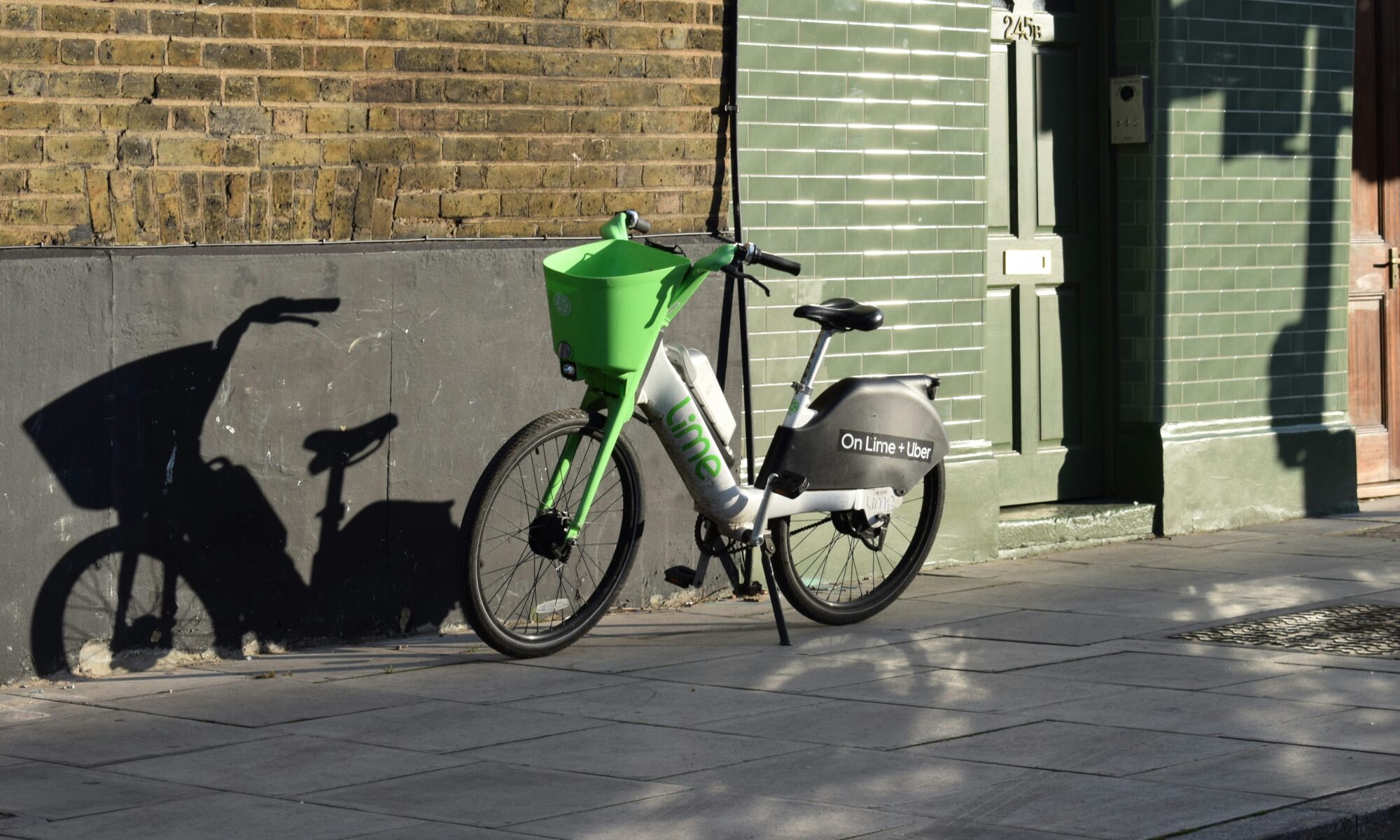
As recently reported by the BBC, decisions by Hounslow and Richmond councils to license competing dockless e-bike rental companies in their areas have led to the creation of what comedian Dara Ó Briain described as a modern day Checkpoint Charlie. Hounslow council has licensed Forest and Voi, but on the other side of the Thames, Richmond council has given permission to rival Lime.
Under an agreement between the councils, the electric motors in Lime’s e-bikes are programmed to cut out when they are ridden over the threshold between the two London Boroughs, rendering them heavy and very difficult to ride. This has caused riders to dump their Lime bikes at crossings on the Richmond side of the Thames, with Forest and Voi users abandoning their bikes on the other (Hounslow) end.
With the situation worsening, there are a growing number of voices joining the call for new legislation to be urgently introduced to regulate the sector.
“The bitterness of poor quality remains long after the sweetness of low price is forgotten.” Benjamin Franklin
First, let the engineers identify the best solution, then let the money people into the room.
Whether you’re an automaker considering a recall, a shipyard designing a modernization, or a city planning a transit scheme, the principle holds. The cost is the pain endured to achieve the best solution; it should not dictate the deliberation.
From bridges and buildings to codebases and consumer goods, history is full of examples where cheap is dear: • Post-war social housing, built cheaply across Europe is now being demolished or retrofitted at great expense. • Banks and governments are stuck with legacy software systems because upgrades were deferred. • The Boeing 737 MAX took shortcuts to stay cost-competitive, leading to tragedy, brand damage, and billions in losses. Quality, safety and longevity may carry a higher upfront cost, but the cost of failure, remediation or replacement is always greater.
The pyramids were built to a design which was brilliant, yet extraordinarily expensive. But they still stand. That is sustainability, resilience, and long-term ROI, all concerns now central to transport, automotive, and logistics.
Fast-forward to post-war London. In 1945, the city had the world’s largest trolleybus network. The vehicles were capacious, fast, quiet and smooth. By 1962, the entire system had all been scrapped in favour of diesel buses, because they were cheap and required no costly infrastructure.
The system wasn’t abandoned because it failed, but because of short-term savings. Today London is spending billions to replace noisy, polluting diesels with hybrid and electric fleets because, unlike many European capitals, it has no trolleybus system.
This lesson speaks directly to today’s EVs, passenger rail, and micromobility. Similar questions echo across the transportation sector:
Is the cheapest EV charging infrastructure really the right choice?
Is it ever cheaper to cut corners on autonomous vehicle sensors, when a single failure could trigger mass recalls and liability?
Is it sensible to use low-grade parts in rail track maintenance, knowing they wear faster and demand earlier replacement?
Is it really economical to delay cybersecurity upgrades in connected vehicles, when a single hack could cost millions in fallout?
Is it wise to underinvest in port electrification, when global regulations are tightening and customers demand cleaner supply chains?
Is it prudent to cut back on aircraft maintenance, when the long-term cost of safety failures is reputationally and financially catastrophic?
Today’s leaders face the same dilemma. Do we design for the next generation or for the next election cycle?
Let’s make decisions about electrification, urban planning, aviation, and shipping with a fifty-year horizon, not a five-year budget cycle. The wires may be gone, but the lessons remain.
On August 21, 2025, the Internal Revenue Service issued new FAQs regarding clean vehicle and other tax credit information under the 2025 Budget Reconciliation Act, also referred to as the “One Big Beautiful Bill Act” or “Tax Reform 2025.” Notably, as to tax credits currently available but scheduled to sunset on September 30, 2025, under the budget act, the IRS provided that the tax credit would be available after the September 30, 2025 sunset if the taxpayer had entered into a written, binding agreement and made a payment for a clean vehicle prior to September 30. The act eliminates the credit for vehicles “acquired“ rather than for vehicles placed in service after September 30, 2025.
While the FAQs are not binding and expressly state they may not be relied upon, there is precedent for allowing a written agreement to preserve tax treatment existing before a sunset. The same concept applied for clean vehicle tax credit changes in the Inflation Reduction Act, holding pre-IRA rules for written contracts entered into prior to the effective date in August 2022. Electric vehicle manufacturers used written agreements to preserve pre-IRA rules for their customers, allowing delivery of vehicles as late as 2024, nearly two years later.
The dynamic surely applies here. OEMs that produce electric vehicles may wish to take advantage of the written contract effective extension of the credit sunset. Direct to consumer EV Sellers may contract with their buyers, and OEMs with traditional independent dealer distribution might facilitate the same with their dealer networks. From the buyer side, significant commercial buyers may wish to contract in advance of September 30 to preserve the 45W credit.
It is worth noting that the IRS position is that the written binding contract must be entered into and a payment be made before September 30, 2025. As to the payment, the IRS FAQ states that “a payment includes a nominal down payment for a vehicle trade-in.“ The nominal concept of the payment is more lenient than the standard of significant under the Tax Reduction Act transition rules. Whether a vehicle trade-in includes a trade-in amount agreed to but not actually provided is not known, although one would not expect that a buyer would trade in a vehicle before receiving delivery of the purchase vehicle and thus a trade-in allowance agreement may be effective. However, in light of the nominal down payment rule, it would appear wiser to rely on that condition rather than the trade-in condition.
The English High Court has authorised public access to unredacted pleadings concerning the parameters and values used by OEMs to regulate vehicle emissions control systems, following a judgment by Mr. Justice Constable. He concluded there was “no proper justification” for retaining the redactions.
In October, the Court will hear arguments on the liability of five OEMs, Ford, Mercedes-Benz, Nissan, Peugeot-Citroen, and Renault (the “Lead Defendants”), in the ongoing Pan-NOx emissions group litigation, arising from the Dieselgate scandal (the “Liability Trial”). The group actions involve allegations that these manufacturers employed prohibited defeat devices (“PDDs”) in their vehicles and are brought on behalf of a cohort of over one million claimants.
A key issue before the Court was the extent to which information over which the Lead Defendants asserted confidentiality should be de-designated and made accessible, which would necessitate removing redactions from pleadings for the upcoming Liability Trial.
In a win for car and truck rental companies, a panel of the Connecticut Appellate Court held in Liam Stanford v. Clayton Nogiec, 233 Conn. App. 862 (2025), that a rental company’s duty to investigate a prospective renter extends only to physical inspection of the renter’s driver’s license to confirm it is valid and unexpired. Unless the renter shows signs of unfitness to operate a motor vehicle, a rental company has no further duty to investigate a driver’s background or driving record.
Read the full Alert on the Duane Morris website here.
Imagine you’re an automaker. The federal government says your gas-powered vehicles are fine. But California steps in—with EPA approval—and tells you they’re not. Who gets to challenge that? Only the fuel suppliers footing the bill? Or the manufacturers whose fleets are directly targeted?
According to the U.S. Supreme Court: both.
That’s more or less what happened in Diamond Alternative Energy LLC v. EPA, a case about electric vehicle mandates masquerading as a fight about standing. On June 20, the Court ruled that fuel companies have standing to challenge a 2022 EPA decision allowing California to enforce tougher emissions standards than the federal government. The decision didn’t settle who’s right on the merits—but it cleared the way for a fight that could reshape national climate policy and the auto industry’s future, at least during the Trump administration.
And it all hinges on California’s decades-old hall pass from the Clean Air Act.
On July 19, 2024, in Lopez v. Aircraft Service International, Inc., Case No. 23-55015 (9th Cir. July 19, 2024), the U.S. Court of Appeals for the Ninth Circuit held that the Federal Arbitration Act’s (FAA) transportation worker exemption applies to an airplane fueling technician. Even though the technician had no hands-on contacts with goods, the Ninth Circuit held that was not required because fuel is necessary to flying the plane that holds the goods. The decision is yet another from the Ninth Circuit broadly applying the FAA’s transportation worker exemption, in spite of multiple recent decisions from the U.S. Supreme Court directing narrow that loop hole to mandatory arbitration. The Lopez decision presents an obstacle for employers seeking to enforce arbitration agreements and class action waivers within the Ninth Circuit, thereby opening the door to arguments that workers who do not even handle goods in the stream of commerce are exempt from arbitration if their work somehow supports the mechanism by which the goods travel.
The potential for rulemaking in 2024 from the National Highway Traffic Safety Administration (NHTSA) and the Federal Motor Carrier Safety Administration (FMCSA) has been deferred to 2025 at the earliest, including on key state-of-the-art technologies such as automatic emergency braking (AEB) in heavy and medium-duty trucks. The NHTSA and FMCSA intended initially to publish a final rule to require and/or standardize equipment performance for AEBs on trucks with a gross vehicle weight rating of more than 10,000 pounds by April 2024. That has now been pushed to January 2025, at the earliest. The delay is despite the fact that the Notice of Proposed Rulemaking comment period ended nearly two years ago, in September 2023.
Bottom line: Manufacturers, fleet operators, and commercial vehicle owners have faced increasing products liability litigation in recent years for alleged negligence in “failing to equip” vehicles with AEBs. The recent deferral shows that significant rule making regarding advanced automatic technologies in heavy vehicles will remain ongoing as the government continues to study the technology and evaluate a potential mandate in heavy and medium-duty trucks. While commercial vehicle manufacturers continue to develop and innovate in this space, the NHTSA and FMCSA continue to take a hands-off approach and have still yet to mandate this technology in heavy and medium-duty trucks.
On April 12, 2023, the EPA announced two proposed vehicle emission rules aimed to accelerate the transition to electric passenger and commercial vehicles.
The proposed standards do not require that manufacturers produce a certain number of electric vehicles, but instead set forth limits on greenhouse gas emissions that manufacturers must comply with for particular vehicle fleets. The EPA predicts such standards will result in a dramatic increase in new electric vehicle sales.
On March 31, 2023, the Treasury Department and the IRS released a Notice of Proposed Rulemaking on the new clean vehicle provisions of the Inflation Reduction Act. The Notice will be published in the Federal Register on April 17, 2023. Comments and requests for a public hearing must be submitted by June 16, 2023.
Section 30D of the Internal Revenue Code, as amended by the Inflation Reduction Act, allows a credit of up to $7,500 on the purchase of qualified electric vehicles. To be eligible for the credit, the vehicle must be a new clean vehicle, manufactured in North American, and powered by a battery that complies with critical mineral and component sourcing specifications. The Notice provides guidance clarifying the new credit eligibility criteria.
We are currently reviewing the proposed guidance. Check back early next week for our assessment.