Sentencing Strategies in Federal Fraud Cases: Key Takeaways for White Collar Practitioners From the ABA’s Annual White Collar Conference

Authors: Gregory Herrold and Eric Boden

Tackling complex and evolving issues surrounding sentencing in federal fraud cases, a panel of distinguished jurists and white collar practitioners shared their thoughts at this year’s ABA White Collar Conference in San Diego, California in a discussion titled: “Effective Sentencing Advocacy – Guidelines, Mitigation, and Data.” The panel, including U.S. District Court Judges Charles Breyer and Trina Thompson of the Northern District of California, explored mitigation strategies defense counsel should implement early in a client’s criminal justice process to most effectively advocate for an appropriate sentence.

Continue reading “Sentencing Strategies in Federal Fraud Cases: Key Takeaways for White Collar Practitioners From the ABA’s Annual White Collar Conference”

Southern District of New York U.S. Attorney’s Office Examines Laws on Prediction Markets

By William M. McSwain and Bryan Shapiro

U.S. Attorney for the Southern District of New York Jay Clayton recently signaled that federal prosecutors are actively evaluating how existing criminal statutes apply to prediction markets—and that enforcement actions may follow in appropriate cases. His remarks underscore law enforcement interest in prediction markets, financial products that may resemble traditional securities or derivatives, and related activity in the crypto ecosystem.

Read the full Alert on the Duane Morris LLP website.

New DOJ Health and Safety Unit Formed to Protect Consumers

On December 2, 2025, the Department of Justice (DOJ) announced the launch of a new unit within the Criminal Division’s Fraud Section, called the Health & Safety Unit (HSU). The creation of this unit comes on the heels of the DOJ disbanding the Civil Division’s Consumer Protection Branch in September of this year, a group that utilized both civil and criminal enforcement in the consumer protection area. The new unit coincides with the DOJ’s restructuring efforts in this space. According to the DOJ, the HSU will serve two main purposes: (i) protecting the food and drug supply for consumers and (ii) enforcing consumer product safety laws.

Read the full Alert on the Duane Morris LLP website.

13 State Attorneys Seek to Intervene in Review of DOJ’s Settlement Allowing $14 Billion Merger

On October 14, 2025, a coalition of 13 state attorneys general, including those from California, New York, Massachusetts and Illinois, filed a motion seeking to intervene in the Tunney Act review by the United States District Court for the Northern District of California of the U.S. Department of Justice’s (DOJ) settlement that allowed the $14 billion merger between Hewlett Packard Enterprise (HPE) and Juniper Networks to proceed.

Read the full Alert on the Duane Morris website.

False Claims Act Working Group Aims to Strengthen DOJ & HHS Collaboration

The U.S. Department of Justice (DOJ) and the U.S. Department of Health and Human Services (HHS) announced on July 2, 2025, the creation of a DOJ-HHS False Claims Act Working Group. The working group is intended to strengthen HHS and DOJ’s “ongoing collaboration to advance priority enforcement areas” of the Trump administration. Read the full Alert on the Duane Morris website.

New DOJ Program Incentivizes Alleged Whistleblowers 

The Department of Justice’s Antitrust Division has officially launched its first-ever Whistleblower Rewards Program through a memorandum of understanding with the United States Postal Service and the U.S. Postal Service Office of Inspector General. This new program offers monetary rewards of up to 30 percent of criminal fines recovered for individuals who provide information leading to successful antitrust prosecutions of at least $1 million in fines. Read the full Alert on the Duane Morris LLP website.

Former U.S. Attorney Who Prosecuted USA v. Kousisis Examines the Supreme Court’s Decision

On May 22, 2025, in a significant and much-anticipated white-collar case, Kousisis, et al. v. United States, the U.S. Supreme Court, in a 9-0 opinion authored by Justice Amy Coney Barrett, held that a defendant who induces a victim to enter into a transaction under materially false pretenses may be convicted of federal fraud even if the defendant did not seek to cause the victim any net economic loss. In other words, if the defendant obtained money or property as a result of a fraudulently induced transaction, that’s enough for a federal fraud conviction—even if the victim received the full economic benefit of the bargain.

Read the full analysis by William M. McSwain, co-chair of Duane Morris’ White-Collar Criminal Defense, Corporate Investigations and Regulatory Compliance division. He served as the U.S. Attorney for the Eastern District of Pennsylvania from 2018 to 2021.

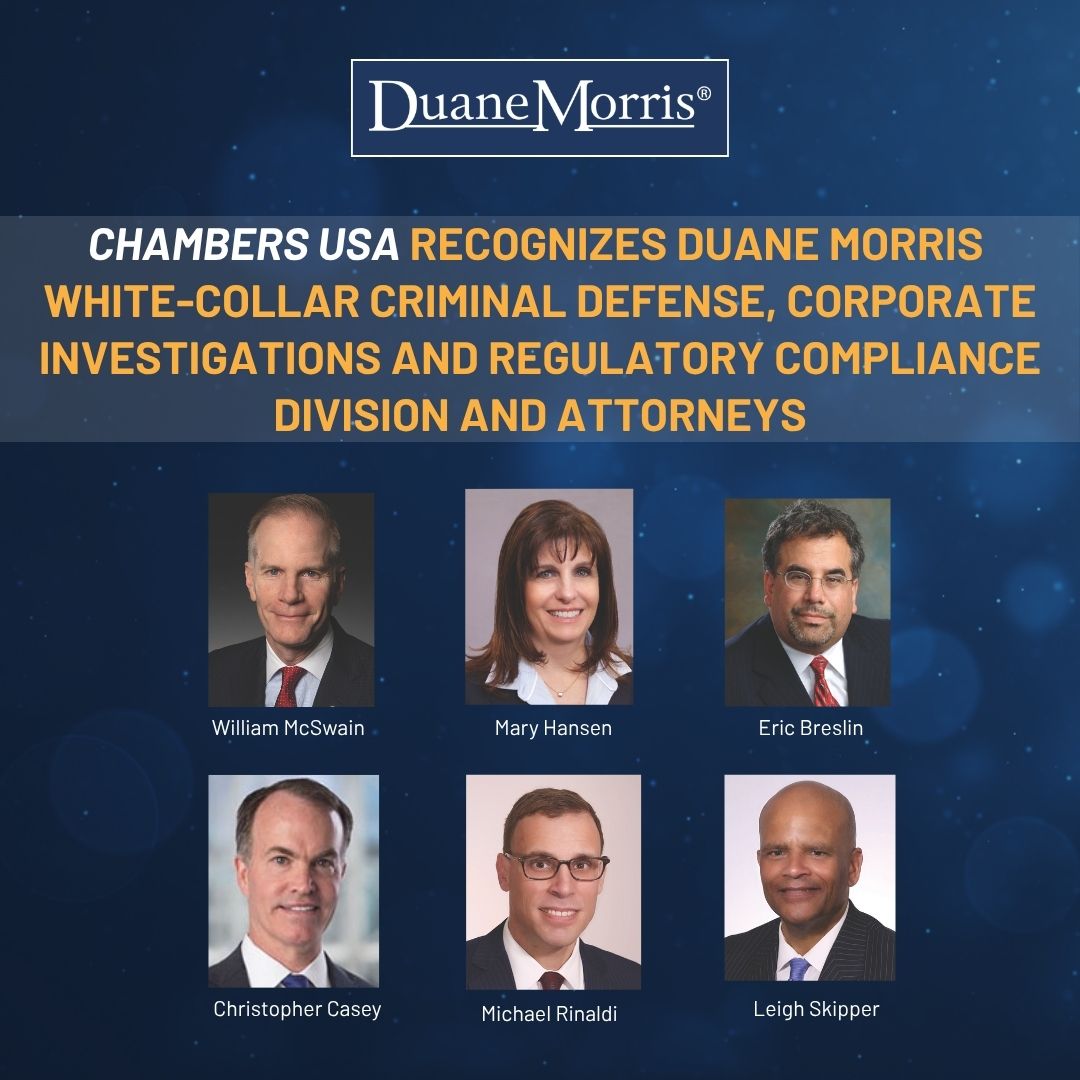
Chambers USA Recognizes Duane Morris White-Collar Division and Attorneys

Duane Morris LLP is pleased to announced that Chambers USA has recognized Duane Morris White-Collar Criminal Defense, Corporate Investigations and Regulatory Compliance division and attorneys.

New Jersey & Pennsylvania

Litigation: White-Collar Crime & Government Investigations

Northern New Jersey attorneys

Eric R. Breslin, Litigation: White-Collar Crime & Government Investigations

Melissa S. Geller, Litigation: White-Collar Crime & Government Investigations

Pennsylvania Attorneys

Christopher H. Casey, Litigation: White-Collar Crime & Government Investigations

Mary P. Hansen, Litigation: White-Collar Crime & Government Investigations

William M. McSwain, Litigation: White-Collar Crime & Government Investigations

Michael M. Mustokoff, Litigation: White-Collar Crime & Government Investigations

Michael J. Rinaldi, Litigation: White-Collar Crime & Government Investigations

Leigh M. Skipper, Litigation: White-Collar Crime & Government Investigations

CMS Issues Final Rule on Returning Medicare and Medicaid Overpayments

By Daniel R. WalworthChristopher H. CaseyFrederick R. BallErin M. Duffy and Arti Fotedar

The Centers for Medicare & Medicaid Services (CMS) issued a Final Rule as part of the 2025 Physician Fee Schedule, which revises requirements for reporting and returning overpayments of Medicare and Medicaid funds. The Final Rule, which took effect January 1, 2025, amends CMS’s regulation interpreting the federal overpayment statute in two key ways: It revises the definition of when an overpayment is “identified” to trigger the 60-day return period and establishes a 180-day timeframe for investigating additional related overpayments.

Read the full story on the Duane Morris LLP website.

© 2009- Duane Morris LLP. Duane Morris is a registered service mark of Duane Morris LLP.

The opinions expressed on this blog are those of the author and are not to be construed as legal advice.

Proudly powered by WordPress