
If It’s Not In The Contract, Don’t Count On Consequential Damages

A recent decision by the New York State Supreme Court, Appellate Division, Fourth Department, in James Vermillion v. The Roofing Guys, Inc., sheds light on the limitations of consequential damages in breach of contract cases. The ruling reinforces the principle that damages are only recoverable if they were reasonably contemplated by both parties at the time the contract was formed.

In this case, the plaintiff hired the defendant to reroof his home. During construction, however, a severe storm caused extensive water damage. The plaintiff sought to introduce expert testimony on damages related to delays—such as increased mortgage rates, rising material costs, and disruptions to financing. However, the trial court excluded this evidence, and the appellate court unanimously upheld that decision.

The appellate court emphasized that consequential damages require clear evidence that both parties anticipated such risks when entering the contract. Here, the agreement focused solely on roofing services and did not address financing risks or potential delays. Because the contract didn’t mention these damages and there was no evidence the parties expected them, the court didn’t allow the plaintiff to recover them.

This ruling underscores the importance of drafting contracts that clearly define the scope of potential damages, especially in construction projects where external factors like weather can significantly impact timelines and costs. To protect against such risks, parties must include specific clauses addressing delays, financing impacts, or other foreseeable complications.

Ultimately, Vermillion reaffirms that courts will enforce contracts as written. If consequential damages are not expressly included, parties may be limited to recovering only direct losses.

Jose A. Aquino (@JoseAquinoEsq on X) is a special counsel at Duane Morris LLP’s New York office, where he is a member of Construction Group,  specializing in construction law, lien law, and government procurement law. He is also a member of the Cuba Business Group.
Preserving Evidence vs. Protecting Property: A Court’s Perspective

The Appellate Division First Department of the Supreme Court of the State of New York recently issued an order affirming the denial of defendants’ renewed motion for spoliation sanctions in Blinbaum v. Chan. The decision arose from a dispute between neighboring townhouse owners regarding damages allegedly caused by construction work.

In January 2018, the plaintiff and defendants entered into a license agreement granting the defendants temporary access to the plaintiff’s property to complete renovations on defendants’ adjoining townhouse. Under the agreement, the plaintiff had sole discretion over any necessary repairs if damage resulted from the defendants’ work. In January 2020, Plaintiff filed a lawsuit asserting that water infiltration in August 2018 had harmed his townhouse. When additional water infiltration occurred in July 2021, the plaintiff repaired the roof.

Defendants sought spoliation sanctions in May 2022, arguing that plaintiff’s July 2021 repairs violated a court order that allowed an expert inspection of the roof. The trial court denied their motion without prejudice, directing another inspection by June 30, 2023. After the inspection, defendants renewed their motion, submitting an expert affidavit stating that the prior repairs had obstructed a proper assessment. Plaintiff opposed with evidence showing that defendants’ insurer, accompanied by their attorney, had inspected the roof and taken photographs in October 2018, just two months after the plaintiff first reported water damage. Additional inspections were made in 2021 and 2023, with sections of the roof removed at the request of defendants’ expert to provide access.

The First Department concluded that the trial court properly exercised its discretion in denying the defendants’ renewed motion for sanctions. The defendants failed to show that the missing evidence was their only means of defending against the plaintiff’s claims or that the July 2021 repairs impaired their ability to challenge allegations that their construction work caused the damage. Notably, they did not dispute that their insurer and counsel had inspected and documented the roof conditions as early as October 2018. Furthermore, their expert acknowledged during a June 2023 inspection that he could distinguish between the July 2021 repairs and earlier ones.

The appellate court also found that the plaintiff acted within his rights under the license agreement in repairing his roof. Given his assertion that water infiltration had continued since August 2018, the court determined that the repairs did not amount to spoliation. The record further supported that the repairs were undertaken to mitigate ongoing damage, not in bad faith.

The decision highlights the balance courts must maintain between preserving evidence and allowing property owners to protect their homes from further damage. By affirming the trial court’s decision, the First Department reinforced the principle that necessary repairs made in good faith should not be penalized under spoliation doctrine.

Jose A. Aquino (@JoseAquinoEsq on X) is a special counsel at Duane Morris LLP’s New York office, where he is a member of Construction Group,  specializing in construction law, lien law, and government procurement law. He is also a member of the Cuba Business Group.

This blog is prepared and published for informational purposes only and should not be construed as legal advice. The views expressed herein are those of the author and do not necessarily reflect the views of Duane Morris LLP or its individual attorneys.

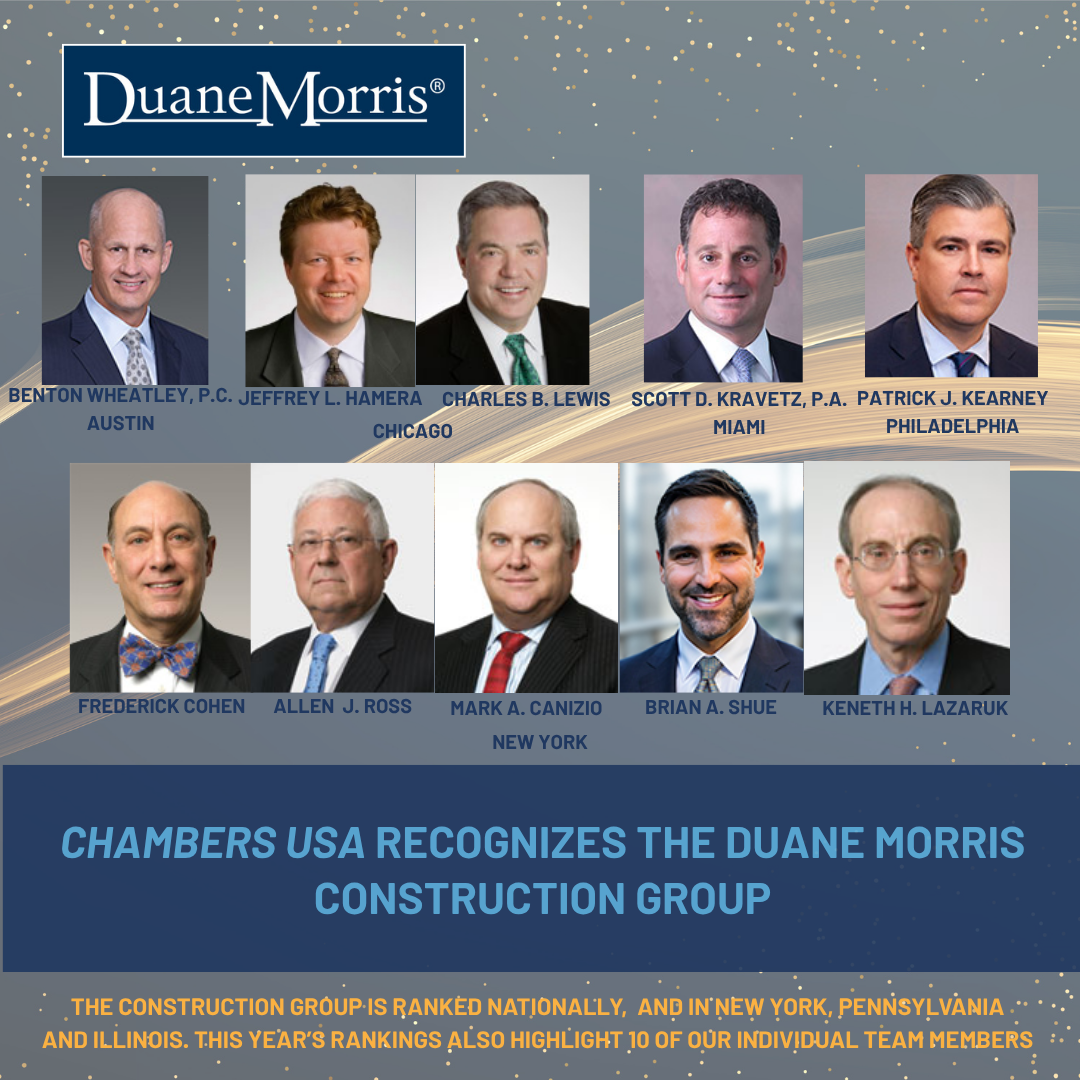
Chambers USA Recognizes Duane Morris Construction Group and 10 Individual Construction Team Members

Duane Morris is pleased to announce that Chambers USA has once again nationally recognized our Construction Group as well as construction attorneys across the country. We share this honor with our clients and colleagues whose support makes this possible.

Austin

Benton T. Wheatley, Construction

Chicago

Jeffrey L. Hamera, Construction

Charles B. Lewis, Construction

Miami

Scott D. Kravetz, P.A., Construction

New York

Mark Canizio, Construction

Frederick Cohen, Construction

Kenneth H. Lazaruk, Construction and Construction: Mediators

Allen J. Ross, Construction: Mediators

Brian A. Shue, Construction

Philadelphia

Patrick J. Kearney, Construction

Duane Morris Recognized as a Top 50 Construction Law Firm by Construction Executive

Duane Morris was ranked in the top 10 among the 2025 Top 50 Construction Law Firms by Construction Executive. Selected for excellence and prominence in the field of construction law, this marks the firm’s fifth consecutive appearance in the top 50 list.

Construction Executive is the leading source for news, market developments and business issues impacting the construction industry. To determine the ranking, published in the June 2025 issue, Construction Executive asked hundreds of U.S. law firms with a construction practice to complete a survey. Data collected included: 1) 2024 revenues from the firm’s construction practice; 2) number of attorneys in the firm’s construction practice; 3) percentage of firm’s total revenues derived from its construction practice; 4) number of states in which the firm is licensed to practice; 5) year in which the construction practice was established; and 6) the number of AEC clients served during fiscal year 2024. The ranking was determined by an algorithm that weighted these factors in descending order of importance.

Duane Morris’ Construction Group is nationally ranked by Chambers USA among the leaders in the industry and recognized as a Leading Law Firm in Construction by The Legal 500.

Construction Liability and Insurance: How State Law Shapes Policy Exclusions

The Arkansas Court of Appeals recently issued a ruling determining that insurance coverage must be provided for both defense and indemnification in a dispute arising from faulty workmanship during flooring installation. The decision, in Nationwide Mutual Insurance Co. v. NWA Restore-It, Inc., 2025 Ark. App. 218, 710 S.W.3d 475 (Ark. Ct. App. 2025), clarifies how exclusions related to completed work and intended use apply in cases where damage occurs during installation rather than afterward.

The dispute began when a contractor installed replacement flooring after a water damage event. Approximately six months after the installation was completed, the flooring started exhibiting defects such as rippling and cracking. Attempts to repair the damage were unsuccessful, leading to a lawsuit alleging improper installation.

The contractor was listed as an additional insured under the installation subcontractor’s commercial general liability policy. After coverage was denied, the contractor sought a judicial declaration that defense and indemnification should be provided. The insurer contested coverage, citing policy exclusions that bar liability for property damage occurring after work has been completed or put to its intended use.

The court rejected these arguments, citing state law that explicitly defines an “occurrence” to include property damage resulting from faulty workmanship. The court found that the underlying complaint alleged damage occurring during installation rather than after completion, meaning that the cited exclusions did not apply.

The ruling distinguished the case from others in which damages were confined to the contractor’s own product. Here, the damage stemmed from the installation, rather than the product itself, which resulted in the court determining that the exclusions did not preclude coverage.

This ruling underscores the significance of statutory definitions in resolving insurance coverage disputes in construction. It establishes that insurers cannot rely solely on policy exclusions when state law has its own definition of covered occurrences.

Jose A. Aquino (@JoseAquinoEsq on X) is a special counsel at Duane Morris LLP’s New York office, where he is a member of both the Construction Group and of the Cuba Business Group,  specializing in construction law, lien law, and government procurement law.

This blog is prepared and published for informational purposes only and should not be construed as legal advice. The views expressed herein are those of the author and do not necessarily reflect the views of Duane Morris LLP or its individual attorneys.

© 2009- Duane Morris LLP. Duane Morris is a registered service mark of Duane Morris LLP.

The opinions expressed on this blog are those of the author and are not to be construed as legal advice.

Proudly powered by WordPress