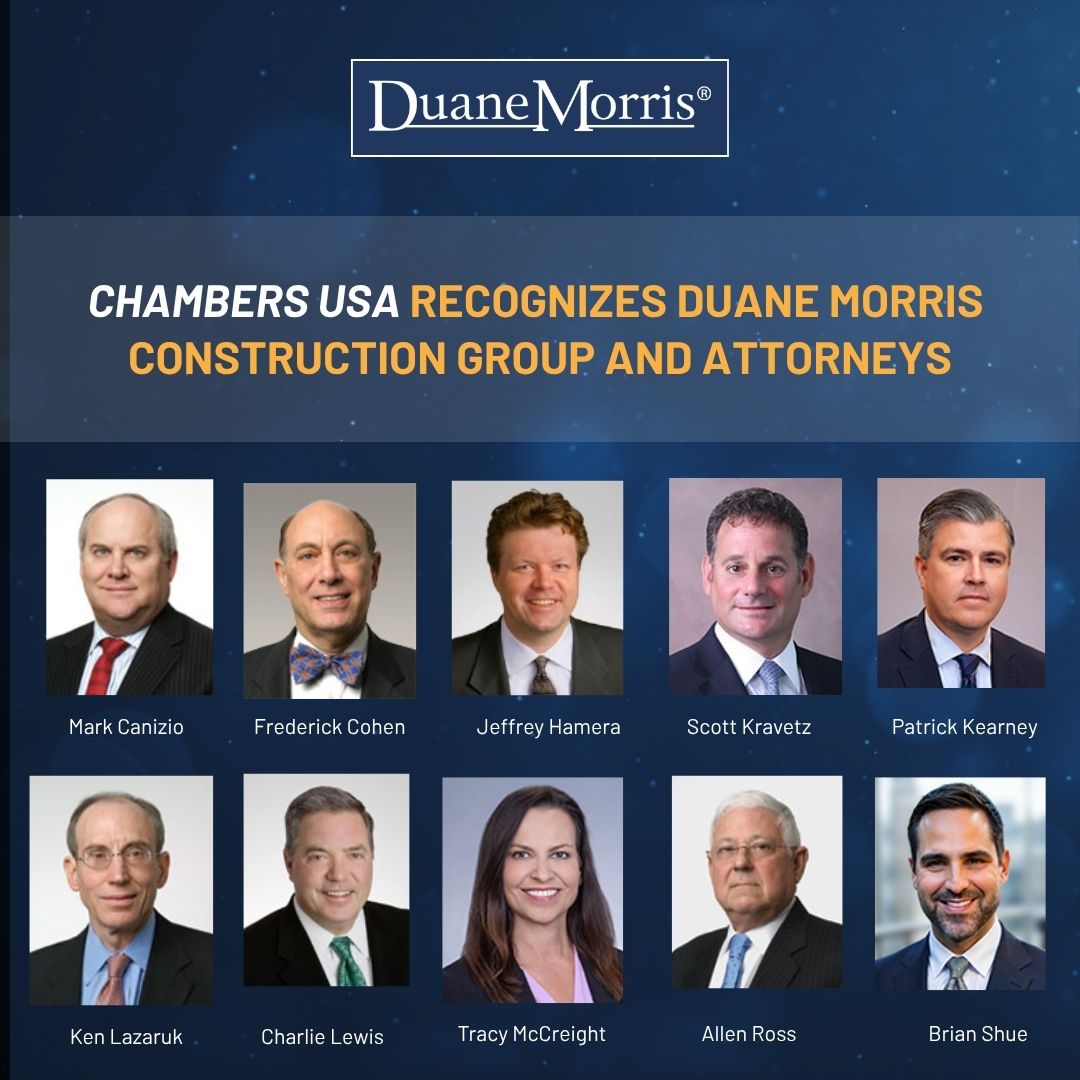
Duane Morris is pleased to announce that Chambers USA has once again nationally recognized our Construction Group as well as construction attorneys across the country.
Here’s what our clients are saying about our construction attorneys:
“Duane Morris has an extremely well-rounded construction team in terms of knowledge and experience.”
“They have streamlined our ability to slice through the nonsense and get straight to the issues at hand.”
“Everyone I have worked with at Duane Morris has deep experience on relevant matters and are all very knowledgeable about the industry.”
The term “piggybacking” in public contracting refers to a municipality using another government’s existing contract instead of running its own competitive bid. In Daniel J. Lynch, Inc. v. Board of Education of the Maine‑Endwell Central School District, the New York Appellate Court made it clear that this shortcut has strict limits. The court held that a school district cannot award a public‑works construction contract by piggybacking through a cooperative purchasing system. Under New York’s General Municipal Law, piggybacking is permitted only for buying goods and related services, not for construction or renovation projects. The decision underscores that cooperative purchasing is a narrow exception, not a substitute for the competitive bidding requirements that govern public‑works contracts.
The school district had finished phase one of a multiyear capital project. When phase two—HVAC upgrades and classroom construction—was delayed by the State Education Department, the district chose not to wait. Instead of putting the HVAC work out for competitive bidding, it turned to a “piggyback” contract through The Interlocal Purchasing System (TIPS). TIPS, a Texas‑based cooperative formed in 2002, allows municipalities nationwide to use contracts and pricing it has already secured. Using its preapproved vendor list, TIPS matched the district with a contractor based on pre‑negotiated pricing.
Local contractors challenged the award, claiming the district sidestepped the competitive bidding rules required under the General Municipal Law. The Supreme Court agreed, ruling that the district’s use of TIPS amounted to improper piggybacking for a public works project. While the court allowed the contractor to finish the HVAC work already underway, it prohibited the district from relying on TIPS or similar cooperatives for the remaining phases of the project.
The Appellate Division affirmed the ruling. It emphasized that General Municipal Law § 103(16)—the statute permitting piggybacking—covers only purchases of “apparatus, materials, equipment or supplies” and related installation or maintenance services. It does not mention public works contracts. As the court explained, leaving out public works contracts from the statute shows that the Legislature did not intend to exempt them from competitive bidding. The legislative history supported this point: when the provision was enacted, lawmakers described it as a tool for cooperative purchasing, not a way to award construction or renovation projects.
The court also dismissed the contractor’s appeal for lack of harm, since none of the relief sought against the contractor—such as repayment, an injunction, or fees—was granted. The contractor’s claim that the ruling might affect its future business was too speculative to give it standing. The court’s decision is clear: cooperative purchasing cannot be used to avoid competitive bidding for public works. It is a limited exception meant only for buying goods and related services.
Jose A. Aquino (@JoseAquinoEsq on X) is a special counsel at Duane Morris LLP’s New York office, where he is a member of Construction Group, specializing in construction law, lien law, and government procurement law. He is also a member of the Cuba Business Group.
This blog is prepared and published for informational purposes only and should not be construed as legal advice. The views expressed herein are those of the author and do not necessarily reflect the views of Duane Morris LLP or its individual attorneys.
Every construction GC has three piles on their desk. A speaker at an ethics CLE early in my legal career named them.
The small one up front: the work they love. The medium one in the corner: the work they tolerate. And the large one accumulating out of sight — the work they avoid. He called that one the malpractice pile.
He was right to name it. The work you avoid has a way of coming due. But the image stayed with me for a different reason.
After eight years of legal practice, and before joining my current firm, I spent six years at Black & Veatch — in project risk management, as a project manager on a power generation megaproject, and as Regional Director for GCC Power Generation. Across those roles, the avoidance pile, while serious, was never the most dangerous one.
General Counsel are lawyers, but they are also executives — and like any executive, they have clients of their own. The CEO, the CFO, the Board: stakeholders who measure risk in dollars and quarters, not legal standards and motion deadlines. What makes perfect sense in the legal department’s conference room doesn’t always translate to the boardroom. Bridging that gap is one of the GC’s most demanding roles — and in some ways, harder than what outside counsel face. The GC doesn’t get to pick her clients.
Here is a contract maintenance checklist built around the same idea as my last post: the wall is strongest when both parties show up and walk it together. From project kick-off to senior leadership check-ins, the checklist provides jumping-off points for developing agendas and guiding purposeful communication between owners and contractors together.
The appellate decision in Landscape Details, Inc. v. Bernard is a reminder that courts are hesitant to dismiss claims at an early stage. The case involved a contractor who performed a landscaping project for a homeowner who was also the contractor’s employee. The parties allegedly agreed that the contractor would be paid through the employee’s bonuses, with any unpaid balance becoming due if the employee left the company before the balance was paid. When the employment ended and no payment was made, the contractor sued to recover the unpaid balance.
The defendant moved to dismiss, arguing that the claim was barred by the statute of frauds because the agreement was oral and could not be performed within one year. The court rejected that argument, reasoning that the statute of frauds applies only if the agreement could not be completed within a year. Since the alleged agreement provided that the balancewould become due upon the employee’s termination—a contingency that could occur within a year—the court concluded that this possibility was sufficient to defeat the statute‑of‑frauds defense at the pleading stage.
The defendant also argued that the agreement was for the sale of goods over $500 and therefore unenforceable without a writing under the Uniform Commercial Code. The court also rejected that argument, noting that even if the UCC applied, there is an exception where goods are received and accepted. The court found that the contractor’s allegations were sufficient to fall within that exception.
The decision holds that oral agreements in a construction setting may be enforceable where performance is alleged, and that statute‑of‑frauds defenses do not warrant dismissal at the pleading stage when the agreement could be performed within one year or falls within a recognized exception. The decision also underscores that, on a motion to dismiss, the court does not assess the ultimate merits but examines only whether the plaintiff has stated a viable claim; if the alleged facts, accepted as true, fit within any cognizable legal theory, the action survives dismissal.
Jose A. Aquino (@JoseAquinoEsq on X) is a special counsel at Duane Morris LLP’s New York office, where he is a member of Construction Group, specializing in construction law, lien law, and government procurement law. He is also a member of the Cuba Business Group.
This blog is prepared and published for informational purposes only and should not be construed as legal advice. The views expressed herein are those of the author and do not necessarily reflect the views of Duane Morris LLP or its individual attorneys.
Every major construction project comes with risk, whether it’s a warehouse build, a multifamily development or a major renovation. Parties tend to be aligned when things are proceeding as planned. But when something goes wrong—cracked concrete, water intrusion, systems that don’t perform as expected—those interests can quickly diverge.
Hadrian’s Wall in Northumberland. A two-thousand-year-old UNESCO World Heritage Site with superb views and excellent walking.
Robert Frost popularized the now-famous phrase “Good Fences Make Good Neighbors” in his poem, Mending Wall, more than a century ago. The neighbors in his poem would meet each spring to walk together along the wall, each replacing the stones that have fallen on his side.
Frost’s speaker is skeptical and asks why the wall needs to exist at all: “He is all pine and I am apple orchard. My apple trees will never get across and eat the cones under his pines.” But the neighbor is unmoved. “Good fences make good neighbors.”
I have frequently used the Good Fences analogy in discussions about how well-developed contracts may improve or at least preserve owner/contractor relationships, and I am not abandoning the premise. But just as Frost’s poem is not really about the quality of the fence, the lesson here is not about the quality of the contract. It is about the ritual of maintaining it. Both neighbors show up. Both walk the fence. The wall gets mended not because one man decides it should be, but because both agree it is worth maintaining.
“Something there is that doesn’t love a wall, That sends the frozen-ground-swell under it, And spills the upper boulders in the sun; And makes gaps even two can pass abreast. …
No one has seen them made or heard them made, But at spring mending-time we find them there.”
Most construction contracts are negotiated carefully, between sophisticated parties, and then filed away. The project mobilizes. The work begins. Owner and contractor go back to their corners, focus on their work, and assume the other side is doing the same.
This works fine. Until winter comes.
In construction, winter comes in many forms: change orders, delayed performance, and supply chain disruptions. None of these are truly unforeseen events. Anyone who has managed or advised on a large construction project knows that change orders will come, that schedules will slip, that conditions will differ from the drawings.
When spring comes, both parties reach for the contract. And what they usually find are the gaps that have formed. Notice provisions may have gone unobserved. Force majeure language may not account for tariff-driven material escalation. Prior schedule or productivity impacts may not have been substantiated. Project challenges like these, if left unaddressed, can leave gaps that undermine the contract’s ability to make “good neighbors.”
“And on a day we meet to walk the line And set the wall between us once again. We keep the wall between us as we go. To each the boulders that have fallen to each.”
Frost’s mending ritual is not complicated. What makes it work is not the sophistication of the process — it is the discipline of showing up. Both neighbors. Together.
Maintaining a construction contract requires the same discipline.
In practice, that means regular, deliberate conversations between owner and contractor about where the project stands and whether they are meeting the contract’s requirements. It means treating the change order process as a shared obligation — documented as it happens — rather than an administrative nuisance. It means revisiting the contract together when circumstances change materially. And perhaps most importantly, it means having difficult conversations up front rather than waiting to see what happens down the line.
The parties who do this — who are diligent in maintaining the contractual relationship together — are far less likely to end up in a courtroom. Not because their projects are free of problems, but because they addressed the problems while they were still problems that could be resolved by neighborly cooperation rather than a legal battle.
“Why do they make good neighbors? Isn’t it Where there are cows? But here there are no cows. Before I built a wall I’d ask to know What I was walling in or walling out, And to whom I was like to give offense. Something there is that doesn’t love a wall, That wants it down.”
Frost’s speaker remained skeptical about the need for a wall and in part, worried about giving offense—perhaps about what the wall said about the relationship between neighbors. It is a reasonable concern. In construction, it frequently manifests as a reluctance to send formal notice, to document a change order while the relationship is still warm, or to insist on contract compliance when the other party is struggling. The instinct to avoid offense is understandable. The cost of acting on it is not.
Clients frequently lament that they avoided providing notice or addressing change as a gesture of good faith, believing both parties would “be fair to each other in the end.” But the paradox is this: the gesture intended to preserve the relationship and avoid offense is often what damages it. When a party withholds notice or stays silent about a developing problem, they are not protecting the partnership — they are building a private version of events that the other party knows nothing about. When spring comes, the relationship fails not because the change order was too large or the delay too long, but because one party knew something the other did not and said nothing. Trust is not preserved by avoiding difficult conversations. It is built by having them.
Good fences make good neighbors. Not because they signal distrust, but because they give both parties a shared structure for managing the inevitable winter events and avoiding the accumulation of gaps.
The best construction contracts work the same way. They are not statements of distrust. They are the shared understanding by which the parties can avoid or mitigate impacts as they occur. So long as both parties show up and walk the line together.
Owen Newman is a construction and energy litigator and international arbitration specialist at Duane Morris LLP in Chicago. Owen previously spent six years managing EPC projects and leading commercial operations for a global engineering and construction contractor—which is where he first learned to walk the line.
In Best Work Holdings (New York), LLC v. Ma, a recent decision from the New York Appellate Division, First Department, the court examines how promissory‑estoppel and unjust‑enrichment claims are evaluated when construction work is performed without a written contract.
Plaintiff building owner accused defendants of participating in a fraudulent contracting scheme. Defendant Li responded with counterclaims, asserting that he performed legitimate preparation work for the building’s renovation because he was told he would be reimbursed. Li alleged that the head of asset management for the owner’s parent company promised him that “if Li performed preparation work… he would be reimbursed the costs for material, labor, equipment, and services.” Li also claimed that he relied on this assurance because of his prior working relationship with the project manager, noting that he had previously managed projects “without a written contract.”
The court held that these allegations were enough to state a claim for promissory estoppel. At the pleading stage, the question is not whether Li will ultimately prove his reliance was reasonable, but whether the allegations, taken as true, are plausible. The court emphasized that the reasonableness of reliance “is an issue for the trier of fact” and that Li is entitled to favorable inferences because his reliance was not “patently unreasonable on its face.”
The court also reinstated Li’s unjust enrichment claim. Li alleged that he spent $200,000 on preparation work and that the building owner benefited from that work without paying for it. The court found these allegations sufficient, explaining that Li claimed the owner “was enriched by Li’s preparation work” and that it would be “against equity and good conscience” for the owner to retain that benefit without payment.
Although the counterclaims lacked detail, the court concluded that they were sufficiently specific to withstand a motion to dismiss. The decision underscores that quasi‑contract claims may proceed even without a formal agreement when a contractor alleges a pattern of similar prior dealings and significant out‑of‑pocket expenditures.
Jose A. Aquino (@JoseAquinoEsq on X) is a special counsel at Duane Morris LLP’s New York office, where he is a member of Construction Group, specializing in construction law, lien law, and government procurement law. He is also a member of the Cuba Business Group.
This blog is prepared and published for informational purposes only and should not be construed as legal advice. The views expressed herein are those of the author and do not necessarily reflect the views of Duane Morris LLP or its individual attorneys.
Duane Morris has been named a finalist for the 2026 Florida Legal Awards in the Litigation Departments of the Year, Construction category. Honorees were selected by the Daily Business Review and Law.com editorial staff with input from distinguished members of the Florida legal community.