NJ Supreme Court: Insurance Brokers, Producers, and Agents Not Exempt from Consumer Fraud Act, Casts Doubt on “Learned Professional” Exemption

By Brad D. Feldman, Gregory D. Herrold and James Hearon

In a unanimous opinion, Lowe v. Audet, __ N.J. ___ (2026) (slip op.), the New Jersey Supreme Court held that insurance brokers, producers, and agents are not exempt from the Consumer Fraud Act (CFA), N.J.S.A. 56:8-1, under the judicially created “learned professional” exemption, as semi-professionals or otherwise. The Court’s opinion will have an immediate impact on the insurance industry in New Jersey, subjecting insurance brokers, agents, and producers to potential liability under the CFA, one of the nation’s strongest consumer protection laws.

Lowe’s reach, however, is not limited to the insurance industry. The opinion portends potential significant exposure for a broad range of other industries currently reliant on the “learned professional” exemption, including the possibility of treble damages, attorneys’ fees, and costs available under the CFA. The Court invited the Legislature to clarify whether certain professionals are exempt from CFA liability and, if so, to identify those professionals with specificity. But the Court signaled that, absent legislative clarity, it will “await a case that presents a direct challenge” to the “learned professional” exemption. While declining to formally abolish the exemption, the Court expressed “serious doubts” about its textual and legislative foundations and left the exemption’s continued viability an open question under New Jersey law. The opinion serves as a stark warning to regulated professionals and businesses operating in New Jersey.

Read the full article published in The New Jersey Law Journal on the Duane Morris LLP website.
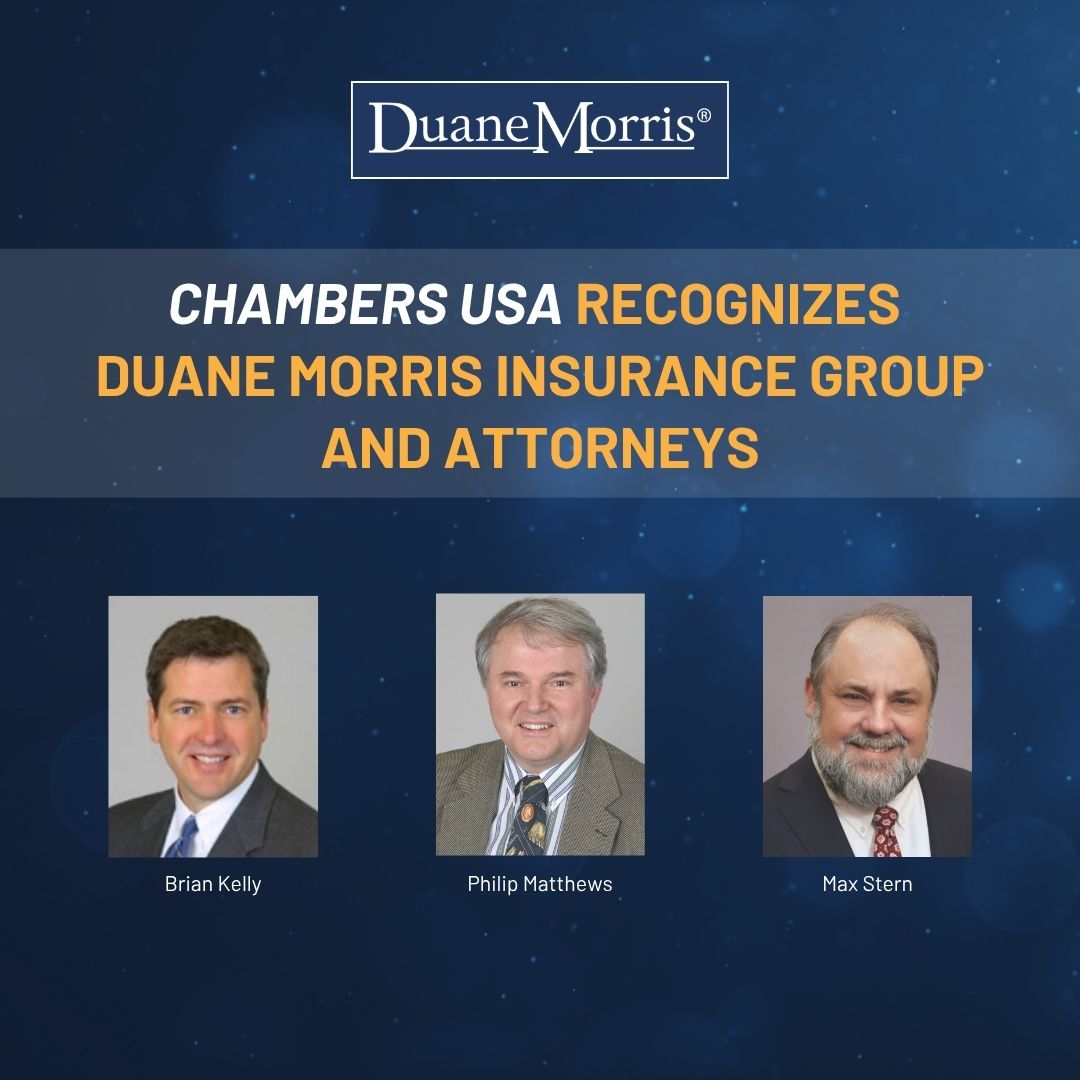
Chambers USA Recognizes Duane Morris Insurance Group and Attorneys

Chambers USA has recognized the Duane Morris Insurance Group and attorneys in its 2026 rankings.

Here’s what clients are saying about our insurance attorneys:

  • “Duane Morris is our go-to firm on all aspects of legal coverage issues.”
  • “They are outstanding on handling complex and sophisticated matters.”

Nationwide

Insurance: Dispute Resolution: Insurer

California

Insurance: Insurer

California Attorneys

Brian Kelly: Insurance: Insurer

Philip Matthews: Insurance: Insurer

Max Stern: Insurance: Insurer

Introducing the First Edition of the Insurance Class Action Review – 2026

By Gerald L. Maatman, Jr. and Jennifer A. Riley

Duane Morris Takeaway: The rise of class action litigation has fundamentally transformed the modern legal landscape, and we are proud to announce the publication of the Insurance Class Action Review – 2026, a comprehensive new resource examining the evolving risks, trends, and defense strategies shaping class action litigation across the insurance sector.

The class action mechanism is unparalleled among procedural rules in terms of its impact on the American legal system. Its ability to exponentially expand the potential damages associated with a single claim has elevated class litigation into one of the most consequential forces confronting corporate defendants. In many instances, the mere threat of class certification can alter litigation strategy, settlement dynamics, and business operations on a massive scale.

Read the full analysis on the Duane Morris Class Action Defense Blog.

New York Court of Appeals Holds Graves Amendment Preempts State Primary Insurance Requirement for Automotive Rental Companies

 By Harry M. Byrne and Ryan F. Monahan

On April 23, 2026, the New York Court of Appeals held in Second Child v. Edge Auto, Inc. that the federal Graves Amendment preempts New York’s minimum insurance statute to the extent it requires automotive rental companies to provide primary liability insurance coverage to renters up to the statutory minimum liability limits. The decision is a major victory for the rental industry and reinforces the broad protections Congress intended to provide the industry when it enacted the Graves Amendment.

Read the full Alert on the Duane Morris LLP website.

Environmental Deregulation Fuels Insurance Uncertainties

Almost eight months into the new administration, the federal government has slashed staffing at the Environmental Protection Agency and begun unwinding both recent and long-standing environmental rules. Policyholders and carriers see the regulatory pullback from pollution and other standards as bringing immediate benefits and long-term uncertainty.

Pollution claims have largely emerged from historic commercial general liability policies written before the mid-1980s, when an absolute pollution exclusion became the industry standard, and subsequent pollution risk policies, said Max H. Stern of Duane Morris.

“Very likely, we’ll see a decrease in new claims being made with a major reduction in environmental enforcement, and that will be helpful to the pollution liability insurance market because they’re just going to have less risk,” he told Law360. Read the full article on the Law360 website.

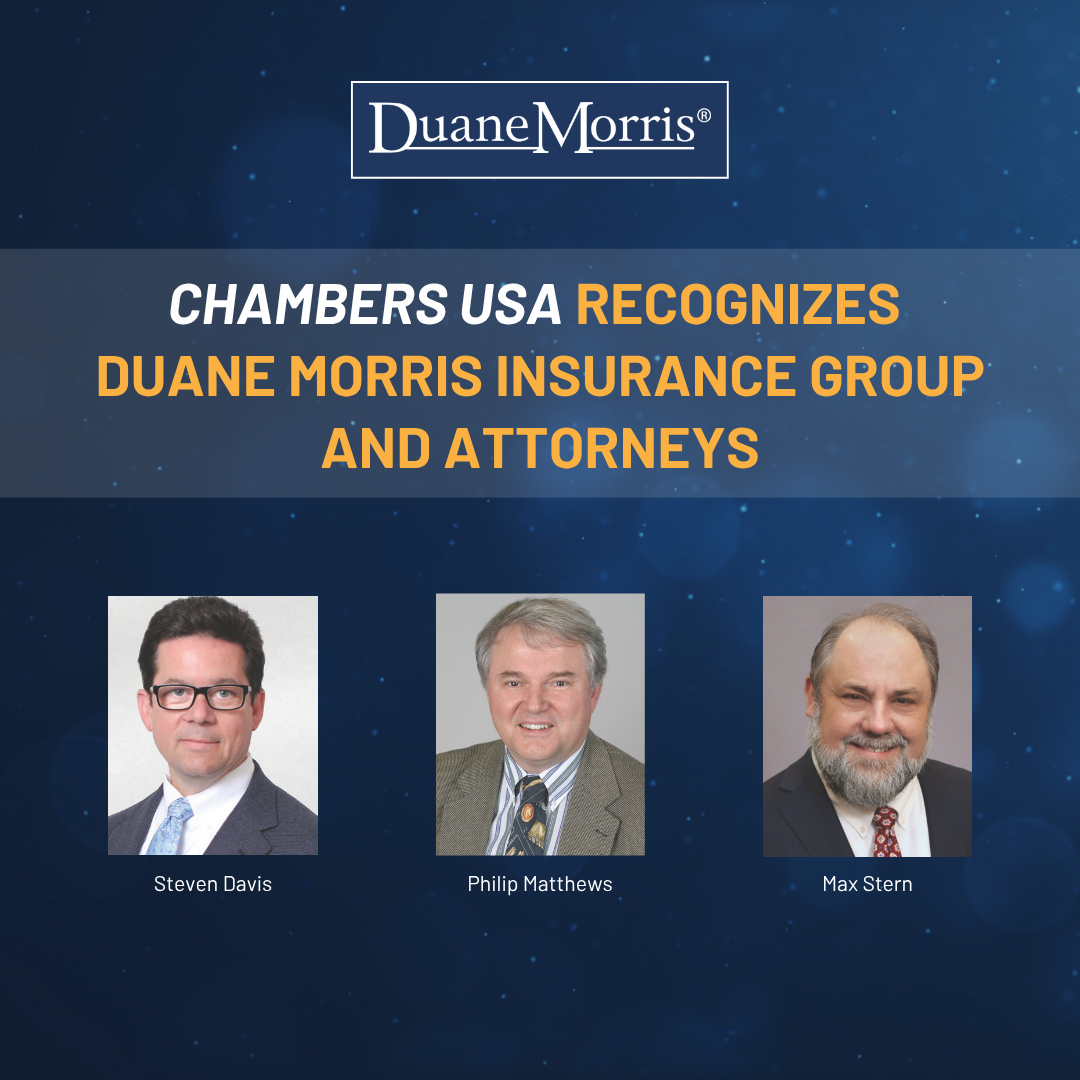
Chambers USA Recognizes Duane Morris Insurance Group and Attorneys

Duane Morris LLP is pleased to announced that Chambers USA has recognized Duane Morris Insurance group and attorneys.

Nationwide

Insurance: Dispute Resolution: Insurer

Philip R. Matthews, Insurance: Dispute Resolution: Insurer

Max H. Stern, Insurance: Dispute Resolution: Insurer

California

Insurance: Insurer

Philip R. Matthews, Insurance: Insurer

Max H. Stern, Insurance: Insurer

Pennsylvania

Steven Burgess Davis, Insurance

SDNY Enforces NY Choice of Law Clause in Policy Despite Alleged Conflict with Law in State of Issuance

Insurance policies frequently contain choice-of-law provisions providing that their interpretation is subject to the law of a particular jurisdiction. Thus, if a policy’s choice-of-law provision requires that the policy be interpreted in accordance with New York law, then the policy should be interpreted in accordance with New York law. That seemingly self-evident proposition was recently upheld by the United States District Court for the Southern District of New York in Cajun Conti, LLC v. Starr Surplus Lines Ins. Co., 23 Civ. 8844 (KPF), 2025 WL 764131 (S.D.N.Y. Mar. 11, 2025).

But, according to the insured, Cajun Conti, the proposition is not self-evident at all. This is because the insurance policy containing the New York choice-of-law provision was issued to Cajun Conti in Louisiana, and, under the Louisiana Insurance Code, foreign choice-of-law provisions are void, at least for policies issued in Louisiana and subject to approval by the Louisiana Department of Insurance. See La. Rev. Stat. § 22:868.

The Southern District, however, rejected Cajun Conti’s invocation of the Louisiana statute, and enforced the parties’ contractual commitment to be bound by New York law. Cajun Conti, 2025 WL 764131, at *4-*7. The Court did so for several reasons.

First, Section 5-1401 of New York’s General Obligations Law provides that any contract governing transactions in excess of $250,000 containing a New York choice-of-law provision is enforceable in New York. Indeed, New York’s highest court has held that a provision subject to Section 5-1401 obviates the need for any further conflicts-of-law analysis. The provision is presumptively enforceable. Cajun Conti, 2025 WL 764131, at *4.

Second, the Cajun Conti court noted that, even in the absence of Section 5-1401, New York courts should enforce choice-of-law provisions as a matter of contract interpretation. To that end, the court cited a recent decision from New York’s Court of Appeals holding that “when the parties have chosen New York law, a court may not contravene that choice through common-law conflicts analysis.” Cajun Conti, 2025 WL 764131, at *5 (citing Petróleos de Venezuela S.A. v. MUFG Union Bank, N.A., 41 N.Y.3d 462, 476 (2024)).
Third, the Cajun Conti court rejected a “public policy” exception to the foregoing rules, finding no basis for such an exception in controlling New York law. Cajun Conti, 2025 WL 764131, at *6.

Based on the foregoing principles of New York law, the Cajun Conti court concluded that the Louisiana statute purporting to void the contract provision is ultimately irrelevant.

The takeaway is that courts in New York should apply New York law to insurance policies requiring the application of New York law, irrespective of alleged public policy concerns arising from contrary law of the insureds’ home state. This rule provides certainty to the parties concerning their rights and obligations and ensures that their contractual intent will be upheld.

Cases We’re Watching: Certified Question to Nevada Supreme Court—Excess Carrier’s Equitable Subrogation Claim

By: Daniel B. Heidtke

Earlier this Fall, the Ninth Circuit certified the following question to the Nevada Supreme Court:

Under Nevada law, can an excess insurer state a claim for equitable subrogation against a primary insurer where the underlying lawsuit settled within the combined policy limits of the insurers?

The Nevada Supreme Court has since accepted the certified question and ordered briefing, which is currently underway.

The case at issue involves an equitable subrogation claim brought by an excess insurer against a primary insurer.  The excess insurer filed suit against the primary insurer after the excess insurer paid $4 million of a $5 million settlement to resolve underlying litigation arising out of a murder at a Las Vegas apartment complex.  The underlying litigation—alleging negligence and wrongful death against the insured owner of the apartment complex—was filed in 2019. 

Continue reading “Cases We’re Watching: Certified Question to Nevada Supreme Court—Excess Carrier’s Equitable Subrogation Claim”

Cases We’re Watching: Fifth Circuit Appeal of Summary Judgment on Stowers Demand

By: Daniel B. Heidtke

Finding that the Stowers doctrine was not “activated,” the United States District Court for the Southern District of Texas entered summary judgment in favor of an insurer on its declaratory relief claim.  After an underlying judgment was entered against its insured, the insurer sought declaratory relief establishing that it owed only its remaining policy limits for an excess verdict. The trial court agreed with the insurer, entered summary judgment, and the matter is now on appeal to the United States Court of Appeals for the Fifth Circuit.

The coverage dispute arose out of an underlying personal injury suit filed in Texas state court.  In the underlying suit, the claimants sued the insured for injuries sustained while at the insured’s business.  The claimants’ counsel sent a written settlement offer to the insured, requesting “payment of all policy limits of any and all insurance contract,” which was subsequently rejected.  The claimants eventually prevailed at trial against the insured, obtaining a verdict totaling $3.2 million.  The insurer tendered its remaining limits, but the claimants asserted that the insurer was obligated to pay the entire judgment because the claimants’ pre-trial settlement demand was a proper Stowers demand.

The trial court provided background on the so-called Stowers doctrine and demands:

“Under G.A. Stowers Furniture Co. v. American Indem. Co., 02 S.W.2d 544 (Tex. Comm’n. App. 1929, holding approved), Texas law imposes a ‘basic tort duty,’ known as the Stowers doctrine, under which insurers, ‘when faced with a settlement offer within policy limits, must accept the offer … when an ordinarily prudent insurer would do so in light of the reasonably apparent likelihood and degree of that insured’s potential exposure to a valid judgment in the suit in excess of policy limits.’” Law Office of Rogelio Solis PLLC v. Curtis, 83 F.4th 409, 411 n.1 (5th Cir. 2023) (quoting Travelers Indem. Co. v. Citgo Petroleum Corp., 166 F.3d 761, 761 (5th. Cir. 1999)). “When . . . the insurer’s negligent failure to settle results in an excess judgment against the insured, the insurer is liable under the Stowers doctrine for the entire amount of the judgment, including the part exceeding the insured’s policy limits.” G.A. Stowers Furniture Co., 15 S.W.2d at 548.

Continue reading “Cases We’re Watching: Fifth Circuit Appeal of Summary Judgment on Stowers Demand”

© 2009- Duane Morris LLP. Duane Morris is a registered service mark of Duane Morris LLP.

The opinions expressed on this blog are those of the author and are not to be construed as legal advice.

Proudly powered by WordPress