Can We Learn Anything from Adjudications in Expedited Arbitrations?

Construction projects are a ripe ground for disputes. When these disputes arise, they often threaten to bring the project itself to a halt if not resolved expeditiously. However, many large-scale construction projects (particularly international ones) provide for their disputes to be referred to arbitration.

To read the full text of this post by Selvam LLC attorney Luis Duhart, please visit the Duane Morris International Arbitration Blog,

TCC Issues New Decision Addressing the Definition of Concurrent Delay

Concurrent delay occurs whenever two or more separate events – at least one of which is an employer risk event and at least one a contractor risk event – independently delay the critical path of a project.

The substantial majority of standard form construction and engineering contracts are silent as to either the definition of or apportionment of responsibility for concurrent delays, and it is generally rare for parties to seek to include language to that effect by way of bespoke amendment. This reluctance to legislate for concurrent delay in contracts probably reflects the inherent difficulty in formulating language that would adequately address what is always a complex and necessarily heavily fact-dependent issue.

Nevertheless, the consequence of this widespread lack of contractual language is that issues concerning concurrent delays are usually left to be determined by the law of the contract.

Traditionally, the cases raising concurrency in the Courts of England and Wales have concerned concurrent delays by a contractor that is claiming an extension of time against an Owner.  In the seminal case, Henry Boot Construction (UK) Ltd v Malmaison Hotel (Manchester) Ltd [1999] 70 Con. L.R. 32, the Court recognized that in such a situation the Contractor would be entitled to an extension of time but not to prolongation costs.

The determination of what is required for two delays to be concurrent under English law, however, has remained unclear.

The preferred approach, the “dominant cause approach”, assigns liability to whichever delay is the “effective, dominant cause” of the critical path impact. If there is such a dominant cause, the delays are not concurrent; concurrency occurs only when both delays are of “approximately equal causative potency.”  North Midland Building Ltd v Cyden Homes Ltd [2018] EWCA Civ 1744; H. Fairweather & Co Ltd v London Borough of Wandsworth [1987] 39 BLR 106 (OR).

A contrary line of cases, however, has resolved apparently concurrent delays based on a first-in-time approach under the reasoning that a subsequent concurrent delay does not actually effect the completion date of the Works: Royal Brompton Hospital NHS Trust v Frederick A Hammond & Ors [2000]. Under this approach, true concurrency would require that “both events in fact cause delay to the progress of the works and the delaying effect of the two events is felt at the same time.”  Id. Note that this approach does not require the events themselves to be concurrent, only the effects of those events.

This view has seemingly been dominant in recent years, having been adopted in Adyard Abu Dhabi v SD Marine Services [2011] EWHC 848 (Comm) (11 April 2011) and Saga Cruises BDF Ltd v Fincantieri SPA [2016] EWHC 1875 (Comm) (29 July 2016).

This approach has also been recommended in the Second Edition of the Society for Construction Law’s Delay and Disruption Protocol, but was condemned by Scotland’s courts as “unnecessarily restrictive and [an approach] which would militate against the achievement of its obvious purpose of enabling the architect, or other tribunal, to make a judgment on the basis of fairness and a common-sense view of causation.”   City Inn Ltd v Shepherd Construction Ltd [2007] CSOH 190 (30 Nov. 2007) – a judgment that was itself criticized in Walter Lilly & Co. Ltd v Mackay [2012] EWHC 1773.

The contrasting approaches adopted by the Courts in this regard undoubtedly reflect the fact that whilst the Courts recognize that this is an area that requires judicial guidance, it is also heavily fact-dependent, such that an approach adopted in one case may not be appropriate with a different set of facts.

Insofar as it is possible to establish overarching principles, they are likely to be those summarized in Saga Cruises v Fincantieri and drawn from Henry Boot v Malmaison:

  • Where an employer risk event actually causes a delay to completion, the contractor will always be entitled to an extension of time notwithstanding any concurrent contractor risk events. This is based in part on the principle that an employer cannot hold a contractor to an obligation that the employer himself has prevented the contractor achieving (the “prevention principle”).
  • The delay caused by an employer risk event must be actual, not notional or theoretical.
  • Where a contractor risk event has caused concurrent delay, the contractor’s claim for prolongation costs arising from the employer risk event is likely to fail for want of causation.
  • In cases of concurrency, the Courts (and therefore contract administrators) should be very cautious to attempt to apportion critical delay between two or more concurrent events.

Notwithstanding these principles, the treatment of concurrency remains uncertain, especially under international contracts where the law of England and Wales is being applied by an external tribunal or arbitrator.

It is thus noteworthy that last week the TCC rendered a decision addressing concurrent delays: Thomas Barnes & Sons PLC v Blackburn with Darwen Borough Council [2022] EWCH 2598 (TCC) (17 Oct. 2022).  The Borough Council for the borough of Blackburn with Darwen (“Blackburn”) contracted with Thomas Barnes to construct a bus terminal under the terms of a Joint Contracts Tribunal agreement.  The subsequent litigation stemmed from Blackburn’s denial of Barnes’ extension of time claims and termination of the Contract based on delays to the Works.

Barnes’ extension of time claim was based on structural steel defects (deflection under load) for which Barnes was not contractually responsible. Completion of the structural steel work was necessary to allow pouring of the concrete topping, which in turn was required for exterior wall construction and interior finishing thereafter.  While the structural steel delays were ongoing, Barnes independently suffered delays to its roof works, which were also a required prerequisite to interior finishing.  The roof delays, however, arose after the structural steel delays, and were resolved prior to the construction of the exterior walls, and therefore did not independently cause delay to the critical path.

The Court found that these roof delays, although subsumed entirely within the critical path impact of the structural steel delays, were concurrent, writing:

“In my judgment this is a case where these causes were concurrent over the period of delay caused by the roof coverings. That is because completion of the remedial works to the hub structural steelwork was essential to allow the concrete topping to be poured and the hub SFS to be installed, without which the hub finishes could not be meaningfully started, but completion of the roof coverings was also essential for the hub finishes to be meaningfully started as well. It is not enough for the claimant to say that the works to the roof coverings were irrelevant from a delay perspective because the specification and execution of the remedial works to the hub structural steelwork were continuing both before and after that period of delay.  Conversely, it is not enough for the defendant to say that the remedial works to the hub structural steelwork were irrelevant from a delay perspective because the roof coverings were on the critical path. The plain fact is that both of the work items were on the critical path as regards the hub finishes and both were causing delay over the same period.”

The Court held that Barnes was entitled to an extension of time based on the delay caused by the steel frame deflection, but was only entitled to prolongation damages for the periods of delay that were not concurrent with Barnes’ own delays to the roof works.

Even given the diversity of approaches taken by the Courts on concurrency this is a curious decision. On the facts as given in the judgment, it appears that the dominant cause of delay was the completion of remedial works to the hub structural steelwork, and that this is therefore not an instance of true concurrency. However, the Court does not discuss the dominance of these works, and it is possible that this issue was not raised in submissions before it. The Court also appears to have ascribed at least some significance to the parties’ contemporaneous evaluation of the critical path impacts of the two delays, a consideration that has not played a prevalent role in prior decisions addressing concurrent delays.

It is not currently known whether this decision will be appealed. Nevertheless, in the meantime this case only increases the uncertainty surrounding the definition of “concurrent delay” under the law of England and Wales.

For More Information

If you have any questions about this blog, the final guidance or its potential implication, please contact Vijay Bange, Chris Chasin, Owen Newman or Steve Nichol.

Duane Morris Named Law Firm of the Year for Litigation-Construction by U.S. News-Best Lawyers

Duane Morris’ Litigation-Construction practice received a preeminent ranking in the U.S. News-Best Lawyers 2022 Best Law Firms results: the selection as Law Firm of the Year for Litigation-Construction. The firm previously received this honor in 2015 and was honored as Law Firm of the Year for Construction Law in 2013 and 2014.

Only one law firm is recognized as the 2022 Law Firm of the Year per practice group. According to U.S. News-Best Lawyers, Duane Morris received this designation for Litigation-Construction due to its impressive overall performance.

To read more about this award, please visit the firm website.

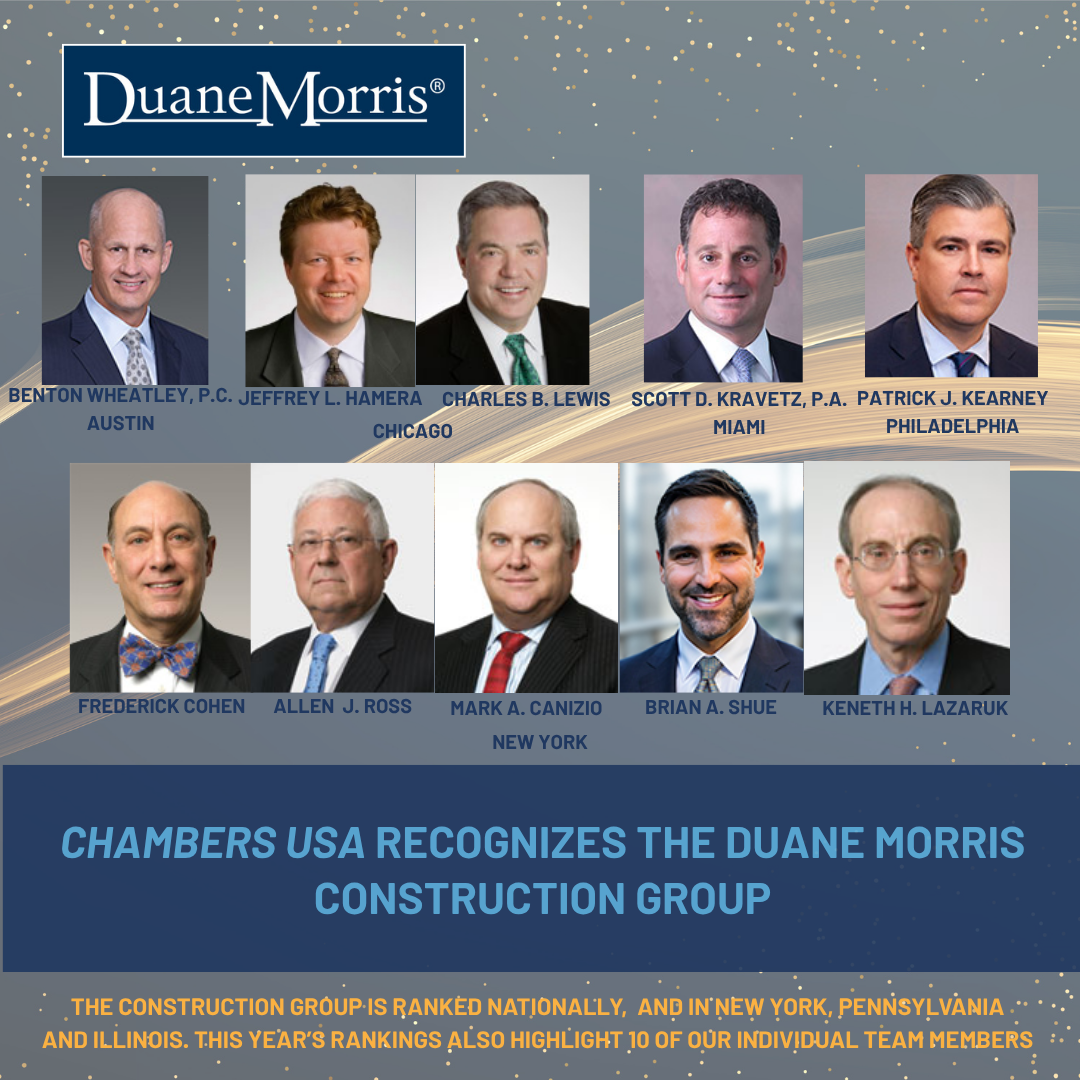
Duane Morris Construction Group Ranked in The Legal 500

Duane Morris’ Construction Group has been ranked in The Legal 500 US 2021 guide.

An excerpt from the publication:

Responsive, transparent, knowledgeable and hard-working,” the team at Duane Morris LLP handles the full range of contentious and non-contentious matters for a variety of project types. In 2020 the team led litigation relating to transport infrastructure, commercial developments and hospitality sites, and also handled contracts work for construction companies, universities and companies in heavy industry.

Meghan DiPerna is named a “Next Generation Partner.”

Testimonials

      • “The firm is exactly what you hear about them: responsive, transparent, knowledgeable and hard-working. They are as talented at articulating and presenting solutions to complex situations as they are with the substantive law.”
      • Owen Newman – Chicago – is an absolute top-notch construction litigator who understands how to handle large, complex construction matters, how to implement a team to work towards a business resolution, and works with all in-house attorneys in the spirit of a true team. He also understand the concepts of construction scheduling and thus works well with outside experts.”
      • “The firm is outstanding. They do an excellent job on construction-related matters. We have worked with them for over 15 years. They are practicable and understand our needs.”

For more information, please visit the firm website.

UK Construction: Legal Riddles and Unsolvable Problems in Multiplex v Bathgate

The decision in Multiplex Construction Europe Ltd v Bathgate Realisation Civil Engineering Ltd and Others is one of the more curious decisions you will ever read.

However, the density and depth of the judgment does not mean it is without interest; far from it. In fact I suspect this case will prove to be one of the more fascinating legal tangles the Courts will be asked to unravel this year.

To read the full text of this post by Duane Morris partner Steve Nichol, please visit the Duane Morris London Blog.

We Still Need Infrastructure in the Digital Age

In 2021, we don’t have hovercars but what we do have is quite incredible digital and information technology that allows many of us to work, shop, order pizza and watch the latest blockbuster from the comfort of our living rooms. And of course, over the last year, most of us having been doing that an awful lot. Because of this, people have started to question whether we now no longer need roads, or indeed all of that other pesky infrastructure that blights our countryside, creates pollution and tends to cost quite a lot of money. 

To read the full text of this post by Duane Morris partner Steve Nichol, please visit the Duane Morris London Blog.

UK Construction & Engineering: Cladding Crisis and Latest Government Intervention

By Vijay Bange

There was considerable interest as to what more the Government will do in its effort to tackle the issue of high rise residential buildings with dangerous cladding, and further measures to help the plight of long leaseholders who are facing significant costs to undertake necessary fire safety remedial works.

To read the full text of this blog post by Vijay Bange please visit the Duane Morris London Blog.

How Not to Settle a Dispute: Aqua v. Benchmark

In its latest offering, “CLC COVID-19 Claims and Disputes in Construction” the Construction Leadership Council (CLC) predicts that disputes related to COVID-19 are set to rise in 2021. While the optimist may hope that parties will continue to or aim to work collaboratively in order to find workable commercial solutions to claims arising from the global pandemic, the realist knows that such disputes are inevitable.

To read the full text of this blog post by Steve Nichol and Matthew Friedlander, please visit the Duane Morris London Blog.

© 2009- Duane Morris LLP. Duane Morris is a registered service mark of Duane Morris LLP.

The opinions expressed on this blog are those of the author and are not to be construed as legal advice.

Proudly powered by WordPress