What Happens When Endangered Species Endanger Each Other?

The U.S. Court of Appeals for the Ninth Circuit decided an interesting Endangered Species Act (ESA) case this week. San Luis Obispo Coastkeeper v. County of San Luis Obispo, No. 24-7807 (9th Cir. Dec. 3, 2025).


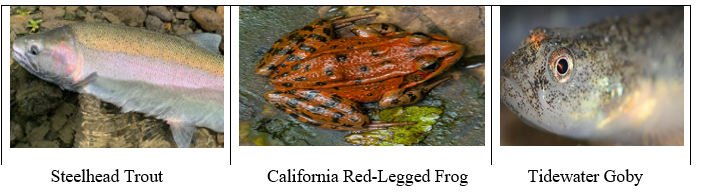
Certain environmental NGO’s claimed that San Luis Obispo County’s operation of a dam potentially harms the steelhead trout, a fish listed as threatened under the ESA. Plaintiffs sought a mandatory preliminary injunction directing changes in the dam’s water flow operation to help the trout. The county opposed, arguing that the mandated operational changes would harm the California red-legged frog and the tidewater goby, both of which live in the same habitat and are listed as endangered under the ESA. The district court granted the injunction without considering the impact on the frog and the goby. The Ninth Circuit reversed.


The appellate court noted that, in ESA cases, only the first two parts of the four-part standard for an injunction – (1) probability of success, (2) irreparable harm, (3) balance of the equities; (4) public interest – apply. This is because, in line with the famous “snail darter” case – TVA v. Hill, 437 U.S. 153 (1978) – Congress has already balanced the equities in favor of the listed species which take precedence over other competing equities “whatever the cost.” So, if there is probability of a take, then the endangered species at issue wins, regardless of how the relief impacts other interests. However, in a case like this one where the relief in favor of one listed species will affirmatively harm other listed species, the TVA rationale “collapses.” Slip op. at 19. In such a case, “[t]he exception to the traditional test, created in TVA, does not apply. The court must balance the equities and consider the public interest as to the other listed species.” Slip op. at 20.


So far so good. But how is a court supposed to do this? The district court here directed the parties to work it out with the National Marine Fisheries and U.S. Fish and Wildlife Services, but those agencies declined to get involved. So now it’s up to the district court. The guidance from the Ninth Circuit was not particularly illuminating:


Species are interconnected. Sometimes, what looks harmful to one species in the short term may benefit it, or others, in the long run. And if there is no way to reconcile the risks to multiple listed species, the equities and public interest in species conservation, to which the ESA gave precedence, do not counsel a single outcome and judgments may need to be made about the relative strength of these considerations in relation to the protected species at issue. [Slip op. at 21].


In other words, do your best. But this can get tricky. As the concurring opinion observed, it may turn out to be a “zero sum game.” Slip op. at 27. Steelheads actually eat red-legged frog tadpoles and gobies, so relief that preserves more trout means that more red-legged frogs and gobies may become trout breakfast. Moreover, the steelhead is threatened while the red-legged frog and goby are endangered. When push comes to shove on who gets to survive, does the threatened species have to give way to the endangered one? This Solomonic decision is left to the district court.
Federal Court Enjoins California Ban on Sale of Alligator and Crocodile Parts

by John M. Simpson.

On Tuesday, a federal district court in California enjoined the enforcement of Cal. Penal Code § 653o which criminalizes the sale and possession for sale of alligator and crocodile parts in California.  April in Paris v. Becerra, No. 2:19-cv-02471-KJM-CKD, consolidated with Louisiana Wildlife Fisheries Comm’n v. Becerra, No. 2:19-cv-02488-KJM-CKD (E.D. Cal. Oct. 13, 2020).  Plaintiffs, business interests importing alligator and crocodile parts into California, brought the action against the California Attorney General and the Director of the state Department of Fish and Wildlife.  The law had been slated to take effect on January 1, 2020, but had been suspended pursuant to a stipulated retraining order pending the court’s decision on the preliminary injunction motion. Continue reading “Federal Court Enjoins California Ban on Sale of Alligator and Crocodile Parts”

Animal Rights Challenge to FWS Sport Trophy Decision Fails in D.C. Circuit

by John M. Simpson.

In Center for Biological Diversity v. Bernhardt, ___ F.3d ___, No. 19-5152 (D.C. Cir. June 16, 2020), the U.S. Court of Appeals for the District of Columbia Circuit recently affirmed a district court’s rejection of a challenge by animal rights groups to a decision by the U.S. Fish & Wildlife Service (FWS) to withdraw blanket findings as to whether the importation under the Endangered Species Act (ESA) of certain sport trophies of “threatened” species taken in other countries would enhance the survival and not be detrimental to the survival of those species. Continue reading “Animal Rights Challenge to FWS Sport Trophy Decision Fails in D.C. Circuit”

Animals and Politics: Traveling Exotic Animal Ban Reintroduced

by Michelle C. Pardo

On May 21, 2019 Representatives Raul M. Grijalva (D-AZ) and David Schweikert (R-AZ) introduced the Traveling Exotic Animal and Public Safety Protection Act (TEAPSPA), a bill that would amend the federal Animal Welfare Act to prohibit the use of exotic and wild animals, including lions, tigers and elephants, in traveling performances.  The bill had previously been introduced in 2017. Continue reading “Animals and Politics: Traveling Exotic Animal Ban Reintroduced”

Wildlife Agencies Announce Proposed Endangered Species Act Regulations

by John M. Simpson

On July 19, 2018, the U.S. Fish and Wildlife Service (FWS) and National Marine Fisheries Service (NMFS) announced three proposed rulemakings that would revise the regulations pursuant to which the Services have implemented the Endangered Species Act (ESA).  These initiatives were the result of public comments solicited by the Services in response to Executive Order 13777, 82 Fed. Reg. 31576 (July 7, 2017), which sought comments on how federal agencies could improve the effectiveness and efficiency of federal regulations and the regulatory process.   Continue reading “Wildlife Agencies Announce Proposed Endangered Species Act Regulations”

© 2009- Duane Morris LLP. Duane Morris is a registered service mark of Duane Morris LLP.

The opinions expressed on this blog are those of the author and are not to be construed as legal advice.

Proudly powered by WordPress