PETA Strikes Out in Challenge to Iowa “Ag Gag” Law

By John M. Simpson.  In Iowa, it is a crime to trespass on private property.  Given recent actions by animal rights activists invading private farm land to film what is claimed to be animal mistreatment, Iowa amended the criminal trespass statute to prohibit use of a camera during a trespass.  The law was originally sustained against a facial First Amendment challenge.  Animal rights group People for the Ethical Treatment of Animals (PETA) and another organization then brought an as-applied challenge arguing that the statute violated the First Amendment if it prevented them from recording on private property that is otherwise open to the public after being asked to leave by the owner but not asked to stop recording.  The U.S. Court of Appeals for the Eighth Circuit disagreed and affirmed dismissal of the case.  People for the Ethical Treatment of Animals v. Reynolds, No. 25-1750 (8th Cir. Apr. 23, 2026).

The court assumed that a trespasser has “general rights of free speech on property privately owned and used nondiscriminatory for private purposes” – an issue that the Supreme Court has yet to decide.  Slip. op. at 8.  Even so, the challenge to the statute failed because the application of the statute at issue survived intermediate scrutiny under the First Amendment.  The law promotes a substantial government interest that would be achieved less effectively absent the statute, and it did not burden speech more than is necessary to further the interest.

The court rejected appellants’ arguments that the statute is not narrowly tailored.

First, appellants’ assertion that privacy and property rights are not furthered if the owner objects to the trespasser’s presence but not to the recording “is nonsensical.  When a property owner uses his ‘power to exclude’ by ejecting a trespasser — ‘one of the most treasured strands in [his] bundle of property rights’ — he necessarily exercises his lesser right to stop the trespasser from unlawfully recording on his property.”  Slip op. at 11.

Second, Iowa’ interests in protecting privacy and property rights are implicated even if the locations at issue are otherwise open to the public:  “[P]roperty owners forfeit neither their right to exclude nor to control their property by opening it to the public for a certain purpose.”  Slip op. at 11.

Third, the assertion that the state failed to produce evidence that “Iowa needed to proscribe all the speech covered by the statute to achieve its interests . . . lacks merit because § 727.8A is subject to intermediate rather than strict scrutiny.”  Slip op.at 12.

So in Iowa, pig farm trespassers with cameras beware.  The first offense is an aggravated misdemeanor with a fine between $855 and $8,540 and up to two years of imprisonment.  The second offense is a class D felony with a fine between $1,025 and $10,245 and up to five years of imprisonment.

Lab-Grown Meat Meets the Supremacy Clause: 11th Circuit Weighs In on Federal Pre-Emption

By John M. Simpson. Can a state state ban a product that the federal government has affirmatively approved for sale? In Upside Foods, Inc. v. Commissioner, Florida Department of Agriculture and Consumer Services, No. 24-13640 (11th Cir. Mar. 23, 2026), the Eleventh Circuit answered yes, holding that Florida’s ban on lab-grown meat is not expressly pre-empted by the federal Poultry Products Inspection Act (“PPIA”). The ruling reinforces a growing consensus among the circuits that a pure product ban is fundamentally different from a regulation of how a federally inspected facility operates, and it carries significant implications for food-technology companies, state regulators, and practitioners alike.

The Parties and Background

Upside Foods, Inc. produces lab-grown chicken by banking embryonic chicken cells, placing them in a “cultivator,” and supplying them with nutrients to form a product that, according to the company’s CEO, “looks, cooks, and tastes, like a conventional boneless, skinless chicken cutlet.” Upside has completed a pre-market consultation with the FDA and received a Grant of Inspection from the USDA’s Food Safety and Inspection Service, making it an “official establishment” subject to the PPIA and authorized to sell its product interstate commerce.

The defendants are the Commissioner of Florida’s Department of Agriculture and Consumer Services and several Florida State Attorneys. The dispute arose from Florida’s SB 1084, which makes it “unlawful for any person to manufacture for sale, sell, hold or offer for sale, or distribute cultivated meat” in the state, with criminal and civil penalties for violators. Upside challenged the law as expressly pre-empted by the PPIA and moved for a preliminary injunction.

Upside’s Pre-Emption Claims

Upside’s complaint rested on the PPIA’s two express pre-emption provisions. The “Ingredients Provision” pre-empts state laws that impose additional or different “ingredient requirements . . . with respect to articles prepared at any official establishment”. The “Facilities Provision” pre-empts state laws that impose additional or different requirements “with respect to premises, facilities and operations of any official establishment.” Upside argued that SB 1084 functioned as both an impermissible ingredient requirement and an impermissible regulation of its facilities and operations, because a ban on its product was effectively a ban on a specific production method that could force its facilities to close. After disposing of two threshold issues, the court reached the merits of the pre-emption claims and affirmed the lower court’s denial of injunctive relief.

The Facilities Provision

Writing for a unanimous panel, Judge Brasher concluded that a pure product ban like SB 1084 does not regulate the premises, facilities, or operations of any official establishment. The central distinction driving the court’s reasoning is between laws that tell a facility how to operate and laws that simply prohibit a product from being made or sold.


The court anchored the Facilities Provision’s three key terms—premises, facilities, and operations—to the physical, onsite activities of a poultry processing plant, applying the canon noscitur a sociis to prevent the broader term “operations” from expanding beyond its narrower neighbors. It further required a direct relationship between the state law and those onsite activities, noting that a looser reading would make the three terms redundant and would swallow the PPIA’s savings clause, which preserves state authority over other matters regulated under the statute. Fifth and Seventh Circuit cases reinforced this reading, upholding state horsemeat bans on the ground that prohibiting a product is not the same as regulating how a slaughterhouse operates.


The court’s distinction came into sharpest focus when it addressed National Meat Association v. Harris, 565 U.S. 452 (2012). In Harris, the pre-empted California law directed slaughterhouses to handle non-ambulatory pigs in specific ways, effectively commanding facilities to restructure their onsite operations. SB 1084 does nothing of the sort—it does not prescribe cell-harvesting methods, cultivator materials, or waste-disposal procedures, but instead categorically prohibits the end product. That difference, the court held, places SB 1084 outside the Facilities Provision’s reach.

The Ingredients Provision

The court applied the same product-ban-versus-operations-rule distinction to the Ingredients Provision. It concluded that an ingredient requirement is a rule specifying what must go into a product—not a categorical ban on the product itself. Upside had recast SB 1084 as targeting the “ingredient” of lab-grown cells, but the court found that framing inconsistent with how both ordinary usage and the PPIA itself treat ingredients, which are items like preservatives, spices, and coloring agents rather than a product’s underlying cellular composition. Other circuits again supported the holding: both the Ninth Circuit (foie gras) and the Fifth Circuit (horsemeat) have held that an outright product ban is not the kind of ingredient requirement the statute pre-empts.

Takeaways

The Eleventh Circuit’s decision in Upside Foods draws a clear line between state laws that regulate how a federally inspected facility operates—which the PPIA pre-empts—and state laws that ban a category of product outright, which it does not. For the growing cultivated-meat industry, the ruling means that federal inspection and approval do not, by themselves, guarantee market access in every state. For state legislators, the opinion provides a roadmap: a flat product ban is more likely to survive pre-emption scrutiny than a law that dictates specific production methods or facility requirements. Practitioners should watch for whether Upside seeks rehearing en banc or files a petition for certiorari.

PETA’s Monkey Speech Claim Fails

By John M. Simpson.  As we previously reported, animal rights group, People for the Ethical Treatment of Animals (PETA), sued the National Institutes of Health and Mental Health in federal court seeking to compel the defendants to install a live video feed in the defendants’ laboratories so that PETA can receive the communications of the rhesus macaques that are being used in medical research.  PETA claimed a First Amendment right “as a listener” to the live feed and a Fifth Amendment “liberty and property interest” in the same channel of communication.  The court granted the defendants’ motion to dismiss for lack of jurisdiction.  PETA v. Nat’l Inst. of Mental Health, No. 8:25-cv-00736-PX, 2026 WL 39219 (D. Md. Feb. 13, 2026).

The court lacked jurisdiction, first, because defendants had sovereign immunity.  While the Administrative Procedure Act could be the basis for waiving sovereign immunity, it could only do so if the agency action at issue was final.  The action here was not final because “the challenged agency action is neither discrete nor specific, but rather cuts to the very kind of programmatic decisions that would require reconciling needs of the experimenters with the public’s video access of the same.”  2026 WL 39210, at *3.  Nor had PETA shown that the defendants had determined PETA’s rights or obligations.  PETA could cite “neither binding nor persuasive authority” that animal communications implicate a First Amendment right as a “listener” or a Fifth Amendment “’life, liberty, or property’ interest in the asserted ‘open channel of communications.’”  Id.  at *4.  Finally, PETA failed to persuade the court that defendants were required by law to provide the access to the macaques that PETA demanded.  Id.

The court also lacked jurisdiction because PETA had no Article III standing to sue.  PETA’s claimed injury to its First Amendment right to listen “is not, as pleaded, a legally protected interest sufficient to confer standing.”  Id. at *5.  As the court observed:

Nowhere does PETA establish any authority whatsoever for the extraordinary proposition that the macaques’ sounds and movements constitute protected speech to which a companion right-to-listen exists.  Rather, PETA relies on a legion of inapposite law concentrating on the public’s right to receive human speech. . . .  But PETA gives the Court nothing that comes close to establishing a constitutional right to receive “non-human primate” sounds or behaviors.  [Id.]

The court also found PETA’s reliance on the decision in Murthy v. Missouri, 603 U.S. 43 (2024) – in which social media users challenged government censorship during COVID-19 – to be misplaced:

Like the plaintiffs in Murthy, PETA relies on a “boundless” theory of the “right to listen” to animal sounds and behavior. As in Murthy, the scope of this theory is breathtaking; it would confer standing to sue on anyone who claims interest in the sounds and movements that animals use to communicate with each other. This is the very kind of overly broad articulation of “injury” that the Murthy Court eschewed. PETA, therefore, has not pointed to any legal authority which supports a constitutionally protected interest in receiving communications from the macaques.  [Id. at *6].

Whether PETA intends to appeal this ruling remains to be seen.

PETA’s Shelter Kill Rate Is Down But Still Deadly

Animal rights group People for the Ethical Treatment of Animals (PETA) runs a facility in Norfolk, Virginia that it calls an animal shelter.  As with any other shelter operator in Virginia, PETA must submit an annual report to the Virginia Department of Agriculture and Consumer Services (VDACS) that reports on the fate of the animals that the shelter took in during the preceding year.  As we have reported over the years (e.g., here, here and here), PETA’s VDACS reports show that PETA euthanizes a substantial number of the dogs and cats that it takes in and does so at a rate that exceeds the rates of public and private shelters in Virginia.

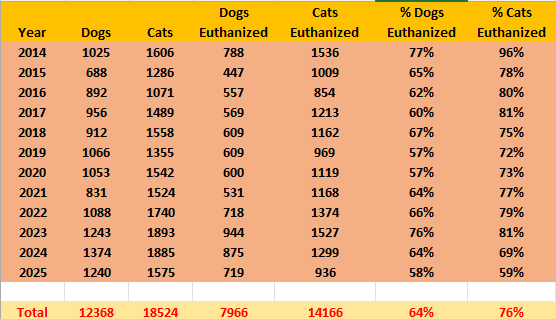
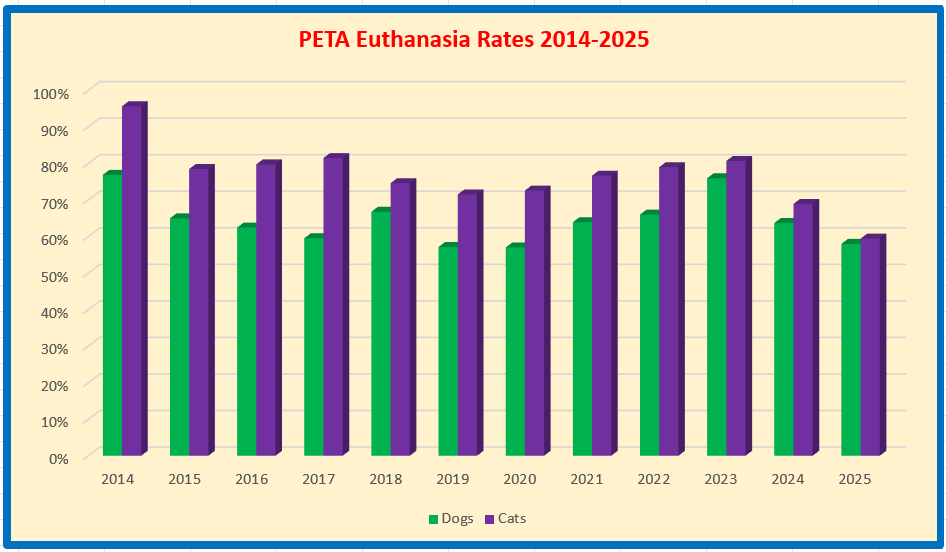
PETA’s report for 2025 continues to show this trend.  Although the kill rate was down from 2024, PETA still euthanized nearly 60% of the dogs and cats that it took in.  The table and graph below show the PETA euthanasia rate for the period 2014 through 2025:

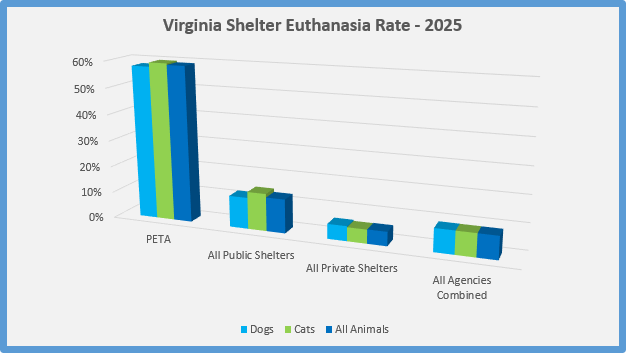
PETA’s kill rate still greatly exceeds the rate at which dogs, cats and animals in general are euthanized in public and private shelters in Virginia.  The following graph shows the results based on 2025 VDACS filings:

The results in PETA’s shelter also stand in stark contrast to the 2025 national euthanasia rate for shelters and rescues.  The Shelter Animals Count (SAC), a data collection program that was acquired by the American Society for the Prevention of Cruelty to Animals, employs a machine learning model to analyze and interpret data from animal shelters across the United States.  SAC describes itself as “a neutral, industry-wide data collection entity.”  According to SAC, in 2025, 5.8 million cats and dogs entered shelters and rescues across America.  Of that number, however, 597,000 – or about 10% — were euthanized.  Thus, PETA’s kill rate, even though modestly down in 2025, was still nearly six times more than the national average.

PETA’s VDACS filing goes on at length about its sterilization services, free dog houses and bedding and so forth, but it doesn’t address the fact that its euthanasia rate vastly exceeds that of other Virginia shelters, including public shelters, many of which are open admission.  As we have observed before, if all of the dogs and cats that PETA puts down are fatally ill or unadoptable, it would be a simple matter for PETA to say so.  The response?  Crickets.

What Happens When Endangered Species Endanger Each Other?

The U.S. Court of Appeals for the Ninth Circuit decided an interesting Endangered Species Act (ESA) case this week. San Luis Obispo Coastkeeper v. County of San Luis Obispo, No. 24-7807 (9th Cir. Dec. 3, 2025).


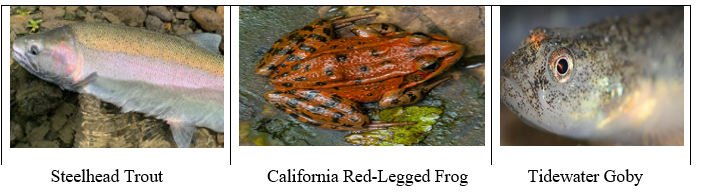
Certain environmental NGO’s claimed that San Luis Obispo County’s operation of a dam potentially harms the steelhead trout, a fish listed as threatened under the ESA. Plaintiffs sought a mandatory preliminary injunction directing changes in the dam’s water flow operation to help the trout. The county opposed, arguing that the mandated operational changes would harm the California red-legged frog and the tidewater goby, both of which live in the same habitat and are listed as endangered under the ESA. The district court granted the injunction without considering the impact on the frog and the goby. The Ninth Circuit reversed.


The appellate court noted that, in ESA cases, only the first two parts of the four-part standard for an injunction – (1) probability of success, (2) irreparable harm, (3) balance of the equities; (4) public interest – apply. This is because, in line with the famous “snail darter” case – TVA v. Hill, 437 U.S. 153 (1978) – Congress has already balanced the equities in favor of the listed species which take precedence over other competing equities “whatever the cost.” So, if there is probability of a take, then the endangered species at issue wins, regardless of how the relief impacts other interests. However, in a case like this one where the relief in favor of one listed species will affirmatively harm other listed species, the TVA rationale “collapses.” Slip op. at 19. In such a case, “[t]he exception to the traditional test, created in TVA, does not apply. The court must balance the equities and consider the public interest as to the other listed species.” Slip op. at 20.


So far so good. But how is a court supposed to do this? The district court here directed the parties to work it out with the National Marine Fisheries and U.S. Fish and Wildlife Services, but those agencies declined to get involved. So now it’s up to the district court. The guidance from the Ninth Circuit was not particularly illuminating:


Species are interconnected. Sometimes, what looks harmful to one species in the short term may benefit it, or others, in the long run. And if there is no way to reconcile the risks to multiple listed species, the equities and public interest in species conservation, to which the ESA gave precedence, do not counsel a single outcome and judgments may need to be made about the relative strength of these considerations in relation to the protected species at issue. [Slip op. at 21].


In other words, do your best. But this can get tricky. As the concurring opinion observed, it may turn out to be a “zero sum game.” Slip op. at 27. Steelheads actually eat red-legged frog tadpoles and gobies, so relief that preserves more trout means that more red-legged frogs and gobies may become trout breakfast. Moreover, the steelhead is threatened while the red-legged frog and goby are endangered. When push comes to shove on who gets to survive, does the threatened species have to give way to the endangered one? This Solomonic decision is left to the district court.

Nonhuman Rights Project Loses Another “Personhood” Case

On October 17, 2025 the Michigan Court of Appeals affirmed a trial court’s summary denial of a writ of habeas corpus brought by the Nonhuman Rights Project seeking to have seven chimpanzees released from the DeYoung Family Zoo and transferred to an animal sanctuary.    Nonhuman Rights Project, Inc. v. DeYoung Family Zoo, LLC, No. 369247 (Mich. App. Oct. 17, 2025).  Plaintiff never got out of the blocks.  The courts did not even require the zoo to show cause or file an opposition to the writ.

The appellate court noted that while the writ is protected by the state constitution, its availability is prescribed by statute.  A habeas action can be brought by any person on behalf of a prisoner, i.e., a person with a cognizable interest in personal liberty.  But neither the constitution nor the statute provides detail on who qualifies as a “person.”  The court therefore looked to the common law.  Centuries of English common law plainly established that the category of persons was confined to human beings and artificial entities such as corporations. Animals were treated as objects of property.  Slip op. at 10-11.

In this regard, the court rejected plaintiff’s “odious” analogy to the plight of women and enslaved persons:

Plaintiff’s analogies to habeas proceedings involving women or enslaved persons do not alter this landscape.  Plaintiff cites no authority suggesting that women were not “persons” at common law.  The slavery analogy cuts the other way:  The atrocity of slavery was that the law permitted persons to be treated as property.  Blackstone observed that the origins of slavery were “built upon false foundations” and that “the law of England abhors, and will not endure the existence of, slavery within this nation.”  . . .  Those episodes reflect failures to honor human personhood, not expansions of it beyond the human species.  [Slip op. at 12; citations omitted.]

As the court summed it up:

[C]himpanzees are animals, and as the common law authorities all make clear, animals – including wild animals, such as these chimpanzees – are treated as property.  No exception exists for “intelligent” animals, which in any event has no natural stopping point – “[e]ven a dog distinguishes between being stumbled over and being kicked.”

. . .

A central aspect of personhood is mankind’s capacity to “give[] up a part of his natural liberty” and oblige[] himself to conform to those laws, which the community has thought proper to establish.”  . . . Chimpanzees – and nonhuman animals generally – are incapable of making this exchange.  [Slip op. at 13; citations omitted.]

In addition to Michigan, the Nonhuman Rights Project has now lost on this same habeas corpus issue with respect to chimpanzees and elephants in the states of New York, Connecticut and California.

Feds Propose Rescinding Rule Defining “Harm” in Endangered Species Act

On April 17, 2025, the U.S. Fish and Wildlife Service (“FWS”) and the National Marine Fisheries Service (“NMFS”) published a notice of proposed rulemaking to rescind the agencies’ respective regulatory definitions of “harm” as that term appears in the statutory definition of “take” in the Endangered Species Act (“ESA”), 16 U.S.C. § 1531 et seq.  Comments on the proposed rescission are due by May 19, 2025.  See 90 Fed. Reg. 16102 (Apr. 17, 2025).

The ESA is the principal U.S. law protecting plants and animals that have been designated as likely to face extinction.  The statute therefore broadly prohibits the “taking” of an endangered species.  The statute itself defines “take” to mean “to harass, harm, pursue, hunt, shoot, wound, kill, trap, capture, or collect, or to attempt to engage in any such conduct.”  16 U.S.C. § 1532(19).  By regulation, FWS further defined the word “harm” to mean “an act which actually kills or injures wildlife.  Such an act may include significant habitat modification or degradation where it actually kills or injures wildlife by significantly impairing essential behavioral patterns, including breeding, feeding or sheltering.”  50 C.F.R. § 17.3.  NMFS issued a materially identical definition of “harm.”  50 C.F.R. § 222.102.

The Supreme Court in Babbitt v. Sweet Home Chapter, 515 U.S. 687 (1995), upheld the regulatory definition of “harm,” giving it Chevron deference.  Since Loper Bright Enterprises v. Raimondo, 603 U.S. 369 (2024), overruled Chevron, the agencies now contend that the current definitions do not constitute the “best reading” of the statutory term “harm.”  Instead, the agencies point to the dissenting opinion in Sweet Home, which interpreted “harm” in light of the traditional understanding of “take,” which is to kill or capture a wild animal.  Under this view, “take” requires an affirmative act against the species, not actions that affect the species indirectly.

The agencies recognize that Loper Bright itself stated that prior cases that relied on Chevron are still subject to statutory stare decisis.  However

under the then prevailing Chevron framework, Sweet Home held only that the existing regulation is a permissible reading of the ESA, not the only possible such reading.  Our rescission of the regulation definition on the ground that it does not reflect the best reading of the statutory text thus would not only effectuate the Executive Branch’s obligation to “take Care that the Laws be faithfully executed,” but would also be fully consistent with Sweet Home.

90 Fed. Reg. at 16103

The rescission of the regulatory definition of “harm” seems geared to address scenarios in which, for example, a construction project does not directly kill or injure a species but modifies the species’ habitat and thereby forces it to vacate the area. 

The rulemaking presents several issues worth considering.

First, on the substance, while the agencies propose to rescind the definition of “harm,” they do not propose rescinding the regulatory definition of “harass.”  “Harass” is defined in part to mean “annoying [the species] to such an extent as to significantly disrupt normal behavioral patterns which include, but are not limited to, breeding, feeding, or sheltering.”  50 C. F. R. § 17.3. (NMFS has no parallel definition of “harass.”)  It would seem that most actions that amount to “harm” on the basis of habitat degradation would also constitute “harassment.”

Second, the rulemaking probably has no impact on endangered species maintained in a captive environment.  Even if the “harm” definition is rescinded, the “harass” definition remains and, as it applies to captive wildlife, “harass” has been consistently defined by FWS to exclude “animal husbandry practices that meet or exceed the minimum standards for facilities and care under the Animal Welfare Act.”  50 C.F.R. § 17.3.  That is, while a captive endangered species cannot be lawfully “harassed” under the ESA, there is no such harassment if the endangered species is held under conditions that comply with the Animal Welfare Act (“AWA”). However, since “harm” was not defined with a link to the AWA, the deletion of the “harm” definition would eliminate the potential ambiguity that a captive species can be “harmed” even if the actions at issue are AWA-compliant.

Third, the rulemaking will likely test the contours of the Loper Bright pronouncement on statutory stare decisisSweet Home was a Chevron-based case, but the agencies seem to be taking the position that statutory stare decisis will not control the outcome because their actions are required by the Executive Branch’s constitutional duty to take care that the laws be faithfully executed.  90 Fed. Reg. at 16103 (citing U.S. Const. art. II, § 3).

D.C. Circuit:  Machine Using AI to Create Artwork Cannot Own a Copyright in the Artwork

On March 18, 2025, the U.S. Court of Appeals for the D.C. Circuit affirmed a district court ruling that a work created with artificial intelligence (AI) using a machine cannot be registered in the name of the machine itself because the Copyright Act requires that a copyright owner be a human being.  Thaler v. Perlmutter, No. 23-5233 (D.C. Cir. Mar. 18, 2025).

The plaintiff had created a picture entitled “A Recent Entrance to Paradise” with a machine called the “Creativity Machine” that generated the artwork using AI.   The plaintiff applied for copyright protection, listing the machine as the author and the plaintiff as the owner.  Plaintiff argued (1) that, under the Copyright Act, an “author” need not be a human being but can be a machine; and (2) that plaintiff could be the owner of the work under the work-for-hire doctrine because non-humans such as corporations can be authors under this doctrine.  As did the Copyright Office and the district court, the appellate court rejected both arguments.

As to the first point, the court noted that, while the Copyright Act does not define “author,” the statute’s use of that term is incompatible with a machine being an author.  This is because, under the Copyright Act an “author”

  • must have the legal capacity to own property;
  • must have a lifespan since copyrights generally last for the author’s life plus 70 years;
  • must have surviving spouses or children under the statute’s inheritance provision;
  • must have a signature;
  • must have a nationality or domicile;
  • must have intentions since authors of joint works intend that the contributions be merged together.

[Slip op. at 11-12.]  Machines can do none of these things.  Furthermore, the Copyright Act at several places discusses machines and makes it clear that machines are tools not authors.

As to plaintiff’s work-made-for-hire argument, the court observed that that provision “allows the copyright and authorship protections attaching to a work originally created by a human author to transfer instantaneously, as a matter of law, to the person who hired the creator.”  [Slip op. at 17.]  The fact remains that the author of the work for hire must still be a human being.

While the plaintiff also argued that he should be considered the “author” of the work because he made and used the Creativity Machine, the court deemed this argument waived because it was not made to the Copyright Office.  [Slip op. at 23.]

So, one might ask, what does this case have to do with animal law?  Well, the Thaler case illustrates the arguments made by litigants seeking to get courts to convey to animals or other non-humans rights and privileges conventionally held only by human beings.  One such argument in Thaler was the plaintiff’s point that the dictionary defined “author” as “one that originates or creates something” and therefore was not limited to human beings.  However, as the court observed:

[S]tatutory construction requires more than just finding a sympathetic dictionary definition.  We “do not read statutes in little bites,” or words in isolation from their statutory context.  Kircher v. Putnam Funds Tr., 547 U.S. 633, 643 (2006). The judicial task when interpreting statutory language, instead, is to discern how Congress used a word in the law.   

[Slip op. at 16.]

In fact, the D.C. Circuit made a specific connection to animal law by citing the decision in Naruto v. Slater, 888 F.3d 418 (9th Cir. 2018), in which the Ninth Circuit held that a monkey cannot be an “author” under the Copyright Act.  And, like Thaler, animal rights groups have tried to base their arguments on dictionary definitions.  See, e.g., Animal Leg. Def. Fund v. U.S. Dep’t of Agriculture, 933 F.3d 1088, 1094 (9th Cir. 2019) (the term “individual” in the Freedom of Information Act cannot reasonably be interpreted to include a Bengal tiger).

As AI continues to develop and grow more robust, stayed tuned for more novel arguments in this space.

PETA Claims First Amendment Right to Communicate with Monkeys

The Beach Boys wrote a song called “Pet Sounds.”  In a recently filed federal lawsuit, animal rights organization People for the Ethical Treatment Animals (“PETA”) claims that it has a First Amendment right to receive monkey sounds (as well as monkey movements).

The lawsuit, filed on March 6, 2025 in the U.S. District Court for the District of Maryland, is entitled People for the Ethical Treatment of Animals v. National Institute of Mental Health, et al., No. 8:25-cv-00736-PX.  The case centers on research done in an NIMH laboratory that utilizes the Rhesus Macaque.  According to the Tulane University National Primate Research Center, Rhesus Macaques are placed within the Cercopithecidae family (Old World Monkeys),  So, for simplicity, we’ll refer to them as monkeys.

The gravamen of the lawsuit is that the federal defendants turned down PETA’s request for a live-stream audiovisual feed of the monkeys in the laboratory.  PETA claims that the monkeys are “willing speakers” who “regularly communicat[e]” about their physical and psychological condition.  According to PETA’s complaint, experts in monkey communication claim the ability to understand the information that the animal sounds, body posture, facial expression and other actions purportedly convey.  PETA claims that denying it the ability to communicate with “fellow primates” violates PETA’s First Amendment rights, and PETA therefore wants the court to permanently enjoin the defendants from “withholding from PETA … access to the rhesus macaques’ communications.”

PETA’s track record in opposing animal-based medical and mental health research is well-known.  Thus, most of the complaint is devoted to describing the research that is performed, the conditions of the laboratory and in making PETA’s overall case for the abolition of animal-based research.  However, the First Amendment predicate for the case is extremely thin, if not nonexistent.  PETA cites a number of cases to the effect that there is a First Amendment right to receive information even though the speaker may not, itself, have a First Amendment right.  But PETA cites no case (and we are aware of none) holding that the sounds and body gestures of a monkey constitute speech that is protected under the First Amendment – whether it concerns the speaker’s right to speak or the listener’s right to receive.

PETA’s complaint also pleads a denial of due process under the Fifth Amendment but is very vague on what “property” or “liberty” interest of PETA was allegedly violated.

This isn’t the first time that PETA and other animal rights groups have sought attention by trying to get a court to confer human rights on an animal, but very few of these efforts has succeeded.   Thus, killer whales are not subject to the Thirteenth Amendment, elephants are not covered by the writ of habeas corpus, a Bengal tiger can’t pursue a Freedom of Information Act request, humans don’t have “next friend” standing to pursue a copyright claim on behalf of a monkey or a bill of attainder claim on behalf of a barn owl, and dogs, birds and dugongs don’t have standing in federal court to sue.  PETA’s current effort to have a federal court declare monkey speech protected by the First Amendment would clearly seem to be headed for a similar fate. Indeed, the U.S. Court of Appeals for the Eleventh Circuit rejected an effort to invoke the First Amendment on behalf of “Blackie the Talking Cat,” an animal that allegedly “spoke, for a fee, on radio and on television shows such as ‘That’s Incredible.’” Miles v. City Council of Augusta, Ga., 710 F.2d 1542, 1543 (11th Cir. 1983) (per curiam).  Affirming dismissal of the First Amendment claim, the court ruled that it “will not hear a claim that Blackie’s right to free speech has been infringed. . . . [A]lthough Blackie arguably possesses a very unusual ability, he cannot be considered a ‘person’ and is therefore not protected by the Bill of Rights.” Id. at 1544 n.5. 

U.S. Supreme Court Limits “Prevailing Party” Status for Attorney’s Fee Recovery by Plaintiffs

The U.S. Supreme Court’s recent opinion in Lackey v. Stinnie, No. 23-621 (U.S. Feb. 25, 2025), clarified for plaintiffs what it means to be a “prevailing party” for recovery of attorney’s fees.  While the case arose under the attorney’s fee provision for civil rights cases – 42 U.S.C. § 1988(b) – the holding has broader implications for federal court litigation, particularly where the only relief sought by the plaintiff is injunctive relief.

The case was a civil rights challenge by Virginia automobile drivers pursuant to 42 U.S.C. § 1983, claiming that they were denied due process by a Virginia statute that required suspension of their drivers’ licenses without sufficient notice or hearing for failure to pay parking tickets and the like, with the suspension lasting until the fine was paid or a payment plan established.  The district court granted a preliminary injunction, finding that plaintiffs were likely to prevail on their constitutional claim.  Before the case could be tried, the state legislature repealed the statute at issue, and the parties, agreeing that the case was moot, stipulated to dismissal.  Plaintiffs then sought recovery of their attorney’s fees under section 1988(b), which permits an attorney’s fee award to a “prevailing party,” inter alia, in a section 1983 case.  Plaintiffs argued that, by obtaining a preliminary injunction that, in all likelihood, led to the repeal of the statute, they were “prevailing parties.”  The Fourth Circuit, sitting en banc, agreed with plaintiffs, but the Supreme Court, in an opinion by Chief Justice Roberts, reversed.

Relying on a legal dictionary definition of “prevailing party” contemporaneous with the enactment of section 1988(b) – a party who successfully prosecutes the action – the Court  reasoned that, because a preliminary injunction is based only on a likelihood of success on the merits, the plaintiff who obtains such relief has not “prevailed:”

Because preliminary injunctions do not conclusively resolve the rights of parties on the merits, they do not confer prevailing party status.  A plaintiff who secures a preliminary injunction has achieved only temporary success at an intermediary “stage[ ] of the suit.”  Black’s Law dictionary 1352.  It cannot yet be said that he will “ultimately prevail[] when the matter is finally set at rest” or that he will have “successfully maintained” his claim “at the end.” Ibid.  And external events that render a dispute moot do not convert a temporary order designed to preserve the status of the parties into a conclusive adjudication of their rights.  [Slip op. at 7.]

According to the Court, its ruling “serves the interests of judicial economy.  A straightforward, bright-line rule is easy to administer, reducing the risk of a ‘second major litigation’ over attorney’s fees.”  [Slip op. at 10].  In this regard, the Court dismissed the plaintiffs’ concern that  a defendant could “strategically moot” a case and avoid an award of attorneys’ fees if it feared ultimately losing the case. The Court noted that plaintiffs with damage claims would not face that threat and, even in cases seeking only injunctive relief, the case does not become moot if the challenged conduct is capable of repetition yet evading review.  [Slip op. at 10].  At bottom, it is up to Congress to decide whether attorney’s fees should be awarded to plaintiffs who achieve some success but do not prevail – as is the case with Freedom of Information Act claims where plaintiffs can seek legal fees if they “substantially prevail[].”  Id. at 11 (citing 5 U.S.C. § 552(a)(4)). 

The Court did, however, limit its ruling to prevailing plaintiffs:

Our decision today should not be read to affect our previous holding that a defendant need not obtain a favorable judgment on the merits to prevail, nor to address the question we left open whether a defendant must obtain a preclusive judgment in order to prevail.  See CRST Van Expedited, Inc. v. EEOC, 578 U.S. 419, 431-434 (2016).  As we have explained, “[p]laintiffs and defendants come to court with different objectives.”  Id., at 431.  [Slip op. at 9 n.*].

The decision in Lackey is likely to have implications beyond section 1988(b).  Several federal statutes award legal fees to “prevailing parties.”  In some regulatory cases, the preliminary injunction is in fact the main event of the case.  For example, animal rights activists often file lawsuits under the National Environmental Policy Act or the Endangered Species Act, seeking to enjoin individual transactions or other activities by businesses who use animals for various purposes.  The granting of a preliminary injunction, even though it is not a final determination of the merits of the case, could spell the end of the defendant’s project, either because the opportunity for the transaction has come and gone or the defendant does not have the resources to further litigate the case.  Yet, in such circumstances, the plaintiff would not be entitled to seek attorney’s fees under the rationale of the Lackey case.

Whether Lackey has the result of cutting down on litigation by plaintiffs in in the regulatory sphere remains to be seen. However, that is what the dissenting opinion by Justice Jackson predicts. She points to research on the effect of the Court’s rejection of the “catalyst theory” in Buckhannon Bd. & Care Home, Inc. v. West Va. Dep’t of Health & Hum. Resources, 532 U.S. 598 (2001), i.e., the theory that a plaintiff “prevails” if its suit was the catalyst for the defendant’s change in conduct. According to the dissent, Buckhannon “had the predictable practical effect of discouraging public interest organizations and private attorneys from taking on civil rights actions.” [Dissenting op. at 18].

© 2009- Duane Morris LLP. Duane Morris is a registered service mark of Duane Morris LLP.

The opinions expressed on this blog are those of the author and are not to be construed as legal advice.

Proudly powered by WordPress