
Duane Morris partners Brian Pandya and Seth Rokosky represented the National Association of Manufacturers in its amicus brief encouraging the Federal Circuit to undo a lower court’s ruling that Moderna, and not the government, must face a multibillion-dollar patent infringement suit over its COVID-19 vaccine. The brief warned that if contractors can’t rely on the government when it commits to bearing the liability of patent infringement suits, it would undermine the government’s ability to procure manufactured goods that are vitally important for responding to national crises and for keeping the daily operations of government running. Read the amicus brief here.
Duane Morris Appellate Lawyers Recognized by Chambers USA
We are pleased to announce that three Duane Morris Appellate division lawyers have been recognized by Chambers USA.
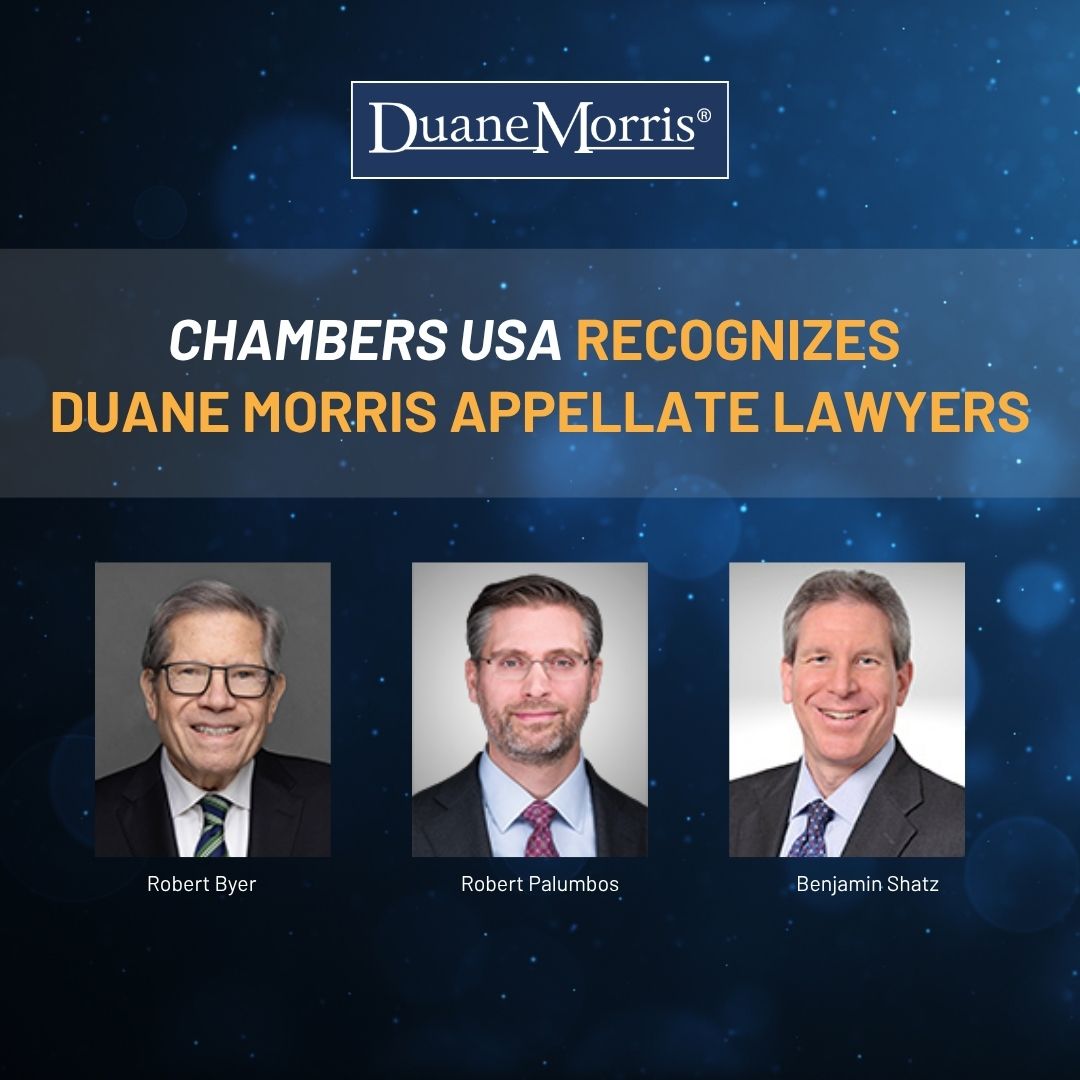
Here’s what clients are saying about our appellate lawyers:
- “[Rob Byer’s] ability to synthesize complex issues into short, concise arguments, and his natural talents for the back and forth of an appellate proceeding are nothing short of amazing.”
- “Robert Palumbos is in the upper echelon of appellate lawyers. He is very intellectual and he has a complex practice.”
- “Benjamin Shatz is one of the best qualified appellate lawyers with whom I have had the pleasure of working.”
Los Angeles Lawyers
Benjamin Shatz: Litigation Appellate
Pittsburgh Lawyers
Robert L. Byer: Litigation: Appellate
Philadelphia Lawyers
Robert M. Palumbos: Litigation: Appellate
Avoiding Pitfalls: Jurisdictional Considerations for Appeals
By Thomas R. Newman and Steven J. Ahmuty, Jr.
The article explains that in New York, only “aggrieved” parties can appeal from proper, written orders or judgments within 30 days. Appeals must follow strict timing and procedural rules; missing deadlines usually results in dismissal. Courts can excuse minor errors, but proper filing and notice are crucial to keep the right to appeal.
Read the full article from the New York Law Journal on the Duane Morris LLP website.
¡Ay, yai, AI! Another Horror Story
When is a 60-day deadline only 20 days?

If you google “How long to appeal arbitration order in California,” the AI Overview response looks something like this: “For court orders denying a petition to compel arbitration, you typically have 20 days to file a notice of appeal.” Using a more grammatical phrasing, if you google “How long does one have to appeal an arbitration order in California,” the result again is something like this: “Key deadlines for arbitration appeals in California: Denial of Motion to Compel Arbitration: 20 days to appeal an order dismissing or denying a petition to compel arbitration.” Similarly, googling “How long does one have to appeal an order denying arbitration order in California,” the AI Overview answer looks something like this: “In California, a notice of appeal regarding an order denying a petition to compel arbitration must typically be filed within 20 days after the superior court clerk or a party serves a ‘Notice of Entry’ of the order or a file-endorsed copy of the order.” (Note that googling these various queries, even verbatim, often returns slightly different phrasings.)
Read the full version of this month’s “Exceptionally Appealing” column from Partner Benjamin G. Shatz at the Daily Journal.
Seth Rokosky: Career Decisions, Appellate Law, and Why Having a Plan Matters
In this episode of the SideBar Advisors podcast, Duane Morris Partner, Seth Rokosky, shares how legal paths actually unfolded in real life—through a series of decisions, tradeoffs, and adjustments. Seth provides insight on his approach to career decisions, what it really takes to build a niche practice from the ground up, and how his background in competitive chess influences the way he thinks about strategy, risk, and decision-making.
Listen to the full episode on Apple Podcasts.
2025 Annual Report of Clerk of the Court of Appeals
We had expected, in keeping with Chief Judge Wilson’s expressed hope in the 2023 Annual Report, that the court would continue to decide more appeals each year until eventually arriving at the over 200 yearly average total dispositions during the 22-year tenure of Chief Judges Kaye and Lippman. But that did not happen. The court decided only 119 appeals (79 civil and 40 criminal), down one from the 120 decided in 2024. We hope the court will increase its caseload this year.
Of the 79 civil appeals decided by the Court in 2025, the jurisdictional predicate for 39 (49%) was permission of the Court of Appeals, 18 (23%) permission of the Appellate Division, 14 (18%) dissents in the Appellate Division, and in 4 (0.5%) a constitutional question was involved. Appx. 4. Stipulations for judgment absolute under CPLR 5601(c) continue to be zero; a wise decision.
Read the full article from the New York Law Journal on the Duane Morris LLP website.
This article was co-authored with Steven J. Ahmuty, Jr.
Appellate Meditation: ‘Aum,’ not ‘Um’
Appellate mediation is widespread and has been a hot topic for ages now. Alternative dispute resolution, or ADR, providers expressly tout their appellate mediation programs (e.g., ADR Services, JAMS). Most California Court of Appeal districts have formal mediation programs: e.g., the 2nd District’s Mediation Program, the 3rd District’s Mediation Program, the 4th District’s Civil Mediation Program, the 5th District’s Mediation Program, and the 6th District’s Mediation Program. So do many federal Courts of Appeals. The 9th Circuit’s Mediation Program has been around for over 30 years and currently has a team of seven Circuit Mediators. Bucking the ubiquitous banal naming convention, the 2nd Circuit may send you to CAMP (its Civil Appeals Mediation Program). The ABA even published a 366-page treatise “Appellate Mediation: A Guidebook for Attorneys and Mediators” (ABA 2016) by California’s own Brendon Ishikawa and Dana Curtis (a former 9th Circuit Mediator). Yes, so very much can and has been said about appellate mediation. But what about appellate meditation?
Read the full version of this month’s “Exceptionally Appealing” column from Partner Benjamin G. Shatz at the Daily Journal.
Duane Morris Partner Benjamin Shatz Named President of the California Academy of Appellate Lawyers

Benjamin Shatz, a partner in the firm’s Los Angeles office, has been named as the next president of the California Academy of Appellate Lawyers.
The California Academy of Appellate Lawyers is the nation’s oldest lawyers’ organization dedicated to appellate practice. Its members are California lawyers with substantial appellate experience, who are elected to membership after rigorous scrutiny of their reputation, character and appellate advocacy skills.
Brian Slipakoff Presents at PBI’s 2026 Annual Environmental Law Forum on Universal Injunctions.
Duane Morris Special Counsel Brian J. Slipakoff presented at the Pennsylvania Bar Institute’s 2026 Annual Environmental Law Forum on April 23, 2026 in Harrisburg, Pennsylvania. Mr. Slipakoff and his co-presenter, Joshua Ash of the University of Pittsburgh Law School, had a lively discussion about the evolution of “universal” injunctions, their recent elimination by the United States Supreme Court and ways forward to achieve broad-based injunctive relief in the environmental legal space in the years to come.
Duane Morris Appellate Practice Named Finalist for Litigation Department of the Year – Specialty Practice by The Legal Intelligencer

The awards recognize the top specialty litigation departments, their record of success and impactful work in 2025. Read more about Duane Morris’ Appellate Practice and the award on the Duane Morris LLP website.