
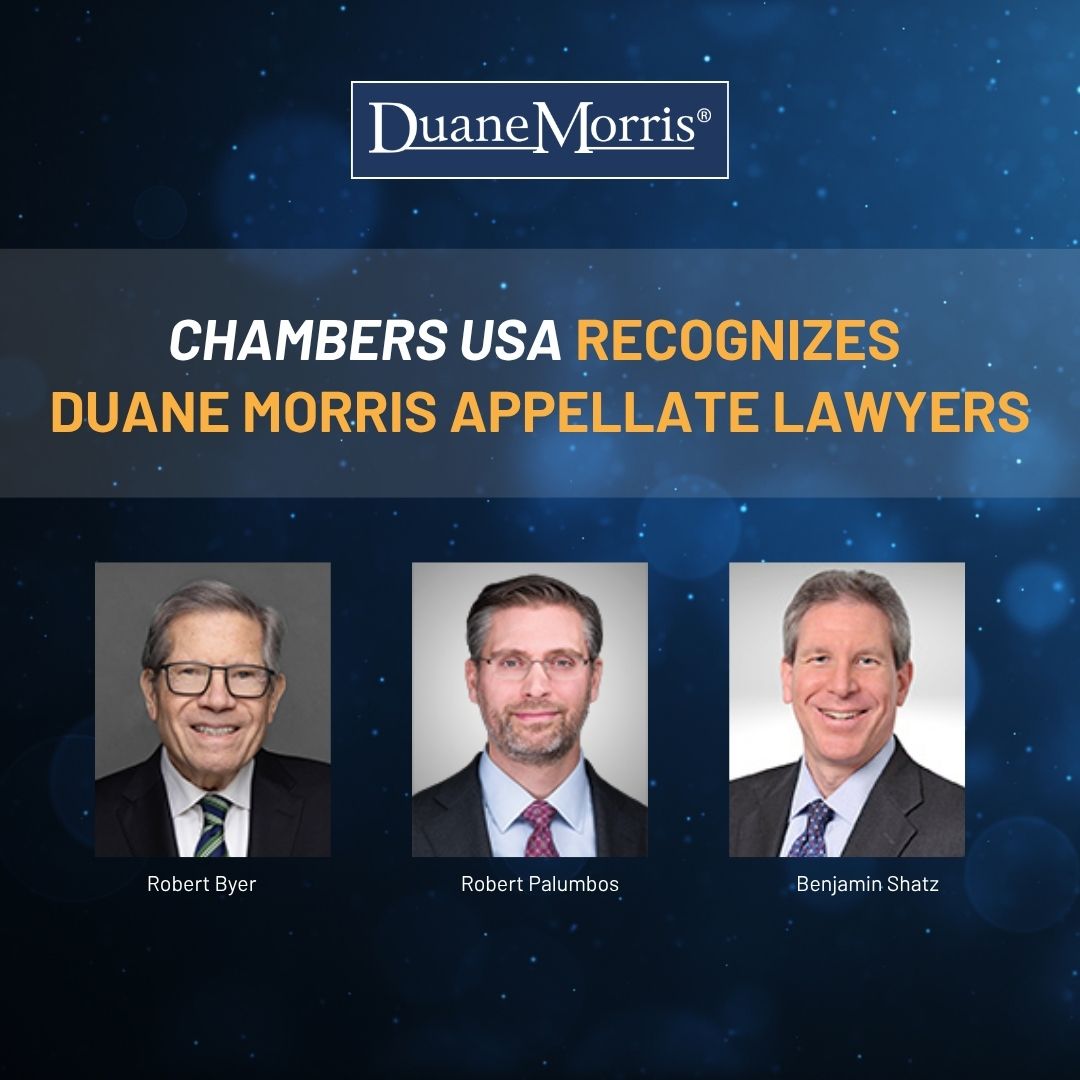
The awards recognize the top specialty litigation departments, their record of success and impactful work in 2025. Read more about Duane Morris’ Appellate Practice and the award on the Duane Morris LLP website.

The awards recognize the top specialty litigation departments, their record of success and impactful work in 2025. Read more about Duane Morris’ Appellate Practice and the award on the Duane Morris LLP website.
Sometimes the strongest litigation strategy is staying silent—strategically choosing not to respond to weak, irrelevant, or low-impact arguments can conserve client resources, preserve credibility, and let lawyers exercise independent judgment without undermining the case.
Read the full version of this month’s “Exceptionally Appealing” column from Partner Benjamin G. Shatz at the Daily Journal.
In a New York Law Journal article, Thomas R. Newman & Steven J. Ahmuty, Jr. , explain that only “aggrieved” parties—those harmed or denied relief—can appeal court decisions under CPLR 5511. Courts can assess aggrievement on their own, and simply disagreeing with a ruling isn’t enough. There are exceptions, like non-parties with affected interests or appeals on alternative grounds. Understanding these rules is crucial for proper appellate standing. Read the full article.
By Robert M. Palumbos, Paul P. Josephson, Christopher H. Casey, Andrew R. Sperl and Justin G. Mignogna
In a February 26, 2026, notice, the Supreme Court of New Jersey announced sweeping amendments to the court rules governing briefing before the court. The new framework provides for merits briefing in all appeals taken on or after February 10, 2026. These changes represent the most significant overhaul of the court’s briefing procedures in years and carry important implications for appellate practitioners, amicus participants and anyone following the court’s docket.
Duane Morris partner Robert L. Byer has been recognized by Best Lawyers® as the “2024 Appellate Lawyer of the Year” in Pittsburgh, Pennsylvania. The recognition is given to only one attorney for each practice area and city. Lawyers are selected based on high marks received during peer-review assessments conducted by Best Lawyers each year. He also received this distinction in 2020, 2016 and 2011.
In 1991, the Pennsylvania Supreme Court created a bright-line rule barring certain types of legal malpractice claims. Specifically, if a client settled a lawsuit but ultimately was unhappy with the settlement, the client could only sue her lawyers for legal malpractice if the lawyers fraudulently induced her to settle. See Muhammad v. Strassburger, McKenna, Messer, Shilobod, & Gutnick, 587 A.2d 1346, 1358 (Pa. 1991). In such situations, claims based on negligence or breach of contract would not be cognizable. Id.
This bright-line rule has slowly eroded over the years. In Collas v. Garnick, 624 A.2d 117 (Pa. Super. 1993), for example, the Superior Court held that Muhammad did not bar claims based on inaccurate legal advice related to a settlement agreement. In that case, a lawyer advised that certain language in a settlement agreement would not affect the client’s ability to sue other potentially liable parties, but that advice turned out to be wrong. Id. at 119. After the plaintiff’s second lawsuit was dismissed based on the release she signed when settling the first lawsuit, the plaintiff sued her lawyer. Id. The trial court held that the plaintiff’s claims were barred by Muhammad, but the Superior Court reversed. The Superior Court noted that Muhammad dealt with clients who were dissatisfied with the amount of the settlement, whereas the clients in Collas were complaining that they were misinformed as to the effect of the settlement. Id. at 121. The Superior Court held that, in such circumstances, lawyers could be liable for malpractice if they failed to exercise the necessary degree of care. Id.
The Superior Court has since clarified when Muhammad bars legal malpractice claims arising from a settlement agreement and when it does not:
[If] a dissatisfied litigant merely wishes to second guess his or her decision to settle due to speculation that he or she may have been able to secure a larger amount of money, i.e.[,] “get a better deal[,]” the Muhammad rule applies so as to bar that litigant from suing his counsel for negligence. If, however, a settlement agreement is legally deficient or if an attorney fails to explain the effect of a legal document, the client may seek redress from counsel by filing a malpractice action sounding in negligence.
Banks v. Jerome Taylor & Assocs., 700 A.2d 1329, 1332 (Pa. Super. 1997).
The Supreme Court will now consider doing away with Muhammad altogether as part of its review of the Superior Court’s decision in Khalil v. Williams, 244 A.3d 830 (Pa. Super. 2021), allocatur granted 53 EAL 2021 (Pa. Aug. 3, 2021). In Khalil, the plaintiff claimed that she only signed the settlement agreement in question after asking her lawyers to add language making clear that her claims in a related lawsuit would not be affected. Khalil, 244 A.3d at 840-41. After the plaintiff signed the revised release, her counsel allegedly doctored the signed release to remove any limiting language. Id. Her claims thus sounded in fraud and were not barred by Muhammad. Id. Yet, the plaintiff also alleged legal malpractice claims based on negligence and breach of contract. While the plaintiff claimed on appeal that she pleaded facts alleging that her counsel gave incorrect advice about the legal effect of the settlement agreement in the alternative, the Superior Court disagreed. Id. The Superior Court found that the only allegations in the complaint supported the fraud claim, not any claims sounding in negligence or breach of contract. Id. at 841. The Superior Court thus affirmed the dismissal of those claims.
The Supreme Court has now agreed to consider two issues on appeal—whether the plaintiff sufficiently pleaded negligence or breach of contract and, if so, whether Muhammad continues to be valid. Depending on the Court’s outcome and reasoning, Khalil could prove to be very important for understanding both the pleading rules for legal malpractice claims in Pennsylvania, as well as the potential liability for lawyers when advising their clients to accept a settlement offer.
On August 24, Duane Morris partner Rob Palumbos will present a CLE webinar at the Pennsylvania Defense Institute about developments in the forum non conveniens doctrine in Pennsylvania. Over the last several years, the Pennsylvania Superior Court has been extremely active on this issue, issuing approximately two dozen new precedential decisions. For more information or to register, please visit the Pennsylvania Defense Institute’s website.
On December 1, 2021, several welcome amendments to Rule 3 of the Federal Rules of Appellate Procedure will take effect (barring highly unlikely Congressional action). These changes clarify and simplify the requirements for notices of appeal.
First, the amendments make clear that a notice of appeal encompasses all interlocutory orders that merge into the designated judgment or appealable order. Appellants need not specifically designate such interlocutory orders in the notice.
Those provisions eliminate a waiver trap that some courts had created by holding that an appellant’s designation of certain interlocutory orders in the notice of appeal excluded review of undesignated orders. The amendments provide that designations of specific orders will not limit the scope of the notice of appeal without an express statement that the notice is so limited.
Second, the amendments make clear that a notice encompasses the final judgment when it identifies a final order that resolves all remaining claims or an order that resolves a post-judgment motion. That change removes waiver traps that had developed based on Rule 3’s prior requirement that a notice designate the “judgment.”
Some courts had held that where an appellant described a final order as an “order” rather than a “judgment,” the notice was limited to that order, excluding review of interlocutory orders that merged into the judgment. Likewise, some courts treated a notice of appeal that designated only an order disposing of a post-judgment motion as limited to that order, excluding review of the judgment itself. The amendments eliminate both traps.
While the amendments reflect the law that already governed in many jurisdictions, they are still a welcome change. The amendments eliminate ambiguity that had caused problems in certain jurisdictions and provide clarity for practitioners.
The Supreme Court heard argument in the second iteration of Henry Schein, Inc. v. Archer & White Sales, Inc., Case No. 19-963, (Henry Schein II) on December 8, 2020, which was broadcast live on CSPAN and is available here. During the course of the argument and questioning, the Court made clear that it was only considering a narrow question: Assume that the contract generally says that an arbitrator decides if a particular dispute must be arbitrated, rather than be litigated in a court. Also assume that the contract says claims for injunctive relief are not subject to arbitration. The parties to the contract have a dispute, and they disagree on whether the dispute seeks injunctive relief. Who decides this threshold dispute—an arbitrator or a court? (For more background on this case, see our pre-argument discussion on the issues presented.)
The question presented to the Court in Henry Schein II seems to be one of pure contract interpretation, which makes it an odd choice for the Court to hear. The Court is ostensibly deciding whether the carve-out for injunctive relief claims in this contract limits just the scope of arbitration or also limits the scope of the contract’s delegation to the arbitrator to decide the threshold issues of arbitrability. Yet, the oral argument revealed a few themes that indicate some of the broader implications of this litigation.
Continue reading “Henry Schein, Inc., II: Post-Argument Analysis”
Arbitrability—or who decides what claims are subject to arbitration—is returning to the Supreme Court next week for the second time in as many years. The first time the matter reached the Court, the Supreme Court unanimously held that, where a contract clearly and unmistakably delegates questions of arbitrability to an arbitrator, a court cannot decide the issue in the first instance, even if the court thinks the argument for arbitration is “wholly groundless.” Henry Schein, Inc. v. Archer & White Sales, Inc., 139 S. Ct. 524 (2019).
The issue has now returned to the Supreme Court following remand and a new decision by the Fifth Circuit. Archer & White Sales, Inc. v. Henry Schein, Inc., 935 F.3d 274 (5th Cir. 2019). On December 8, 2020, the Court will hear the case again, this time to decide “[w]hether a provision in an arbitration agreement that exempts certain claims from arbitration negates an otherwise clear and unmistakable delegation of questions of arbitrability to an arbitrator.”