
Duane Morris Partner Joseph Cox and Special Counsel Jason Boatright co-authored the article “The Path to an Appealable Final Judgment” for the Dallas Bar Association Headnotes.
Appellate Trial Support: Accelerating Growth or ‘New Normal’ for Defense Teams?
Duane Morris Partner Leah Mintz was quoted in The Legal Intelligencer article “Appellate Trial Support: Accelerating Growth or ‘New Normal’ for Defense Teams?” to discuss the growing role of appellate attorneys during the trial stage of litigation.
“I think that trend has definitely continued and continued to accelerate. We have not seen a leveling off of interest, at least in our practice,” Mintz said, noting that they have seen “more and more clients coming to us for this type of work as they get close to trial.”
Read the full article on The Legal Intelligencer’s website (subscription required).
From the Mailbag – Feedback Tidbits Prompted by Past Columns
Please read “From the Mailbag – Feedback Tidbits Prompted by Past Columns,” the latest “Exceptionally Appealing” column by Duane Morris partner Benjamin Shatz in the Daily Journal.
Mulling Modifications
Please read “Mulling Modifications,” the latest “Exceptionally Appealing” column by Duane Morris partner Benjamin Shatz and associate Sylvia (Yoo Jin) Cheong in the Daily Journal.
Pennsylvania Supreme Court to Review Issues Regarding Vicarious Liability and Increased Risk of Harm in Upcoming Appeal
By Sharon L. Caffrey, Robert M. Palumbos, Anne A. Gruner and J.J. Larkins
On July 29, 2026, the Pennsylvania Supreme Court granted allocatur to review Hagans v. Hospital of the University of Pennsylvania, in which the Superior Court affirmed a $182.7 million jury award that, accounting for delay damages, produced a judgment exceeding $207 million. The court will decide whether vicarious liability may be imposed on a hospital without an express jury finding against a specific named agent, and whether the jury may find liability based on either factual causation or increased risk of harm, resolving a direct conflict between Superior Court panels on this important causation question.
Read the full Alert on the Duane Morris LLP website.
Pennsylvania Superior Court Narrowly Interprets “Non-Negligent Failure” Exception for Untimely Appeals
The risk of missing a filing deadline is a major—if not the principal—source of anxiety among legal professionals. That concern is well-founded: an honest miscalculation, miscommunication, or unexpected emergency resulting in a late filing can have disastrous consequences, particularly at the appellate level. While a judicial reprieve for a late-filed appeal is theoretically possible under Pennsylvania law, the Superior Court recently issued a stark reminder that, absent fraud or an administrative breakdown, permission to appeal nunc pro tunc will be granted only in the most extraordinary circumstances.
Read the full article from The Legal Intelligencer on the Duane Morris LLP website.
Amicus Brief Drafted for NAM in Support of Reversing Ruling that Moderna, Rather than the Government, Must Face a Multibillion-Dollar Patent Infringement Suit
Duane Morris partners Brian Pandya and Seth Rokosky represented the National Association of Manufacturers in its amicus brief encouraging the Federal Circuit to undo a lower court’s ruling that Moderna, and not the government, must face a multibillion-dollar patent infringement suit over its COVID-19 vaccine. The brief warned that if contractors can’t rely on the government when it commits to bearing the liability of patent infringement suits, it would undermine the government’s ability to procure manufactured goods that are vitally important for responding to national crises and for keeping the daily operations of government running. Read the amicus brief here.
Duane Morris Appellate Lawyers Recognized by Chambers USA
We are pleased to announce that three Duane Morris Appellate division lawyers have been recognized by Chambers USA.
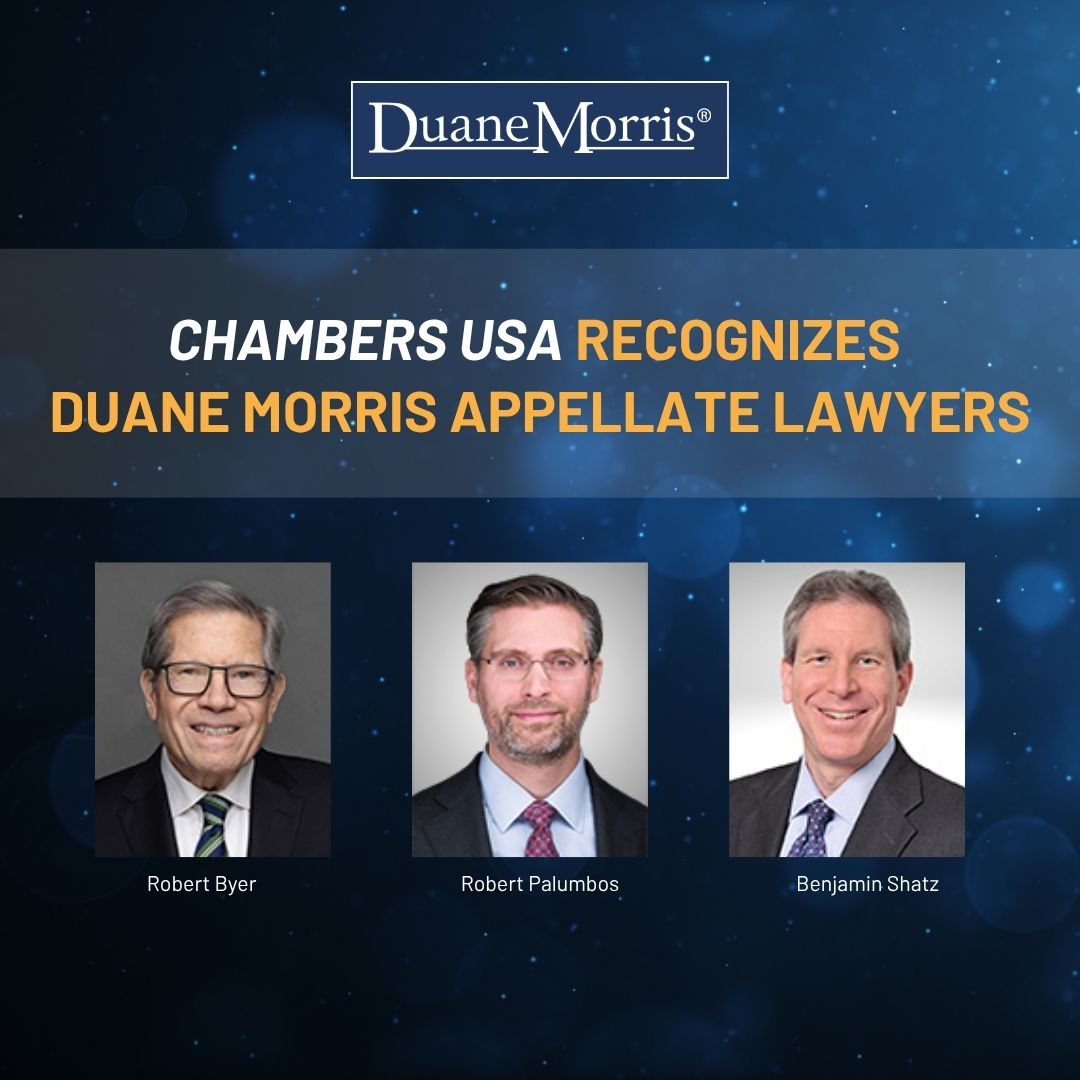
Here’s what clients are saying about our appellate lawyers:
- “[Rob Byer’s] ability to synthesize complex issues into short, concise arguments, and his natural talents for the back and forth of an appellate proceeding are nothing short of amazing.”
- “Robert Palumbos is in the upper echelon of appellate lawyers. He is very intellectual and he has a complex practice.”
- “Benjamin Shatz is one of the best qualified appellate lawyers with whom I have had the pleasure of working.”
Los Angeles Lawyers
Benjamin Shatz: Litigation Appellate
Pittsburgh Lawyers
Robert L. Byer: Litigation: Appellate
Philadelphia Lawyers
Robert M. Palumbos: Litigation: Appellate
Avoiding Pitfalls: Jurisdictional Considerations for Appeals
By Thomas R. Newman and Steven J. Ahmuty, Jr.
The article explains that in New York, only “aggrieved” parties can appeal from proper, written orders or judgments within 30 days. Appeals must follow strict timing and procedural rules; missing deadlines usually results in dismissal. Courts can excuse minor errors, but proper filing and notice are crucial to keep the right to appeal.
Read the full article from the New York Law Journal on the Duane Morris LLP website.
2025 Annual Report of Clerk of the Court of Appeals
We had expected, in keeping with Chief Judge Wilson’s expressed hope in the 2023 Annual Report, that the court would continue to decide more appeals each year until eventually arriving at the over 200 yearly average total dispositions during the 22-year tenure of Chief Judges Kaye and Lippman. But that did not happen. The court decided only 119 appeals (79 civil and 40 criminal), down one from the 120 decided in 2024. We hope the court will increase its caseload this year.
Of the 79 civil appeals decided by the Court in 2025, the jurisdictional predicate for 39 (49%) was permission of the Court of Appeals, 18 (23%) permission of the Appellate Division, 14 (18%) dissents in the Appellate Division, and in 4 (0.5%) a constitutional question was involved. Appx. 4. Stipulations for judgment absolute under CPLR 5601(c) continue to be zero; a wise decision.
Read the full article from the New York Law Journal on the Duane Morris LLP website.
This article was co-authored with Steven J. Ahmuty, Jr.