

The Class Action Weekly Wire – Episode 140: Key Developments In Products Liability & Mass Torts Class Actions

Duane Morris Takeaway: This week’s episode features Duane Morris partner Jerry Maatman and associates Andrew Quay and Elizabeth Underwood with their discussion of the key trends and developments analyzed in the 2026 edition of the Products Liability & Mass Torts Class Action Review.   

Check out today’s episode and subscribe to our show from your preferred podcast platform: Spotify, Amazon Music, Apple Podcasts, Podcast Index, Tune In, Listen Notes, iHeartRadio, Deezer, and YouTube.

Episode Transcript

Jerry Maatman: Welcome to our listeners! Thank you for being here for our weekly podcast series entitled The Class Action Weekly Wire. I’m Jerry Maatman, a partner at Duane Morris, and joining me today on our podcast are my colleagues Andrew Quay and Elizabeth Underwood. This episode is number 140 in our series, something we’re very proud of in terms of delivering the Class Action Weekly Wire. To our clients and listeners, we’re excited to keep delivering our content on noteworthy class action developments. So, thanks so much for being here, Andrew and Elizabeth.

Andrew Quay: Thank you, Jerry, happy to be here.

Elizabeth Underwood: Thanks for having me, Jerry.

Jerry: Today on our podcast, we’ll be discussing publication of the third edition of the Duane Morris Products Liability & Mass Torts Class Action Review, which was published this past week and put on the Duane Morris Class Action Defense Blog. Andrew, can you tell our listeners a little bit about this desk reference publication?

Andrew: Absolutely, Jerry. The Duane Morris Products Liability & Mass Torts Class Action Review – 2026 analyzes the key rulings and developments in these areas for 2025, and the significant legal decisions and trends impacting this type of class action litigation for 2026 moving forward. We hope that companies will benefit from this resource and their compliance with these evolving laws and standards.

Jerry: As a general rule, products liability in the class action space involves two types of claims. One, personal injuries caused by the product, or mislabeling of the product in terms of defects in what is being delivered. Some cases are litigated in what are called MDLs, others in the class action space, some are suited to mass torts, some are not. Elizabeth, could you kind of give us an overview in terms of this particular area as it relates to class actions?

Elizabeth: Sure, Jerry. So, both class actions and mass tort cases often brought in what is known as a multi-district litigation, MDL, which are forms of procedural mechanisms used to manage and resolve complex litigation cases involving multiple plaintiffs. While both mechanisms are designed to streamline the legal process, they differ in key aspects. In a class action, a single representative plaintiff, or a few named plaintiffs, sues on behalf of a class of individuals who have similar claims against a defendant. On the other hand, the MDL involves the consolidation of cases with shared factual or legal issues. For MDL proceedings, each individual case maintains its identity, and representative plaintiffs do not litigate on behalf of a single consolidated class.

Jerry: Well, I know MDLs make up half of all federal dockets. Some people call them the perpetual black hole – easy to get sucked into it, very hard to get out of it. As of November of 2025, the Judicial Panel on Multidistrict Litigation in the federal courts reported that a total of 157 MDLs had been established across the country, but with 23 of those MDLs containing 1,000 or more lawsuits, including class actions. So, against that kind of analytical set of statistics, how did the plaintiffs’ bar do in the past 12 months in terms of certifying class actions in this space?

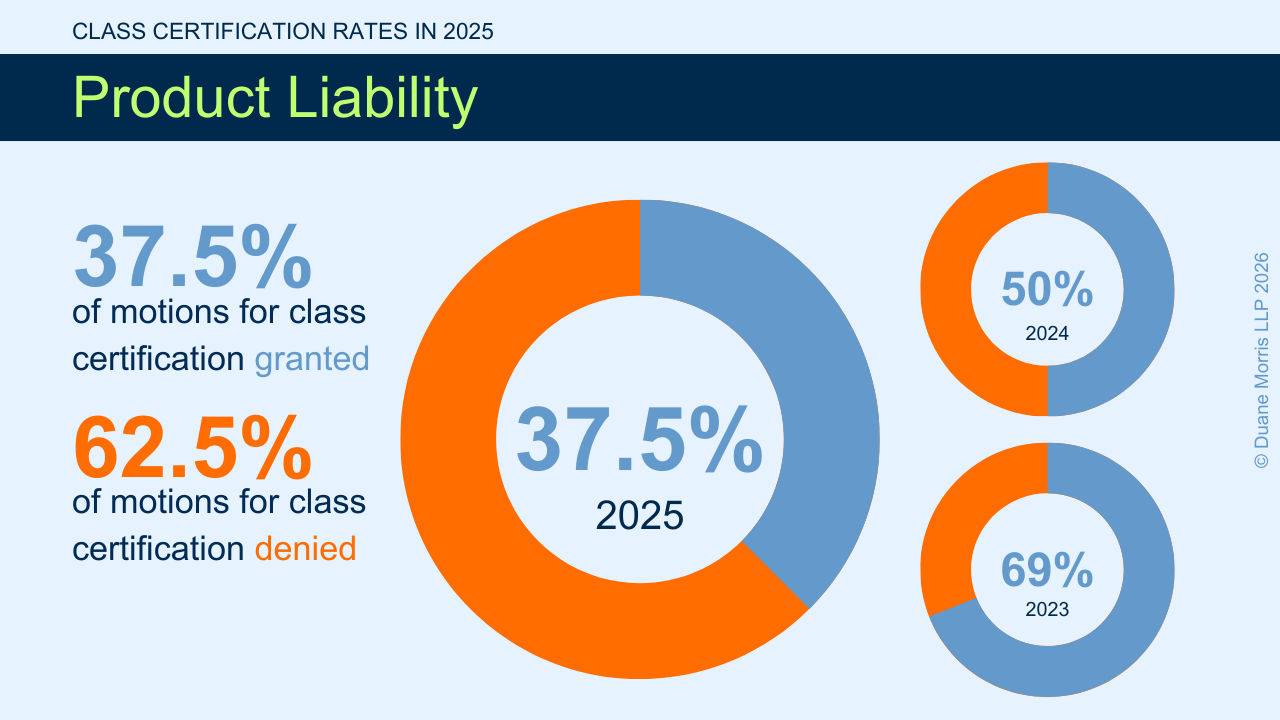
Andrew: Plaintiffs had less favorable results with respect to class certification of products liability and mass tort actions in 2025 over previous years. The certification rate was 37.5%, with 3 of 8 motions for class certification granted, and 62.5%, or 5 of 8 motions denied. This rate was significantly lower than the 2024 rate, when 50% were granted and the other 50% were denied.
Jerry: That’s a pretty big drop-off, and an indication that the plaintiffs’ bar was doing a good job over the past 12 months. Were there any important rulings that stick out in your mind in terms of class certification decisions in 2025?

Elizabeth: Yes, so one of the cases in obtaining class certification was In Re Takata Airbag Products Liability Litigation, a major class action involving allegedly defective airbags in luxury vehicles. At the center of the dispute are cars manufactured by Mercedes-Benz, which were equipped with airbags made by Takata. These airbags used ammonium nitrate, a chemical that can become unstable in high heat and humidity, and potentially explode with excessive force, which pose serious risks of injury or even death. The plaintiffs were a group of car buyers who claimed that Mercedes-Benz either knew or should have known about this defect but failed to disclose it. Because of that, they argued consumers overpaid for vehicles they believed were safe.

Andrew: Building off that, the court granted the plaintiffs’ motion for class certification, holding that all claims revolved around the same core questions of, for example, ‘were the airbags defective, and did Mercedes-Benz conceal that defect?’ The court held that common issues predominated over individual ones, and that a class action was the most efficient way to resolve the dispute. However, there was one important exception, and that was Georgia consumers were excluded from the multi-state class, and that’s because Georgia law has stricter requirements for proving reliance and fraud claims, and the plaintiffs couldn’t show that all Georgia buyers received uniform misrepresentations. For the remaining states, the court acknowledged some differences in fraud and consumer protection laws, but said they were similar enough not to defeat class treatment.

Jerry: That’s a very significant decision because it kind of goes against the tide of other rulings that tend to find individual issues predominating when a case depends on the laws of multiple states, and you have a nationwide class. Shows that courts are willing to certify these multi-state fraud and products liability cases when there’s a strong core at the center of these cases, and the courts are able to efficiently administer such a case in one setting and one lawsuit with one class.

We discussed the numbers for class certification in 2025, but the mantra of the plaintiffs’ bar is to find a client, file the lawsuit, certify it, and then monetize it. How did the plaintiffs’ bar do in converting certified class actions into settled class actions in this space over the past 12 months?

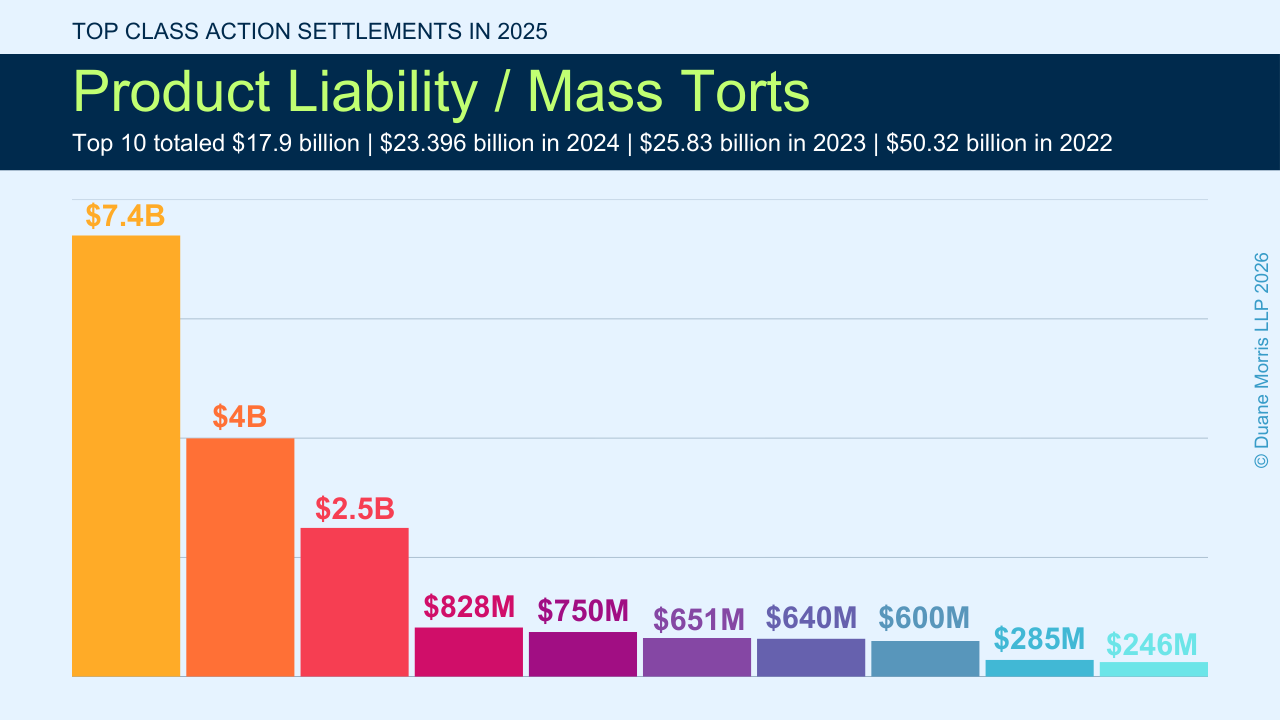
Elizabeth: So, the plaintiffs’ class action bar was enormously successful in obtaining class-wide settlements in this area in 2025. The top 10 products liability and mass tort class-wide settlements totaled $17.9 billion in the past year. However, this total was a decrease from the 2024 total of $23.396 billion.
Jerry: Well, $17.9 billion sure is a lot of coin, and that’s only the top 10 products liability class action settlements, so it’s certainly a significant area of concern and heightened risk for Corporate America.

Well, thank you very much for tracking those settlement numbers and lending your thought leadership in this space. Thank you, Andrew and Elizabeth, for being here, and thank you to our loyal listeners for tuning in.

Andrew: Thanks for having me, Jerry. Thanks to all our listeners.

Elizabeth: Thanks, everyone, it was a pleasure to be here.

Consumer Fraud Class Actions On The Rise In The Cannabis Industry – With More To Come With Interstate Sales

By Seth Goldberg, Gerald L. Maatman, Jr., and Jennifer A. Riley

Duane Morris Takeaways: Cannabis products – such as vapes, pre-rolled joints, tinctures, gummies, and beverages – are consumer packaged goods that are required under state law to be marketed with packaging and labeling that demonstrates their safety to consumers. Although the U.S. state-licensed cannabis industry has been one of the fastest-growing industries in the U.S. over the past decade, consumer fraud lawsuits arising out of alleged packaging and labeling problems, which are a common risk for CPG manufacturers in other industries, have, until now, not been a major consideration for the cannabis supply chain.  However, that is changing. As three recent lawsuits suggest, consumer fraud class actions may be on the rise in the industry. Given the media attention cases like these attract, and the potential for damages for thousands or millions of potential consumers, the cannabis supply chain should take notice. As discussed below, this is going to be especially true once cannabis products are permitted to be sold interstate.

Key Cases

In Centeno et al. v. DreamFields Brands Inc., and Med for America, Inc., a consumer class action filed on October 20, 2022, in the Superior Court of California for Los Angeles County, two putative class representatives filed a putative class action against the manufacturers of Jeeter-branded pre-roll joints on behalf of “all persons who, while in the State of California and within the applicable statute of limitations period, purchased or more Jeeter Products.”  The complaint alleges that the putative class representatives purchased a variety of Jeeter-branded pre-rolled joints based on the high THC potencies stated on the labeling of such products, but those products were actually lower in THC than stated on the labeling. Given that products with greater THC potency are priced higher than products with lower THC, the putative class representatives claim they paid a premium they would not have paid had they known the true THC potency of the Jeeter products they purchased, and thus they suffered an economic loss for which they should be made whole. Their complaint alleges that “millions of other consumers” bought Jeeter pre-rolled joints and suffered the same economic loss. As the Complaint asserts:

If Defendants told the truth — that is, that its products’ THC content is substantially lower than represented on the label — the price of its Products would fall dramatically. If  consumers knew the truth — that the Products contain substantially less THC than the label says —  Defendants could not sell their Products for its current prices. Indeed, as explained above, cannabis products with lower declared amounts of THC content sell for substantially less than ones with higher declared amounts of THC content. Accordingly, if Defendants told the truth about the THC content of their products, they would have had to lower the price, and Plaintiffs and class members would have paid less.

In addition to seeking for themselves and the class of “millions of consumers” damages for the amounts overpaid for the Jeeter-branded pre-rolls, the putative class representatives also seek punitive damages, attorneys’ fees, and injunctive relief to stop the allegedly fraudulent labeling under California’s unfair competition and false advertising statutes, as well as various common law claims.

We previously wrote about a number of separate actions filed against Curaleaf, the largest U.S. cannabis product manufacturer in 2021, arising out of allegations that Curaleaf mislabeled tinctures containing THC that were marketed as containing CBD. One of those cases, Williamson v. Curaleaf, Inc., a consumer class action filed in the U.S. District Court for the District of Oregon on May 30, 2022, was reported last week to have settled for payments of $150 to $200 for as many as 500 class members who are alleged to have consumed the mislabeled Curaleaf tinctures. Like the class action complaint filed in Centeno arising out of the mislabled Jeeter pre-rolls, Williamson’s class action complaint sought statutory damages, punitive damages, and attorneys’ fees under Oregon’s consumer fraud statute known as the unfair Trade Practices Act.

In addition to Centeno and Williamson, we previously wrote about Plumlee v. Steep Hill Inc., a putative class action filed in the U.S. District Court for the Eastern District of Arkansas against cannabis testing lab and cannabis cultivators NSMC-OPCO LLC, Bold Team LLC and Osage Creek Cultivation LLC, which, like Centeno, arose out of allegations that the operators falsified the amount of THC in their cannabis products. As in Centeno, Plumlee seeks class-wide damages for economic loss, i.e., amounts overpaid for mislabeled cannabis products, and as in Centeno and Williamson, Plumlee seeks punitive damages and attorneys’ fees for the alleged fraudulent conduct. Interestingly, although the claims in Plumlee are sound in consumer fraud, Plumlee asserts that the defendants acted together to form an enterprise in violation of the Racketeer Influenced and Corrupt Organizations Act. As we previously wrote, these claims could just as easily been asserted as consumer fraud.

Future Litigation Prospects

There are a few reasons cannabis consumer fraud class actions may not have been attractive to the plaintiffs’ class action bar in recent years. First, given that cannabis products may only be manufactured and sold in the same state, the size of a class and the amount of damages are limited to consumers in a single state, as opposed to the type of nationwide class action one see with other CPGs. Indeed, Centeno, Williamson, and Plumlee, assert claims on behalf of a single state-wide class.

Second, most state cannabis markets have only recently – in the past few years – begun to grow into markets of hundreds of thousands or millions of consumers, and thus a single state class a few years ago would likely have been too small to warrant the investment in an expensive litigation by plaintiffs’ counsel.

Third, and similarly, defendants’ pockets are deeper today as a result of the increased sales over time than they were just a few years ago. For these reasons, the continued growth of state cannabis markets is likely to result in more cannabis consumer fraud class actions.

However, the interstate sale of cannabis products is really going to change the risk spectrum from consumer fraud class actions.

Once interstate sales of cannabis products are permitted, the mass marketing and distribution of cannabis products to consumers in multiple states in a region, if not nationally, will open the door to claims asserted on a nationwide basis that a cannabis consumer product was mislabeled. While such claims would be asserted under state-specific consumer fraud laws, they may be asserted on behalf of consumers around the country, resulting in significant exposure to the cannabis supply chain, i.e., growers, processors, labs, and dispensaries, for economic loss and punitive damages, as well as attorneys’ fees. These types of claims are routinely filed by the plaintiffs’ class action bar on behalf of nationwide classes arising out of the alleged mislabeling of other CPGs, and that bar will no doubt have cannabis products in their sights when interstate sales cannabis begin.

© 2009- Duane Morris LLP. Duane Morris is a registered service mark of Duane Morris LLP.

The opinions expressed on this blog are those of the author and are not to be construed as legal advice.

Proudly powered by WordPress