Florida Federal Court Denies Certification Of Nationwide Classes Of Burger King Consumers in Suit Alleging Deceptive Practices

By Gerald L. Maatman, Jr., Brett Bohan, and Andrew Quay

Duane Morris Takeaways: On November 25, 2025, in Coleman, et al. v. Burger King Corp., Case No. 22-CV-20925, 2025 U.S. Dist. LEXIS 231422 (S.D. Fla. Nov. 25, 2025), Judge Roy K. Altman of the U.S. District Court for the Southern District of Florida denied a motion for class certification of three nationwide classes of consumers against one of the Burger King after the lawsuit narrowly survived two motions to dismiss.  The Court held that due to the predominance of individual questions between the proposed classes, and plaintiffs’ lack of class-wide evidence to support certification, the plaintiffs failed to establish the prerequisites for class certification from the sale of “Whoppers” and “Big Kings” across the country.  The opinion illustrates the hurdles plaintiffs face when attempting to certify multi-state, let alone nationwide, classes, and the fundamental, yet effective arguments corporate counsel can raise to defeat them.

Case Background

Plaintiffs, a group of Burger King consumers alleging that Burger King materially overstates the size of its burgers in advertisements, sought certification of three nationwide classes.  Id. at *2.  Plaintiffs sought certification under Rule 23(b)(3), which allows a district court to certify a class only if “the court finds that the questions of law or fact common to class members predominate over any questions affecting only individual members, and that a class action is superior to other available methods for fairly and efficiently adjudicating the controversy.”  Id. at *6-7 (quoting Fed. R. Civ. P. 23(b)(3)).  Plaintiffs insisted that they each purchased a burger because of the advertising and would not have if the size of the burgers had been portrayed accurately.  Id. at *3.  Notably, the plaintiffs did not offer any substantive analysis on variations between state laws despite their request for certification of nationwide classes.

Burger King responded that plaintiffs’ motion could not satisfy predominance and superiority under Rule 23(b)(3) and commonality and typicality under Rule 23(a).  Id. at *8.  Burger King argued that plaintiffs’ lack of class-wide evidence, coupled with Burger King’s affirmative defenses that raise additional individualized questions, was fatal to their motion for class certification.  Id. at *33.  Also weighing against predominance, Burger King argued, the proposed class members “were exposed to a wide variety of advertisements,” and “[n]o single photograph of a burger . . . can represent the appearances of the burgers every other class member received.”  Id. at *23, 28. 

The Court’s Opinion

In a 35-page opinion, Judge Roy K. Altman denied plaintiffs’ motion for class certification for failing to carry their Rule 23 burden.  Explaining that plaintiffs are not entitled to “a mere pleading standard” on a motion for class certification, and that they must “affirmatively demonstrate” their compliance with each element of Rule 23, the Court held that plaintiffs failed to establish predominance and superiority under Rule 23(b)(3) and, at minimum, commonality under Rule 23(a).  Id. at *5 (quoting Wal-Mart Stores, Inc. v. Dukes, 564 U.S. 338, 350 (2011)).

As for predominance, the Court explained that Plaintiffs needed to be able to prove “the relative smallness of the burgers [they bought compared to the burgers in the advertisements] with a few pieces of common evidence that apply with equal force to everyone.”  Id. at *30.  Plaintiffs could not do that, the Court held, because each putative class member saw a particular advertisement and received a specific burger.  Id.  Plus, by seeking certification of nationwide or multi-state classes, plaintiffs bear the heavy burden to demonstrate that “variations in state law” do not threaten to “swamp any common issues and defeat predominance.”  Id. at *10 (quoting Klay v. Humana, Inc., 382 F.3d 1241, 1261 (11th Cir. 2004)).  Plaintiffs’ motion for certification did not provide “any analysis of potential state-law conflicts,” thus “utterly fail[ing]” to meet their burden of showing that common issues of law predominate.  Id. at *12.

The Court further agreed that Burger King’s affirmative defenses raised additional individualized inquiries.  If the Court were to grant certification, a “potentially significant percentage” of the putative class members may be precluded from pursuing their claims by virtue of an arbitration clause and class action waiver that loyalty rewards program users had agreed to, and with respect to at least one class, numerous plaintiffs and putative class members did not properly notify Burger King of the alleged breaches within a reasonable time after they discovered the alleged breaches.

For similar reasons, the Court rejected plaintiffs’ proffered method of calculating class-wide damages by subtracting the price of the burger from the value of the item as determined by the jury.  Id. at *45.  Burger King menu items vary by location, and the prices likely differed throughout the class period, so the Court would need to confirm when and where each individual plaintiff purchased a burger in order to compute damages.  Id. at *46. 

Turning to superiority, the Court held that plaintiffs’ proposed classes “would create an administrative nightmare.”  Id. at *51.  Plaintiffs contended that “there are no significant or unusual difficulties in managing this case” because Burger King’s liability “can be proven by its uniform advertisements and photographs of the actual Menu Items served to customers, which are common to the entire class.”  Id. at *50.  The Court rejected plaintiffs’ conclusory argument because the proposed class involves millions of consumers stretching to 2018, “very few of whom are likely to have retained proof of (or even remember) their fast-food purchases.”  Id. at *52.

Finally, though not necessary for denying class certification, the Court held that plaintiffs failed to show that common questions they raised, such as whether Burger King’s advertisements are materially misleading, can be raised through class-wide evidence.  Id. at *54.  While plaintiffs offered questions common to the class, they failed to show that a class-wide proceeding would “generate common answers apt to drive the resolution of the litigation.”  Id. at *55 (quoting Dukes, 564 U.S. at 350).

In sum, after narrowly surviving two motions to dismiss, plaintiffs were unable to surmount their burden at the class certification stage, and the Court denied their motion for class certification.

Implications For Companies

The Court’s holding in Coleman demonstrates the burden that plaintiffs must overcome when seeking to certify a class.  Coleman shows that plaintiffs cannot rest on the allegations in their complaints to satisfy the elements of class certification and must instead put forth evidence from which courts may determine commonality and predominance.

In cases involving allegations of consumer fraud, it may not be sufficient for plaintiffs to establish that they were all deceived by the same allegedly fraudulent behavior.  Instead, to certify a nationwide class, plaintiffs may also need to overcome differences between locations; difficulties in supplying reliable, supporting proof; and variations between state laws. 

Additionally, Coleman represents a reminder of the continued utility of an arbitration agreement for defeating class certification, even where the agreement may not extend to all members of the class.

Chicago Skyway Toll Collector Dismissed From Illinois Consumer Fraud Class Action Lawsuit

By Gerald L. Maatman, Jr., George J. Schaller, and Jeremy H. Salinger

Duane Morris Takeaways: On June 23, 2025, in Rowe, et al. v. Skyway Concession Company LLC, et al., No. 24-CV-6313, 2025 U.S. Dist. LEXIS 118449 (N.D. Ill. June 23, 2025), Judge Mary M. Rowland of the U.S. District Court for the Northern District of Illinois dismissed a putative class action based on allegations of increased toll charges and instances of double-billing by Defendants who controlled and collected revenue from the Chicago Skyway’s tolls. 

The ruling in Rowe illustrates consumers alleging consumer fraud claims stemming from an asserted breach of contract must first show they are beneficiaries to the underlying contract.  And even if the consumers are beneficiaries, then they must plead specific facts demonstrating deceptive acts or unfair practices to survive dismissal for Illinois Consumer Fraud Act claims.

Case Background

In January 2025, the City of Chicago transferred control of the Chicago Skyway (a toll road that connects the Indiana Toll Road to the Dan Ryan Expressway in Chicago) to Skyway Concession Company LLC (“Skyway Concession”) under the Chicago Skyway Concession and Lease Agreement (“Agreement”).  Id. at 2.  The Agreement granted Skyway Concession the right to set tolls and collect all toll revenue from the Chicago Skyway.  Id.  The Agreement also contained a provision that “nothing contained in the Agreement . . . [shall] be construed in any way to grant, convey or create any rights or interests in any Person not a Party to this Agreement.”  Id. 

Plaintiffs Rockwell Rowe, Jr., and Michelle Rowe (“Plaintiffs”) brought a putative class action against Skyway Concession and its indirect equity holder Calumet Concession Partners, Inc. (“Calumet Concession”) (collectively “Defendants”). 

Plaintiffs alleged that Defendants charged more for certain tolls than allowed under the Agreement, charged a $0.03 surcharge above the maximum tolls to drivers who use the electronic tolling E‑ZPass system, and double-billed some drivers for the E-ZPass surcharge.  Id. at 3. 

Plaintiffs asserted multiple causes of action, including (i) deceptive acts and unfair practices in violation of the Illinois Consumer Fraud Act (“ICFA”) (Counts I and II); (ii) breach of contract (Count III); and (iii) unjust enrichment (Count IV).  Id. at 4.  Defendants moved to dismiss.

The District Court’s Order

The Court granted Defendants Motion to Dismiss on all Counts. 

The Court began its analysis with Plaintiffs’ breach of contract claim because it was “relevant to all remaining claims.”  Id. at 4.  The Court explained that “only a party to a contract, or one in privity with a party, may enforce a contract, except that a third party beneficiary may sue for breach of a contract made for his benefit.”  Id. at 5. Because Plaintiffs were “not parties to the Agreement and the Agreement expressly provides that it does not benefit non-parties to the agreement,” id., and “Plaintiffs have not identified any provision of the [Agreement] that provides rights or specific benefits to putative class members,” id. at 6, the Court dismissed Count III.  For clarity, the Court added “[the fact] that Skyway users may indirectly benefit from [Skyway Concession’s] compliance — or indeed be indirectly harmed by [Skyway Concession’s] non-compliance—does not give them the right to enforce the contract.”  Id. 

The Court then similarly concluded that the purported ICFA claims were insufficient to survive dismissal.  The Court determined that “Plaintiffs failed to allege an actionable deceptive act” because “Plaintiffs nowhere allege that Defendants charged any toll greater than Defendants posted or otherwise communicated to the public the toll prices would be” and “putative class [members] paid the tolls that Defendants communicated they would charge.”  Id. at 9.  In sum, the Court determined, “Defendants advertised the cost to drive on the Skyway, and armed with that knowledge, Plaintiffs paid the advertised price to drive on the Skyway.”  Id. at 10.  Furthermore, the Court held that Plaintiffs double-billed EZ-Pass allegations failed to establish any deceptive act because Plaintiffs did “not allege that the charges occurred as a result of any deception.”  Id.  The Court therefore dismissed Plaintiffs’ Count I deceptive acts ICFA claim.

The Court next determined Plaintiffs “fail[ed] to allege any unfair practice that violate the ICFA.” Id.  First, Plaintiffs argued that “the charges violated 815 ILCS 510/2(a)(11) concerning misleading statements regarding price reductions,” but the Court disagreed because “the underlying alleged misconduct has nothing to do with price reductions.”  Id. at *11.  Second, plaintiffs point to a “well-established public policy that parties uphold their [contractual] obligations,” but the Court opined Plaintiffs cited no case law standing for such a policy under the ICFA.  Id.  Third, the Court reasoned Plaintiffs’ double-billed EZ-Pass surcharge allegations “likewise fail because it is not immoral, oppressive, unethical, or unscrupulous to mistakenly charge a fee.” Id. at 12.  Accordingly, the Court dismissed Plaintiffs’ Count II unfair practices ICFA claim as well. 

Given Plaintiffs’ unjust enrichment allegations involved “the same conduct underlying Counts I and II,” the Court also dismissed Count IV concerning unjust enrichment.  Id. at 12.

Accordingly, the Court granted Defendants’ Motion to Dismiss and terminated Plaintiffs’ case.

Implications For Companies

With Rowe, Illinois-based companies can rest easier knowing that consumers cannot sustain breach-of-contract claims on the theory that they are indirectly benefitted by a contract.  Moreover, the decision reaffirms that consumer discontent does not amount to a deceptive act or unfair practice required to state a claim under the Illinois Consumer Fraud Act. 

The Class Action Weekly Wire – Episode 49: 2024 Preview: Consumer Fraud Class Action Litigation

Duane Morris Takeaway: This week’s episode of the Class Action Weekly Wire features Duane Morris partner Jerry Maatman and associate Alessandra Mungioli with their discussion of 2023 developments and trends in consumer fraud class action litigation as detailed in the recently published Duane Morris Consumer Fraud Class Action Review – 2024.

Check out today’s episode and subscribe to our show from your preferred podcast platform: Spotify, Amazon Music, Apple Podcasts, Google Podcasts, the Samsung Podcasts app, Podcast Index, Tune In, Listen Notes, iHeartRadio, Deezer, YouTube or our RSS feed.

Episode Transcript

Jerry Maatman: Welcome loyal blog listeners. Thank you for being on our weekly podcast, the Class Action Weekly Wire. My name is Jerry Maatman, I’m a partner at Duane Morris, and joining me today is my colleague, Alessandra. Thank you for being on our podcast to talk about thought leadership with respect to class actions.

Alessandra Mungioli: Thank you, Jerry. I’m glad to be here.

Jerry: Today we’re going to discuss our recent publication, our e-book on the Duane Morris Consumer Fraud Class Action Review. Listeners can find this book on our blog. Could you tell us a little bit about what readers can expect from this e-book?

Alessandra: Absolutely Jerry. Class action litigation in the consumer fraud space remains a key focus of the plaintiff’s bar. A wide variety of conduct gives rise to consumer fraud claims which typically involve a class of consumers who believe they were participating in a legitimate business transaction, but due to a merchant or a company’s alleged deceptive or fraudulent practices, the consumers were actually being defrauded.

Every state has consumer protection laws, and consumer fraud class actions require courts to analyze these statutes, both with respect to plaintiffs’ claims and also with respect to choice of law analyses when a complaint seeks to impose liability that is predicated on multiple states’ consumer protection laws.

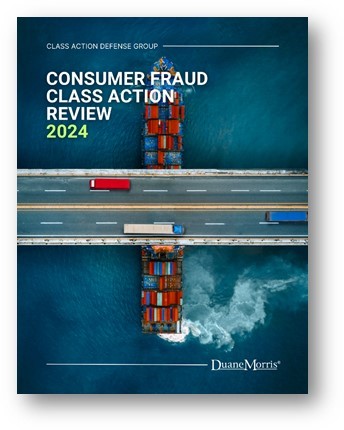
To assist corporate counsel and business leaders with navigating consumer fraud class action litigation, the class action team here at Duane Morris has put together the Consumer Fraud Class Action Review, which analyzes significant rulings, major settlements, and identifies key trends that are apt to impact companies in 2024.

Jerry: This is a great, essential desk reference for practitioners and corporate counsel alike dealing with class actions in this space. Difficult to do in a short podcast, but what are some of the key takeaways in that desk reference?

Alessandra: Just as the type of actionable conduct varies, so, too, do the industries within which consumer fraud claims abound. In the last several years, for example, the beauty and cosmetics industry saw a boom in consumer fraud class actions as consumers demanded increased transparency regarding the ingredients in their cosmetic products and the products’ effects. In 2023, consumer fraud class actions ran the gamut of false advertising and false labeling claims as well.

Artificial intelligence also made its way into the class action arena in the consumer fraud space for the first time in 2023. In MillerKing, LLC, et al. v. DoNotPay Inc., the plaintiff, a Chicago law firm, filed a class action alleging the defendant, an online subscription service that uses “robot lawyers” programmed with AI, was not licensed to practice law and therefore brought claims for consumer fraud, deceptive practices, and breach of trademark. The defendant moved to dismiss the action on the basis that the plaintiff failed to establish an injury-in-fact sufficient to confer standing, which the court granted. The plaintiff asserted that the conduct caused “irreparable harm to many citizens, as well as to the judicial system itself,” and constituted “an infringement upon the rights of those who are properly licensed,” such as “attorneys and law firms.” The court found that the plaintiff failed to demonstrate any real injury per its claims, and granted the defendant’s motion to dismiss.

Jerry: Well, robot lawyers and lawyer bots – that’s quite a development in 2023. How did the plaintiffs’ bar do in – what I consider the Holy Grail in this space – securing class certification, and then conversion of a certified class into a monetary class-wide settlement?

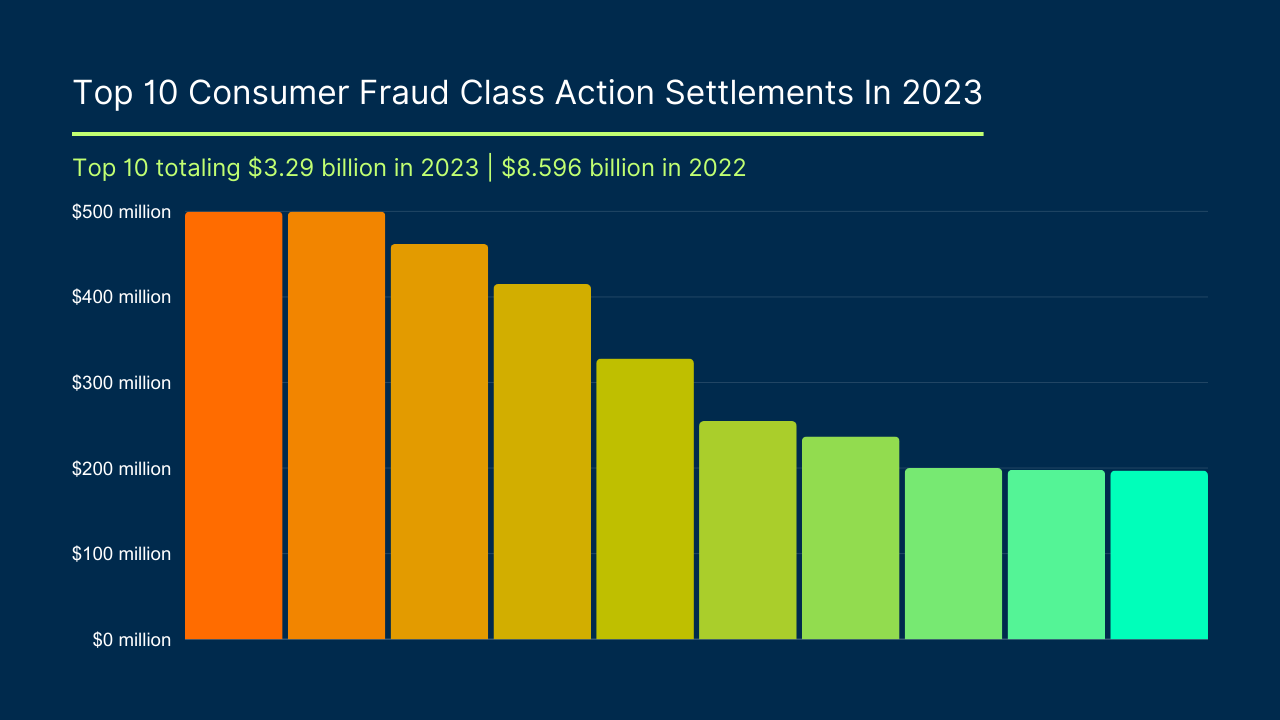
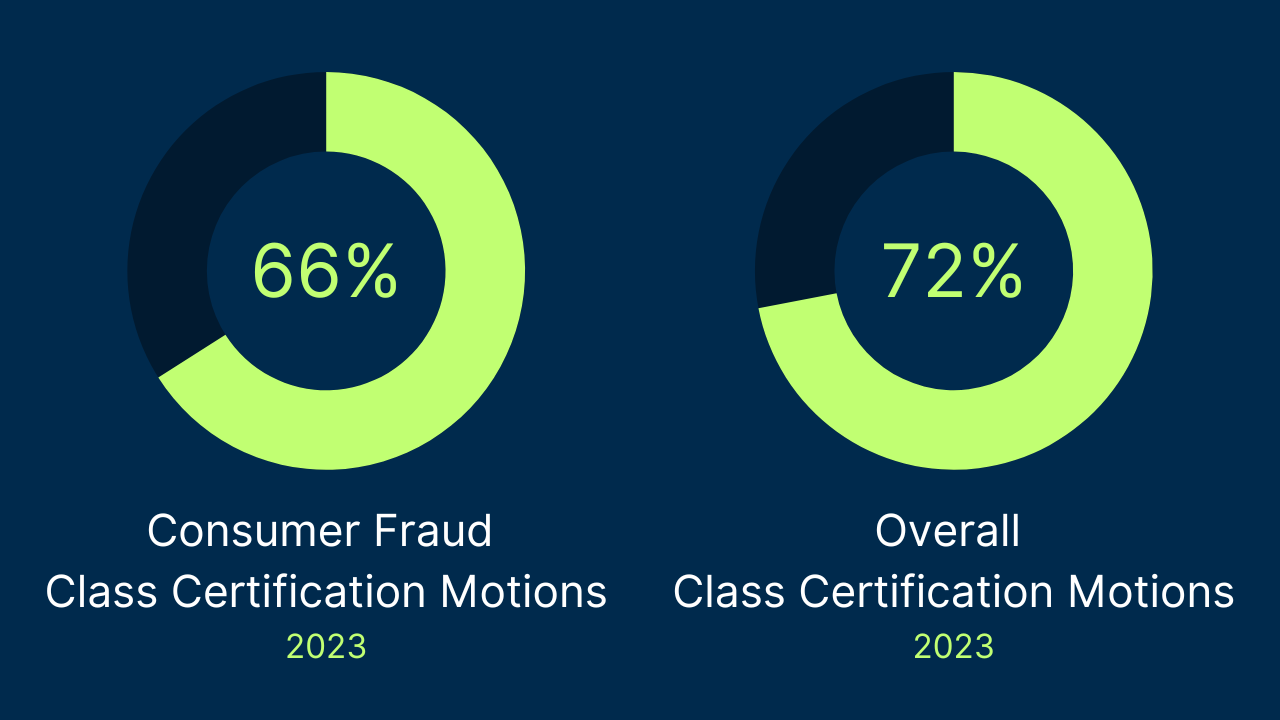
Alessandra: So settlements were very lucrative in 2023. The top 10 consumer fraud class action settlements in 2023 totaled $3.29 billion. And by comparison, the top 10 settlements in 2022 had totaled $8.5 billion, so we have seen a downward trend. Notably, five of these 10 settlements last year took place in California courts. The top settlements in 2023 resolved litigation stemming from a variety of different theories, from smartphone performance issues to the marketing of vape products. Last year, courts granted plaintiffs’ motions for class certification in consumer fraud lawsuits approximately 66% of the time. And the overall certification rate for class actions in 2023 was 72%.

Jerry: Well, that’s quite a litigation scorecard. And this is an area of interest that the class action team at Duane Morris will be following closely and blogging about in 2024. Well, thank you for being with us today and thank you loyal blog readers and listeners for joining our weekly podcast again. You can download the Duane Morris Consumer Fraud Class Action Review off our website. Have a great day!

Alessandra: Thank you!

Introducing The Duane Morris Consumer Fraud Class Action Review – 2024!

By Gerald L. Maatman, Jr. and Jennifer A. Riley

Duane Morris Takeaway: Within the vast realm of class action litigation, consumer fraud class actions remain at the forefront. Consumer fraud class actions typically involve a class of consumers who believe they were participating in a legitimate business transaction, but, due to a merchant or company’s alleged deceptive or fraudulent practices, the consumers were actually being defrauded. A wide variety of conduct gives rise to consumer fraud claims. For example, if a business or merchant makes misleading statements about a retail product’s origin, quality, or potential use, over-exaggerates a product’s benefits, imposes classic bait-and-switch tactics on consumers – wherein consumers are forced to make decisions based on inaccurate or incomplete information – or charges fees or surcharges that are unrelated to the subject of the merchant’s transaction with the consumer, a claim for consumer fraud will arise because these actions may harm consumers.

Every state has consumer protection laws, and consumer fraud class actions require courts to analyze these statutes both with respect to plaintiffs’ claims, and also with respect to choice of law analyses when a complaint seeks to impose liability upon multiple states’ consumer protection laws.

To that end, the class action team at Duane Morris is pleased to present a new publication – the 2024 edition of the Consumer Fraud Class Action Review. We hope it will demystify some of the complexities of consumer fraud class action litigation and keep corporate counsel updated on the ever-evolving nuances of these issues.  We hope this book – manifesting the collective experience and expertise of our class action defense group – will assist our clients by identifying developing trends in the case law and offering practical approaches in dealing with consumer fraud class action litigation.

Click here to download a copy of the Duane Morris Consumer Fraud Class Action Review – 2024 eBook.

Stay tuned for more consumer fraud class action analysis coming soon on our weekly podcast, the Class Action Weekly Wire.

© 2009- Duane Morris LLP. Duane Morris is a registered service mark of Duane Morris LLP.

The opinions expressed on this blog are those of the author and are not to be construed as legal advice.

Proudly powered by WordPress