
Duane Morris Takeaway: This week’s episode features Duane Morris partner Jerry Maatman and associates Andrew Quay and Elizabeth Underwood with their discussion of the key trends and developments analyzed in the 2026 edition of the Products Liability & Mass Torts Class Action Review.
Check out today’s episode and subscribe to our show from your preferred podcast platform: Spotify, Amazon Music, Apple Podcasts, Podcast Index, Tune In, Listen Notes, iHeartRadio, Deezer, and YouTube.
Episode Transcript
Jerry Maatman: Welcome to our listeners! Thank you for being here for our weekly podcast series entitled The Class Action Weekly Wire. I’m Jerry Maatman, a partner at Duane Morris, and joining me today on our podcast are my colleagues Andrew Quay and Elizabeth Underwood. This episode is number 140 in our series, something we’re very proud of in terms of delivering the Class Action Weekly Wire. To our clients and listeners, we’re excited to keep delivering our content on noteworthy class action developments. So, thanks so much for being here, Andrew and Elizabeth.
Andrew Quay: Thank you, Jerry, happy to be here.
Elizabeth Underwood: Thanks for having me, Jerry.
Jerry: Today on our podcast, we’ll be discussing publication of the third edition of the Duane Morris Products Liability & Mass Torts Class Action Review, which was published this past week and put on the Duane Morris Class Action Defense Blog. Andrew, can you tell our listeners a little bit about this desk reference publication?
Andrew: Absolutely, Jerry. The Duane Morris Products Liability & Mass Torts Class Action Review – 2026 analyzes the key rulings and developments in these areas for 2025, and the significant legal decisions and trends impacting this type of class action litigation for 2026 moving forward. We hope that companies will benefit from this resource and their compliance with these evolving laws and standards.
Jerry: As a general rule, products liability in the class action space involves two types of claims. One, personal injuries caused by the product, or mislabeling of the product in terms of defects in what is being delivered. Some cases are litigated in what are called MDLs, others in the class action space, some are suited to mass torts, some are not. Elizabeth, could you kind of give us an overview in terms of this particular area as it relates to class actions?
Elizabeth: Sure, Jerry. So, both class actions and mass tort cases often brought in what is known as a multi-district litigation, MDL, which are forms of procedural mechanisms used to manage and resolve complex litigation cases involving multiple plaintiffs. While both mechanisms are designed to streamline the legal process, they differ in key aspects. In a class action, a single representative plaintiff, or a few named plaintiffs, sues on behalf of a class of individuals who have similar claims against a defendant. On the other hand, the MDL involves the consolidation of cases with shared factual or legal issues. For MDL proceedings, each individual case maintains its identity, and representative plaintiffs do not litigate on behalf of a single consolidated class.
Jerry: Well, I know MDLs make up half of all federal dockets. Some people call them the perpetual black hole – easy to get sucked into it, very hard to get out of it. As of November of 2025, the Judicial Panel on Multidistrict Litigation in the federal courts reported that a total of 157 MDLs had been established across the country, but with 23 of those MDLs containing 1,000 or more lawsuits, including class actions. So, against that kind of analytical set of statistics, how did the plaintiffs’ bar do in the past 12 months in terms of certifying class actions in this space?
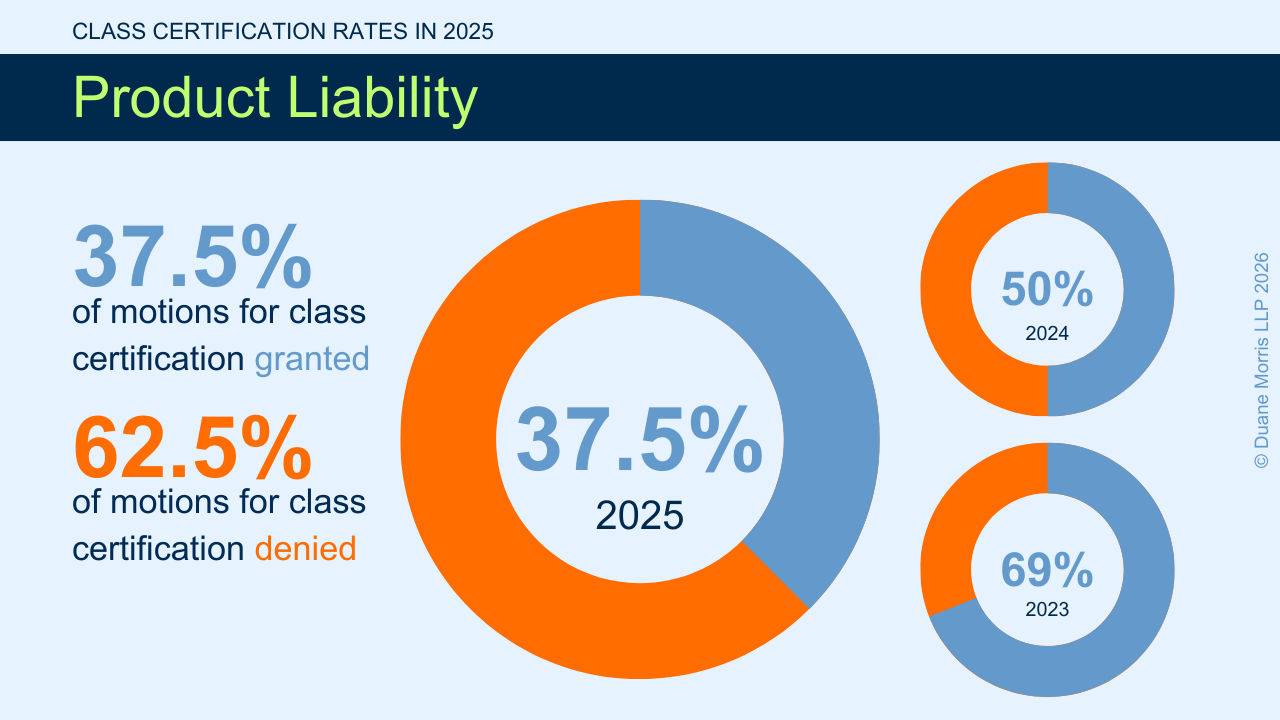
Andrew: Plaintiffs had less favorable results with respect to class certification of products liability and mass tort actions in 2025 over previous years. The certification rate was 37.5%, with 3 of 8 motions for class certification granted, and 62.5%, or 5 of 8 motions denied. This rate was significantly lower than the 2024 rate, when 50% were granted and the other 50% were denied.
Jerry: That’s a pretty big drop-off, and an indication that the plaintiffs’ bar was doing a good job over the past 12 months. Were there any important rulings that stick out in your mind in terms of class certification decisions in 2025?
Elizabeth: Yes, so one of the cases in obtaining class certification was In Re Takata Airbag Products Liability Litigation, a major class action involving allegedly defective airbags in luxury vehicles. At the center of the dispute are cars manufactured by Mercedes-Benz, which were equipped with airbags made by Takata. These airbags used ammonium nitrate, a chemical that can become unstable in high heat and humidity, and potentially explode with excessive force, which pose serious risks of injury or even death. The plaintiffs were a group of car buyers who claimed that Mercedes-Benz either knew or should have known about this defect but failed to disclose it. Because of that, they argued consumers overpaid for vehicles they believed were safe.
Andrew: Building off that, the court granted the plaintiffs’ motion for class certification, holding that all claims revolved around the same core questions of, for example, ‘were the airbags defective, and did Mercedes-Benz conceal that defect?’ The court held that common issues predominated over individual ones, and that a class action was the most efficient way to resolve the dispute. However, there was one important exception, and that was Georgia consumers were excluded from the multi-state class, and that’s because Georgia law has stricter requirements for proving reliance and fraud claims, and the plaintiffs couldn’t show that all Georgia buyers received uniform misrepresentations. For the remaining states, the court acknowledged some differences in fraud and consumer protection laws, but said they were similar enough not to defeat class treatment.
Jerry: That’s a very significant decision because it kind of goes against the tide of other rulings that tend to find individual issues predominating when a case depends on the laws of multiple states, and you have a nationwide class. Shows that courts are willing to certify these multi-state fraud and products liability cases when there’s a strong core at the center of these cases, and the courts are able to efficiently administer such a case in one setting and one lawsuit with one class.
We discussed the numbers for class certification in 2025, but the mantra of the plaintiffs’ bar is to find a client, file the lawsuit, certify it, and then monetize it. How did the plaintiffs’ bar do in converting certified class actions into settled class actions in this space over the past 12 months?
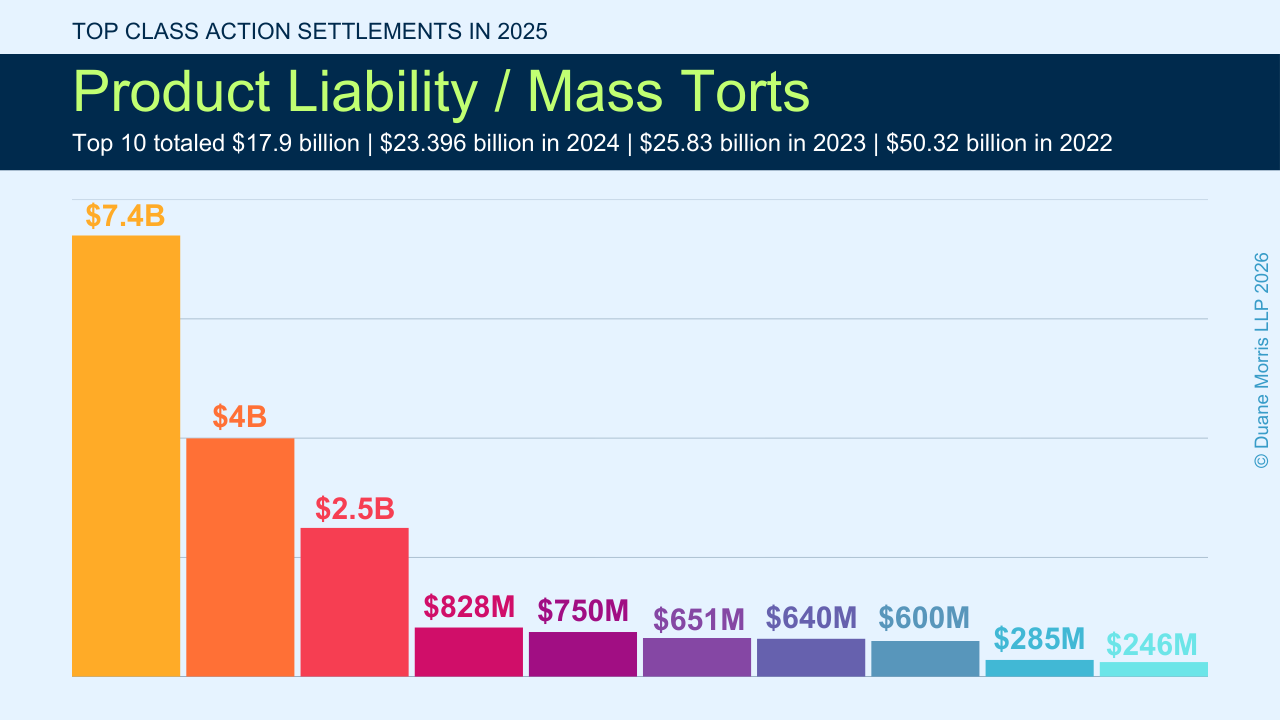
Elizabeth: So, the plaintiffs’ class action bar was enormously successful in obtaining class-wide settlements in this area in 2025. The top 10 products liability and mass tort class-wide settlements totaled $17.9 billion in the past year. However, this total was a decrease from the 2024 total of $23.396 billion.
Jerry: Well, $17.9 billion sure is a lot of coin, and that’s only the top 10 products liability class action settlements, so it’s certainly a significant area of concern and heightened risk for Corporate America.
Well, thank you very much for tracking those settlement numbers and lending your thought leadership in this space. Thank you, Andrew and Elizabeth, for being here, and thank you to our loyal listeners for tuning in.
Andrew: Thanks for having me, Jerry. Thanks to all our listeners.
Elizabeth: Thanks, everyone, it was a pleasure to be here.