By Gerald L. Maatman, Jr., Jennifer A. Riley, and Elizabeth G. Underwood
Duane Morris Takeaways: On July 6, 2026, in Shellenberger v. AIG WarrantyGuard, Inc., et al., No. 25-1448 (9th Cir. July 6, 2026), Judges Christen, Hurwitz, and Bade of the U.S. Court of Appeals for the Ninth Circuit reversed a district court’s dismissal of a putative class action alleging that AIG WarrantyGuard, Inc. and Whirlpool Corporation violated the Washington Consumer Protection Act (“CPA”) in connection with a KitchenAid service plan. The Ninth Circuit held that the named Plaintiff plausibly alleged that the Defendants’ offer letter and service contract, taken together, had the capacity to deceive a reasonable consumer, and that the district court erred in resolving that fact-intensive question at the motion to dismiss stage.
This ruling serves as a cautionary tale for companies that market service plans, particularly where buyout provisions or qualifiers in the fine print may be read as cutting against the offerings set out in consumer offer letters.
Case Background
Plaintiff Hadassah Shellenberger (“Plaintiff”) filed a putative class action against AIG WarrantyGuard, Inc. and Whirlpool Corporation (collectively, “Defendants”), asserting a claim under the CPA, Wash. Rev. Code §§ 19.86.020, 19.86.093. Id. at 1. Plaintiff alleged that Defendants’ offer letter created the impression “that the KitchenAid Service Plan would provide repairs or replacements for covered malfunctions, with repairs performed by KitchenAid-certified technicians, at no out-of-pocket expense to her.” Id. at 3. Plaintiff further alleged that this impression was inconsistent with the terms of the service contract, which included a buyout option, exercisable at Defendants’ sole discretion, allowing Defendants to technically satisfy all obligations under the contract without ever providing a repair or replacement. Id.
The district court dismissed Plaintiff’s CPA claim, finding that she had failed to plausibly allege the first element of a CPA claim, namely, “whether the defendant has engaged in an unfair or deceptive act or practice.” Id. at 2. Plaintiff appealed the ruling to the Ninth Circuit. Id. at 1.
The Ninth Circuit’s Decision
The Ninth Circuit reversed and remanded, finding that the district court erred in dismissing Plaintiff’s CPA claim. Id. at 7. The Ninth Circuit determined that Plaintiff’s interpretation of the offer letter was “facially plausible” because the offer letter mentioned only repairs and replacements as modes of performance, while the buyout option in the service contract provided an alternative manner of performance that was “inconsistent with the advertised benefits.” Id. at 3.
The Ninth Circuit rejected Defendants’ arguments that caveats in the offer letter and a fine-print disclaimer made Plaintiff’s interpretation implausible, finding the disclaimer language “insufficiently clear to change the apparent meaning of the offer letter’s representations.” Id. at 4 (internal quotation marks omitted). In addition, the Ninth Circuit similarly rejected the argument that qualifiers, such as “covered” and “where applicable”, defeated Plaintiff’s reading, concluding that those terms plausibly limited only the specific representations immediately next to them. Id. at 5.
Finally, the Ninth Circuit highlighted that whether a representation is misleading to a reasonable consumer is “a fact-intensive question not typically susceptible to resolution at the motion to dismiss stage.” Id. at 7.
Implications For Companies
This decision underscores that companies cannot avoid liability at the motion to dismiss stage under the CPA and other similar consumer protection statutes by simply pointing to fine-print disclaimers or qualifying words like “covered” or “where applicable.” Instead, courts will look to whether that fine print is clear enough to actually change the overall impression created by a company’s offer letter.
Overall, companies should audit consumer-facing offer letters and relevant marketing materials against discretionary provisions in service contracts to ensure consistency and compliance, especially where materials promise specific modes of performance, such as repair or replacement by certified technicians as seen in this case, that could be undercut by a seller’s discretion to satisfy its obligations through a different mechanism.
By Gerald L. Maatman, Jr., Jennifer A. Riley, Daniel D. Spencer, and Kenny T. Tran
Duane Morris Takeaways: On June 30, 2026, Governor Newsom signed Assembly Bill 2155 (AB 2155), which amends California Code of Civil Procedure section 1281 to provide that any arbitration agreement deemed unenforceable under the Federal Arbitration Act (FAA) is likewise unenforceable under the California Arbitration Act (CAA). The amendment is designed to align California law with federal law by ensuring that the same limitations, exceptions, and exemptions governing the enforceability of arbitration agreements under the FAA also apply under the CAA.
Overview
AB 2155 expressly incorporates two significant FAA exemptions into the CAA, including: (1) the “transportation worker” exemption, which applies to contracts of employment for seamen, railroad employees, and other classes of workers engaged in foreign or interstate commerce; and (2) the federal Ending Forced Arbitration of Sexual Assault and Sexual Harassment Act of 2021 (EFAA), which renders predispute arbitration agreements unenforceable with respect to claims involving sexual assault or sexual harassment disputes.
AB 2155 becomes effective on January 1, 2027, and the legislation contains no indication that it applies retroactively. Prior to this amendment, employers frequently argued that even if the FAA did not govern an arbitration agreement, the agreement remained enforceable under the CAA because California law did not recognize the FAA’s transportation worker exemption. AB 2155 eliminates that argument. Beginning January 1, 2027, if an arbitration agreement is unenforceable under the FAA due to the transportation worker exemption, it will likewise be unenforceable under the CAA.
Implications for Employers
Employers, particularly those whose operations involve interstate commerce, should review their arbitration agreements and dispute resolution strategies in anticipation of AB 2155’s effective date. The amendment is likely to increase litigation challenging the enforceability of arbitration agreements, including class and representative actions brought by transportation workers and claims falling within the scope of the EFAA.
Duane Morris Takeaway: In the first half of 2026, across all major types of class actions, courts issued rulings on more than 155 motions to grant or deny class certification, and plaintiffs succeeded in obtaining or maintaining certification in 97 rulings, with an overall success rate of 63%. In contrast, comparing apples to apples, in the first half of 2025, courts issued rulings on more than 211 motions to grant or deny class certification, and plaintiffs succeeded in obtaining or maintaining certification in 145 rulings, with an overall success rate of 69%.
Percentages for year over year rulings for 2022 to 2025 are below. Across all major areas of class action litigation in 2025, courts issued rulings on 435 motions for class certification. Courts granted 297 motions for class certification in whole or in part, a rate of approximately 68%. In 2024, courts issued rulings on 432 motions to grant or to deny class certification. Of these, plaintiffs succeeded in obtaining or maintaining certification in 272 rulings, for an overall success rate of 63%. In 2023, by comparison, courts issued rulings on 451 motions to grant or to deny class certification, and plaintiffs succeeded in obtaining or maintaining certification in 324 rulings, an overall success rate of nearly 72%. In 2022, courts issued rulings on 335 motions to grant or to deny class certification, and plaintiffs succeeded in obtaining or maintaining certification in 247 rulings, an overall success rate of nearly 74%.
In 2026, the number of motions that courts considered varied significantly by subject matter area, and the number of rulings varied across substantive area:
The following list summarizes the results in each of ten key areas of class action litigation.
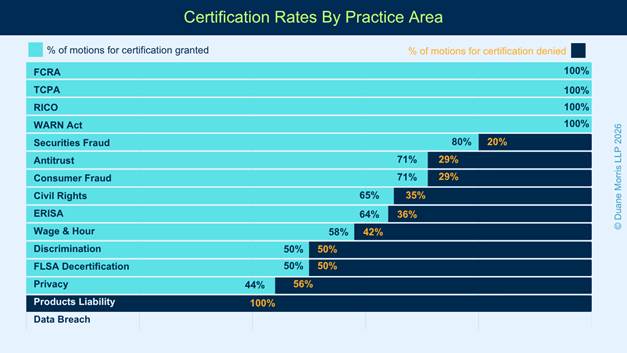
FCRA – 100% granted / 0% denied (2 of 2 granted / 0 of 2 denied) TCPA – 100% granted / 0% denied (2 of 2 granted / 0 of 2 denied) RICO – 100% granted / 0% denied (1 of 1 granted / 0 of 1 denied) WARN Act – 100% granted / 0% denied (1 of 1 granted / 0 of 1 denied)A Security Fraud – 80% granted / 20% denied (8 of 10 granted / 2 of 10 denied) Antitrust – 71% granted / 29% denied (5 of 7 granted / 2 of 7 denied) Consumer Fraud – 71% granted / 29% denied (10 of 14 granted / 4 of 14 denied) Civil Rights – 65% granted / 35% denied (13 of 20 granted / 7 of 20 denied) ERISA – 64% granted / 36% denied (9 of 14 granted / 5 of 14 denied) FLSA / Wage & Hour (Conditional Certification) – 58% granted / 42% denied (39 of 67 granted / 28 of 67 denied) Discrimination – 50% granted / 50% denied (2 of 4 granted / 2 of 4 denied) FLSA / Wage & Hour (Decertification) – 50% granted / 50% denied (1 of 2 granted / 1 of 2 denied) Privacy – 44% granted / 56% denied (4 of 9 granted / 5 of 9 denied) Products Liability / Mass Torts – 0% granted / 100% denied (0 of 1 granted / 1 of 1 denied) Data Breach – 0% granted / 0% denied (no class certification rulings in 2026)
The plaintiffs’ class action bar obtained 100% success rates in four areas, FCRA, TCPA, RICO, and WARN. There have only been two FCRA and TCPA certification rulings in 2026, and one each for RICO and WARN, which were all granted by the court for a 100% success rate. In cases alleging securities fraud violations, plaintiffs succeeded in obtaining orders certifying classes in 8 of 10 rulings, for a success rate of 80%. In cases alleging antitrust violations, plaintiffs managed to obtain class certification rulings in 5 of 7 rulings issued during the first half of 2026, a success rate of 71%. And in wage & hour litigation, plaintiffs were not nearly as successful as in previous years. They succeeded in obtaining orders certifying classes and/or collective actions in 39 of 67 rulings issued during 2026, a success rate of only 58%.
Courts Issued More Rulings In FLSA Collective Actions and Wage & Hour Class Actions Than In Any Other Areas Of Law
For the first half of calendar year 2026, courts issued more certification rulings in FLSA collective actions and wage & hour class actions than in other types of cases. Plaintiffs historically have been able to obtain conditional certification of FLSA collective actions at a high rate, which surely has contributed to the number of filings in this area. Of the 67 rulings addressing first-stage motions for conditional certification, the court granted 39, for a success rate of a much lower than typical 58%
In contrast, from January 1 to July 1, 2025, issued 74 rulings. Of these, 71 addressed first-stage motions for conditional certification of collective actions under 29 U.S.C. § 216(b), and 3 addressed second-stage motions for decertification of collective actions. Of the 71 rulings that courts issued on motions for conditional certification, 58 rulings favored plaintiffs, for a success rate of 82%.
At the decertification stage, courts generally have conducted a closer examination of the evidence and, as a result, defendants historically have enjoyed an equal if not higher rate of success on these second-stage motions as compared to plaintiffs. The results so far in 2026 have not supported that typical success. There have only been 2 rulings thus far that courts issued on motions for decertification of collective actions, and only 1 ruling favored defendants, for a success rate of 50%.
An analysis of the rulings demonstrates that a disproportionate number emanated from traditionally pro-plaintiff jurisdictions, including the judicial districts within the Second Circuit (16 decisions) and Ninth Circuit (14 decisions), which include New York and California, respectively.
Takeaways From Certification Statistics Midway Through 2026
Notable thus far at the halfway point of the year, there have been a very small number of rulings emanating from the Fifth and Sixth Circuits (2 and 1 decisions, respectfully), which was true in 2025 as well. There have overall been less rulings issued by the courts, and at a lower success rate than previous years.
We will continue to track class certification trends in 2026 and will report on final numbers in the Duane Morris Class Action Review – 2027, which will be published in the first week of January. Stay tuned!
By Gerald L. Maatman, Jr., Jamar D. Davis, and Olga A. Romadin
Duane Morris Takeaways: On July 1, 2026, the U.S. Equal Employment Opportunity Commission released a preliminary draft of its 2026-2030 Strategic Plan. The draft sets forth the EEOC plans to prevent and address employment discrimination via improved procedures and key performance metrics, expand outreach and training activities, and improve internal processes via talent retention and use of technology that improves efficiency. The four-year plan was published on the regulations.gov webpage and is open for comment until July 19, 2026. Even if employers do not submit comments, they would be well-advised to review the draft and final Strategic Plan once it is announced because it provides a window into the EEOC Commissioners’ thinking for how the agency will use its resources to redress and deter workplace discrimination.
Introduction
Every four years, the EEOC prepares a Strategic Plan that guides its anti-discrimination enforcement priorities. The 2026-2030 Strategic Plan newly published on the regulations.gov webpage gives significant insight into specific goals and metrics that the agency will measure its performance by in the next several years. The three goals of the draft Strategic Plan and their significance are critical information for employers to understand in navigating interpretations and compliance with EEOC regulations and guidelines.
Operational Improvements And Performance Metrics Sought By The EEOC
The 2026-2030 Strategic Plan draft signals that the EEOC will focus its operations on three key areas. First, the EEOC aims to increase the number of favorable outcomes and to seek non-monetary relief where appropriate. For its matter outcomes, the EEOC aims to obtain at least one million dollars in monetary relief for select systematic investigations, to favorably resolve at least ninety percent of its enforcement lawsuits, and ensure its hearings, investigations, and appears meet or exceed unspecified metrics. (Draft Strategic Plan at 14-16.) On this point, the draft Strategic Plan explains that the EEOC will use its prosecutorial discretion to focus on prioritizing the investigation, litigation, and resolution of complex cases. (Id.) In addition to seeking monetary relief, the EEOC aims to also seek non-monetary relief. The draft Plan explains the EEOC’s view that this type of relief could encompass hands-on training for employers and workers, implementing discrimination deterrence practices, and monitoring. (Id.)
The EEOC additionally aims to “achieve[] targeted equitable relief and at least $1 million in monetary relief” at a rate of 80% of its systemic investigations where cause is found. (Id.) The draft Strategic Plan states that the emphasis here is on cases with broad overall impact and relief for employees impacted by systemic discriminatory patterns, practices, or policies. (Id.)
Further, “the EEOC will make significant progress toward enhanced monitoring of conciliation agreements,” with the goal of publishing developments of its achievements for each year. (Id.) The Strategic Plan explains that improved training, enhanced tracking, and streamlined reporting are crucial aspects of this point. (Id.)
With regards to employees of the federal government, the draft Strategic Plan outlines a baseline measurement for cabinet-level agency compliance with Equal Employment Opportunities. (Id. at 16.) This includes improvements in processing complaints, approving affirmative action plans, and establishing compliance with the Elijah E. Cummings Federal Employee Anti-Discrimination Act of 2020 through timeliness. (Id.) Reasoning that the federal government is the largest employer in the country, the draft Strategic Plan notes that “reducing unlawful employment discrimination in the federal sector is an integral part of combatting employment discrimination in the nation’s workplaces,” and thus will have a great impact on private sector employers. (Id.)
The EEOC aims to have “at least 90% of completed investigations and conciliations, hearings, and federal appeals meet or exceed criteria” implemented in the Quality Practices Plan (“QEP”) for each program. (Id.) Building on the EEOC’s prior Strategic Plan’s QEP, the Commission states that the quality targets for resolving cases without litigation paved a way to success when implemented rigorously. (Id. at 17.) Further, the EEOC will seek to assess the current status of its previous goals and update them as needed in FY 2027-2030. (Id.)
Next, the EEOC plans to broaden its outreach and training activities to ensure that employees know their rights, and that employers are equipped with the tools necessary to preclude discrimination. (Id. at 18-20.) The action items for this goal include use of social media engagement, the implementation of three innovative means to conduct outreach, updating training materials to be user-friendly, and tracking the effectiveness of each outreach effort. (Id. at 19, 22.)
The EEOC additionally seeks to improve its accessibility through updating its technological capabilities. (Id. at 17.) The priority outlined in its seventh measure highlights reducing processing time and looks to speed up the charge filing process following intake, with the ultimate goal of reducing pending cases in the long-term. (Id.)
Finally, the EEOC will strive to improve its overall operations via three distinct areas of focus, which include (1) personnel, (2) services, and (3) financial efficiency. The EEOC would like to improve its operations with regards to its employees by maintaining staffing levels at or greater to 95% of the FTE baseline, invest in in-person trainings, and allow for select employees to participate in leadership development programs. (Id. at 25-26.) For its services, the EEOC will issue feedback surveys to assess areas of growth for the intake process, outreach and training, and mediation services offered, then implement process improvements to targeted areas. (Id. at 27.) For budget concerns, each program area will strive to meet operating constraints and meet all submission deadlines. (Id.)
Implications For Employers
The EEOC’s FY 2026-2030 draft Strategic Plan is a document that provides insight into the direction the agency will take to improve how it functions, and where it will focus the majority of its resources. Knowing what to expect from the Commission over the next four years places employers at an advantage when it comes to contingency planning and updating workplace discrimination policies.
By Gerald L. Maatman, Jr., Olga A. Romadin, and Elizabeth G. Underwood
Duane Morris Takeaways: On June 29, 2026, in Martinez v. T. Slack Environmental Services, Inc., No. A-1008-24 (N.J. App. Div. June 29, 2026), the New Jersey Appellate Division addressed key issues in a wage and hour representative action brought pursuant to the New Jersey Wage and Hour Law (“WHL”) and the Prevailing Wage Act (“PWA”), including whether a representative action brought under the WHL and the PWA is distinct from a class action under N.J. Rule 4:32-1, and the appropriate statute of limitations for companion wage claims. Id. at 2. The Appellate Division affirmed in part and reversed in part a decision of the trial court holding that the WHL and PWA statutory language is independent of Rule 4:32-1 and therefore does not require class certification, and finding that a two-year—and not six—statute of limitations applies to WHL and Earned Sick Leave Law (“ESLL”) claims. Id. at 3.
This decision is significant for employers in because it confirms that representative wage actions under New Jersey’s wage statutes may proceed outside Rule 4:32-1 class certification procedures while also clarifying that WHL and ESLL claims carry a two-year limitations period, and PWA claims carry a six-year limitations period as breach of contract claims.
Case Background
Juan Martinez (“Martinez”) alleged that he worked as an hourly laborer for T. Slack Environmental Services, Inc. (“T. Slack”), a small, non-union New Jersey contractor that employed between six and ten hourly laborers subject to the same pay practices from 2006 to 2019. Id. at 3-4.
In February 2020, Martinez filed a lawsuit in which he alleged that T. Slack failed to pay required prevailing wages for public work, including for tasks classified as “B” and “C” laborer functions under the PWA. Id. at 4. He also claimed that defendants miscalculated overtime by paying him at lower rates rather than using a blended or weighted rate when he worked on both public and private projects or in different job titles during the same week. Id. at 5. Martinez further alleged uncompensated “off-the-clock” work, including transporting equipment to and from worksites and defendants’ Kenilworth facility, and asserted that earned sick leave was improperly calculated using the lower private wage rate. Id. at 5-6.
Following discovery conducted under the supervision of a special adjudicator, Martinez moved to certify a statutory representative action under the WHL and PWA in September 2024. Id. at 6-7. Defendants opposed on several grounds, arguing that Martinez had not satisfied the class action requirements of Rule 4:32-1, that a representative action was not permissible outside of Rule 4:32-1, that the putative class lacked numerosity, that Martinez was not an adequate representative, and that individualized questions precluded both representative and class treatment. Id. at 7.
The motion court granted Martinez’s motion, certified the matter as a representative action, designated Martinez as the representative of defendants’ current and former employees, and imposed a six-year look-back period for overtime claims from February 28, 2014, to February 28, 2020. Id. at 7. Defendants appealed. Id. at 8.
The Appellate Division’s Decision
The Appellate Division held, consistent with its recent decision in Cano v. County Concrete Corp., 483 N.J. Super. 459 (App. Div. 2026), that “the statutory language of both the WHL and PWA is independent of Rule 4:32-1 and therefore does not require class certification.” Id. at 3. The Appellate Division explained that the remedial nature of the PWA permits any worker “to maintain such action for and on behalf of [themselves] or other work[ers] similarly situated,” N.J.S.A. 34:11-56.40, and that this statute addresses the similar concerns of the WHL and ESLL. Id. at 15.
In addition, the Appellate Division rejected T. Slack’s argument that Martinez was required to present evidence of other similarly situated employees to qualify as a representative action. Id. Instead, it determined that, as in Cano, Martinez’s complaint put defendants on notice regarding the existence of similarly situated employees, and that the plain language of the PWA and WHL does not require a named plaintiff to identify the similarly situated employees to defendants. Id. at 15-16. Defendants, moreover, were already aware of approximately fifteen employees whose names and contact information had previously been provided to Martinez. Id. at 16.
Lastly, the Appellate Division reversed the six-year look-back period for WHL claims, and, by incorporation, ESLL claims. Id. at 18. Relying on Maia v. IEW Constr. Grp., 257 N.J. 330 (2024), the Appellate Division held that the 2019 amendment extending the WHL limitations period from two years to six years applies prospectively only, so the two-year limitations period governed those claims. Id.
On the other hand, the Appellate Division affirmed the six-year look-back period for PWA claims. Id. at 18-19. Because PWA claims for unpaid prevailing wages are treated as breach of contract claims, and the PWA does not provide its own limitations period, the general six-year contract limitations period under N.J.S.A. 2A:14-1 applied. Id. at 19.
Implications For Employers
This decision confirms that representative wage actions under New Jersey’s WHL, PWA, and ESLL may proceed independently of Rule 4:32-1 class certification requirements. While this may expand procedural avenues for plaintiffs pursuing wage claims on behalf of similarly situated employees, employers should note that the decision also limits potential exposure for WHL and ESLL claims by applying a two-year statute of limitations to pre-2019 conduct.
By Gerald L. Maatman, Jr., Daniel D. Spencer, and George J. Schaller
Duane Morris Takeaways: On June 10, 2026, in Citizens of Humanity, LLC v. John Donboli et al., No. D085849, 2026 Cal. App. LEXIS 360 (Cal. App. June 10, 2026), the California Court of Appeal affirmed the trial court’s decision in favor of Defendants in a malicious prosecution action stemming from a consumer class action over “Made in the U.S.A.” labeling on jeans. The Court of Appeal held that a familial relationship between a named plaintiff and class counsel does not, as a matter of law, deprive a class action of probable cause, and that Apple Computer, Inc. v. Superior Court, 126 Cal.App.4th 1253(2005), does not establish a per se bar on relatives of class counsel serving as class representatives.
For companies that have faced consumer class actions and are considering malicious prosecution counterclaims, this decision underscores that the probable cause standard remains a high bar and requires a showing that any reasonable attorney would agree the underlying claims were totally and completely without merit.
Case Background
Citizens of Humanity LLC is a jeans manufacturer whose products had “Made in the U.S.A.” labels, despite Citizens Ingrid-style jeans having fabrics and components sourced from Japan and China. Citizens of Humanity, LLC v. John Donboli et al., No. D085849, 2026 Cal. App. LEXIS 360, *7 n. 2 (Cal. App. June 10, 2026).
In June 2014, attorneys John Donboli and JL Sean Slattery of Del Mar Law Group LLP filed a putative class action against Citizens in federal court, alleging the labels violated former California Business and Professions Code § 17533.7, the Consumers Legal Remedies Act, and the Unfair Competition Law. Id. at *3.
In the federal court action against Citizens, Louise Clark served as the named-plaintiff who previously purchased Citizens’ Ingrid-style jeans. Citizens later discovered Clark was attorney Slattery’s sister-in-law. Id. Based on this familial relationship, Citizens moved to disqualify Del Mar Law Group as class counsel. While that motion was pending, Clark filed a motion to withdraw and substitute a new named-plaintiff, Coni Hass. Id. at *4. The federal court granted the motion to withdraw and substitute and found that the substitution “vitiate[d]” Citizen’s disqualification motion and also held Citizens “failed to demonstrate that [Clark] or her counsel . . . acted in bad faith” in requesting substitution. Id.
As the action was pending, the California Legislature amended § 17533.7 to permit “Made in the U.S.A.” labeling where foreign-sourced materials constitute no more than 5% (or 10% if not domestically sourceable) of the final wholesale value of the product. Id. In response to the amendment, Citizens moved to dismiss. The district court granted Citizens’ motion and allowed Hass leave to amend, but Hass elected not to amend and the case was dismissed. Id.
In February 2018, Citizens filed this action for malicious prosecution against attorneys Donboli and Slattery, Del Mar Law Group, and former named plaintiffs Clark and Hass (collectively “Defendants”).
Defendants moved to strike the complaint under the anti-SLAPP statute, but the trial court denied their motion, and that ruling was later affirmed by this Court of Appeal (see Citizens of Humanity, LLC v. Hass, 46 Cal.App.5th 589 (2020)). Citizens of Humanity, LLC, 2026 Cal. App. LEXIS 360 at *5.
In affirming, the Court of Appeal “found two conflicting narratives . . . regarding the origin of the federal mislabeling case.” Id. at *5-6. It concluded one possible narrative was “that Clark was a shill plaintiff, and [her attorneys] were aware of this fact.” The second possible narrative focused on Hass and whether Defendants “knew ‘that Hass purchased Ingrid-style jeans with a label that said ‘Made in the U.S.A.’ and components of those jeans came from a foreign country[.]’” Id. at *6.
After affirming, the case was remanded and the matter proceeded to trial. After opening statements, and after Citizens presented testimony from the company’s founder, the parties asked the court “to ‘review certain exhibits, [and] deposition testimony from Clark and Hass’ and the parties ‘agreed to have the [c]ourt make a determination on probable cause’” consequently waiving their right for the jury to decide that issue. Id. at *7. After accepting evidence and hearing argument the trial court ruled in favor of Defendants concluding “Citizens had not established [Defendants] lacked probable cause for” the previously filed putative class action and entered judgment for Defendants. Id. at *7-8. Citizens appealed.
The Court of Appeal’s Decision
The Court of Appeal affirmed the decision of the trial court.
Citizens’ primary argument on appeal was that Defendants lacked probable cause as a matter of law because Clark, as Slaterry’s sister-in-law, was an improper class representative under Apple Computer, Inc. v. Superior Court. Citizens relied on the Apple court’s observation that “the majority of courts . . . have refused to permit class attorneys, their relatives, or business associates from acting as the class representative.” Citizens of Humanity, LLC, 2026 Cal. App. LEXIS 360 at *10-11. The Court of Appeal rejected this argument on multiple grounds.
First, the Court of Appeal distinguished Apple factually and noted that the plaintiff in that case was an attorney at one of the representing firms who stood to gain monetarily from recovery of attorney fees. Id. at *11. The Court of Appeal reasoned that Apple addressed a “‘financial relationship and interdependence between’ the plaintiff and associated.” Id. Here, however, Citizens presented no information “about any ‘financial relationship’ between Slattery and Clark.” The Court of Appeal also determined it was not “reasonable to presume ‘interdependence’ solely based on [Slattery and Clark’s] relationship as siblings-in-law.” Id.
Second, the Court of Appeal held that the relevant passage in Apple is, “at best” “dictum that cannot bind very reasonable attorney on threat of a malicious prosecution judgment.” Id. at *12.
Third, it reasoned that even if a disqualifying conflict existed, it would not be fatal to the putative class action against Citizens. As the Court of Appeal noted “Clark could have pursued the claim with different counsel, or [Del Mar] Law Group could have proceeded with a different representative plaintiff, which is what the district court authorized here after Clark decided to withdraw.” Id. at *13.
Accordingly, the Court of Appeal affirmed and agreed with “the trial court’s conclusion that Apple is not determinative of the probable cause analysis here.” Id.
Implications For Corporate Litigants
For companies facing consumer class actions, including those with origin-of-manufacture claims such as “Made in the U.S.A.,” this decision serves as a reminder that labeling must comply with current statutory standards.
Even assuming a company is successful in defeating a consumer class action, then companies considering malicious prosecution actions should take note that class representative conflicts, including familial relationships with class counsel, are evaluated on a fact-specific basis. There is no per se rule of disqualification, and even where a conflict exists, it goes to the fitness of counsel or the representative, not the viability of the underlying claim itself. As the Court of Appeal noted here, the class action can proceed with substitute counsel or a substitute plaintiff.
The decision in Citizens of Humanity, LLC, serves as a cautionary tale that even relatives of class counsel can potentially serve as class representatives and further narrows adequacy challenges to class certification. It also demonstrates another way class counsel can creatively select representative plaintiffs while still allowing courts to scrutinize representative plaintiffs for actual conflicts on a case-by-case basis.
Duane Morris Takeaways: Corporate defendants saw unprecedented settlement numbers across all areas of class action litigation between 2022 and 2025, and mid-year through 2026, settlement numbers are even more robust. The cumulative value of the top ten settlements across all substantive areas of class action litigation hit record highs in 2025, surpassing the highest levels ever in 2022. When the numbers for the previous few years are combined, the total signals that corporate defendants have entered a new era of heightened risks and higher stakes in the valuation of class actions.
On an aggregate basis, across all areas of litigation, class actions and government enforcement lawsuits garnered more than $79 billion in 2025, $42 billion in 2024, $51.4 billion in settlements in 2023, and a $66 billion in 2022. When combined, the four-year settlement total eclipses any other four-year period in the history of American jurisprudence.
As a prelude to the Duane Morris Class Action Review – 2027, this blog post reports on our analysis of class action settlements through the first half of 2026. The data shows that for the period of January 1 to June 30, 2026, the current year is ahead of the historically high numbers of 2025. As of the end of the first half of 2026, the aggregate settlement total across all areas of class action litigation and government enforcement lawsuits is $53.795 billion (in accounting for the top 5 settlements in the various substantive areas of law). By comparison, in 2025 at the half-way mark, the aggregate settlement total was $21.77 billion.
It is anticipated that these numbers will increase across the board by the end of the year and when measured by the top 10 settlements in each category.
More Billion Dollar Class Action Settlements
At the mid-way point of 2026, there are three settlements over the billion-dollar mark. There were eight total billion-dollar settlements in 2025. The 10 individual billion-dollar settlements in 2024 surpassed the number in 2023, and only fell short of the number of billion-dollar settlements in 2022. In 2023, parties resolved nine class actions for $1 billion or more. In 2022, parties resolved 15 class actions for $1 billion or more in settlement dollars. Together with the three thus far in 2026, corporations have seen 45 settlements of one billion dollars or more in four and a half years. This string of settlements marks the most extensive set of billion-dollar class action settlements in the history of the American court system.
The Scorecard On Leading Class Actions Settlements Halfway Through 2026
The plaintiffs’ class action bar has scored rich settlements thus far in 2026 in virtually every area of class action litigation. The following list shows the totals of the top 5 settlements at the mid-year point in 2026 in key areas of class action litigation:
$34.875 Billion – Antitrust class actions $8.609 Billion – Products liability/Mass Tort class actions $4.25 Billion – Government Enforcement actions $1.979 Billion – Securities Fraud class actions $1.535 Billion – Consumer Fraud class actions $624 Million – Privacy class actions $501 Million – ERISA class actions $392.1 Million – Discrimination class actions $323.9 Million – Wage & Hour class and collective actions $309.7 Million – Data Breach class actions $242.45 Million – Labor class actions $105.05 Million – Fair Credit Reporting Act class actions $60.93 Million – TCPA class actions $41.9 Million – Civil Rights class actions
The high dollar settlements of the past four years suggested that the plaintiffs’ bar would continue to be equally, if not more aggressive, with their case filings and settlement positions. From the 2026 data, it certainly looks to be the case as we end the first half of the year. The data points in each category are set out in the following charts.
Top Class & Collective Action Litigation Settlements In 2026
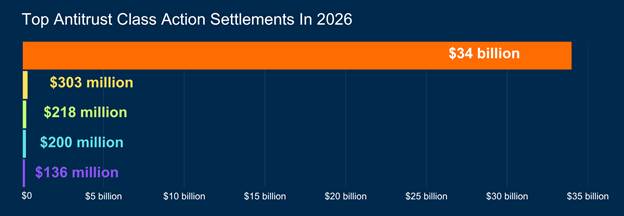
Top Antitrust Class Action Settlements In 2026
The top 10 antitrust class action settlements totaled $45.99 billion in 2025, $8.412 billion in 2024, $11.74 billion in 2023, and $3.72 billion in 2022.
$34 billion – In Re Payment Card Interchange Fee And Merchant Discount Antitrust Litigation, Case No. 05-MD-1720 (E.D.N.Y. June 9, 2026) (preliminary settlement approval granted to Visa’s and Mastercard’s revised settlement with merchants who accused the card networks of charging too much to process payments on their credit cards).
$303 million – Ray, et al. v. NCAA, Case No. 23-CV-425 (E.D. Cal. May 12, 2026) (final settlement approval granted in a class action to resolve claims from thousands of Division I volunteer coaches alleging that the organization’s rules fixed their compensation at zero).
$218 million – In Re Realpage Inc. Rental Software Antitrust Litigation, Case No. 23-MD-3071 (M.D. Tenn. May 22, 2026) (May 22, 2026) (preliminary settlement approval granted to resolve claims from a second set of renters alleging antitrust claims that they colluded with revenue management firm RealPage Inc. to fix rental prices across the country).
$200 million – In Re Generic Pharmaceutical Pricing Antitrust Litigation, Case No. 16-MD-2724 (E.D. Penn. Jan 23, 2026) (final settlement approval granted in a class action to resolve claims alleging antitrust claims alleging the defendants conspired with other drugmakers to inflate generic drug prices).
$136 million – In Re PVC Pipe Antitrust Litigation, Case No. 24-CV-7639 (N.D. Ill. May 13, 2026) (preliminary settlement approval granted in a class action to resolve claims alleging that the company conspired with other polyvinyl chloride pipe producers to fix prices).
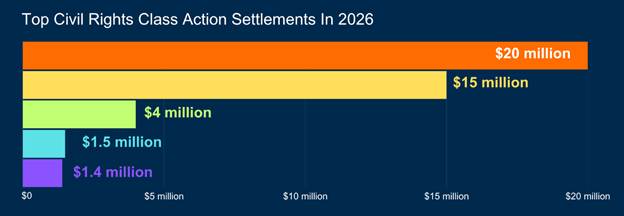
Top Civil Rights Class Action Settlements In 2026
The top 10 civil rights class action settlements totaled $580.9 million in 2025, $313.8 million in 2024, $643.15 million in 2023, and $1.31 billion in 2022.
$20 million – Healy, et al. v. Jefferson County Kentucky Louisville Metro Government, Case No. 17-CV-71 (W.D. Ky. Mar. 11, 2026) (preliminary settlement approval granted in a class action to resolve claims alleging that the County regularly imprisons, detains or incarcerates persons longer than ordered by Courts of the Commonwealth of Kentucky, and under conditions that violate the orders of such Courts).
$15 million – Johnson, et al. v. City Of Annapolis, Case No. 21-CV-112 (D. Md. May 26, 2026) (settlement reached in two class actions to resolve claims from more than 1,400 city residents of public housing and by representatives of a former public housing resident who died alleging substandard housing conditions at properties owned and operated by the Housing Authority of the City of Annapolis (HACA).
$4 million – Cody, et al. v. City Of St. Louis, Case No. 17-CV-2707 (E.D. Mo. Feb. 13, 2026) (preliminary settlement approval granted in a class action to resolve claims from hundreds of people who say they endured inhumane conditions while held at the city’s Medium Security Institution, commonly known as the Workhouse).
$1.5 million – Coleman, et al. v. City Of Brookside, Case No. 22-CV-423 (N.D. Ala. Feb. 6, 2026) (preliminary settlement approval sought in a class action to resolve claims brought by four drivers who said they were targeted in an aggressive towing and ticketing scheme).
$1.4 million – Santiago, et al. v. City Of Chicago, Case No. 22-CV-5827 (N.D. Ill. Apr. 8, 2026) (preliminary settlement approval granted in two consolidated actions to resolve claims alleging the city of Chicago tows vehicles it deems abandoned without properly notifying their owners).
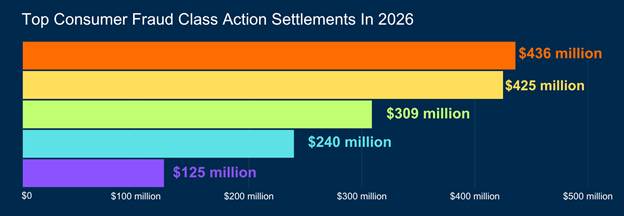
Top Consumer Fraud Class Action Settlements In 2026
The top 10 consumer fraud class action settlements totaled $2.1 billion in 2025, $2.44 billion in 2024, $3.29 billion in 2023, and $8.596 billion in 2022.
$436 million – Broadmoor Lumber & Plywood Co. et al. v. Toyota Industries Corp., Case No. 24-CV-6640 (N.D. Cal. Feb. 26, 2026) (preliminary settlement approval granted in a class action to resolve claims alleging that the defendant and its subsidiaries misled tens of thousands of business buyers into thinking the emissions of its forklift and construction engines were “the cleanest” in the industry).
$425 million – In Re Capital One 360 Savings Account Interest Rate Litigation, Case No. 24-MD-311 (E.D. Va. Apr. 20, 2026) (final settlement approval granted in a class action to resolve claims alleging that Capital One deceptively advertised its 360 Savings accounts).
$309 million – In Re Amazon Return Policy Litigation, Case No. 23-CV-1372 (W.D. Wash. Jan. 27, 2026) (settlement approval sought in a class action to resolve a proposed class action accusing Amazon of shortchanging customers on refunds for returned items).
$240 million – Bickerstaff, et al. v. SunTrust Bank, Case No. 10EV010485 (Ga. Cir. Ct. May 26, 2026) (final settlement approval granted in a class action alleging that the bank charged illegal overdrafts on ATM and debit card transactions which harmed Georgia consumers).
$125 million – National Veterans Legal Services Program, et al. v. United States, Case No. 24-1757 (Fed. Cir. Mar. 20, 2026) (settlement approval affirmed in a class action to resolve claims of hundreds of thousands of PACER users who were allegedly made to pay more than the law allowed).
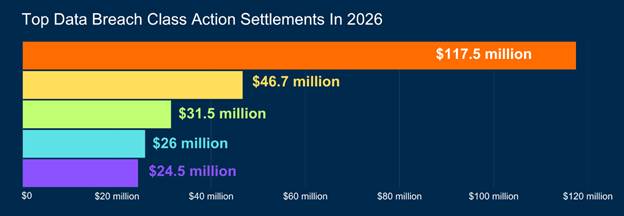
Top Data Breach Class Action Settlements In 2026
The top 10 data breach class action settlements totaled $515.79 million in 2025, $593.2 million in 2024, $515.75 million in 2023, and $719.21 million in 2022.
$117.5 million – Hasson, et al. v. Comcast Cable Communications LLC, Case No. 23-CV-5039 (E.D. Penn. May 13, 2026) (final settlement approval granted in a consolidated class action lawsuit alleging the internet and mobile services provider failed to implement proper cybersecurity measures to safeguard sensitive consumer information, leading to an October 2023 data breach).
$46.7 million – In Re 23andMe, Inc., Customer Data Security Breach Litigation, Case No. 24-MD-3098 (N.D. Cal. Feb. 6, 2026) (final settlement approval granted in a class action to resolve claims alleging that 23andMe Inc. and affiliates had a data breach in which millions of customers’ genetic data and personally identifiable information (PII) was hacked).
$31.5 million – Angus, et al. v. Flagstar Bank FSB, Case No. 21-CV-10657 (E.D. Mich. Mar. 12, 2026) (preliminary settlement approval granted in a class action to resolve consolidated class claims that Flagstar Bank failed to protect the personal information of customers and employees in two data breaches impacting more than 2 million people).
$26 million – In Re Lakeview Loan Servicing Data Breach Litigation, Case No. 22-CV-20955 (M.D. Fla. Feb. 4, 2026) (preliminary settlement approval granted to settle a class action over their personally identifiable information potentially being accessed during a data breach).
$24.5 million – In Re LastPass Data Security Incident Litigation, Case No. 22-CV-12047 (D. Mass. Feb. 2, 2026) (preliminary settlement approval granted to settle a proposed class action over a 2022 data breach that exposed the personal information of millions of people and led to the looting of cryptocurrency accounts).
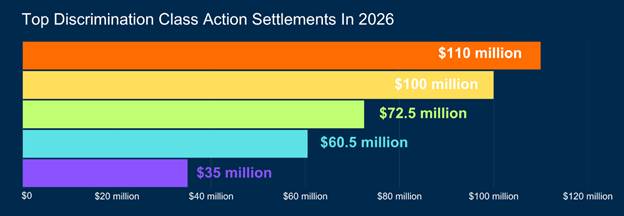
Top Discrimination Class Action Settlements In 2026
The top 10 discrimination class action settlements totaled $507.10 million in 2025, $356.8 million in 2024, $762.2 million in 2023, and $597 million in 2022.
$110 million – In Re Wells Fargo & Co. Hiring Practices Derivative Litigation, Case No. 22-CV-5173 (N.D. Cal. May 15, 2026) (final settlement approval granted in a class action to resolve a shareholder derivative lawsuit accusing the bank of corporate mismanagement through discriminatory hiring and lending).
$100 million – Snyder-Hill, et al. v. The Ohio State University, Case No. 23-cv-2993, Knight, et al. v. The Ohio State University, Case No. 23-CV-2994, and Gonzales, et al. v. The Ohio State University, Case No. 23-CV-3051 (S.D. Ohio June 22, 2026) (board approval of a settlement agreement to resolve claims from approximately 300 former students accusing former Ohio State University sports doctor Richard Strauss of sexual abuse).
$72.5 million – Doe, et al. v. Bank Of America NA, Case No. 25-CV-8520 (S.D.N.Y. Apr. 2, 2026) (preliminary settlement approval granted in a class action to resolve claims alleging that the defendant Jeffrey Epstein’s sex trafficking and abuse).
$60.5 million – Candelore, et al. v. Tinder, Inc., Case No. BC583162 (Cal. Super. Ct. June 4, 2026) (final settlement approval granted in a class action to resolve claims alleging that the company charged older users more than younger users for Tinder Plus and Tinder Gold subscriptions.
$35 million – Bensky, et al. v. Darren Indyke, Case No. 24-CV-1204 (S.D.N.Y. Mar. 3, 2026) (preliminary settlement approval granted in a class action alleging that the defendants helped facilitate Jeffrey Epstein’s vast sex trafficking enterprise).
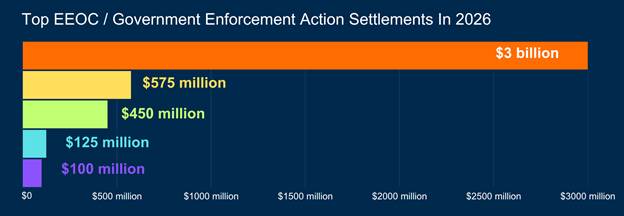
Top EEOC / Government Enforcement Class Action Settlements In 2026
The top 10 EEOC / government enforcement class action settlements totaled $3.29 billion in 2025, $335.9 million in 2024, $263.58 million in 2023, and $404.5 million in 2022.
$3 billion – New Jersey Department Of Environmental Protection, et al. v. E.I. du Pont de Nemours & Co., Case No. 19-CV-14758 & 19-CV-14766 (D.N.J. June 24, 2026) (settlement approval pending to resolve the state’s claims over contamination caused by the manufacture and discharge of forever chemicals).
$575 million – United States Of America, et al. v. PacifiCorp., Case No. 24-CV-2102 (D. Ore. Feb. 20, 2026) (settlement reached to resolve claims for damages related to wildfires in Oregon and Northern California).
$450 million – United States Of America, et al. v. Chemours Co., Case No. 26-CV-418 (S.D. W. Va. June 24, 2026) (proposed consent decree entered for a multi-state settlement with Chemours Co. over alleged years-long, illegal discharges of synthetic “forever chemicals” used to make products resistant to water, grease and stains).
$125 million –Illinois And Peoples Gas and Northshore Gas (Ill. Cmrc. Comm. Apr. 30, 2026) (settlement reached with two gas companies and the Attorney General’s office on behalf of customers concerning costs related to Peoples Gas’ ongoing, massive program to retire cast- and ductile-iron mains).
$100 million – Federal Trade Commission, et al. v. Walmart Inc., Case No. 26-CV-1655 (N.D. Cal. Feb. 27, 2026) (consent decree entered to settle claims the company misled its “Spark” delivery program drivers over the amount they would be paid, and deceived customers over how much of the tips they paid would go to their drivers).
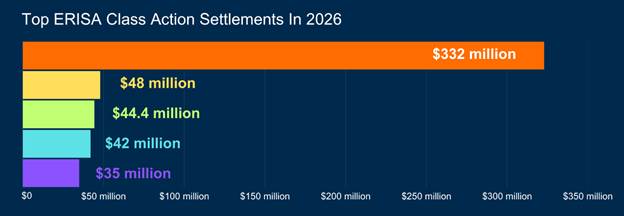
Top ERISA Class Action Settlements In 2026
The top 10 ERISA class action settlements totaled $680.30 million in 2025, $413.3 million in 2024, $580.5 million in 2023, and $399.6 million in 2022.
$332 million – McCutcheon, et al. v. Colgate-Palmolive Co., Case No. 16-CV-4170 (S.D. N.Y. Jan. 14, 2026) (final settlement approval granted in a class action to resolve claims alleging that Colgate-Palmolive violated ERISA by miscalculating pension benefits for retirees who took lump-sum distributions between 1989 and 2005).
$48 million – Hoak, et al. v. Ledford, Case No. 15-CV-3983 (N.D. Ga. May 13, 2026) (preliminary settlement approval sought in a class action to resolve claims alleging that the defendant failed to provide annuity payments for life).
$44.4 million – In Re AME Church Employee Retirement Fund Litigation, Case No. 22-MD-3035 (W.D. Tenn. Mar. 24, 2026) (preliminary settlement approval granted in a multidistrict litigation from a class of African Methodist Episcopal Church workers who alleged that mismanagement of their annuity retirement plan allowed a rogue employee to embezzle $90 million).
$42 million – Halter, et al. v. Providence Health & Services, Case No. 25-CV-210 (W.D. Wash. June 4, 2026) (preliminary settlement approval granted in a class action to resolve claims alleging that Providence mismanaged its employees’ retirement plan by failing to use money forfeited by departing workers to reduce administrative expenses).
$35 million – Iron Workers District Council Of New England Health And Welfare Fund, et al. v. Teva Pharmaceutical Industries Ltd., Case No. 23-CV-11131 (D. Mass. Apr. 3, 2026) (preliminary settlement approval granted in a class action to resolve claims from a coalition of union healthcare funds alleging that the defendant schemed to delay generic competition for its QVAR asthma inhalers).
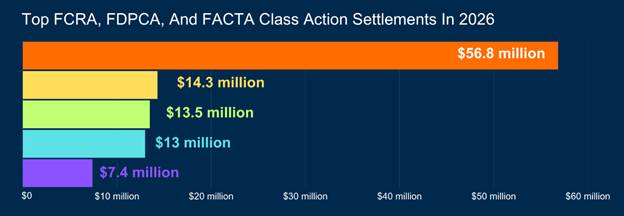
Top FCRA, FDPCA, And FACTA Class Action Settlements In 2026
The top 10 FCRA, FDPCA, and FACTA class action settlements totaled $74.77 million in 2025, $42.43 million in 2024, $100.15 million in 2023, and $210.11 million in 2022.
$56.85 million – Stoff, et al. v. Wells Fargo Bank N.A., Case No. 37-2020-00020808-CU-BT-CTL (Cal. Super. Ct. Apr. 17, 2026) (final settlement approval granted in a class action to resolve claims alleging that the company violated the federal Fair Credit Reporting Act (FCRA) by failing to report CARES Act forbearances accurately).
$14.3 million – Ray, et al. v. AdaptHealth Corp., Case No. 22-CV-898 (M.D.N.C. June 1, 2026) (preliminary settlement approval sought in a class action to resolve claims alleging that the company violated the North Carolina Debt Collection Act by overcharging and trying to collect debts from patients who had returned medical equipment to the company).
$13.5 million – Scroggins, et al. v. LexisNexis Risk Solutions FL Inc., Case No. 22-cv-00545 (E.D. Va. Mar. 16, 2026) (final settlement approval granted in a class action to resolve claims alleging that the defendant incorrectly reported some consumers as deceased).
$13 million – VanderKodde, et al. v. Elliott, Case No. 17-CV-203 (W.D. Mich. Apr. 13, 2026) (final settlement approval granted in a class action to resolve claims from debtors who alleged that a creditor law firm charged unlawfully high post-judgment interest rates during debt collection).
$7.4 million – Keim, et al. v. Trader Joe’s, Case No. 19STCV36790 (Cal. Super. Ct. Feb. 5, 2026) (preliminary settlement approval granted in a class action to resolve claims alleging that the grocery store violated the Fair and Accurate Credit Transactions Act by providing customers with printed receipts that displayed both the first six and last four digits of their card numbers).
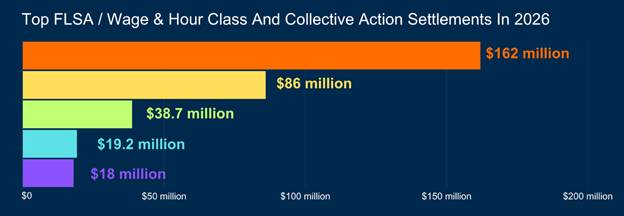
Top FLSA / Wage & Hour Class And Collective Settlements In 2026
The top 10 FLSA / wage & hour class and collective action settlements totaled $430.58 million in 2025, $614.55 million in 2024, $742.5 million in 2023, and $574.55 million in 2022.
$162 million – Calderon, et al. v. Public Partnerships LLC, Case No. 25-CV-2320 (E.D.N.Y. June 23, 2026) (preliminary settlement approval sought in a class action to resolve claims alleging that the company failed to timely and accurately pay about 200,000 personal assistants).
$86 million – Callister, et al. v. Swedish Health Services, Case No. 21-2-16148-7 (Wash. Super. Ct. May 8, 2026) (preliminary settlement approval granted in a class action alleging that the company failed to provide required second meal periods for employees working shifts longer than 10 hours, and underpaid workers through a policy of rounding time entries).
$38.7 million – Pruess, et al. v. Presbyterian Health Plan Inc., Case No. 19-CV-629 (D.N.M. Jan. 9, 2026) (D.N.M. June 24, 2026) (final settlement approval granted to resolve claims alleging that the defendant failed to pay overtime compensation to care workers in violation of the FLSA).
$19.2 million – Diaz, et al. v. New York Paving Inc., Case No. 18-CV-4910 (S.D.N.Y. June 17, 2026) (final settlement approval granted in a class action to resolve claims alleging that the defendant failed to pay for pre- and post-shift work and for overtime compensation).
$18 million – Abarca, et al. v. Werner Enterprises Inc., Case No. 14-CV-319, Smith, et al. v. Werner Enterprises Inc., Case No. 15-CV-287, and Vester, et al. v. Werner Enterprises Inc., Case No. 17-CV-145 (D. Neb. Feb. 5, 2026) (preliminary settlement approval granted in a collective action to resolve claims alleging that Werner failed to pay minimum wages for non-driving work time, including time spent in sleeper berths, waiting for loads, performing pre-trip and post-trip inspections and attending to cargo security).
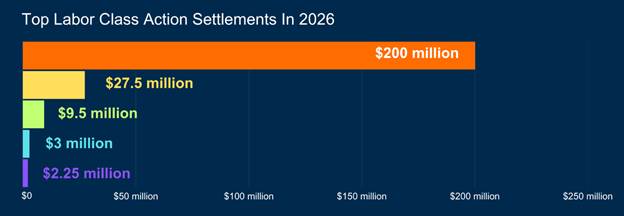
Top Labor Class Action Settlements In 2026
The top 10 labor class action settlements totaled $210.5 million in 2025, $237.0 million in 2024 and $129.67 million in 2023.
$200.2 million – Brown, et al. v. JBS, Inc., Case No. 22-CV-2946 (D. Colo. Jan. 15, 2026) (preliminary settlement approval granted in a class action to resolve claims between former employees and Agri Beef, American Foods Group, Cargill, Hormel, JBS, National Beef, Nebraska Beef, Perdue Farms, Quality Pork, Seaboard Foods, Triumph Foods and Tyson Foods alleging that the companies unlawfully conspired to suppress the wages of workers at their processing plants).
$27.5 million – Hoffman, et al. v. United Airlines, Inc., Case No. 21-CV-6395 (N.D. Ill. Mar. 11, 2026) (settlement reached in a class action to settle a lawsuit by former employees who say the defendant mishandled recent voluntary buyout programs).
$9.5 million – Dorrell, et al. v. Constellation Energy Corp., Case No. 25-CV-2251 (D. Md. May 12, 2026) (preliminary settlement approval sought in a class action alleging that the company conspired with other major nuclear power generation companies to illegally limit compensation for employees).
$3 million – Bailey, et al. v. Sedgwick Claims Management Services, Inc., Case No. 24-CV-2749 (W.D. Tenn. May 1, 2026) (preliminary settlement approval sought in a class action to resolve claims alleging that the defendant failed to retroactively reimburse the tobacco penalties paid by certain employees who subsequently complete a quit-smoking program, and of failing to inform workers that recommendations from their personal physicians will be considered in the course of assessing penalties).
$2.25 million – Brinkman, et al. v. Target Corporation, Case No. 24-2- 25091-3 (Wash. Super. Ct. May 5, 2026) (final settlement approval granted in a class action to resolve claims alleging that the company failed to disclose wage scales and salary ranges in Washington job postings).
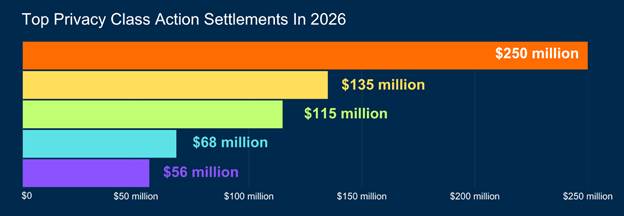
Top Privacy Class Action Settlements In 2026
The top 10 privacy class action settlements totaled $801.85 million in 2025, $2.01 billion in 2024, $1.32 billion in 2023, and $896.7 million in 2022.
$250 million – Landsheft, et al. v. Apple Inc., Case No. 25-CV-2668 (N.D. Cal. May 5, 2026) (preliminary settlement approval sought in a class action to resolve claims alleging that Apple misled millions of iPhone buyers by falsely touting artificial intelligence capabilities for its Siri voice assistant in 2024).
$135 million – Taylor, et al. v. Google LLC, Case No. 20-CV-7956 (N.D. Cal. Jan. 27, 2026) (preliminary settlement approval sought in a class action class action alleging Google illegally consumes the cellular data consumers have purchased from their cellular providers).
$115 million – Katz-Lacabe, et al. v. Oracle America Inc., No. 24-7648 (9th Cir. Feb. 13, 2026) (final settlement approval affirmed in a privacy lawsuit over the defendant’s online data-collection practices despite the objections of one class member).
$68 million – In Re Google Assistant Privacy Litigation, Case No. 19-CV-4286 (N.D. Cal. Mar. 19, 2026) (preliminary settlement approval granted in a class action to resolve claims alleging that Google eavesdropped on and recorded confidential communications without user consent).
$56 million – Frasco, et al. v. Flo Health Inc., Case No. 21-CV-757 (N.D. Cal. Apr. 22, 2026) (preliminary settlement approval granted in a class action to resolve from Flo users who alleged Google illegally intercepted the private menstrual health data of millions of users without their consent).
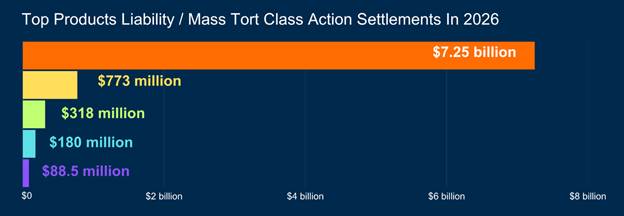
Top Products Liability And Mass Tort Class Action Settlements In 2026
The top 10 products liability / mass tort class action settlements totaled $17.9 billion in 2025, $23.40 billion in 2024, $25.83 billion in 2023, and $50.32 billion in 2022.
$7.25 billion – King, et al. v. Monsanto Co., Case No. 2622-CC00325 (Mo. Cir. Ct. Mar. 4, 2026) (preliminary settlement approval granted to resolve current and future claims across the U.S. that weed killer Roundup causes non-Hodgkin lymphoma).
$773 million – In Re National Prescription Opiate Litigation, Case No. 17-MD-2804 (N.D. Ohio Apr. 14, 2026) (Albertsons Cos. Inc. and the attorneys general of California, Colorado, Illinois, and Oregon agreed to a settlement in principle to end claims brought by states, local governments, and Native American tribes over its role in the opioid crisis).
$318 million – In Re 650 Fifth Avenue and Related Properties, Case No. 08-CV-10934 (S.D.N.Y. Mar. 23, 2026) (settlement approval granted in a class action to resolve claims stemming from the federal government’s forfeiture action against a 36-story Midtown Manhattan office tower linked to the Iranian government).
$180 million – The Diocese of Camden, New Jersey, Case No. 20-BK-21257 (D.N.J. Bank. Ct. Feb. 17, 2026) (settlement reached pending approval by the bankruptcy court in a class action to resolve a dispute arising from claims of sexual abuse by members of the Diocesan clergy).
$88.5 million – In Re National Prescription Opiate Litigation, Case No.17-MD-2804 (N.D. Ohio Jan. 29, 2026) (final settlement agreement granted with Amneal Pharmaceuticals and several states to resolve litigation over its role in creating and fueling the opioid overdose epidemic).
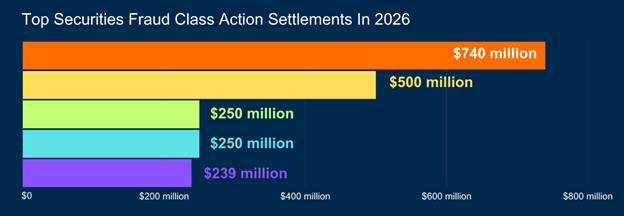
Top Securities Fraud Class Action Settlements In 2026
The top 10 securities fraud class action settlements totaled $3.45 billion in 2025, $2.55 billion in 2024, $5.4 billion in 2023, and $3.25 billion in 2022.
$740 million – In Re Didi Global Securities Litigation, Case No. 21-CV-5807 (S.D.N.Y. June 16, 2026) (final settlement approval granted in a class action to resolve claims by investors alleging that defendants violated the federal securities laws by making false and misleading statements and omissions in the Registration Statement and engaged in deceptive conduct in connection with DiDi’s June 30, 2021 Initial Public Offering (IPO).
$500 million – Sjunde AP-Fonden, et al. v. The Goldman Sachs Group Inc., Case No. 18-CV-12084 (S.D.N.Y. May 20, 2026) (settlement reached in a class action brought by investors who asserted that they lost money after it came to light that the company was allegedly involved in a bribery scandal tied to Malaysia’s sovereign wealth fund).
$250 million – Crews, Jr., et al. v. Rivian Automotive, Inc., Case No. 22-CV-1524 (C.D. Cal. May 20, 2026) (final settlement approval granted in a class action to resolve claims from investors alleging that the company misled investors in connection with its Initial Public Offering).
$250 million – Sjunde AP-Fonden, et al. v. Activision Blizzard Inc., Case No. 2022-1001 (Del. Chanc. Ct. May 22, 2026) (settlement reached with Microsoft Corp. to end shareholder litigation over its $75.4 billion acquisition of Activision Blizzard Inc.
$239 million – In Re Celgene Corp. Securities Litigation, Case No. 18-CV-4772 (D.N.J. May 8, 2026) (final settlement approval granted in a class action to resolve claims alleging that the Celgene and two of its former officers violated the federal securities laws by making material misrepresentations and omissions during the regarding certain Celgene products and product candidates).
Top TCPA Class Action Settlements In 2026
The top 10 TCPA class action settlements totaled $69.1 million in 2025, $84.73 million in 2024, $103.45 million in 2023, and $134.13 million in 2022.
$28 million – Campbell, et al. v. Sirius XM Radio Inc., Case No. 22-CV-2261 (C.D. Ill. May 11, 2026) (final settlement approval granted in a class action to resolve claims alleging that Sirius XM made telephone calls to persons registered on the National Do Not Call Registry or Sirius XM’s Internal Do Not Call Registry).
$10.5 million – Fried, et al. v. Kaiser Foundation Health Plan, Inc., d/b/a Kaiser Permanente, Case No. 2025-016220-CA-01 (Cal. Super. Ct. Jan. 28, 2026) (final settlement approval granted in a class action to resolve claims from class members who alleging they received text messages sent by or on behalf of Kaiser after the person communicated that they did not wish to receive text messages by replying to the messages with a “stop” or similar opt-out instruction, in alleged violation of the TCPA and the Florida Telephone Solicitation Act (FTSA).
$9.95 million – Jackson, et al. v. Gen Digital Inc., Case No. 25-CV-535 (D. Ariz. Jan. 28, 2026) (preliminary settlement approval granted in a class action to resolve claims alleging that the cybersecurity software company wrongfully placed prerecorded telephone calls regarding a LifeLock or Norton account to consumers who did not have an account with either company, or Gen Digital, in violation of the Telephone Consumer Protection Act).
$6.5 million – Walston, et al. v. National Retail Solutions, Inc. d/b/a NRS Pay, Case No. 24-CV-083 (Ill. Cir. Ct. Jan. 14, 2026) (preliminary settlement approval granted in a class action to resolve claims alleging that the defendant placed prerecorded telemarketing telephone calls to cellular telephone numbers to individuals who did not give their prior express written consent in violation of the Telephone Consumer Protection Act).
$5.975 million – Ryan, et al. v. Wilshire Law Firm, P.L.C., Case No. 2025-022621 (Fla. Cir. Ct. June 3, 2026) (final settlement approval granted in a class action to resolve claims alleging that the defendant violated the TCPA by sending pre-recorded messages to cellular telephone numbers).
By Gerald L. Maatman, Jr., Jennifer A. Riley, and Ryan T. Garippo
Duane Morris Takeaways: On June 24, 2026, in Hossfeld v. Allstate Insurance Co., No. 25-1518, 2026 WL 1815908 (7th Cir. June 24, 2026), Judge Amy St. Eve, writing for the U.S. Court of Appeals for the Seventh Circuit, reversed a summary judgment ruling in a class action against Allstate Insurance Co. (“Allstate”) and held that the plaintiff failed to establish vicarious Telephone Consumer Protection Act (“TCPA”) liability for calls placed by a subcontracted telemarketer. The decision is a significant win for companies in the lead generation space and forces plaintiffs to prove downstream agency for the calls at issue.
Case Background
Allstate sells car insurance policies nationwide. To make these sales, Allstate works with insurance agents to help sell its policies. In this case, Allstate contracted with two insurance agents, Jason Fleming and Daniel Gilmond. Fleming and Daniels signed contracts, which authorized them to work with “Non‑Contracted Telemarketers,” who do not contract directly with Allstate. Id. at *2. The “Non‑Contracted Telemarketers,” however, were required to comply with Allstate’s do-not-call policies. Id.
In 2020, Fleming and Daniels retained a “Non‑Contracted Telemarketer,” called Transfer Kings, to attempt to sell Allstate policies to interested consumers. Id. But, without informing Allstate or the agents, Transfer Kings subcontracted its duty to a third company, called Atlantic, which actually placed the calls. Atlantic bought “lead” lists from a fourth company, KP Leads, which represented that the list of consumers had consented to the calls. One lead was Plaintiff Robert Hossfeld (“Hossfeld”) who had been on Allstate’s internal do-not-call registry since July 10, 2020.
In reliance on the “lead” list from KP Leads, Atlantic made twelve calls to Hossfeld, between November 2020 and February 2021, and tried to sell him Allstate insurance policies. As a result, Hossfeld sued Allstate under 47 U.S.C. §227(c)(5) of the TCPA and its internal do‑not‑call regulations under 47 C.F.R. §64.1200(d). Ultimately, Hossfeld moved for class certification and summary judgment, whereas Allstate moved for summary judgment. The district court denied class certification, but granted summary judgment for Hossfeld, holding that Allstate was vicariously liable for the calls in question. Allstate appealed the summary judgment ruling, and Hossfeld appealed the denial of class certification.
The Seventh Circuit’s Ruling
Judge St. Eve, writing for the Seventh Circuit, reversed the district court’s summary judgment holding and found that Hossfeld failed to create a genuine issue of material fact as to whether Allstate was liable for Atlantic’s calls under any agency theory.
First, Judge St. Eve reasoned that in order to impute Atlantic’s conduct to Allstate, Atlantic must be Allstate’s “subagent.” She reasoned that “subagency” exists when “a principal . . . authorize[s] its agent to appoint an additional party to perform some of the tasks the principal delegated to the agent.” Hossfeld, 2026 WL 1815908, at *4. If authorized, subagents may appoint additional subagents. Id. “But for this to occur, there must be appointing authority at each level to support an agency relationship between each subagent and the principal.” Id. Here, there was no evidence Allstate ever communicated with Transfer Kings before it hired Atlantic or even knew Transfer Kings existed before the lawsuit was filed. Allstate, therefore, did not delegate any agency decisions to Transfer Kings or authorize the hiring of additional subagents. Simply put, Fleming and Daniels likely had the authority to hire Transfer Kings on Allstate’s behalf, but Transfer Kings did not have the authority to hire Atlantic and claim that the decision should be imputed to Allstate.
Second, Judge St. Eve reasoned that Hossfeld’s second argument, i.e., that Transfer Kings had apparent authority to hire Atlantic, also failed. Apparent authority must be created by the principal’s words or conduct toward the plaintiff. In this case, Allstate was the principal. Thus, because Hossfeld offered no evidence that Allstate ever represented to him that Atlantic was its agent, or otherwise interacted with him, Hossfeld could not establish that Allstate vested Atlantic with apparent authority.
Third, Hossfeld’s last argument that “Allstate ratified Atlantic’s calls to him by accepting benefits arising from the non-compliant calls” also failed. Id. at *7. Hossfeld’s ratification theory would have required him to show Allstate knowingly accept the benefits of an unauthorized act. But “Hossfeld admit[ed] he never obtained insurance or any other services from Allstate,” and thus Allstate never retained any benefit from Hossfeld specifically. Id. Thus, the Seventh Circuit found that no reasonable jury could find that this conduct rose to the level of ratification.
Fourth, the Seventh Circuit turned to the class certification ruling and affirmed the denial of class certification. Judge St. Eve explained Hossfeld only identified 33 unique telephone numbers on Allstate’s internal do‑not‑call list that Transfer Kings or Atlantic had called as part of the same campaign to sell insurance. The Seventh Circuit has recognized that “a forty-member class is often regarded as sufficient to meet the numerosity requirement.” Id. at *9 (quoting Orr v. Shicker, 953 F.3d 490, 498 (7th Cir. 2020)) But 33 putative class members “easily” falls “below the general forty‑member benchmark.” Id. Thus, because the “only mechanism for disturbing the district court’s class certification ruling is to reverse it if . . . the court abused its discretion,” the Seventh Circuit was left with no choice but to affirm.
Implications For Companies
Hossfeld is a powerful and practical decision for companies that use telemarketing vendors, such as lead generators. Because plaintiffs must show actual or apparent authority at each level of delegation to prevail on a subagency theory, corporate counsel should ensure that multiple levels of delegation are not authorized by their companies’ vendor agreements. This prophylactic measure is the type of “easy fix” which will prevent massive class action lawsuits down the line.
Corporate counsel should also ensure that their vendor agreements require outside vendors, or lead generators, to comply with existing TCPA policies to minimize any risk that the principal should be liable for its agents’ (or subagents’) failure to follow applicable law. TCPA class actions can be devastating for an organization, and front-end compliance goes a long way.
By Gerald L. Maatman, Jr., Adam D. Brown, and Elizabeth G. Underwood
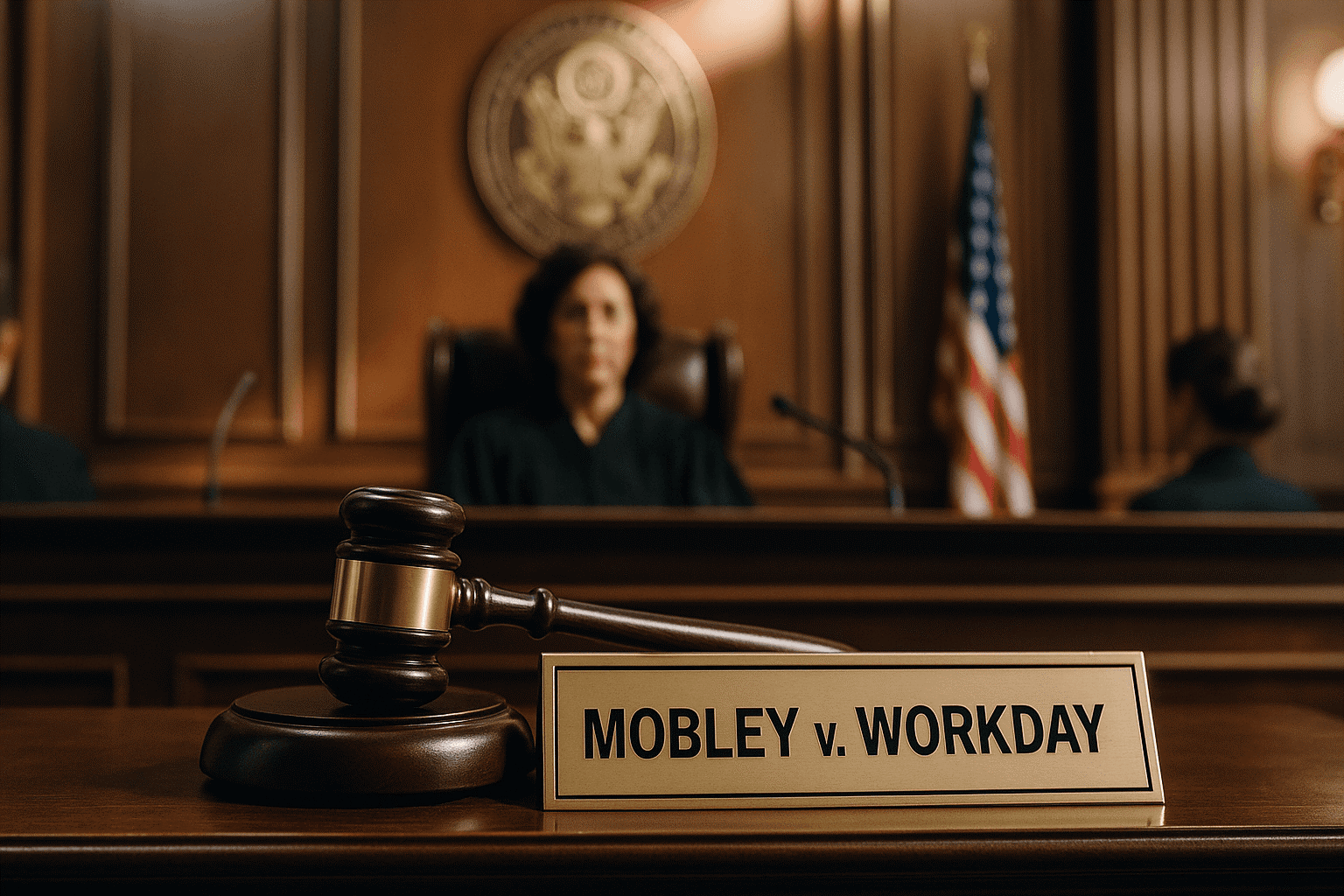
Duane Morris Takeaways: In the closely watched AI-related litigation entitled Mobley, et al. v. Workday, Inc., No. 23-CV-00770 (N.D. Cal. June 22, 2026) (ECF No. 360), Judge Rita F. Lin of the U.S. District Court for the Northern District of California issued an order denying in part and granting in part Workday’s motion to dismiss. The Court denied Workday’s motion to dismiss Plaintiffs’ California Fair Employment and Housing Act (“FEHA”) claims, holding that Plaintiffs adequately alleged a nexus to California because Workday allegedly designs, develops, and operates its algorithmic screening tools from its California headquarters. Id. at 3-4. The Court also denied the motion as to one of the plaintiffs’ Americans with Disabilities Act (“ADA”) claim, determining that her new proxy-discrimination factual allegations fell within the scope of a prior order granting leave to amend to address certain deficiencies in a prior iteration of Plaintiffs’ Complaint, despite Workday’s argument to the contrary. Id. at 8. However, the Court granted Workday’s motion to dismiss as to Plaintiff Rowe’s newly asserted race-based disparate impact claim because Rowe did not seek leave to add a race-based claim, and therefore Rowe could not add this claim to the Third Amended Complaint (“TAC”). Id. at 9.
For employers and AI vendors defending against AI employment discrimination claims, this decision provides important guidance on how defendants can successfully move to strike unauthorized claims and legal theories that exceed the scope of court-granted leave to amend.
This development follows the Court’s previous Discovery Order, which we blogged on here, Workday’s unsuccessful Motion to Dismiss Plaintiff’s Amended Complaint, which we blogged about here, Workday’s first successful Motion to Dismiss, which we blogged on here, and the EEOC’s amicus brief filing, which we blogged about here.
Case Background
Plaintiffs Derek Mobley, Jill Hughes, Sheilah Johnson-Rocha, and FaithLinh Rowe brought this action against Workday, alleging that Workday’s algorithm-based applicant screening tools discriminated against them and other similarly situated job applicants based on race, age, and disability. Id. at 1. After the Court ruled on two rounds of motions to dismiss, Mobley proceeded on claims for disparate impact discrimination based on race under Title VII, disability under the ADA, and age under the ADEA. Id. at 1-2.
On November 12, 2025, Mobley sought leave to file a further amended complaint adding three new named plaintiffs and claims for sex-based discrimination under Title VII and sex-based, race-based, and age-based discrimination under the FEHA. Id. at 2. The Court found good cause for the late amendment under Federal Rules of Civil Procedure 15 and 16. Id. Workday moved to dismiss the resulting Second Amended Complaint (“SAC”), and the motion was granted in part and denied in part. Id. Plaintiffs were given leave to remedy deficiencies in their FEHA claims, which lacked allegations of a nexus to California, and Hughes was given leave to amend her ADA claim. Id. Plaintiffs then filed a TAC. Id.
Subsequently, Workday filed a motion to dismiss and to strike portions of the TAC, arguing Plaintiffs’ FEHA claims failed to plead a non-conclusory nexus between the alleged misconduct and California, and that the other amendments were unauthorized because they fell outside the scope of Plaintiffs’ leave to amend. Id. at 1.
The Court’s Decision
The decision addressed several issues.
Plaintiffs’ FEHA Claims Were Plausibly Asserted
First, the Court denied Workday’s motion to dismiss the FEHA claims, finding that Plaintiffs sufficiently alleged that Workday, whose principal place of business is in California, participated in the alleged misconduct from its California headquarters. Id. at 3. The TAC alleged that Workday’s tools were “designed, developed, maintained, and controlled from [Workday’s] California headquarters” and that the “screening, scoring, and rejection” of Plaintiffs’ applications “originate[d] in and [was] carried out from California.” Id. at 4. The Court reasoned that the TAC adequately alleged “material participation in the allegedly unlawful discriminatory employment decisions by an actor (Workday, through its algorithmic decision-making tools) in California.” Id.
The Court rejected Workday’s argument that its liability as an agent under the FEHA must turn on the liability of its customers, relying on the California Supreme Court’s decision in Raines v. U.S. Healthworks Medical Grp., 534 P.3d 40 (Cal. 2023). Id. Under Raines, Workday is not subject to derivative liability based on its employer-customer’s liability but instead “is directly liable for its ‘own engagement in FEHA-regulated activities on the employer’s behalf.’” Id. (quoting Raines, 534 P.3d at 53).
The Court also rejected Workday’s contention that applying the FEHA to its California-based conduct would amount to an impermissible extraterritorial application, reasoning that wrongful conduct within California’s borders is not properly understood as “extraterritorial” regardless of where an aggrieved worker resides. Id. at 5-7.
Plaintiff Hughes’s Amended ADA Claim Was Permissible
Second, the Court denied Workday’s motion as to the permissibility of Plaintiff Hughes’s ADA claim. Id. at 8. The TAC alleged that “algorithmic hiring tools can identify and rely upon [ ] proxy indicators of illness or health-related limitations” such as “medical-related leave, or patterns consistent with treatment and recovery,” and “can disproportionately flag and screen out such applicants based on inferred health status rather than job-related qualifications.” Id. The Court rejected Workday’s argument that the Court had not authorized new theories of proxy discrimination for physical disabilities, reasoning that the additional allegations were squarely within the scope of the leave to amend. Id.
Plaintiff Rowe’s Race-Based Disparate Impact Claim Was Dismissed
Third, the Court dismissed Plaintiff Rowe’s race-based disparate impact claim under Title VII, which sought for the first time to assert discrimination based on her race as an Asian American. Id. at 9. The Court reasoned that the Second Amended Complaint did not contain such a claim and that Plaintiffs had not previously sought or received authorization to add the claim, as the prior race-related allegations were limited to African American and Black applicants. Id.
Plaintiffs’ Direct-Employer Theory Was Stricken
Finally, the Court dismissed Plaintiffs’ new legal theory that Workday is liable as an employer because it used the challenged recruitment and hiring procedures in screening and selecting its own employees, explaining that this legal theory was unauthorized. Id. at 10.
Implications For Employers
This decision highlights that companies developing and operating AI-driven hiring tools in and/or from California may be subject to the FEHA for their own California-based conduct, even when the affected applicants reside and apply for jobs out of state.
Moreover, the Court’s treatment of the amendments to the complaint underscores the importance of carefully observing the scope of court-granted leave to amend. While the Court permitted new proxy-discrimination allegations supporting an existing ADA claim, the Court dismissed and struck a new race-based theory and a new direct-employer theory that exceeded the scope of the amendments the Court had authorized, illustrating that plaintiffs cannot use amendments to incorporate entirely new claims or theories without leave.
By Gerald L. Maatman, Jr., Olga A. Romadin, and Elizabeth G. Underwood
Duane Morris Takeaways: On June 18, 2026, Judge Anthony J. Brindisi of the U.S. District Court for the Northern District of New York denied the EEOC’s motion for reconsideration of the Court’s earlier order denying cross-motions for summary judgment in EEOC v. Hunter-Tannersville Central School District, No. 1:21-CV-00352, 2026 WL 1759441 (N.D.N.Y. June 18, 2026). The district court found that the EEOC failed to satisfy the standard for reconsideration, reasoning that the EEOC had not identified an intervening change in controlling law, new evidence, or a clear error warranting relief.
This ruling is significant for employers defending Equal Pay Act claims and reinforces the high burden parties must satisfy to obtain reconsideration, namely, that a motion for reconsideration cannot be used to relitigate old issues or present evidence that was previously available.
Case Background
On March 26, 2021, the EEOC filed this action against the Hunter-Tannersville Central School District (“District”) alleging that the District violated § 206(d)(1) of the Equal Pay Act of 1963 by paying a former District superintendent, Dr. Susan T. Vickers (“Vickers”), less than her male colleagues for substantially equal work. Id. at *1. In response, the District denied the allegations and raised a statutory affirmative defense, asserting that any alleged pay disparity resulted from factors other than sex under 29 U.S.C. § 206(d)(1)(iv). Id.
After several years of discovery, the parties filed cross-motions for summary judgment. Id. The Court denied both motions, finding that genuine disputes of material fact precluded summary judgment in favor of either party. Id. The EEOC then timely moved for reconsideration, which the District opposed. Id.
The Court’s Decision
The Court ultimately denied the EEOC’s motion for reconsideration of the Court’s order denying cross-motions for summary judgment. Id.
First, the EEOC argued that the Court had erroneously accepted certain facts as undisputed after overlooking contrary evidence, specifically a deposition exhibit that the EEOC admittedly did not submit with its prior motion papers. Id. However, the Court rejected this argument for two reasons. Id. The omitted deposition exhibit did not qualify as “new evidence” because it was readily available at the time of the earlier briefing. Id. Moreover, the EEOC did not show that the omitted evidence was inconsistent with any of the challenged findings. Id. at *2.
Next, the EEOC contended that the Court misapplied Second Circuit precedent on the question of substantial equivalence. Id. The Court disagreed, explaining that the Second Circuit has made clear that “[w]hether two positions are ‘substantially equivalent’ for Equal Pay Act purposes is a question for the jury.” Id. (quoting Lavin-McEleney v. Marist Coll., 239 F.3d 476, 480 (2d Cir. 2001)). In particular, the Court determined that the EEOC did not show a clear error in the Court’s application of the law because the “expansive record” included “sufficient evidence from which a reasonable factfinder could conclude that Vickers’ comparators had different or additional job responsibilities and performance requirements.” Id.
The EEOC also argued that the Court failed to require the District to “prove” that the pay disparities between Vickers and her comparators stemmed from gender-neutral factors. Id. at *3. The Court, however, determined that the EEOC’s argument misunderstood the relative burdens on a motion for summary judgment. Id. While the District would have needed to “prove” its affirmative defense as a matter of law to succeed on its own motion, to survive the EEOC’s motion and get to trial, “the District was only required to identify sufficient evidence from which a reasonable factfinder could conclude that ‘the pay disparity in question result[ed] from a differential based on any factor except for sex.’” Id. (quoting Eisenhauer v. Culinary Inst. of Am., 84 F.4th 507, 522–23 (2d Cir. 2023)). The Court found the District met that standard. Id.
Finally, the Court rejected the EEOC’s argument that the Court failed to apply the law requiring the District to prove that longevity and negotiation were gender-neutral factors. Id. In rejecting the EEOC’s argument, the Court noted that the EEOC cited no controlling authority for the proposition that longevity and negotiations cannot constitute factors other than sex, identifying several courts within the Second Circuit that have found such factors to be legitimate factors other than sex. Id.
Because the Court declined to reconsider its earlier ruling, the Court indicated that the EEOC’s contingent requests regarding the issues of willfulness, good faith, and damages were rendered moot. Id. at *4.
Implications For Employers
The Court’s decision underscores that motions for reconsideration are subject to a demanding standard and cannot be used as a second opportunity to relitigate issues or present evidence that was available during an earlier round of briefing.
This decision also reinforces that the question of whether two job positions are “substantially equivalent” under the Equal Pay Act is a fact-intensive inquiry properly reserved for a jury, and that shared job descriptions alone do not establish substantial equivalence as a matter of law. Id. at *2.
Lastly, the Court’s analysis confirms that longevity and salary negotiations remain viable “factors other than sex” under the Equal Pay Act in the Second Circuit. Id. at *3. Employers should therefore document the legitimate, gender-neutral factors underlying compensation decisions to support a potential affirmative defense in the event of an Equal Pay Act challenge.