Duane Morris Takeaways:Legal compliance to prevent discrimination is a corporate imperative. Companies and business executives operate in the court of public opinion and workplace inequality continues to grab headlines and remains forefront in the public eye. In this environment, employers can expect discrimination class actions to reach even greater heights in 2025. To that end, the class action team at Duane Morris is pleased to present the second edition of the Discrimination Class Action Review – 2026.
This publication analyzes the key discrimination-related rulings and developments in 2025 and the significant legal decisions and trends impacting discrimination class action litigation for 2026. We hope that companies and employers will benefit from this resource in their compliance with these evolving laws and standards.
Click here to bookmark or download a copy of the Discrimination Class Action Review – 2026 e-book. Look forward to an episode on the Review coming soon on the Class Action Weekly Wire!
By Gerald L. Maatman, Jr., Jennifer A. Riley, and Ryan T. Garippo
Duane Morris Takeaways: On February 25, 2026, in Bradford v. Sovereign Pest Control of Texas Inc., No. 24-20379, 2026 WL 520620, at *2 (5th Cir. Feb. 25, 2026), the Fifth Circuit held that the Federal Communications Commission (the “FCC”) lacked the statutory authority under the Telephone Consumer Protection Act (the “TCPA”) to require prior express written consent for all telemarketing calls using a prerecorded voice. This decision reverses decades of precedent requiring written consent for such calls and green lights a path to future challenges to the TCPA’s implementing regulations.
Case Background
In 2023, Radley Bradford agreed to a contract with Sovereign Pest for pest control services. When Bradford executed that agreement, he orally provided his phone number to Sovereign Pest. As a result, Sovereign Pest called him on that telephone number several times to schedule renewal inspections and Bradford agreed to those renewals. By every account, it was a normal business relationship.
But there was one wrinkle. Sovereign Pest did not call Bradford using one of its live employees. Instead, it used a prerecorded voice. Prerecorded voice calls always implicate the TCPA and its draconian statutory damages. As a result, Bradford ultimately sued Sovereign Pest in a federal class action lawsuit claiming the call constituted telemarketing. Thus, because Sovereign Pest did not have “prior express written consent” to contact him using a prerecorded voice, Bradford claimed he was entitled to damages in the amount of $1,500 per call for the 24 calls it made to him. In other words, Bradford claimed Sovereign Pest owed him $36,000 in statutory damages and millions of dollars more to the putative class.
The only problem for Bradford was that the TCPA does not contain the term “prior express written consent.” It only refers to “prior express consent.” So, Bradford sought to rely on FCC regulations that have long required written consent to make telemarketing calls using a prerecorded voice. Bradford claimed that Sovereign Pests calls constituted such telemarketing. The district court disagreed with Bradford, granting a motion for summary judgment filed by Sovereign Pest, and held that the calls did not constitute telemarketing as a matter of law. Bradford appealed.
The Fifth Circuit’s Ruling
Judge Jennifer Elrod, writing for the U.S. Court of Appeals for the Fifth Circuit, affirmed the judgment entered by the district court, but not for the reasons one might think. Rather than dive into whether or not the calls constitute telemarketing, the Fifth Circuit held that the distinction was irrelevant. It explained that although “[t]he regulation relevant to this case mostly tracks the statute” it adds an additional prohibition of “written consent for pre-recorded telemarketing calls.” Bradford, 2026 WL 520620, at *2. The FCC, however, did not have the authority to add that language to the statute.
In years past, courts may have deferred to the FCC’s interpretation of the TCPA. In 2025, however, the U.S. Supreme Court unequivocally held that district courts are “not bound by the FCC’s interpretation of the TCPA” and that courts are required to interpret the text of the statute for themselves. McLaughlin Chiropractic Assocs., Inc. v. McKesson Corp., 606 U.S. 146, 168 (2025). Thus, because the plain language of the TCPA does not impose an additional requirement of written consent for telemarketing calls, the Fifth Circuit concluded that it was outside the scope of the FCC’s regulatory authority to require such consent. As a result, the Fifth Circuit affirmed the judgement entered below.
Implications For Companies
The implications of Bradford cannot be understated.
The FCC’s imposition of a bright line rule requiring written consent for prerecorded telemarketing calls is one of the hallmarks of the statute’s regulatory regime. It is also a frequent tool used by the plaintiff’s bar to assert technical violations of the TCPA where it is clear by the context that a customer approved of such calls. In the wake of McKesson, however, the FCC’s regulations now fall by the wayside for district courts in Louisiana, Mississippi, and Texas. Companies operating in those states will now be able to rely on oral agreements with their customers to prove the existence of prior consent.
The Bradford decision is not alone. Some district courts have even suggested Congress’s delegation of any authority to the FCC “may run afoul of the nondelegation doctrine, since there are no delimitations on the discretion it grants the Commission.” McGonigle v. Pure Green Franchise Corp., No. 25-CV-61164, 2026 WL 111338, at *2 (S.D. Fla. Jan. 15, 2026). Although Bradford does not go that far, the decision represents unmistakable pushback on the FCC’s longstanding unchecked power to interpret the TCPA.
Of course, the standards are still far from clear as the Fifth Circuit is the only federal appellate court to have endorsed this approach. This decision continues the trend which has started to create a “patchwork” approach to the TCPA’s standards and complicates compliance for companies making calls nationwide. Thus, corporate counsel should continue to monitor this blog to stay on top of these varying decisions and contact experienced counsel if their organizations are facing TCPA related threats as the resulting liability can be ruinous.
By Gerald L. Maatman, Jr., Jennifer A. Riley, and Hayley Ryan
Duane Morris Takeaways: On February 20, 2026, in Clark v. Blue Diamond Growers, Case No. 22-CV-01591, 2026 WL 483275 (N.D. Ill. Feb. 20, 2026), Judge Jorge L. Alonso of the U.S. District for the Northern District of Illinois denied class certification in a deceptive advertising lawsuit brought under the Illinois Consumer Fraud and Deceptive Business Practices Act (“ICFA”). The Court concluded that the named plaintiff was not an adequate class representative because she knew the allegedly misleading representation was false yet continued purchasing the product. Because that knowledge defeated proximate causation and created a unique defense, the Court determined that class certification was improper.
This decision is a reminder that plaintiffs asserting deceptive advertising claims must show they were actually deceived. Where a named plaintiff knew “the truth” and continued to buy the product anyway, adequacy under Rule 23(a)(4) is vulnerable.
Background
Plaintiff Margo Clark filed a putative class action complaint against Blue Diamond Growers, a cooperative of California almond growers that sells flavored almonds, including “Smokehouse® Almonds.” Id. at *1. She alleged that the “Smokehouse®” label misled consumers into believing the almonds were smoked in a smokehouse, when in fact the smoky flavor derived from added seasoning. Id. According to Plaintiff’s Complaint, this purported misrepresentation enabled Blue Diamond to charge a price premium in violation of the ICFA. Id.
Plaintiff moved to certify a class of Illinois purchasers of Smokehouse® Almonds from March 2019 to the present. Id.
The Court’s Ruling
Judge Alonso denied certification based on a failure to establish adequacy of representation. Id. at *2. Under Federal Rule of Civil Procedure 23(a)(4), a class may be certified only if “the representative parties will fairly and adequately protect the interests of the class.” Where the named plaintiff is subject to an arguable unique defense, however, adequacy is lacking. Id. at *1.
Here, the dispositive issue was proximate causation under the ICFA. To prevail on a deceptive advertising claim under the ICFA, a plaintiff must establish that the alleged deception proximately caused her injury, i.e., that she was actually deceived. Id. at *2. A plaintiff who knows the truth cannot establish proximate cause because she was not misled. Id.
At her deposition, Plaintiff testified that she learned as early as 2019 or 2020, after viewing a Facebook advertisement from her counsel, that the almonds were seasoned rather than smoked. Id. Despite that knowledge, she continued to purchase the product for over a year. Id. The Court found this testimony fatal, holding that Plaintiff was “inadequate to serve as the class representative because she cannot show proximate causation as required to prevail on her claim.” Id.
Plaintiff’s counsel attempted to rehabilitate the claim through a declaration asserting that the Facebook advertisements were not targeted to Illinois consumers in 2019 or 2020. Id. However, counsel also acknowledged in the same declaration that Plaintiff submitted her information in response to the advertisement approximately one year before signing her representation agreement in March 2022. Id. The Court concluded that this timeline did not resolve the proximate cause problem. Even accepting counsel’s version, Plaintiff “saw the advertisement around March 2021, yet she still continued to purchase almonds for another year.” Id.
Plaintiff’s counsel also relied on Plaintiff’s amended interrogatory responses in which she claimed she first learned the almonds were not smoked during a conversation with her attorney after signing the representation agreement. Id. at *3. Based on that revision, Plaintiff’s counsel argued that Plaintiff could establish proximate causation because she stopped purchasing the almonds after she signed the representation agreement. Id.
The Court was unpersuaded. Weighing the deposition testimony, the declaration, and Plaintiff’s original interrogatory responses, the Court concluded that Blue Diamond’s proximate cause defense was at least arguable – and that was sufficient. Id. The Court emphasized that a unique defense need only be “arguable” to defeat adequacy, and here it was “certainly arguable.” Id.
Accordingly, the Court denied certification and directed the parties to submit a joint status report addressing how they intend to proceed on Plaintiff’s individual claims and whether they have considered settlement discussions in light of the Court’s certification ruling. Id.
Implications for Companies
Clark reinforces a core Rule 23 principle that a named plaintiff subject to a unique defense cannot adequately represent a class. In deceptive advertising cases under the ICFA and similar statutes, knowledge is often outcome-determinative. If a plaintiff knew of the alleged defect before purchasing, or continued purchasing after learning the truth, proximate causation becomes vulnerable.
For companies defending consumer fraud class actions, deposition testimony, purchase history, and discovery into when and how the plaintiff allegedly learned of the “defect” or deception may provide a powerful adequacy challenge. As Clark illustrates, even an “arguable” unique defense can be enough to defeat class certification.
Duane Morris Takeaway: The Telephone Consumer Protection Act (TCPA), 47 U.S.C. § 227, et seq., has long been a focus of class action litigation. Since the TCPA was enacted 30 years ago, the methods and technology that businesses use to engage and interact with customers has evolved and changed. The trend of states enacting or amending their own mini-TCPAs shows no signs of slowing down, making this subject area a likely continued focus for the plaintiffs’ class action bar in years to come.
To that end, the class action team at Duane Morris is pleased to present the 2026 edition of the TCPA Class Action Review. We hope it will demystify some of the complexities of TCPA class action litigation and keep corporate counsel updated on the ever-evolving nuances of these issues. We hope this book – manifesting the collective experience and expertise of our class action defense group – will assist our clients by identifying developing trends in the case law and offering practical approaches in dealing with TCPA class action litigation.
Click here to bookmark or download a copy of the TCPA Class Action Review – 2026 e-book.
Stay tuned for more TCPA class action analysis coming soon on our weekly podcast, the Class Action Weekly Wire.
By Gerald L. Maatman, Jr., Jennifer A. Riley, Daniel D. Spencer, Katherine L. Alphonso, and Kenny T. Tran
Duane Morris Takeaways: On January 21, 2026, in Yeh v. Barrington Pacific, LLC, Case No. B337904, 2026 Cal. App. LEXIS 30 (Cal. App. Jan. 21, 2026), the California Court of Appeal for the Second Appellate District held that plaintiffs have standing to sue under the Investigative Consumer Reporting Agencies Act (ICRAA) without showing any actual injury because the statute authorizes a $10,000 minimum recovery untethered to any actual harm. At the same time, the Court of Appeal affirmed dismissal of the Unfair Competition Law (UCL) claims, reinforcing that UCL standing remains firmly rooted in concrete economic loss that cannot be manufactured from purely technical statutory violations.
Case Background
Barrington Pacific, LLC (Barrington) and its related entities own and operate multiple apartment complexes across Los Angeles, all managed under a centralized process. Id. at *3. Prospective tenants were required to complete a standardized rental application, authorize background screening, and pay a nonrefundable $41.50 application fee. Id. at *4. That fee was expressly allocated to obtaining credit reports, eviction histories, and resident screening reports, as well as processing internal costs. Id. Each applicant signed a written authorization permitting Barrington to obtain background information “including, but not limited to, resident screening and credit checking.” Id.
Between November 2020 and July 2022, more than 100 applicants, who were ultimately approved as tenants, filed individual lawsuits alleging Barrington violated the ICRAA’s disclosure requirements. Id. The alleged violations were procedural in nature, including failure to provide plaintiffs with a means of requesting a copy of such reports, failure to identify the consumer reporting agency, failure to disclose the scope of the investigative consumer reports procured, and failure to offer or provide copies of the reports. Id. at *4-5. Notably, no plaintiff alleged inaccurate information, denial of housing, identity theft, or any adverse consequence whatsoever. Id. at *7. Three plaintiffs also asserted UCL claims premised on the same alleged ICRAA violations. Id. at *5.
After the cases were related and consolidated, with Yeh designated as the lead action, Barrington moved for summary judgment. Id. at *5. Barrington argued that plaintiffs lacked standing because they could not show concrete injury, relying heavily on Limon v. Circle K Stores Inc., 84 Cal.App.5th 671 (2002), which held that uninjured plaintiffs lack standing under the federal Fair Credit Reporting Act (FCRA) when claims are based solely on statutory violations. The trial court agreed, concluding that the ICRAA’s $10,000 provision did not create standing through statutory penalty and that plaintiffs suffered no harm because they became tenants and alleged no inaccuracies in any of the information Barrington had. Id. at *6-7. Summary judgment was entered for Barrington on both the ICRAA and UCL claims. Id. at *6.
The California Court of Appeal’s Decision
The Court of Appeal reversed as to the ICRAA, holding plaintiffs need not prove actual harm to bring an ICRAA claim. Id. at *25. Central to the Court of Appeal’s analysis was Civil Code section 1786.50(a)(1), which permits recovery of “[a]ny actual damages sustained by the consumer as a result of the failure or, except in the case of class actions, ten thousand dollars ($10,000), whichever sum is greater.” Id. at *19. Emphasizing the disjunctive “or,” the Court of Appeal concluded that actual damages and the $10,000 amount are alternative remedies, not cumulative or interdependent. Id. at *20. The Court of Appeal relied on a line of recent California decisions recognizing that statutory schemes may confer standing through statutory damages or penalties untethered from actual harm. It cited Chai v. Velocity Investments, LLC, 108 Cal.App.5th 1030 (2025), Guracar v. California Capital Insurance Co., 111 Cal.App.5th 337 (2024), and Kashanian v. National Enterprise Systems, Inc., 114 Cal.App.5th 1037 (2025), each of which held that statutory damages provisions create standing even where plaintiffs admit no concrete injury. Id. at *11-16. Like those statutes, the ICRAA creates informational rights and attaches a fixed monetary consequence to their violation in order to punish and deter noncompliance. Id. at *18.
The Court of Appeal expressly declined to follow Limon, explaining that its reasoning was tied to the FCRA’s distinct statutory language and federal Article III standing concerns. See Limon, supra, 84 Cal.App.5th at 700-03. The Court of Appeal reasoned that the legislative materials make clear that the “ICRAA was designed to overcome the FCRA’s practical limitations by ensuring that consumers could obtain a nontrivial recovery and thus would be motivated to enforce ICRAA, even when actual damages were nonexistent.” Id. at *24-25. Legislative history also showed the California Legislature intentionally set a minimum recovery, which was $300 in 1975 and has since been increased to $10,000, to incentivize enforcement and compliance. Id. at *25. Of note, opponents of the ICRAA’s enactment criticized the statute precisely because it would impose liability “without regard to whether the individual has ever suffered damages,” further confirming that this result was not accidental but deliberate. Id. at *24.
The Court’s Reasoning on the UCL Claims
Where the opinion strongly favors the defense bar is its treatment of the UCL claims, the Court of Appeal affirmed summary adjudication, holding that Business and Professions Code section 17204 requires injury in fact and loss of money or property, regardless of whether the predicate statute allows recovery without harm. Id. at *31-32. Relying on cases such as Peterson v. Cellco Partnership, 164 Cal.App.4th 1583 (2008), the Court of Appeal reiterated that private UCL standing demands real economic injury. Id. at *31. Per Peterson, a private plaintiff must make a twofold showing: “he or she must demonstrate injury in fact and a loss of money or property caused by unfair competition.” Peterson, 164 Cal.App.4th at 1590.
Here, the Plaintiffs’ theory that the $41.50 application fee constituted lost money failed outright. Id. at *32. They argued that they were harmed because they were required to pay for a report that they were not given a copy of. Id. The Court of Appeal disagreed – the rental application described how the $41.50 non-refundable processing fee would be used to screen applicants with respect to their credit history and other background information. Id. Moreover, the application broke down the elements of the $41.50 fee: $22.99 for credit and screening reports, and $18.51 in costs, including overhead and soft costs, related to the processing of the application. Id. Since the application did not suggest that the $41.50 fee was for a consumer report to be provided to the applicant, the Court of Appeal determined that Plaintiffs received precisely what they paid for: the processing and consideration of their rental applications, which resulted in their approval as tenants. Id. at *32-33. Finally, any failure to provide plaintiffs with copies of their consumer reports within three days also does not constitute an injury because plaintiffs failed to allege any concrete or particularized harm as a result of the delay. Id. at *33.
The Court of Appeal emphasized that applicants paid for screening and processing, received exactly that, and were approved as tenants. Id. The alleged failure to timely provide copies of reports did not deprive plaintiffs of property, cause lost opportunities, or result in financial harm. Id. Technical noncompliance alone was not enough.
Implications for Companies
The takeaway here is twofold.
First, Investigative Consumer Reporting Agencies (ICRAs) under the ICRAA, loosely defined as any person who, for compensation, gathers or communicates information regarding a consumer’s character, reputation, or personal characteristics, usually obtained through extensive, often more personal investigative methods — such as interviews or public record checks — should carefully audit ICRAA disclosures as plaintiffs can proceed without needing to prove actual harm. This decision underscores the ICRAA as a strict liability statute with teeth, and technical compliance matters even when no one is harmed.
Second, this case confirms that California courts remain unwilling to dilute UCL standing requirements. Even in an era of expansive statutory enforcement, courts continue to draw a hard line against no injury, no loss UCL claims. This ruling provides powerful authority to limit exposure by cutting off UCL claims early where plaintiffs cannot show injury in fact and a loss of money or property.
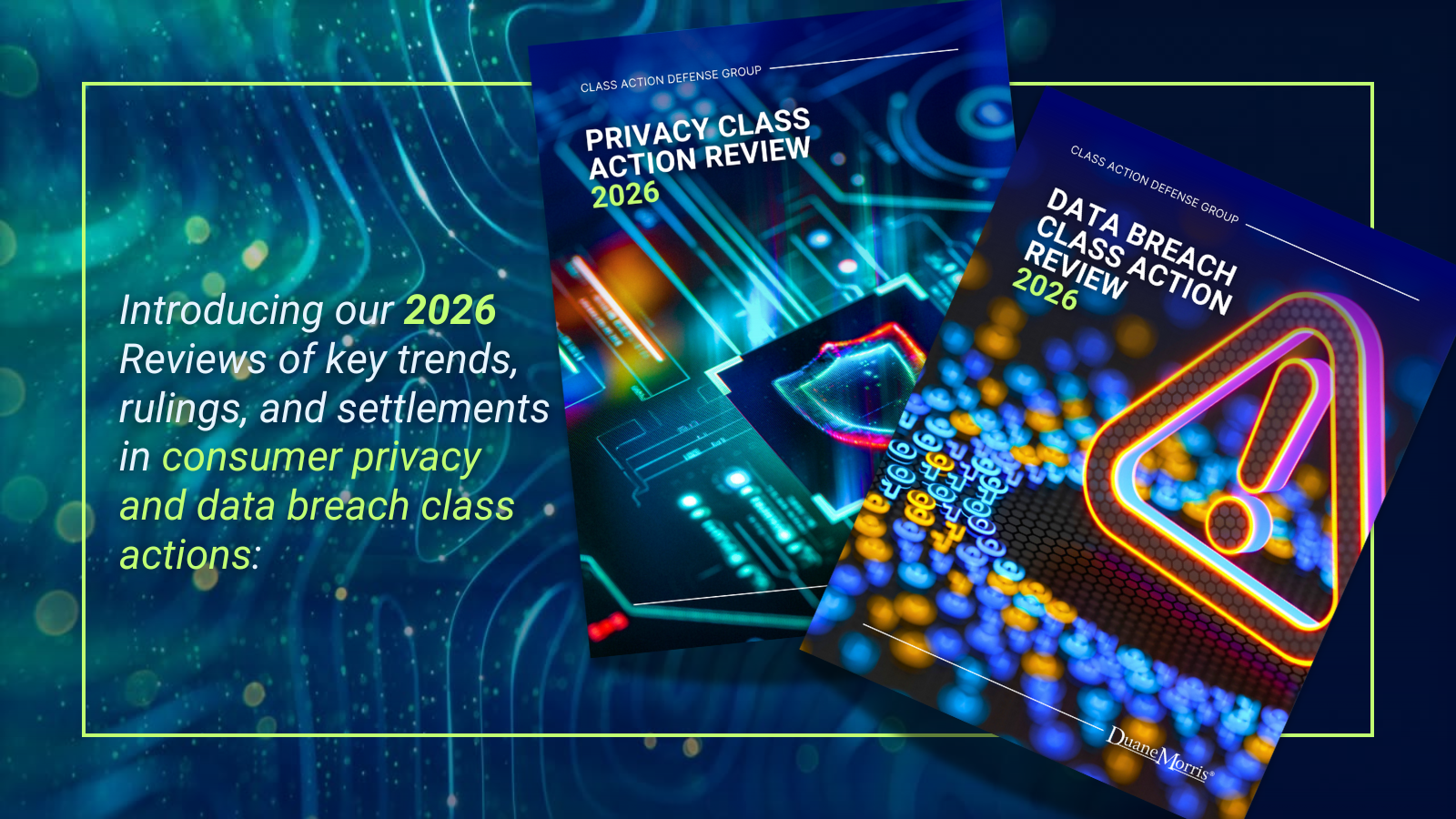
Duane Morris Takeaways: Data breaches are becoming increasingly common and detrimental to companies. The scale of data breach class actions continued its record growth in 2025, as companies faced copycat and follow-on lawsuits across multiple jurisdictions. The last year also saw a virtual explosion in privacy class action litigation. As a result, compliance with privacy and data privacy laws in the myriad of ways that companies interact with employees, customers, and third parties is a corporate imperative.
To that end, the class action team at Duane Morris is pleased to present the third editions of the Data Breach Class Action Review – 2026 and the Privacy Class Action Review – 2026. These publications analyze the key data breach and privacy-related rulings and developments in 2025 and the significant legal decisions and trends impacting data breach and privacy class action litigation for 2026. We hope that companies and employers will benefit from this resource and assist them with their compliance with these evolving laws and standards.
Click here to download a copy of the Duane Morris Data BreachClass Action Review – 2026 eBook.
Click here to download a copy of the Duane Morris Privacy Class Action Review – 2026 eBook.
Stay tuned for more data breach and privacy class action analysis coming soon on our weekly podcast, the Class Action Weekly Wire.
Duane Morris Takeaways: Given the importance of compliance with workplace anti-discrimination laws for our clients, we are pleased to present the fourth annual edition of the Duane Morris EEOC And Government Enforcement Litigation Review – 2026. The EEOC And Government Enforcement Litigation Review – 2026 analyzes the EEOC’s and U.S. Department of Labor enforcement lawsuit filings in 2025 and the significant legal decisions and trends impacting this litigation for 2026.
Click here to bookmark or download a copy of the EEOC And Government Enforcement Litigation Review – 2026 e-book.
The Review explains the impact of the EEOC’s six enforcement priorities as outlined in its Strategic Enforcement Plan on employers’ business planning and how the direction of the Commission’s Plan should influence key employer decisions. The Review also contains a compilation of significant rulings decided in 2025 that impacted government-initiated litigation and a list of the most significant settlements in 2025.
We hope readers will enjoy this new publication. We will continue to update blog readers on any important EEOC developments and look forward to sharing further thoughts and analysis in 2026!
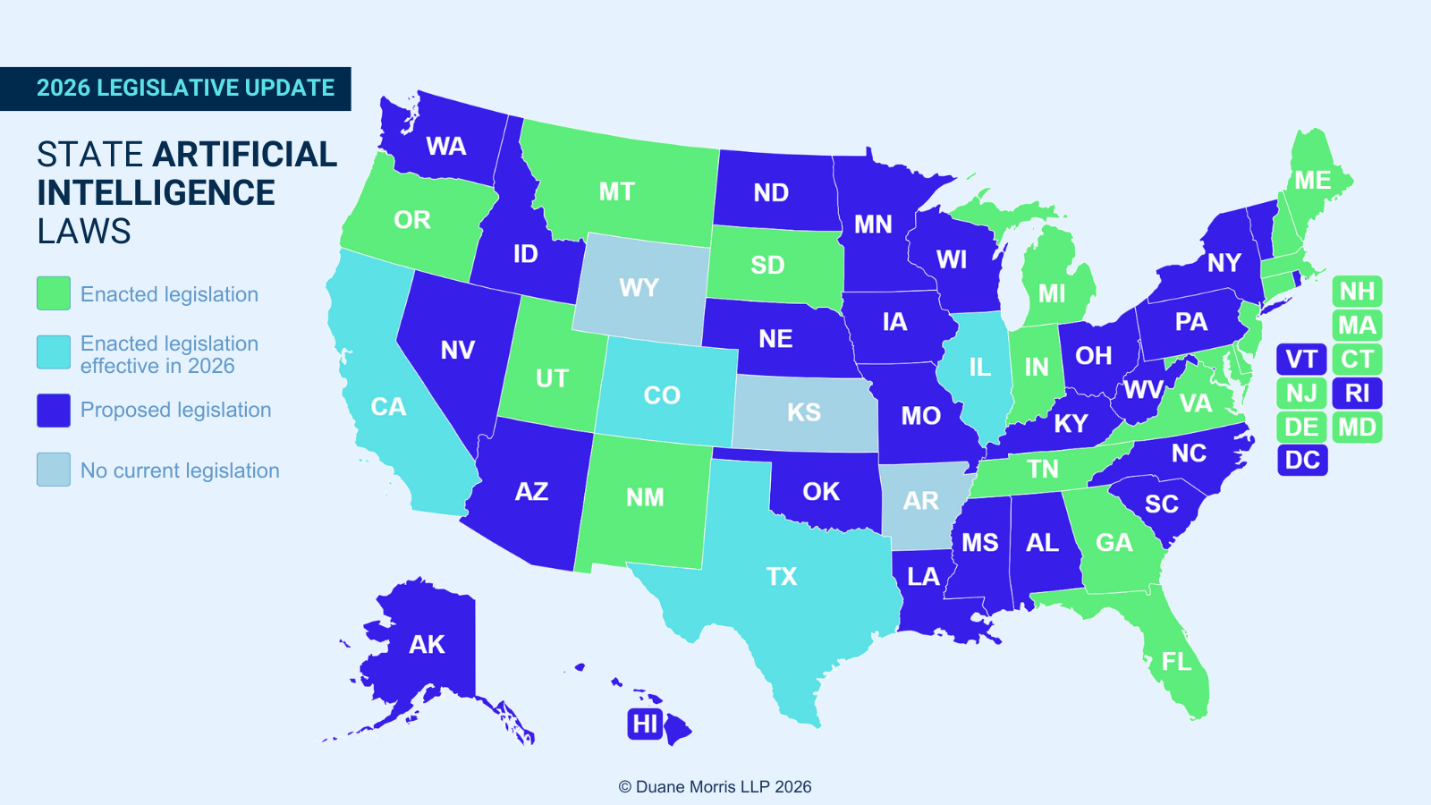
Duane Morris Takeaway: In 2025, Artificial Intelligence – AI – continued to influence class action litigation on multiple fronts. First, we saw a growth of class action lawsuits targeting AI, including in the copyright area and employment space, as well as the securities fraud area with claims of “AI washing.” Second, we saw an increasing number of courts and lawyers err in their use of AI to generate documents filed on dockets across the country and encountered numerous examples of the ways in which AI is continuing to impact the efficiencies that underlie the litigation process.
DMCAR Editor Jerry Maatman discusses this trend in detail in the video below:
AI Provided Raw Material For Class Action Lawsuits
AI has been an accelerating force in class action litigation as a source of claims stemming from the development, use, and promotion of AI technologies. In 2025, some of those filed claims or ongoing claims included claims stemming from alleged copyright infringement, algorithmic bias or discrimination, and securities fraud.
On the copyright front, courts issued key decisions, including divergent decisions on whether using copyrighted works to train generative AI models constitutes “fair use” under the Copyright Act. In copyright cases, the plaintiffs typically allege that a developer of a generative AI tool violated copyright laws by using publicly available copyrighted works to train and inform the output of the AI tools. In Tremblay v. OpenAI, Inc., No. 23-CV-3223 (N.D. Cal. June 13, 2024), for instance, the plaintiffs alleged that OpenAI trained its algorithm by “copying massive amounts of text” to enable it to “emit convincingly naturalistic text outputs in response to user prompts.” The plaintiffs alleged these outputs included summaries that were so accurate that the algorithm must have collected and retained knowledge of the ingested copyrighted works in order to output similar textual content. The plaintiffs typically invoke the Copyright Act to allege that the defendant willfully made unauthorized copies of thousands of copyrighted works, generating damages up to $150,000 per copyrighted work for willful infringement, and, therefore, to seek billions in damages.
The $1.5 billion settlement reached in Bartz, et al. v. Anthropic is a landmark settlement and a prime example. In that suit, three authors filed a class action lawsuit against Anthropic claiming that Anthropic had downloaded millions of copyrighted books from “shadow libraries” like Library Genesis and Pirate Library Mirror to train its AI systems. In June 2025, Judge William H. Alsup of the Northern District of California denied Anthropic’s motion for summary judgment on the issue of fair use in a split-the-baby decision. The record showed that Anthropic downloaded more than seven million books from pirate sites but also bought and scanned millions more. The court held that Anthropic’s use of legally acquired books for AI training was protected fair use but that downloading and keeping pirated copies was not, noting that a developer that has obtained copies of books “from a pirate site has infringed already, full stop.” In August 2025, Judge Alsup granted the plaintiffs’ motion for class certification, sua sponte defining the class to include “all beneficial or legal copyright owners of the exclusive right to reproduce copies of any book” in the datasets that met his criteria. With tens of billions of dollars on the line, the parties promptly reached a settlement for $1.5 billion, the largest settlement of any class action in 2025.
Notably, shortly after Judge Alsup’s decision on summary judgment, Judge Vince Chhabria of the U.S. District Court for the Northern District of California reached a different conclusion in Kadrey, et al. v. Meta Platforms, Inc., No. 2023-CV-03417 (N.D. Cal. June 25, 2025). In that case, 13 authors, mostly famous fiction writers, sued Meta for downloading their books from online “shadow libraries” and using the books to train Meta’s generative AI models (specifically, its large language models, called Llama). The parties filed cross-motions for partial summary judgment regarding fair use. The court rejected the plaintiffs’ argument that “the fact that the AI developer downloaded the books from shadow libraries and did not start with an ‘authorized copy’ of each book gives them an automatic win.” The court held that, because Meta’s use of the works was highly transformative, to overcome a fair use defense, the plaintiffs needed to show that the AI model harmed the market for the plaintiffs’ works. Because the plaintiffs presented no meaningful evidence of market dilution, the court entered summary judgment for Meta on the fair use defense.
On the employment front, Mobley, et al. v. Workday, Inc., No. 23-CV-770 (N.D. Cal. May 16, 2025), continues to reign as one of the most watched and influential cases. In Mobley, the plaintiff, an African American male over the age of 40, who alleged that he suffers from anxiety and depression, brought suit against Workday claiming that its applicant screening tools discriminated against applicants on the basis of race, age, and disability. The plaintiff claimed that he applied for 80 to 100 jobs, and despite holding a bachelor’s degree in finance, among other qualifications, did not get a single job offer. The district court granted the defendant’s motion to dismiss on the ground that plaintiff failed to plead sufficient facts regarding the supposed liability of Workday as a software vendor for the hiring decisions of potential employers. In other words, the plaintiff failed to allege that Workday was “procuring” employees for its customers and merely claimed that he applied for jobs with a number of companies that all happened to use Workday.
On February 20, 2024, the plaintiff filed an amended complaint alleging that Workday was an agent of the employers that delegated authority to Workday to make hiring process decisions or, alternatively, that Workday was an employment agency or an indirect employer. Plaintiff claimed, among other things, that, in one instance, he applied for a position at 12:55 a.m. and his application was rejected less than an hour later. Judge Rita F. Lin granted in part and denied in part Workday’s motion to dismiss the amended complaint. The court reasoned, among other things that the relevant statutes prohibit discrimination “not just by employers but also by agents of those employers,” so an employer cannot “escape liability for discrimination by delegating [] traditional functions, like hiring, to a third party,” and an employer’s agent can be independently liable when the employer has delegated to the agent “functions [that] are traditionally exercised by the employer.” The court noted that, if it reasoned otherwise, and accepted Workday’s arguments, then companies could “escape liability for hiring decisions by saying that function has been handed to over to someone else (or here, artificial intelligence).”
The court opined that, given Workday’s allegedly “crucial role in deciding which applicants can get their ‘foot in the door’ for an interview, Workday’s tools are engaged in conduct that is at the heart of equal access to employment opportunities.” The court also denied Workday’s motion to dismiss the plaintiff’s disparate impact discrimination claims reasoning that “[t]he zero percent success rate at passing Workday’s initial screening” combined with the plaintiff’s allegations of bias in Workday’s training data and tools plausibly supported an inference that Workday’s algorithmic tools disproportionately rejected applicants based on factors other than qualifications, such as a candidate’s race, age, or disability. Thereafter, the court conditionally certified a collective action of all individuals aged 40 and over who applied for jobs using Workday’s platform and were rejected. In doing so, it authorized plaintiff to send notice of the lawsuit to applications nationwide. This litigation has been closely watched for its novel case theory based on artificial intelligence use in making personnel decisions and, given its success to date, is likely to prompt tag along and copycat litigation.
On the securities front, over the past three years, plaintiffs have filed dozens of lawsuits alleging that various defendants made false or misleading statements related to AI technology or related to AI as a driver of market revenue or demand, including claims that companies overstated their AI capabilities, effectiveness, or revenue generation in a practice known as “AI washing.” For instance, on April 17, 2025, the plaintiff Wayne County Employees’ Retirement System filed suit against AppLovin Corporation, No. 25-CV-03438 (N.D. Cal.), alleging that, among other things, the company falsely attributed its financial success to its enhanced AXON 2.0 digital ad platform and the use of “cutting edge” AI technologies to match advertisements to mobile games. In the complaint, the plaintiffs claim that the company’s revenue instead stemmed from manipulative ad practices, such as forced, silent app installations and that, upon release of short-seller reports disclosing the alleged practices, the company’s share price declined more than 12%.
Because investors have shown a willingness to pay a premium for shares of companies that appear positioned to capitalize on the effective use of AI, such statements have had the tendency to boost share prices. When projections fail to materialize, however, and share prices decline, plaintiffs are poised to take advantage.
In another example, plaintiffs filed a securities class action against Apple in the Northern District of California alleging that Apple made misleading and false statements regarding Siri’s generative AI features. The plaintiffs allege that Apple, at its annual Worldwide Developers Conference and on earnings calls, made claims that its AI solution called Apple Intelligence would create a more advanced and capable Siri. The plaintiffs allege that Apple continued to maintain that these features would arrive in early 2025 until March 2025 when it admitted that “[i]t’s going to take us longer than we thought.” The plaintiffs allege that, in the wake of these announcements, Apple’s share price dropped almost $47.
In sum, with AI continuing to flourish, the implications of its development, use, and advertisement are providing the raw material for creative plaintiffs’ class action lawyers. We should expect to see an upward trend of key decisions and new cases in 2026 and beyond as this burgeoning area of the law continues to expand.
AI Continued To Impact The Litigation Process
As legal professionals on both sides leverage AI to attempt to increase efficiency and gain a strategic advantage, examples of improper use abound. Rarely a day passes without a headline reporting attorney misconduct. To date, much of the AI misuse has centered on attorneys submitting or courts generating filings and legal briefs with fake citations. So-called “AI hallucinations” can take the form of citations to cases that do not exist or, even worse, the attribution of incorrect “hallucinated” holdings or quotations to existing opinions.
Bar associations have compiled dozens if not hundreds of instances of attorneys misusing generative AI in complaints, legal memoranda, expert reports, and appellate briefs. Perhaps more disturbing, these examples are joined by at least two instances of courts withdrawing decisions due to the incorporation of AI-generated contend.
Such conduct has led to severe sanctions, including fines and suspensions for violation of ethical duties, as well as (presumably) terminations. To date, claims of overbilling for such AI-generated worked product have not been made public, and lawyers continue to reiterate and train that AI is a tool and not a substitute for the application of legal analysis and judgment.
At the same time, AI is becoming an asset in the hands of more cautious connoisseurs who are taking advantage of its efficiencies for projects involving data analytics, document reviews, and form generation. Its use has become transformative in the settlement administration process where it has exposed vulnerabilities in the claims administration process by, for example, generating thousands of entries that dilute legitimate claims, thereby reducing legitimate recoveries.
Similar to classrooms where teachers use AI to detect AI, recipients are responding with their own AI-based tools to detect irregularities.
As the technology continues to evolve, it continues to impact that class action space in particular, which is particularly susceptible to mass-generated claims, demand letters, and form complaints. As a result, we are likely seeing the tip of the iceberg in terms of AI’s influence on the class action space.
Duane Morris Takeaway:In 2025, case law continued to develop in fragmented ways among the federal circuits on issues material to plaintiffs’ ability to maintain and certify class actions, enhancing the likelihood of and incentive for forum shopping. In terms of standards governing conditional certification of FLSA, EPA, and ADEA matters, 2025 saw the crystallization of four distinct standards, ranging in the burdens applicable to plaintiffs, as well as in the review and consideration of the evidence presented. A second chasm relates to courts’ approaches uninjured class members, or the notion that each member of a putative class as defined might not have experienced a concrete injury sufficient to provide such individual standing to pursue a claim. A third chasm reflects courts’ divergent views relative to personal jurisdiction and whether a court that cannot exercise general personal jurisdiction must have a basis for specific personal jurisdiction as to each putative class member.
DMCAR co-editor Jennifer Riley explains this trend in detail in the video below:
These fractures have made forum selection more consequential than ever. Plaintiffs are increasingly skewing their filings toward federal circuits where they anticipate a greater likelihood of a favorable outcome, including toward jurisdictions where judges are taking a more lenient approach to certification or a more permissive view on issues like standing and jurisdiction. To date, efforts to persuade the U.S. Supreme Court to take up cases that would resolve these splits have failed, so we expect they will continue to drive uncertainty in class-related litigation through 2026.
Courts Disagree Over The Standards For Conditional Certification Of Collective Actions
The standards for conditional certification under the FLSA, EPA, and ADEA, continue to diverge such that district and appellate courts are applying any of at least four distinct approaches. These statutes provide little guidance as to the process they intended to incorporate for so-called conditional certification. In 29 U.S.C. § 216(b), the FLSA provides that “[a]n action . . . may be maintained against any employer (including a public agency) . . . by any one or more employees for and in behalf of himself or themselves and other employees similarly-situated. No employee shall be a party plaintiff to any such action unless he gives his consent in writing to become a party and such consent is filed in the court in which such action is brought.” 29 U.S.C. § 216(b). Courts have interpreted such language to authorize a process by which courts grant “conditional certification” of a collective action, authorize notice to persons who fall within the defined group, and permit those persons to “opt-in” by returned their consent forms. Courts, however, have disagreed over the standards plaintiffs must satisfy to initiate this process. In other words, how and when should a court determine if such persons are “similarly-situated”?
To date, federal courts that have addressed these issues have developed or adopted one of four primary schemes.
First, for many years, court accepted the familiar and lenient two-step standard set forth in Lusardi v. Xerox Corp., 118 F.R.D. 351 (D.N.J. 1987), and the U.S. Court of Appeals for the Second Circuit expressly adopted this standard in Scott v. Chipotle Mexican Grill, Inc., 954 F.3d 502, 515 (2d Cir. 2020), while the First, Third, Tenth, and Eleventh Circuits had done the same by “acquiescence” without express adoption. See Kwoka v. Enterprise Rent-A-Car Company of Boston, LLC, 141 F.4th 10, 22 (1st. Cir. 2025); Zavala v. Wal Mart Stores Inc., 691 F.3d 527, 534 (3d Cir. 2012); Thiessen v. General Electric Capital Corp., 267 F.3d 1095, 1105 (10th Cir. 2001); Hipp v. Liberty National Life Insurance Co., 252 F.3d 1208, 1219 (11th Cir. 2001)
Under Lusardi, a court considers at “step one” whether a plaintiff has made a “modest factual showing” based on his or her evidence, which often comprises one or more declarations, and may or may not even look at competing evidence submitted by the employer. If the court determines that a plaintiff has satisfied his or her “lenient” burden, the court authorizes notice. At the close of discovery, the employer then can move to decertify the conditionally certified collective action, and the court will consider based on the evidence whether the plaintiff has demonstrated that the persons who joined the action are similarly situated.
The Ninth Circuit clarified in Campbell v. City of Los Angeles, 903 F.3d 1090, 1114 (9th Cir. 2018), that the plaintiff must show he or she is similarly situated with respect to “some material aspect” of his or her claim and not merely in some way that is irrelevant to the claims asserted.
Second, in the first example of a court revisiting and examining the text of the FLSA, the Fifth Circuit prompted the ensuing split with its decision in Swales v. KLLM Transportation Services, LLC, 985 F.3d 430, 443 (5th Cir. 2021). In that decision, the Fifth Circuit rejected Lusardi’s two-step approach outright and directed district courts to “rigorously enforce” the FLSA’s similarity requirement at the outset of the litigation in a one-step approach. “[T]he district court needs to consider all of the available evidence” at the time the motion is filed and decide whether the plaintiff in fact has “met [his or her] burden of establishing similarity.” Id. at 442-43.
Third, in the wake of Swales the Sixth Circuit likewise revisited the standard in Clark v. A&L Homecare & Training Center, LLC, 68 F.4th 1003 (6th Cir. 2023). The Sixth Circuit rejected Lusardi, but also declined to adopt Swales. Instead, the court likened the standard to one comparable to the standard for obtaining a preliminary injunction. An employee must show a “strong likelihood” that others are similarly situated to the employee before the district court may authorize the plaintiff to send notice of the action. The Sixth Circuit left open the standard by which the court should consider a potential motion for decertification down the line. Id. at 1011.
Fourth, most recently, the Seventh Circuit addressed the same issue in Richards, et al. v. Eli Lilly & Co., 149 F.4th 901 (7th Cir. 2025). The Seventh Circuit rejected the Lusardi framework but declined to go as far as Swales or Clark. Instead, the Seventh Circuit ruled that “a plaintiff must first make a threshold showing that there is a material factual dispute as to whether the proposed collective is similarly situated” to secure a ruling authorizing notice, and an employer “must be permitted to submit rebuttal evidence” for the court to consider. Id. at 913. The court declined to set any bright line rule as to whether a court should decide the similarly situated question in a one or two step approach, noting that the analysis is not an “all-or-nothing determination.” Id. at 913-914.
The U.S. Courts of Appeal for the District of Columbia, Fourth, and Eighth Circuits have not yet opined on the proper method, leaving district courts to exercise their discretion. These divergent standards have influenced forum selection, as plaintiffs significantly have decreased the number of collective actions they pursue in the Fifth and Sixth Circuits in particular, in favor of filing in forums that apply more lenient standards.
Courts Continue To Disagree Over Standing And Personal Jurisdiction
Courts continue to disagree regarding the impact and treatment of uninjured class members, a key issue that remains unresolved. It is axiomatic that individuals who did not suffer injury as the result of the defendant’s conduct cannot maintain claims, and courts do not have the power to award them relief. As the U.S. Supreme Court reiterated in its seminal 2020 decision in TransUnion, “Article III does not give federal courts the power to order relief to any uninjured plaintiff, class action or not.” TransUnion LLC v. Ramirez, 141 S.Ct. 2190, 2208 (quoting Tyson Foods v. Bouaphakeo, 577 U.S. 442, 466 (2016) (Roberts, C.J., concurring)). In this respect, the “plaintiffs must maintain their personal interest in the dispute at all stages of the litigation . . . And standing is not dispensed in gross; rather, plaintiffs must demonstrate standing for each claim that they press and for each form of relief that they seek.” Id.
Despite this admonition, courts continue to grapple with the application of these concepts in the class certification context and, in particular, they disagree over whether to certify a class, a plaintiff must demonstrate that every putative class member has standing, or, stated differently, must demonstrate that the class excludes those individuals who did not suffer harm. In TransUnion, the Supreme Court expressly left open the question of “whether every class member must demonstrate standing before a court certifies a class.” Id. at n.4. Such a requirement has significant consequences for the class action landscape.
As a result, in January 2025, the U.S. Supreme Court granted a petition for certiorari in Laboratory Corporation Of American Holdings v. Davis, 145 S.Ct. 1608 (2025). In Davis, plaintiffs filed suit on behalf of a putative class of legally blind patients alleging that Lab Corp. violated the ADA by failing to make its self-service check-in kiosks accessible. In May 2022, the district court certified a broad class of that included all legally blind individuals were denied full and equal enjoyment of its goods and services due to “LabCorp’s failure to make its e-check-in kiosks accessible,” emphasizing that individualized damages questions do not defeat the predominance requirement. Lab Corp. sought interlocutory appeal, arguing that plaintiffs’ class definition swept in uninjured individuals who would not have used kiosks anyway. The Ninth Circuit granted the petition and affirmed. Applying Ninth Circuit precedent, the appellate court reasoned that Rule 23 permits certification of a class even when the class “‘potentially includes more than a de minimis number of uninjured class members.’” The U.S. Supreme Court granted certiorari in January 2025. Following briefing and oral argument, the U.S. Supreme Court declined to resolve the issue and dismissed the writ as improvidently granted. Justice Kavanaugh authored a dissent from such decision noting that, if given the opportunity, he would hold that “[f]ederal courts may not certify a damages class under Rule 23 when, as here, the proposed class includes both injured and uninjured class members.”
Without guidance from the U.S. Supreme Court, lower federal courts have continued to reach varying decisions on the issue. For instance, on July 17, 2025, the Fifth Circuit issued its decision in Wilson v. Centene Management Co., 144 F.4th 780 (5thCir. 2025). The plaintiffs in this case asserted breach of contract claims against the defendant insurance companies, alleging that it issued inaccurate provider lists and thereby caused the plaintiffs to pay artificially inflated premiums for access to providers who were not available. The district court denied class certification finding that the plaintiffs lacked standing. On appeal, the Fifth Circuit held that, at the class certification state, a plaintiff need only demonstrate his or her own standing, and the district court erred in its determination of the plaintiff’s standing, which it reached through a merits-based evaluation of the plaintiff’s expert.
The Seventh Circuit addressed the question in Arandell Corp. v. Xcel Energy Inc., 149 F.4th 883 (7th Cir. 2025). In that case, the plaintiffs brought a putative state-wide class action alleging that defendants engaged in a price-fixing conspiracy to manipulate natural gas prices. The Seventh Circuit noted that, to the extent defendants suggested that, before class certification, the plaintiffs must show all class members suffered some injury, “that is not correct.” It reiterated its prior holding that that “a class should not be certified if it is apparent that a great many persons who have suffered no injury at the hands of the defendant,” it clarified that “[t]here is no precise measure for ‘a great many.’ Such determinations are a matter of degree and will turn on the facts as they appear from case to case.”
In contrast, the Fourth Circuit took a different approach in Freeman v. Progressive Direct Insurance Co., 149 F.4th 461 (4th Cir. 2025). After an automobile collision, the plaintiff’s insurer provided her a payment based on the “actual cash value” of her car that it determined using a “projected sold adjustment.” Although the plaintiff accepted the payment, and did not contest the valuation, she filed suit for breach of contract. Although the district court certified a class, the Fourth Circuit reversed. The Fourth Circuit explained that, to succeed on her claim, the plaintiff needed to show that her insurer paid her less than the actual cash value of her vehicle and, likewise, that her insurer paid members of the class less than the actual cash value of their vehicles, regardless of whether the “projected sold adjustment” was used in determining that value. Yet, the class was defined to include anyone who was paid “compensation for the total loss of a covered vehicle, where . . . the actual cash value was decreased based upon Projected Sold Adjustments.” Thus, the class was defined to include insureds who accepted the insurer’s offer of payment, insureds who negotiated a higher payment, and insureds who invoked the appraisal process in the policy, simply because in each circumstance the insurer made its calculation using the Projected Sold Adjustment. “Yet, none of those could claim injury because each agreed to resolution of the loss. . . This characteristic of the certified class alone justifies reversal of the class certification order.”
Similarly, courts have continued to disagree regarding the scope of a court’s personal jurisdiction over the defendant in the class action context. In short, the U.S. Supreme Court decided Bristol Myers Squibb v. Superior Court, 137 S. Ct. 1773 (2017), in 2017 and ruled that a court must have a basis for exercising personal jurisdiction over a defendant for each claim it adjudicates. In that case, which involved a mass tort action, the U.S. Supreme Court concluded that the existence of similar claims asserted by plaintiffs who purchased a drug in California did not provide a court with personal jurisdiction over the defendant for purposes of adjudicating claims asserted by plaintiffs who purchased the same drug outside of California.
Again, despite this clear ruling, courts have continued to grapple with the application of these concepts in the class certification context and, in particular, they disagree over whether, to certify a class that includes nationwide class members, a plaintiff must demonstrate that the court can exercise personal jurisdiction over the defendant for purposes of resolving each of their claims or, stated differently, must demonstrate that each claim arises from or relates to a foreign defendant’s contacts with the forum state.
On July 1, 2025, the Ninth Circuit became the latest to address this issue. In Harrington, et al. v. Cracker Barrel Old Country Store, 142 F.4th 678 (9th Cir. 2025), the Ninth Circuit ruled that the U.S. Supreme Court’s decision in Bristol-Meyers applies to collective actions brought under the FLSA. The Ninth Circuit held that, when a plaintiff relies on specific personal jurisdiction as the basis for personal jurisdiction over the defendant in an FLSA collective action, district courts must assess whether they can exercise specific personal jurisdiction over the defendant on a claim-by-claim basis. This means that the claim of every opt-in plaintiff must arise out of or relate to the defendant’s activities in the forum state, and opt-in plaintiffs with no connection to the forum cannot rely on the connections of the named plaintiffs to establish personal jurisdiction.
In sum, courts continue to disagree as to their power in the class action context and the extent to which a procedural rule like Rule 23 can alter otherwise fundamental concepts of subject matter and personal jurisdiction for putative class members. Given the implications of such rules, we can anticipate that such questions will continue to influence forum selection for plaintiffs and continue to fuel uncertainty for defendants through 2026.
Duane Morris Takeaway:Government enforcement litigation is similar in many respects to class action litigation. In lawsuits brought by the U.S. Equal Employment Opportunity Commission (EEOC), as well as the U.S. Department of Labor (DOL), the government asserts various claims on behalf of or as a representative of numerous allegedly impacted individuals. These cases typically present numerous claimants, as well as significant monetary exposure.
The video below featuring DMCAR editor Jerry Maatman explains this trend in detail:
While plaintiffs in private party class actions must meet the requirement of Rule 23 to secure class certification, the law does not require the government to clear such hurdle. For example, systemic “pattern or practice” lawsuits brought by the EEOC follow a framework established by the U.S. Supreme Court in International Brotherhood Of Teamsters v. United States, 431 U.S. 324 (1977), rather than Rule 23. Nonetheless, EEOC systemic lawsuits present similar issues and similar risk for corporate defendants.
While the EEOC and DOL historically have been among the most aggressive litigants in terms of their pursuit of claims, the Trump Administration has had a profound impact on these agencies and their enforcement agendas. President Trump ran for election on a platform that runs counter to many of the “emerging issues” on the EEOC’s priority list, foreshadowing a realignment of litigation priorities.
The Trump Administration has kept its promise of less government oversight and regulation and has shifted the priorities of these agencies to more closely match the administration’s objectives.
Litigation And Settlement Trends
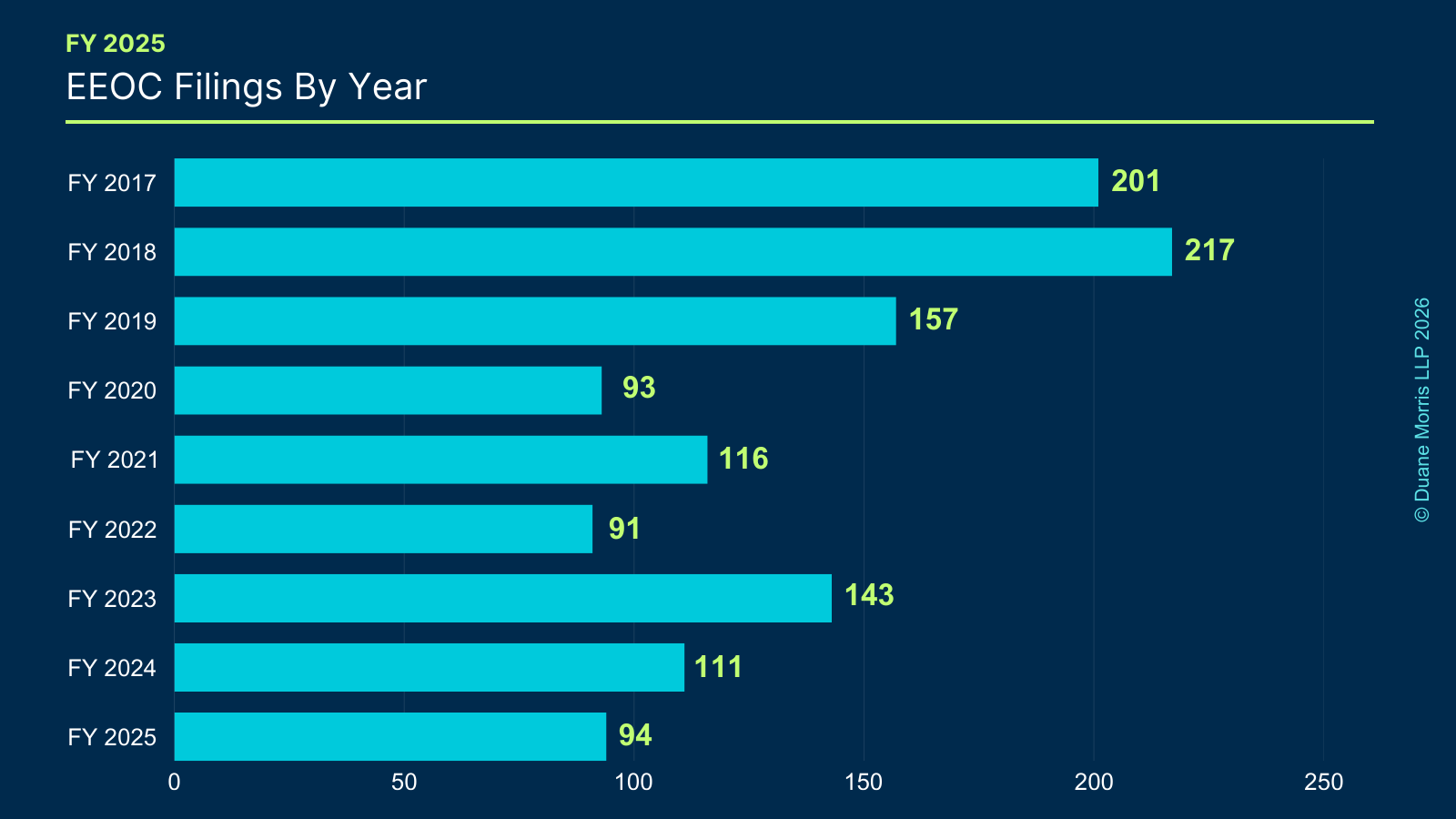
In fiscal year (FY) 2025, which ran from October 1, 2024, to September 30, 2025, the EEOC’s litigation enforcement activity stalled significantly as compared to previous years.
By the numbers, the EEOC filed a total of 94 lawsuits, far fewer than it filed at the height of filings in FY 2018, when it filed 217 lawsuits.
The decline in enforcement activity shows that, for President Trump’s second term in office, companies should expect the EEOC to be less aggressive as compared to past regimes in terms of the volume of enforcement lawsuits filed.
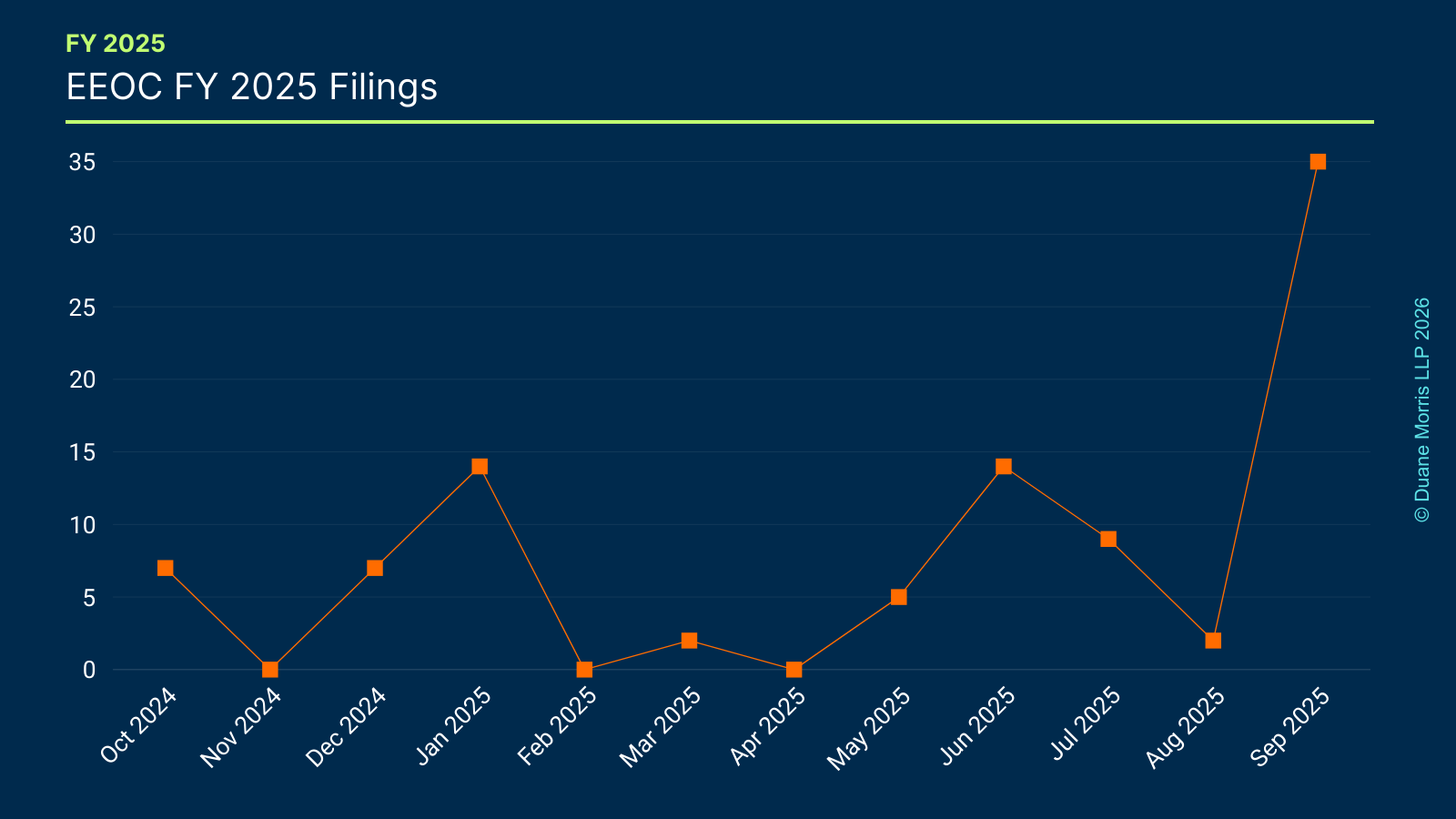
Each year, the EEOC’s fiscal year ends on September 30, and the agency engages in a sprint to the finish as it files a substantial number of lawsuits during the month of September. In FY 2025, the EEOC filed 94 lawsuits. Of these, it filed 35 – or 37% of the annual total – during September, the last month of its fiscal year. The overall number represents a decrease from prior years, but the filings followed a somewhat similar pattern. In FY 2024, the EEOC filed 110 lawsuits. It filed 67 of these actions, or more than 60%, during the month of September. By comparison, in FY 2023, the EEOC filed 144 lawsuits, with a similarly heavy September tranche of 35.We track the EEOC’s filing efforts across the entire fiscal year from its beginning in October through the anticipated filing spree in September.
Unlike other fiscal years, during 2025, the EEOC’s filing patterns were consistent in the first half of FY 2025, peaking with 14 lawsuits in January. Filings again slowed until the summer, when the EEOC filed another 14 lawsuits in June 2025. Thereafter, lawsuit filings dipped until the “eleventh hour” in September. The following shows filing activity by month:
Lawsuit Filings By EEOC District Office
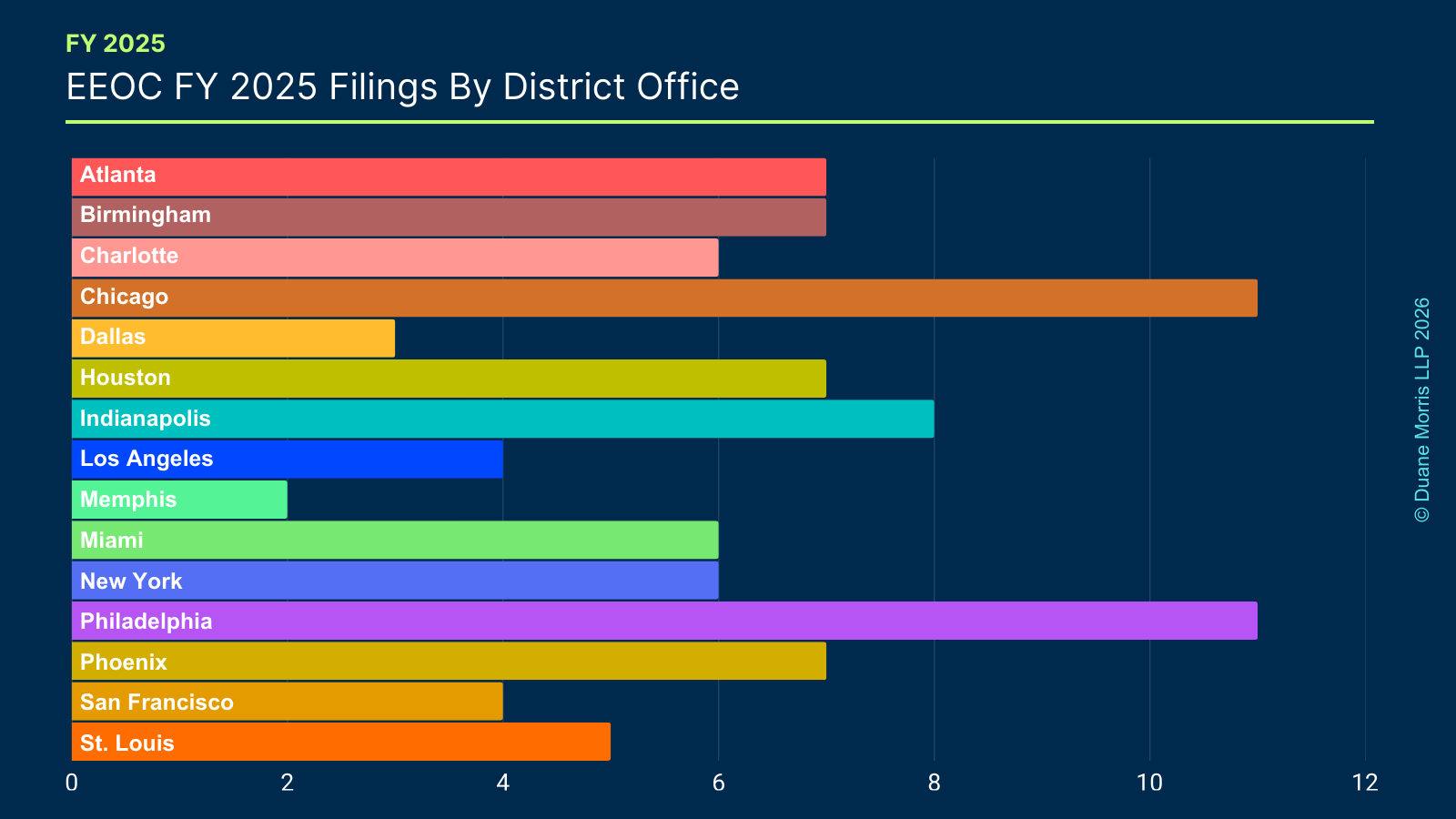
In addition to tracking the total number of filings, the litigation filing patterns of the EEOC’s 15 district offices are telling. Some districts tend to be more aggressive than others, and some focus on different case filing priorities. The following chart shows the number of lawsuit filings by each of the EEOC district offices in FY 2025.
In FY 2025, Philadelphia and Chicago led the pack in filing the most lawsuits, with 11 each, followed by Indianapolis with eight filings, then Atlanta, Birmingham, Houston, and Phoenix with seven filings, and Charlotte, New York, and Miami each with six filings.
St. Louis had five filings, Los Angeles and San Francisco had four filings, and Dallas had three filings. Memphis had the lowest amount with only two filings.
As in FY 2024, Philadelphia proved itself as a leader in EEOC enforcement filings. Chicago remained steady with 11 filings, the same as FY 2024. St. Louis (two filings in FY 2024) and Phoenix (four filings in FY 2024) showed increases in filing numbers as compared to FY 2024.
Other offices comparatively lagged in enforcement activity. Atlanta (11 filings in FY 2024), Indianapolis (nine filings in FY 2024), and Houston (eight filings in FY 2024) showed slight decreases in enforcement activities. Across the board, filings generally became more even for district offices compared to FY 2024, but filing activity decreased.
Lawsuit Filings Based On Type Of Claim
The types of claims the EEOC filed in FY 2025 provides a window into its shifting strategic priorities.
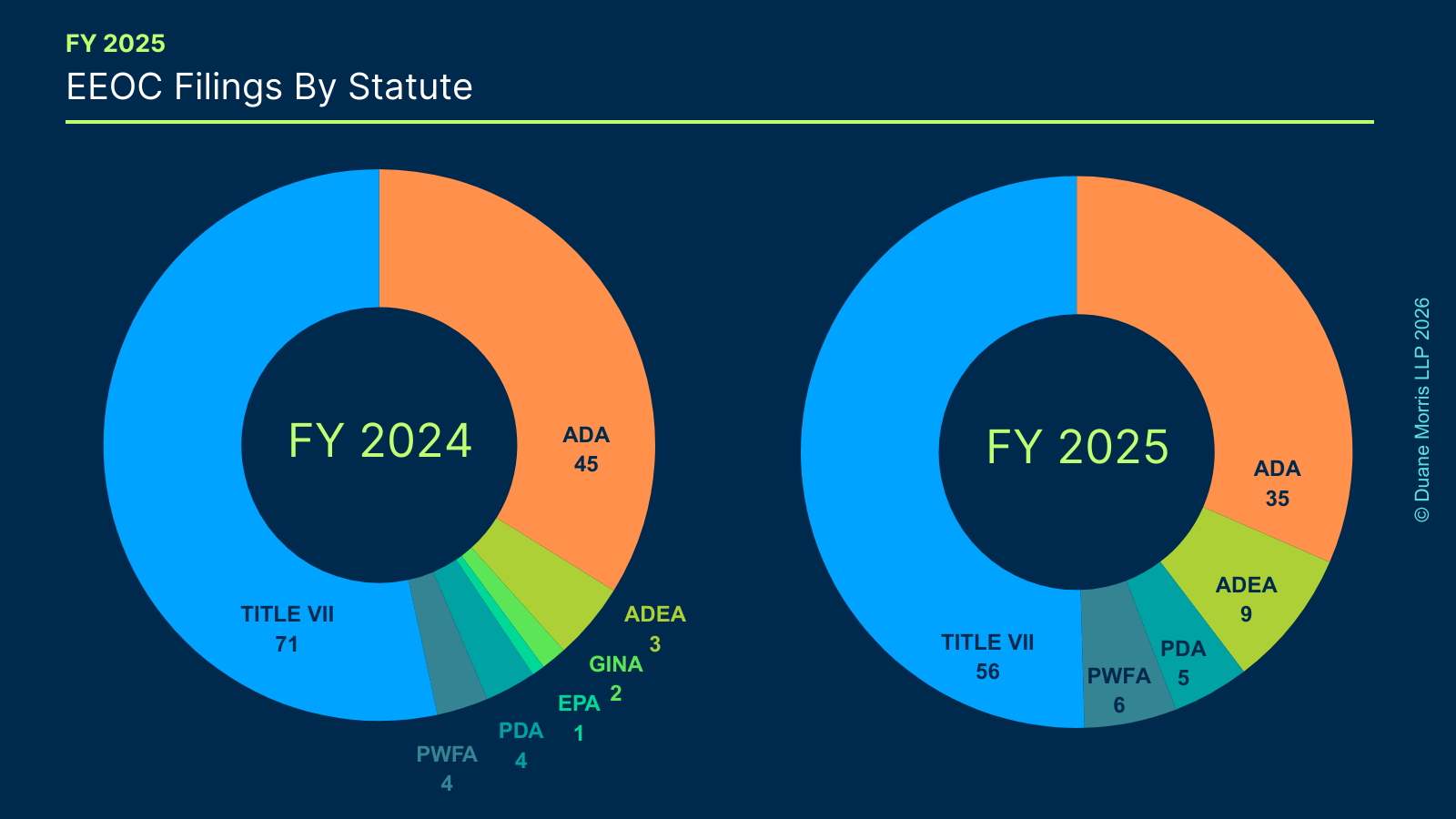
When considered on a percentage basis, the distribution of cases filed by statute skewed significantly in favor of Title VII cases when comparing FY 2025 to prior years.
The EEOC again based most of its claims on alleged violations of Title VII, but these claims comprised 50% of its filings in FY 2025, compared to 58% of its filings in FY 2024. Those numbers represent a significant decrease from FY 2023 and FY 2022, when Title VII claims represented 68% of the EEOC’s filings in FY 2023 and 69% of its filings in FY 2022.
Overall claims for alleged violation of the ADA made up the next most significant percentage of the EEOC’s FY 2025 filings – totaling 31.5%. This share again shows a decrease from prior years when ADA claims comprised 42% of filings in FY 2025, 34% of filings in FY 2023, and 37% of filings in FY 2021. The percentage is marginally higher than FY 2022, when ADA filings on a percentage basis comprised 29.7% of all filings.
The EEOC filed more claims for alleged violation of the ADEA in FY 2025. It filed nine ADEA cases in FY 2025, as compared to six ADEA age discrimination cases in FY 2024, but it filed 12 ADEA age discrimination cases in FY 2023 and seven in FY 2022.
As in FY 2024, this past year the EEOC pursued claims under the Pregnant Worker’s Fairness Act. It filed six cases, compared to three in FY 2024. In addition, the EEOC filed slightly more claims for alleged violation of the Pregnancy Discrimination Act in FY 2025. It filed five such cases, as compared to four in FY 2024.
Notably, the EEOC refrained from filing any claims for alleged violation of the Equal Pay Act in FY 2025 and any cases for alleged violation of the Genetic Information Nondiscrimination Act.
The following graph shows the number of lawsuits filed according to the statute under which they were filed.
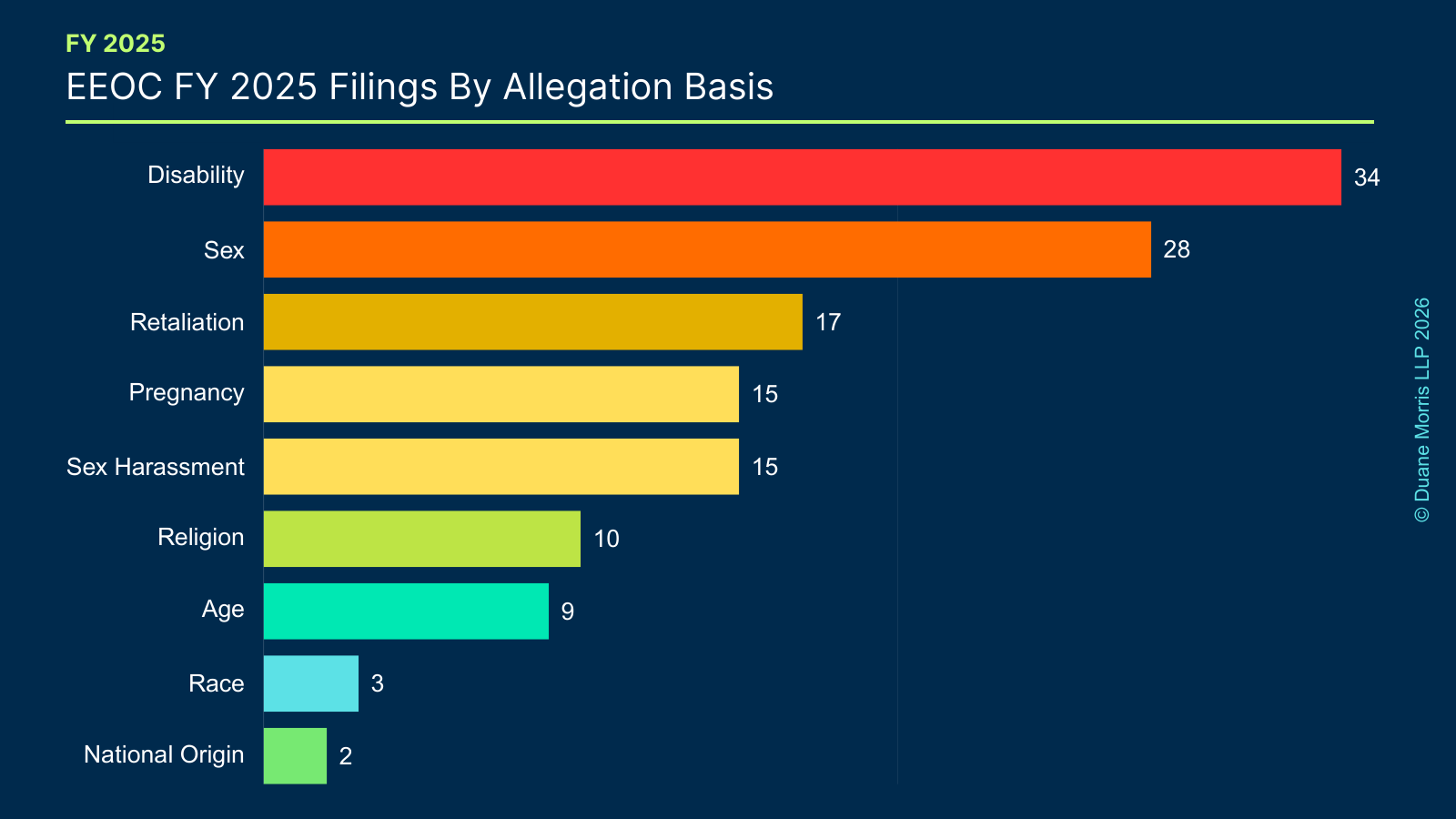
The grounds for such claims are reflect the stated priorities of the Trump Administration, including by reflecting a decreased emphasis on targeting alleged racial discrimination, and an increased emphasis on routing out disparate treatment based on gender and health-related and family-related conditions. Claims based on alleged disability discrimination, sex discrimination, and retaliation led the way. Collectively, these three theories provided the foundation for 59.4% of FY 2025 EEOC filings.
Notably, in FY 2025, the EEOC filed only three lawsuits asserting discrimination based on race or national origin, a total of 2.3% of the lawsuit filings. In FY 2024, 8.9% of all filings included claims based on race. The following graph shows a breakdown of the allegations underlying the FY 2025 filings.
Lawsuits Filings Based On Industry
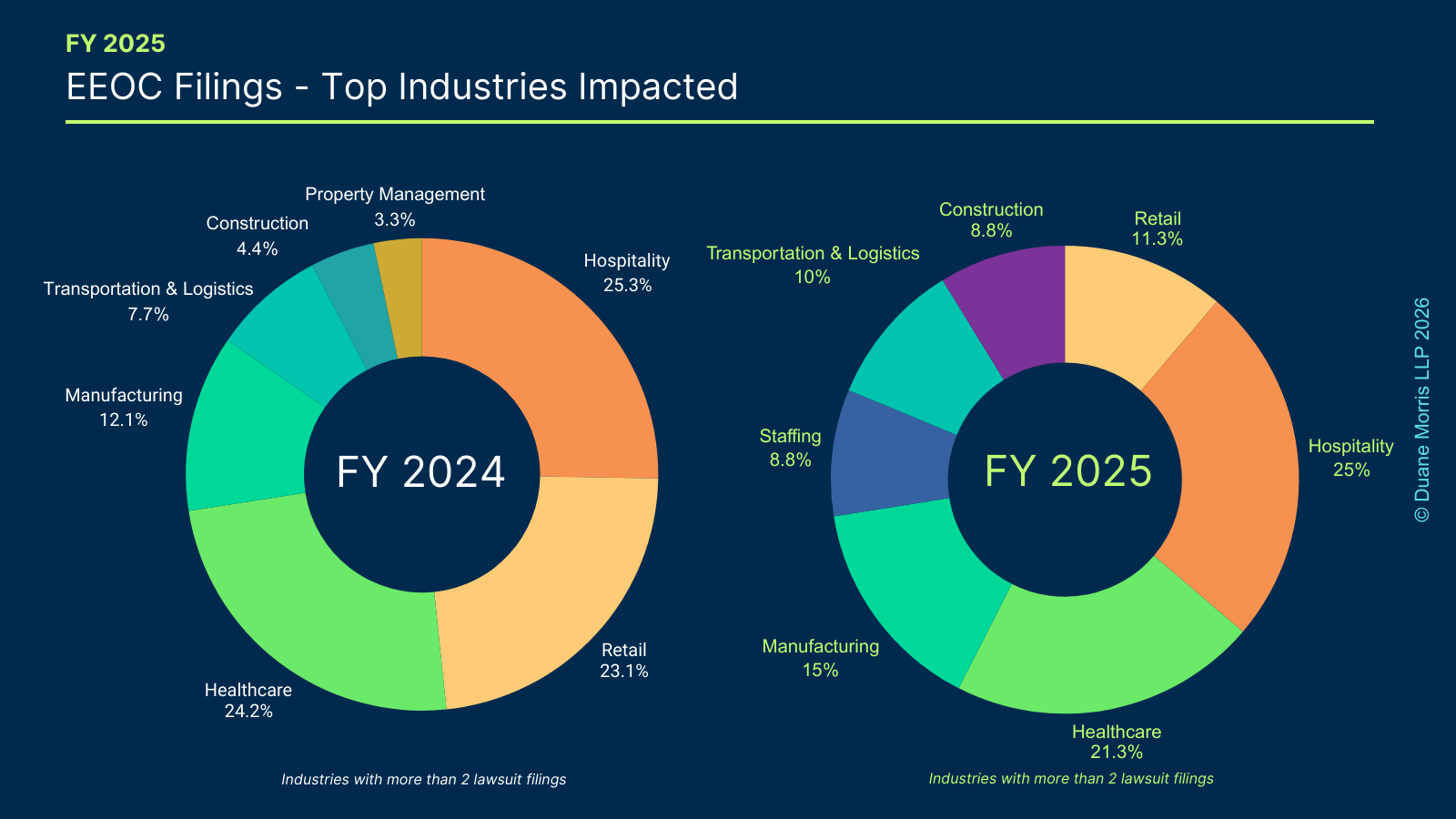
In terms of filings by industry, FY 2025 aligned with prior years and reflected the EEOC’s focus on a few major industries. In FY 2025, two industries remained among the EEOC’s top targets – hospitality and healthcare.
On a percentage basis, hospitality industry employers (restaurants / hotels / entertainment) were recipients of 25% of EEOC filings, and healthcare industry employers received 21.3%. In FY 2025, manufacturing (15% of FY 2025 filings, 12.1% of FY 2024 filings) overtook retail (11.3% of FY 2025 filings; 23.1% of FY 2024 filings) as the next most targeted industry, with retain experiencing a double-digit decline. Only one other industry, transportation & logistics received a double-digit percentage share of EEOC-initiated lawsuits (with 10%). Filings against employers in staffing and construction remained flat in terms of relative percentage in FY 2025 as compared to FY 2024 (8.8% and 8.8% of filings, respectively). As in FY 2024, in FY 2025, the EEOC did not file any of its enforcement lawsuits against employers in the automotive, security, and/or technology industries.
Strategic Priorities
Moving into FY 2026, the EEOC’s budget justification includes a $19.618 million decrease from FY 2025. This move is reflective of the Trump Administration’s stated priority of returning to the “agency’s true mission.” The EEOC aims to return to its founding principles and restore evenhanded enforcement of employment civil rights laws on behalf of all Americans.
Every new presidential administration brings with it an array of objectives focused on different priorities. Since President Trump’s inauguration, the Trump Administration has taken unique steps to significantly reshape the EEOC. Among its moves to overhaul the agency, President Trump dismissed two Democratic-appointed EEOC commissioners and its General Counsel and replaced them with officials viewed as more aligned with his agenda. The Administration appointed new leadership, including Chair Andrea Lucas and Acting General Counsel Andrew Rogers. On October 7, 2025, Brittany Panuccio was confirmed by the Senate as a commissioner, thereby restoring a quorum.
President Trump has issued a series of executive orders reflecting its shift in enforcement priorities, particularly against DEI initiatives. On January 20, 2025, the White House issued an executive order, “Ending Radical and Wasteful Government DEI Programs and Preferencing,” and, on January 21, 2025, the White House issued, “Ending Illegal Discrimination and Restoring Merit-Based Opportunity.” The latter’s stated purpose is to end “dangerous, demeaning, and immoral race- and sex-based preferences under the guise of so-called ‘diversity, equity, and inclusion’ (DEI) or ‘diversity, equity, inclusion, and accessibility’ (DEIA) that can violate the civil-rights laws of this Nation.” President Trump ordered all executive departments and agencies to terminate all “discriminatory and illegal preferences” and to “combat illegal private-sector DEI preferences, mandates, policies, programs, and activities.”
Shortly thereafter, in February 2025, the EEOC took prompt action to implement the Administration’s shift in direction. Citing the Trump Administration’s Executive Order on “gender ideology extremism,” the EEOC announced that it would withdraw seven lawsuits it had filed across the country, including:
EEOC v. Sis-Bro Inc., No. 25-CV-968 (S.D. Ill.) EEOC v. Harmony Hospitality LLC, No. 24-CV-357 (M.D. Ala.) EEOC v. Brik Enterprises, Inc., et al., No. 24-CV-12817 (E.D. Mich.) EEOC v. Reggio’s Pizza Inc., No. 24-CV-8910 (N.D. Ill.) EEOC v. Lush Handmade Cosmetics LLC, No. 24-CV-6859 (N.D. Cal.) EEOC v. Boxwood Hotels, LLC, No. 24-CV-902 (W.D.N.Y.) EEOC v. Starboard Group Inc., No. 24-CV-2260 (S.D. Ill.)
On February 18, 2025, in EEOC v. LeoPalace, No. 25-CV-4 (D. Guam), the EEOC settled a lawsuit for more than $1.4 million and entered into a three-year consent decree with LeoPalace Resort, a large hotel in Guam. The EEOC alleged that LeoPalace provided employees of non-Japanese national origin with less favorable wages and benefits than their Japanese counterparts. This lawsuit is significant because it was the first seven figure settlement that the Commission procured after President Trump took office in January 2025 – and because it was accompanied by a statement from Chair Andrea Lucas announcing the Commission’s new enforcement agenda and its intent to protect all workers from national origin discrimination and “Anti-American Bias.”
In the accompanying press release, Chair Lucas announced that “Federal anti-discrimination laws ensure equal employment opportunity for jobs performed by all workers regardless of national origin. . . . This case is an important reminder that unlawful national origin discrimination includes discrimination against American workers in favor of foreign workers.” This was the Commission’s first publicized settlement since Lucas was appointed Acting Chair of the EEOC. One day after the settlement was announced, the EEOC published a second press release on its Newsroom “putting employers and other covered entities on notice” that the Commission was committed to protecting all workers from unlawful national origin discrimination, including American workers.
The Commission has stated that it is committed to carrying out President Trump’s policy agenda, consistent with his executive orders related to (1) “unlawful DEI-motivated race and sex discrimination,” (2) “defending the biological and binary reality of sex and related rights,” (3) “protecting workers from religious bias and harassment, including antisemitism,” and (4) “anti-American national origin discrimination.”
Further evidencing these stated objectives, among other things, Acting Chair Lucas has announced that one of her priorities for compliance, investigations, and litigation is to defend the biological and binary reality of sex and related rights, including women’s rights to single-sex spaces at work. She likewise removed the agency’s “pronoun app,” a feature in employees’ Microsoft 365 profiles, which allowed an employee to opt to identify pronouns, which then appeared alongside the employee’s display name across all Microsoft 365 platforms, including Outlook and Teams. This content was displayed both to internal and external parties with whom EEOC employees communicated. She also has ended the use of the “X” gender marker during the intake process for filing a charge of discrimination and directed the modification of the charge of discrimination and related forms to remove “Mx.” from the list of prefix options.
On December 19, 2025, Chair Lucas announced in an interview with Reuters that, “[i]f you have a DEI program or any employee program that involves taking an action in whole or in part motivated by race or sex or any other protected characteristic, that’s unlawful.” She confirmed that federal inquiries into corporate diversity programs are underway and warned that initiatives tied to hiring, promotion, or marketing may come under scrutiny. Lucas reiterated the White House’s position that white men have been subject to discrimination in the workplace through DEI programs and encouraged the submission of complaints.
In several respects, FY 2025 represented a hard pivot in enforcement targets. While total filings decreased, the new administration foreshadowed a new direction and targeted approach in upcoming EEOC enforcement.