EU – another sanctioned tanker – the Toa Payoh – boarded in the Mediterranean

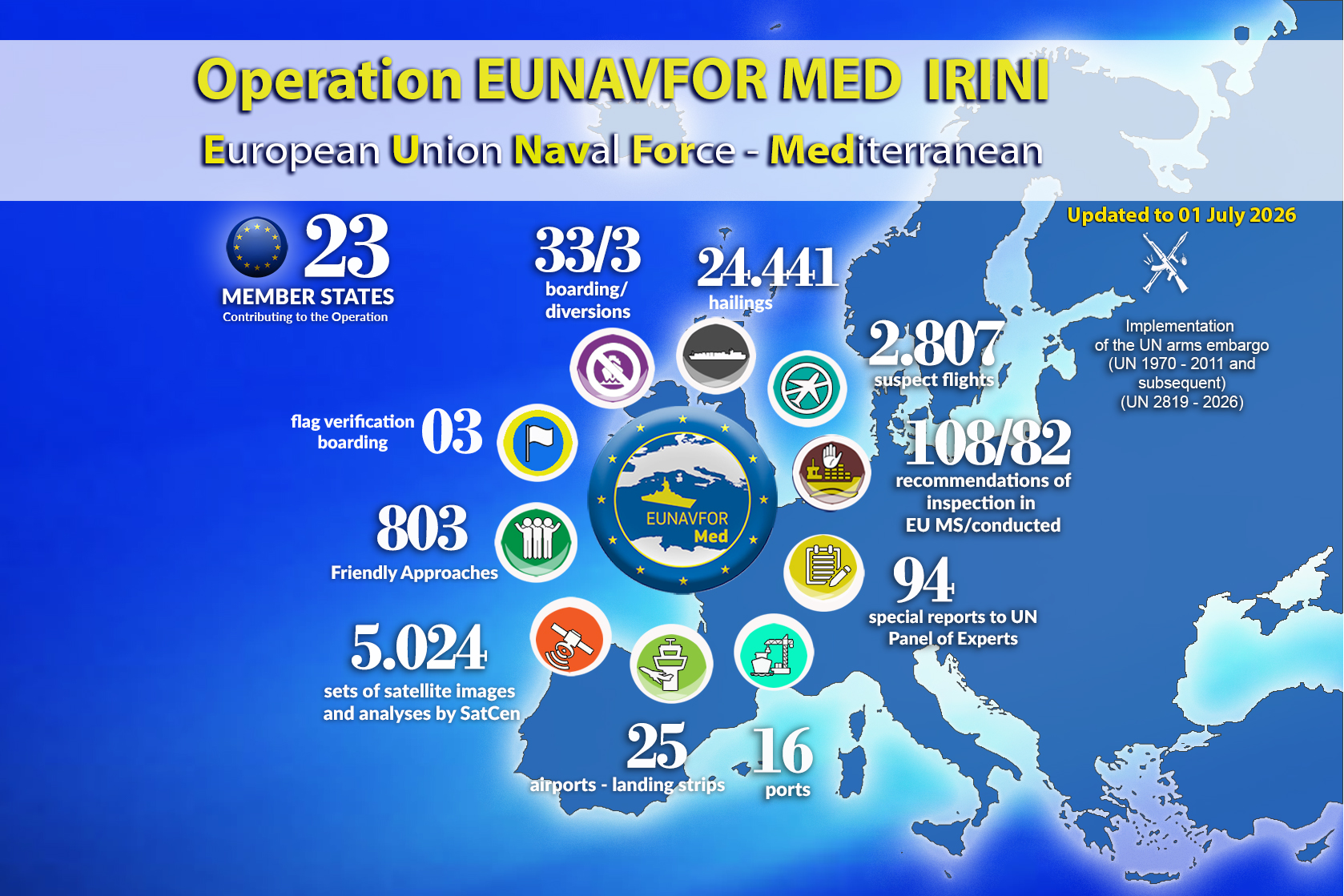
Further to our earlier post, it is being reported that, on Sunday 2 August, the EU’s operation EUNAVFOR MED Irini has boarded another tanker, the Toa Payoh, off Sicily. The vessel was sailing from Benin to Istanbul.

The boarding was to determine and investigate the flag status of the vessel which was claiming to have recently switched to a Cameroonian flag.

The vessel was not seized or detained as part of the operation.

EU – sanctioned oil tanker boarded in Mediterranean

It is being reported that on 20 July, the EU’s Mediterranean naval taskforce IRINI boarded the Turkish-owned oil tanker, the South Star, in order to assess and investigate its flag status. Under a different name the vessel had been designated by both the EU and the UK in 2025.

The report states that there was uncertainty over the vessel’s flag status as between Cameroon and Equatorial Guinea.

The vessel was allowed to proceed after the boarding and inspection.

The same reporting refers to IRINI’s published information which says that it had conducted three earlier flag verification boardings during the month of June.

United Kingdom – £6.4m fine for strategic export control failures

Further to our earlier post reporting on the UK’s investigation into Airbus, HMRC has today issued a Notice to Exporters that Airbus Operations Limited (AOL) has entered into a compound settlement with HMRC under which it will pay a fine of £6,409,388 for offences under The Export Control Order 2008.

This is the largest fine imposed by HMRC under the compound settlement regime, and is another example of the new practice of sometimes naming companies that enter into such settlements.

The offences do not relate to sanctions but to the UK’s strategic export controls regime.

The breaches took place “over a sustained period” before November 2022 and were self-reported by AOL which cooperated with the investigation and has implemented remediation.

The breaches are described in only general terms as follows:

  • Article 29(2)(a-g) on multiple occasions for failing to keep accurate records of transfers of controlled technology as per the conditions of three of their Open General Export Licences (OGELs)
  • Article 29(3) on multiple occasions for failing to keep registers in relation to their OGELs
  • Article 29(2)(i) on multiple occasions for failing to keep accurate records contrary to the conditions of one of their OGELs
  • a Standard Individual Export Licence (SIEL) on one occasion, relating to a failure of licence conditions

United Kingdom – bail denied and trial date set for prosecution of captain of the tanker Smyrtos

Further to our earlier post, it is being reported that a hearing took place in London on Thursday of last week relating to the prosecution of Ajay Pant, the Indian national who was captain of the oil tanker the MV Smyrtos.

As part of the hearing Pant’s application to be released on bail was refused and a four week trial was listed to start on 15 December.

In addition, the court has scheduled a hearing on 12 November to hear an application by the defendant to have the charges dismissed. The reporting does not mention the basis for that application.

France – guilty plea for Tagor tanker owner leads to €1m fine and release

Further to our earlier post regarding the detention by the French authorities of the oil sanctioned shadow fleet tanker, the Tagor, on 2 July, the company owning the vessel pleaded guilty in a Brest court to failing to be flagged and a refusal to comply with an order.

The company was fined, and paid, a fine of €1m. Upon payment the vessel was released and the is now sailing for Istanbul.

Our European Vessel Seizure Tracker has been updated.

Finland – conviction for Russian truck exports with 3 years and 8 months jail and €6.6 million confiscated

Further to our earlier posts (here, and here, and here), Risto Riihimäki has been convicted of aggravated sanctions breaches for his role in the export of 135 trucks to Russian in breach of the EU’s sanctions.

The trucks were declared to be transiting through Russia, but that was actually their final destination.

Mr Riihimäki was the CEO of the company Idän liikennevälitys IL Oy, and he has been sentenced to jail for three years and eight months, just below the 4 year maximum sentence for the offence under Finnish law.

In addition, the court has imposed confiscation order for €608,275 against Mr Riihimäki as the proceeds of crime, and a confiscation order against the company for profits it obtained from the exports in the sum of €6m. The company was also fined €10,000.

Although two other employees had originally been the subject of the investigation, ultimately they were not charged.

The conviction and sentence remain subject to appeal.

UK – compound penalty of £569,157 imposed on named energy company

The UK’s HM Revenue and Customs has announced the imposition of a compound penalty of £569,157 on Petrofac Facilities Management Limited.

This is the first time, in a long time, that HMRC has named the recipient of a compound penalty.

The breaches took place in 2022 and 2023 with the company supplying prohibited goods to individuals connected with Russia and also providing technical assistance in relation to those goods.

The company subsequently self-reported and cooperated with the investigation.

The change in naming policy is addressed:

Naming those involved brings us into line with other enforcement partners whilst sending a clear message on the consequences of breaching sanctions rules.”

The Notice further states that “Where appropriate, HMRC will now include naming as a condition when offering a compound settlement for strategic export and sanctions offences“. It appears that naming will now become more common if not done universally.

The Notice also gives helpful guidance on when HMRC will consider a compound penalty rather than prosecution, noting that a penalty will only be pursued where HMRC considers it has enough evidence to prosecute, and other considerations, including:

  • the seriousness of the alleged offence;
  • whether fraudulent intent can be proven;
  • the extent of the efforts to perpetrate the alleged offence;
  • the type and value of any goods involved;
  • the offender’s previous history;
  • the extent to which the offender has co-operated with any investigation; and
  • the level of financial penalties known to have been imposed by courts for similar offences.

Finland – trial begins in prosecution for exporting trucks and trailers to Russia

Further to our earlier post regarding the prosecution for exporting 135 trucks and 29 trailers from Finland to Russia, it is being reported that the criminal trial has started this week in Helsinki.

The prosecution are seeking a four year jail term for the individual and a fine for the company involved.

It is alleged that in 2022 and 2023 the vehicles were declared as bound for Kazakhstan and Türkiye and only transiting via Russia, but were actually exported to Russia.

UK – OFSI imposes Russian sanctions fine of £1,000,920.59

The UK’s Office of Financial Sanctions Implementation has issued a Penalty Notice against Sabre Global Technologies Limited (SGTL) imposing a fine of just over £1m against this UK entity.

SGTL continued to provide services to JSC Ural Airlines after that entity was designated in May 2022 and after the fact of the designation was communicated to SGTL by its lawyers on the same day.

Three payments were made to SGTL by JSC Ural Airlines between June and September 2022 totalling $906,576.30. These payments were blocked by SGTL’s bank.

In October 2022 SGTL self-disclosed the breaches to OFSI.

The Penalty Notice identified the following breaches:

  1. by invoicing JSC Ural Airlines SGTL made available a financial benefit (and so “funds”) in the form of the discharge of a debt obligation by the airline;
  2. by continuing to provide the airline with access to a product providing travel content up until 6 December 2022, SGTL was making an “economic resource” available to the airline;
  3. by exploring alternative payment routes to avoid the UK, including the making of a “test” payment of $200 to SGTL’s US bank account, SGTL was circumventing the UK’s sanctions in breach of regulation 19.

These breaches, especially the continued offering of SGTL’s product, were assessed as having a value of £2,634,001.54.

OFSI assessed the breaches as being in the “most serious” category given the value, the duration and the efforts at circumvention. The fine was assessed at the maximum of 50% of the value, and then the company obtained a 20% discount to reflect self-disclosure.

The Penalty Notice makes several other “Notes on Compliance”:

  1. firms must not test, reroute, restructure, or otherwise manipulate payment pathways in order to avoid, evade, or defeat the effect of UK sanctions. Attempts to engineer alternative channels, including staging of payments through third countries, may constitute circumvention and a breach in and of itself. Such conduct will be treated as aggravating and will significantly increase the seriousness of any case“;
  2. firms must be vigilant in identifying what may constitute an “economic resource” under UK sanctions regulations. Economic resources are assets of every kind, whether tangible or intangible, movable or immovable, which are not funds but can be used to obtain funds, goods, or services. Services that can be exchanged, directly or indirectly, for funds, goods, or services may constitute an economic resource even if they are intangible or provided digitally. In particular, firms should not assume that software, data services, or digital tools fall outside the scope of financial sanctions. A service that enables a designated person or entity to generate revenue, maintain operations, or otherwise obtain an economic advantage may amount to making an economic resource available“; and
  3. Although it is reasonable for a firm to take some time to assess the nature and extent of the breach, or seek legal advice, this should not delay an effective response to the breach. In practice, firms should contact OFSI early to inform us of a breach or potential breach. Where full disclosure is not possible, firms should make an early disclosure with partial information on the basis that it is still working out the facts and will make a further and full disclosure as soon as possible“.

© 2009- Duane Morris LLP. Duane Morris is a registered service mark of Duane Morris LLP.

The opinions expressed on this blog are those of the author and are not to be construed as legal advice.

Proudly powered by WordPress