United Kingdom – Irish subsidiary of Apple fined £390,000 by OFSI

The UK’s Office of Financial Sanctions Implementation has issued a Penalty Notice fining the Irish-incorporated company Apple Distribution International Limited (“ADIL”), £390,000 for breaches of the UK’s Russian sanctions.

ADIL was fined for issuing payment instructions to a UK bank, and for failing to cancel those payment instructions. The two payments in June and July 2022 for a total of £635,618.75 were to Okko LLC, a company wholly owned by the designated person JSC New Opportunities.

OFSI took the view that the instructions issued to a UK bank, and the failure to cancel those instructions, amounted to conduct within the UK for the purposes of the jurisdictional reach of the UK’s sanctions. This is in line with older case law that had established that sending instructions into the UK could amount to an offence within the UK.

ADIL self-disclosed the conduct in October 2022. The Penalty Notice was also arrived at by way of an agreed settlement pursuant to OFSI’s new enforcement procedures.

The penalty is also noteworthy because JSC New Opportunities was designated by the UK at 11am on 29 June 2022. The first payment instruction had been made on 6 June but with a value date of 30 June. The second payment instruction was issued on 30 June with a value date of 28 July 2022.

OFSI took the view that there was a “narrow window” in which the first payment could have been stopped, and that it was an aggravating factor justifying enforcement action that a second payment had been ordered. The Penalty Notice also expressly states that OFSI was relying on the “strict liability” enforcement rules that come into effect in 15 June 2022. Earlier payments made to Okko LLC, while it had been owned by a different designated person were also made in breach of the UK’s sanctions, but were not the subject of OFSI’s enforcement action as they took place before the coming into force of the “strict liability” rules.

OFSI also stated that despite the failings of the external screening provider used by ADLI, it was ultimately ADLI’s responsibility as the payment issuer, to ensure compliance with the UK’s sanctions.

France – Chinese shadow fleet captain sentenced in absentia to a year’s jail

Further to our earlier post relating to the trial of the captain of the Boracay, the shadow fleet vessel seized by France in October 2025.

The trial has concluded with the Chinese national captain, Chen Zhangjie, sentenced to a year’s jail and ordered to pay a fine of €150,000.

As the captain was tried in absentia, the French authorities have issued an arrest warrant for him.

The offence that was the basis of the conviction was for failing to stop the Boracay when ordered to do so.

Latvia – company and individual convicted of timber imports from Russia

The Latvian authorities have convicted, and fined, an individual and company for sanctioned timber imports from Russia.

The imports were of 50 packages of timber.

The company which procured the import was fined €39,000, and the individual who arranged the imports was fined €14,800. In addition the individual had the proceeds of the sale (€13,935) confiscated as the proceeds of crime.

As separate prosecution has been brought again the customs agent.

Belgium – €10m payment and rectifying infractions required to obtain release of seized shadow fleet tanker

Further to our earlier post regarding the Belgian seizure of the tanker, the Ethera, it is now being reported that 45 infractions have been identified in relation to the flag status and condition of the vessel.

It is also being reported that these infractions will need to be rectified before the vessel will be released and that a €10m payment will need to be made. Different reports (here, here and here) describe this payment as a bond, a bail payment, or a fine.

The blog’s 700th post – sanctions enforcement milestones reached

With today’s post on convictions in Germany, the blog has reached the milestone of 700 posts.

The post also takes European Sanctions Enforcement over several other milestones:

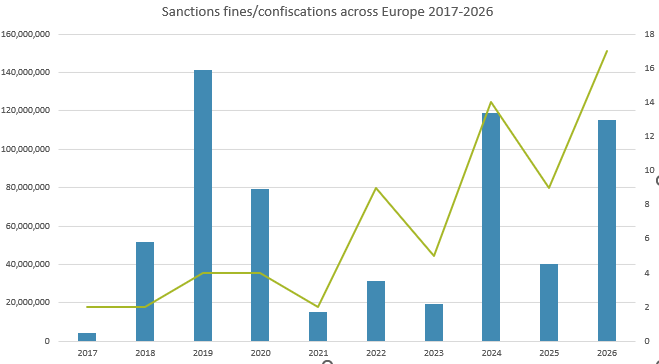
  • The €20m confiscated is Europe’s seventh largest sanctions fine/confiscation since 2017. All but one of those from the UK were fines imposed by the Financial Conduct Authority.

  • There has now been more than €500m in fines, penalties or confiscations since 2017.
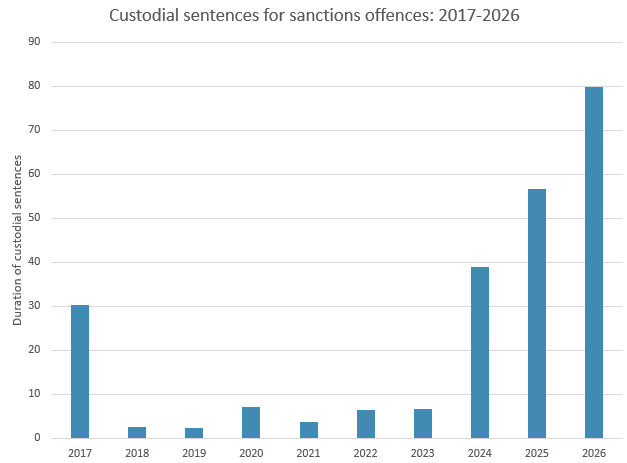
  • More than a century of jail time has been handed out since 2024, and Germany alone has seen sentences of more than 70 years of jail since 2017.

Enforcement across Europe is trending upwards.

Germany – convictions, €20m confiscation and 6 years in jail for luxury car exports to Russia

German Customs has announced the result in a criminal prosecution of two individuals charged with exporting 111 luxury cars to Russia in breach of EU sanctions.

See our earlier post relating to the raids conducted in 2024.

The vehicles were armored and classified as luxury under the EU sanctions.

One defendant pleaded guilty ahead of the trial, Inna W, and was given a 2-year suspended sentence. The main defendant, Andreas M, pleaded guilty mid way through the trial. He was given a six year jail term and has been in detention since his arrest in November 2024.

The defendants had further plans for the export of another 400 cars valued at €40m.

The evidence indicated an extensive procurement network of shell companies for purchasing the vehicles before export. Customers for the vehicles included various Russian state agencies and state-owned corporations.

The sentence included the confiscation of “approximately €20m” as the proceeds of crime said to be from the individuals and the companies involved.

Netherlands – DNB fines imposed on payment services provider upheld on appeal

Further to our earlier post, a payment services provider has brought a further appeal against fines imposed upon it by the Dutch National Bank.

In the previous appeal the original DNB fines of €1.1m and €625,000 had been reduced to €850,190 and €562,500.

Those fines have been upheld in this further appeal.

The defendant company, which had self-reported itself, and which operates ATMs had sought to argue that it was the banks and debit/credit card issuers who had the sanctions screening and due diligence obligations, and that its own self-report could not be used in evidence against it on the basis that it could not be required to incriminate itself.

The court dismissed these objections. The self-reporting had been voluntary and not required and, as a payment service provider, the sanctions compliance obligations also applied to the appellant.

Netherlands – sanctions fine from Financial Markets Authority upheld but reduced on appeal

The Rotterdam District Court has issued its decision in an appeal against a fine imposed by the Dutch Financial Markets Authority (the “AFM”).

Three related fine were initially imposed in 2023 valued at €31,000, €94,000 and €31,000 for a total of €156,000. The fines were for a mixture of compliance failings including, AML, terrorist financing and sanctions. The sanctions compliance failures were a failure to screen customers between 2017 and 2022.

The Claimant, a manager of seven real estate investment funds, appealed against this decision, including (amongst others) on the basis that the fine in relation to sanctions should be struck down because none of the customers were actually subject to sanctions.

The court upheld the fine noting (in machine translation):

“The fact that the AFM’s investigation has shown that the clients of the investment institutions … have not been … on a sanctions list does not detract from the seriousness of the violations either. This circumstance is not relevant to the legal obligations of [Claimant] as gatekeeper in the investigation of those clients and the source(s) of their funds, in order … to comply with the Sanctions Law. The assertion that the [Claimant] often knows the clients personally and that the risks were kept to a minimum … do not detract from this either”.

The fine was, however, reduced by 10% (for a revised total of €148,500) because the enforcement proceedings had taken longer than the 2 years permitted under Dutch law.

France – company that owns the seized ‘Grinch’ tanker fined “millions”

The company that owns the oil tanker ‘Grinch’ has, according to a press release by the Prefecture of Bouches-du-Rhône pleaded guilty in a Marseilles court.

It is being reported that the company was fined several million euros.

The vessel has been allowed to leave French waters with its cargo intact.

The offence alleged was failing to provide proof of the ship’s flag status under article L 5233-2 of the French Transport Code.

United Kingdom – OFSI fines bank £160,000 for Russian sanctions breaches

The UK’s Office of Financial Sanctions Implementation (“OFSI”) has issued a Penalty Notice to the Bank of Scotland fining the bank £160,000.

The bank opened an account for a designated person in February 2023 and then allowed 24 transactions to and from that account to take place between 8 and 24 February totalling over £77,000.

The bank’s screening system missed the fact that the person was designated, using the spelling in the person’s passport that had a different transliteration from cyrillic than used in the UK’s Consolidated List. One of OFSI’s complaints in the Penalty Notice is that the screening tool was insufficiently able to create a “match” despite the spelling variations.

The designation was first identified because the person was identified as a PEP and adverse media searches then revealed the designation. This was not then escalated to be resolved.

OFSI also noted that the in-house training to the Bank’s staff “was out of date and did not reflect risks associated with the contemporary sanctions landscape, such as the heightened risk posed by Russia sanctions post-2022”.

After an investigation into a different account, the Bank identified this particular account as belonging t a designated person and reported a suspected breach to OFSI on 10 March 2023 and an actual breach to OFSI on 16 March 2023.

The fine was first set at £175,000, including a 50% discount for prompt self-reporting, but this was reduced by OFSI, after further representations from the bank, to £160,000.

In the Penalty Notice’s “Notes on Compliance” attention is drawn to the failure to use a sufficiently robust screening tool, the lack of a clear escalation procedure, and the poor training.

The Penalty Notice does not name the designated person, but similarities indicate that this notice relates to the UK’s conviction of Dmitri Ovsiannikov (see our earlier post).

© 2009- Duane Morris LLP. Duane Morris is a registered service mark of Duane Morris LLP.

The opinions expressed on this blog are those of the author and are not to be construed as legal advice.

Proudly powered by WordPress