
UK – arms dealers each sentenced to 16 years jail

Further to our earlier post regarding the convictions, the UK’s judiciary has published the Sentencing Remarks relating to the sentencing of David Greenhalgh and Christos Farmakis (who was tried in absentia and is believed to be in Greece). They were convicted of supplying prohibited military equipment without a licence to a range of destinations including those subject to sanctions such as Libya, Sudan and South Sudan.

The Court noted the absence of published (or even analogous) Sentencing Guidelines for the court to follow and so approached sentencing by reference to previous decisions. Most influential appears to have been the decision in R v John Knight [2008] EWCA Crim 478 in which the court had given a range of factors to be considered including:

“the nature of the weapon, the quantities and values involved, the nature of the intended customer, the level of involvement of the particular defendant, the degree of planning by the defendant, his level of involvement, and his degree of knowledge and status. The Court went on to observe that in a case such as this, previous good character would count for relatively little, anything other than a significant term of imprisonment would be rare, and a deterrent element was appropriate“.

The court also noted that an assessment of the “harm” caused is “not confined to harm actually done but also by reference to the harm risked or intended, and the financial gain intended to the offender”.

The court assessed various aggravating features including the payment of bribes for fake end-user certificates, the longevity of the offending over 7 years (ending 9 years ago), the warning given of the need for UK licences, and the efforts to mask the conduct through companies and banking outside the UK.

Each man was given 9 years for Count 1, and 7 years for count 2 (to be served consecutively), with the jail term of 6 years for each of the other counts (7 and 8 respectively) to be served concurrently.
The blog’s 800th post – fines and jail terms

It was only in March that the blog passed the milestone of 700 posts, and now it is at 800. To mark the occasion we are publishing some graphs on the current state of enforcement across Europe.

Fines

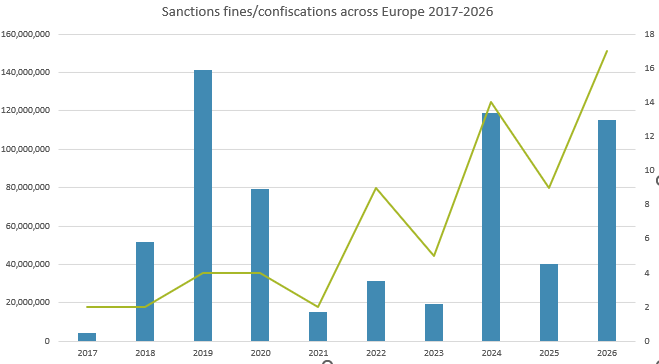
The first graph shows (in blue columns) the annual values (in euros) of fines/confiscations/penalties/forfeitures for sanctions breaches across Europe from 2017 to 2026.

The green line is the number of fines in any given year valued at €1 million or more.

With nearly four months to go 2026 is at €115.3m and is on track to surpass both 2024 and 2019 in terms of total value (and 2019 had a single fine of £102m from the UK’s FCA).

What the graph also illustrates is that while 2018-2020 had a small number of very large fines, countries across Europe are now imposing a much higher number of significant fines than before.

Jail terms

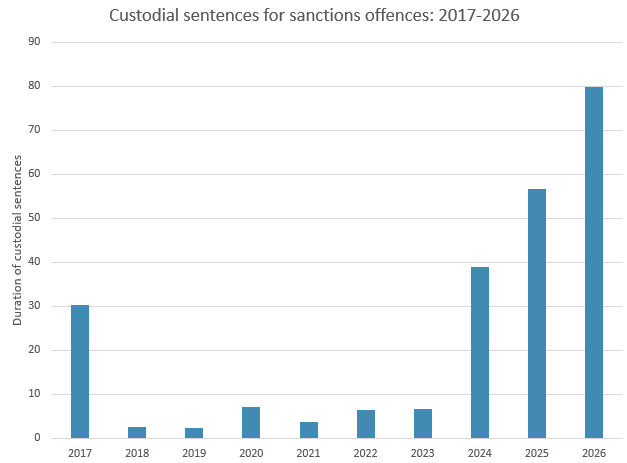
The next graph is another way of showing the sea change in enforcement outcomes since 2022.

In the last three years over 175 years of jail time (not including suspended sentences) have been handed down. The adoption and implementation of the EU’s harmonization directive, is only going to reinforce and further drive this trend as more member states take on the power to impose a custodial sentence.

Germany – lengthy jail terms for machinery exports to Russia

Further to our earlier post, relating to two brothers pleading guilty to sanctions offences mid-trial, the court in Germany has now sentenced (and here in German) the pair.

The younger brother was sentenced to 4 years and one month, and the elder brother to 3 years and 10 months. This was part of a plea deal in which, according to reports, admissions were also made in relation to offences that did not form part of the prosecution.

The convictions relate to 65 exports to Russia via, Turkey and Kyrgyzstan, of a total of €833,000 worth of engineering equipment and machinery used in weapons manufacturing.

Austria – two convicted for exporting sanctioned machinery to Russia

Further to our previous post, it is now being reported that the Austrian investigation into suspected exports of CNC machines has ended in two criminal convictions.

A 28 year old was the director and shareholder in the Vienna-based company involved. He received a 21 month sentence of which 19 months were suspended. He was released upon his conviction having already served more than two months in detention.

The second defendant was a 24-year old who dealt with the company’s accounts and was also a shareholder. She was given a 15-month suspended sentence.

Both had pleaded guilty to the charges.

The reporting makes no mention of a financial fine, or of any confiscation of the proceeds of crime.

Finland – conviction for Russian truck exports with 3 years and 8 months jail and €6.6 million confiscated

Further to our earlier posts (here, and here, and here), Risto Riihimäki has been convicted of aggravated sanctions breaches for his role in the export of 135 trucks to Russian in breach of the EU’s sanctions.

The trucks were declared to be transiting through Russia, but that was actually their final destination.

Mr Riihimäki was the CEO of the company Idän liikennevälitys IL Oy, and he has been sentenced to jail for three years and eight months, just below the 4 year maximum sentence for the offence under Finnish law.

In addition, the court has imposed confiscation order for €608,275 against Mr Riihimäki as the proceeds of crime, and a confiscation order against the company for profits it obtained from the exports in the sum of €6m. The company was also fined €10,000.

Although two other employees had originally been the subject of the investigation, ultimately they were not charged.

The conviction and sentence remain subject to appeal.

Belgium – three convicted of Russian sanctions breaches

Reuters is reporting that three individuals have today been convicted of Russian sanctions offences.

The offending involved the shipment of goods for the Russian defence sector via third countries including Hong Kong and Kazakhstan. The goods are described as “sanctioned goods, including rare earths, an explosive detector and ​a defence-related machine”.

The first defendant, named in the reporting as Victor Labin, was given an €80,000 fine and a five year prison sentence, with one year of that suspended.

The second defendant, reported to be Ruslan Labin, and tried in absentia was sentenced to six years in jail and an €8,000 fine.

The third defendant, named only as P.I., was given a three year sentence, suspended for five years, and an €8,000 fine.

Estonia – sanctions enforcement data since January 2026 for Customs and Tax Board

Collating the outcomes published in the weekly reports by Estonia’s Tax and Customs Board (see our earlier post for the period from 14 October 2025 to 13 January 2026), reveals the following data:

  • 18 fines
  • total fines of €226,669, with most being small and one of €219,210 including confiscation
  • 13 cases referred to misdemeanour prosecution
  • 3 cases referred to criminal prosecution, including one case that resulted in a 1 year jail term, a 3 year ban on entry to Estonia and a €3400 fine
  • 6 cases referred for further investigation.

The weekly reports give details of many other prevented exports and imports where no further action was taken for first time offenders.

Germany – publication of the latest 6-monthly sanctions enforcement update

The German authorities have published the third instalment of their 6-monthly updates on their current enforcement actions.

The report highlights:

  1. The conviction on 2 March 2026 of two individuals relating to the export of 111 luxury cars to Russia, with €20m confiscated, and jail sentences of 6 years and 2 years (the latter suspended). See our previous post.
  2. Raids conducted in November 2025 and the ongoing investigation into the suspected export of machine tool to Russia value at €1.7m. The report confirms that the investigation by the Stuttgart Public Prosecutor’s Office and the Stuttgart Customs Investigation Office remains ongoing. See our previous post.
  3. An investigation into five suspects for the organized circumvention of sanctions against Russia. A company is alleged to have exported technical equipment and accessories worth c. €689,000 to a company in Russia via third countries. The investigation started in February 2025 and is being conducted by the Essen customs investigation office, is ongoing. See our previous post.
  4. The prosecution of a 41-year old suspected of exporting 236 cars to Russia valued at approximately €18.86m. See our previous post.
  5. The arrest of five suspects on 2 February suspected of 16,000 illegal deliveries to 24 listed Russian arms companies of good worth at least €30m. The prosecution was supported by the Federal Intelligence Service (the BND). See our previous post.
  6. On 27 March raids conducted on 14 premises in the Rhine-Main region against two companies suspected of exporting machine parts and chemicals to Russia. A third company is said to have been involved in the alleged use of a transport and logistics companies to try and circumvent the EU’s sanctions. See our previous post.
  7. The ongoing investigation into a member of the Saxon state parliament for allegedly falsifying the export declaration in relation to a telescopic handler rather than stating the correct destination of Belarus. Searches were conducted at residential and business premises. See our earlier post.

The update also reports on a decision of the CJEU from 5 February 2026 upholding the seizure by German customs of a Mercedes car purchased in Russia and imported to Germany. The CJEU held that the single specific import did not need to “generate significant revenue for the Russian state”, so long as the general category of goods did.

Further cases noted previously in the blog over the last few months, but not included in the report are:

  • an investigation from February 2026 in relation to the import of goods valued at over €4m from Russia;
  • an investigation made public in January 2026 into the use of RussPost to export goods to Russia;
  • reporting from January 2026 into a mutual legal assistance request made to Ukraine as part of an investigation into the suspected export of drone parts to Russia;
  • the arrest in January 2026 of two people on suspicion of making available funds and economic resources to the Donetsk and Luhansk People’s Republics;
  • an investigation made public in December 2025 by the Munich Prosecutor’s Office into alleged export of 50 luxury cars valued at over €10m; and
  • raids in November 2025 in relation to the suspected export of 346 cars to Russia.

France – cement maker Lafarge and eight executives convicted of sanctions and terrorist financing breaches

Further to our earlier posts, a court in Paris had today handed down judgment in the long-running Lafarge prosecution.

The company has been convicted of breaches of the EU’s Syrian sanctions as well as terrorist financing and has been fined €1.125m as well as a separate fine of €4.57m for breach of sanctions.

Of the executives also being prosecuted:

– Bruno Pescheux (former director of the Syrian cement factory) received a 5-year jail term and was fined €225,000;

– Bruno Lafont (former Lafarge CEO) was sentenced to 6 years in jail and fined €225,000;

– Christian Herrault (former deputy Managing Director) was sentenced to five years in jail and fined €225,000;

– Frederic Jolibois (successor to Pescheux) was sentenced to three years in jail, two of which were suspended, and fined €80,000;

– Jacob Waerness was sentenced to 18 months in jail and fined €20,000 and a ban from entering France;

– Ahmad Al Jaloudi was sentenced to 2 years in jail and fined €20,000 and a ban from entering France;

– Amro Taleb, a Syrian intermediary, was sentenced to 3 years in jail and fined and fined €60,000 and a ban from entering France;

– Firas Tlass, tried in absentia, was convicted and sentenced to seven years in jail with a €225,000 fine and a ban from entering France.

It appears that a decision on the confiscation of the proceeds of crime in this case is awaited. The prosecution was seeking confiscation of €30m.

Some of the individual defendants have already indicated their intention to appeal.

France – Chinese shadow fleet captain sentenced in absentia to a year’s jail

Further to our earlier post relating to the trial of the captain of the Boracay, the shadow fleet vessel seized by France in October 2025.

The trial has concluded with the Chinese national captain, Chen Zhangjie, sentenced to a year’s jail and ordered to pay a fine of €150,000.

As the captain was tried in absentia, the French authorities have issued an arrest warrant for him.

The offence that was the basis of the conviction was for failing to stop the Boracay when ordered to do so.

© 2009- Duane Morris LLP. Duane Morris is a registered service mark of Duane Morris LLP.

The opinions expressed on this blog are those of the author and are not to be construed as legal advice.

Proudly powered by WordPress