
Duane Morris Takeaway: This week’s episode of the Class Action Weekly Wire features Duane Morris partner Jennifer Riley and associate Nathan Norimoto with their discussion of developments and trends in the area of civil rights class action litigation.
Check out today’s episode and subscribe to our show from your preferred podcast platform: Spotify, Amazon Music, Apple Podcasts, Google Podcasts, the Samsung Podcasts app, Podcast Index, Tune In, Listen Notes, iHeartRadio, Deezer, YouTube or our RSS feed.
Episode Transcript
Jennifer Riley: Hello, everyone, and thank you for being here again for the next episode of our weekly, podcast the Class Action Weekly Wire, I’m, Jennifer, Riley partner and Dwayne Morris and joining me today is Nathan Norimoto. Thank you for being on the podcast Nathan.
Nathan Norimoto: Great to be here, Jen.
Jennifer: Today we wanted to discuss some trends and important developments in the area of civil rights class action litigation. Nathan, do you want to talk a bit about this area of law before we get into a development over the past year?
Nathan: Yes, definitely. For more than 70 years, class actions have been among the most powerful tools to secure civil rights in America. This began with the class action of Brown, et al. v. The Board Of Education, which declared school segregation unlawful and arguably set the stage for the Civil Rights Movement. In 1966, Congress and the judicial rule-making authorities crafted Rule 23 with the express goal of empowering litigants, challenging systemic discrimination, particularly segregation, to force courts to order widespread objective relief that would protect members of the class as a whole. Ever since, this provision remains as salient to the enforcement of federal civil rights statutes and constitutional claims as it was at its inception. So, for a multitude of reasons, class actions are often a tool of first resort by advocacy groups to remedy civil rights violations.
Jennifer: Thank you so much for that overview. What were some of the major developments in 2023 and during the first half of 2024 in the civil rights class action litigation space?
Nathan: Class actions in the civil rights context span numerous issues during that time period. Given this breadth of subject area, there were well over 100 decisions in this space. In these far ranging claims and groups of individuals, one common theme continues to be whether litigants can meet the commonality and typicality requirements of Rule 23, under the federal rules of civil procedure, to establish class certification. 2023 saw court rulings where numerous civil rights cases were certified, as well as granted class certification affirmed on appeal.
Jennifer: Are there any key rulings from this past year that listeners need to know about in the civil rights litigation class action area?
Nathan: Definitely. So, among all civil rights cases, the ruling on class certification in Progeny, et al. v. City Of Wichita was likely amongst the most significant. The plaintiffs, a nonprofit organization and several individuals, filed a class action alleging that the defendant, the city of Wichita, kept a “gang list” created and maintained by the Wichita Police Department, or WPD, whom WPD personnel had determined that the definition of a criminal street gang member. The individual plaintiffs alleged that they were wrongfully designated as criminal street gang members and added to the gang list, which adversely affected their lives. The plaintiff filed a motion for class certification pursuant to Rule 23, and the court granted the motion. The plaintiff proposed class consisted of all persons included in the Wichita Police Department’s gang list as an active or inactive gang member or gang associate. The court also determined that several common questions existed to establish commonality, including whether the statute was unconstitutionally vague, whether it failed to provide procedural protections to persons on the gang list, and whether inclusion in the gang list has a chilling effect on the right to freedom of association. The court held that the plaintiffs established that the defendant acted or refused to act by applying the gang list criteria to add persons to the gang list without procedural protections for those persons, which was applicable to the entire class. So the court ruled that the requested injunction seeking to bar the defendant from enforcing the statute was appropriate to the class as a whole, because all class members were on the gang list, and therefore the court granted class certification.
Jennifer: Thank you, Nathan, for that overview. So, turning to some trends and developments – there were over 100 rulings in this area in 2023. How are things progressing thus far in 2024 – have there been any interesting cases where class certification was granted?
Nathan: Certainly. So it seems like courts are continuing to grant class certification rulings in this area so far this year. One example here in California, Berg, et al. v. County Of Los Angeles, the plaintiffs were a group of protesters who filed a class action asserting that the Los Angeles Sheriff’s Department, or the LASD, had used excessive force against peaceful protesters and unlawfully detain them in violation of their First, Fourth, and Fourteenth Amendment rights in connection with the George Floyd protests. The plaintiffs filed a motion for class certification on one injunctive relief class and two damages classes, and that motion was granted by the court. As to the injunctive relief class, the defendants opposed the motion on mootness and standing grounds, and the court found that could not determine that the class would be moot, and that because the plaintiffs had stated they plan to attend future protests, they could plausibly be fearful of future harm. Next, for the first damages class, containing individuals who were arrested at the protests, the court stated that there were several common issues central to the class, including (i) whether the defendants have a custom and practice of using indiscriminate force against the peaceful protesters; (ii) whether there has been a manifest failure by the defendants to train employees on the use of force against the protesters; and (iii) whether the defendants had ratified violations of peaceful protesters’ rights. So finally, on the last and third class, the other damages class which contained individuals who were subject to the use of rubber bullets or tear gas, the court determined that the plaintiffs sufficiently established the common alleged harm of a “chill” to their First Amendment rights to unify the class. The court stated that the class met the predominance requirement under Rule 23 because the plaintiffs alleged class-wide general damages and challenged only a single “custom and practice of abusing indiscriminate force against peaceful protesters.” The court concluded that class action would be superior method of adjudication for the direct force class, or the third class, and granted the motion for class certification in its entirety.
Jennifer: It certainly seems like we will see courts continuing to grapple with motions for class certification in this area in 2024, and the plaintiffs’ bar continuing to aggressively pursue certification on behalf of plaintiffs. We know that successful certification often leads to settlements between the parties, rather than continuing the litigation and ultimately going to trial. How successful were plaintiffs in securing settlement dollars in this space in 2023?
Nathan: Pretty successful. Settlement numbers in civil rights class actions in 2023 were definitely significant. The top 10 settlements total $643.15 million. However, this is significant, but it was a decrease from the prior year when the top 10 civil rights class action settlements topped $1.3 billion.
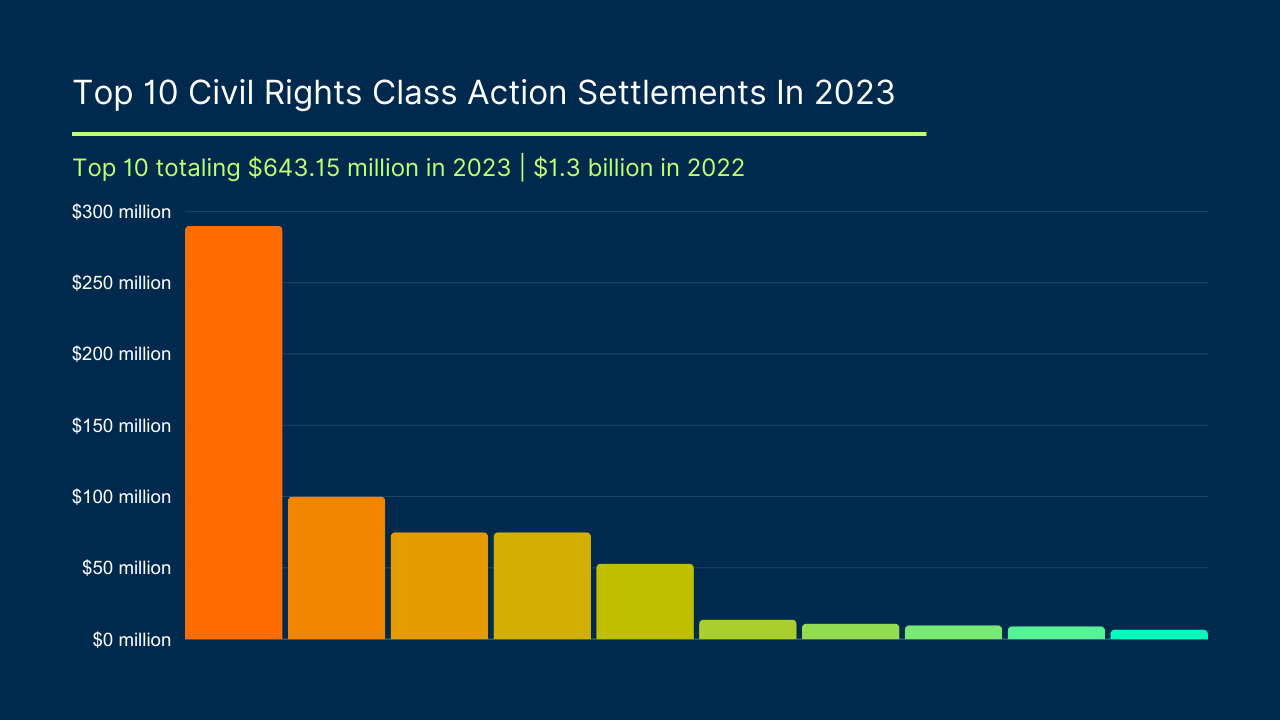
Jennifer: The top settlement amounts in each area of law have been massive in recent years, and a major trend that we track in the Duane Morris Class Action Review. We will continue to track these numbers in 2024 and keep listeners aware of developments. Is there anything else corporate counsel and employers should be on the lookout for in 2024?
Nathan: So given the volume of litigation in the civil rights area, as well as the frequency which with classes are granted and new burgeoning issues for that can percolate in these cases – for example, claims connection with COVID-19 in connection with the increase homelessness issues that we’re facing in our cities – it’s anticipated that the plaintiffs’ bar will continue to be creative, and definitely inventive in this space, as we progress through 2024.
Jennifer: Well, thanks so much for all of this great analysis, Nathan. Thank you for being here with me today. Listeners, thank you for tuning in. And if you have any questions or comments on today’s podcast please feel free to send us a DM on Twitter @DMClassAction.
Nathan: Thanks for having me, Jen, and thank you listeners for being here today.
Jennifer: Thank you listeners again for joining us today, and please join us next week for the next episode of the Class Action Weekly Wire.