By Gerald L. Maatman, Jr., Mike Rosenblatt, and Ryan Garippo
Duane Morris Takeaways: On August 10, 2026, in Kalman v. Sevigny, et al., No. 26-CV-00619 (D.N.J. Aug. 10, 2026), Judge Christine P. O’Hearn ruled that Attorney Matthew Kalman could not serve simultaneously as class representative and counsel prosecuting the case on behalf of the class. The decision serves as a helpful reminder for any company facing a class action to review opposing counsel and class representatives for conflicts of interest.
Conflicts of interest can be an early death knell for a class action suit, allowing companies to dispose of class actions without even addressing the case’s merits.
Case Background
As both class representative and class counsel, Matthew Kalnan brought suit against a myriad of financial services companies and their executives, alleging that he was defrauded in a systematic scheme to solicit investments from retirees and conservative investors. According to Kalnan, the scheme started in 2015 when he hired Aaron Sevigny of Acadia to invest his retirement funds. Kalnan claims that he entrusted Sevigny and Acadia to invest conservatively on his behalf.
But according to Kalnan, the investments recommended by Acadia were anything but risk averse. He claimed instead that his funds were invested in, for example (1) a private placement later charged by the SEC as a “Ponzi-like scheme”; (2) a conservation easement, which served as “abusive tax shelters”; and (3) a collateral debt obligation vehicle with “limited repurchases, … suspended offerings, and illiquidity risks.” Kalnan further alleged that Sevigny and Acadia failed to provide accountings or disclose risks of the investments, and as losses mounted in November 2024, Sevigny and Acadia stopped communicating with Kalnan altogether. Kalnan estimates he lost around $2 million in the scheme.
Kalnan brought the suit as a class action, however, rather than as a claim solely for his own damages. Kalnan’s class definition included “[a]ll persons who invested funds with or through Defendants in unsuitable alternative investments.”
Kalnan filed his complaint on January 20, 2026, and filed a First Amended Complaint on March 9, 2026. In both complaints, he served as both class counsel and class representative. Kalnan brought claims for racketeering, violations of federal security law, violations of New Jersey consumer fraud law, fraud, and other common law allegations. Defendants filed a motion to disqualify Kalnan from serving as both counsel and class representative on May 6, 2026.
The District Court’s Ruling
In a 3-page opinion, Judge O’Hearn struck all class allegations in the instant case and conditioned Kalnan’s refiling of class claims “only if alternative counsel enters an appearance and Kalnan withdraws his appearance in its entirety.” Op. at 3 (emphasis in original). The ruling also permits Kalnan to continue litigating the instant case as an individual and representing himself pro se.
Judge O’Hearn based her ruling on the Third Circuit’s holding in Kramer v. Science Control Corp., 534 F.2d 1085 (3d Cir. 1976). Kramer held that where a class action may result in an award of attorneys’ fees, the plaintiff class representative may not also serve as class counsel. The Third Circuit based its decision on “the possible conflict of interest between the class member plaintiff qua plaintiff and the class member qua counsel, under circumstances in which an equitable fund may be created from which an attorneys’ fee may be awarded.” Id. at 1090.
O’Hearn rejected Kalnan’s arguments that the motion to disqualify him as counsel was premature. Kalnan argued that procedurally, disqualification should wait until class certification or discovery began. The decision rejected this argument, stressing that “[n]o discovery could alter those facts or the conclusion that such representation is improper.” Op. at 2.
Implications for Companies
The Kalnan decision serves as a critical reminder to companies and defense counsel to search for and raise potential conflicts of interest between class and counsel as early into litigation as possible. Courts take great care in ensuring that class counsel’s interests in recovering attorneys’ fees does not interfere with representation of absent class members. This care typically arises later in the case when the parties move towards settlement and the court must serve as a steward of the class.
But conflicts of interest can arise at any time, and identifying a conflict of interest between class and counsel can be an efficient way to dispose of a class action in its early stages. Here, defendants were able to effectively dismiss all class claims with a single, 3-page motion, filed just two months after the First Amended Complaint. While Kalnan can continue to litigate his own case, the elimination of class claims substantially reduces defendants’ exposure. Companies should take note of this decision and be on the lookout for similar opportunities in their own class action defenses.
Duane Morris Takeaway:This week’s episode features Duane Morris partners Jerry Maatman and Sharon Caffrey with their analysis of a proposed $5.5 billion settlement aimed to resolve thousands of lawsuits alleging Johnson & Johnson’s talc-based products caused ovarian cancer.
Jerry Maatman: Thank you for being here again for the next episode of our weekly podcast, the Class Action Weekly Wire. I’m Jerry Maatman, a partner at Duane Morris, and joining me today is my partner and colleague, Sharon Caffrey. Thanks so much for being on the podcast today.
Sharon Caffrey: Thank you, Jerry, it’s great to be here.
Jerry: Today, we’ll be discussing Johnson & Johnson’s recent announcement that it has agreed to pay approximately $5.5 billion to settle thousands of lawsuits alleging that its products containing talcum powder caused ovarian cancer. Sharon, I know this story has been unfolding for quite a while. What exactly happened here?
Sharon: Yeah, this is certainly one of the most significant settlements we’ve seen in the mass tort arena. Johnson & Johnson announced that it has reached a proposed agreement to resolve the claims against it brought by roughly 70,000 plaintiffs in federal talc multi-district litigation, which is pending in New Jersey, along with some related state court proceedings. Under the agreement, the company has agreed to commit at least $5.5 billion to compensate claimants. Importantly, though, the settlement is conditioned on participation by at least 95% of those plaintiffs. So, while it’s a major breakthrough, there are still some procedural hurdles before the settlement becomes final.
Jerry: One aspect of the settlement that stood out to me is that Johnson & Johnson maintains that its talc products are safe and do not cause cancer. So, this isn’t a situation where a company is admitting any liability.
Sharon: That’s exactly correct. Throughout the litigation, Johnson & Johnson has been consistent in arguing that its talc products do not contain asbestos and do not cause ovarian cancer. The company’s been unwavering on that position and in announcing the settlement, Johnson & Johnson characterized the agreement as a practical business decision rather than a concession on the merits. The company emphasized that it remains confident in the science supporting its products and believes it would have continued to prevail if these cases continued to move forward.
Jerry: That confidence also seems to be reinforced by some recent developments in the litigation itself.
Sharon: That’s correct, and in fact, the timing of the settlement is especially interesting, because it comes on the heels of a significant ruling in the multi-district litigation. Just last week, the federal court overseeing the MDL ordered the plaintiffs to demonstrate that they could produce admissible expert testimony linking talc to ovarian cancer. Without that evidence, the plaintiffs faced the possibility that their remaining claims would be dismissed. And that ruling followed the withdrawal of two key causation experts for the plaintiffs in Bellwether cases. Johnson & Johnson argued that those developments highlighted the fundamental problems for plaintiffs, proving that talc exposure caused a specific individual’s ovarian cancer.
Jerry: Certainly, when you talk about settlement of major litigation leverages everything, and it seems to me that the legal landscape might have been shifting in favor of Johnson & Johnson and against the plaintiffs here.
Sharon: Yeah, based on the specific causation issues that the plaintiffs were facing, that is accurate. Company representatives were pointing to those expert challenges at this time once the courts engaged in some more scrutiny of those experts. They essentially argued that plaintiffs were increasingly facing an uphill battle to establish specific causation, which is one of the most difficult things in product liability litigation.
Jerry: Well, $5.5 billion is what it is, and so the plaintiffs also claim victory here.
Sharon: Oh, of course they did. Plaintiffs’ leadership described the settlement as a landmark achievement and characterized it as long-delayed justice for women and families who have been waiting years for compensation. One of the more compelling points made by plaintiffs’ counsel was that the litigation is stretched on for more than a decade. During that time, many claimants have faced serious health issues, and some, unfortunately, have passed away before seeing a resolution of their claims. From that perspective, plaintiffs view this settlement as delivering certainty and compensation after years of legal battles.
Jerry: In terms of mass tort resolutions and class action litigation, an interesting feature, if not an unusual feature, that stood out to me was the fact that the settlement is uncapped. Could you explain to our listeners and viewers what that means?
Sharon: Sure. Usually, when there is a settlement of a mass tort, there is a fund, a specific fund, that is created for eligible claimants. And, it’s a fixed amount that must be divided amongst those claimants, so claimants step forward and their cases are weighed, usually on a tiered system. In this instance, plaintiffs’ counsel is very bullish on the fact that Johnson & Johnson is not capping this at $5.5 billion. It will depend on the levels of participation and the qualifying claims. In addition, the settlement applies only to current plaintiffs and does not resolve claims that may potentially arise in the future.
Jerry: Well, maybe the price of a settlement is making everybody equally unhappy or happy, but if you look at the recent trial results, it’s easy to see why both sides of the V in this case concluded that settlement was preferable to continued litigation.
Sharon: Right, the most recent case was tried in June, and that was in Los Angeles, and there was verdict was rendered in favor of Johnson & Johnson after a six-week trial of an ovarian cancer bellwether case. And then earlier this year, an Oklahoma jury also sided with the company in a mesothelioma case involving alleged asbestos-containing talc products. At the same time, the plaintiffs have secured notable victories as well, including a $65.5 million verdict that was recently upheld in a case involving a woman who alleged that Johnson & Johnson’s talc products caused her exposure to asbestos and contributed to her cancer. And also another prior Los Angeles plaintiff obtained a $40 million verdict in a bellwether trial. So, the mixed outcomes really create uncertainty for both sides, and trials are expensive, appeals take very long time, sometimes years, and neither party can fully predict how the juries are going to respond, particularly with the complex science.
Jerry: Sharon, from a broader perspective, what do you think this settlement tells us about, the mass tort space going forward into the later half of 2026?
Sharon: Well, there should be a whole lot less tort cases, but, first, I think mostly expert testimony remains the centerpiece for modern mass tort litigation. Regardless of the size of the case, the ability to establish reliable scientific causation often determine whether claims survive Daubert or Frye challenges. And second, the settlement pressure increases dramatically when courts begin to scrutinize expert evidence. The MDL court’s recent rulings appear to have created a pivotal inflection point in these proceedings, particularly for the plaintiffs who faced not having specific causation experts. And then, finally, after years of litigation and multiple trial victories for both sides, global resolution is probably the most attractive option because of the uncertainty in what the outcomes would be.
Jerry: Final question for you, do you think this is the end of the talc litigation story?
Sharon: It’s the end of a major chapter of the talc litigation story. Settlement still requires substantial participation by all the plaintiffs and there may be implementation issues as the claims proceed. Also, remember that this is only for the existing claimants, and there could be future claimants. And then I think If the participation threshold is met, this is going to be one of the most consequential resolutions in mass tort history and could bring some closure to a significant portion of the ovarian talc litigation involving cosmetic talc.
Jerry: Sharon, thanks so much for joining us on this week’s edition of the Class Action Weekly Wire. This has been a great discussion, and thank you for your detailed analysis, kind of inside baseball look at the settlement. Thanks to our listeners. We’re glad you were here to tune in to another edition of our weekly podcast series.
Sharon: Thank you, Jerry, for inviting me to speak on this topic.
By Gerald L. Maatman, Jr., Eden E. Anderson, and Rebecca S. Bjork
Duane Morris Takeaways:On August 5, 2026, a panel of the U.S. Court of Appeals for the Ninth Circuit affirmed a decision denying a motion to compel arbitration brought by an employee on a representative basis under California law against his employer. In Rickes v. Thermo Fisher Scientific, Inc., et al., No. 25-5138 (9th Cir. Aug. 5, 2026), the Ninth Circuit decided that a district court had properly determined that there was insufficient evidence that the plaintiff assented to the arbitration agreement that had been sent to his work email address by his employer four times. The panel decided the evidence showed the plaintiff never opened the emails, supporting his declaration that he was not aware of those emails and never saw them until after he filed suit. The Ninth Circuit then held that the district court correctly decided that the plaintiff’s continued employment after he received the emails could not be construed as consent to arbitrate workplace claims because silence does not constitute assent.
Employers with a workforce in California who are considering rolling out or updating arbitration programs should take note and consider designing and implementing appropriate non-coercive, non-electronic methods of following up with employees who do not open or respond to such emails.
Case Background
Plaintiff Scott Rickes brought a lawsuit in the U.S. District Court for the Southern District of California against his employer, Thermo Fisher Scientific, Inc. (“Thermo Fisher”), alleging he and others similarly situated whom he seeks to represent were unlawfully subjected to age discrimination under California law. Thermo Fisher moved to compel arbitration, relying on emails the company sent to the plaintiff’s work email address that contained a link to an agreement to arbitrate claims such as this. Thermo Fisher relied on evidence it submitted to the district court to demonstrate that it sent that email to the plaintiff four times in 2019. The plaintiff, however, declared that he never saw those emails because he was very busy at work and it was not uncommon for him to have unopened emails. Id. He argued that there was insufficient evidence to demonstrate that he assented to the arbitration agreement and therefore it could not be enforced.
The district court denied Thermo Fisher’s motion to compel arbitration, finding no evidence that an agreement to arbitrate had been reached by the parties under California contract formation principles. Thermo Fisher appealed the district court’s ruling.
The Ninth Circuit’s Decision
On August 5, 2026, a panel of the Ninth Circuit, in an unpublished decision, unanimously affirmed the district court’s decision. The Ninth Circuit agreed no evidence had been submitted to demonstrate that the plaintiff had ever opened any of the emails containing a link to the arbitration agreement. Asa result, there was no evidence that the plaintiff saw the arbitration agreement.
In explaining its rationale, the Ninth Circuit first noted that a contract can only be formed with mutual assent. Under California law, this requires both notice of an agreement and mutual assent to it. Mutual assent is absent when a party has not received notice of the proposed contract.
The Ninth Circuit also concluded that while “outward manifestations” of assent can be objectively inferred by a party’s conduct at times, such is not the case where this plaintiff’s conduct was mere silence in response to the offer to form an agreement to arbitrate claims related to his employment. Id. at 3.
As a result, the Ninth Circuit considered – and rejected – Fisher Scientific’s argument that where a current employee continues to work at his position after having been informed that an arbitration agreement will govern any employment claims going forward, such employee is legally considered to have assented to arbitration by inference. Due to his silence, the Ninth Circuit decided the plaintiff could not have been deemed to have accepted the agreement by failing to opt out within forty-five days.
Finally, the Ninth Circuit dispensed with Fisher Scientific’s argument that continued employment despite unsigned arbitration agreements can constitute assent to arbitration because the cases cited were inapposite. Some applied to situations where a plaintiff was subject to an employment agreement that he agreed to that contained an arbitration clause (which is not the case in this matter) and others applied to cases where an employee signed a receipt saying they received an agreement or an employee handbook containing an arbitration provision (again not at issue in this matter).
Implications For Employers
Employers with a workforce in California should heed this ruling if they are planning on rolling out new or revised arbitration agreements to cover potential employment law claims. Relying solely upon electronic means to implement such a workplace arbitration program is likely insufficient to bind employees. Employers should consider planning for non-electronic follow-up contact methods to reach employees who do not respond to emailed requests to consent to arbitration agreements; implementing tracking methods to identify such employees; and carefully crafting such follow-up communications to neutrally and in a non-coercive manner inform the employees of the need to open the email and respond to it in a timely manner. Doing so could mean the difference between facing expensive and protracted litigation in California state or federal court involving potential additional aggrieved individuals and perhaps defending a single plaintiff arbitration matter at much lower costs.
Duane Morris Takeaway:This week’s episode features Duane Morris partner Jennifer Riley and associate Elizabeth Underwood with their analysis of a ruling from the Eighth Circuit affirming a district court’s judgment in favor of an employer following a jury verdict rejecting a hostile work environment claim brought by the EEOC and an intervenor employee.
Jennifer Riley: Thank you for being here again for the next episode of our weekly podcast, the Class Action Weekly Wire. I’m Jennifer Riley, partner at Duane Morris, and joining me today is my colleague, Elizabeth Underwood. Thank you so much for being on the podcast today, Elizabeth.
Elizabeth Underwood: Great to be here, Jen. Thanks for having me.
Jennifer: Today, we’re discussing a significant new decision from the Eighth Circuit involving employer liability for workplace harassment. So, this is an important decision for employers. It reinforces what courts expect of employers when responding to harassment complaints. And just as importantly, it also talks about what an employer must know about a situation before liability can attach. So, let’s start with the basics. Elizabeth, can you tell our listeners what happened in this case?
Elizabeth: Sure. The case is EEOC v. Sun Chemical Corporation, decided by the Eighth Circuit on August 4, 2026. The EEOC and an employee, Bryan Banks, brought a Title VII hostile work environment claim after a coworker directed the N-word at Banks multiple times during a workplace confrontation. Banks immediately reported the incident. Sun Chemical investigated, suspended the coworker for five days without pay, warned that any future misconduct could result in termination, and also issued Banks a written warning for profanity use during the confrontation. The EEOC later sued, arguing that Sun Chemical’s response and its efforts to prevent the harassment in the first place were insufficient. After a jury trial, however, the jury found in favor of the employer, and the EEOC appealed.
Jennifer: And I understand the appeal wasn’t really about whether the incident happened or whether it didn’t happen. Instead, the appeal really focused on the legal instructions given to the jury, right?
Elizabeth: Exactly. The EEOC argued that the jury instructions were too narrow. Specifically, it claimed the instructions focused only on whether Sun Chemical responded appropriately after learning about the harassment, rather than whether the company should have prevented the harassment from occurring. The instructions required the plaintiffs to prove that Sun Chemical knew or should have known about the harassing conduct and failed to take prompt and appropriate corrective action. The EEOC argued that there was another theory of liability, that the employer had failed to prevent the harassment before it happened.
Jennifer: How did the Eighth Circuit respond to those arguments?
Elizabeth: Interestingly, the Eighth Circuit didn’t decide whether the jury instructions were perfect. Instead, it assumed, for the sake of argument, that the EEOC’s theory could apply, and then held that there simply wasn’t enough evidence to support it. The court explained that even under the EEOC’s theory, an employer must have actual or constructive knowledge of ongoing harassment and fail to take remedial action reasonably calculated to stop it. In other words, employers can’t prevent misconduct that they have no reason to anticipate.
Jennifer: That does seem to be the key takeaway. So, what evidence did the EEOC rely on to argue that Sun Chemical should have known?
Elizabeth: The EEOC pointed to one prior incident in which the same employee had allegedly used the N-word toward another Black employee. But the court said that single prior incident was not enough to put the company on notice that the employee was a serial harasser, or that ongoing racial harassment was occurring. The court distinguished situations where employers received repeated complaints or observe a pattern of misconduct. Here, there simply wasn’t enough evidence that management knew, or reasonably should have known, that additional harassment was likely.
Jennifer: The Eighth Circuit also spent some time discussing the employer’s disciplinary response, if I recall, correct?
Elizabeth: It did. The EEOC argued that the company should have taken stronger action after the earlier incident. The Eighth Circuit acknowledged that Sun Chemical’s response could have been stronger but emphasized that Title VII doesn’t require employers to terminate an employee after a first offense in order to demonstrate an adequate remedial response. The court noted that the employee had more than 30 years of service without a prior history of harassment, and that the company documented its discipline and warned that future misconduct could lead to termination. So, the court looked at the totality of the circumstances, rather than applying a one-size-fits-all approach.
Jennifer: There was also an argument about alleged unreported uses of a similar slur in workplace conversations if I recall. How did the court handle that?
Elizabeth: So, the Eighth Circuit rejected that argument, because there wasn’t enough evidence that those alleged comments had ever been reported to management, without reports or facts suggesting management reasonably should have known; the court found there wasn’t enough to establish constructive knowledge. That’s an important point, because constructive knowledge isn’t based on speculation. There has to be enough information that a reasonable employer would recognize a probability that harassment is occurring.
Jennifer: What a great decision. So, let’s talk about what employers should take away from the ruling.
Elizabeth: Well, there are several practical lessons. First, employers should continue to maintain clear anti-harassment policies and multiple reporting avenues. Those reporting mechanisms are critical because an employer generally cannot address contracts it doesn’t know about.
Second, every complaint should be investigated promptly and documented carefully. Courts continue to examine not only whether employers responded, but whether the response was reasonably calculated to stop future misconduct.
Third, progressive discipline remains important. While immediate termination may be appropriate in some situations, this decision reinforces that Title VII does not automatically require firing an employee after a first incident. Courts will consider the severity of the conduct, the employee’s disciplinary history, prior complaints, and the employer’s overall response.
Fourth and finally, documentation matters. Employers should carefully document complaints, investigations, disciplinary decisions, and the reasons supporting those decisions. That record often becomes critical years later during litigation.
Jennifer: Thanks so much, Elizabeth, for that great overview. I feel like this decision is really an important reminder that Title VII requires employers to take workplace harassment seriously, but it also, at the same time, recognizes the practical limitations on employer liability. The Eighth Circuit made clear here that employers are expected to respond promptly and effectively to known harassment, but they’re also not liable for failing to prevent misconduct that they really had no actual or constructive reason to anticipate. For employers, I think that means the best defense continues to be strong policies, effective reporting procedures, prompt investigations, appropriate corrective action, and thorough documentation.
Elizabeth, again, thank you so much for walking us through this important decision, and thank you to our listeners. We are glad you tuned in to another edition of the Class Action Weekly Wire.
Elizabeth: Thanks, Jen, and thank you, listeners. It was a pleasure to be here.
By Gerald L. Maatman, Jr., Tiffany Alberty, and Brett Bohan
Duane Morris Takeaways: On August 4, 2026, in Equal Employment Opportunity Commission v. Sun Chemical Corporation, No. 25-1318 (8th Cir. Aug. 4, 2026), the U.S. Court of Appeals for the Eighth Circuit affirmed the district court’s judgment in favor of an employer following a jury verdict rejecting a hostile work environment claim brought by the EEOC and an intervenor employee. The Eighth Circuit held that even assuming the jury instructions failed to adequately cover the EEOC’s theory that the employer could have prevented the harassment, the evidence in the record did not support such a theory. The opinion illustrates the importance of employers taking prompt corrective action in response to workplace harassment and reinforces the principle that an employer cannot be held liable for failing to prevent harassment when it lacked actual or constructive knowledge of ongoing discriminatory conduct.
Case Background
Bryan Banks and Ricardo Nevarez were both technicians at Sun Chemical Corporation, a manufacturer of inks, colorants, and coatings. Id. at 1. Their relationship deteriorated over time, culminating in a confrontation in which Nevarez punched a locker while standing near Banks and screamed that Banks was a “f***ing [N-word]” three times. Id. Banks reported the incident to a manager. Id. Sun Chemical suspended Nevarez for five days without pay and warned him that future incidents would lead to further discipline, up to and including termination. Id. at 1-2. Banks received a written warning for his profanity during the exchange. Id. at 2.
Banks subsequently filed a charge of race discrimination with the EEOC. Id. After conciliation efforts failed, the EEOC sued Sun Chemical in the U.S. District Court for the Western District of Missouri, alleging violations of Title VII of the Civil Rights Act of 1964. Id. Banks intervened. Id. Together, the EEOC and Banks argued that Sun Chemical’s response to Nevarez using the N-word was insufficient.
The Plaintiffs’ hostile work environment claim proceeded to a jury trial. Id. at 3. The jury returned a verdict in favor of Sun Chemical, concluding that the company did not discriminate against Banks. Id.
The Eighth Circuit’s Opinion
On appeal, the EEOC argued the jury received flawed jury instructions that did not cover its theory that Sun Chemical could have prevented the harassment. Id. The instructions indicated that plaintiff needed to prove that the company “knew or should have known of the harassing conduct” and “failed to take prompt and appropriate corrective action to end the harassment.” Id. The EEOC contended that the instructions addressed only whether Sun Chemical adequately responded to the harassment rather than whether the company had failed to prevent the harassment. Id. at 3-4.
The Eighth Circuit declined to decide whether the instructions adequately reflected the EEOC’s failure-to-prevent-harassment theory, holding instead that the evidence in the record did not support such a theory. Id. at 4. It explained that, even under the EEOC’s theory, Sun Chemical had to (1) have actual or constructive knowledge of “ongoing” harassment by Nevarez, and (2) decline to take “remedial action reasonably calculated to stop it.” Id.
As to the first element, the Eighth Circuit found that, at most, Sun Chemical may have known that Nevarez had used the N-word on one previous occasion toward a different Black employee. Id. Nothing about that incident would have placed the company on notice that Nevarez was a “known serial harasser.” Id. The Eighth Circuit distinguished cases where employers knew of continued harassment from a single isolated incident, noting that “a single harassing act might not be actionable standing alone.” Id. citing Engel v. Rapid City Sch. Dist., 506 F.3d 1118, 1124 (8th Cir. 2007).
Regarding the second element, shortly after the first incident, Sun Chemical sent a written disciplinary action to Nevarez directing him to “take a step back and begin to think about what you are about to say and the consequences that may follow.” Id. Although the Eighth Circuit acknowledged the response “could have been stronger,” it concluded that the discipline “reflected Nevarez’s more than three decades of service without a history of harassment,” and the law does not require an employer “to fire a harasser in the first instance to demonstrate an adequate remedial response.” Id. at 4-5.
The Eighth Circuit also rejected the EEOC’s unsupported argument that Nevarez used the N-word in occasional workplace conversations, finding that no one reported that conduct to Sun Chemical and there was not “enough information to raise a probability of harassment in the mind of a reasonable employer.” Id. at 5. It concluded that the occasional uses of the slur were not “so severe and pervasive that management reasonably should have known of them.” Id.
Implications For Employers
The Eighth Circuit’s decision in Sun Chemical provides several important takeaways for employers. First, the decision reinforces that an employer’s duty to prevent workplace harassment is triggered only when it has actual or constructive knowledge of discriminatory conduct. A single isolated incident, without more, does not place an employer on notice that an employee is a serial harasser requiring heightened preventive measures.
The opinion also confirms that courts will consider the totality of the circumstances, including the employee’s length of service and disciplinary history, when evaluating whether an employer responded appropriately. Employers should, however, document all known incidents and any progressive discipline, making clear that further incidents will result in escalating consequences, and in turn, underscoring the importance of reporting mechanisms. The Eighth Circuit found that the EEOC could not establish constructive knowledge of unreported incidents of alleged harassment. Employers who maintain clear reporting channels and anti-harassment policies may be better positioned to defend against claims that they should have known about discriminatory conduct that was never brought to management’s attention.
By Gerald L. Maatman, Jr., Jennifer A. Riley, Betty Luu, and Jamar Davis
Duane Morris Takeaway: On July 21, 2026, in Sara Reyes, et al v. Grow Smart Labor, Inc., et al, Case No. 1:24-CV-00028, Magistrate Judge Stanley Boone of the U.S. District Court for the Eastern District of California issued findings and recommendations denying an employee’s motion for class certification under the California Labor Code. This decision is a reminder that courts scrutinizing motions for class certification will conduct a rigorous, fact-intensive analysis of each Rule 23 requirement rather than accept generalized allegations of common policies or practices. Even where numerosity is easily met, courts will closely examine whether the proposed class is sufficiently uniform across workers, supervisors, pay methods, and timekeeping systems before finding that commonality, typicality, and predominance are satisfied.
Background:
On January 5, 2024, Plaintiff Sara Reyes (“Plaintiff”) filed a class action asserting claims for violations of the Migrant and Seasonal Agricultural Worker Protection Act and the California Labor Code on behalf of herself and those similarly situated in the State of California. Id. at 6.
Defendant Grow Smart Labor, Inc. (“Grow Smart”) employed Plaintiff as a grape picker and packer in August 2023 for a two-week period. Id. at 3-4. Plaintiff alleges she was paid less than the piece-rate basis, was not separately compensated for rest periods or other nonproductive time, and that Grow Smart supervisors instructed her and other employees not to take meal periods or rest breaks, instead directing them to continue working. Id. at 4-6.
On May 14, 2026, Plaintiff moved to certify a class of all non-exempt agricultural employees employed by any Grow Smart from January 5, 2021 to the present.
The Magistrate Judge’s Findings and Recommendations:
The Magistrate Judge recommended denying Plaintiff’s motion for class certification and addressed each Rule 23(a) prerequisite in turn. As to numerosity, the Magistrate Judge agreed with Plaintiff that her proposed subclasses (ranging from 160 to 1,067 members) comfortably exceeded the roughly 40-member threshold generally required in the Ninth Circuit. Id. at 22-23. On commonality, however, the Magistrate Judge found Plaintiff failed to meet her burden as to both her meal-break and piece-rate claims. Id. at 23. The Magistrate Judge reasoned that Grow Smart’s workforce was too heterogeneous to generate common answers, since employees worked for different third-party contractees, at different locations, under different supervisors, different pay methods, and different timekeeping systems. Id. at 31-32. The Court also rejected Plaintiff’s reliance on the rebuttable presumption of meal-period violations recognized in Donohue v. AMN Services, LLC, 11 Cal. 5th 58 (2021), explaining that Wage Order No. 14, unlike the wage order at issue in Donohue, exempts agricultural employers from recording meal periods when operations cease, so the absence of recorded breaks did not, on its own, establish noncompliance on a class-wide basis. Id. at 23-32.
On typicality, the Magistrate Judge found Plaintiff’s claims were not typical of the class she sought to represent. Id. at 33. Plaintiff worked only eight shifts, all for a single contractee, all on a piece-rate basis, and had no experience with the different contractees, supervisors, pay methods, or timekeeping systems used elsewhere in Grow Smart’s operations. Id. at 33-35. The Magistrate Judge also found Plaintiff could not represent employees who, beginning in March 2024, became subject to a mandatory arbitration agreement that Plaintiff herself never signed. Id. at 33-38. Because Plaintiff was not typical, the Magistrate Judge likewise found her inadequate to represent the class generally and, specifically, inadequate as to the arbitration-agreement subgroup. Id. at 38.
Turning to Rule 23(b), the Magistrate Judge found Plaintiff met neither subsection she invoked. Id. at 39. Under Rule 23(b)(2), the Magistrate Judge held that class treatment was inappropriate because Plaintiff sought individualized monetary damages (not solely injunctive or declaratory relief), which Wal-Mart Stores, Inc. v. Dukes, 564 U.S. 338, 360-361 (2011),forecloses under that subsection, and because the arbitration agreements and varying work conditions meant no single injunction could resolve the claims class-wide. Id. at 39-40. Under Rule 23(b)(3), the Magistrate Judge found predominance lacking for the same reasons commonality failed, and further found Plaintiff had not shown superiority, since resolving the claims would require individualized inquiries into each employee’s assignment, contractee, timekeeping format, and pay method. Id. at 41-43. Having found Plaintiff met only numerosity while failing commonality, typicality, and both invoked Rule 23(b) categories, the Magistrate Judge recommended that the motion for class certification be denied in full. Id. at 43.
It should be noted that the Magistrate Judge’s findings and recommendations remain subject to adoption by the District Judge. Under the Eastern District of California’s Local Rule 304 and 28 U.S.C. § 636(b)(1)(B) and (C), the parties have fourteen days from service to file objections, and the District Judge will then conduct the applicable review before deciding whether to adopt, modify, or reject the Magistrate Judge’s recommendation.
Implications for Companies
This decision offers useful guidance for agricultural employers and other companies using third-party staffing arrangements across varied worksites.
The decision demonstrates that a named plaintiff’s own work history can substantially narrow the class she is permitted to represent, giving employers grounds to contest an overbroad proposed class even when certain claims otherwise survive. Further, adopting an arbitration agreement even after litigation begins can carve out a meaningful subset of the workforce from any later-certified class, since a plaintiff who never signed such an agreement cannot represent employees who did.
Duane Morris Takeaway:This week’s episode features Duane Morris partner Jerry Maatman and senior associate Hayley Ryan with their analysis of the $1.5 billion settlement set to resolve a class action brought by authors alleging artificial intelligence developer Anthropic pirated their work to train its large language model.
Jerry Maatman: Thank you, loyal listeners, for being here again for the next episode of our weekly podcast series entitled The Class Action Weekly Wire. I’m Jerry Maatman, a partner at Duane Morris, and joining me today is my colleague, Hayley Ryan. Thanks so much for being here on the podcast today.
Hayley Ryan: Great to be here, Jerry. Thanks for having me.
Jerry: Today, we’re discussing one of the most significant class action settlements ever, a copyright class action settlement that was recently approved for $1.5 billion between Anthropic and a class of authors and copyright holders whose books were allegedly downloaded from online piracy libraries and used in connection with AI training. The court, in its settlement approval order, called it the largest copyright class action settlement in the history of American jurisprudence. Hayley, let’s start with the basics. What was the case about?
Hayley: Yeah, Jerry, so the case was brought by authors and copyright holders against Anthropic. Plaintiffs allege that Anthropic downloaded hundreds of thousands of copyrighted books from the online repositories Library Genesis, or LibGen, and Pirate Library Mirror, often referred to as PiLiMi. The settlement class included copyright owners of books appearing on a specific works list, containing approximately 482,000 works that Anthropic had downloaded from those sources.
Jerry: As I understand it, in the history of the case, the judge, a federal district court judge in the Northern District of California, granted final settlement approval on July 20, 2026.
Hayley: That’s right, Jerry. The court concluded that the settlement satisfied Rule 23’s requirements and was fair, reasonable, and adequate. The court viewed the settlement as providing substantial value to the class. According to the court’s order, the average recovery is expected to be approximately $3,000 per word. The court stated that this amount is roughly four times the statutory minimum damages available for ordinary copyright infringement, and about 15 times the minimum for innocent infringement.
Jerry: As is inevitable in large class action settlements, I understand that some objectors lodged objections to the settlement, claiming that the settlement amount should have been larger, is that right?
Hayley: Yes, they sure did, Jerry. Several objectors pointed out that copyright law allows statutory damages of up to $150,000 per work in certain circumstances. The court concluded that continued litigation carried substantial risks, including the possibility of losing at trial, appellate reversals, delays, and constitutional challenges to a massive statutory damages award.
Jerry: One thing that stood out to me was the participation rate among class action members. I’ve seen settlements where the participation rate is under 3%. What did their data analytics look like in this particular settlement?
Hayley: Yes, Jerry, so here, the participation rate was extraordinarily high. By April of 2026, claims have been submitted for more than 91% of the works on the works list. The court noted that this level of participation was far above what is typically seen in class actions. The settlement administrator received only 350 timely opt-outs, covering just 1,802 works, despite notice reaching hundreds of thousands of potential class numbers. The court also noted that only 54 objectors or comments were filed, and several class members affirmatively supported the settlement.
Jerry: Notice program in a class action settlement is always important, but let’s talk about it in the context of this case, where there were an enormous amount of authors and copyright holders.
Hayley: Yes, Jerry, so the notice program was extensive. The settlement administrator gathered contact information from publishers, authors organizations, copyright records, ISBN databases, commercial sources, and internet searches. Notice was sent to nearly 595,000 potential class members, and the court found that notice reached owners associated with more than 99.5% of the works on the works list. The campaign also included industry publications, newspapers, press coverage, newsletters, as well as social media outreach.
Jerry: The scope of a release in a class action settlement review process is always important. How did it play out in this particular case?
Hayley: Absolutely. So, the settlement only releases claims related to works appearing on the specific works list, and only for certain past conduct. The judge emphasized that class members are not releasing claims concerning future conduct. They’re also not releasing claims based on AI outputs. So, the settlement focused primarily on alleged downloading and copying of works that occurred before August 25, 2025.
Jerry: Class action settlements of this ilk also often involve injunctive, programmatic, or non-monetary relief. How did that play out in the settlement approval process?
Hayley: Yes, Jerry, so Anthropic agreed to destroy the pirated copies of class members’ works that had been downloaded from LibGen and PiLiMi, subject to preservation obligations and other legal requirements. The court viewed that destruction obligation as a significant benefit to the class.
Jerry: And then, inevitably, in all class action settlements, a portion of the amount of the settlement is devoted to attorneys’ fees. I found this opinion on settlement approval particularly interesting insofar as attorneys’ fees approval issues was concerned.
Hayley: Yes, it really is, Jerry. Class counsel initially sought 20% of the settlement fund, which would have been $300 million. They later reduced that request to 12.5%, or $187.5 million. Even after that reduction, the court found the request too high.
Jerry: That’s certainly a significant amount of money to be paid to law firms for prosecuting a class action. Is this because, was the court’s opinion because this is the type of settlement that would fall into the category of what’s called a megafund class action settlement?
Hayley: Exactly, Jerry. The judge concluded that applying a percentage of the fund approach would generate a windfall for class counsel. So, instead, the court used the lodestar method. Class counsel reported approximately $27 million in lodestar fees, and the court applied a multiplier of 3.75. So, that resulted in a fee award of just over $101.5 million, which equates to roughly 6.8% of the settlement fund.
Jerry: Well, an enormous fee, one of the largest of 2026 thus far in any class action settlement, but certainly significantly less than what plaintiffs’ counsel had requested. The named plaintiffs, I assume, also requested service awards?
Hayley: Yes, they did. So, the class representatives asked for $50,000 each. The court found that amount to be excessive, although the representatives devoted substantial time and effort to the litigation, the judge concluded there was no showing of retaliation risk comparable to some employment class actions. So, the court instead awarded $15,000 to each of the three class representatives.
Jerry: Bottom line, Hayley, what are your biggest takeaways for corporate counsel from this decision?
Hayley: So, Jerry, courts remain willing to approve extraordinarily large settlements involving AI-related copyright claims when the settlement provides meaningful and immediate value to the class. However, the fee ruling reinforces that courts will scrutinize attorney’s fees in megafund settlements and may depart significantly from the traditional 25% benchmark.
Jerry: In following, class actions that are filed and settled, I think there’s one more takeaway, maybe, and that’s that this settlement resolves historic claims never before brought involving a defined set of books, but it leaves the door open and invites future litigation involving AI outputs and future conduct in privacy situations. So, it probably won’t be the last major case we see in this particular space.
Well, Hayley, thank you so much for this great discussion and your thought leadership in this area. Thanks for the detailed analysis of this important settlement, and thanks for being here today. Along with our listeners, thank you for joining us for this latest installment of the Class Action Weekly Wire.
Hayley: Thanks, Jerry, and thank you, listeners, it was a pleasure to be here.
By Gerald L. Maatman, Jr., Jennifer A. Riley, and Ryan T. Garippo
Duane Morris Takeaways: On July 21, 2026, in Smith v. GetMeHealthCare, LLC, No. 25-CV-00568, 2026 WL 2089044 (M.D. Fla. July 21, 2026), Judge Sheri Polster Chappell, writing for the U.S. District Court for the Middle District of Florida denied a Telephone Consumer Protection Act (“TCPA”) plaintiff’s motion to dismiss a common law fraud claim brought by the defendant. Although TCPA claims can prove difficult to win on a motion to dismiss, this decision provides TCPA defendants with another powerful tool at the pleadings stage and helps create opportunities for companies to educate courts on a plaintiff’s fraudulent activity early in the proceedings.
Case Background
In 2025, Plaintiff Keneisha Smith (“Plaintiff” or “Smith”) filed a TCPA lawsuit against GetMeHealthCare, LLC (“GMHC”), alleging she received 31 unwanted telemarketing calls over a 10-day period. She claims these calls were made without her consent and even though she registered her telephone number on the national do-not-call registry.
Nonetheless, on June 12, 2025, Smith answered one of these alleged telemarketing calls. She provided her name, phone number, address, date of birth, and current insurance information. The agent then transferred Smith to a GMHC employee, who helped Smith complete the enrollment process, and signed her up for an insurance plan. Even though Smith willingly signed up for insurance, she sued GMHC claiming it violated Section 227(c)(5) of the TCPA, and its implementing regulations, for calling her telephone number despite its registration on the national do-not-call registry.
But GMHC decided to put these facts in front of the Court right away. Instead of simply moving to dismiss the claims, GMHC answered the complaint and filed counterclaims for fraudulent misrepresentation and fraudulent inducement. It argued that “Smith’s willingness to participate in the June 12, 2025, call is inconsistent with her wish not to be contacted.” Id. at *1. Smith also allegedly lied about her age, her actual willingness to obtain health insurance, and her desire to be contacted in the future. In support of its counterclaims, “GMHC sent a recording of the June 12, 2025 call and attached transcript of the call” to its pleadings. Id. at *1, n.1.
In response, Smith moved to dismiss the counterclaims.
The Court’s Decision
In a well-reasoned order, Judge Chappell denied Smith’s motion to dismiss in its entirety, finding “all of Smith’s arguments to be meritless.” Id. Although Smith asserted various arguments regarding the Court’s jurisdiction and GMHC’s requested relief, the majority of the opinion focused on the actual allegations of GMHC’s counterclaim, which were sufficiently pled to survive a motion to dismiss.
In federal court, fraud claims must be pled with a heightened degree of particularity. See Fed. R. Civ. P. 9(b). Under this standard, “claims of fraud must proffer ‘the who, what, when, where, and how of the fraud alleged.’” Smith, 2026 WL 2089044, at *2 (quoting Omnipol, a.S. v. Worrell, 421 F. Supp. 3d 1321, 1343 (M.D. Fla. 2019), aff’d sub nom., 32 F.4th 1298 (11th Cir. 2022))
Here, Judge Chappell found that GMHC pled all of these details and the misrepresentations could be actionable. Judge Chappell found that Smith’s alleged conduct before the call where she “consent[ed] to be contacted,” when coupled with her misrepresentations about her “age” and desire to complete “enrollment,” could plausibly constitute fraud. Smith, 2026 WL 2089044, at *3. Judge Chappell also accepted GMHC’s plausible allegations that Smith’s “motivation [was] to commit fraud” and the communication was orchestrated to form the basis of “a lawsuit against GMHC to get money.” Id. Judge Chappell also independently concluded that the recording and transcript of the call supported “most, if not all, of GMHC’s allegations.” Id.
Thus, Judge Chappel rejected “Smith’s Rule 9(b) argument” and declined to dismiss the claim. Id.
Implications For Companies
The litigation strategy in Smith is significant for companies facing TCPA lawsuits.
As many companies know, it is common for a consenting customer to invite telemarketing calls, and then “deceptively play[] along” upon receipt of those calls, only to turn around and sue the caller in a TCPA class action. Abramson v. Oasis Power LLC, No. 18-CV-00479, 2018 WL 4101857, at *5 (W.D. Pa. July 31, 2018). When companies try to explain these tactics to courts at the pleadings stage, the concerns are often brushed away as “unpersuasive.” Id. The reason that strategy is ineffective is because “[p]rior express consent is an affirmative defense to a claim under the TCPA” and typically must be resolved after discovery. Murphy v. DCI Biologicals Orlando, LLC, No. 12-CV-1459, 2013 WL 6865772., at *4 (M.D. Fla. Dec. 31, 2013) (quotations omitted).
With the benefit of discovery, companies can often demonstrate the “Plaintiff invited the initial call . . . [and] further calls by playing along on the first call” as a basis why a class should not be certified because it is a unique defense that “will distract from the claim to the Class’s detriment.” Sapan v. Fed. Sav. Bank, No. 23-CV-00075, 2025 WL 3050064, at *8 (C.D. Cal. Sept. 30, 2025) (denying class certification based on typicality); see also Sapan v. Veritas Funding, LLC, No. 23-CV-00468, 2023 WL 6370223, at (C.D. Cal. July 28, 2023) (same). But it requires a significant investment to litigate a claim through class certification, and many companies are looking for an exit opportunity prior to that stage in the proceedings.
Smith provides companies with a tool to get these facts in front of courts at the earliest stages of the litigation and shape the judge’s impression of the case. It also provides companies with additional recourse as common law fraud opens up the door to tort damages that are traditionally off the table in TCPA cases. For example, in Illinois, there is an argument that “actions at common law fraud provide for the award of attorney fees and costs, as well as punitive damages.” Father & Sons, Inc. v. Taylor, 703 N.E.2d 532, 547 (Ill. App. Ct. 1998).
Further, even if the counterclaim cannot result in the entire action being dismissed at the outset of a case, it can create leverage for the company to negotiate a favorable exit from the litigation early on. And, if the case proceeds to discovery regardless, the counterclaim can prove useful given that “a defense or counterclaim defeats typicality if it is likely to become the litigation’s focus.” Hirsch v. USHealth Advisors, LLC, 337 F.R.D. 118, 133 (N.D. Tex. 2020).
Thus, corporate counsel facing TCPA actions should be carefully considering the facts in their cases to determine whether they support the use of a similar counterclaim or other creative procedural defenses.
Duane Morris Takeaway:This week’s episode features Duane Morris partner Jerry Maatman and special counsel Justin Donoho with their analysis of a $10 million preliminary settlement between a data aggregator and a group of plaintiffs from nine states alleging violations of their right to publicity.
Jerry Maatman: Thank you for being here again for our next episode of the weekly podcast, the Class Action Weekly Wire. I’m Jerry Maatman of Duane Morris, and joining me today is my colleague Justin Donoho, who knows all things privacy. Thanks so much for being on the podcast today.
Justin Donoho: Great to be here, Jerry. Thanks for having me.
Jerry: Today, we’re discussing for our listeners a significant class action settlement involving data privacy, the right to publicity, and the use of personal information on online marketing purposes. The case is called Kellman v. Spokeo. There’s been a lot of interest in this case by our clients, and the parties have now reached a proposed settlement. So, we’re going to talk about what the case raises for companies, what the proposed settlement actually provides, and more importantly, what are the key takeaways for companies. Justin, let’s start with the basics – what’s the case about?
Justin: Yes, this case concerns Spokeo’s use of personal information in what the plaintiffs called “teaser profiles.” So, Spokeo operates a people search website. Users can search for information about individuals, and Spokeo provides information about those individuals through its website. Now, some of that information is available through a free search, while additional information is behind a paywall or requires a subscription. So, the plaintiffs allege that Spokeo used their personal information, including their names and home addresses in teaser profiles to market and sell subscriptions to the Spokeo website. The theory was that Spokeo wasn’t simply providing information about individuals. According to the plaintiffs, it was using individuals’ identities to promote a commercial service without obtaining their consent, and that distinction was important because the plaintiffs brought claims under a right of publicity laws in various states.
Jerry: So, as things go, this was not a traditional data breach case, right?
Justin: Correct. There was no allegation that Spokeo suffered a data breach that exposed information to any cybercriminals or anything like that. Instead, this case involved the commercial use of personal information, alleged commercial use. That’s an important distinction for companies because privacy risk isn’t limited to cybersecurity incidents. A company can face potential liability based on what it does with information that it lawfully possesses. Here, the plaintiffs alleged that Spokeo’s use of their identities in connection with marketing paid subscriptions violated state right of publicity laws.
Jerry: So, as I understand it, those laws can be particularly significant, and may provide pretty weighty statutory damages, even without proof of a pocketbook injury or actual economic loss.
Justin: Exactly. The proposed settlement filing explains that the relevant laws in Alabama and a lot of other states – California, Illinois, Indiana, Louisiana, Nevada, Ohio, South Dakota, and Washington – generally prohibit the unauthorized commercial use of an individual’s identity. The statutes differ from state to state, but they do provide statutory minimum damages. So, it ranged from $750,000 to $5,000 – in our home state of Illinois, I think it’s $1,000 – everything within that range among those states. So, that creates a potentially significant litigation risk when a company allegedly applies the same practice to large numbers of people.
Jerry: Let’s talk about the history of the case in terms of how the settlement occurred. As I understand it, the case had been ongoing for several years.
Justin: Yes, the original lawsuit was filed in November of 2021 by three plaintiffs asserting claims under California, Ohio, and Indiana law. Spokeo moved to dismiss, arguing, among other things, a lack of standing had not stated valid claims. In April of 2022, the court denied the motion to dismiss. There was permission sought for an interlocutory appeal, extensive discovery. According to the settlement filing, that included written discovery, document production, depositions, discovery disputes, expert work, motion practice. So, this was not a case that settled at the very beginning of the litigation.
Jerry: And as we have discussed many times on this podcast, pursuit and successful victory in the class certification context is all about gaining and obtaining class certification. That’s the holy grail that enables plaintiffs’ counsel to negotiate favorable settlements. In this case, was class certification a major pivot point in the case?
Justin: Absolutely, yes. The plaintiffs moved for class certification in 2023. Ultimately, they withdrew their request for a nationwide damages class, but the court certified California and Ohio classes with modifications to the proposed class definitions. Spokeo petitioned the Ninth Circuit for permission to appeal that order. The Ninth Circuit denied the petition, so that was an important point in the litigation because class certification significantly increased the stakes.
Jerry: If the settlement is ultimately approved by the court under Rule 23, let’s talk about the numbers in the settlement. The proposed settlement has the headline number of $10 million, is that correct?
Justin: Yes, that’s right. Spokeo would establish nine state-specific settlement funds totaling that $10 million, right? The funds are described as non-reversionary, also. That means the money if it’s not initially distributed to class members, it doesn’t simply go back to Spokeo. Instead, the settlement provides mechanisms for the remaining funds to be redistributed to claiming class members where practicable or otherwise handled as directed by the court. The actual amount each person receives will depend on a number of factors, including the number of valid claims submitted in that state and deductions for settlement administration expenses attorneys’ fees and costs, and any incentive awards approved by the court. So, the plaintiffs’ filing estimates that, assuming a 10% claims rate, individual recoveries could range from tens of dollars to more than $1,000, depending on the state.
Jerry: Was there any class-wide injunctive relief in the proposed settlement?
Justin: Yes, also a very important aspect of this settlement from a business perspective. Under the proposed settlement or agreement, when a user conducts a search that Spokeo’s algorithms interpret as a name search, Spokeo will modify the relevant purchase and payment pages so that the full name and home address of individuals in the injunction classes will no longer be displayed in that portion of the website flow. So, the proposed change is to be implemented within 30 days after entry of an order granting final approval. Gotta change all those business processes within 30 days.
Jerry: I think those aspects of the settlement tend to be more relevant to companies in terms of lessons learned. In terms of lessons learned, what are the takeaways for companies about the commercial use of data, and not just collection or security of that data?
Justin: Well, I think it means that a company might lawfully obtain information from public records or third-party data providers, but what this case teaches is that that doesn’t necessarily answer whether the company can use that information in every conceivable way. The question becomes, what is the company doing with this information? Is it displaying it, selling access to it, using it to generate leads? Using it to target advertising, using someone else’s name or likeness to promote a product, Incorporating somebody’s identity? Most importantly, is any of that violating any laws? So those are different uses, and they can present different legal risks.
Jerry: Let’s dig into that a little bit. What should a company do if it’s operating a business model involving the use of personal information like that?
Justin: Oh, boy, so many different uses of personal information. So, the first thing to do is to map the data lifecycle. Companies should know what personal information they collect, where it comes from, how it’s stored, who has access to it, how it’s ultimately used kind of a complex process there for many companies with a lot of personal information. Second, companies should specifically identify any uses of personal information that are commercial or promotional. Third, companies should conduct a state-by-state legal analysis where appropriate. Nationwide businesses shouldn’t assume that because a practice is permissible under one state’s law, it’s necessarily permissible everywhere. Fourth, companies should review their marketing and product design practices together. Sometimes legal risk is created not by a single marketing campaign, but by the design of the whole customer journey. And fifth, companies should think about class action exposure. If a company has a practice that is applied uniformly to thousands or millions of people, the aggregate litigation risk can be much greater than the potential exposure associated with any one individual claim.
Jerry: So, from a company’s perspective, I take it this means that a potential privacy or right of privacy issue should be evaluated early on before the business practice becomes the subject, obviously, of class action litigation.
Justin: Absolutely, and that’s particularly important as companies increasingly rely on data aggregation, AI, personalization, targeted advertising, automated marketing, all of that.
Jerry: So, the practical takeaway on the checklist should be know your data, know where it comes from, know how you’re using it, and understanding what laws apply to those uses.
Justin: Yes, absolutely. And also review practices that have become embedded in your products over time. Sometimes a feature was created years ago, when the legal environment was different, and no one’s revisited.
Jerry: Well, Justin, this has been a great tour of the privacy world, a super discussion. Thank you for your detailed analysis of the settlement and thank you for being here today. And thank you to our listeners for being here today, we’re glad you tuned in for another edition of the Class Action Weekly Wire.
Justin: Thanks, Jerry, and thank you to the listeners. It was a great time to be here. Appreciate it.
Duane Morris Takeaway:This week’s episode features Duane Morris partners Jerry Maatman and Jennifer Riley with their analysis of class certification data in the first six months of 2026 and their prognostications for trends shaping the remainder of the year.
Read our full mid-year settlement review here and class certification data here.
Jerry Maatman: Hello, everyone, and welcome to the next episode of the Class Action Weekly Wire. I’m Jerry Maatman, and with me today for a special mid-year review of class certification numbers is Jen Riley. Jen, welcome back to the show.
Jennifer Riley: Thanks, Jerry, it’s great to be here, especially with so much going on in the class action space this year.
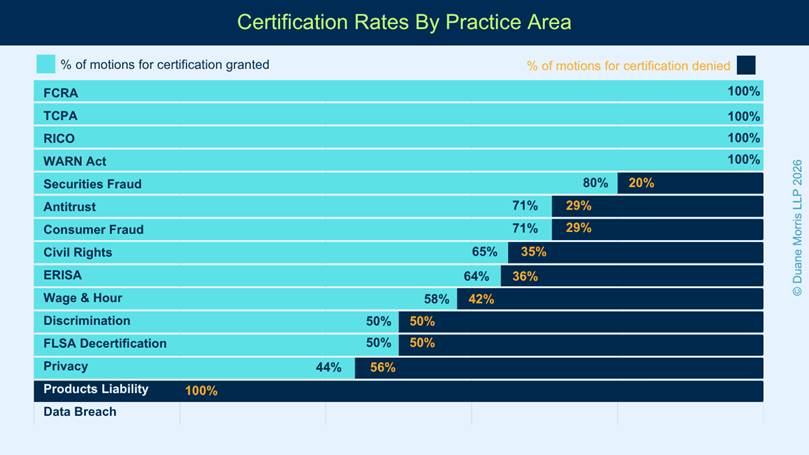
Jerry: Well, here we are, halfway through 2026. Let’s start with the big picture. Courts ruled on more than 155 class certification motions in just the first half of the year, and plaintiffs were successful in 63% of those situations. That’s quite a difference from the year before, isn’t it?
Jennifer: It is. Last year, the success rate was 68%, so we’re seeing a notable downtick. An even bigger change that we saw in 2024, 2023, and 2022, when certification success rates hit 69%, 72%, and 74%, respectively. So, the trajectory so far this year suggests that plaintiffs might not be as successful as they have been in the past.
Jerry: Seems to me what’s interesting, behind the numbers is the downturn isn’t across the board, it really depends on the subject matter area at issue in the class action.
Jennifer: Exactly. So, certification rates are all over the place. FCRA, TCPA, RICO, and WARN class certification decisions have all been small in number, with only one or two rulings in each of those areas, but all of them have been granted. So, 80% of class certification motions and securities fraud cases have been granted. Then on the flip side, less than half of certification motions and privacy were granted, and the one ruling on a class certification and products liability was denied.
Jerry: That really does run the gamut, and its very statute-oriented or subject matter oriented. Let’s talk about wage and hour or Fair Labor Standards Act conditional certification. Does that continue to be the most active area litigation in this space?
Jennifer: It does. From January through June, courts issued 69 rulings in FLSA matters. 67 of those were first stage motions for conditional certification, and plaintiffs won 39. So, that’s a success rate of only 58%, which is way down from the 76% in 2025 and the 79% we saw in 2024.
Jerry: When I look at those numbers and look at the locations, it’s striking how those rulings are congregated in certain geographic areas. A large chunk came from the Second and Ninth Circuits – places like New York City and San Francisco and Los Angeles, which tend to be more favorable to the plaintiffs’ bar.
Jennifer: That’s absolutely right. And at the decertification stage, the usual trend where defendants succeed more often hasn’t really been playing out this year. We’ve seen only two decertification rulings so far, and plaintiffs won one of those. So, it’s 50-50 so far this year.
Jerry: One of the key takeaways for me from this mid-year data analytics analysis is how much locations impact where cases get filed. We’re seeing very few rulings, for instance, from the Fifth, Sixth, and Seventh Circuits: only five in total. Any thoughts on why this is going on?
Jennifer: Great question. So, I think it’s likely a strategic move by the plaintiffs. Those circuits have adopted stricter standards for conditional certification, really making them less appealing venues. So, plaintiffs may be shifting, shifting their filings toward more lenient circuits to give them a better chance of success.
Jerry: If more circuits would follow the lead of the Fifth, Sixth, and Seventh Circuits, and start abandoning the traditional two-step certification process established in the Lusardi case out of New Jersey in 1987, that could have a big impact on where cases are brought and how they’re treated by the courts.
Jennifer: Absolutely. The mid-year numbers show us that venue selection, subject matter, and timing are all very critical in class action strategy. And with the FLSA continuing to dominate, we’ll be watching closely to see how courts respond in the second half of the year.
Jerry: Well, we’ll have the final data and full analysis in the Duane Morris Class Action Review for 2027 coming out in the first week of January of next year, so stay tuned. We’ll be back with more insights then. Jen, thanks as always for being here and for giving us your analysis of these trends on class certification.
Jennifer: Thank you, Jerry, and thanks to our listeners for tuning in.