United Kingdom – corporate registry moves to dissolve entities sanctioned by the U.S. as related to the IRGC

The OCCRP has reported on actions taken by England’s Companies House to dissolve the company, and crypto exchange, Zedxion Exchange Ltd.

Zedxion is an SDN under U.S. sanctions for its links to Babak Zanjani (another SDN) and the IRGC.

Companies House has posted a notice on the pages for Zedxion stating:

“The registrar is intending to take, or has taken, steps to strike off this company under section 1002A of the Companies Act 2006. This relates to information or a statement in an application for incorporation that is misleading, false or deceptive.“

As per the OCCRP the false, misleading or deceptive information appears to relate to the identification information provided as to the shareholder, and person of significant control, of Zedxion.
Spain – raids and three arrests relating to alleged transfers of villas by a designated person

On Monday the Spanish authorities conducted raids on multiple properties in Mallorca alleged to be owned by or for Nikolai Kolesov, a businessman designated under the EU’s sanctions since December 2024.

Three people have been arrested including a lawyer and someone who stood as proxy as part of the alleged transactions.

The raids were conducted on the homes of those arrested and at the villa properties.

The blog’s 700th post – sanctions enforcement milestones reached

With today’s post on convictions in Germany, the blog has reached the milestone of 700 posts.

The post also takes European Sanctions Enforcement over several other milestones:

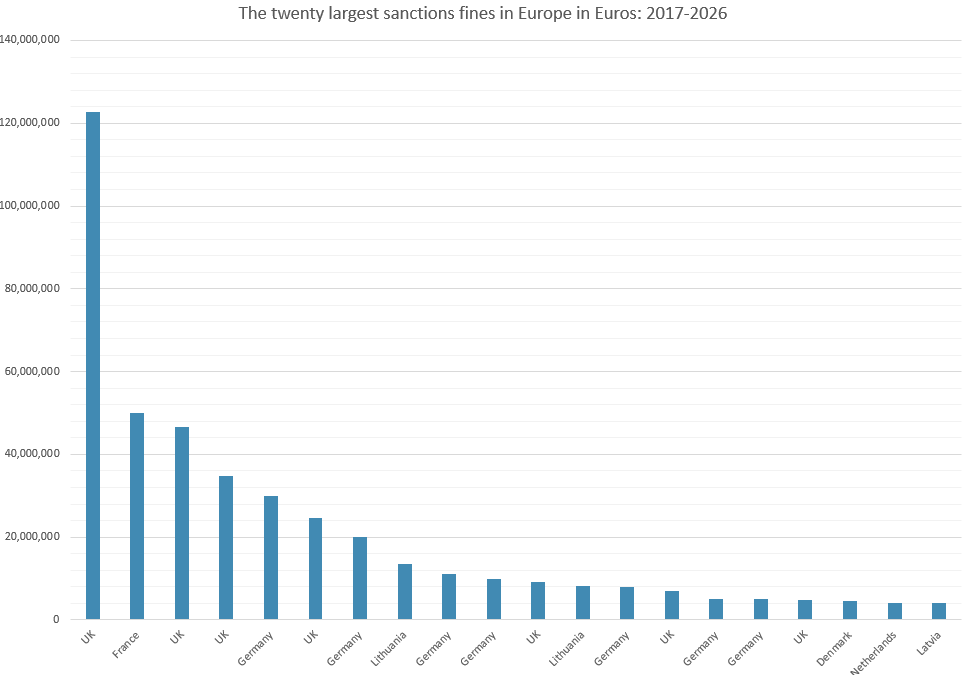
  • The €20m confiscated is Europe’s seventh largest sanctions fine/confiscation since 2017. All but one of those from the UK were fines imposed by the Financial Conduct Authority.

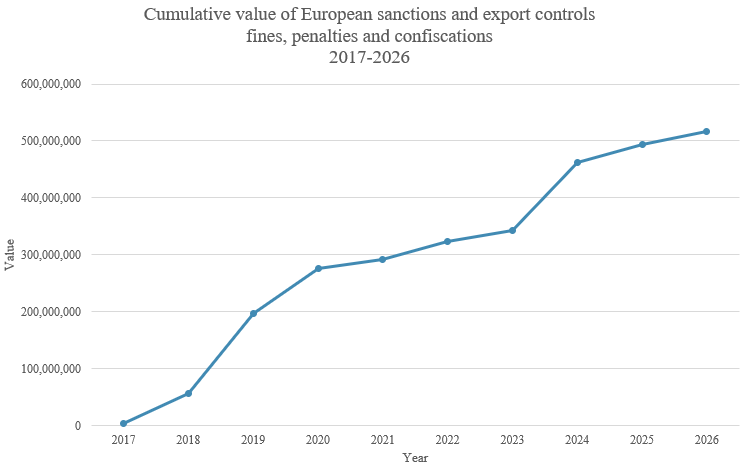
  • There has now been more than €500m in fines, penalties or confiscations since 2017.
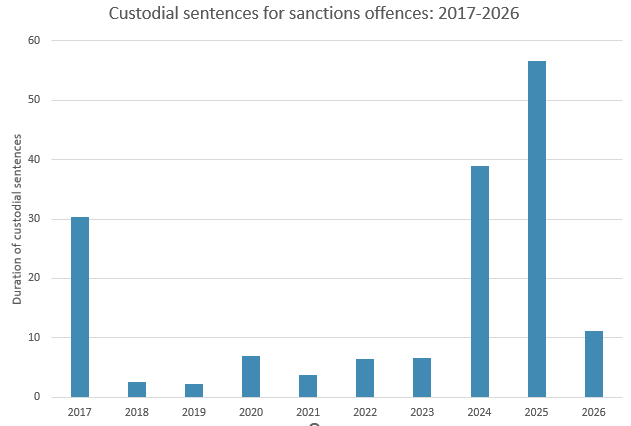
  • More than a century of jail time has been handed out since 2024, and Germany alone has seen sentences of more than 70 years of jail since 2017.

Enforcement across Europe is trending upwards.

Portugal – Public Prosecutor opens 26 investigations into Russian sanctions breaches

It is being reported that the Portuguese Public Prosecutor’s Office has opened 26 criminal investigations into possible Russian sanctions breaches since the start of the full-scale war in Ukraine.

No further information is provided as to the nature of the alleged offending or the current state of progress of those investigations.

It is also reported that the Security Intelligence Service (SIS) has “been monitoring and assessing presence in Portugal of elements connected, directly or indirectly with Vladimir Putin’s regime”.

Switzerland – FINMA revokes licence of merchant bank for AML and sanctions compliance failures

The Swiss financial services regulator has put out a press release announcing its decision, taken several weeks ago, to revoke the licence of MBaer Merchant Bank AG for AML and sanctions compliance failings.

Initially the bank appealed this decision.

In the wake of the US regulator FinCEN announcing that it proposed to name the bank as a “financial institution of primary money laundering concern”, the bank has withdrawn the appeal against FINMA’s decision, and a liquidator has now been appointed to oversee the bank’s liquidation.

Sweden – closed criminal investigation into alleged Russian funds transfers

Press reporting of a civil dispute between Sweden’s SEB Bank and certain Russian customers associated with Olga Pavlova, the Vice-Chair of Gazprom, and relating to attempts to transfer SEK 60 million, has revealed that the same transfers had been the subject of now-concluded a preliminary criminal investigation in Sweden.

It is unclear when the investigation took place, or the basis for the conclusion that no crime had been committed.

Austria – Financial Market Authority partially suspends crypto exchange over lack of AML and sanctions compliance officers

Austria’s Financial Market Authority has announced that its has partially suspended its approval for KuCoin EU Exchange GmbH under the EU’s Markets in Crypto Assets regulations.

The suspension means that KuCoin is unable to take on new customers, conclude new contracts, or offer new services.

The suspension is based on the the loss, without replacement, of a Anti-Money Laundering Officer and a Sanctions Compliance Officer.

The FMA has stated that the suspension will remain in place while those positions remain unfilled.

Netherlands – DNB fines imposed on payment services provider upheld on appeal

Further to our earlier post, a payment services provider has brought a further appeal against fines imposed upon it by the Dutch National Bank.

In the previous appeal the original DNB fines of €1.1m and €625,000 had been reduced to €850,190 and €562,500.

Those fines have been upheld in this further appeal.

The defendant company, which had self-reported itself, and which operates ATMs had sought to argue that it was the banks and debit/credit card issuers who had the sanctions screening and due diligence obligations, and that its own self-report could not be used in evidence against it on the basis that it could not be required to incriminate itself.

The court dismissed these objections. The self-reporting had been voluntary and not required and, as a payment service provider, the sanctions compliance obligations also applied to the appellant.

Netherlands – sanctions fine from Financial Markets Authority upheld but reduced on appeal

The Rotterdam District Court has issued its decision in an appeal against a fine imposed by the Dutch Financial Markets Authority (the “AFM”).

Three related fine were initially imposed in 2023 valued at €31,000, €94,000 and €31,000 for a total of €156,000. The fines were for a mixture of compliance failings including, AML, terrorist financing and sanctions. The sanctions compliance failures were a failure to screen customers between 2017 and 2022.

The Claimant, a manager of seven real estate investment funds, appealed against this decision, including (amongst others) on the basis that the fine in relation to sanctions should be struck down because none of the customers were actually subject to sanctions.

The court upheld the fine noting (in machine translation):

“The fact that the AFM’s investigation has shown that the clients of the investment institutions … have not been … on a sanctions list does not detract from the seriousness of the violations either. This circumstance is not relevant to the legal obligations of [Claimant] as gatekeeper in the investigation of those clients and the source(s) of their funds, in order … to comply with the Sanctions Law. The assertion that the [Claimant] often knows the clients personally and that the risks were kept to a minimum … do not detract from this either”.

The fine was, however, reduced by 10% (for a revised total of €148,500) because the enforcement proceedings had taken longer than the 2 years permitted under Dutch law.

Latvia – prosecution for providing IT services to Russian company

The State Security Service of Latvia has announced the prosecution of an individual for providing programming services to a Russian company.

This is the fifth recent prosecution in Latvia either in relation to the provision of prohibited services under Regulation 833/2014, or the provision of services to a designated person with the services treated as an “economic resource” that breaches the imposed asset freeze (see October 2025, October 2025, December 2025, and December 2025).

The individual is also being prosecuted on the basis that his salary was paid into Alfa-Bank, which is a designated person under the EU’s sanctions, and that this constitute making funds available to that designated person.

© 2009- Duane Morris LLP. Duane Morris is a registered service mark of Duane Morris LLP.

The opinions expressed on this blog are those of the author and are not to be construed as legal advice.

Proudly powered by WordPress