Duane Morris Takeaway: This week’s episode features Duane Morris partners Jerry Maatman and Alyson Walker Lotman and associate Jamar Davis with their discussion of Duane Morris’ Transportation, Automotive, & Logistics Class Action Review, highlighting several trends and developments shaping class action litigation in this industry.
Check out today’s episode and subscribe to our show from your preferred podcast platform: Spotify, Amazon Music, Apple Podcasts, Podcast Index, Tune In, Listen Notes, iHeartRadio, Deezer, and YouTube.
Episode Transcript
Jerry Maatman: Welcome to our loyal blog listeners. Thank you for being here for our weekly podcast, The Class Action Weekly Wire. I’m Jerry Maatman, a partner at Duane Morris, and joining me today are my colleagues Alyson Walker Lotman and Jamar Davis, who are both members of the Duane Morris Transportation, Automotive, and Logistics Industry Group. Thank you so much for both being here on our podcast.
Alyson Walker Lotman: Thank you, Jerry. Happy to be here.
Jamar Davis: Thanks for having me, Jerry.
Jerry: Today on the podcast, we are discussing publication of a brand-new e-book and desk reference, the Duane Morris Transportation, Automative, And Logistics Class Action Review. Listeners can find our e-book on our blog at the Duane Morris Class Action Defense Blog. Jamar, can you tell our listeners a little bit about this new offering and desk reference?
Jamar: Absolutely, Jerry. Duane Morris released the fourth in a series of industry-focused class action publications, the Transportation, Automotive, And Logistics Class Action Review – 2026. The publication analyzes the key related rulings and developments in 2025 and the significant legal decisions and trends impacting class action litigation in this industry for 2026. We hope that companies and employers will benefit from this resource and compliance with these evolving laws and standards.
Jerry: Well, class action litigation certainly seems to be on the rise across all industries. What’s driving this trend here?
Alyson: It was really a mix of old and new risks. You still have product liability and labor issues, but now they’re intersecting with technology, supply chains, and regulatory shifts. Overall, four themes stood out: product liability and recalls, data and antitrust claims, labor misclassification, and supply chain disputes. Automotive companies are still dealing with defect and recall cases, but courts are more open to economic loss claims now. Plaintiffs don’t always need physical injury – allegations of pre-sale knowledge of defects can be enough. And newer technologies like ADAS, EV batteries, and connected systems are driving the next wave of litigation risk.
Jerry: That’s exceedingly interesting, a lot going on in this space, and it certainly gives a clean perspective on the vast array of claims we’re seeing in class actions in this particular industry. Jamar, what did the analytics and data show in 2025?
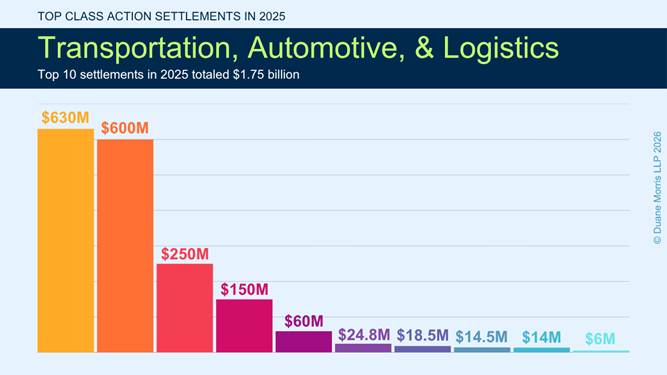
Jamar: We’re seeing more antitrust and data access cases as these industries digitize. The CDK Global case is a great example: a $630 million settlement over restricting dealership data and inflating software prices. These cases focus on control of platforms and data, and that’s likely to expand as vehicles become more software-driven labor issues with misclassification claims and logistics and delivery networks also led to multi-million dollar settlements in 2025. These cases continue to test the line between contractor and employee status with real implications for companies.
Jerry: Certainly, for the plaintiffs’ bar, certification is the Holy Grail, and the most important moment in these lawsuits. In terms of getting these cases certified as class actions, we saw an increasingly consistent and enhanced certification rate across the board in 2025 as compared to prior years. Procedurally, are courts granting class certification for claims against these defendants at a higher rate?
Alyson: So, Jerry, courts are tightening class certification standards, especially around predominance, ascertainability , and standing. That matters here because individualized issues like vehicle use or contract differences can make class treatment harder.
Jerry: Well, as we mentioned before, the rate of class actions being filed each year seems to keep going up. What are the filing numbers like for the transportation and logistics space?
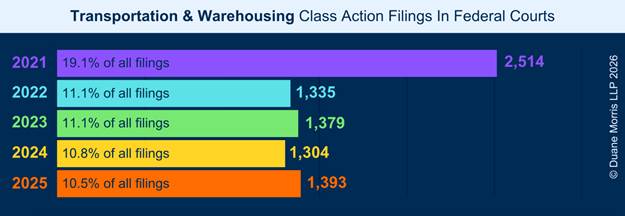
Jamar: Jerry, they’ve been fairly steady. Transportation and warehouse filings rose slightly to 1,393 in 2025, from 1,304 in 2024, but still below the 2021 peak of 2,514.
Jerry: Well, thank you for those analytics. Before we wrap up, any final thoughts on where this trend is heading?
Alyson: So, I think we’ll continue to see growth in the number of class actions, particularly as regulations evolve and technology becomes even more integrated into operations.
Jamar: I agree with Alyson, and with continued growth comes the ability for a plaintiffs’ lawyer to try and monetize the filings into settlement dollars. Businesses need to adapt accordingly.
Jerry: Well, it’s certainly been the case and justified by our analysis and the data over the last several years, and settlement dollars have been increasing, and our sense is don’t look for any downward trend in settlement numbers in the near future.
Well, thanks, Alyson and Jamar, for being here today, and thank you, loyal listeners, for tuning in. Please stop by our blog for a free copy of the Transportation, Automotive, And Logistics Class Action Review e-book.
Jamar: Thank you for having me, Jerry, and thank you, listeners.
Alyson: Thanks so much, everyone.