
By Gerald L. Maatman, Jr., Jennifer A. Riley, Daniel D. Spencer, and Alex W. Karasik
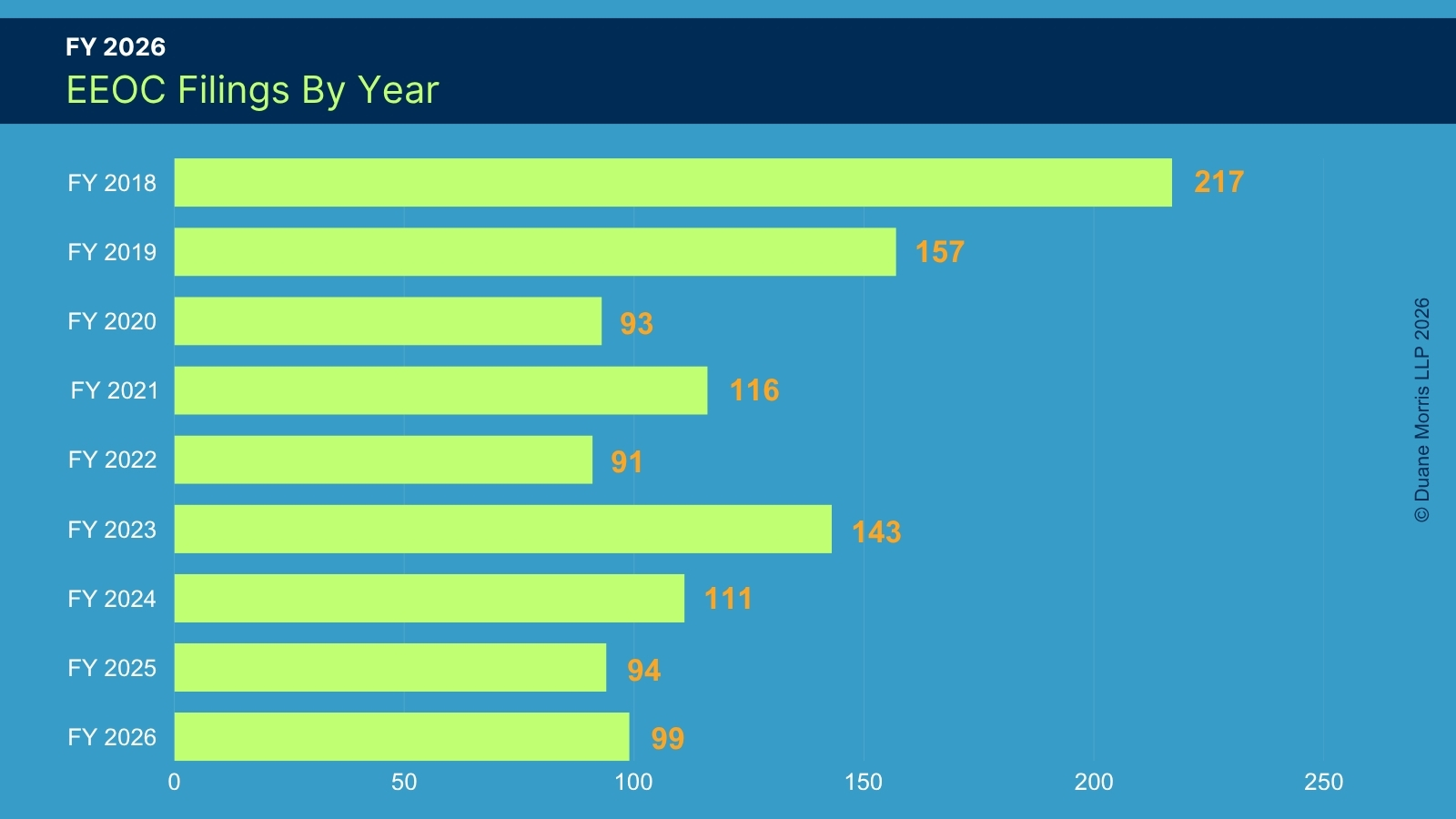
Duane Morris Takeaway: In FY 2026 (October 1, 2025 to September 30, 2026), the EEOC’s litigation enforcement activity experienced a modest uptick compared to FY 2025. By the numbers, FY 2026 concluded with 99 lawsuits filed, marking an increase from the 94 lawsuits filed in FY 2025. Although the Commission remains well below its modern enforcement peak of 217 lawsuits filed in FY 2018, the increase suggests that the EEOC has stabilized its litigation program after several years of fluctuating enforcement activity.
Overall filing totals remain comparatively low by historical standards. However, one common theme of EEOC-initiated litigation holds true: the importance of location and industry. Our analysis of the FY 2026 litigation data demonstrates that the Commission maintained an active enforcement presence while directing its resources toward targeted priorities involving disability discrimination, pregnancy-related claims, religious discrimination, and employers in several key industries.
In sum, while the EEOC is not filing lawsuits at the pace seen during prior administrations, the Commission continues to pursue strategic enforcement litigation. Employers should continue monitoring developments closely — particularly in the geographic regions (i.e. Chicago and Philadelphia) and industries (i.e. hospitality and retail) mentioned below — and ensure compliance with all federal anti-discrimination laws and EEOC initiatives.
Lawsuit Filings Based On Month And Year
The EEOC’s fiscal year ends each year on September 30th. As in prior years, the Commission concentrated a substantial portion of its lawsuit filings near fiscal year-end. In September 2026 alone, the EEOC filed 24 lawsuits, accounting for nearly one-quarter of all FY 2026 filings. Although September remained the busiest filing month, the concentration of year-end filings was less pronounced than in FY 2025, when 35 lawsuits were filed during the final month of the fiscal year.
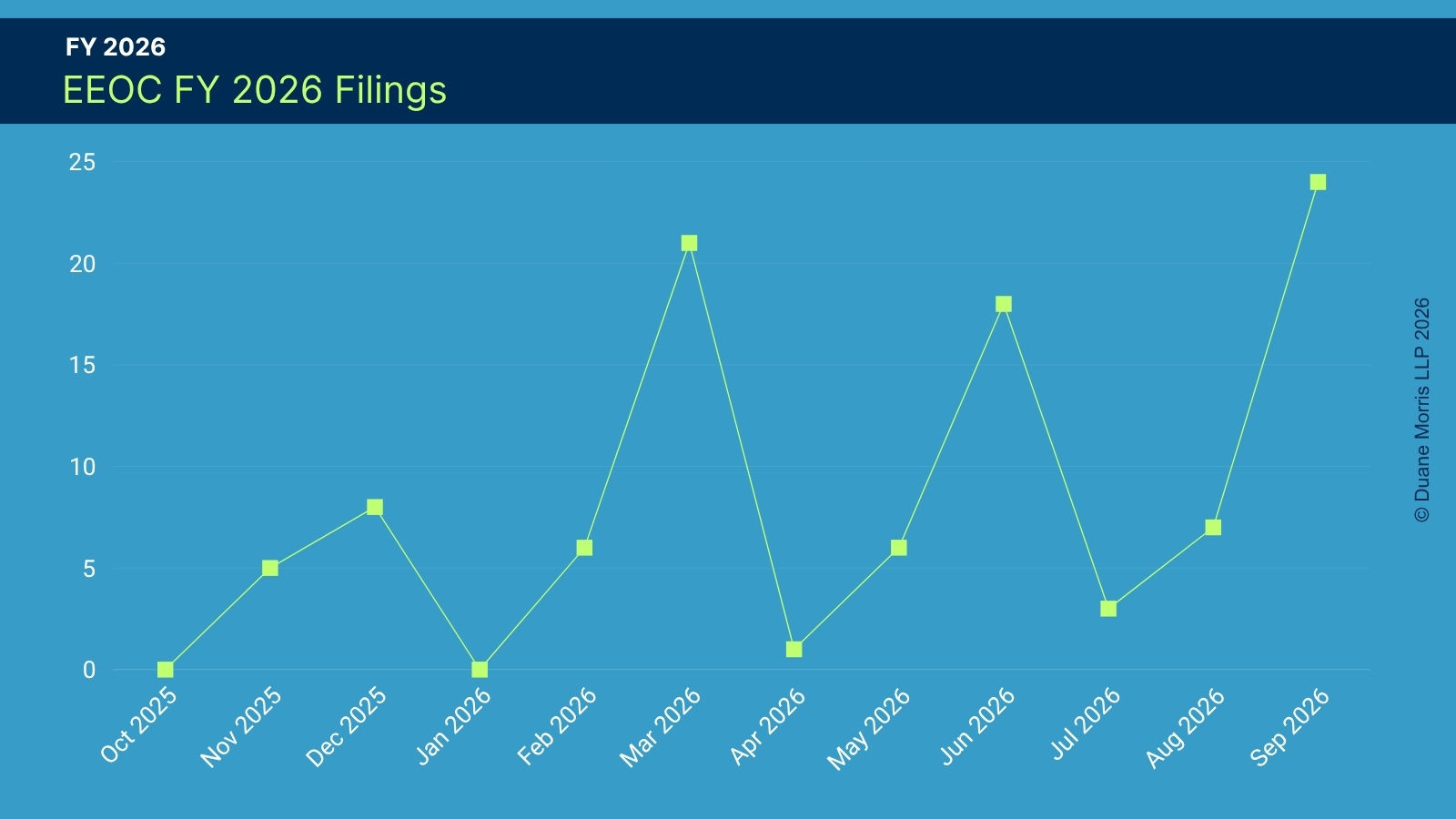
Unlike FY 2025, where filing activity was relatively subdued until September, FY 2026 featured several periods of heightened activity throughout the year. The Commission filed 21 lawsuits in March 2026 and another 18 lawsuits in June 2026. After a slower July, filing activity once again accelerated through August and September, culminating in the customary year-end litigation surge.
The filing pattern suggests a more evenly distributed enforcement strategy throughout the fiscal year compared to previous years, though the EEOC’s traditional year-end filing push remained intact.
Comparing FY 2026 to prior years, the EEOC filed more lawsuits than FY 2025 (94 filings), but substantially fewer than FY 2024 (111 filings) and FY 2023 (143 filings). Although overall litigation levels remain significantly below historical highs, the increase in FY 2026 demonstrates a renewed willingness by the Commission to pursue federal court enforcement actions.
Lawsuit Filings Based On EEOC District Offices
In addition to tracking total filings, we closely monitor which of the EEOC’s 15 district offices are most actively initiating litigation. In FY 2026, Chicago emerged as the most active litigation district office with 14 filings. Philadelphia followed closely with 12 filings, while Phoenix recorded 9 filings. Atlanta, Dallas, Indianapolis, and St. Louis each filed 7 lawsuits. Houston had 6 filings, while Birmingham, Charlotte, Los Angeles, and San Francisco each recorded 5 filings. Miami and New York each filed 4 lawsuits, and Memphis had the lowest total with 2 filings.
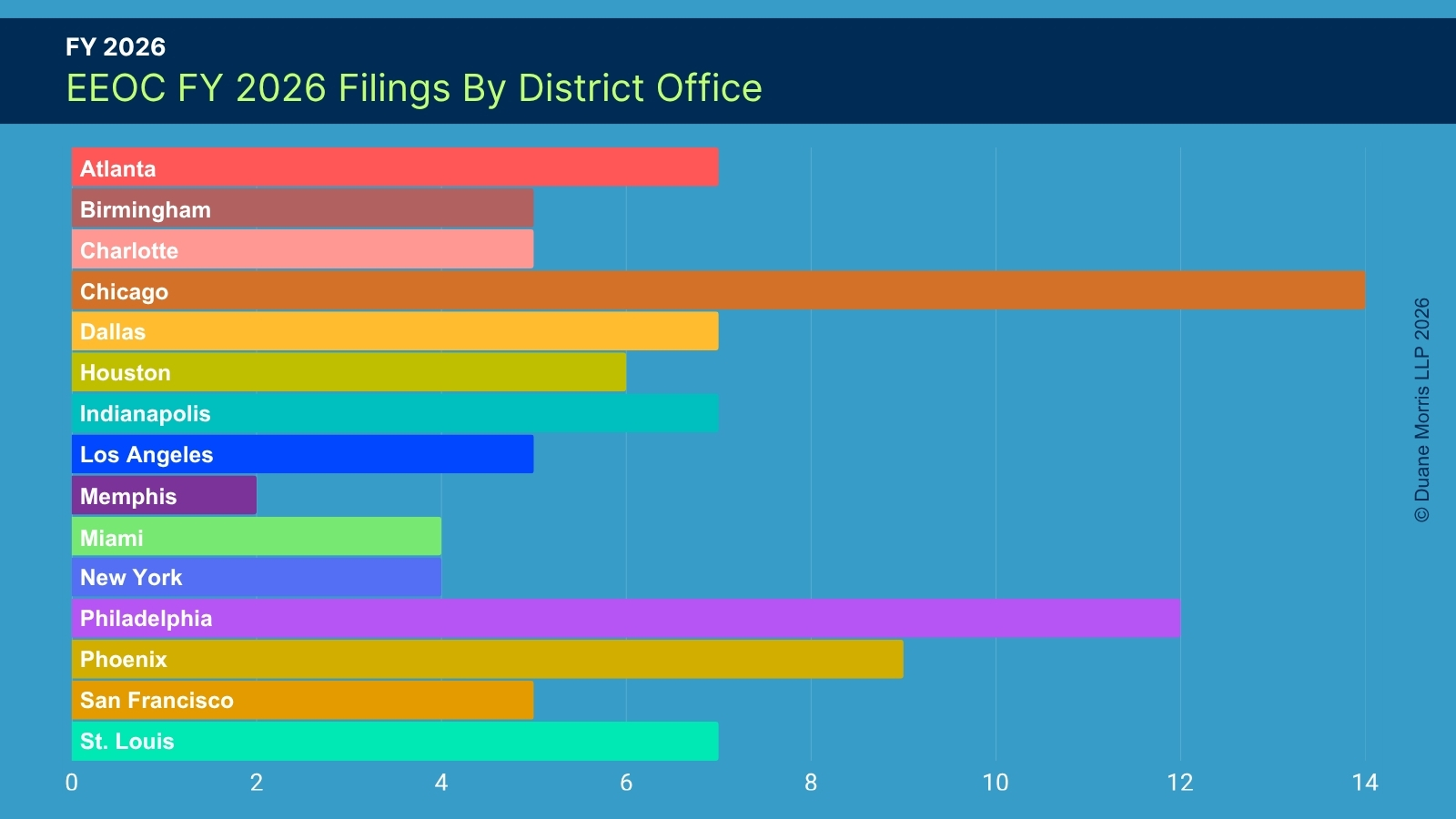
Like prior years, the Chicago and Philadelphia District Offices remained the primary drivers of EEOC litigation activity nationwide. Chicago increased its enforcement activity from 11 filings in FY 2025 to 14 filings in FY 2026 and reassumed sole possession of the top position among district offices. Philadelphia likewise increased its activity from 11 filings to 12 filings.
Phoenix continued its upward trend, increasing from 7 filings in FY 2025 to 9 filings in FY 2026. Dallas more than doubled its activity, rising from 3 lawsuits in FY 2025 to 7 lawsuits in FY 2026. In contrast, several offices experienced modest declines, including Indianapolis, Houston, and Miami.
Overall, the data demonstrates that EEOC litigation activity remains broadly distributed throughout the country but continues to be concentrated among a handful of particularly active district offices. Employers with significant operations in Chicago, Philadelphia, and Phoenix should remain particularly attentive to EEOC charge activity and enforcement developments within those jurisdictions.
Lawsuit Filings Based On Type Of Discrimination
We also analyze the types of lawsuits the EEOC files in terms of both statutes and allegations to determine how the Commission’s enforcement priorities are evolving.
Statutory Basis
When considered by statute, Title VII again dominated the EEOC’s enforcement portfolio. In FY 2026, the EEOC filed 61 Title VII lawsuits, representing approximately 53% of all statutory filings. This marks an increase from 56 Title VII lawsuits filed in FY 2025.
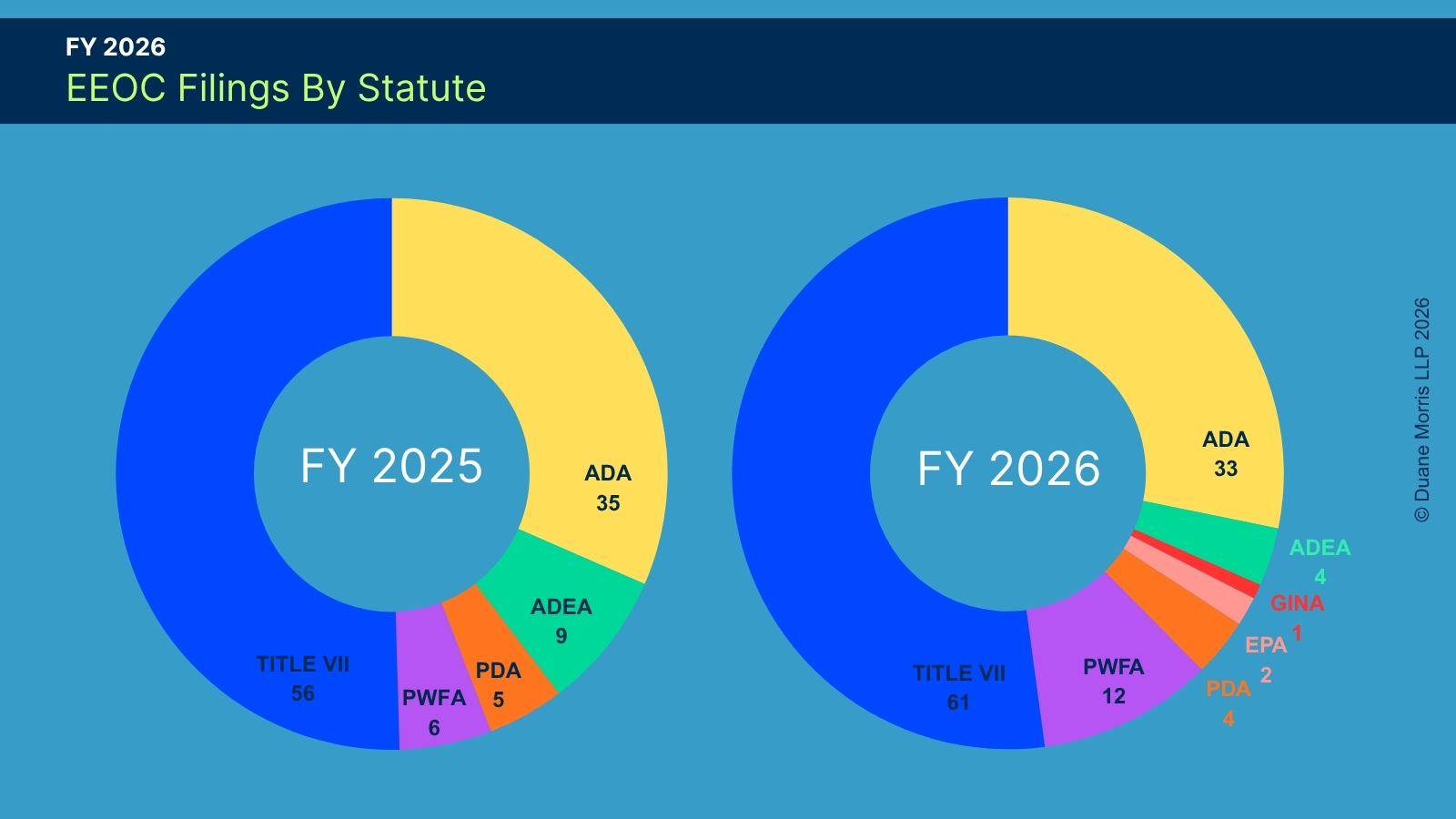
ADA litigation remained the second-largest category, with 33 filings compared to 35 in FY 2025. While disability discrimination continues to represent one of the Commission’s principal enforcement priorities, ADA filings declined slightly in absolute numbers year-over-year.
One of the most notable developments in FY 2026 involved the Pregnant Workers Fairness Act. The EEOC filed 12 PWFA lawsuits, doubling its FY 2025 total of 6 filings. This sharp increase confirms that pregnancy-accommodation enforcement remains a major strategic priority for the Commission.
The EEOC also filed 4 ADEA lawsuits and 4 Pregnancy Discrimination Act lawsuits. Notably, FY 2026 included the Commission’s first filings under both the Equal Pay Act and the Genetic Information Nondiscrimination Act in recent years, with one GINA case and two EPA cases filed.
The growth in PWFA litigation, coupled with the reappearance of EPA and GINA filings, suggests an expanding enforcement focus beyond the EEOC’s traditional Title VII and ADA docket.
Allegation Basis
The EEOC’s most frequently asserted allegations in FY 2026 remained disability discrimination, sex discrimination, and retaliation claims. Disability allegations appeared in 33 lawsuits, sex discrimination allegations appeared in 23 lawsuits, and retaliation claims were asserted in 17 lawsuits.
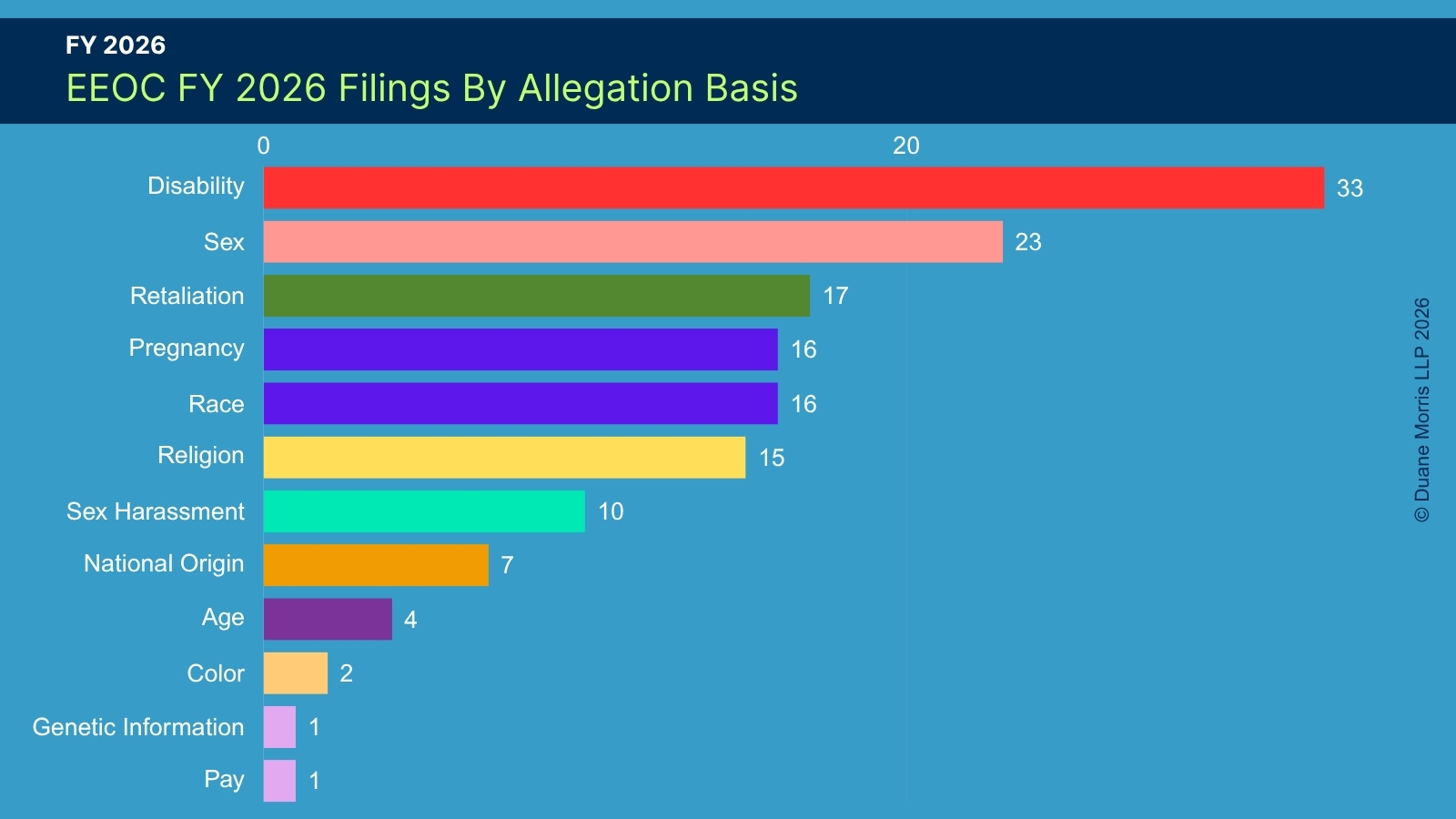
A significant development in FY 2026 was the substantial growth in pregnancy-related litigation. The EEOC alleged pregnancy discrimination in 16 lawsuits, making pregnancy one of the Commission’s most frequently asserted theories of discrimination.
Likewise, race discrimination claims rebounded dramatically. After only a handful of race-based lawsuits in FY 2025, the EEOC alleged race discrimination in 16 lawsuits during FY 2026. Religious discrimination litigation also increased substantially, appearing in 15 lawsuits.
Together, the increase in pregnancy, race, and religion-based claims suggests the Commission broadened its enforcement focus during FY 2026 while maintaining its traditional emphasis on disability, sex discrimination, and retaliation matters.
Lawsuit Filings Based On Industry
Analysis of FY 2026 filings by industry reveals several notable shifts in the industries most frequently targeted by EEOC enforcement actions.
Hospitality remained the most impacted industry, accounting for 21.3% of all FY 2026 filings. Retail closely followed with 22.5% of filings and experienced one of the largest increases compared to FY 2025, when it represented only 11.3% of lawsuits. The return of Retail as a primary enforcement target marks one of the most significant shifts in this year’s data.
Transportation and Logistics also experienced a substantial increase, accounting for 16.3% of FY 2026 filings compared to 10% in FY 2025. Manufacturing remained steady at 15% of all filings.
Healthcare, by contrast, experienced a meaningful decline. After representing 21.3% of EEOC filings in FY 2025, Healthcare accounted for only 13.8% of FY 2026 lawsuits. Construction also declined modestly from 8.8% to 7.5%.
Another notable change is the emergence of Education among the Commission’s most affected industries, representing 3.8% of all filings.
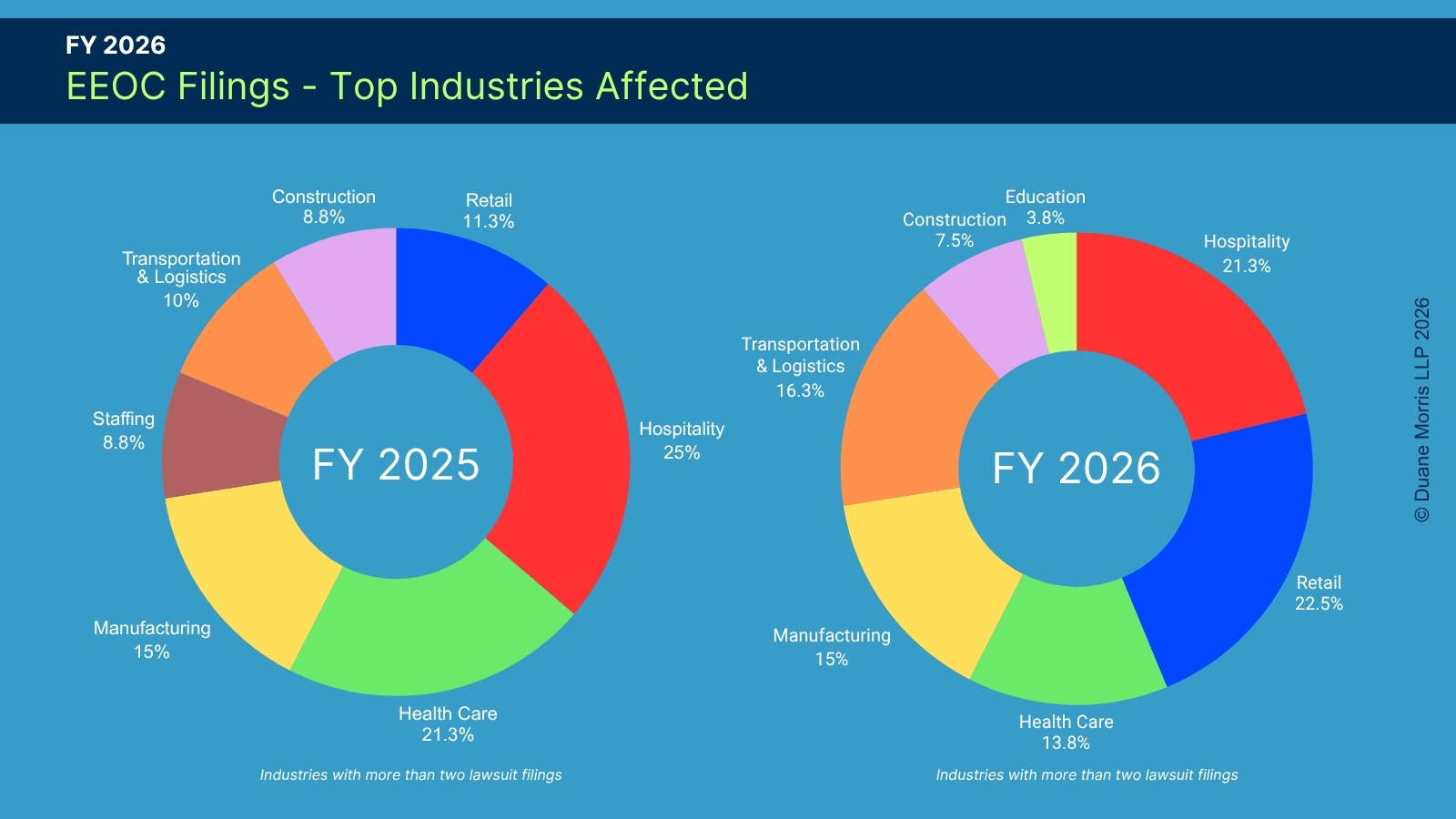
Overall, the distribution of lawsuits reflects a broader enforcement focus than in FY 2025. While Hospitality remained a consistent target, Retail and Transportation & Logistics experienced the largest increases in enforcement activity. Employers operating in these industries should remain particularly vigilant regarding compliance efforts and internal equal employment opportunity practices.
Looking Ahead To Fiscal Year 2027
Moving into FY 2027, the EEOC appears positioned to continue its targeted enforcement strategy while maintaining a relatively consistent level of litigation activity. Although FY 2026 produced only a modest increase in overall filings, several substantive trends emerged that may foreshadow future priorities.
Most notably, the Commission substantially increased litigation involving pregnancy-related accommodations under the PWFA and expanded its focus on race and religion-based discrimination claims. At the same time, traditional enforcement areas such as disability discrimination, sex discrimination, and retaliation remained central components of the EEOC’s litigation portfolio.
The geographic concentration of filings among the Chicago, Philadelphia, and Phoenix District Offices further demonstrates that employers must pay close attention not only to national EEOC priorities but also to regional enforcement trends.
Given the continued evolution of the Commission’s priorities, employers should expect the EEOC to remain active in pursuing strategic litigation designed to advance its enforcement objectives. Accordingly, employers should continue auditing workplace policies, training programs, accommodation practices, and discrimination complaint procedures to minimize litigation exposure and ensure compliance with federal employment laws.
Key Employer Takeaways
In several respects, FY 2026 represented both continuity and change in EEOC enforcement activity. While overall lawsuit filings increased modestly from 94 to 99 cases, enforcement remained highly targeted and concentrated in specific statutory areas, allegations, industries, and geographic regions.
Perhaps most significantly, the Commission doubled its PWFA filings and substantially increased race, religion, and pregnancy-related litigation. Disability discrimination, sex discrimination, and retaliation claims remained cornerstone enforcement priorities, while Retail and Transportation & Logistics emerged as increasingly significant enforcement targets.
Although total litigation activity remains well below pre-pandemic levels, FY 2026 suggests the EEOC has found a stable enforcement footing and continues to deploy its litigation authority strategically. As a result, employers should remain proactive in ensuring compliance with federal anti-discrimination laws and closely monitor EEOC enforcement developments throughout FY 2027.
Finally, employers can and should expect the EEOC to start paying closer attention to the use of AI in the hiring and recruiting processes. On the eve of federal government midterm elections, AI is front and center in terms of hot-button issues. The Commission’s enforcement priorities are apt to follow suit. Employers should take a proactive approach to making sure they ethically and responsibly incorporate AI into their employment practices in compliance with federal anti-discrimination laws.