Class Action Defense Blog – Next Week Live From London!

By Gerald L. Maatman, Jr.

Duane Morris Takeaway: On October 10-11, 2023, Jerry Maatman will blog live from London as he travels across the pond to present on global class action issues at the Thought Leaders 4 Dispute’s event called Group Litigation and Class Actions 2023 – The 3rd Annual Forum. This global event will feature thought leaders from a variety of legal backgrounds in Europe, Asia, Africa, and the Americas to discuss hot topics in the global class action world.

Jerry will present key trends from the Duane Morris Class Action Review – 2023, and discuss the current state of class action litigation in the United States.

Check in to the blog next week to learn more and get information directly from the London event about what employers and corporations need to know.

Click here to learn more about the event.


North Carolina Federal Court Certifies Class While Refusing To Decertify FLSA Collective Action

By Gerald L. Maatman, Jr., Zachary J. McCormack, and Emilee N. Crowther

Duane Morris Takeaways: In Wade et al. v. JMJ Enterprises LLC, No. 1:21-CV-506 (M.D.N.C. Sept. 30, 2023), Judge Loretta C. Biggs of the U.S. District Court for the Middle District of North Carolina granted in part Plaintiff’s motion to certify a Rule 23 class involving North Carolina Wage and Hour Act (“NCWHA”) claims by certifying Plaintiffs’ claims for unpaid wages due for training, mandatory meetings, and improper reductions from employee time logs. In addition, Judge Biggs ruled that the Fair Labor Standards Act (“FLSA”) preempted Plaintiff’s claim for failure to pay overtime wages under the NCWHA. In turn, Judge Biggs denied Defendants’ motion to decertify the FLSA collective action claims involving failure to pay overtime wages. This decision provides a good roadmap of the interplay in “hybrid wage & hour lawsuits” relative to the standards for certification of both class actions and collective actions.

Case Background

JMJ Enterprises LLC and owner Traci Johnson Martin (collectively “JMJ”) operate three group homes in Greensboro, North Carolina. The group homes assist children with mental illnesses or emotional disturbances, as well as adults suffering from mental illnesses and developmental issues. The Named Plaintiff, Tiffany Wade (“Ms. Wade”), was employed at Fresh Start Home for Children, one of the three group homes operated by JMJ from February 2021 to April 2021, and alleged she was not fully compensated for her time attending training sessions and mandatory meetings. Specifically, Wade alleged three claims under the FLSA, including failure to pay minimum wages, failure to pay overtime wages, and retaliation. Wade also brought two state law claims against JMJ under the NCWH for failure to pay wages due and failure to pay overtime wages. In her ruling, Judge Biggs issued an order in response to Wade’s motion to certify her class claims pursuant to Rule 23(a) and Rule 23(b)(3) of the Federal Rules of Civil Procedure, and JMJ’s attempt to decertify Wade’s FLSA collective action.

The Court’s Order

State Law Claim Preempted By The FLSA 

Wade alleged two state law claims against her former employer under the NCWHA. In the first claim, Ms. Wade alleged JMJ failed to pay wages due pursuant to N.C. Gen. Stat. § 95-25.6 and § 95-25.7. Section 95-25.6 is commonly known as the “payday statute” and requires an employer to pay “all wages and tips accruing to the employee on the regular payday.” See Martinez-Hernandez v. Butterball, LLC, 578 F. Supp. 2d 816, 818, 821 (E.D.N.C. 2008). In the second state law claim, Wade alleged JMJ failed to pay overtime wages pursuant to N.C. Gen. Stat. § 95-25.4.

Judge Biggs concluded that Wade’s second state law claim, the overtime claim, was preempted by the FLSA. The Court reasoned that N.C. Gen. Stat. § 95-25.14 provided an exemption to employees covered under the FLSA. Although arising from the same facts, Wade’s wages due claim did not fall under any NCWHA exemption and was deemed sufficiently separate and distinct from her FLSA claims for minimum wage and overtime wages considering that her theory of liability did not invoke provisions of the FLSA.

Rule 23 Class Certification 

Considering Wade’s first state law claim, the wages due claim, the Court ruled that it was not preempted by the FLSA, Judge Biggs focused on whether Ms. Wade could meet her burden to certify a class involving similar NCWHA claims. Ms. Wade, as class representative, sought to establish a class of hourly, non-exempt employees who worked at JMJ with similar wage claims. The Court considered the four prerequisites established in Rule 23, including numerosity, commonality, typicality, and adequacy of representation. Gunnells v. Healthplan Servs., Inc., 348 F.3d 417, 423 (4th Cir. 2003).

The Court agreed with Wade that nearly 100 class members rendered joinder impracticable, therefore satisfying the numerosity requirement. Judge Biggs ruled commonality was achieved through JMJ’s improper time recording and wage policies and practices, which determined compensation for class members. Even though each member had distinguishable circumstances, the Court opined that the heart of the claims was similar, and typicality was met. Regarding adequacy of representation, the Court looked at the resume of L. Michelle Gessner at Gessner Law, PLLC, who was appointed as class counsel. JMJ argued that she could not competently represent this class by pointing to Gessner’s extensive objections during Wade’s depositions (which JMJ contended demonstrated Gessner’s lack of sufficient understanding and control of the case). Judge Biggs rejected this defense position. Relying on Gessner’s 20 plus years of experience practicing labor and employment law, specifically complex wage and hour class and collective action cases, The Court held that she was adequate counsel for purposes of representing the class.

Defendants’ Motion To Decertify The FLSA Collective Action  

In order for this FLSA collective cction to proceed to trial, Judge Biggs applied a heightened standard to the “similarly situated” analysis. Wade argued that all employees making up the proposed collective action were paid based on a common policy, had similar roles at JMJ, and worked at one JMJ’s three group homes. The Court agreed that JMJ had common policies and practices with respect to training, mandatory meetings, overtime pay, and employee time logs, which applied to all employees and proved a common resolution of the FLSA claims was possible. Judge Biggs further determined there were sufficient similarities between the employees’ factual allegations and employment settings, and similar circumstances with regard to JMJ’s defenses. Judge Biggs therefore allowed the FLSA collective action to proceed.

Implications For Employers

The ruling in Wade details the burden employers must meet to decertify a FLSA collective action and also the burden for employees to certify a class action in the Fourth Circuit. This is yet another case which details the importance of employers’ obligations to abide by all record-keeping and paperwork requirements in their respective jurisdictions.


In The Latest Application of the Sixth Circuit’s Novel “Strong Likelihood” Standard, Ohio District Court Denies Plaintiffs’ Motion to Issue Notice of FLSA Overtime Lawsuit

By Gerald L. Maatman, Jr., Jennifer A. Riley, and Kathryn Brown

Duane Morris Takeaways: On September 27, 2023, District Court Judge Charles E. Fleming in Woods et al. v. First Transit, Inc., et al., 21-cv-739 (N.D. Ohio Sept. 27, 2023) denied plaintiffs’ motion for court-authorized notice of bus drivers’ claims of alleged unpaid overtime wages under the Fair Labor Standards Act (FLSA).  The district court applied the Sixth Circuit’s newly-minted standard to conclude the plaintiffs failed to demonstrate a “strong likelihood” exists that they are similarly situated in relevant respects to other employees of the defendant transportation company.  The court’s rejection of the plaintiffs’ “self-serving declarations” and consideration of the defendants’ competing evidence illustrates how the Sixth Circuit’s new standard is a game changer for FLSA litigants in Ohio, Michigan, Tennessee and Kentucky.

Case Background

On April 6, 2021, three named plaintiffs filed a class and collective action lawsuit asserting claims of unpaid overtime in violation of the FLSA and Ohio, California and New York state laws.  The plaintiffs alleged that the defendant failed to pay overtime wages to fixed-route bus drivers for work performed before and after their shifts.  The plaintiffs also alleged the defendant deducted 30 minutes’ worth of time from their pay for unpaid meal breaks even when they did not receive uninterrupted break time.  After the district granted the defendant’s partial motion to dismiss the New York and California state law claims, only the Ohio state law claims survived.  Additionally, only two named plaintiffs remained after one of the named plaintiff s was shown never to have worked as a fixed-route bus driver.

Two individuals filed consents to join the lawsuit as opt-in plaintiffs in October 2021 and a third joined the lawsuit in February 2022.

After approximately six months of fact discovery solely on the issue of conditional certification, the named plaintiffs moved for conditional certification of their claims under the FLSA on June 29, 2022.  If granted, the plaintiffs would have authority to issue notice to a collective including any person who drove a fixed bus route for the defendant in any week during the prior three years.

In support of their motion, the plaintiffs submitted sworn declarations of the two named plaintiffs and three putative opt-in plaintiffs, job descriptions, an employee handbook and a user guide for time entry.  In opposition to the motion, the defendant submitted sworn declarations of managers at the locations at which the named or opt-in plaintiffs had worked, declarations of corporate human resources and payroll staff and collective bargaining agreements governing fixed-route bus drivers at various locations.

After the parties fully briefed the motion, the district court deferred ruling on the motion until the Sixth Circuit Court of Appeals issued its anticipated decision on the standard for conditional certification in FLSA cases.

On May 19, 2023, the Sixth Circuit in Clark v. A&L Homecare and Training Center, LLC, 68 F.4th 1003 (6th Cir. 2023), announced a new standard for determining whether FLSA plaintiffs may issue court-sanctioned notice to other employees.  Rejecting the prior standard in which a plaintiff need only make a “modest factual showing” to win court-authorized notice, the Sixth Circuit held that plaintiffs must put forth sufficient evidence to demonstrate a “strong likelihood” exists that they are similarly situated to other employees.  Factors relevant to the analysis include whether the potential other plaintiffs performed the same tasks and were subject to the same timekeeping and pay policies as the named plaintiffs.  After Clark, the parties submitted supplemental briefs arguing how the new standard applied to the plaintiffs’ pending motion.

The Court’s Decision

Upon weighing the parties’ competing evidence, the district court answered “no” to the question whether a strong likelihood exists that the named plaintiffs experienced the same policies of unpaid overtime wages as other employees of the defendant.

The district court concluded that the plaintiffs did not introduce any evidence of a “company-wide policy” binding on all fixed-route bus drivers that potentially violates the FLSA.  The court stated that the only evidence of the alleged unlawful overtime pay practices came in the form of “self-serving declarations” of doubtful credibility.  For example, an opt-in plaintiff declared that she worked as a fixed-route bus driver until December 2020.  However, the manager who oversaw the opt-in plaintiff’s location declared that no driver at that location drove a fixed bus route.  The court reasoned no “strong likelihood” exists that the opt-in plaintiff is similarly situated to the named plaintiffs given that the opt-in plaintiff could not be in the proposed collective of fixed-route bus drivers.

The court also considered the evidence of written policies regarding meal breaks, or the lack thereof, for fixed-route bus drivers.  Contrary to the plaintiffs’ allegation of company-wide automatic pay deductions for meal break time, the manager of the location at which one of the named plaintiffs had worked declared that drivers at that location did not even receive meal breaks.

The collective bargaining agreements in evidence showed that different locations of work had different policies governing time entry and breaks for fixed-route bus drivers.  For example, a collective bargaining agreement for one location stated that the defendant paid drivers for 15 minutes of time prior to their route to perform pre-shift work.  A collective bargaining agreement for another location said the defendant paid drivers 20 minutes for pre-shift work.

In sum, the court reasoned that the evidence revealed dissimilarity in policies and practices concerning compensation for the company’s fixed-route bus drivers.  Because the evidence showed employees were subject to different policies concerning key issues such as how they report time, how schedules are set, what period of time is compensable, whether they receive a meal break and how meal breaks are paid, the court concluded the plaintiffs did not satisfy the “strong likelihood” standard announced in Clark to obtain court-authorized notice of their FLSA claims.

Implications For Employers

The district court’s ruling in Woods leaves no doubt that FLSA plaintiffs in the Sixth Circuit face a heightened evidentiary burden to obtain court-authorized notice in the wake of the Sixth Circuit’s new standard in Clark.  The district court clarified that the “strong likelihood” standard in Clark is an evidentiary standard, not a pleading standard.  The court’s analysis in Woods shows defendants have a genuine opportunity to present evidence to attack the plaintiffs’ efforts to show a common policy of FLSA-violating conduct and thereby block notice to other employees who may expand the scope of the lawsuit exponentially.  Employers with operations in the Sixth Circuit ought to use Clark as an opportunity to look anew at their wage and hour policies and practices to guard against the risk of costly and time-consuming FLSA litigation.

Texas Federal Court Shoots Down Executive Order 14,026

By Gerald L. Maatman, Jr., Jennifer A. Riley, and Shaina Wolfe

Duane Morris Takeaways: On September 26, 2023, in Texas v. Biden, No. 6:22-CV-00004 (S.D. Tex. Sept. 26, 2023), Judge Drew B. Tipton of the U.S. District Court for the Southern District of Texas granted in part and denied in part the States’ Motion for Summary Judgment and enjoined the federal government from enforcing Executive Order 14,026 and the Final Rule against the States of Texas, Louisiana, and Mississippi and their agencies. Judge Tipton found that the President acted exceeded his authority by issuing Executive Order 14,026 and unilaterally requiring federal contractors to increase their employees’ minimum wage from $10.10 to $15 per hour. Other district courts have considered the President’s authority in issuing Executive Order 14,026, but Judge Tipton is the first federal judge to find that the President exceeded his authority. This ruling hits only the surface of what is yet to come. The parties in other cases have already filed appeals in the Ninth and Tenth Circuits challenging district court opinions that have issued contrary rulings, and the government in this case is bound to appeal this decision to the Fifth Circuit.

Procedural Background

The Federal Property and Administrative Services Act (“Procurement Act” or the “Act”) applies to federal and contractor employees. Congress implemented the Act to centralize the process by which various good and services are purchased by agencies on behalf of the government.

On April 21, 2021, President Biden, relying solely on the Act, issued Executive Order 14,026 (“EO 14,026”) to require federal contractors and subcontractors to pay certain employees $15 per hour. EO 14,026 was scheduled to begin on January 30, 2023, with annual increases thereafter. Specifically, in issuing EO 14,026, President Biden invoked his authority to “promote economy and efficiency in procurement by contracting with sources that adequately compensate their workers.” Id. at 5. After engaging in notice-and-comment rulemaking, the U.S. Department of Labor published its Final Rule, Increasing the Minimum Wage for Federal Contractors, on November 24, 2021, implementing EO 14,026 (the Final Rule and EO 14,026 are the “Wage Mandate”). Id.

Three months later, three states – Texas, Louisiana, and Mississippi (the “States”) – sued President Biden, the U.S. Department of Labor (“DOL”), and certain DOL executives (collectively the “federal government”) challenging the validity of the Wage Mandate. Id. at 2-3.

The parties cross-filed cross-motions to dismiss and motions for summary judgment. The federal government argued generally that two of the Act’s provisions, read together, provide the President with a broad grant of authority to implement policies “that the President considers necessary to foster an economical and efficient system for procuring and supplying goods and services for using property,” including the Wage Mandate. Id. at 13. The States argued that the Act is far more narrow and that it is primarily meant as a means to “centralize and introduce flexibility into government contracting to remedy duplicative contracts and inefficiencies,” which does not include setting the minimum wage for federal contractors. Id.

The District Court’s Decision

The District Court granted in part and denied in part the States’ cross-motion for summary judgment. It found that the States proved that that the President acted “ultra vires,” or beyond his authority in issuing EO 14,026. Judge Tipton enjoined the federal government from enforcing EO 14,026 and the Final Rule against Texas, Louisiana, and Mississippi and their agencies.

The District Court agreed with the States and held that Sections 101 and 102 of the Act “read together, unambiguously limit the President’s power to the supervisory role of buying and selling goods.” Id. The District Court found that the Act’s historical context further supported its holding that the President’s authority “does not include a unilateral policy-making power to increase the minimum wage of employees of federal contractors.” Id. at 15.

Judge Tipton further found that the purpose of the Act purpose conflicts with the Wage Mandate. He explained that the Act’s purpose is to provide “a relatively hands-off framework that enables agencies to determine for themselves the quantity and quality of items to procure on behalf of the federal government. It does not confer authority for the President to decree broad employment rules.” Id. at 20. As an example, the District Court compared the Act to two other permissible federal wage statutes – the Davis Bacon Act and the Walsh-Healey Public Contracts Act. Id. at 20-21. Judge Tipton opined that unlike those two permissible federal wage-statutes, in which Congress expressly gave the Secretary of Labor limited power to tailor the minimum wage of certain classes of federal contractors, the Procurement Act did not permit the President unlimited wage-setting authority. Id. at 21. The District Court concluded that the “Procurement Act’s text, history, purpose and structure limit the President to a supervisory role in policy implementation rather than a unilateral, broad policy-making power to set a minimum wage.” Id. at 22.

The federal government will likely appeal the decision, and the Fifth Circuit will join the Ninth and Tenth Circuits in deciding whether the President exceeded his authority in issuing EO 14,026.

Implications for Employers

The District Court’s decision is a huge win for employers in Texas, Louisiana, and Mississippi as the federal government is prohibited from enforcing EO 14,026. Companies should stay tuned for the imminent showdown in the Fifth, Ninth, and Tenth Circuit’s on the President’s Authority over increasing the minimum wage for federal contractors and subcontractors.

California District Court Grants Class Certification In Wage Statement Action

By Gerald L. Maatman, Jr., Jennifer Riley, Nick Baltaxe, Nathan K. Norimoto

Duane Morris Takeaways: In Oman v. Delta Air Lines, Inc., No. 15-CV-00131(N.D. Cal. Sept. 22, 2023), 2023 U.S. Dist. LEXIS 169540, Judge William Orrick of the U.S. District Court for the Northern District of California certified a class of flight attendants based in California on the limited issue of whether Delta Airlines’ wage statements were compliant with Section 226 of the California Labor Code. This decision further highlights the low barriers plaintiffs face in certifying wage statement claims under California law and emphasizes the importance for employers to review wage statements on a regular basis for compliance with the California Labor Code.

Case Background

Following dispositive motion practice and an appeal to the Ninth Circuit, Plaintiffs moved to certify a class of class of California employees who worked as flight attendants for Defendant Delta Air Lines, Inc. (“Delta Airlines or “Delta”). Id. at 1. Plaintiffs attempted to certify a very narrow class regarding compliant wage statements issued to flight attendants who worked from January 10, 2022, to October 7, 2022, and did not participate in Delta’s Enhanced Retirement or Voluntary Opt-Out Programs. Id. at 2. Plaintiffs did so after the Ninth Circuit found that Delta had a good faith defense to the wage statement claim prior to January 10, 2022, and that Delta changed its wage statements in an effort to make them compliant on October 8, 2022. Id. at 1. This motion came after the parties’ negotiations to certify this narrowed class fell apart when Plaintiffs refused to stipulate that Delta’s post-October 21, 2022, wage statements were compliant. Id. at 1.

Delta Airlines opposed Plaintiffs’ motion for class certification. Delta’s opposition to Plaintiffs’ motion for class certification did not dispute the Rule 23 requirements of numerosity and commonality. Id. at 2. However, Delta argued that the claims were not “typical.” Id. Delta relatedly argued that Plaintiffs’ request for certification would create “prejudicial” discrepancies between Plaintiffs and putative class members that disqualifies them and their counsel as adequate class representatives under Rule 23 of the Federal Rules of Civil Procedure. Id.

In addition, Delta sought relief to file a second motion for summary judgment to secure an “advisory opinion” from the Court that its wage statements issued after October 21, 2022, were fully compliant with the Labor Code. Id.

The District Court’s Decision

The Court granted Plaintiffs’ motion for class certification and held that Plaintiffs satisfied the Rule 23 requirements of typicality, adequacy, predominance, and superiority of a class action. Id. at 2-5.

First, the Court held that Plaintiffs’ alleged wage statement violations were “typical” of the putative class in light of Delta’s “good faith defense” to any wage statement violations that occurred before the proposed class period’s start date and Delta’s admission that it revised wage statements immediately after the class period’s end date. Id. at 2-3. The Court rejected Delta’s argument that Plaintiffs’ proposed class period was shorter than the class alleged in the operative pleading which prevented Plaintiffs’ claim from being typical, because Plaintiffs had provided “adequate justification” for narrowing the class period, especially after the Ninth Circuit’s ruling. Id.

Second, the Court held that Plaintiffs and their counsel were adequate representatives given the “sensible and logical manner” Plaintiffs used to narrow the class definition, i.e., the class period starts immediately after the time period of Delta’s good faith defense and the class period ends when Delta admittedly started making revisions to its wage statements. Id. at 3. The Court dismissed Delta’s accusation of “claim splitting” as Plaintiffs were not “jettisoning categories of damages to make this case more certifiable to the detriment of class members.” Id.

As the final step in certifying the class, the Court determined that predominance and the superiority of resolving Plaintiffs claims on a class-wide basis were satisfied given the amount of class members who were “based in California and performed a majority of their work in California.” Id. at 4-5. Delta’s argument that Plaintiffs’ proposed class did not account for the number of intrastate flights outside of California and the hours worked in non-California airports was rejected by the Court as Delta, which apparently had “that information at its disposal,” did not introduce any evidence to support those defenses with its opposition. Id. The Court overruled Delta’s attempts to invalidate Plaintiff’s proposed class certification notice and instead, found the notice was “short, clear, and written in plain language.”

Finally, the Court denied Delta’s request for leave to file a second motion for summary judgment on the question of whether the wage statements issued after the class period complied with the Labor Code requirements. Id. at 5-6. The Court ordered Plaintiffs to file an amended pleading that conforms to the certified class and, since Delta’s request implicated statements provided after the class period, there was no “case or controversy remaining” on the issue. Id. at 6.

Implications For Employers

California employers already face strict regulations for compliant wage statements. Even if fully compliant, California employers can face a litany of derivative wage statement penalties. Employers can limit liability by arguing good faith defenses and updating their wage statements for compliance, as Delta did. However, this case shows that, even with those arguments and changes, Courts are willing to certify even limited classes. As this litigation shows, an employer’s proactive audits of wage statement compliance can be critical to reducing future wage statement-related liability in California.

EEOC’s September Spree Of Filings Caps Off Landmark Year In FY 2023

By Gerald L. Maatman, Jr., Alex W. Karasik, George J. Schaller, and Jennifer A. Riley

Duane Morris Takeaways:  In FY 2023, the EEOC’s litigation enforcement activity showed that any previous slowdown due to the COVID-19 pandemic is well in the rearview mirror, as the total number of lawsuits filed by the EEOC increased from 97 in 2020 to a whopping total of 144 in FY 2023. Per tradition, September 2023 was a busy month for EEOC-Initiated litigation, as this month marks the end of the EEOC’s fiscal year. This year, 67 lawsuits were filed September, up from the 39 filed in September of FY 2022.

Overall, the FY 2023 lawsuit filing data confirms that EEOC litigation is back in full throttle, with no signs of slowing down. Employers should take heed. Amplifying that activism, the Commission issued a press release at the end of the fiscal year touting its increased enforcement litigation activity, a somewhat unprecedented media statement that the EEOC has never issued in previous years.

Lawsuit Filings Based On EEOC District Offices

In addition to tracking the total number of filings, we closely monitor which of the EEOC’s 15 district offices are most actively filing new cases over the year and throughout September. Some districts tend to be more aggressive than others, and some focus on different case filing priorities. The following chart shows the number of lawsuit filings by EEOC district offices.
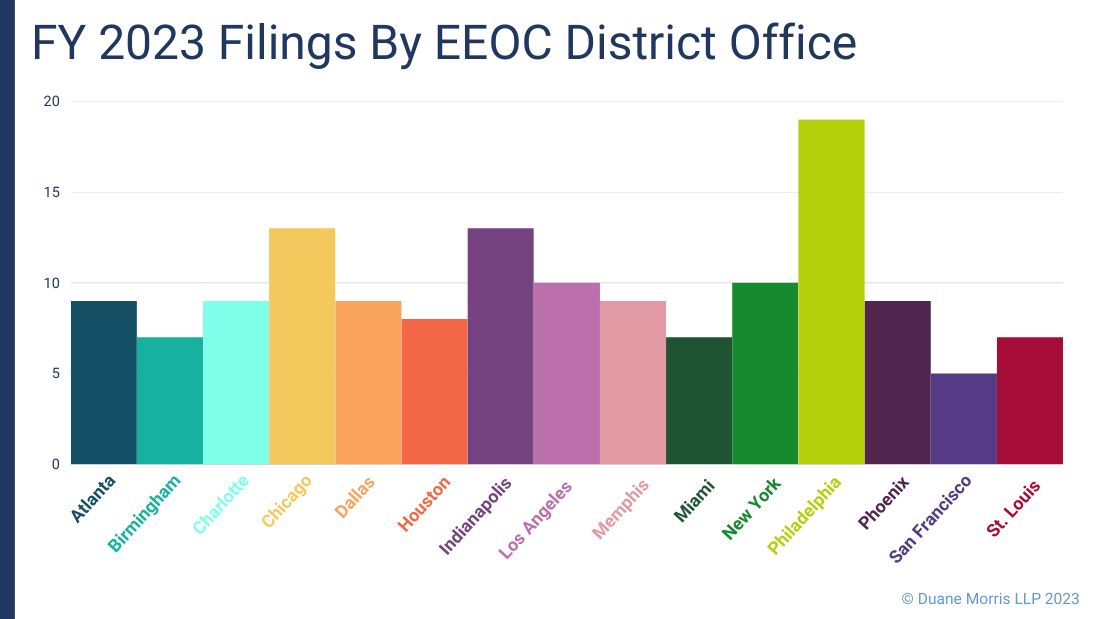
In FY 2023, Philadelphia District Office had by far the most lawsuit filings with 19, followed by Indianapolis and Chicago with 13 filings, and New York and Los Angeles each with 10 filings. Charlotte, Atlanta, Dallas, Phoenix, and Memphis had 9 each,  Houston had 8, Miami, Birmingham, and St. Louis had 7 each, and San Francisco had 5 filings.

The most noticeable trend of FY 2023 is the filing deluge in Philadelphia (19 lawsuits), compared to FY 2022 where Philadelphia District Office filed 7 lawsuits. Similarly, Indianapolis ramped up its filings compared to the 7 filings from FY 2022.  Like FY 2022, Chicago remained steady near the top of the list again with 13 filings.  Los Angeles, had a slight increase, based on the 8 filings it had in FY 2022.  Going another direction, Miami filings slightly fell compared to its 8 filings in FY 2022.   Finally, both New York and Charlotte increased their filings from FY 2022, with New York substantially increasing from 7, and Charlotte moderately increasing from 7 filings.

The balance across various District Offices throughout the country confirms that the EEOC’s aggressiveness is in peak form, both at the national and regional level.

Lawsuit Filings Based On Type Of Discrimination

We also analyzed the types of lawsuits the EEOC filed, in terms of the statutes and theories of discrimination alleged, in order to determine how the EEOC is shifting its strategic priorities.

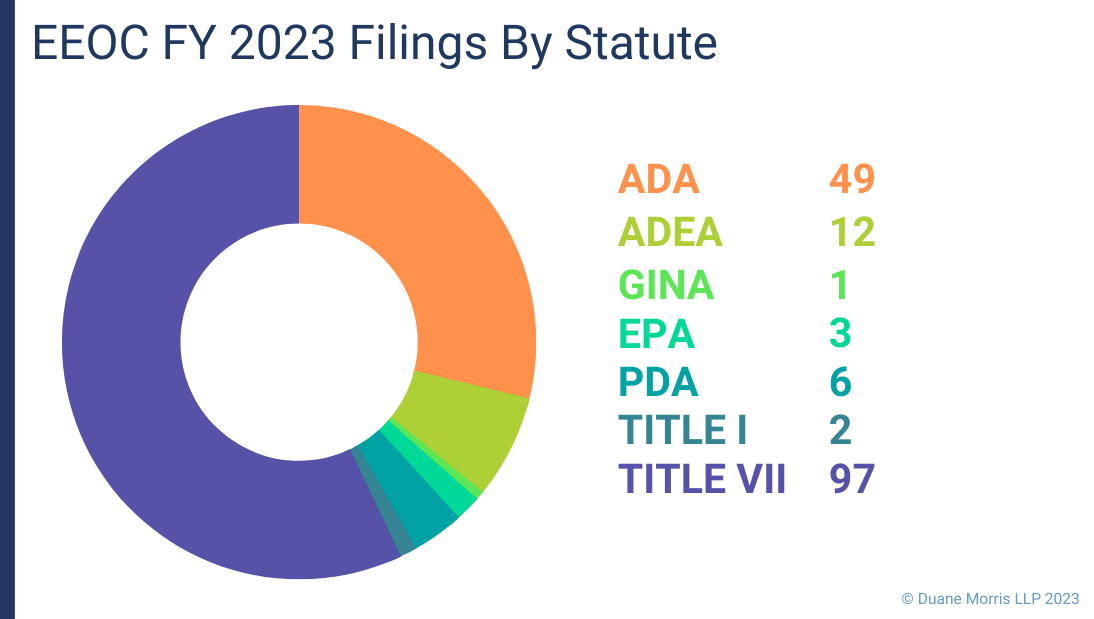
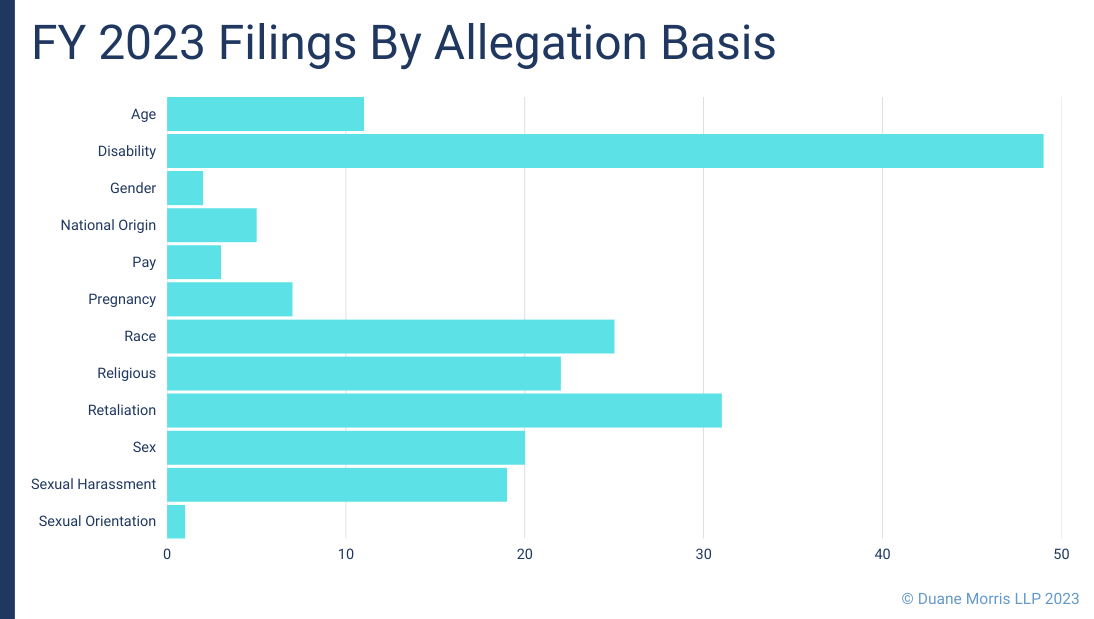
When considered on a percentage basis, the distribution of cases filed by statute remained roughly consistent compared to FY 2023 and FY 2022. Title VII cases once again made up the majority of cases filed, making up 68% of all filings (down from the 69% filings in FY 2022, and significantly above 61% in FY 2021). ADA cases also made up a significant percentage of the EEOC’s September filings, totaling 34%, in line with 29.7% in FY 2022, although down from the 37% in FY 2021. There were also 12 ADEA cases filed in FY 2023, after 7 age discrimination cases filed in FY 2022.

The graphs below show the number of lawsuits filed according to the statute under which they were filed (Title VII, Americans With Disabilities Act, Pregnancy Discrimination Act, Equal Pay Act, and Age Discrimination in Employment Act) and, for Title VII cases, the theory of discrimination alleged.
Lawsuits Filings Based On Industry

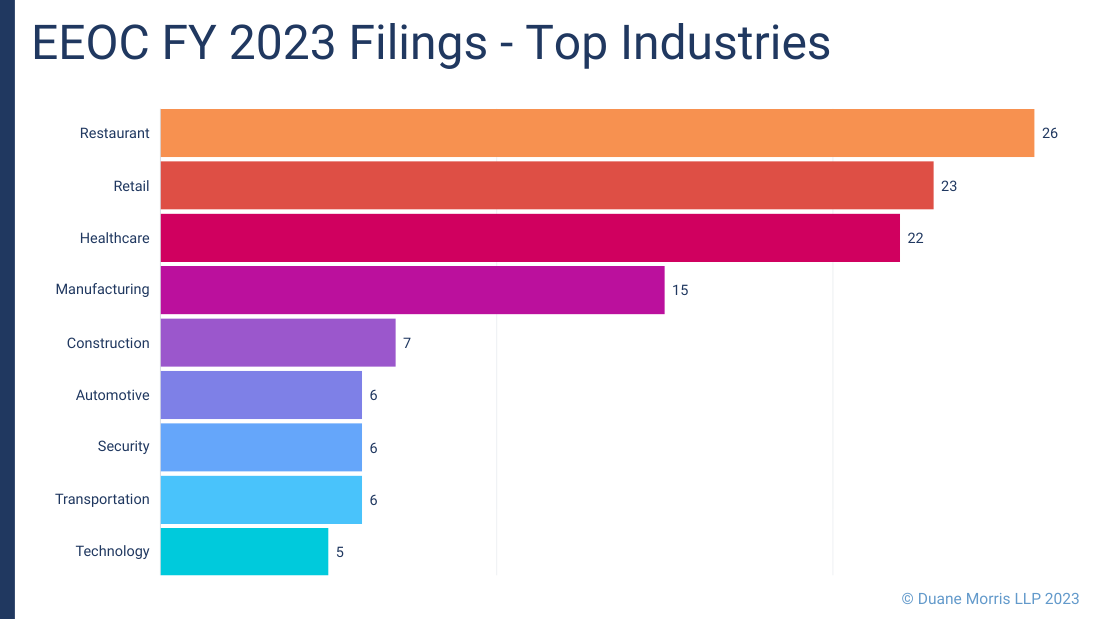
The graphs below show the number of lawsuits filed by industry.  Three industries were the primary targets of lawsuit filings in FY 2023:  Restaurants with 28 filings, Retail with 24 filings, and Healthcare with 24 filings.  Not far off those industries are Manufacturing with 15 filings; Construction with 7 filings; Automotive, Security, and Transportation with 6 filings each; and Technology with 5 filings.

Hospitality and Healthcare employers should be keenly aware of the EEOC’s enforcement of alleged discriminatory practices in these sectors.  But in reality, employers in nearly any industry are vulnerable to EEOC-initiated litigation., as detailed by the below graph.
Looking Ahead To Fiscal Year 2024

Moving into FY 2024, the EEOC’s budget includes a $26.069 million increase from 2023, and focuses on six key areas including advancing racial justice and combatting systemic discrimination on all protected bases; protecting pay equity; supporting diversity, equity, inclusion, and accessibility (DEIA); addressing the use of artificial intelligence in employment decisions and preventing unlawful retaliation.

The EEOC also announced goals for its own Diversity, Equity, Inclusion, and Accesibility (DEIA) program where it seeks to achieve four goals, including workplace diversity, employee equity, inclusive practices, and accessibility. Additionally, the EEOC continues to polish its FY 2021 software initiatives addressing artificial intelligence, machine learning, and other emerging technologies in continued efforts to provide guidance.  Finally, the joint anti-retaliation initiative among the EEOC, the U.S. Department of Labor, and the National Labor Relations Board will continue to address retaliation in American workplaces.

Key Employer Takeaways

In sum, FY 2023 was a year of new leadership and structural changes at the EEOC.  With a significantly increased proposed budget, it is more crucial than ever for employers pay close attentions in regards to the EEOC’s strategic priorities and enforcement agendas.  We anticipate these figures will grow by next year’s report, so it is more crucial than ever for employers to comply with discrimination laws.


The Class Action Weekly Wire – Episode 32: California Court Approves $36 Million Deal In Wage & Hour Class Action


Duane Morris Takeaway:
This week’s episode of the Class Action Weekly Wire features Duane Morris partners Jerry Maatman and Shireen Wetmore with their discussion of the $36 million settlement approved last week resolving claims from multiple cases in both federal and California state court challenging an employer’s wage and hour practices.

Check out today’s episode and subscribe to our show from your preferred podcast platform: Spotify, Amazon Music, the Samsung Podcasts app, Podcast Index, Tune In, Listen Notes, iHeartRadio, Deezer, or our RSS feed.

Episode Transcript

Jerry Maatman: Thank you loyal blog readers and listeners, welcome to our Friday weekly podcast series entitled The Class Action Weekly Wire. I’m very excited to welcome our guest, my partner Shireen Wetmore from our San Francisco office. Welcome, Shireen!

Shireen Wetmore: Thanks, Jerry. Happy to be here.

Jerry: Today we’re going to focus on and talk about a rather hefty settlement just approved by a court in the wage and hour space for $36 million. The name of the case is Fodera v. Equinox Holdings. Could you tell us and explain to our listeners some of the background behind a class action that would spike at $36 million?

Shireen: Of course, Jerry. Yeah, this settlement represents the resolution of claims from multiple cases in both Federal and California State Court. The settlement covers a class of over 15,000 hourly non-exempt employees and former employees of Equinox from around April 2015 through December 2022, as well as a PAGA group of non-exempt employees that includes fitness trainers and instructors. And plaintiffs alleged that Equinox, the gym where they were teaching classes and providing personal training, failed to pay for pre- and post-shift work. Plaintiffs also challenged Equinox policies regarding meal and rest breaks wage statements and other wage and hour practices. Alameda Superior Court Judge Herbert approved a final settlement just last week on September 21, 2023.

Jerry: California is a super tough place to do business, and certainly so for wage and hour liability. Many, many employers doing business in the Golden State end up receiving these sorts of lawsuits. In your opinion, and based on your thought leadership in this space, what do you think were the main takeaways from the problems in that case that resulted in a settlement of $36 million?

Shireen: You know, Jerry, oftentimes in these cases we see this with our clients all the time – settlement doesn’t always mean that there’s a problem, settlement doesn’t always mean that something wasn’t done properly – there are lots and lots of reasons why clients may choose to settle a case. Certainly a case with the scale and scope of one like this, where there’s multiple pieces of litigation progressing at the same time. That often counsels settlement, just to avoid some of the really complicated procedural issues and costs associated with litigation, as you very well know California, like you said, tough place to do business. Some of the highlights that are coming out of this particular case is that these plaintiffs claimed that they were paid per session rate for the fitness classes that they were teaching and that they weren’t getting compensation for pre- and post-shift work outside of the class time. And so they alleged that they were required to engage in certain activities, like recruiting potential students or participants, and wanted compensation for that time. Also the residual impacts of that type of work impacting their meal and rest periods.

Jerry: In terms of the overall settlement, where does this rank in calendar year 2023 among the major wage and hour class action settlements?

Shireen: That’s a great question. So far this year this settlement will go right in the middle, actually a little surprising for such a large recovery, but in the top 10 it would be the fifth largest so far this year.

Jerry: That’s incredible. I’m a believer that success begets copycats, and when there are large settlements, employers experience an uptick of lawsuits brought. Certainly workers, plaintiffs’ lawyers notice these big numbers. And so that’s one of the reasons the Duane Morris Class Action review tracks and analyzes large settlements. Given that feature of our system where success begets success. Well, thank you so much, Shireen, for joining us and providing us with your thought leadership. Great to have you on the show.

Shireen: Thanks for having me, Jerry. Thank you, listeners!

New York Federal Court Rules That One Long-Tenured Employee’s Testimony Is Sufficient To Support Granting Of Conditional Certification Of An FLSA Collective Action

By Gerald L. Maatman, Jr., Jennifer A. Riley, and Gregory S. Slotnick 

Duane Morris TakeawaysOn September 25, 2023, Judge Colleen McMahon of the U.S. District Court for the Southern District of New York District granted conditional certification of a collective class under the Fair Labor Standards Act (“FLSA”) in Ademi v. Central Park Boathouse, LLC et al., No. 22 Civ. 8535 (S.D.N.Y. Sept. 25, 2023).  In its order, the Court found that one single affidavit, submitted by a long-tenured named employee, provided allegations sufficient to grant his request to conditionally certify the collective action.  Employers in the Second Circuit (i.e., New York, Connecticut, and Vermont) should note the extremely minimal burden workers are required to meet at the conditional certification stage of a wage & hour lawsuit, as granting certification based on a single declaration is at the low end of the spectrum as certifications rulings go.  The case also serves as the latest reminder for businesses to ensure their wage & hour practices and compliance are up to date given the ever-changing landscape and evolving federal, state, and local rules and regulations concerning wage & hour issues.

Case Background

Plaintiff, a former long-tenured server who worked at the Central Park Boathouse (the “Boathouse”) from approximately January 2011 through October 16, 2022, filed a complaint on behalf of himself and all current and former front-of-the-house tipped employees (captains, assistants, bartenders, bussers, runners, and servers) employed at the Boathouse within the last six years.  In the complaint, the worker sought to recover unpaid wages (including overtime) due to an invalid tip credit policy, unreimbursed costs for maintenance of uniforms, and unpaid wages due to improper meal credit deductions in violation of the FLSA and the New York Labor Law (“NYLL”), as well as failure to provide proper wage statements under the NYLL.  Plaintiff also brought a claim for unlawful retaliation against him in violation of both laws, and all claims were filed against the Boathouse and its former owner and operator.  Id. at 1.

Plaintiff claimed that he was regularly scheduled to work seven hours a day, five days per week, but also regularly worked two or three double-shifts per week, totaling approximately 49 to 56 hours worked per week.  Id. at 3.  Plaintiff’s declaration included a list of the first (but not last) names of six other servers also allegedly scheduled to work similar hours and shifts, and he claimed there were additional names of other workers as well.  Id.  Plaintiff asserted that the Boathouse paid tipped front-of-the-house employees tip-credited wages without providing them notice that tip credits would be taken against their wages.  Id. at 4.  The complaint claimed the Boathouse thus paid the tipped employees below the New York minimum and overtime rate based on the tip credit, and attached paystubs generated between 2016 and 2020 confirming such rates.  Id.  Plaintiff claimed he personally observed and discussed the Boathouse paying below the required minimum amounts with named and unnamed co-workers.  The Complaint also alleged the Boathouse maintained a tip credit policy despite requiring tipped workers spend more than 20% of their total weekly hours performing non-tipped work and required the workers to maintain their own uniforms without proper cost reimbursement to offset cleaning costs.  Id. at 4-5.  Finally, Plaintiff alleged the restaurant improperly deducted meal credits from wages of all tipped front-of-house employees for meals that often made coworkers sick and often consisted of unsold chicken and seafood leftovers.  Id. at 5.

On March 23, 2023, Plaintiff filed a motion for conditional certification of a collective action under the FLSA, seeking the Court also allow mailing out notice of the opportunity to join the case to all putative opt-in plaintiffs.  Id. at 2.

The Order Granting Conditional Certification

In its decision, the Court noted that in assessing whether a plaintiff is “similarly situated” to employees the plaintiff seeks to represent, courts look to the pleadings, affidavits, and declarations, but often authorize notice at the conditional certification stage based “solely on the personal observations of one plaintiff’s affidavit.”  Id. at 9.  The Court confirmed that at the conditional certification stage (the first of a two-step process for certifying a collective action in the Second Circuit), courts do not resolve factual disputes or weigh the merits of the underlying claims when determining whether potential members of the collective action are similarly situated.  Id.  A more rigorous factual review takes place during the second stage of the certification analysis after discovery, where a court may decertify a conditionally certified collective action and dismiss the claims of the opt-in plaintiffs (without prejudice).  Id. at 8.

Judge McMahon specifically cited the fact that courts in the Second Circuit have “routinely” granted conditional certification of a FLSA collective action based on a single plaintiff’s affidavit when the employee declares that other co-workers were subjected to similar employer practices.  In applying the principle to this matter, the Court cited to the single affidavit submitted by the named Plaintiff that chronicled his eleven years of employment at the Boathouse during which he claimed the Boathouse failed to provide him and all other tipped front-of-house employees with notice it was taking a tip credit against their wages, including for all worked hours during which they performed non-tipped duties for more than 20% of the time.  Id. at 10-11.  According to the employee, these common practices resulted in the Boathouse unlawfully compensating him and the other tipped workers below the New York tipped minimum wage and overtime rates.  Plaintiff also claimed the Boathouse required him and all tipped front-of-house employees to maintain their work uniforms without proper reimbursement and further deducted a meal credit from their wages for meals that did not meet New York’s minimal meal requirements.  Id.

Critically, the employee declared that he had personal knowledge from his own observations and his conversations with named and unnamed co-workers during the course of his eleven years of employment of the Boathouse applying the same policies (and violations) to “all tipped front-of-house employees.”  Id. at 11.  Judge McMahon found that based on his declaration alone, Plaintiff satisfied his minimal burden of showing he is “similarly situated” to the proposed class members.  The Court found that Plaintiff set forth a factual basis for his claims of common policies violating the FLSA, i.e., specifically, policies “depriving tipped front-of-house workers of wages, failing to reimburse workers for uniform maintenance, and deducting improper meal credits.”  Id.

The Court found unconvincing the Boathouse’s arguments that the worker did receive proper notice of the restaurant’s tip credit policy, failed to plead sufficient facts to support his allegations, and that his declaration contained false statements.  The Court instead noted that at the first stage of conditional certification, it “does not resolve any factual disputes” and stated that case law is “clear” that a single plaintiff’s affidavit may be enough to meet the evidentiary burden.  Id. at 11-12.  However, the Court did agree with the Boathouse that because two of the job positions Plaintiff sought to include in his collective action (“captains” and “assistants”) did not actually exist at the restaurant while it was owned and operated by Defendants, those positions should not be included in the definition of the collective action.  Id.  Otherwise, the Court found that the worker met his “low burden” to show that he was similarly-situated with the other proposed class members.

Notably, the Court limited the proposed collective action to any persons employed at the Boathouse from October 6, 2019 through the date the Complaint was filed (October 26, 2022), but not including those currently employed on the date of the Decision and Order (September 25, 2023), unless that person was also employed on October 26, 2022.  Id. at 12-13.  This was in light of a new concessionaire (and not the defendants sued in the case) reopening the Boathouse restaurant in June 2023 after it was closed between October 16, 2022 through that time.

As a result of its granting conditional certification, the Court authorized notice to be sent out to a collective class consisting of all tipped front-of-house bartenders, bussers, runners, and servers employed at the Boathouse during the aforementioned three-year period.  In order to effectuate the notice mailing process, the Court also ordered the Boathouse to provide plaintiff with names and addresses of all collective class members to allow them the opportunity to opt-in to the case.  The Judge also denied plaintiff’s request to post the notice at the Boathouse, as it is no operated under entirely new management, but granted plaintiff’s request to equitably toll the statute of limitations from the date plaintiff filed his motion for conditional certification through the date notice is mailed out to the potential opt-in plaintiffs.

Implications for Employers

The order in this case is the latest example of the stark minimal burden employees must meet in order to conditionally certify a FLSA collective action within the Second Circuit.  In this case, a single plaintiff’s affidavit – which included alleged discussions with unnamed co-workers confirming they were subjected to common unlawful policies – was enough to convince a judge to conditionally certify a proposed collective class.  In order to give themselves a chance at defeating a conditional certification motion similar to the one filed against the Boathouse in this case, employers and businesses in the Second Circuit are well- advised to regularly keep themselves up to speed and aware of the ever-evolving developments in the world of wage& hour law, state and local rules and regulations concerning pay practices, and abide by all necessary paperwork and record-keeping requirements in their respective jurisdictions.

The Class Action Weekly Wire – Available Everywhere You Get Your Podcasts!

Our weekly podcast, the Class Action Weekly Wire, is now available everywhere you get your podcasts! Episodes are uploaded to the Duane Morris Class Action Weekly Wire RSS feed here, and we are also on Spotify, Amazon Music, the Samsung Podcasts app, Podcast Index, and Listen Notes. Now you never have to be without breaking weekly legal updates and commentary on what’s hot in the class action world. You can also rate, review, and subscribe to the podcast from your preferred platform. Tune in every Friday for a brand new episode!

The Class Action Weekly Wire – Episode 31: Artificial Intelligence: The Next Generation Of Class Action Litigation

Duane Morris Takeaway: This week’s episode of the Class Action Weekly Wire features Duane Morris partner Jerry Maatman and special counsel Brandon Spurlock with their discussion of the Senate Banking Committee’s hearing this week regarding consumer protection in the financial sector from the risks of artificial intelligence, as well as their analysis of the potential implications in the regulatory environment and class action space as AI continues to be utilized in workplace and commercial operations.

Episode Transcript

Jerry Maatman: Welcome, loyal blog readers and listeners to our Friday weekly podcast series. I’m joined by my colleague Brandon Spurlock today, and we’re going to be focusing on artificial intelligence and the fact that that issue has been foremost in the mind of legislators in Washington, D.C. Brandon, welcome to our weekly podcast.

Brandon Spurlock: Thanks, Jerry. Always happy to be here.

Jerry: Brandon, there was quite a lot of activity at the Senate Banking Committee this week with respect to artificial intelligence. It involved consumers and protection of consumers. To me AI is everywhere and in the news, in terms of how it impacts the workplace, how it impacts consumers – what’s your take away from what occurred in Washington, D.C. this week?

Brandon: Yeah, Jerry, this topic is exploding everywhere, and the changes in every sector are fast and furious is AI advances. The hearing was led by the committee’s chairman, Democratic Senator Sherrod Brown from Ohio. Brown opened the hearing by highlighting positive aspects of technology for society in the financial world. And you think about things like ATM machines providing quick access to money, smartphone apps that can access banking online and bill paying, but also explain that automation has led to many of the financial crises that we’ve seen in the past two decades. Brown stressed that any AI use in the financial sector should be utilized to make the economy better for consumers, and that there should be significant safeguards in place to ensure that it does so.

His Republican counterpart, Senator Mike Rounds of South Dakota, who was filling in for the committee’s ranking member, also stressed the risks of AI, but took a different stance on the issues of regulation. He stated that there should be regulations regarding “transparency and explainability in decision-making, especially where credit is involved” – but that Congress should take a “pro-innovative stance” so the U.S. can attract talent, and that halting the progress of AI in the financial sector could put the U.S. at a competitive disadvantage.

Jerry: It struck me that here is a great example of technology accelerating faster than the law, and the law is trying to catch up, and government regulators are thinking about the void that exists in the system about regulation. I know that the Senate Committee and Senator Brown focused on fraud and antitrust concerns, but the overlay also was in the fear that artificial intelligence incorporates a bias, that use of the artificial intelligence could have an adverse impact on protected minority groups. What’s your takeaway in terms of what we’re going to see in the future in this particular area?

Brandon: Well, that’s spot on Jerry. Brown highlighted several AI tools that companies in the financial sector already use have been shown to have ingrained discriminatory biases towards Black and Latino American borrowers. Specifically, banks use algorithms and machine learning AI models and consumer lending that can determine a borrowers creditworthiness. But it often automates, super charges the biases that end up excluding minorities.

Jerry: I know that the Consumer Financial Protection Bureau is dabbling in this area, also focusing on regulations. But it seems to me that this is an area that the plaintiffs’ class action bar is following. And my sense is that we’re going to see a tipping point soon where there is going to be private plaintiff lawsuits brought over these issues with allegations that either the use of the AI implicated antitrust or fraud concerns or discrimination, either in the employment arena in the workplace, or with the extension of credit or with loans. What’s your takeaway of class action risks in this area?

Brandon: Well, you know there was a committee witness attending the hearing, Daniel Gorfine. He’s the founder and CEO of advisory firm Gattaca Horizons, and he’s a former chief innovation officer with the CFTC. He noted the risk of AI, but stated the “speculative fear or fear of future harm … should not broadly block development of AI in financial services.”

Another witness, University of Michigan computer science and engineering professor Michael Wellman, urged that public and open knowledge on what practices can create risk will help better prepare financial systems for AI and inspire market rules and systems that remain resilient to AI’s inevitable impacts.

So with all this said, Jerry, there will probably be no shortage of class action lawsuits that are filed, and I think as we see how those class actions progress, we’ll also see how they impact the regulatory environment. I think both are going to have an impact on one another.

Jerry: Brandon, you’re a thought leader in this area, and we’ll be closely following artificial intelligence and its implications in litigation and government regulation, and in terms of what it means to companies in the private sector. Sincerely appreciate you lending your expertise today to our podcast and thanks so much for joining us.

Brandon: Thanks for having me, Jerry.

© 2009- Duane Morris LLP. Duane Morris is a registered service mark of Duane Morris LLP.

The opinions expressed on this blog are those of the author and are not to be construed as legal advice.

Proudly powered by WordPress