Duane Morris Takeaway:This week’s episode features Duane Morris partners Jerry Maatman, Jennifer Riley, and Daniel Spencer with their discussion of the key trends and developments analyzed in the new edition of the EEOC And Government Enforcement Litigation Review – 2026.
Jerry Maatman: Thank you for being here, loyal blog readers and listeners, for the next episode of our regular podcast series, The Class Action Weekly Wire. My name is Jerry Maatman, and I’m a partner at Duane Morris, and joining me today are my colleagues and fellow partners, Jen Riley and Daniel Spencer. Welcome.
Jennifer: Great to be here, Jerry. Thanks for having me.
Daniel: Yeah, thanks, Jerry.
Jerry: Today, we’re here to announce our publication of the 2026 edition of Duane Morris’ EEOC And Government Enforcement Litigation Review. The review is available on our blogsite as an e-book and is a must-read for employers.
Jennifer: Absolutely, Jerry. Government enforcement litigation continues to look more and more like class action litigation in terms of both its exposure and its complexity. When you’re dealing with lawsuits brought by agencies like the EEOC or the Department of Labor, you’re often looking at significant risk, a large number of claimants, and serious reputational concerns for the companies involved.
Daniel: And one of the key points that we emphasize in the Review is that while these cases resemble class actions, they don’t actually operate the same way procedurally. In private class actions, plaintiffs have to jump through a bunch of hoops, like Rule 23, to get through class certification. That’s not the case with government enforcement and litigation.
Jerry: Exactly. A great example is what are known as EEOC systemic pattern or practice lawsuits, where there’s no class certification requirement, and the practical impact of the case, however, is just like a class action in terms of the amount of money necessary to defend it, the amount of management time that has to be allocated to the defense of the case, and the need to defend against widespread company-wide allegations of alleged discriminatory behavior. It’s certainly a high-stakes sort of lawsuit.
Jennifer: And that’s why employers cannot afford to underestimate these cases. Even without Rule 23, EEOC systemic lawsuits raise many of the same strategic and litigation challenges as private class actions raise. And those agencies are aggressive – the EEOC and the DOL, they continue to be two of the most active federal enforcement bodies.
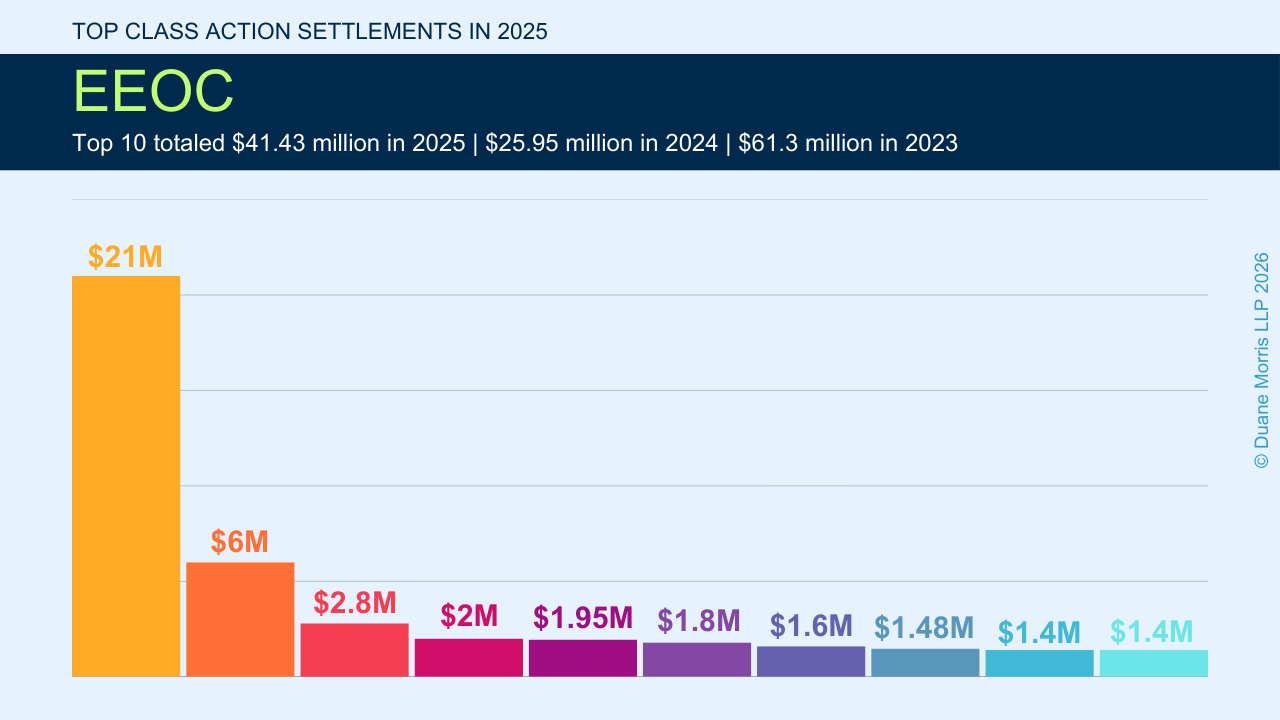
Daniel: Yeah, Jen, and the numbers from 2025 really drive that point home. In fact, the top 10 EEOC enforcement action settlements and verdicts totaled $41.43 million, which is a notable increase from $25.95 million in 2024. The trend tells us that enforcement activity is not slowing down.
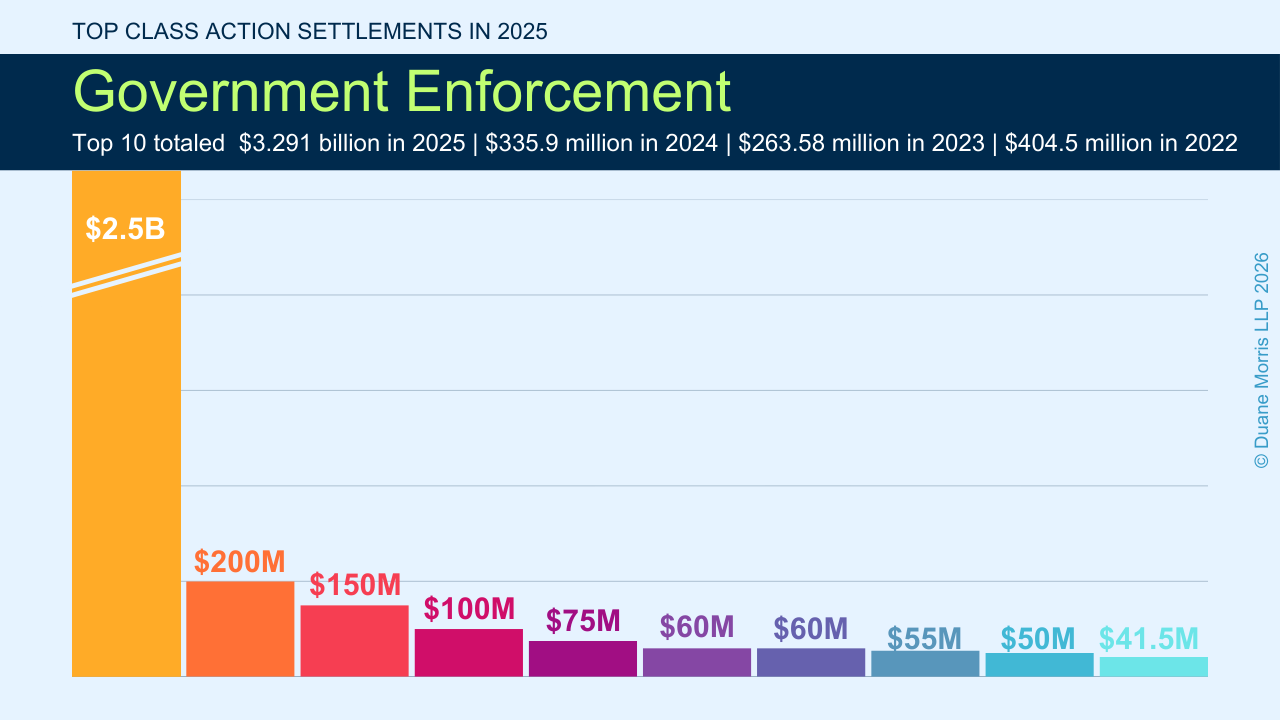
Jerry: I think it’s pertinent to note that the Department of Labor numbers are even more eye-popping from the perspective of corporate decision makers. In 2025, the top 10 settlements in the DOL space totaled $3.29 billion. That was up, quite a bit from 2024, when it was $335 million. So, you can see how dramatic the increase has been with the Department of Labor on its radar screen, looking for employers engaged in what it calls as alleged wage theft against workers.
Jennifer: Those DOL cases covered a range of issues, also Fair Labor Standards Act claims, as well as litigation involving consent decrees and injunctions. The rulings we analyzed in the review show how broad and potentially impactful the DOL enforcement actions can be.
Daniel: And that’s why this Review is so important for companies across the country. It looks at the legal issues that are being litigated, the enforcement strategies these agencies are using, and identifies and understands those critical trends for companies trying to stay ahead of the risk.
Jerry: Well, that’s well said, Jen and Daniel. And for anyone who wants to dig deeper, the full Review is available in e-book format on the Duane Morris Class Action Defense Blog. And we’ll be continuing to cover legal developments and rulings in the EEOC and the DOL space over the remainder of 2026, so stay tuned to the Class Action Weekly Wire.
Jennifer: Thanks for having me on the podcast, Jerry, and thanks to our listeners for being here. As always, subscribe to stay updated on the latest trends in class action law.
Daniel: Glad to be a part of the podcast, and thanks very much to all the listeners. Be sure to download your copy of the Review today.
By Gerald L. Maatman, Jr., Shannon Noelle, and Anna Sheridan
Duane Morris Takeaways: On January 7, 2026, in Valli et al. v. Avis Budget Group Inc. et al., Case No. 24-3025 (3d Cir. Jan. 7, 2026), the Third Circuit issued a mandate vacating an order from the District Court for the District of New Jersey denying a rental car company’s motion to compel arbitration and remanding the action for the District Court to address properly presented challenges to enforceability of the arbitration provisions that it did not reach in its decision. Avis appealed an order from the District Court denying its motion to compel arbitration of the claims of a certified class of renters presenting legal challenges to imposition of fees associated with traffic or parking fines incurred during the rental period. The Third Circuit found that Avis did not waive its right to compel arbitration by participating in litigation for years with the named Plaintiffs (whose rental agreements did not contain arbitration provisions) as Avis asserted its arbitration rights as an affirmative defense in its answers, raised the issue in opposition to class certification, and promptly field to a motion to compel after its Rule 23(f) petition challenging class certification was denied. This decision underscores that where named plaintiffs are not subject to arbitration provisions, but class members may have such constraints, pre-certification conduct preserving arbitration rights is essential to avoid waiver post-certification when arbitration rights are ripe.
Case Background
The named Plaintiff Dawn Valli filed a putative class action in September 2014 challenging Avis’ imposition of fees associated with a speeding traffic violation caught by a traffic camera that Avis paid and then charged Plaintiff Valli the $150 traffic fine it covered as well as a $30 administrative fee. Case No. 24-3025, ECF No. 53-3, at 3. The notice that Avis sent to Plaintiff Valli warned that Avis would charge $180 to Ms. Valli’s credit card if she did not make timely payment. Id. at 4. Plaintiff Valli brought an action on behalf of herself and other putative class members asserting state law claims including violations of the New Jersey Consumer Fraud Act and unjust enrichment on the theory that Avis deprived renters of an opportunity to contest the traffic violations by paying fines before notifying renters of the infractions and allowing them the ability to contest the fines. Id.
Avis moved to dismiss the complaint several times for failure to state a claim. Id. at 4-5. On April 1, 2016, Avis updated its rental agreement to include a mandatory arbitration provision for disputes arising out of the rental agreement and rental of its vehicles. Id. at 5. After Avis filed a renewed motion to dismiss (which did not mention the arbitration agreement as it only applied prospectively), the District Court denied the motion on May 10, 2017. Id. at 6. On May 25, 2017, Avis answered the First Amended Complaint (“FAC”) asserting its arbitration rights as an affirmative defense. Id. In June 2018, Avis allowed Ms. Valli to file a second amended complaint (“SAC”) adding another named Plaintiff. Id. at 7. Avis again invoked its arbitration rights as an affirmative defense in its answer. Id.
In July 2019, the two named Plaintiffs moved to certify a class of renters that were required to reimburse Avis for traffic, parking, tolls, or other violations and associated administrative fees. Id. at 8. In support of the motion for class certification, Plaintiffs defined the class period for the first time as September 30, 2008, through the present. Id. In opposition to class certification, Avis argued that the named Plaintiffs—who were not subject to its 2016 arbitration provisions—could not adequately represent the interest of renters that must arbitrate their claims. Id. Avis also argued that, at the motion to dismiss stage, such arguments were not ripe as it was unclear how the named Plaintiffs would define the class and whether it would include renters bound by arbitration agreements. Id. Oral argument on class certification occurred two years later, but Avis asserted the argument that the arbitration provisions defeated class certification. Id. at 8-9. Plaintiffs countered that Avis waived the argument by not having raised it earlier and choosing to participate in the litigation. Id. at 9. The District Court ordered supplemental briefing on the issue. Id. In its supplemental brief filed on September 15, 2022, Avis reiterated that nearly half the members of the putative class signed arbitration agreements and the named Plaintiffs (who had not) could not fairly represent the interests of those putative class members. Id. Avis filed another brief approximately two weeks later, arguing that it had preserved its arbitration rights by raising arbitration as an affirmative defense in its answers to both the FAC and SAC. Id. Avis also emphasized that Plaintiffs’ July 2019 class certification motion was the first time they identified arbitration-bound renters as putative class members. Id.
In October 2023, the District Court certified a subclass of individuals that rented an Avis vehicle from September 30, 2008, through the present and whose rented vehicle was the subject of an alleged parking, traffic, tolls, or other violation, where the class member was charged for such fine, penalty, and court costs, and/or associated administrative fee. Id. at 10. Avis filed a Rule 23(f) petition challenging certification of the class that was denied in November 2023. Id. at 10-11. Three months later, in February 2024, Avis moved to compel individual arbitration of the relevant class members’ claims. Id. at 11. Avis disputed that it waived its right to enforce its arbitration agreements arguing that any earlier motion to compel would have been directed at unnamed class members and would have therefore been futile before class certification. Id. On September 30, 2024, the District Court denied Avis’ motion to compel arbitration and faulted Avis for failing to formally seek to enforce arbitration until after the class had been certified. Avis appealed that decision to the Third Circuit.
The Third Circuit’s Decision
The Third Circuit found that Avis’ pre-certification litigation conduct was indeed relevant to the waiver issue, but this conduct indicated that the company had adequately preserved its arbitration rights.
The Third Circuit found that “[c]entral to th[e] case” was the “interplay between” the doctrine of waiver and futility. Id. at 12. The Third Circuit resolved the parties’ dispute as to whether Avis’ pre-certification conduct was relevant to the issue of waiver by answering this question in the affirmative. Id. at 14. In support of that finding, the Third Circuit found it notable that Avis “knew” of its prospective right to enforce arbitration “even if it lacked a present ability to enforce it pre-certification.” Id. at 19. The Third Circuit reasoned that the purpose of the waiver doctrine is to prevent “gamesmanship” or permitting a defendant to litigate aggressively for a merits advantage so that it can pivot to arbitration “the moment it becomes advantageous to do so, all without consequence.” Id. at 20. Yet, the Third Circuit found that the doctrine of futility “excuses the failure to file a formal motion to compel as to the unnamed class members” because to do so would be futile given that a District Court lacks jurisdiction to grant such a request. Id. The Third Circuit next addressed what a party must do to preserve future arbitration rights it cannot presently enforce. Id. at 21. The Third Circuit held that to implicitly waive arbitration rights, a party must litigate in a way that is inconsistent with a desire to arbitrate.
The District Court had identified two such events: (1) Avis’ motion of August 18, 2016 that did not mention arbitration; and (2) Avis’ participation in discovery and mediation. Id. at 26. Rejecting the first ground for finding waiver, the Third Circuit opined that it was not until two years later that plaintiffs defined the putative class to include post-April 2016 renters thus the motion to dismiss did not waive its arbitration rights. As to the second ground for finding waiver, the Third Circuit ruled that while Avis did not object to discovery or seek to exclude information concerning arbitration-bound renters, Plaintiffs could identify “only a single instance in which Avis produced information not also relevant to other customers who are not subject to arbitration.” Id. at 27. Further, “critically, Avis never sought discovery specifically targeted at arbitration-bound putative class members.” Id. at 27-28. The Third Circuit clarified that “discovery and mediation conduct can support a finding of waiver in the appropriate circumstances,” but explained that “discovery directed at non-arbitrable claims does not, by itself, waive the right to arbitrate arbitrable claims.” Id. at 28. The Third Circuit also found it significant that Avis “repeatedly put its intent to arbitrate on record” by consistently asserting its arbitration rights in opposing certification and reaffirming its stance two years later during oral argument. Id. at 29. The Third Circuit further reasoned that the fact that Avis moved to compel arbitration four months after the District Court’s certification decision was prompt enough and “not unreasonable” particularly as Avis’ Rule 23(f) petition was still pending. Id. Ten days after the Third Circuit denied the Rule 23(f) petition, the District Court held a status conference on December 14, 2023, setting a deadline of February 2024 for the motion to compel which Avis met. Id. at 29-30.
The Third Circuit stopped short of directing the District Court to compel the relevant class members to arbitrate their claims and did not reach the Plaintiff’s claims challenging the enforceability of the arbitration agreements, finding that the District Court relied exclusively on waiver in its decision and remanding the action permitting the District Court to reach the issue of enforceability if properly presented.
On January 13, 2026, the District of New Jersey issued an order implementing the mandate of the Third Circuit and vacating its September 30, 2024 order denying Avis’ motion to compel arbitration. A status conference is set for February 2026.
Implications For Class Action Defendants
Where named plaintiffs are not subject to arbitration agreements but defendants suspect that putative class members may be, defendants must act promptly to preserve their arbitration rights even where a motion to compel arbitration is not ripe, by asserting arbitration rights as an affirmative defense in answers to class action complaints and in opposition to class certification (as a basis for lacking commonality, adequate representation, typicality, etc.). The Third Circuit’s decision in Avis provides a guidepost for proper preservation of arbitration rights that class action defendants are well-advised to heed.
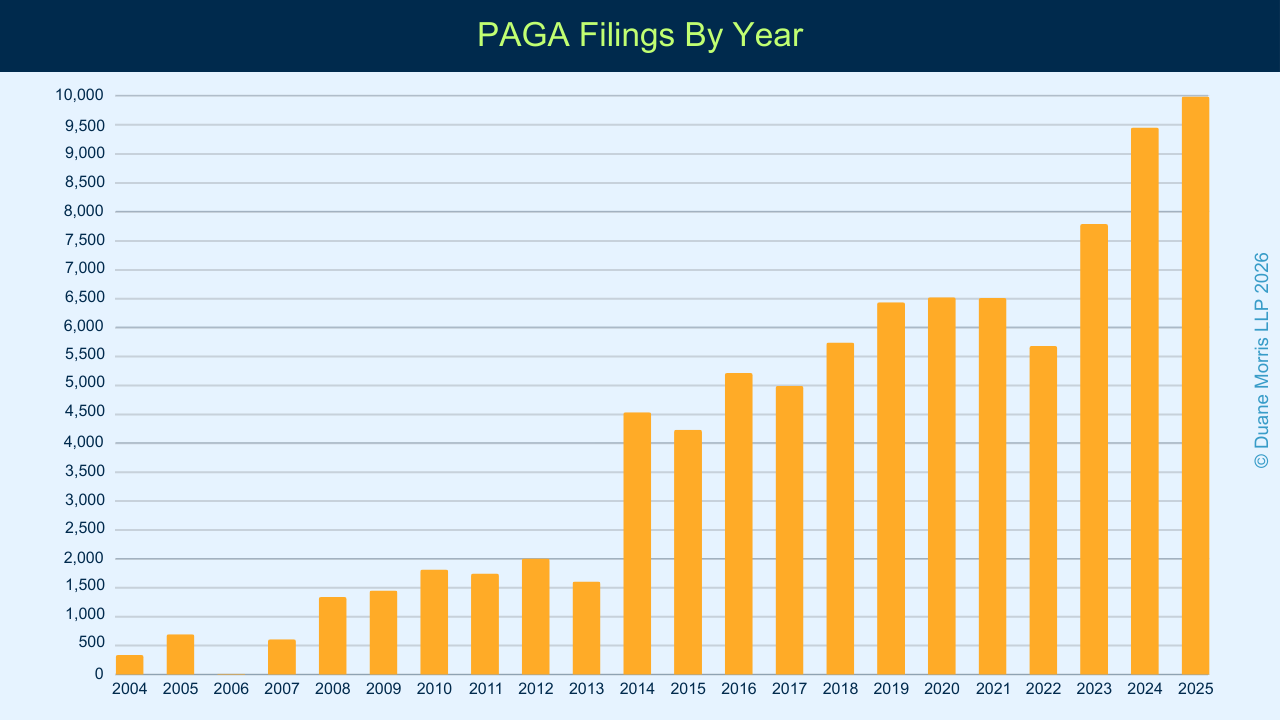
Duane Morris Takeaway: The final trend in our DMCAR series outlines how the California Private Attorneys General Act (PAGA) inspired more representative lawsuits than any other statute in America over the past three years. According to the California Department of Industrial Relations, the number of PAGA notices filed in 2025 approached 9,900, which surpasses the 9,464 PAGA notices in 2024.
DMCAR co-editor Jennifer Riley outlines this trend in the following video:
The so-called PAGA reform legislation passed in 2024 by California lawmakers seemingly did little to nothing to curb interest in these cases.
The PAGA created a scheme to “deputize” private citizens to sue their employers for penalties associated with violations of the California Labor Code on behalf of other “aggrieved employees,” as well as the State. A PAGA plaintiff may pursue claims on a representative basis, i.e., on behalf of other allegedly aggrieved employees, but need not satisfy the class action requirements of Rule 23.
Thus, the PAGA provides the plaintiffs’ class action bar a mechanism to harness the risk and leverage of a representative proceeding without the threat of removal to federal court under the CAFA and without the burden of meeting the requirements for class certification.
The PAGA’s popularity in recent years, however, also flows from its status as one of the most viable workarounds to workplace arbitration agreements. Thus, it presents one of the most pervasive litigation risks to companies doing business in California.
The Growth Of PAGA Notices Continues
According to data maintained by the California Department of Industrial Relations, the number of PAGA notices filed with the LWDA has increased exponentially over the past two decades.
The number grew from 11 notices in 2006, to 1,606 in 2013, and then underwent three sizable jumps – to 4,530 in 2014, to 5,732 in 2018, and to 7,464 in 2023, each coinciding with a significant shift in the legal landscape regarding arbitration. In 2024, notices exceeded 9,464 for the first time and, in 2025, the number of PAGA notices reached a new all-time high of approximately 9,981.
Employers saw the largest single year increase in 2014, when the number of notices increased from 1,605 in 2013 to 4,532 notices in 2014, an increase of 182%.
The most significant drop in the past two decades occurred in 2022, when notices fell from 6,502 in 2021 to 5,817 in 2022, before their resurgence in 2023 and continued growth in 2024 and 2025. The following chart illustrates this trend.
These numbers closely tie to the shifting impact of workplace arbitration programs, in that each of the major shifts coincides with the timing of a significant expansion or pull back in the law governing the enforcement of arbitration agreements.
PAGA reform seemingly has had little to no impact on the growth on PAGA filings. On June 18, 2024, Governor Newsom announced that labor and business groups had inked a deal to alter the PAGA in return for removing the referendum to repeal the PAGA from the November 2024 ballot. The California Legislature quickly moved to approve two bills (AB 2288 and Senate Bill 92). The alterations included reforms to the penalty structure, new defenses for employers, changes to the PAGA’s standing requirements, and a new “cure” process for both small and large employers, among other changes. These reforms affect all PAGA notices filed on or after June 19, 2024, with some exceptions. As noted above, however, PAGA reform did little to quell PAGA filings.
Could PAGA Activity Skyrocket?
As noted above, the PAGA emerged as one of the most popular tools of the plaintiffs’ class action bar in recent years due to its potential immunity from workplace arbitration agreements. The California Supreme Court is poised to consider the viability of so-called “headless” PAGA actions in 2026 – i.e., actions that lack or disclaim any individual PAGA claim (often because the plaintiff signed an arbitration agreement covering such claim) and seek to pursue only the representative PAGA component on behalf of other allegedly aggrieved employees.
The growing adoption of arbitration programs led the plaintiffs’ class action bar to identify various workarounds, and the PAGA emerged as one of the most viable in 2016 when the California Supreme Court issued its decision in Iskanian v. CLS Transportation Los Angeles, 59 Cal.4th 348 (Cal. 2014). In that case, the California Supreme Court held that representative action waivers in arbitration agreements are “contrary to public policy and unenforceable as a matter of state law.” Id. at 384. In so holding, Iskanian essentially immunized PAGA claims from arbitration and permitted plaintiffs to pursue representative actions under PAGA unhindered by arbitration agreements or commitments to arbitrate on an individual basis. The decision undoubtedly fueled the filing of PAGA notices in 2014, which catapulted from 1,606 in 2013 to 4,530 in 2014.
The PAGA suffered its first setback as an arbitration work-around in 2022 with the U.S. Supreme Court’s decision in Viking River Cruises, Inc. v. Moriana, 142 S.Ct. 1906 (2022). In Viking River, the U.S. Supreme Court held that, to the extent Iskanian precludes division of PAGA actions into individual and non-individual claims, and thereby “prohibit[s] parties from contracting around this joinder device,” the FAA preempts such rule. Id. As a result, the U.S. Supreme Court held that the lower court should have compelled arbitration of the plaintiff’s individual PAGA claim and should have dismissed the PAGA representative claim. Id.
The set-back was short lived as, in 2023, the California Supreme Court minimized the impact of the Viking River decision. In Adolph v. Uber Technologies, Inc., 14 Cal. 5th 1104 (Cal. 2023), the California Supreme Court took up the issue of whether, under California law, a PAGA plaintiff who’s individual PAGA claim is compelled to arbitration retains standing to bring a representative PAGA claim. The California Supreme Court answered the question in the affirmative. It held that, once a PAGA plaintiff is compelled to arbitrate his or her individual PAGA claim, so long as he or she is found to be an “aggrieved employee,” the plaintiff retains standing to maintain a non-individual PAGA claim in court. Id. at 1105.
By deciding that an individual who signs an arbitration agreement can return to court after arbitration to pursue a representative proceeding under the PAGA, the California Supreme Court relegated arbitration agreements to a mere hurdle rather than a bar to PAGA representative actions. Still, the plaintiffs’ bar has continued its attempt to eliminate the arbitration defense altogether to streamline their ability to proceed with representative actions in court. One emerging tool is the so-called “headless” PAGA action.
While such a tool seemingly runs counter to the ruling in Adolph and other cases, which have held that a PAGA claim necessarily consists of both and individual and representative portions, the California Court of Appeal gave it life in April 2024 with its decision in Balderas v. Fresh Start Harvesting, 101 Cal. App. 5th 533 (2024). In that opinion, the California Court of Appeal denied a motion to compel arbitration, holding that a plaintiff could maintain a representative PAGA action, even without an individual PAGA claim, so long as the plaintiff alleges that he or she suffered a Labor Code violation.
Appellate courts have taken different views as to this strategy over the past year. On July 7, 2025, for instance, in CRST Expedited, Inc. v. Superior Court Of Fresno County, 112 Cal. App. 5th 872 (Cal. App. 2025), the Court of Appeal for the Fifth District concluded that a worker’s dismissal of his individual PAGA claim did not bar him from pursuing a representative PAGA claim. The trial court granted the worker’s unopposed motion to dismiss his individual PAGA claim, and the defendant then sought dismissal of the non-individual PAGA claim on the ground that the plaintiff lacked standing to proceed. The trial court denied the motion. On appeal, the Court of Appeal concluded that the PAGA statute is ambiguous on this point and, faced with an ambiguous statute, opined that the primary objective of the PAGA statute is to maximize enforcement of labor laws and deter employer violations. As such, it held that requiring arbitration of individual claims before pursuing non-individual claims would undermine those enforcement efforts and that, to achieve effective enforcement, the PAGA statute should be interpreted to allow “PAGA plaintiffs and their counsel the flexibility to choose among bringing a PAGA action that seeks to recover of civil penalties on (1) the LWDA’s individual PAGA claims, (2) the LWDA’s non-individual PAGA claims, or (3) both.” Id. at 917.
In Williams, et al. v. Alacrity Solutions Group, LLC, 2025 Cal. LEXIS 4161 (Cal. App. July 9, 2025), the Court of Appeal for the Second District reached the opposite conclusion. The plaintiff, a former insurance adjuster, filed an action alleging that the defendant failed to pay overtime compensation. Although the plaintiff separated from his employment in January 2022, the plaintiff waited until March 2023 to file a PAGA notice with the LWDA. The plaintiff thereafter filed suit solely on behalf of other current and former employees and did not seek penalties on his own behalf. The trial court dismissed the plaintiff’s action holding that, because the plaintiff filed his PAGA notice more than a year after his employment ended, his individual claim was time-barred and, without a timely individual claim, he could not maintain a PAGA representative claim. The Court of Appeal affirmed the trial court’s ruling. It explained that a PAGA plaintiff must have a timely claim for violations he or she personally suffered. The plaintiff filed a petition for review with the California Supreme Court, and the California Supreme Court granted and deferred the appeal pending consideration and disposition of related issues in Leeper, et al. v. Shipt, 331 Cal. Rptr. 3d 450 (Cal. 2025)
In Leeper, the Court of Appeal for the Second District reached a similar conclusion. The plaintiff, a former Shipt worker, alleged that Shipt misclassified her and others as independent contractors in violation of state wage & hour laws. The trial court denied the defendant’s motion to compel arbitration ruling that, because the plaintiff sought only non-individual civil penalties, there were no individual claims to arbitrate. On appeal, the Court of Appeal reversed. It reasoned that every PAGA action inherently includes an individual claim, alongside the representative claim. The Court of Appeal opined that the statutory language of the PAGA states that a PAGA action is one brought both on behalf of the plaintiff (the individual claim) and on behalf of others (the representative claim). On request for review, the California Supreme Court agreed to review the Court of Appeal’s order and to address the following questions: (i) Does every PAGA necessarily include both individual and non-individual PAGA claims, regardless of whether the complaint specifically alleges individual claims; and (ii) can a plaintiff choose to bring only a non-individual PAGA action?
If the California Supreme Court sides with the plaintiffs on these issues and allows plaintiffs to maintain “headless” or representative-only PAGA claims, it will allow plaintiffs with arbitration agreements to bypass arbitration and to avoid the risk that they might not succeed on their individual PAGA claims. If plaintiffs can avoid arbitration altogether, such a ruling surely would bolster PAGA’s popularity as an arbitration work-around. Either way, given the technical requirements of California wage & hour law, coupled with the potentially crushing statutory penalties available to successful plaintiffs, employers should anticipate continued growth of PAGA lawsuits in 2026.
Duane Morris Takeaways: Given the importance of compliance with workplace anti-discrimination laws for our clients, we are pleased to present the fourth annual edition of the Duane Morris EEOC And Government Enforcement Litigation Review – 2026. The EEOC And Government Enforcement Litigation Review – 2026 analyzes the EEOC’s and U.S. Department of Labor enforcement lawsuit filings in 2025 and the significant legal decisions and trends impacting this litigation for 2026.
Click here to bookmark or download a copy of the EEOC And Government Enforcement Litigation Review – 2026 e-book.
The Review explains the impact of the EEOC’s six enforcement priorities as outlined in its Strategic Enforcement Plan on employers’ business planning and how the direction of the Commission’s Plan should influence key employer decisions. The Review also contains a compilation of significant rulings decided in 2025 that impacted government-initiated litigation and a list of the most significant settlements in 2025.
We hope readers will enjoy this new publication. We will continue to update blog readers on any important EEOC developments and look forward to sharing further thoughts and analysis in 2026!
Duane Morris Takeaway: In 2025, Artificial Intelligence – AI – continued to influence class action litigation on multiple fronts. First, we saw a growth of class action lawsuits targeting AI, including in the copyright area and employment space, as well as the securities fraud area with claims of “AI washing.” Second, we saw an increasing number of courts and lawyers err in their use of AI to generate documents filed on dockets across the country and encountered numerous examples of the ways in which AI is continuing to impact the efficiencies that underlie the litigation process.
DMCAR Editor Jerry Maatman discusses this trend in detail in the video below:
AI Provided Raw Material For Class Action Lawsuits
AI has been an accelerating force in class action litigation as a source of claims stemming from the development, use, and promotion of AI technologies. In 2025, some of those filed claims or ongoing claims included claims stemming from alleged copyright infringement, algorithmic bias or discrimination, and securities fraud.
On the copyright front, courts issued key decisions, including divergent decisions on whether using copyrighted works to train generative AI models constitutes “fair use” under the Copyright Act. In copyright cases, the plaintiffs typically allege that a developer of a generative AI tool violated copyright laws by using publicly available copyrighted works to train and inform the output of the AI tools. In Tremblay v. OpenAI, Inc., No. 23-CV-3223 (N.D. Cal. June 13, 2024), for instance, the plaintiffs alleged that OpenAI trained its algorithm by “copying massive amounts of text” to enable it to “emit convincingly naturalistic text outputs in response to user prompts.” The plaintiffs alleged these outputs included summaries that were so accurate that the algorithm must have collected and retained knowledge of the ingested copyrighted works in order to output similar textual content. The plaintiffs typically invoke the Copyright Act to allege that the defendant willfully made unauthorized copies of thousands of copyrighted works, generating damages up to $150,000 per copyrighted work for willful infringement, and, therefore, to seek billions in damages.
The $1.5 billion settlement reached in Bartz, et al. v. Anthropic is a landmark settlement and a prime example. In that suit, three authors filed a class action lawsuit against Anthropic claiming that Anthropic had downloaded millions of copyrighted books from “shadow libraries” like Library Genesis and Pirate Library Mirror to train its AI systems. In June 2025, Judge William H. Alsup of the Northern District of California denied Anthropic’s motion for summary judgment on the issue of fair use in a split-the-baby decision. The record showed that Anthropic downloaded more than seven million books from pirate sites but also bought and scanned millions more. The court held that Anthropic’s use of legally acquired books for AI training was protected fair use but that downloading and keeping pirated copies was not, noting that a developer that has obtained copies of books “from a pirate site has infringed already, full stop.” In August 2025, Judge Alsup granted the plaintiffs’ motion for class certification, sua sponte defining the class to include “all beneficial or legal copyright owners of the exclusive right to reproduce copies of any book” in the datasets that met his criteria. With tens of billions of dollars on the line, the parties promptly reached a settlement for $1.5 billion, the largest settlement of any class action in 2025.
Notably, shortly after Judge Alsup’s decision on summary judgment, Judge Vince Chhabria of the U.S. District Court for the Northern District of California reached a different conclusion in Kadrey, et al. v. Meta Platforms, Inc., No. 2023-CV-03417 (N.D. Cal. June 25, 2025). In that case, 13 authors, mostly famous fiction writers, sued Meta for downloading their books from online “shadow libraries” and using the books to train Meta’s generative AI models (specifically, its large language models, called Llama). The parties filed cross-motions for partial summary judgment regarding fair use. The court rejected the plaintiffs’ argument that “the fact that the AI developer downloaded the books from shadow libraries and did not start with an ‘authorized copy’ of each book gives them an automatic win.” The court held that, because Meta’s use of the works was highly transformative, to overcome a fair use defense, the plaintiffs needed to show that the AI model harmed the market for the plaintiffs’ works. Because the plaintiffs presented no meaningful evidence of market dilution, the court entered summary judgment for Meta on the fair use defense.
On the employment front, Mobley, et al. v. Workday, Inc., No. 23-CV-770 (N.D. Cal. May 16, 2025), continues to reign as one of the most watched and influential cases. In Mobley, the plaintiff, an African American male over the age of 40, who alleged that he suffers from anxiety and depression, brought suit against Workday claiming that its applicant screening tools discriminated against applicants on the basis of race, age, and disability. The plaintiff claimed that he applied for 80 to 100 jobs, and despite holding a bachelor’s degree in finance, among other qualifications, did not get a single job offer. The district court granted the defendant’s motion to dismiss on the ground that plaintiff failed to plead sufficient facts regarding the supposed liability of Workday as a software vendor for the hiring decisions of potential employers. In other words, the plaintiff failed to allege that Workday was “procuring” employees for its customers and merely claimed that he applied for jobs with a number of companies that all happened to use Workday.
On February 20, 2024, the plaintiff filed an amended complaint alleging that Workday was an agent of the employers that delegated authority to Workday to make hiring process decisions or, alternatively, that Workday was an employment agency or an indirect employer. Plaintiff claimed, among other things, that, in one instance, he applied for a position at 12:55 a.m. and his application was rejected less than an hour later. Judge Rita F. Lin granted in part and denied in part Workday’s motion to dismiss the amended complaint. The court reasoned, among other things that the relevant statutes prohibit discrimination “not just by employers but also by agents of those employers,” so an employer cannot “escape liability for discrimination by delegating [] traditional functions, like hiring, to a third party,” and an employer’s agent can be independently liable when the employer has delegated to the agent “functions [that] are traditionally exercised by the employer.” The court noted that, if it reasoned otherwise, and accepted Workday’s arguments, then companies could “escape liability for hiring decisions by saying that function has been handed to over to someone else (or here, artificial intelligence).”
The court opined that, given Workday’s allegedly “crucial role in deciding which applicants can get their ‘foot in the door’ for an interview, Workday’s tools are engaged in conduct that is at the heart of equal access to employment opportunities.” The court also denied Workday’s motion to dismiss the plaintiff’s disparate impact discrimination claims reasoning that “[t]he zero percent success rate at passing Workday’s initial screening” combined with the plaintiff’s allegations of bias in Workday’s training data and tools plausibly supported an inference that Workday’s algorithmic tools disproportionately rejected applicants based on factors other than qualifications, such as a candidate’s race, age, or disability. Thereafter, the court conditionally certified a collective action of all individuals aged 40 and over who applied for jobs using Workday’s platform and were rejected. In doing so, it authorized plaintiff to send notice of the lawsuit to applications nationwide. This litigation has been closely watched for its novel case theory based on artificial intelligence use in making personnel decisions and, given its success to date, is likely to prompt tag along and copycat litigation.
On the securities front, over the past three years, plaintiffs have filed dozens of lawsuits alleging that various defendants made false or misleading statements related to AI technology or related to AI as a driver of market revenue or demand, including claims that companies overstated their AI capabilities, effectiveness, or revenue generation in a practice known as “AI washing.” For instance, on April 17, 2025, the plaintiff Wayne County Employees’ Retirement System filed suit against AppLovin Corporation, No. 25-CV-03438 (N.D. Cal.), alleging that, among other things, the company falsely attributed its financial success to its enhanced AXON 2.0 digital ad platform and the use of “cutting edge” AI technologies to match advertisements to mobile games. In the complaint, the plaintiffs claim that the company’s revenue instead stemmed from manipulative ad practices, such as forced, silent app installations and that, upon release of short-seller reports disclosing the alleged practices, the company’s share price declined more than 12%.
Because investors have shown a willingness to pay a premium for shares of companies that appear positioned to capitalize on the effective use of AI, such statements have had the tendency to boost share prices. When projections fail to materialize, however, and share prices decline, plaintiffs are poised to take advantage.
In another example, plaintiffs filed a securities class action against Apple in the Northern District of California alleging that Apple made misleading and false statements regarding Siri’s generative AI features. The plaintiffs allege that Apple, at its annual Worldwide Developers Conference and on earnings calls, made claims that its AI solution called Apple Intelligence would create a more advanced and capable Siri. The plaintiffs allege that Apple continued to maintain that these features would arrive in early 2025 until March 2025 when it admitted that “[i]t’s going to take us longer than we thought.” The plaintiffs allege that, in the wake of these announcements, Apple’s share price dropped almost $47.
In sum, with AI continuing to flourish, the implications of its development, use, and advertisement are providing the raw material for creative plaintiffs’ class action lawyers. We should expect to see an upward trend of key decisions and new cases in 2026 and beyond as this burgeoning area of the law continues to expand.
AI Continued To Impact The Litigation Process
As legal professionals on both sides leverage AI to attempt to increase efficiency and gain a strategic advantage, examples of improper use abound. Rarely a day passes without a headline reporting attorney misconduct. To date, much of the AI misuse has centered on attorneys submitting or courts generating filings and legal briefs with fake citations. So-called “AI hallucinations” can take the form of citations to cases that do not exist or, even worse, the attribution of incorrect “hallucinated” holdings or quotations to existing opinions.
Bar associations have compiled dozens if not hundreds of instances of attorneys misusing generative AI in complaints, legal memoranda, expert reports, and appellate briefs. Perhaps more disturbing, these examples are joined by at least two instances of courts withdrawing decisions due to the incorporation of AI-generated contend.
Such conduct has led to severe sanctions, including fines and suspensions for violation of ethical duties, as well as (presumably) terminations. To date, claims of overbilling for such AI-generated worked product have not been made public, and lawyers continue to reiterate and train that AI is a tool and not a substitute for the application of legal analysis and judgment.
At the same time, AI is becoming an asset in the hands of more cautious connoisseurs who are taking advantage of its efficiencies for projects involving data analytics, document reviews, and form generation. Its use has become transformative in the settlement administration process where it has exposed vulnerabilities in the claims administration process by, for example, generating thousands of entries that dilute legitimate claims, thereby reducing legitimate recoveries.
Similar to classrooms where teachers use AI to detect AI, recipients are responding with their own AI-based tools to detect irregularities.
As the technology continues to evolve, it continues to impact that class action space in particular, which is particularly susceptible to mass-generated claims, demand letters, and form complaints. As a result, we are likely seeing the tip of the iceberg in terms of AI’s influence on the class action space.
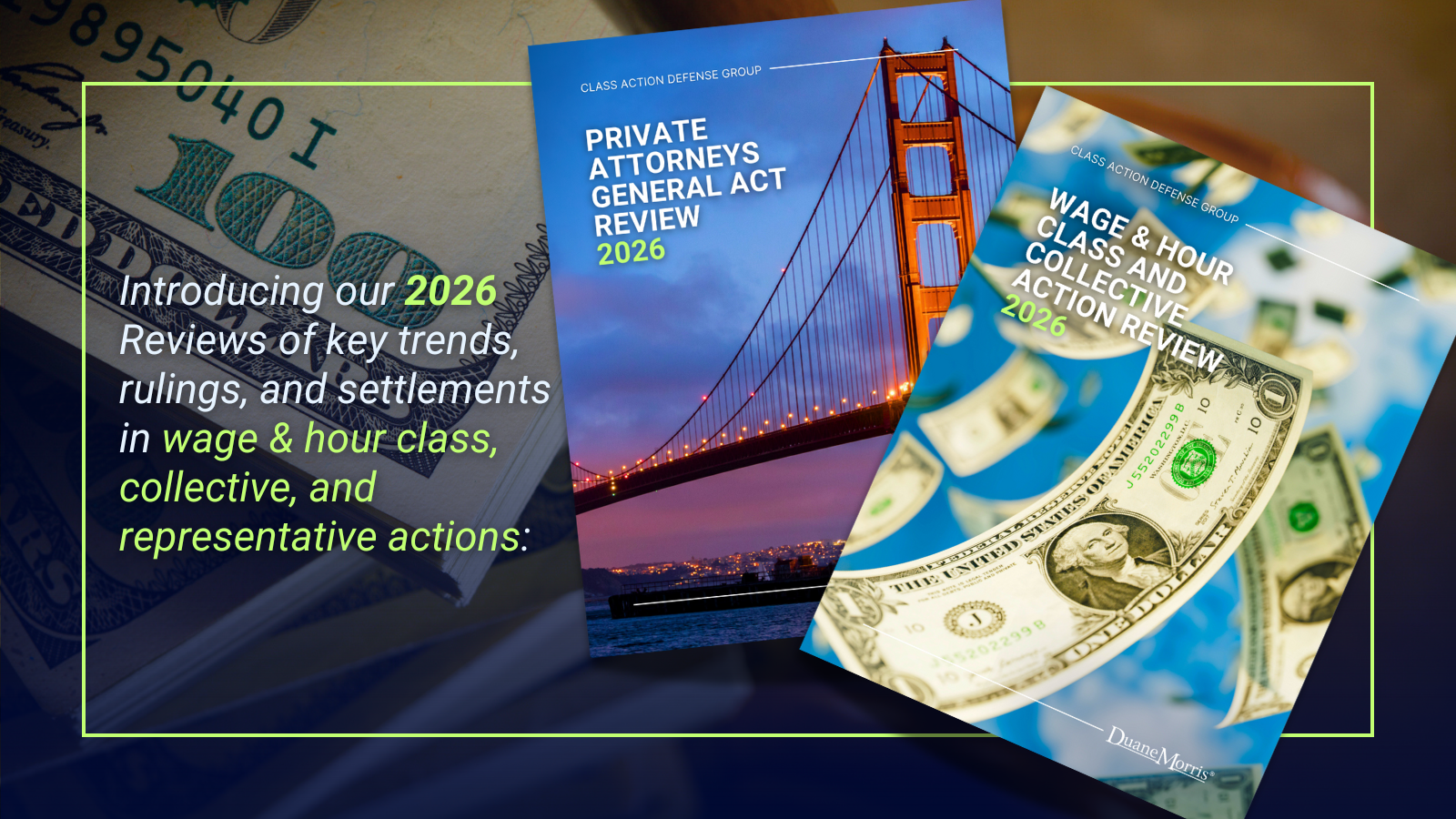
Duane Morris Takeaway:The Class Action Weekly Wire is back on the air in 2026 and our first episode features Duane Morris partners Jerry Maatman and Jennifer Riley with their discussion of the key trends and developments analyzed in the new editions of the Wage & Hour Class And Collective Action Review – 2026 and the Private Attorneys General Act Review – 2026. Our virtual desk references are fully searchable and accessible from any device.
Jerry Maatman: Thank you, loyal blog listeners and readers, for our first podcast of 2026. I’m Jerry Maatman, a partner at Duane Morris, and joining me today on the Class Action Weekly Wire podcast series is my colleague and partner, Jennifer. Thanks so much for being here, Jen.
Jennifer Riley: Great to be here, Jerry. Thanks for having me, and Happy New Year to you and to all of our listeners.
Jerry: Thanks so much. Our topic on today’s podcast are two desk references for employers that we put together, one on wage and hour issues, and the other on the California PAGA statute. It’s apropos that we talk about those mini-books, because after the publication of the Duane Morris Class Action Review on Tuesday, January 6, within a period of 10 days the Review and its analysis of wage and hour issues was cited in pleadings filed with the U.S. Supreme Court, so we’re very honored with the notion that the High Court received our analysis within less than 10 days after publication of the Duane Morris Class Action Review.
So, we wanted to talk, Jen, about some of the areas covered by the wage and hour and PAGA books, because I think these are our hottest mini-books and bestsellers.
Jennifer: That’s exactly right, I agree. These reports really capture how active and fast-moving these spaces continue to be. Starting with wage and hour, once again, in 2025, as we’ve seen for several years now, we saw litigation alleging violations of the Fair Labor Standards Act and related state wage and hour laws remain hot. That area remained an intense area of focus for the plaintiffs’ bar. In fact, plaintiffs filed more wage and hour class and collective actions in 2025 than any other type of complex litigation. That continues to give this area in particular outsized importance for employers.
Jerry: One of the core issues that we track is the ability of plaintiffs’ lawyers to certify their cases. In the class action space, obviously, certification is the holy grail. Cases rise and fall on it, and those certification rates are highest in several areas, including wage and hour. But at the same time, what we’re seeing is there are a myriad of standards now that have replaced the original standard articulated by a court called Lusardi in 1987 in the District Court of New Jersey. What’s going on, and what did 2025 represent in this space, Jen?
Jennifer: So, great question. So, there is a first stage and a second stage to these cases, traditionally, as you know. In the first stage, to conditionally certify a collective action per the Lusardi standard you mentioned, Jerry, plaintiffs need to make what the courts call this modest factual showing that they’re similarly situated to the members of their proposed collective action. That’s a fairly low threshold, and plaintiffs usually rely on declarations, from themselves, or maybe from a few other employees as well, sometimes some time in payroll records, and that’s pretty much it to meet that standard. If they succeed, courts typically allow, then, the plaintiffs to send notice of the action to these potential collective action members, who then have the opportunity to opt in and join the case.
So that’s the first stage. And then in the second stage, after opt-ins join the case, and after some discovery, courts conduct a much more searching analysis of whether the plaintiffs and the opt-ins are actually similarly situated. Courts then, and only then usually, dig into things like job duties, nature of the claims, the proof, and whether the case realistically can be managed through trial on a representative basis. That usually happens when the employer moves to decertify, although sometimes the plaintiffs seek a final certification order.
So that two-step approach, until recently, was almost universally applied. And frankly, it’s still the dominant approach in most federal courts today. But that uniformity is really starting to fracture.
Jerry: It really is. It all started in 2021 with the Fifth Circuit and its decision in Swales v. KLM Transport Services, where the two-step process was abandoned entirely and collapsed into one hearing and one motion. And then two years later, in 2023, the Sixth Circuit opined and waded in to this area in a case called Clark v. A&L Home Care, which also collapsed the two-step process into one step, but with a different procedural and evidentiary standard. And then if things weren’t complicated enough, the Seventh Circuit weighed in on August 5, 2025, in a case called Richards v. Eli Lilly, to give district courts discretion to fashion a single up or down certification hearing on these areas.
Jennifer: Agreed. That Eli Lilly decision really laid out another new framework. To obtain notice under that standard, the plaintiffs need to make that threshold showing that there’s a material factual dispute as to whether the proposed collective action members are similarly situated. The defendants, though, are then expressly allowed to submit rebuttal evidence, and courts need to weigh that evidence before deciding the issue, in terms of whether to send notice. The Seventh Circuit also recognized that there’s some flexibility there. If the key evidence, for instance, is in the hands of employees who haven’t yet received notice, the court can authorize notice while deferring that final similarity determination. And some courts may allow limited expedited discovery to resolve the similarly situated questions before the court makes a determination.
Jerry: Well, the bottom line is, today we now have four different approaches, which is a head-scratcher, given that this is a piece of New Deal legislation enacted in 1938. And now it’s 2026, and parties are still arguing over how a court should approach a certification issue and a wage and hour collective action. And this is why I think that we were so honored to be cited in Supreme Court briefs that were submitted last week in Washington, in yet another case, this one from the Fifth Circuit, called Cracker Barrel, where, the losing party is, again, getting before the Supreme Court and saying, ‘you need to provide some direction here, because having four different standards makes no sense.’ What we see from a practical standpoint is the same employer can be sued in different jurisdictions, and because of these different standards, there could be different outcomes based on the same facts. So, it’s something we’ll be watching closely in 2026 to see if there’s some uniformity or change in the direction of federal courts in dealing with these certification issues in the wage and hour space.
Jennifer: That’s good, absolutely. Let’s pivot now to our second publication, the Private Attorneys General Act Review – 2026. So, as a refresher, the California Private Attorneys General Act, or PAGA, allows employees to step into the shoes of the labor commissioner and seek civil penalties for labor code violations. So, for more than a decade, PAGA claims have been among the most frequently filed in California. Plaintiffs historically have favored PAGA over class actions for several reasons, including because of the relaxed requirements, to maintain that case on a representative basis. For instance, in PAGA, there’s no requirement to go through a class certification process. According to data from the California Department of Industrial Relations, the number of PAGA notices filed with the state LWDA reached an all-time high in 2025, continuing that trend that’s really been building for decades.
Jerry: Well, I know, Jen, you have a nationwide defense practice in class actions, but as a member of the California Bar and resident in both our Los Angeles and San Francisco offices, you spend a considerable amount of time defending employers in the state of California. Seemed to me there was a kind of an earthquake out there with a major decision in 2025 in the Lyft case. Why, in your opinion, was that case so significant to employers, sued under the PAGA statute in California?
Jennifer: Great question, Jerry. So that case you’re referring to is Turrieta v. Lyft. In that case, the California Supreme Court held that plaintiffs in separate PAGA actions cannot intervene in, object to, or seek to vacate a settlement reached in another PAGA case. The California Supreme Court there emphasized that the state is the real party in interest, that PAGA only requires notice and oversight by the LWDA and the trial court. The California Supreme Court noted that permitting intervention would result in a PAGA claim involving multiple sets of lawyers all purporting to advocate for the same client and fighting over who could control the litigation and the settlement process, and who could recover the attorneys’ fees. So, not only does PAGA not itself address such complexities, but such a messy situation would thwart the pursuit of PAGA claims contrary to the state’s purpose.
Jerry: My sense is the factual backdrop here is very important insofar as multiple Lyft drivers filed overlapping PAGA actions. One plaintiff had settled for $15 million – one of the more substantial pocket settlements of the year – and the other plaintiffs tried to derail that settlement. And I think sometimes, conceptually, it’s good to analyze decisions as door openers or door closers, and certainly the California Supreme Court, closed the door and shut down those efforts to intervene. Which is somewhat contrary to the general notion out there that the California Supreme Court always rules in favor of workers and against employers.
Jennifer: Exactly, I agree. That ruling gives employers much more certainty. It means they can resolve one PAGA case without fear that other plaintiffs will come in, disrupt the settlement – provided, of course, that the court approves it. Taken together, I think these developments show just how dynamic wage and hour and PAGA litigation continues to be.
Jerry: Well, that underscores the rationale for our creation and publication of these two books on wage and hour and PAGA developments to help employers understanding this patchwork quilt of laws and standards, where things stand, where they’re headed, and how to navigate these risks. So, we encourage our readers to take a look at those 2026 editions of the wage and hour and PAGA handbooks. The price is right: they’re for free. And you can download them, and they’re searchable – you could even look at them on your phone.
Well, thanks for joining me today, Jen, and thank you to all our listeners, and we’re glad you tuned in for this, first of the year installment of the Class Action Weekly Wire.
Jennifer: Thanks, Jerry, and thank you, listeners. It was a pleasure to be here today.
Duane Morris Takeaway:In 2025, case law continued to develop in fragmented ways among the federal circuits on issues material to plaintiffs’ ability to maintain and certify class actions, enhancing the likelihood of and incentive for forum shopping. In terms of standards governing conditional certification of FLSA, EPA, and ADEA matters, 2025 saw the crystallization of four distinct standards, ranging in the burdens applicable to plaintiffs, as well as in the review and consideration of the evidence presented. A second chasm relates to courts’ approaches uninjured class members, or the notion that each member of a putative class as defined might not have experienced a concrete injury sufficient to provide such individual standing to pursue a claim. A third chasm reflects courts’ divergent views relative to personal jurisdiction and whether a court that cannot exercise general personal jurisdiction must have a basis for specific personal jurisdiction as to each putative class member.
DMCAR co-editor Jennifer Riley explains this trend in detail in the video below:
These fractures have made forum selection more consequential than ever. Plaintiffs are increasingly skewing their filings toward federal circuits where they anticipate a greater likelihood of a favorable outcome, including toward jurisdictions where judges are taking a more lenient approach to certification or a more permissive view on issues like standing and jurisdiction. To date, efforts to persuade the U.S. Supreme Court to take up cases that would resolve these splits have failed, so we expect they will continue to drive uncertainty in class-related litigation through 2026.
Courts Disagree Over The Standards For Conditional Certification Of Collective Actions
The standards for conditional certification under the FLSA, EPA, and ADEA, continue to diverge such that district and appellate courts are applying any of at least four distinct approaches. These statutes provide little guidance as to the process they intended to incorporate for so-called conditional certification. In 29 U.S.C. § 216(b), the FLSA provides that “[a]n action . . . may be maintained against any employer (including a public agency) . . . by any one or more employees for and in behalf of himself or themselves and other employees similarly-situated. No employee shall be a party plaintiff to any such action unless he gives his consent in writing to become a party and such consent is filed in the court in which such action is brought.” 29 U.S.C. § 216(b). Courts have interpreted such language to authorize a process by which courts grant “conditional certification” of a collective action, authorize notice to persons who fall within the defined group, and permit those persons to “opt-in” by returned their consent forms. Courts, however, have disagreed over the standards plaintiffs must satisfy to initiate this process. In other words, how and when should a court determine if such persons are “similarly-situated”?
To date, federal courts that have addressed these issues have developed or adopted one of four primary schemes.
First, for many years, court accepted the familiar and lenient two-step standard set forth in Lusardi v. Xerox Corp., 118 F.R.D. 351 (D.N.J. 1987), and the U.S. Court of Appeals for the Second Circuit expressly adopted this standard in Scott v. Chipotle Mexican Grill, Inc., 954 F.3d 502, 515 (2d Cir. 2020), while the First, Third, Tenth, and Eleventh Circuits had done the same by “acquiescence” without express adoption. See Kwoka v. Enterprise Rent-A-Car Company of Boston, LLC, 141 F.4th 10, 22 (1st. Cir. 2025); Zavala v. Wal Mart Stores Inc., 691 F.3d 527, 534 (3d Cir. 2012); Thiessen v. General Electric Capital Corp., 267 F.3d 1095, 1105 (10th Cir. 2001); Hipp v. Liberty National Life Insurance Co., 252 F.3d 1208, 1219 (11th Cir. 2001)
Under Lusardi, a court considers at “step one” whether a plaintiff has made a “modest factual showing” based on his or her evidence, which often comprises one or more declarations, and may or may not even look at competing evidence submitted by the employer. If the court determines that a plaintiff has satisfied his or her “lenient” burden, the court authorizes notice. At the close of discovery, the employer then can move to decertify the conditionally certified collective action, and the court will consider based on the evidence whether the plaintiff has demonstrated that the persons who joined the action are similarly situated.
The Ninth Circuit clarified in Campbell v. City of Los Angeles, 903 F.3d 1090, 1114 (9th Cir. 2018), that the plaintiff must show he or she is similarly situated with respect to “some material aspect” of his or her claim and not merely in some way that is irrelevant to the claims asserted.
Second, in the first example of a court revisiting and examining the text of the FLSA, the Fifth Circuit prompted the ensuing split with its decision in Swales v. KLLM Transportation Services, LLC, 985 F.3d 430, 443 (5th Cir. 2021). In that decision, the Fifth Circuit rejected Lusardi’s two-step approach outright and directed district courts to “rigorously enforce” the FLSA’s similarity requirement at the outset of the litigation in a one-step approach. “[T]he district court needs to consider all of the available evidence” at the time the motion is filed and decide whether the plaintiff in fact has “met [his or her] burden of establishing similarity.” Id. at 442-43.
Third, in the wake of Swales the Sixth Circuit likewise revisited the standard in Clark v. A&L Homecare & Training Center, LLC, 68 F.4th 1003 (6th Cir. 2023). The Sixth Circuit rejected Lusardi, but also declined to adopt Swales. Instead, the court likened the standard to one comparable to the standard for obtaining a preliminary injunction. An employee must show a “strong likelihood” that others are similarly situated to the employee before the district court may authorize the plaintiff to send notice of the action. The Sixth Circuit left open the standard by which the court should consider a potential motion for decertification down the line. Id. at 1011.
Fourth, most recently, the Seventh Circuit addressed the same issue in Richards, et al. v. Eli Lilly & Co., 149 F.4th 901 (7th Cir. 2025). The Seventh Circuit rejected the Lusardi framework but declined to go as far as Swales or Clark. Instead, the Seventh Circuit ruled that “a plaintiff must first make a threshold showing that there is a material factual dispute as to whether the proposed collective is similarly situated” to secure a ruling authorizing notice, and an employer “must be permitted to submit rebuttal evidence” for the court to consider. Id. at 913. The court declined to set any bright line rule as to whether a court should decide the similarly situated question in a one or two step approach, noting that the analysis is not an “all-or-nothing determination.” Id. at 913-914.
The U.S. Courts of Appeal for the District of Columbia, Fourth, and Eighth Circuits have not yet opined on the proper method, leaving district courts to exercise their discretion. These divergent standards have influenced forum selection, as plaintiffs significantly have decreased the number of collective actions they pursue in the Fifth and Sixth Circuits in particular, in favor of filing in forums that apply more lenient standards.
Courts Continue To Disagree Over Standing And Personal Jurisdiction
Courts continue to disagree regarding the impact and treatment of uninjured class members, a key issue that remains unresolved. It is axiomatic that individuals who did not suffer injury as the result of the defendant’s conduct cannot maintain claims, and courts do not have the power to award them relief. As the U.S. Supreme Court reiterated in its seminal 2020 decision in TransUnion, “Article III does not give federal courts the power to order relief to any uninjured plaintiff, class action or not.” TransUnion LLC v. Ramirez, 141 S.Ct. 2190, 2208 (quoting Tyson Foods v. Bouaphakeo, 577 U.S. 442, 466 (2016) (Roberts, C.J., concurring)). In this respect, the “plaintiffs must maintain their personal interest in the dispute at all stages of the litigation . . . And standing is not dispensed in gross; rather, plaintiffs must demonstrate standing for each claim that they press and for each form of relief that they seek.” Id.
Despite this admonition, courts continue to grapple with the application of these concepts in the class certification context and, in particular, they disagree over whether to certify a class, a plaintiff must demonstrate that every putative class member has standing, or, stated differently, must demonstrate that the class excludes those individuals who did not suffer harm. In TransUnion, the Supreme Court expressly left open the question of “whether every class member must demonstrate standing before a court certifies a class.” Id. at n.4. Such a requirement has significant consequences for the class action landscape.
As a result, in January 2025, the U.S. Supreme Court granted a petition for certiorari in Laboratory Corporation Of American Holdings v. Davis, 145 S.Ct. 1608 (2025). In Davis, plaintiffs filed suit on behalf of a putative class of legally blind patients alleging that Lab Corp. violated the ADA by failing to make its self-service check-in kiosks accessible. In May 2022, the district court certified a broad class of that included all legally blind individuals were denied full and equal enjoyment of its goods and services due to “LabCorp’s failure to make its e-check-in kiosks accessible,” emphasizing that individualized damages questions do not defeat the predominance requirement. Lab Corp. sought interlocutory appeal, arguing that plaintiffs’ class definition swept in uninjured individuals who would not have used kiosks anyway. The Ninth Circuit granted the petition and affirmed. Applying Ninth Circuit precedent, the appellate court reasoned that Rule 23 permits certification of a class even when the class “‘potentially includes more than a de minimis number of uninjured class members.’” The U.S. Supreme Court granted certiorari in January 2025. Following briefing and oral argument, the U.S. Supreme Court declined to resolve the issue and dismissed the writ as improvidently granted. Justice Kavanaugh authored a dissent from such decision noting that, if given the opportunity, he would hold that “[f]ederal courts may not certify a damages class under Rule 23 when, as here, the proposed class includes both injured and uninjured class members.”
Without guidance from the U.S. Supreme Court, lower federal courts have continued to reach varying decisions on the issue. For instance, on July 17, 2025, the Fifth Circuit issued its decision in Wilson v. Centene Management Co., 144 F.4th 780 (5thCir. 2025). The plaintiffs in this case asserted breach of contract claims against the defendant insurance companies, alleging that it issued inaccurate provider lists and thereby caused the plaintiffs to pay artificially inflated premiums for access to providers who were not available. The district court denied class certification finding that the plaintiffs lacked standing. On appeal, the Fifth Circuit held that, at the class certification state, a plaintiff need only demonstrate his or her own standing, and the district court erred in its determination of the plaintiff’s standing, which it reached through a merits-based evaluation of the plaintiff’s expert.
The Seventh Circuit addressed the question in Arandell Corp. v. Xcel Energy Inc., 149 F.4th 883 (7th Cir. 2025). In that case, the plaintiffs brought a putative state-wide class action alleging that defendants engaged in a price-fixing conspiracy to manipulate natural gas prices. The Seventh Circuit noted that, to the extent defendants suggested that, before class certification, the plaintiffs must show all class members suffered some injury, “that is not correct.” It reiterated its prior holding that that “a class should not be certified if it is apparent that a great many persons who have suffered no injury at the hands of the defendant,” it clarified that “[t]here is no precise measure for ‘a great many.’ Such determinations are a matter of degree and will turn on the facts as they appear from case to case.”
In contrast, the Fourth Circuit took a different approach in Freeman v. Progressive Direct Insurance Co., 149 F.4th 461 (4th Cir. 2025). After an automobile collision, the plaintiff’s insurer provided her a payment based on the “actual cash value” of her car that it determined using a “projected sold adjustment.” Although the plaintiff accepted the payment, and did not contest the valuation, she filed suit for breach of contract. Although the district court certified a class, the Fourth Circuit reversed. The Fourth Circuit explained that, to succeed on her claim, the plaintiff needed to show that her insurer paid her less than the actual cash value of her vehicle and, likewise, that her insurer paid members of the class less than the actual cash value of their vehicles, regardless of whether the “projected sold adjustment” was used in determining that value. Yet, the class was defined to include anyone who was paid “compensation for the total loss of a covered vehicle, where . . . the actual cash value was decreased based upon Projected Sold Adjustments.” Thus, the class was defined to include insureds who accepted the insurer’s offer of payment, insureds who negotiated a higher payment, and insureds who invoked the appraisal process in the policy, simply because in each circumstance the insurer made its calculation using the Projected Sold Adjustment. “Yet, none of those could claim injury because each agreed to resolution of the loss. . . This characteristic of the certified class alone justifies reversal of the class certification order.”
Similarly, courts have continued to disagree regarding the scope of a court’s personal jurisdiction over the defendant in the class action context. In short, the U.S. Supreme Court decided Bristol Myers Squibb v. Superior Court, 137 S. Ct. 1773 (2017), in 2017 and ruled that a court must have a basis for exercising personal jurisdiction over a defendant for each claim it adjudicates. In that case, which involved a mass tort action, the U.S. Supreme Court concluded that the existence of similar claims asserted by plaintiffs who purchased a drug in California did not provide a court with personal jurisdiction over the defendant for purposes of adjudicating claims asserted by plaintiffs who purchased the same drug outside of California.
Again, despite this clear ruling, courts have continued to grapple with the application of these concepts in the class certification context and, in particular, they disagree over whether, to certify a class that includes nationwide class members, a plaintiff must demonstrate that the court can exercise personal jurisdiction over the defendant for purposes of resolving each of their claims or, stated differently, must demonstrate that each claim arises from or relates to a foreign defendant’s contacts with the forum state.
On July 1, 2025, the Ninth Circuit became the latest to address this issue. In Harrington, et al. v. Cracker Barrel Old Country Store, 142 F.4th 678 (9th Cir. 2025), the Ninth Circuit ruled that the U.S. Supreme Court’s decision in Bristol-Meyers applies to collective actions brought under the FLSA. The Ninth Circuit held that, when a plaintiff relies on specific personal jurisdiction as the basis for personal jurisdiction over the defendant in an FLSA collective action, district courts must assess whether they can exercise specific personal jurisdiction over the defendant on a claim-by-claim basis. This means that the claim of every opt-in plaintiff must arise out of or relate to the defendant’s activities in the forum state, and opt-in plaintiffs with no connection to the forum cannot rely on the connections of the named plaintiffs to establish personal jurisdiction.
In sum, courts continue to disagree as to their power in the class action context and the extent to which a procedural rule like Rule 23 can alter otherwise fundamental concepts of subject matter and personal jurisdiction for putative class members. Given the implications of such rules, we can anticipate that such questions will continue to influence forum selection for plaintiffs and continue to fuel uncertainty for defendants through 2026.
Duane Morris Takeaway:Government enforcement litigation is similar in many respects to class action litigation. In lawsuits brought by the U.S. Equal Employment Opportunity Commission (EEOC), as well as the U.S. Department of Labor (DOL), the government asserts various claims on behalf of or as a representative of numerous allegedly impacted individuals. These cases typically present numerous claimants, as well as significant monetary exposure.
The video below featuring DMCAR editor Jerry Maatman explains this trend in detail:
While plaintiffs in private party class actions must meet the requirement of Rule 23 to secure class certification, the law does not require the government to clear such hurdle. For example, systemic “pattern or practice” lawsuits brought by the EEOC follow a framework established by the U.S. Supreme Court in International Brotherhood Of Teamsters v. United States, 431 U.S. 324 (1977), rather than Rule 23. Nonetheless, EEOC systemic lawsuits present similar issues and similar risk for corporate defendants.
While the EEOC and DOL historically have been among the most aggressive litigants in terms of their pursuit of claims, the Trump Administration has had a profound impact on these agencies and their enforcement agendas. President Trump ran for election on a platform that runs counter to many of the “emerging issues” on the EEOC’s priority list, foreshadowing a realignment of litigation priorities.
The Trump Administration has kept its promise of less government oversight and regulation and has shifted the priorities of these agencies to more closely match the administration’s objectives.
Litigation And Settlement Trends
In fiscal year (FY) 2025, which ran from October 1, 2024, to September 30, 2025, the EEOC’s litigation enforcement activity stalled significantly as compared to previous years.
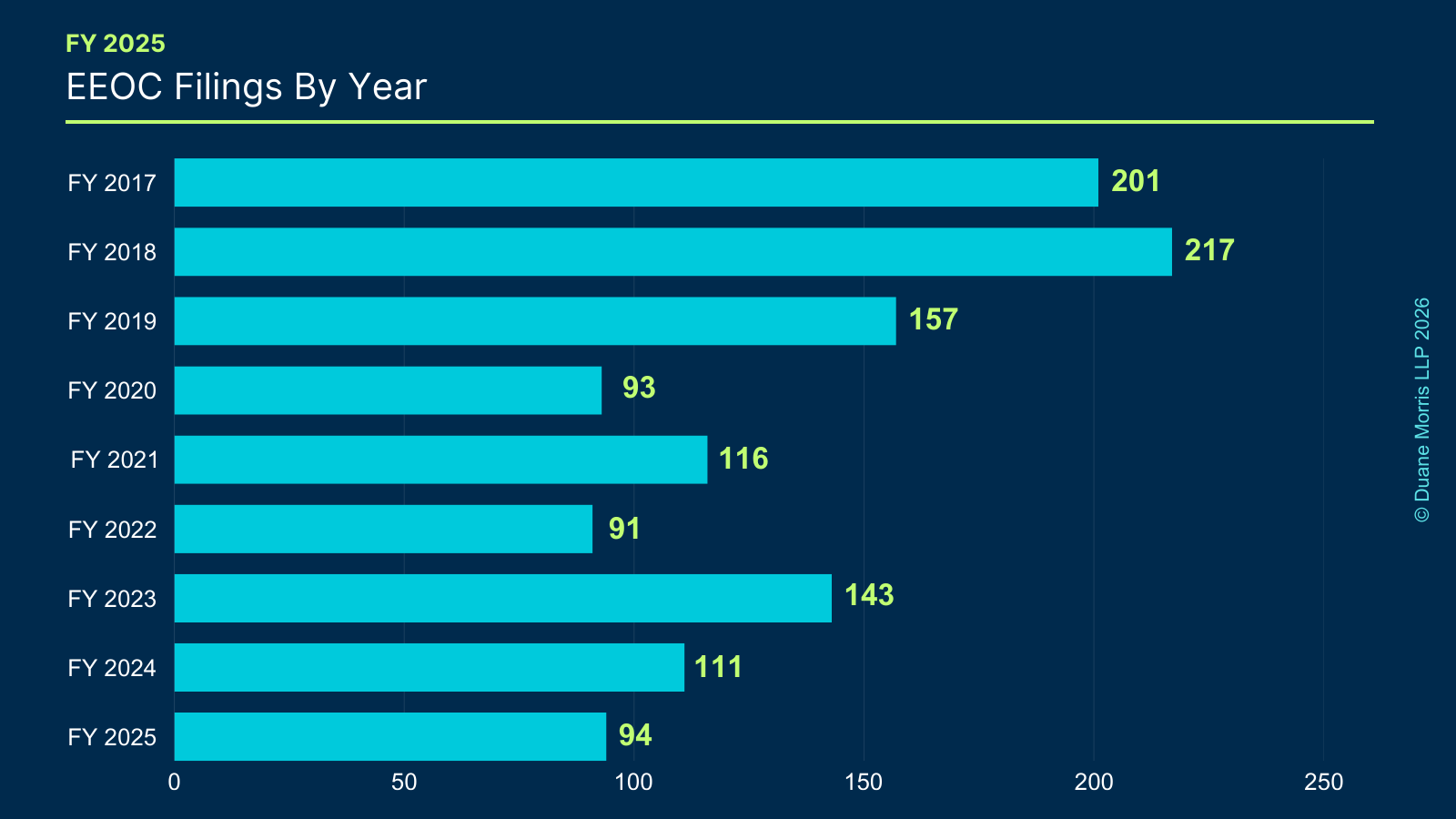
By the numbers, the EEOC filed a total of 94 lawsuits, far fewer than it filed at the height of filings in FY 2018, when it filed 217 lawsuits.
The decline in enforcement activity shows that, for President Trump’s second term in office, companies should expect the EEOC to be less aggressive as compared to past regimes in terms of the volume of enforcement lawsuits filed.
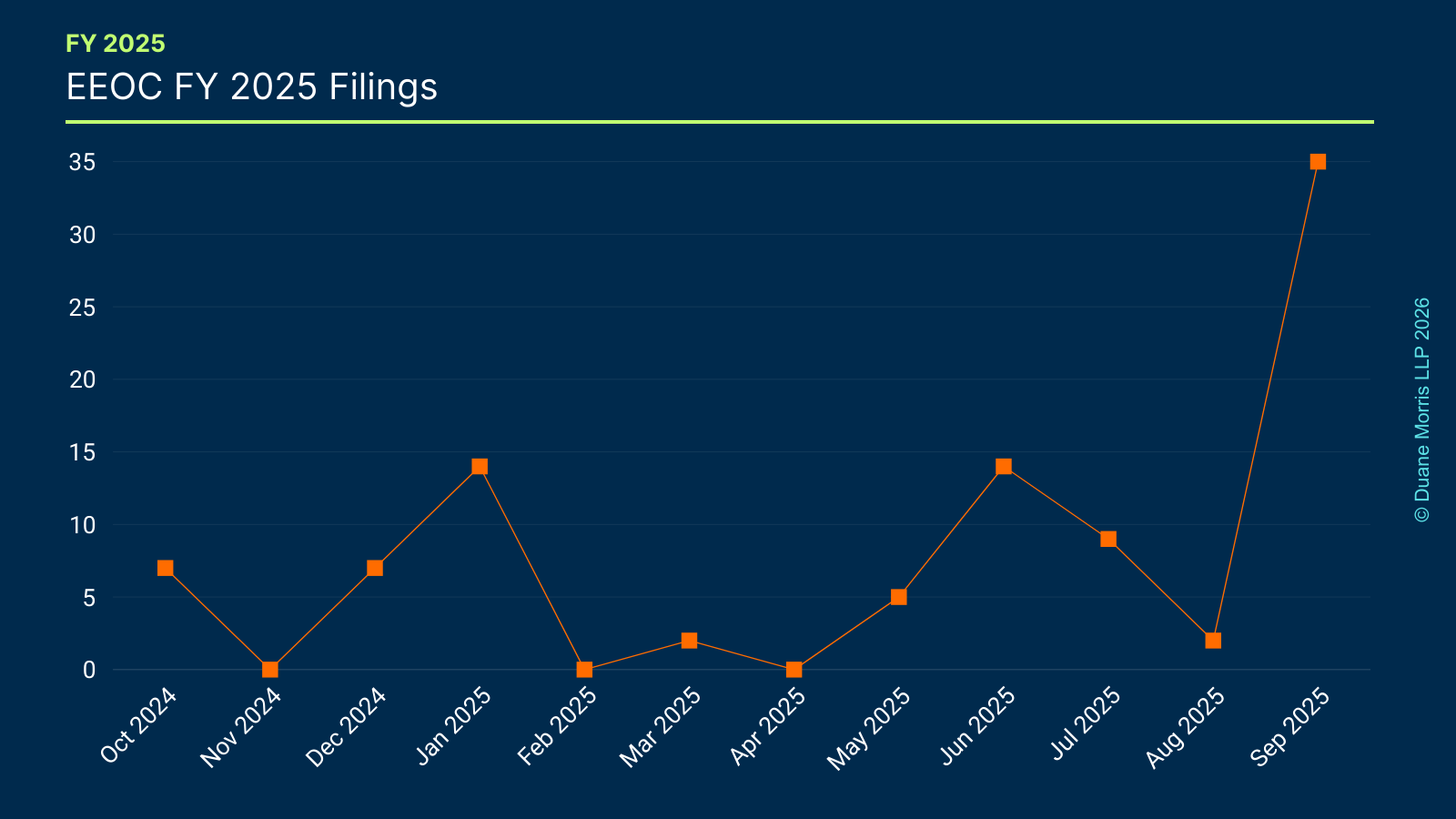
Each year, the EEOC’s fiscal year ends on September 30, and the agency engages in a sprint to the finish as it files a substantial number of lawsuits during the month of September. In FY 2025, the EEOC filed 94 lawsuits. Of these, it filed 35 – or 37% of the annual total – during September, the last month of its fiscal year. The overall number represents a decrease from prior years, but the filings followed a somewhat similar pattern. In FY 2024, the EEOC filed 110 lawsuits. It filed 67 of these actions, or more than 60%, during the month of September. By comparison, in FY 2023, the EEOC filed 144 lawsuits, with a similarly heavy September tranche of 35.We track the EEOC’s filing efforts across the entire fiscal year from its beginning in October through the anticipated filing spree in September.
Unlike other fiscal years, during 2025, the EEOC’s filing patterns were consistent in the first half of FY 2025, peaking with 14 lawsuits in January. Filings again slowed until the summer, when the EEOC filed another 14 lawsuits in June 2025. Thereafter, lawsuit filings dipped until the “eleventh hour” in September. The following shows filing activity by month:
Lawsuit Filings By EEOC District Office
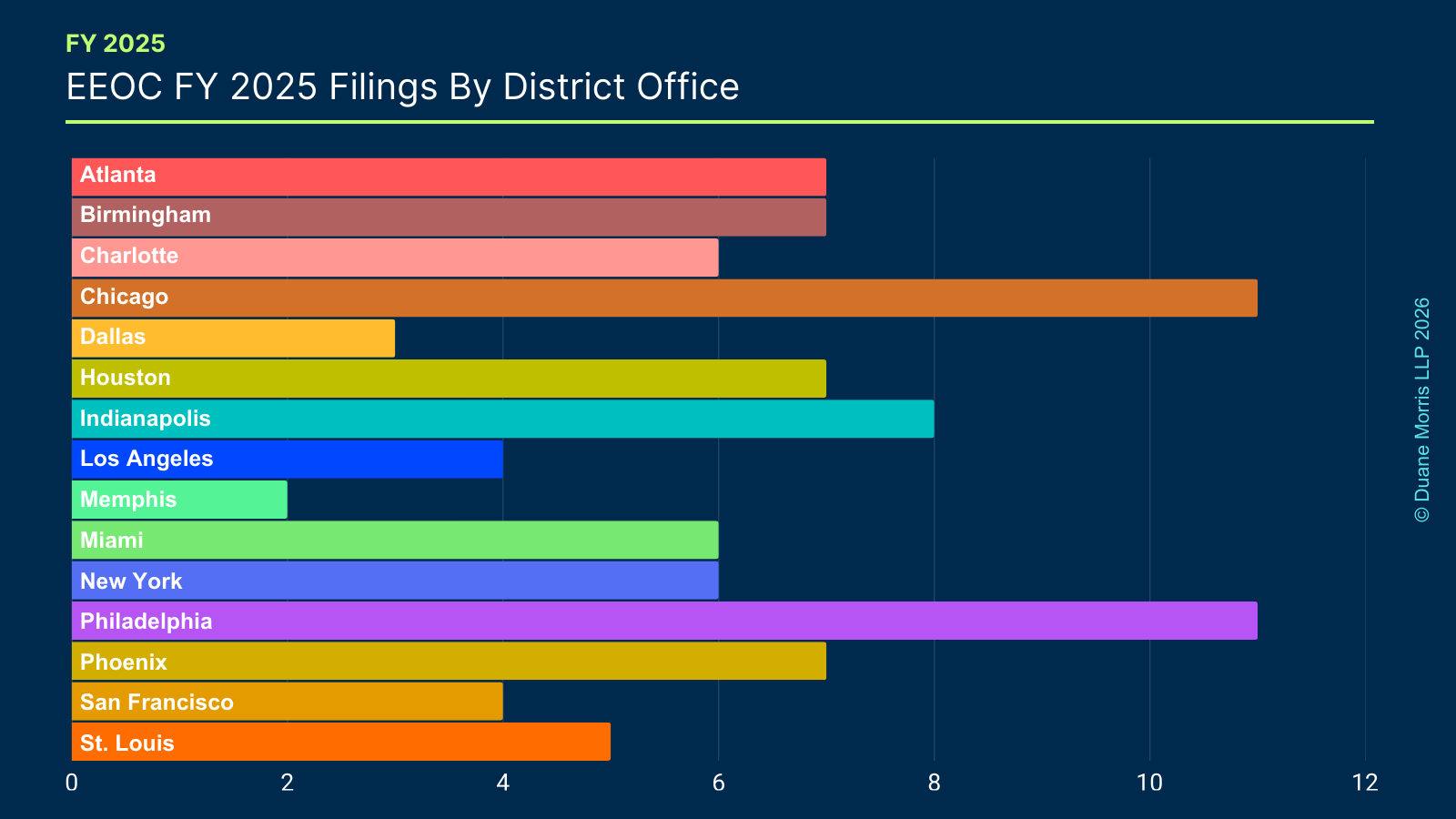
In addition to tracking the total number of filings, the litigation filing patterns of the EEOC’s 15 district offices are telling. Some districts tend to be more aggressive than others, and some focus on different case filing priorities. The following chart shows the number of lawsuit filings by each of the EEOC district offices in FY 2025.
In FY 2025, Philadelphia and Chicago led the pack in filing the most lawsuits, with 11 each, followed by Indianapolis with eight filings, then Atlanta, Birmingham, Houston, and Phoenix with seven filings, and Charlotte, New York, and Miami each with six filings.
St. Louis had five filings, Los Angeles and San Francisco had four filings, and Dallas had three filings. Memphis had the lowest amount with only two filings.
As in FY 2024, Philadelphia proved itself as a leader in EEOC enforcement filings. Chicago remained steady with 11 filings, the same as FY 2024. St. Louis (two filings in FY 2024) and Phoenix (four filings in FY 2024) showed increases in filing numbers as compared to FY 2024.
Other offices comparatively lagged in enforcement activity. Atlanta (11 filings in FY 2024), Indianapolis (nine filings in FY 2024), and Houston (eight filings in FY 2024) showed slight decreases in enforcement activities. Across the board, filings generally became more even for district offices compared to FY 2024, but filing activity decreased.
Lawsuit Filings Based On Type Of Claim
The types of claims the EEOC filed in FY 2025 provides a window into its shifting strategic priorities.
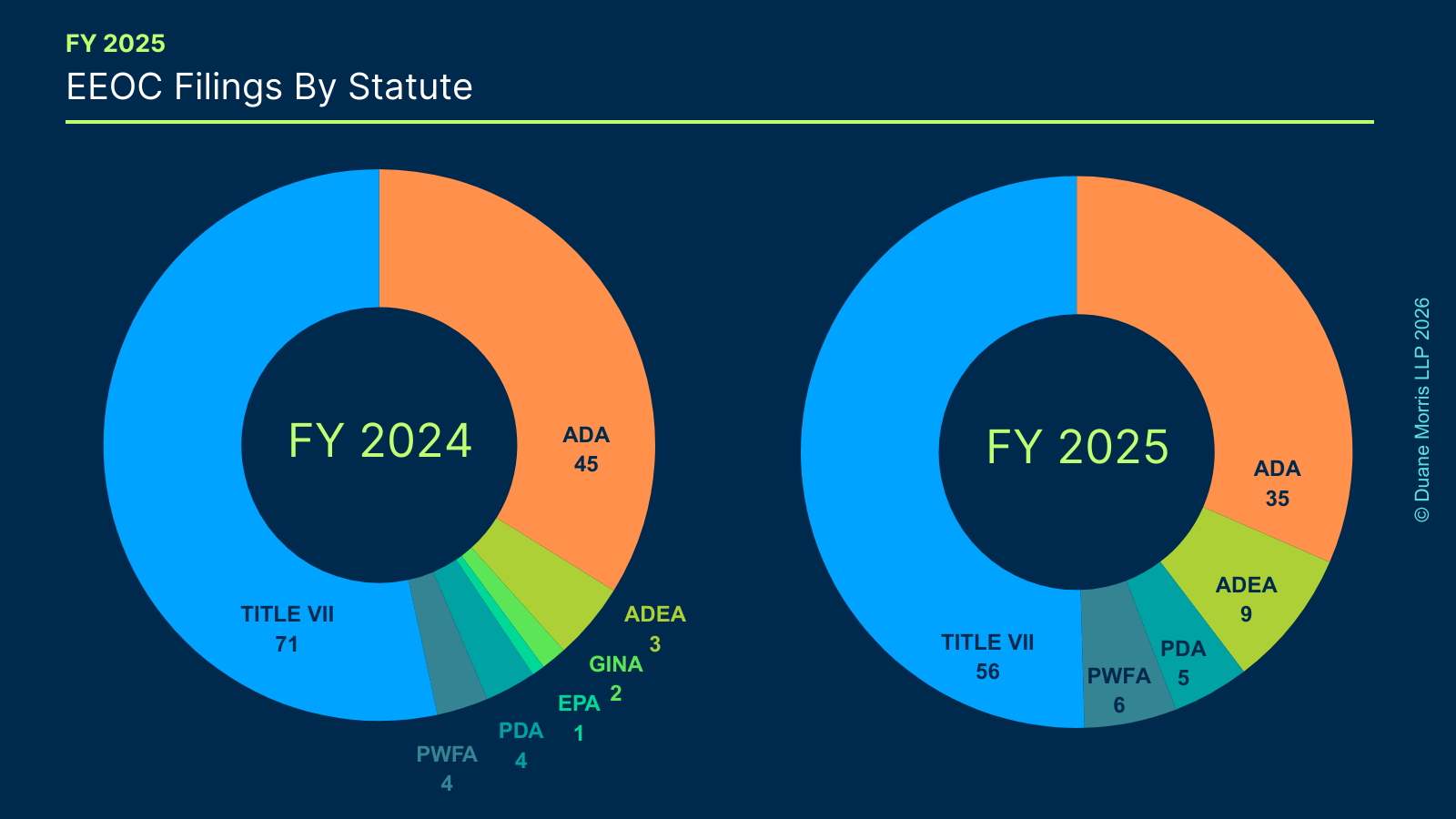
When considered on a percentage basis, the distribution of cases filed by statute skewed significantly in favor of Title VII cases when comparing FY 2025 to prior years.
The EEOC again based most of its claims on alleged violations of Title VII, but these claims comprised 50% of its filings in FY 2025, compared to 58% of its filings in FY 2024. Those numbers represent a significant decrease from FY 2023 and FY 2022, when Title VII claims represented 68% of the EEOC’s filings in FY 2023 and 69% of its filings in FY 2022.
Overall claims for alleged violation of the ADA made up the next most significant percentage of the EEOC’s FY 2025 filings – totaling 31.5%. This share again shows a decrease from prior years when ADA claims comprised 42% of filings in FY 2025, 34% of filings in FY 2023, and 37% of filings in FY 2021. The percentage is marginally higher than FY 2022, when ADA filings on a percentage basis comprised 29.7% of all filings.
The EEOC filed more claims for alleged violation of the ADEA in FY 2025. It filed nine ADEA cases in FY 2025, as compared to six ADEA age discrimination cases in FY 2024, but it filed 12 ADEA age discrimination cases in FY 2023 and seven in FY 2022.
As in FY 2024, this past year the EEOC pursued claims under the Pregnant Worker’s Fairness Act. It filed six cases, compared to three in FY 2024. In addition, the EEOC filed slightly more claims for alleged violation of the Pregnancy Discrimination Act in FY 2025. It filed five such cases, as compared to four in FY 2024.
Notably, the EEOC refrained from filing any claims for alleged violation of the Equal Pay Act in FY 2025 and any cases for alleged violation of the Genetic Information Nondiscrimination Act.
The following graph shows the number of lawsuits filed according to the statute under which they were filed.
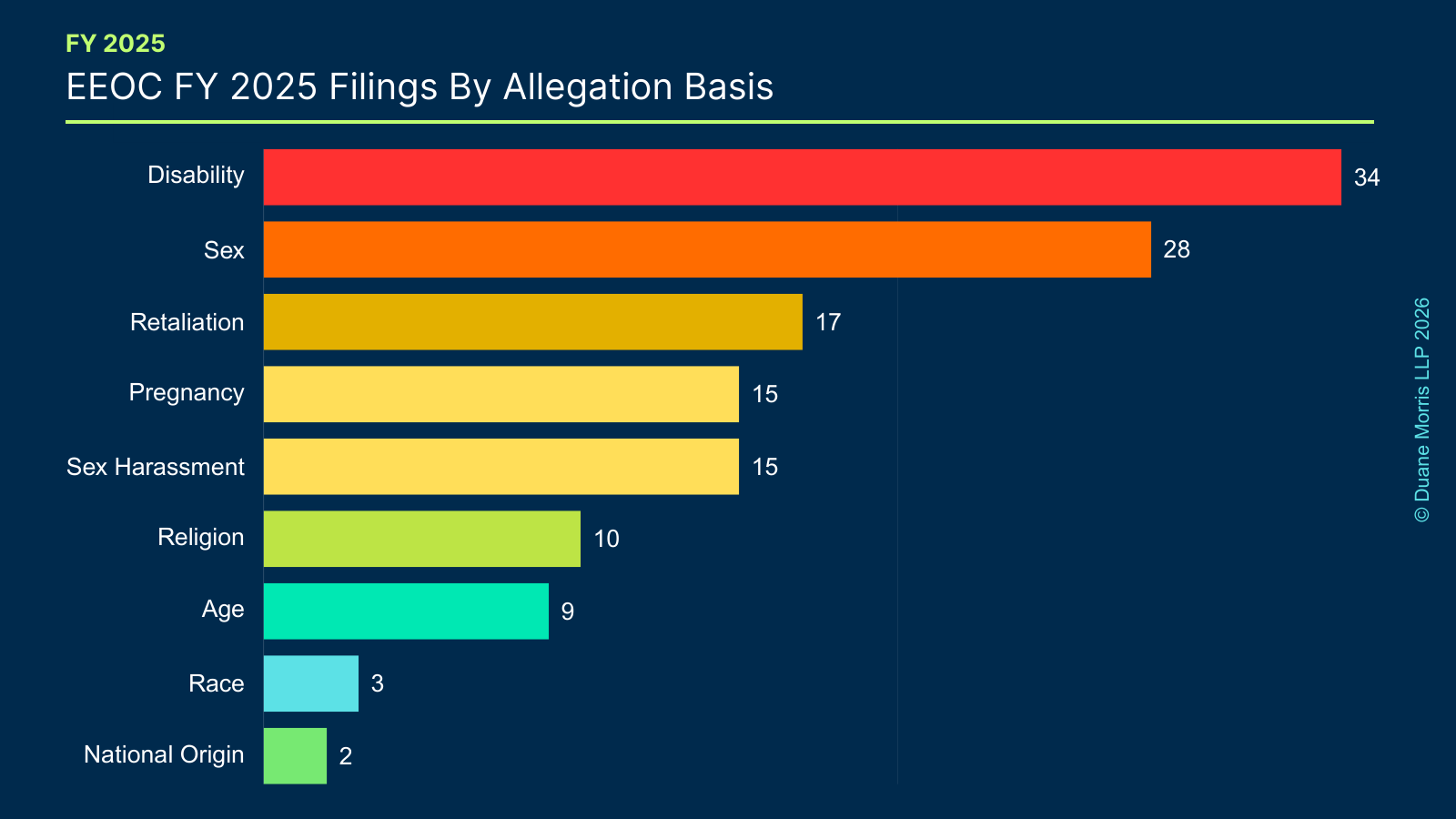
The grounds for such claims are reflect the stated priorities of the Trump Administration, including by reflecting a decreased emphasis on targeting alleged racial discrimination, and an increased emphasis on routing out disparate treatment based on gender and health-related and family-related conditions. Claims based on alleged disability discrimination, sex discrimination, and retaliation led the way. Collectively, these three theories provided the foundation for 59.4% of FY 2025 EEOC filings.
Notably, in FY 2025, the EEOC filed only three lawsuits asserting discrimination based on race or national origin, a total of 2.3% of the lawsuit filings. In FY 2024, 8.9% of all filings included claims based on race. The following graph shows a breakdown of the allegations underlying the FY 2025 filings.
Lawsuits Filings Based On Industry
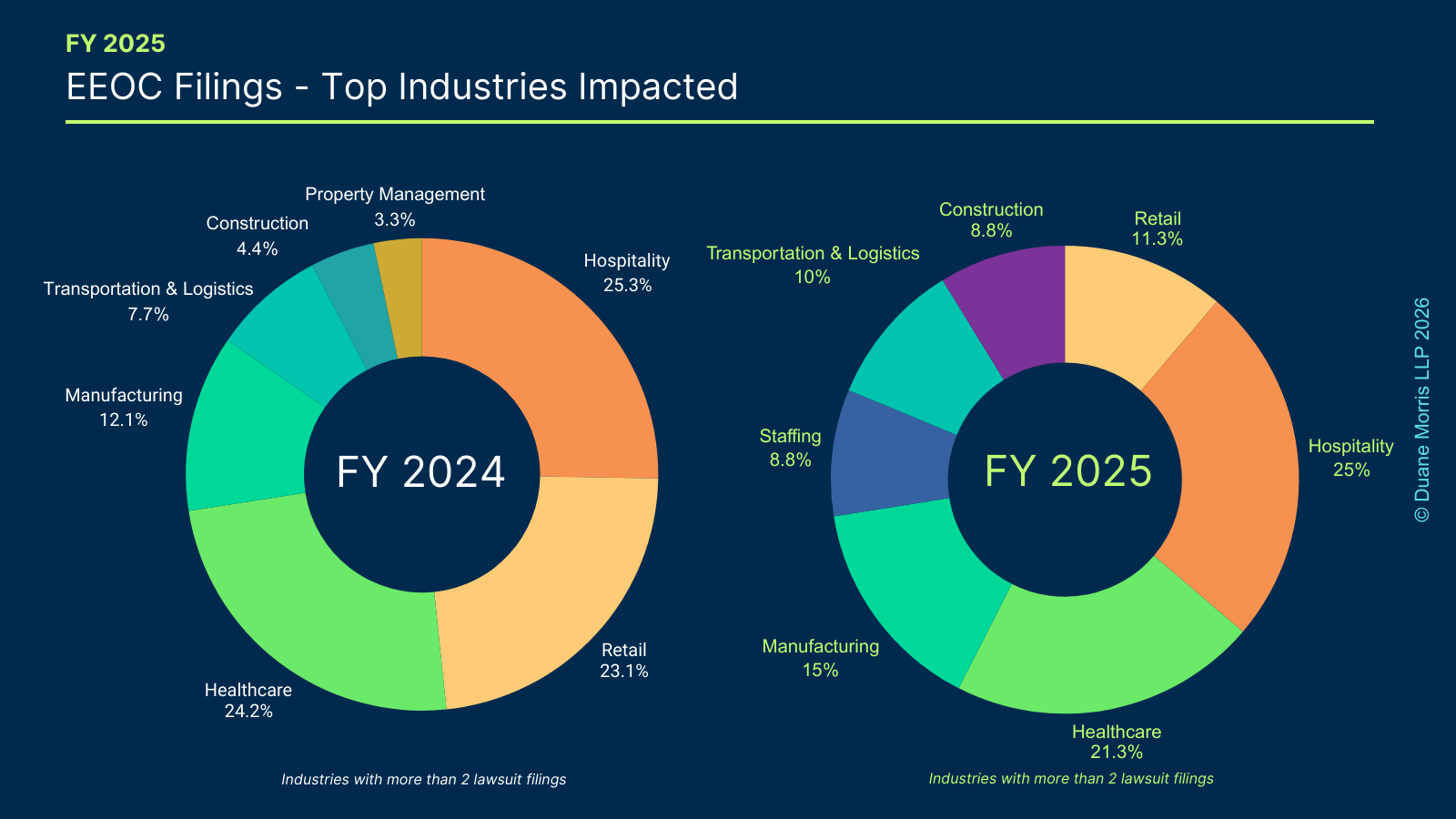
In terms of filings by industry, FY 2025 aligned with prior years and reflected the EEOC’s focus on a few major industries. In FY 2025, two industries remained among the EEOC’s top targets – hospitality and healthcare.
On a percentage basis, hospitality industry employers (restaurants / hotels / entertainment) were recipients of 25% of EEOC filings, and healthcare industry employers received 21.3%. In FY 2025, manufacturing (15% of FY 2025 filings, 12.1% of FY 2024 filings) overtook retail (11.3% of FY 2025 filings; 23.1% of FY 2024 filings) as the next most targeted industry, with retain experiencing a double-digit decline. Only one other industry, transportation & logistics received a double-digit percentage share of EEOC-initiated lawsuits (with 10%). Filings against employers in staffing and construction remained flat in terms of relative percentage in FY 2025 as compared to FY 2024 (8.8% and 8.8% of filings, respectively). As in FY 2024, in FY 2025, the EEOC did not file any of its enforcement lawsuits against employers in the automotive, security, and/or technology industries.
Strategic Priorities
Moving into FY 2026, the EEOC’s budget justification includes a $19.618 million decrease from FY 2025. This move is reflective of the Trump Administration’s stated priority of returning to the “agency’s true mission.” The EEOC aims to return to its founding principles and restore evenhanded enforcement of employment civil rights laws on behalf of all Americans.
Every new presidential administration brings with it an array of objectives focused on different priorities. Since President Trump’s inauguration, the Trump Administration has taken unique steps to significantly reshape the EEOC. Among its moves to overhaul the agency, President Trump dismissed two Democratic-appointed EEOC commissioners and its General Counsel and replaced them with officials viewed as more aligned with his agenda. The Administration appointed new leadership, including Chair Andrea Lucas and Acting General Counsel Andrew Rogers. On October 7, 2025, Brittany Panuccio was confirmed by the Senate as a commissioner, thereby restoring a quorum.
President Trump has issued a series of executive orders reflecting its shift in enforcement priorities, particularly against DEI initiatives. On January 20, 2025, the White House issued an executive order, “Ending Radical and Wasteful Government DEI Programs and Preferencing,” and, on January 21, 2025, the White House issued, “Ending Illegal Discrimination and Restoring Merit-Based Opportunity.” The latter’s stated purpose is to end “dangerous, demeaning, and immoral race- and sex-based preferences under the guise of so-called ‘diversity, equity, and inclusion’ (DEI) or ‘diversity, equity, inclusion, and accessibility’ (DEIA) that can violate the civil-rights laws of this Nation.” President Trump ordered all executive departments and agencies to terminate all “discriminatory and illegal preferences” and to “combat illegal private-sector DEI preferences, mandates, policies, programs, and activities.”
Shortly thereafter, in February 2025, the EEOC took prompt action to implement the Administration’s shift in direction. Citing the Trump Administration’s Executive Order on “gender ideology extremism,” the EEOC announced that it would withdraw seven lawsuits it had filed across the country, including:
EEOC v. Sis-Bro Inc., No. 25-CV-968 (S.D. Ill.) EEOC v. Harmony Hospitality LLC, No. 24-CV-357 (M.D. Ala.) EEOC v. Brik Enterprises, Inc., et al., No. 24-CV-12817 (E.D. Mich.) EEOC v. Reggio’s Pizza Inc., No. 24-CV-8910 (N.D. Ill.) EEOC v. Lush Handmade Cosmetics LLC, No. 24-CV-6859 (N.D. Cal.) EEOC v. Boxwood Hotels, LLC, No. 24-CV-902 (W.D.N.Y.) EEOC v. Starboard Group Inc., No. 24-CV-2260 (S.D. Ill.)
On February 18, 2025, in EEOC v. LeoPalace, No. 25-CV-4 (D. Guam), the EEOC settled a lawsuit for more than $1.4 million and entered into a three-year consent decree with LeoPalace Resort, a large hotel in Guam. The EEOC alleged that LeoPalace provided employees of non-Japanese national origin with less favorable wages and benefits than their Japanese counterparts. This lawsuit is significant because it was the first seven figure settlement that the Commission procured after President Trump took office in January 2025 – and because it was accompanied by a statement from Chair Andrea Lucas announcing the Commission’s new enforcement agenda and its intent to protect all workers from national origin discrimination and “Anti-American Bias.”
In the accompanying press release, Chair Lucas announced that “Federal anti-discrimination laws ensure equal employment opportunity for jobs performed by all workers regardless of national origin. . . . This case is an important reminder that unlawful national origin discrimination includes discrimination against American workers in favor of foreign workers.” This was the Commission’s first publicized settlement since Lucas was appointed Acting Chair of the EEOC. One day after the settlement was announced, the EEOC published a second press release on its Newsroom “putting employers and other covered entities on notice” that the Commission was committed to protecting all workers from unlawful national origin discrimination, including American workers.
The Commission has stated that it is committed to carrying out President Trump’s policy agenda, consistent with his executive orders related to (1) “unlawful DEI-motivated race and sex discrimination,” (2) “defending the biological and binary reality of sex and related rights,” (3) “protecting workers from religious bias and harassment, including antisemitism,” and (4) “anti-American national origin discrimination.”
Further evidencing these stated objectives, among other things, Acting Chair Lucas has announced that one of her priorities for compliance, investigations, and litigation is to defend the biological and binary reality of sex and related rights, including women’s rights to single-sex spaces at work. She likewise removed the agency’s “pronoun app,” a feature in employees’ Microsoft 365 profiles, which allowed an employee to opt to identify pronouns, which then appeared alongside the employee’s display name across all Microsoft 365 platforms, including Outlook and Teams. This content was displayed both to internal and external parties with whom EEOC employees communicated. She also has ended the use of the “X” gender marker during the intake process for filing a charge of discrimination and directed the modification of the charge of discrimination and related forms to remove “Mx.” from the list of prefix options.
On December 19, 2025, Chair Lucas announced in an interview with Reuters that, “[i]f you have a DEI program or any employee program that involves taking an action in whole or in part motivated by race or sex or any other protected characteristic, that’s unlawful.” She confirmed that federal inquiries into corporate diversity programs are underway and warned that initiatives tied to hiring, promotion, or marketing may come under scrutiny. Lucas reiterated the White House’s position that white men have been subject to discrimination in the workplace through DEI programs and encouraged the submission of complaints.
In several respects, FY 2025 represented a hard pivot in enforcement targets. While total filings decreased, the new administration foreshadowed a new direction and targeted approach in upcoming EEOC enforcement.
Duane Morris Takeaway: Data privacy class action filings continued to expand in 2025, marking it as one of the fastest growing areas in the complex litigation space. Plaintiffs filed approximately 1,822 data privacy class actions in 2025. This represents an average of more than 150 fillings per month and more than seven filings per business day. These numbers reflect growth of more than 18% over the number of data breach class actions filed in 2024 and growth of more than 200% over the number of data breach class actions filed just three years ago in 2022.
Watch Review co-editor Jennifer Riley as she explains this trend in more detail below:
In 2025, courts also granted motions to dismiss these complaints at increasingly high rates, leading to many dismissals, many pre-ruling settlements, and few rulings on motions for class certification. Indeed, despite the significant increase in filings, courts issued few – only three – rulings on motions for class certification in 2025, suggesting that many motions are in the pipeline or that cases are increasingly resolved prior to class certification through dismissal or settlement.
Filing Numbers Continued Their Upward Trajectory
The volume of data breach class actions continued to expand in 2025 as data breach solidified its spot among the fastest growing areas of class action litigation. After every major (and even not-so-major) report of a data breach, companies should expect the negative publicity to prompt one or more class action lawsuits. These suits saddle companies with the significant costs of responding to the data breach as well as the costs of dealing with the resulting high-stakes class action lawsuits, often on multiple fronts.
Companies that were unfortunate enough to fall victim to data breaches in 2025 faced class actions at an increasing rate. In 2025, plaintiffs filed approximately 1,822 data privacy class actions, which represents a 18% increase over 2024. In 2024, plaintiffs filed 1,488 data privacy class actions, compared with 1,320 in 2023, and 604 in 2022.
As the graphic depicts, the growth of filings in the data breach area has been extraordinary, from 109 class action filings in 2018 to 1,822 class action filings in 2025, an increase of more than 1,613% in seven years.
Several factors are likely continuing to fuel this growth in data breach class actions. First, data breaches have continued to increase at a rate that roughly tracks the shape of the curve depicted above. Second, whereas defendants have achieved success in the courthouse, recent court decisions have provided a better roadmap for plaintiffs to attempt to escape dismissal with some portion of their complaint intact. Third, and most importantly, hefty settlements have continued to fuel filings. Observing the difficulty that plaintiffs have faced attempting to certify data breach class actions, plaintiffs are increasingly incentivized to file and then monetize their data breach claims early in the litigation, prior to reaching that crucial juncture, while their investment remains low.
So long as defendants continue to play ball on the settlement front, we are likely to continue to see even low settlement payouts continue to lure plaintiffs to this space and fuel those filing numbers.
Plaintiffs Continued To Face Hurdles In The Courthouse
Data breach plaintiffs continued to face hurdles in the courthouse in 2025. In 2025, federal courts issued substantive rulings on 222 motions to dismiss that they granted, granted in part, or denied. In those rulings, courts granted 150 motions to dismiss in whole or in part, and denied 72 of those motions, representing a success rate for defendants of 67.5%. Contrasting those results with 2024, in 2024, federal courts issued rulings on 265 motions to dismiss that they granted, granted in part, or denied. In those rulings, courts granted 171 motions to dismiss in whole or in part, and denied 94 of those motions, representing a success rate for defendants of 64.5%. Considering the increasing filing numbers, this suggests that defendants attacked the pleadings in a lower percentage of matters in 2025, or that a lower percentage of cases made it to the motion to dismiss stage.
In terms of the 150 favorable rulings for defendants in 2025, courts granted dismissal in 81 matters and granted dismissal in part in 69 matters. Thus, of the 150 rulings favoring defendants, 54% of those favorable rulings dismissed complaints in their entirety, often for lack of standing as discussed below. Defendants fared slightly better in 2025 than in 2024 in terms of gaining full dismissals. In 2024, courts issued 171 favorable rulings for defendants, granted dismissal in 103 matters and granted dismissal in part in 68 matters, meaning that, of the 171 rulings favoring defendants in 2024, 60% of those favorable rulings dismissed complaints in their entirety.
In terms of full dismissals, many of the decisions granting such motions addressed the issue of standing. The U.S. Supreme Court’s decision in TransUnion LLC v. Ramirez, 141 S.Ct. 2190 (2021), continues to fuel a fundamental threshold challenge in terms of whether a plaintiff can show that he or she suffered a concrete injury such that he or she has standing to sue. In TransUnion, the Supreme Court ruled that certain putative class members, who did not have their credit reports shared with third parties, did not suffer concrete harm and, therefore, lacked standing to sue. Since the TransUnion decision, standing has emerged as a key defense to data breach litigation because the plaintiffs often have difficulty demonstrating that they suffered concrete harm.
Courts have handed down a kaleidoscope of decisions on the issue of standing. For instance, some courts have found that mere public disclosure of private facts is sufficiently “concrete” enough for an injury to establish standing, whereas others have required allegations showing harm from misuse of the plaintiffs’ data. Decisions on motions to dismiss data breach class actions often turn on the sensitivity and level of exposure of the information involved, as well as plaintiffs’ ability to plausibly allege a credible risk of future harm, a duty to protect confidentiality of information, and many other specifics relevant to a large number various common law and statutory theories asserted by plaintiffs, who often file multiple claims, and sometimes file dozens of claims under dozens of theories in data breach class actions, in the hopes of finding one that will stick.
In Teague, et al. v. AGC America, Inc., 2025 U.S. Dist. LEXIS 102564 (N.D. Ga. Jan. 6, 2025), for instance, the plaintiff filed a class action alleging that the defendant failed to adequately safeguard personal information, resulting in a data breach. The plaintiff claimed that the breach exposed the PII of more than 20,000 individuals, which subsequently was accessed by cybercriminals. The defendant moved to dismiss, arguing that the plaintiff failed to show actual losses or a causal connection between the breach and his alleged injuries. The court, however, held that the plaintiff had standing to sue because he demonstrated a substantial risk of future harm resulting from the data breach. The court reasoned that the plaintiff’s allegations of misuse of his PII by criminals and the immutable nature of the information were sufficient for standing.
In Dougherty, et al. v. Bojangles’ Restaurants, Inc., 2025 U.S. Dist. LEXIS 194879 (W.D.N.C. Sept. 30, 2025), by contrast, the court dismissed a putative class action arising from a 2024 cyberattack against Bojangles. A group of former employees alleged negligence and violations of North Carolina tort and consumer protection laws, claiming emotional distress, privacy loss, and risk of identity theft. The court held that plaintiffs failed to allege a concrete injury sufficient for Article III standing. Eight of the nine plaintiffs based their claims solely on a speculative risk of future harm – such as potential sale of data on the dark web, increased spam calls, and time spent on mitigation – without a showing of any actual misuse. The lone plaintiff alleging fraudulent debit card charges failed to establish traceability, as he did not claim to have provided his card information to Bojangles.
Plaintiffs who clear the standing hurdle face another key inflection point at the class certification phase. Despite the robust filing activity, in 2025 courts issued few decisions on motions for class certification. In 2025, courts ruled on only three motions for class certification in the data breach area, and plaintiffs prevailed on one, for a success rate of 33%. Similarly, in 2024, courts ruled on only five motions for class certification in the data breach area, and plaintiffs prevailed on two, for a success rate of 40%. By comparison, in 2023, courts issued seven rulings on motions for class certification, and plaintiff prevailed on one, for a success rate of 14%. Given the volume of filings, these numbers suggest that hundreds of motions remain in the pipeline or that, observing the difficulty that plaintiffs have faced in certifying data breach such cases over the past three years, plaintiffs are electing to monetize their data breach claims prior to reaching that crucial juncture.
The court’s ruling in Theus, et al. v. Brinker International Inc., 2025 U.S. Dist. LEXIS 122165 (M.D. Fla. June 27, 2025), is illustrative. The plaintiff filed a class action against the defendant, Chili’s parent company Brinker International, Inc., alleging that hackers stole customers’ credit and debit card information and posted it for sale on a dark web marketplace called Joker’s Stash. The plaintiff filed a motion for class certification on behalf of all affected customers across the United States. The district court certified a class that included individuals who shopped at affected Chili’s locations during March and April 2018, had their data accessed by cybercriminals, and incurred expenses or time mitigating the consequences. However, Brinker appealed, and the Eleventh Circuit vacated the district court’s ruling. On appeal, the Eleventh Circuit reasoned that the phrase “data accessed by cybercriminals” was too broad and could include uninjured individuals. Id. at *4. The Eleventh Circuit ordered the district court to either revise the class definition to include only those who experienced fraudulent charges or had data posted on the dark web, or to reassess the original definition while recognizing it might contain uninjured members. On remand, the plaintiff initially proposed a narrower class definition but ultimately deferred to the Eleventh Circuit’s directive, which refined the class to include only those who: (i) experienced fraudulent charges or had their data posted on the dark web due to the breach; and (ii) spent time or money mitigating those consequences. Despite this refinement, the district court denied class certification. The district court found individualized questions, such as whether someone’s data was compromised, what expenses he or she incurred, or whether his or her card was ever posted or misused, would require case-by-case analysis. The district court ruled that proving the individualized issues would require “a great deal of individualized proof,” making the case unsuitable for class certification. Id. at *11.
In sum, while filing numbers continue to climb, the number of rulings on key phases of data breach class actions is continuing to decline. Observing the difficulty that plaintiffs have faced overcoming motions to dismiss and certifying such cases over the past three years, plaintiffs are increasingly incentivized to monetize their data breach claims early in the litigation, prior to reaching either juncture. As we continue to see filings grow in this area, we could continue to see a decline in the number of rulings. So long as defendants continue to play ball on the settlement front, and payouts remain higher than the associated transaction costs, we are likely to continue to see settlements lure plaintiffs to this space.
By Gerald L. Maatman, Jr., Jennifer A. Riley, Gregory Tsonis, Daniel Spencer, and Eden Anderson
Duane Morris Takeaways: Duane Morris is proud to announce the publication of two Reviews, the Wage & Hour Class And Collective Action Review – 2026, and the Private Attorneys General Act Review – 2026. We hope these publications will demystify some of the complexities of Wage & Hour and PAGA litigation and keep corporate counsel updated on the ever-evolving nuances of these issues. We hope these books – manifesting the collective experience and expertise of our class action defense group – will assist our clients by identifying developing trends in the case law and offering practical approaches in dealing with Wage & Hour and PAGA litigation.
Once again in 2025, as has been the case for several years, litigation against employers alleging violations of the Fair Labor Standards Act (FLSA) and/or related state law wage & hour laws continued to be an area of intense focus for plaintiffs’ attorneys. The plaintiffs’ bar in 2025 filed more wage & hour class and collective actions against companies than any other type of complex litigation, resulting in outsized importance for this area of substantive law. Similarly, claims filed under the California Private Attorneys General Act (PAGA), continue to be one of the most popular types of complex litigation filed in California. PAGA representative lawsuits allow plaintiffs to bring claims on behalf of their co-workers with no class certification requirements and minimal barriers to legal standing. By all accounts, 2025 was a very active year on the PAGA litigation front.
Click here to bookmark or download a copy of the Wage & Hour Class And Collective Action Review – 2026 e-book.
Click here to bookmark or download a copy of the Private Attorneys General Act Review – 2026 e-book.
Stay tuned for more Wage & Hour and PAGA class action analysis coming soon on our podcast, the Class Action Weekly Wire.