Duane Morris Takeaway: The Duane Morris Class Action Review, our 22nd annual study of the class action space, is the biggest and most comprehensive edition yet, at over 750 pages. The 2026 Review has more analysis than ever before, with discussion of over 1,761 class certification rulings from federal and state courts examining all categories of class action litigation.
We will host an in-depth discussion of the key trends analyzed over the past 12 months at the Duane Morris Class Action Review – 2026 Book Launch Event on Thursday, February 5, 2026, from 3:30 p.m. to 6:00 p.m. at the Northwestern University School of Law. Register here to reserve your in-person or virtual seat and join us for a 60-minute live panel with DMCAR editors Jerry Maatman and Jennifer Riley and guest speaker Hon. Wayne R. Andersen (Ret.). CLE, SHRM, and HRCI credit will be available.
Duane Morris Takeaway: Arbitration agreements with class action waivers provide the foundation for one of the most potent defenses to class action litigation. While the U.S. Supreme Court has continued to promote arbitration agreements, plaintiffs have continued to attack their enforceability, and courts across the country have continued to apply exceptions in inconsistent and expansive ways.
Watch Review Editor Jerry Maatman explain this trend below:
One of the most impactful examples is the transportation worker exemption, which courts have applied expansively to local workers, such that the U.S. Supreme Court is poised to examine the exemption again, for a third time in the past five years. A defendant’s ability to enforce an arbitration agreement containing a class or collective action waiver continues to reign as one of the most impactful defenses in terms of shifting the pendulum of class action litigation. The U.S. Supreme Court cleared the last hurdle to widespread adoption of such agreements with its decision in Epic Systems Corp. v. Lewis, et al., 138 S. Ct. 1612 (2018).
In response, more companies of all types and sizes updated their onboarding systems, terms of use, and other types of agreements to require that employees and consumers resolve any disputes in arbitration on an individual basis.
Defendants Continued To Enforce Arbitration Agreements At High Rates
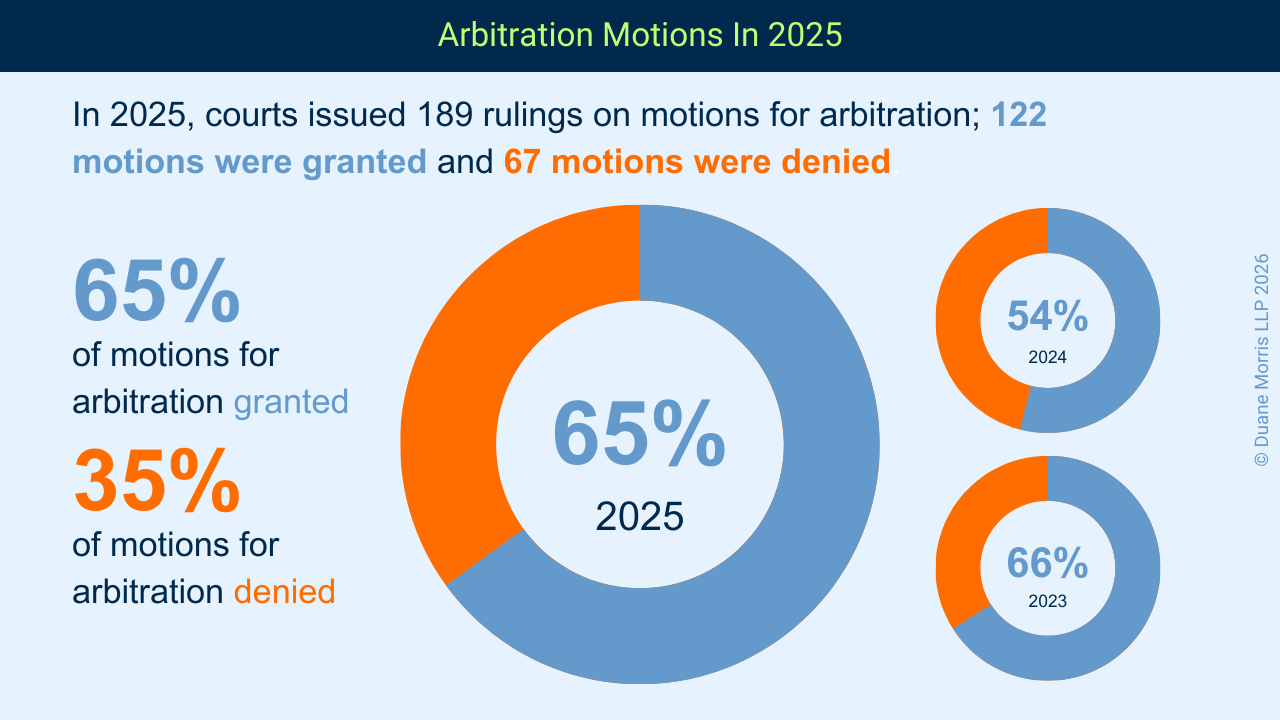
Their success rate in 2025 was not wholly out of line with their success rates over the past two years. In 2024, courts issued rulings on 167 motions to compel arbitration, and defendants prevailed in 91 of those rulings, a success rate of approximately 54%. In 2023, courts issued rulings on 187 motions to compel arbitration, and defendants prevailed on 123 motions, which translated into a success rate of 66%.
Given the potency of the arbitration defense, the plaintiffs’ class action bar has continued to press potential exceptions to its coverage. One of the most litigated is the transportation worker exemption to the FAA. Over the past year, plaintiffs made significant strides in terms of expanding that exemption as courts issued a mixed bag of rulings. Many lower federal courts continued to apply the transportation worker exemption in a broad manner to workers who handled goods that moved in interstate commerce, irrespective of whether the workers played a direct and necessary role in transporting the goods across borders, leading to divergent outcomes for last-mile delivery drivers, warehouse workers, and local distributors.
Section 1 of the FAA exempts from arbitration “contracts of employment of seamen, railroad employees, or any other class of workers engaged in foreign or interstate commerce.” The third category for workers “engaged in commerce” commonly is called the “transportation worker” exemption. Although the U.S. Supreme Court has instructed lower courts to interpret the exemption “narrowly,” its parameters have proved a slippery slope for lower courts.
In Southwest Airlines Co. v. Saxon, et al., 142 S.Ct. 1783 (2022), the U.S. Supreme Court considered application of the transportation worker exemption to an airport ramp supervisor. Considering the language of the exemption, the U.S. Supreme Court reasoned that the exemption turns on the actual work that the “class of workers” to which the plaintiff belongs “typically carr[ies] out.” Id. at 1792. The parties did not contest that the plaintiff, a ramp supervisor, frequently loaded and unloaded cargo. The U.S. Supreme Court held that, to be “engaged in foreign or interstate commerce,” the class of workers must “at least play a direct and necessary role in the free flow of goods across borders” or, put another way, must “be actively engaged in transportation of those goods across borders via the channels of foreign or interstate commerce.” It concluded that cargo loaders exhibited this central feature, reasoning that “there could be no doubt that [interstate] transportation [is] still in progress” when they do the work of loading or unloading cargo. Id. at 1793-94.
This ruling set off a barrage of disparate decisions as courts struggled to find a workable line. As a result, in April 2024, the U.S. Supreme Court took up Bissonnette, et al. v. LePage Bakeries Park Street, LLC, 601 U.S. 246 (2024). As in Saxon, the U.S. Supreme Court emphasized that the test for application of the transportation worker exemption focuses on the work performed and not the employer’s industry. Addressing the employer’s argument that its test would fold virtually all workers who load or unload goods, such as pet shop employees and grocery store clerks, into the exemption, the U.S. Supreme Court stated that the exemption has “never” been interpreted to apply in “such limitless terms.” Id. at 256. It held that, for the exemption to apply, the worker “must at least play a direct and necessary role in the free flow of goods across borders.” Id.
The Bissonnette decision, however, appears to have had a smaller impact on the lower courts, which continued to issue opinions before and after Bissonette that broadly construe the transportation worker exemption. In 2025, rulings by lower courts diverged substantially, particularly with respect to workers who move goods, which have crossed or ultimately will cross state borders, within a facility or local area.
The court in Wolford, et al. v. United Coal Co. LLC, 2025 U.S. Dist. LEXIS 15681 (W.D. Va. Jan. 28, 2025), for example, rejected plaintiffs’ attempts to apply the exception to mine workers like electricians and machine operators who did not directly transport coal across state lines. The plaintiffs argued that their work was closely related to the interstate transportation of coal via a beltline, which crossed state lines into Virginia, because they interacted with the beltline. The court found that the plaintiffs’ work did not qualify them as transportation workers under the FAA. Although coal crossed state lines, the court opined that the plaintiffs were primarily involved in tasks performed within the mine in Kentucky and their work was too far removed from the interstate transportation of coal to be considered transportation work.
Similarly, the court in Rubio-Leon, et al. v. Fresh Harvest, Inc., 2025 U.S. Dist. LEXIS 181816 (N.D. Cal. Sept. 16, 2025), ruled that the plaintiffs, a group of seasonal farm workers who hauled and trucked agricultural products, failed to show they qualified for the exemption. The plaintiffs demonstrated that they moved products from fields to a cooling facility at the farm’s processing plant but did not produce evidence as to what then happened with the products. The plaintiffs pointed to statements on the defendant farms’ websites indicating the farms’ products were distributed nationally, but the court found such statements insufficient to show how, when, and where the products moved through the supply chain or how the plaintiffs played a meaningful role in that movement. The court therefore concluded that the FAA applied and compelled individual arbitration.
By contrast, numerous courts reached opposite conclusions. For example, the court in Mitchell, et al. v. Lineage Logistics Services, LLC, 2025 US Dist. LEXIS 35792 (E.D. Cal. Feb. 27, 2025), applied the transportation worker exemption to plaintiff, a warehouse worker, who organized boxes of goods and therefore denied the employer’s motion to compel arbitration. Although the court found the plaintiff to be part of a class of workers that organizes boxes in preparation for storage or shipment, it concluded that such work was tied to the movement of goods in interstate commerce and thus applied the exemption. The court explained that “preparing boxes for egress from the facility or organizing them for storage before they are ready to be shipped is necessary to the subsequent transit of those goods out of the facility. In other words, those goods cannot be transported without the workers like Plaintiff.” Id. at *15.
In Joyner, et al. v. Frontier Airlines, Inc., 2025 U.S. Dist. LEXIS 101068 (D. Colo. May 19, 2025), the court applied the exemption to three customer service agents who worked for an airline. Two of the plaintiffs worked at ticket counters and the third plaintiff worked at the boarding gates. The defendant argued that the plaintiffs were not supposed to touch customer baggage but were instead required to supervise passengers as they tagged and loaded their own bags onto conveyer belts. The plaintiffs argued that they often weighed bags, tagged bags, and loaded them onto conveyer belts or, if the conveyer belts malfunctioned, loaded baggage on to carts. As such, the court found that the plaintiffs belonged to a class of workers who lift, weigh, inspect, and tag baggage and move it to conveyer belts or carts during a route to a destination on a plane. The court concluded that the plaintiffs played a direct and necessary role in ensuring that passengers’ baggage moves through the airport for loading on to planes and that this sufficed to establish the plaintiffs’ status as transportation workers.
Finally, in Silva, et al. v. Schmidt Baking Distribution, LLC, No. 24-2103-CV (2nd Cir. Dec. 22, 2025), the Second Circuit applied the exemption to commercial truck drivers who created their own corporations and executed arbitration agreements in their capacities as presidents of their own companies. The drivers filed a putative class action alleged violation of wage & hour laws and, after the district court granted the defendant’s motion to compel arbitration, the appellate court reversed. The appellate court noted that, before and after they formed their own corporations, their daily responsibilities involved driving commercial trucks to the defendant’s warehouse to pick up baked goods, delivering the product to retail outlets within their assigned territories, unloading the goods, and stocking the goods on retail shelves. The Second Circuit held that truck-driving work directly impacts the free flow of goods and, therefore, concluded that the drivers qualified as transportation workers without any examination of whether their routes or the goods crossed borders. It also credited the workers’ allegations that they were faced with a Hobson’s choice of adopting a corporate form or losing their jobs and, therefore, declined to allow such form to circumvent the transportation worker exemption.
These and other decisions reflect continued inconsistent application of the transportation worker exemption. In 2025, this led the U.S. Supreme Court to grant a writ of certiorari in Flower Foods, Inc. v. Brock, No. 24-945, 2025 U.S. LEXIS 3947 (U.S. Oct. 20, 2025). That case involves a plaintiff who worked as a local distributor of baked goods. He placed orders for products, most of which were produced by Flowers bakeries outside the state, picked up the products at a local warehouse, loaded them onto his own vehicle, and delivered them to his customers within the same state. The district court denied Flowers’ motion to compel arbitration based on the transportation worker exemption, and the Tenth Circuit affirmed that decision. The U.S. Supreme Court granted a writ of certiorari and is set to answer the question of whether workers who locally deliver goods, which traveled in interstate commerce, are transportation workers for purposes of the FAA exemption.
Thus, the Supreme Court is set to add some clarity to the scope of the transportation worker exemption in 2026, and its ruling could have a profound impact on class actions. Because nearly all products travel across state lines, the ruling effectively could exempt most workers from the FAA, weakening the force of arbitration agreements, or it could significantly curtail the broad reading the lower courts have given Saxon. Either way, given the enduring impact of the arbitration defense in class action litigation, the plaintiffs’ class action bar is apt to continue to attempt to develop creative work arounds to arbitration agreements and to continue to push the boundaries of the transportation worker exemption.
Duane Morris Takeaway: Continued settlements in the privacy space have inspired more members of the plaintiffs’ bar to make privacy litigation the centerpiece of their business models. Although the landscape has shifted over the past five years, the recipe has remained similar — combine archaic statutory schemes, which provide for lucrative statutory penalties, with a ubiquitous technology, to yield the threat of a potential business-crushing class action that can be made via widespread use of form letters and cookie-cutter complaints, to generate payouts on a massive scale.
Watch Class Action Review co-editor Jennifer Riley explain this trend in the following video:
Privacy continued to dominate as one of the hottest areas of growth in terms of class action filings by the plaintiffs’ bar in 2025.
As noted, the landscape has shifted over the past five years. In 2023, many plaintiffs’ attorneys targeted session replay technology, which captures and reconstructs a user’s interaction with a website, or website chatbots, which are programs that simulate conversation through voice or text, or biometric technologies, which capture traits like fingerprints or facial scans for purposes of identification.
Over the past two years, the focus for many plaintiffs’ class action lawyers has shifted to website pixels – pieces of code embedded on websites to track activity and, in some circumstances, to provide information about that activity to third-party social media and analytics providers. Plaintiffs have launched thousands of claims via form letters, cookie-cutter complaints, and mass arbitration campaigns.
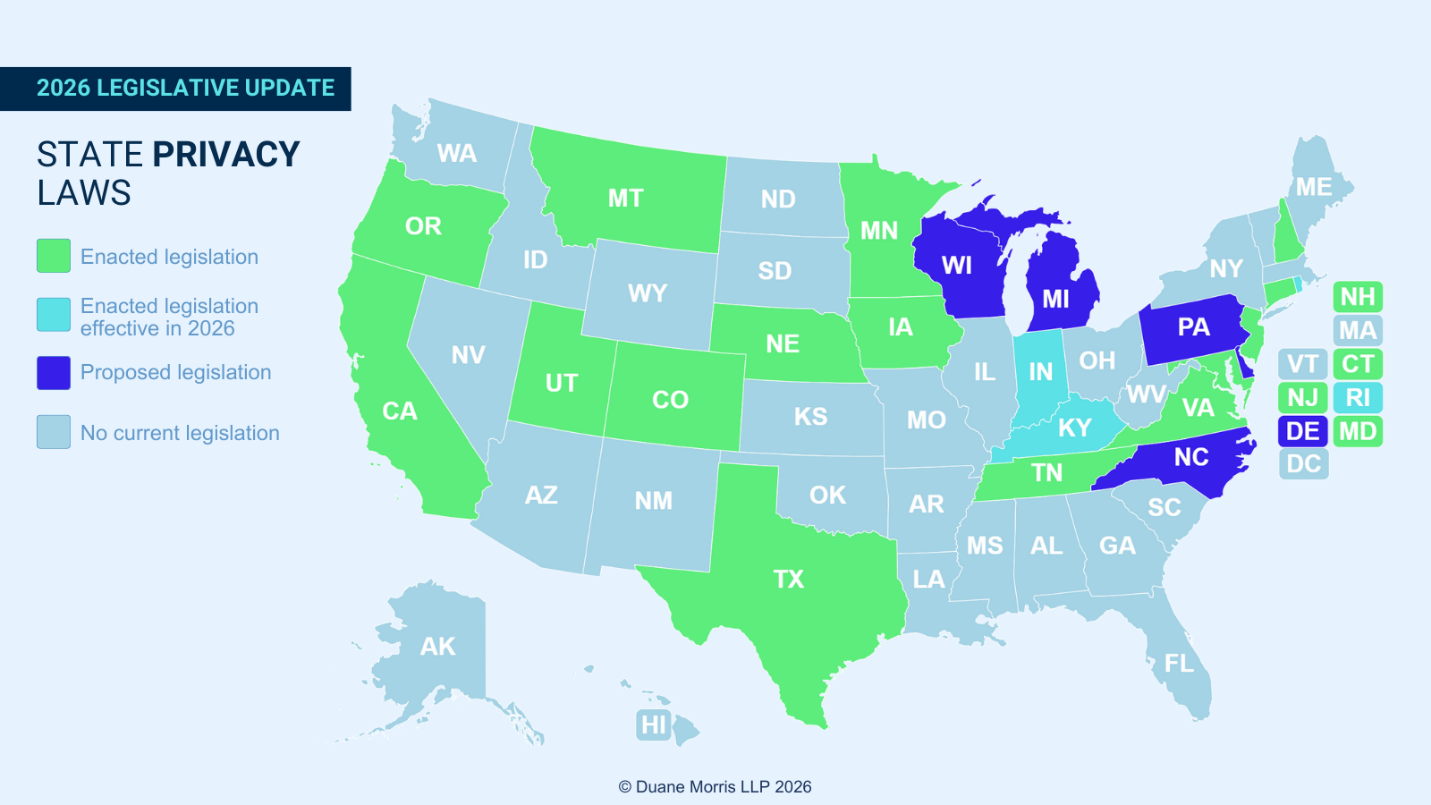
In 2025, while plaintiffs pulled back on filings in areas like biometric privacy, we saw a surge in litigation over internet tracking technologies based on a patchwork quilt of state-level laws, including the California Invasion of Privacy Act (“CIPA”).
Illinois Biometric Information Privacy Act (“BIPA”) Claims
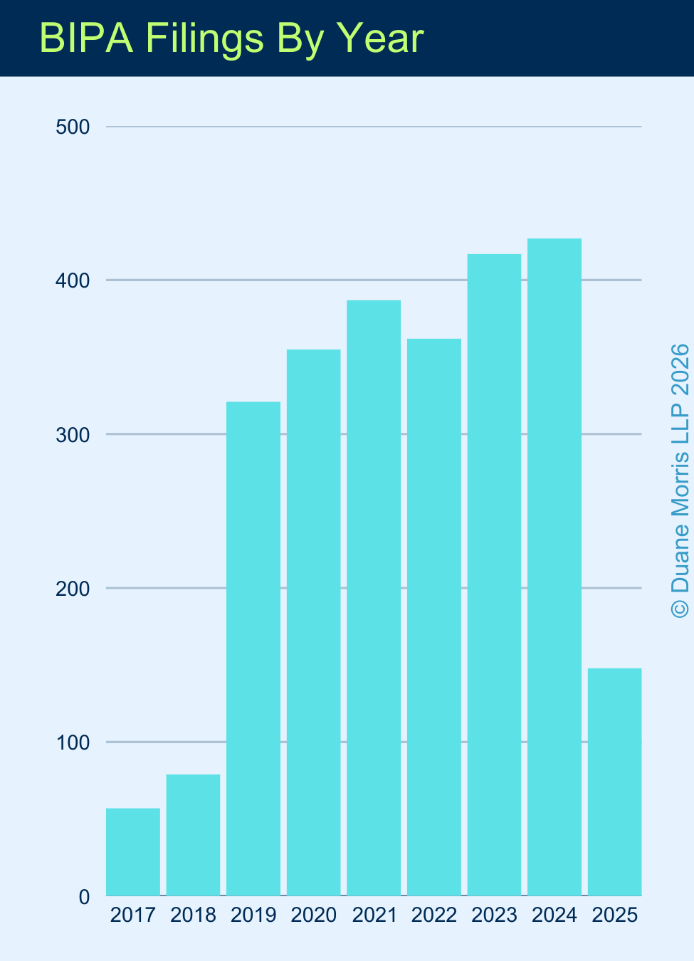
Following steep year-over-year growth between 2017 through 2024, companies that operate in Illinois finally saw a reprieve from the growth in BIPA litigation in 2025. The BIPA was once one of the most popular privacy laws in the United States. On August 2, 2024, however, the Illinois Governor signed a long-awaited amendment to the BIPA that eliminated “per-scan” statutory damages in favor of a “per-person” model. Over the past year, the impact of this amendment became apparent as the plaintiffs’ class action bar shifted its attention away from the BIPA and toward potentially more lucrative statutory schemes.
Enacted in 2008, the BIPA regulates the collection, use, and handling of biometric information and biometric identifiers by private entities. Subject to certain exceptions, the BIPA prohibits collection or use of an individual’s biometric information and biometric identifiers without notice, written consent, and a publicly available retention and destruction schedule.
For nearly a decade following enactment of the BIPA, activity under the statute remained largely dormant. The plaintiffs’ bar filed approximately two total lawsuits per year from 2008 through 2016 before filings increased in 2017 and then skyrocketed in 2019. In 2020, plaintiffs filed more than six times as many class action lawsuits for alleged violations of the BIPA than they filed in 2017 and more than the number of class action lawsuits they filed from 2008 through 2016 combined.
Filings continued to accelerate in 2023, prompted by two rulings from the Illinois Supreme Court that increased the opportunity for recovery of damages under the BIPA. On February 2, 2023, the Illinois Supreme Court held that a five-year statute of limitations applies to claims under the BIPA, and, on February 17, 2023, the Illinois Supreme Court held that a claim accrues under the BIPA each time a company collects or discloses biometric information. SeeTims v. Black Horse Carriers, 2023 IL 127801 (Feb. 2, 2023); Cothron v. White Castle System, Inc., 2023 IL 1280004 (Feb. 17, 2023). BIPA-related filings jumped markedly in the months following these rulings.
In 2024, the Illinois General Assembly abrogated Cothron. On August 2, 2024, the Illinois Governor signed SB 2979 into law, which amended the BIPA and clarified that plaintiffs are limited to one recovery per person under §§ 15(b) and 15(d). In other words, a private entity that, in more than one instance, collects, captures, or otherwise obtains the same biometric identifier or biometric information from the same person using the same method of collection “has committed a single violation” for which an aggrieved person is entitled, at most, to one recovery. See 740 ILCS 14/20 (b), (c).
In a welcome relief for defendants, within a year after the BIPA’s new “per person” damages regime took effect, we saw a substantial drop in filings. Whereas their rate of growth slowed in 2024, BIPA-related filings remained robust in 2024 in comparison with prior years. In 2025, however, filings declined by a substantial margin. Plaintiffs filed only 150 lawsuits invoking the BIPA in 2025, compared with 427 lawsuits in 2024, 417 in 2023, and 362 in 2022.
The graphic shows the number of BIPA-related filings over the past eight years, including the year over year growth, followed by the substantial drop off in 2025. The rapid drop in BIPA-related filings suggests that damages available under other, perhaps more widely applicable and/or more generous per-violation statutes proved a more attractive lure to the plaintiffs’ class action bar in 2025.
Although website activity tracking tools are nothing new, and appear on most websites, this past year they continued to fuel a growing wave of lawsuits alleging that such tools caused companies in various industries to share users’ private information. In 2025, plaintiffs filed thousands of class action complaints – and served many more demand letters – alleging that companies had software code embedded in their websites that secretly captured plaintiffs’ data and shared it with Meta, Google, or other online advertising agencies.
Advertising technology, often called “adtech,” broadly describes the software and tools that advertisers use to reach audiences and to measure digital advertising campaigns. Adtech enables advertisers to track customers’ online behaviors so that they can shape advertising content. Advertisers rely on adtech to inform decisions on who to target, how to present information, and how to track success.
Plaintiffs have asserted claims attacking adtech based on one or more of a wide variety of statutes and legal theories, such as the Video Privacy Protection Act (“VPPA”), the Electronic Communications Privacy Act (“ECPA”), as well as state specific statutes such as the California Invasion of Privacy Act (“CIPA”). Many of the statutes that plaintiffs seek to invoke predate the technology by multiple decades, forcing courts to attempt to apply them to technologies that the drafters never contemplated, leading to a patchwork quilt of divergent outcomes.
Plaintiffs typically seek to invoke a statute that provides for statutory damages, asserting that hundreds of thousands of website visitors, times $10,000 per claimant in statutory damages under the Federal Wiretap Act, for example, or that hundreds of thousands of website visitors, times $5,000 per violation in statutory damages under the CIPA, equals billions of dollars in supposed damages.
Certain members of the plaintiffs’ class action bar have constructed business models designed to efficiently leverage such allegations. After identifying any of millions of websites with adtech, they generate form or templated demand letters asserting violations of the CIPA or other statutes based on the use of tracking technologies provided by companies such as TikTok, LinkedIn, X, or others. They slow-play any formal filing, with the goal of leveraging a quick settlement and avoiding investment of fees and costs.
This repeatable formula is fueled by settlement dollars and dependent on continued disagreement among courts on basic attributes of these claims. This past year plaintiffs asserted such claims under various statutes and common law theories. While claims under the VPPA encountered roadblocks, court rulings in other areas showed more promise, driving claims toward statutes like CIPA.
The VPPA
In cases where websites allegedly transmit video viewing information, plaintiffs often assert claims for alleged violations of the federal VPPA. The statute prohibits a “video tape service provider” from knowingly disclosing “personally identifiable information concerning any consumer of such provider.” 18 U.S.C. § 2710(b)(1).
The statute defines a “video tape service provider” to include any person “engaged in business, or affecting interstate or foreign commerce, of rental, sale, or delivery of prerecorded video cassette tapes or similar audio-visual materials.” 18 U.S.C. § 2710(a)(4). The VPPA provides for damages up to $2,500 per violation in addition to costs and attorneys’ fees for successful litigants, making it an attractive source of filings for the plaintiffs’ class action bar.
Reflecting its comparatively narrower scope, Plaintiffs filed fewer VPPA class actions in 2025, compared to 116 VPPA class actions in 2024, and 137 in 2023, fueled in large part by adtech claims.
In 2025, many defendants succeeded in dismissing VPPA claims at the outset, particularly in the Second Circuit, which surely depressed filings in this area. Solomon v. Flipps Media, Inc., 2025 U.S. App. LEXIS 10573 (2d Cir. May 1, 2025), is a prime example. In that case, the Second Circuit applied a narrow reading of the VPPA, holding that the statute protects against only those disclosures that an ordinary person could use to identify a consumer’s video-viewing history. The plaintiff, a subscriber to Flipps Media’s streaming platform, alleged that each time she watched a video on the platform, Flipps transmitted to Facebook, via the Facebook Pixel, an encoded URL identifying the video and her unique Facebook ID (FID) in violation of the VPPA. The district court dismissed the complaint reasoning that, although Flipps transmitted data to Facebook, the plaintiff had not shown that her Facebook ID, even when paired with a video URL, would enable an ordinary person to identify her or her video-viewing behavior. On appeal, the Second Circuit affirmed. The Second Circuit emphasized that Congress intended to prevent disclosures that an average person, “with little or no extra effort,” could use to link an individual to specific video content. Id. at *27. The data Flipps transmitted was embedded in a mass of technical code and unreadable to a layperson.
Whereas such rulings had a muting effect on filings, courts in other jurisdictions applied different standards, signaling some continued daylight for the VPPA to fuel claims. In Manza, et al. v. Pesi, Inc., 784 F. Supp. 3d 1110 (W.D. Wis. 2025), for instance, the plaintiff purchased videos from Pesi, Inc. and she brought a putative class action alleging that Pesi disclosed her purchasing history and unique identifiers (e.g., Facebook ID, Google/Pinterest client or user IDs, hashed emails, IP addresses) to third-party ad platforms and data brokers via tracking technologies (Meta Pixel, Google Analytics/Tag Manager, Pinterest Tag) without her consent in violation of the VPPA. Pesi moved to dismiss arguing that: (i) it is not a “videotape service provider” under the VPPA (citing its nonprofit status); (ii) the data disclosed is not “personally identifiable information” within the meaning of the statute; and (iii) Manza’s factual allegations were insufficient to satisfy federal pleading standards. Id. at *2-3. The court denied the motion. It held that, at the pleading stage, it was reasonable to infer that Pesi is a “videotape service provider” because it regularly sold videos on its website. Id. at *5. The court held that unique identifiers tied to a specific account (e.g., Facebook ID, client/user IDs) qualify as personally identifiable information under the VPPA when paired with video titles the customer obtained from the defendant. Finally, the court rejected the “ordinary person” test (and decisions adopting it), reasoning that the VPPA’s text and purpose support a broader reading that covers identifiers capable of being used to trace a customer’s video purchases.
The CIPA
Companies that operate websites frequented by California consumers have received a wave of demand letters threatening claims under the CIPA, many of which have matured into lawsuits and arbitration proceedings. The CIPA presents an attractive option for plaintiffs because it offers statutory damages of $5,000 per violation, making it one of the most, if not the most, generous damages schemes provided by any privacy law.
California passed the CIPA, a criminal statute, in 1967 to prevent unlawful wiretapping to eavesdrop on telephone calls. Among other things, the CIPA prohibits use of pen registers and “trap and trace” devices without either a court order or explicit consent. The CIPA defines a pen register as “a device or process that records or decodes dialing, routing, addressing, or signaling information” for outgoing communications, and it defines a trap-and-trace device as a surveillance tool that captures similar information for incoming communications.
Plaintiffs frequently allege that website tracking technologies, such as cookies and pixels, run afoul of the CIPA because they permit companies to acquire identifying information about website visitors, such as their phone numbers and email addresses and other personal information. In the past few years, plaintiffs have filed hundreds if not thousands of cases attacking various types of widely used website technologies. While plaintiffs have filed many lawsuits alleging violations of the CIPA, they have sent many more demand letters that resulted in arbitration or pre-lawsuit settlements.
Inconsistency in the case law continues to fuel these claims. Taking a recent example, in Camplisson, et al. v. Adidas, Case No. 25-CV-603 (S.D. Cal. Nov. 18, 2025), the plaintiff, a website visitor, claimed that the sportswear company used pixels on its website that collected private information from visiting consumers.
The court denied the motion to dismiss. The court held that the plaintiff sufficiently alleged that the trackers on Adidas’ website collected a “broad set” of personal identifying and addressing information and thus alleged a concrete harm in the loss of control of their own information. The court also held that the plaintiff sufficiently alleged that such web-based trackers plausibly qualify as pen registers and that users did not effectively consent because the website did not make its terms conspicuous and did not provide a mechanism for affirmative assent.
The ruling runs counter to other decisions and thus contributes to the patchwork quilt of rulings in this area. For instance, among other thing, the court distinguished the Ninth Circuit’s ruling in Popa, et al. v. Microsoft Corp., 153 F.4th 784, 786, 791 (9th Cir. 2025), from earlier this year.
It explained that Popa addressed a claim concerning the defendant’s use of session-replay technology, which collected information on what products the plaintiff browsed and where her mouse hovered while on the website, and thus concerned how the plaintiff interacted with the website rather than her personal, private information.
The ruling also failed to account for Price, et al. v. Converse, Case No. 24-CV-08091 (C.D. Cal. Sept. 30, 2025), where another district court considered similar allegations and reached a different conclusion. The plaintiff alleged that the TikTok pixel engages in “device fingerprinting” to collect data about visitors to the Converse website including browser information, geographic information, and referral tracking information. The court found the plaintiff’s allegations insufficient to establish a “concrete injury” as required for standing because the plaintiff failed to plead any kind of harm that is remotely like the ‘highly offensive’ interferences or disclosures that were actionable at common law.
On June 3, 2025, the California Senate unanimously passed Senate Bill 690 (SB 690), which would have amended the CIPA on a prospective basis by providing a “commercial business purpose” exception. The bill defined “commercial business purpose” as the processing of personal information either to further a business purpose, as defined in the CCPA, or when the collection of personal information is subject to a consumer’s opt-out rights under the CCPA.
The California Assembly, however, later placed SB 690 on hold, classifying it as a two-year bill, meaning that its earliest reconsideration would occur in 2026, if at all, and its future is uncertain.
Thus, without a legislative response, the continued variation among courts in their approaches to these claims is likely to continue to fuel uncertainty and, as a result, both claims and settlements in this area. An expansive discussion of the vast and growing patchwork quilt of differing approaches to adtech claims appears in Chapter 14 regarding Privacy Class Actions.
Duane Morris Takeaway: The gargantuan settlement numbers and high rates of certification have continued to fuel growth in class action filings by the plaintiffs’ class action bar. In 2025, large settlements continued to attract skilled attorneys to the plaintiffs’ side and continued to incentivize plaintiffs’ attorneys to file more and more lawsuits on a class basis.
Watch the video below to see Class Action Review Editor Jerry Maatman discuss this trend:
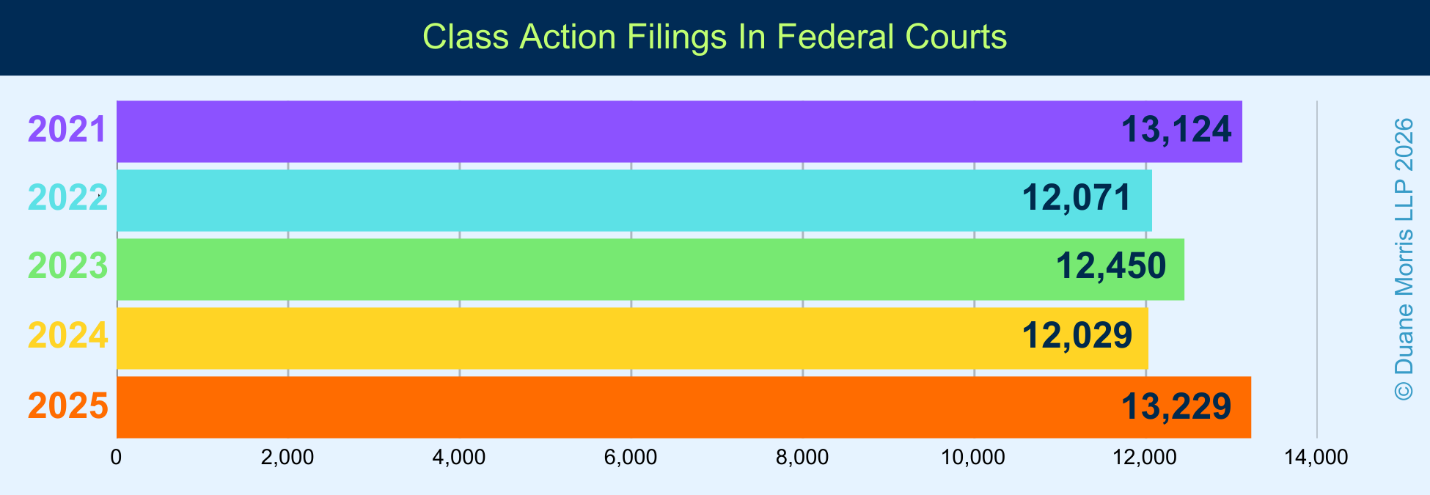
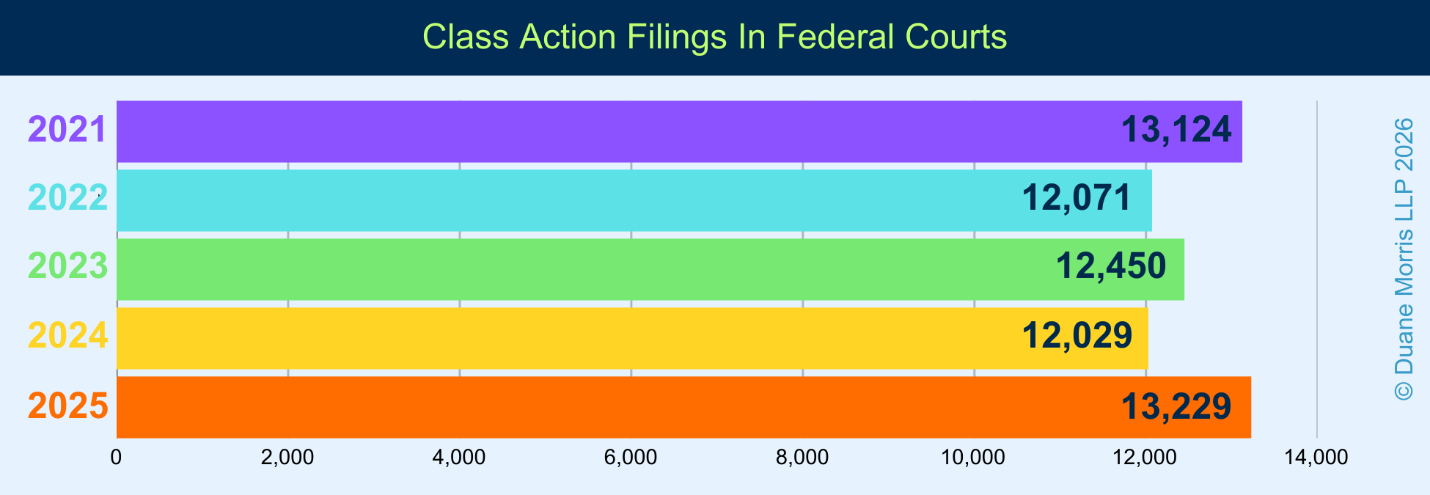
In 2025, the number of class action lawsuits filed in federal courts across the country exceeded 13,229, which equates to more than 52 class actions filed per day on each of the 250 court days in 2025.
That number represents an increase from 2024 and reflects a growth trend relative to the number of class action filed over the past four years.
Indeed, the number of class action lawsuits filed in 2022 in federal courts totaled 12,071, the number of class actions filed in 2023 totaled 12,450, and the number of class actions filed in federal courts in 2024 totaled 12,029.
The number filed in 2025 represents a 9% increase over the number of class actions filed in federal court in 2022 and 2024.
Class action filings over the same period likewise shifted toward perceived plaintiff-friendly jurisdictions.
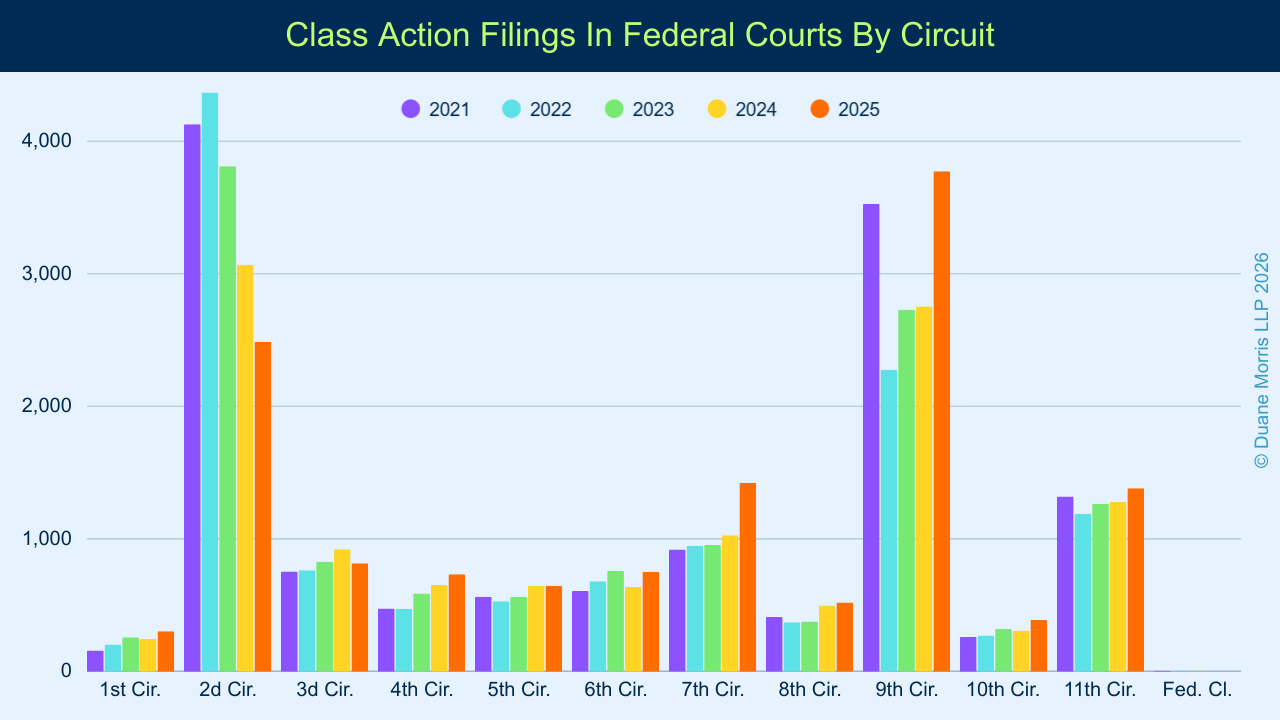
From 2022 to 2025, class action filings in federal courts across the country grew unevenly across the federal circuits, as reflected in the following graph.
In terms of the most growth, from 2022 to 2025, class action filings grew by more than 50% in four federal Circuits – the First, Fourth, Seventh, and Ninth. In the First Circuit, in 2022, plaintiffs filed 202 class actions and, in 2025, filed more than 303 class actions, an increase of 50%.
In the Fourth Circuit, in 2022, plaintiffs filed 471 class actions, and, in 2025, plaintiffs filed more than 732 class actions, an increase of 55%. In the Seventh Circuit, in 2022, plaintiffs filed 948 class actions, and, in 2025, they filed 1,423 class actions, an increase of 50%.
In the Ninth Circuit, in 2022, plaintiffs filed 2,276 class actions and, in 2025, plaintiffs filed 3,791 class actions, an increase of 67%.
In 2025, those four Circuits likewise had higher percentages of judicial seats appointed by Democratic presidents than Republican presidents. In the First Circuit, there were 29 district court seats within the First Circuit in 2025, and six or 23% were held by judges nominated by Republican presidents, and 20 or 77% were held by judges nominated by Democratic presidents, with three vacancies.
In the Fourth Circuit, there were 56 district court seats in 2025, and 22 or 43% were held by judges nominated by Republican presidents, and 29 or 57% were held by judges nominated by Democratic presidents, with five vacancies. Four of the five vacancies (all in North Carolina) were filled by Republican nominees on December 2, 3, and 4, 2025.
In the Seventh Circuit, there were 48 district court seats in 2025, and 17 or 36% were held by judges nominated by Republican presidents, and 30 or 64% were held by judges nominated by Democratic presidents, with one vacancy.
In the Ninth Circuit, there were 110 district court seats in 2025, and 21 or 20% were held by judges nominated by Republican presidents, and 86 or 80% were held by judges nominated by Democratic presidents, with three vacancies.
The appellate courts in those three of those four federal Circuits reflected similar imbalances. In 2025, there were six appellate court seats on the First Circuit, and one or 17% was held by a Republican-nominated judge, and five or 83% were held by Democratic-nominated judges.
In 2025, there were 15 appellate court seats on the Fourth Circuit, and 6 or 40% were held by Republican nominees, and 9 or 60% were held by Democratic nominees. In 2025, there were 29 appellate court seats on the Ninth Circuit, and 13 or 45% were held by Republican-nominated judges, and 16 or 55% were held by Democratic-nominated judges.
With respect to the Seventh Circuit, while the number of Democratic nominees does not yet exceed the number of Republican nominees, the proportion has shifted over the past four years. In 2021, eight of the 10 judges were nominated by Republican presidents and two by Democratic presidents with one vacancy. By 2025, only six of the 10 judges were nominated by Republican presidents, and five of the 10 judges were Democratic nominees.
Myriad factors are contributing to the increase in class action filings. No one factor is the key driver; instead, the legal landscape manifests various causes that contribute to the surge of lawsuits.
These factors include: (i) changes in laws and regulations that make it easier to bring suits, or adoption of new statutes affording expanded causes of action; (ii) evolving judicial interpretations of Rule 23 that facilitate class certification; (iii) increased awareness of rights and corporate accountability by workers, consumers, and the public; (iii) social inflation pressures that fuel great jury awards and higher settlements; (iv) outside investors financing lawsuits; (v) more complex business operations and data-drive technologies, including artificial intelligence; and (vi) activist organizations and government enforcement litigators pushing the boundaries of causes or action and recoveries for alleged corporate wrongdoing.
Implications: In sum, class action filings in 2025 grew to new heights. The highest growth rates occurred in federal Circuits with high percentages of Democratic-appointed district court judges, suggesting that plaintiffs are filing more class actions in jurisdictions where they anticipate more favorable case law precedent and a higher chance of a more plaintiff-friendly judicial assignments.
Duane Morris Takeaway: Although courts issued a similar number of decisions on motions for class certification in 2025 as compared to 2024, the plaintiffs’ class action bar obtained certification at a higher rate overall across all substantive areas, suggesting that plaintiffs are being more selective in their investments and the cases they pursue through class certification.
Watch Duane Morris partner Jennifer Riley discuss the certification rates in 2025 and what it means for 2026 in the video below:
Courts issued a similar number of decisions on motions for class certification in 2025, as compared to 2024, but the plaintiffs’ class action bar obtained certification at a higher rate overall.
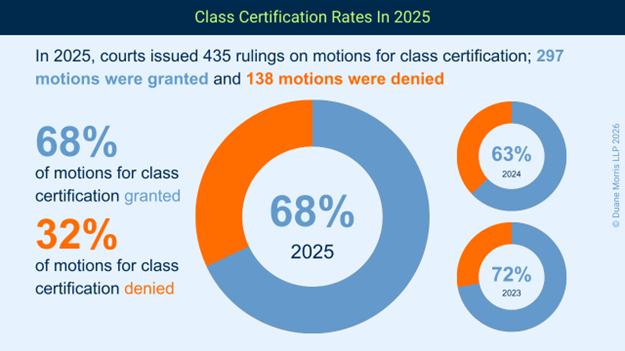
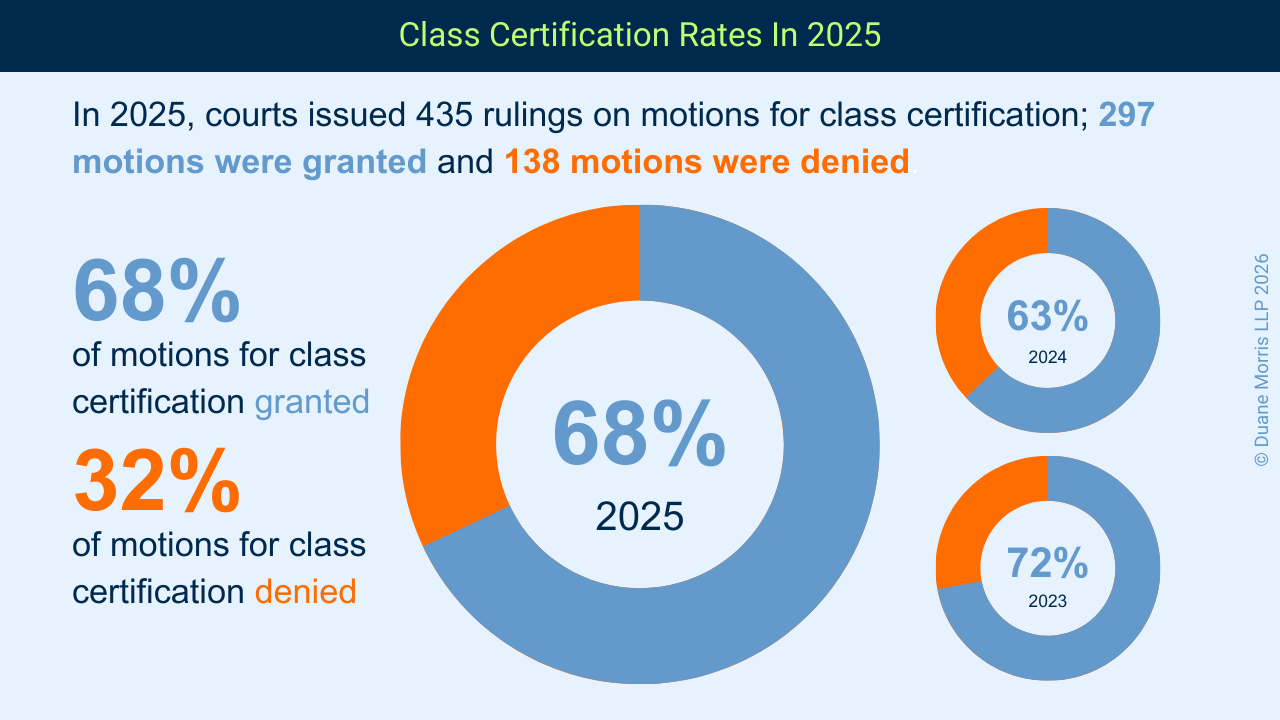
Across all major areas of class action litigation in 2025, courts issued rulings on 435 motions for class certification. By comparison, in 2024, courts issued rulings on 432 motions for class certification, and, in 2023, court issued rulings on 451 motions for class certification.
In 2025, however, courts granted motions for class certification at a higher rate. Courts granted 297 motions for class certification in whole or in part, a rate of approximately 68%.
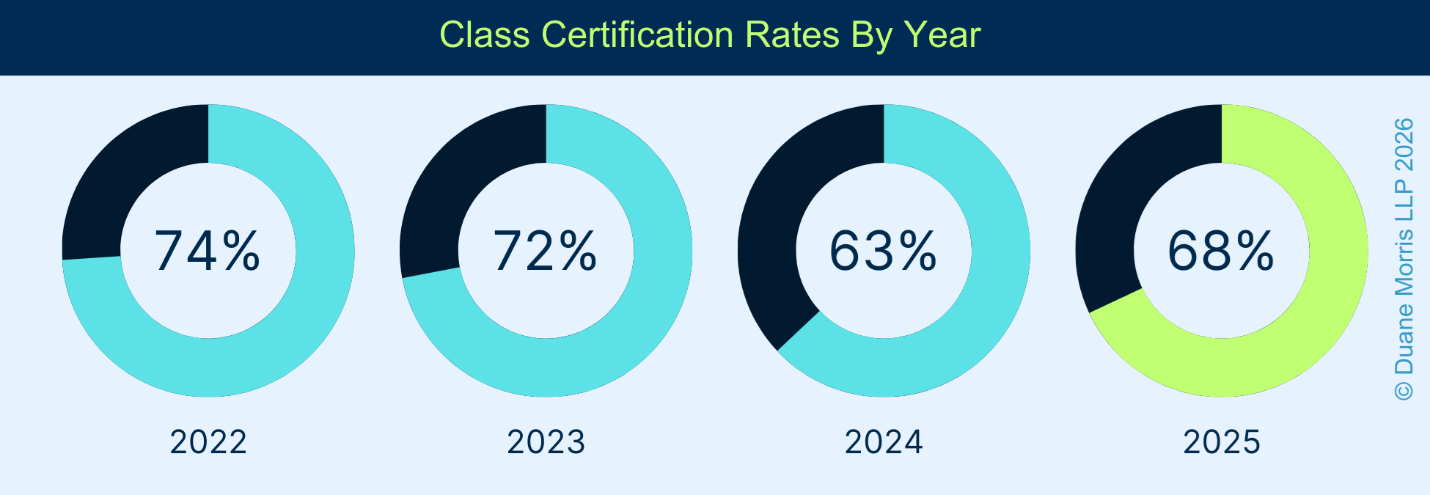
This number is higher than the percentage granted in 2024, where courts granted 272 motions for class certification, for a certification rate of approximately 63%, but on par with plaintiffs’ success rate in 2023. In 2023, courts granted 324 motions for class certification, for a certification rate of approximately 72%.
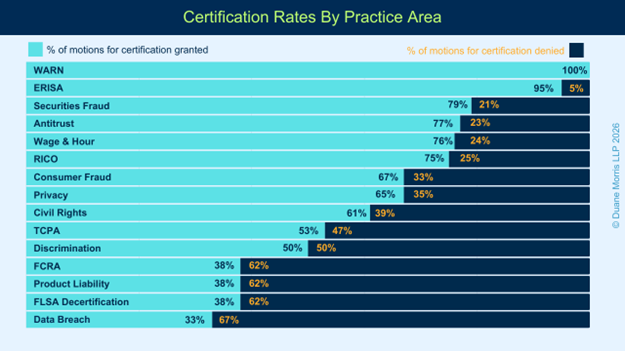
In 2025, plaintiffs also maintained more consistent certification rates across substantive areas, from a low of 33% in the data breach area, to highs above 70% in the antitrust, wage & hour, and securities fraud areas. Likewise, courts granted more than 90% of the motions for class certification that they adjudicated in 2025 in the ERISA and WARN areas.
Of these, plaintiff succeeded in obtaining or maintaining certification in 297 rulings, for an overall success rate of approximately 68%. Thus, although courts certified fewer classes in 2025, they granted certification at a higher rate as compared to 2024.
In 2024, plaintiffs succeeded in obtaining or maintaining certification in 272 rulings, an overall success rate of approximately 63%.
The success rate plaintiffs achieved in 2025 is closer to the rates of certification in 2022 and 2023. In 2023, courts issued rulings on 451 motions to grant or deny class certification, and plaintiffs succeeded in obtaining or maintaining certification in 324 rulings, with an overall success rate of 72%. In 2022, courts issued rulings on 335 motions to grant or to deny class certification, and plaintiffs succeeded in obtaining or maintaining certification in 247 rulings, an overall success rate of nearly 74%.
WARN Act Class Actions: 100% granted (5 of 5 granted / 0 of 5 denied)
ERISA Class Actions: 95% granted (18 of 19 granted / 1 of 19 denied)
Securities Fraud Class Actions: 79% granted (26 of 33 granted / 7 of 33 denied)
Antitrust Class Actions: 77% granted (17 of 22 granted / 5 of 22 denied)
Wage & Hour Class/ Collective: 76% granted (103 of 135 granted / 32 of 135 denied)
RICO Class Actions: 75% granted (6 of 8 granted / 2 of 8 denied)
Privacy Class Actions: 67% granted (8 of 12 granted / 4 of 12 denied)
Consumer Fraud Class Actions: 66% granted (34 of 51 granted / 17 of 51 denied)
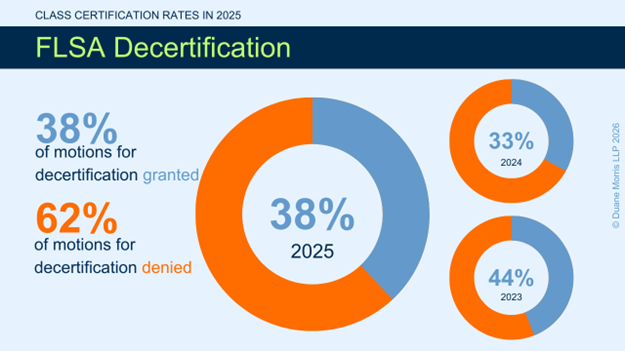
FLSA Decertification: 62% denied (8 of 13 denied / 5 of 13 granted)
Civil Rights Class Actions: 61% granted (48 of 79 granted / 30 of 79 denied)
TCPA Class Actions: 53% granted (10 of 19 granted / 9 of 19 denied)
Discrimination Class Actions: 50% granted (10 of 20 granted / 10 of 20 denied)
Products Liability Class Actions: 38% granted (3 of 8 granted / 5 of 8 denied)
FCRA Class Actions: 38% granted (3 of 8 granted / 5 of 8 denied)
Data Breach Class Actions: 33% granted (1 of 3 granted / 2 of 3 denied)
The plaintiffs’ class action bar obtained high rates of success on motions for class certification across most substantive areas in 2025. Plaintiffs obtained the highest rates of success in class actions asserting violations of the WARN Act, the ERISA, and the RICO, followed closely by wage & hour and securities fraud.
In cases where plaintiffs alleged claims for violation of the WARN Act, plaintiffs succeeded in certifying classes in all five of the rulings they obtained during 2025, a success rate of 100%. In 2024, by contrast, plaintiffs prevailed in six of seven rulings, a success rate of 85.7%.
In ERISA class actions, plaintiffs succeeded in obtaining orders granting certification in 18 of the 19 rulings issued during 2025, a success rate of 95%. In cases alleging RICO violations, plaintiffs succeeded in obtaining orders certifying classes in 6 of 8 rulings during 2025, a success rate of 75%. In 2024, by contrast, plaintiffs achieved a lower rate of success in both areas. In ERISA litigation, plaintiffs prevailed on 24 of 36 motions for class certification, for a success rate of 66.6%, and, in cases alleging RICO violations, plaintiffs prevailed on only two of six motions for class certification in 2024, a success rate of 33.3%.
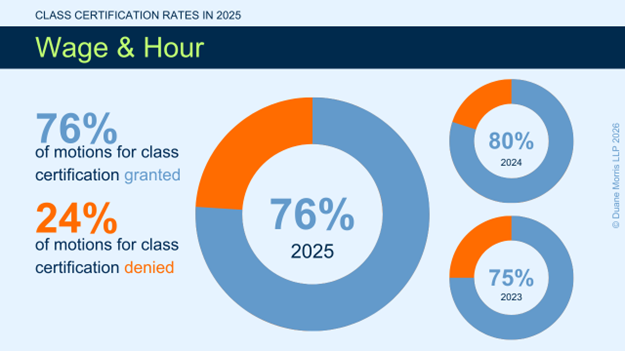
In wage & hour class and collective actions, plaintiffs succeeded in obtaining orders granting certification in 103 of the 135 rulings issued during 2025, a success rate of 76%. In securities fraud class actions, plaintiffs succeeded in certifying classes in 26 of 33 rulings issued during 2025, a success rate of 79%. These numbers are on par with plaintiffs’ rates of success in 2024. In 2024, plaintiffs succeeded on 124 of 156 motions for certification of wage & hour class and collective actions, a success rate of 79%, and on 19 of 27 motions for class certification in securities fraud matters, a success rate of 70%.
As noted above, the overall certification rate was higher in 2025, moving from 63% in 2024 to 68% in 2025, but plaintiffs also fared better across substantive areas. Plaintiff succeeded in certifying classes at a rate greater than 50% across all substantive areas except discrimination (50%), products liability (38%), FCRA (38%), and data breach (33%). By contrast, in 2024, plaintiffs fell short of that benchmark in data breach (50%), products liability (50%), privacy (45%), civil rights (40%), FCRA (38%), TCPA (38%), and RICO (33%).
Courts Issues More Rulings In FLSA Collective Actions Than In Any Other Area Of Law
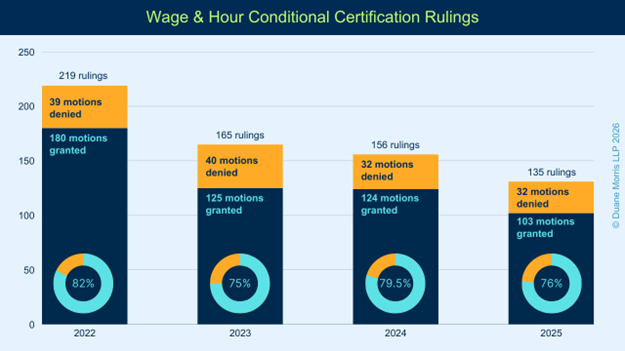
In 2025, courts condintued to issue more certification rulings in FLSA collective actions than in any other type of complex litigation area. Many courts historically have applied a two-step process in the FLSA context that allows a plaintiff to obtain an order granting “conditional” certification early in the proceeding with a modest showing. This standard allows plaintiffs to increase the size of their cases with comparatively low investment, contributing to the number of filings in this area. In 2025, courts considered more motions for certification in FLSA matters than in any other substantive area. Overall, courts issued 148 rulings. Of these, 135 addressed motions for conditional certification of collective actions, and 13 addressed motions for decertification of conditionally certified collective actions. Of the 135 conditional certification rulings, 103 granted conditional certification, for a success rate of over 76%.
While plaintiffs’ success rate has remained steady over the past few years, the number of rulings has declined.
In 2024, courts issued 171 rulings on motions for certification. Of these, 156 addressed motions for conditional certification of collective actions, and 15 addressed motions for decertification of conditionally certified collective actions. Of the 156 rulings that courts issued on motions for conditional certification, 124 rulings favored plaintiffs, for a success rate of 79.5%.
In 2023, courts issued 183 rulings on motions for certification. Of these, 165 addressed motions for conditional certification of collective actions, and 18 addressed motions for decertification of conditionally certified collective actions. Of the 167 rulings that courts issued on motions for conditional certification, 125 rulings favored plaintiffs, for a success rate of nearly 75%.
In 2022, courts issued 236 rulings on motions for certification. Of these, 219 addressed motions for conditional certification of collective actions, and 18 addressed motions for decertification of conditionally certified collective actions. Of the 219 rulings that courts issued on motions for conditional certification, 180 rulings favored plaintiffs, for a success rate of 82%.
The likely reason for this drop is the prevalence of arbitration agreements with class action and collective action waivers. Such arbitration agreements cause a depression in the numbers because: (i) some plaintiffs’ lawyers will bypass the court system altogether and proceed with claims in arbitration; or (ii) for those that file lawsuits, a significant percentage are thrown out of court based on motions to compel arbitration filed by the defendant.
The decline in the number of rulings on motions for conditional certification from 236 in 2022, to 135 in 2025, represents a decrease of 43%. This phenomenon reflects the impact of the shifting standards by which courts are adjudicating such motions.
Until 2021, courts almost universally applied a two-step process to certification of FLSA collective actions. At the first stage, courts required a plaintiff to make only a “modest factual showing” that he or she is similarly situated to others. Plaintiffs often met that burden at the outset of litigation by submitting declarations from themselves and/or a limited number of potential collective action members, and courts then authorized them to send notice of the lawsuit to potential opt-in plaintiffs. At the second stage, courts conducted a more thorough examination of the evidence to determine whether, with the benefit of discovery, a plaintiff demonstrated that he or she in fact is similarly-situated to others and the court manageably can try the case on a collective basis.
Over the past five years, however, courts have revisited the two-step process and considered whether it comports with the plain language of the FLSA. Federal appellate courts in three circuits – the Fifth Circuit, the Sixth Circuit, and the Seventh Circuit – along with various district courts – have answered that question in the negative.
In 2021, the Fifth Circuit in Swales, et al. v. KLLM Transport Services, LLC, 985 F.3d 430, 436 (5th Cir. 2021), rejected the two-step approach to evaluating motions for certification of collective actions. The Fifth Circuit held instead that district courts should “rigorously scrutinize the realm of ‘similarly-situated’ workers … at the outset of the case.”
In 2023, the Sixth Circuit in Clark v. A&L Homecare & Training Center, LLC, 68 F.4th 1003 (6th Cir. 2023), likewise jettisoned the two-step approach but expressly declined to adopt the standard approved by the Fifth Circuit. Instead, the Sixth Circuit introduced a new standard that requires the plaintiff to demonstrate a “strong likelihood” that other employees are “similarly-situated” to the plaintiff.
In 2025, the Seventh Circuit in Richards v. Eli Lilly & Co., 149 F.4th 901 (7th Cir. 2025), rejected the two-step process but declined to go as far as Clark or Swales. Instead, the Seventh Circuit required the plaintiff to demonstrate a genuine dispute as to whether proposed collective action members are similarly-situated, noting that a defendant “must be permitted to submit rebuttal evidence” for the court to consider.
Although encompassing different standards, Swales,Clark, and Richards require plaintiffs to make a more substantial showing than the first step of the two-step approach entails, thereby requiring more factual development and, as a result, more investment on the part of the plaintiffs’ bar.
As a result, filings have shifted. Plaintiffs filed fewer wage & hour lawsuits (and hence brought fewer certification motions) in the Fifth and Sixth Circuits over the past two years, as plaintiffs shifted their efforts away from pursuing collective actions in the Fifth and Sixth Circuits. As a result of Richards, plaintiffs likely will shift their efforts away from pursuing collective actions in the Seventh Circuit over the upcoming year.
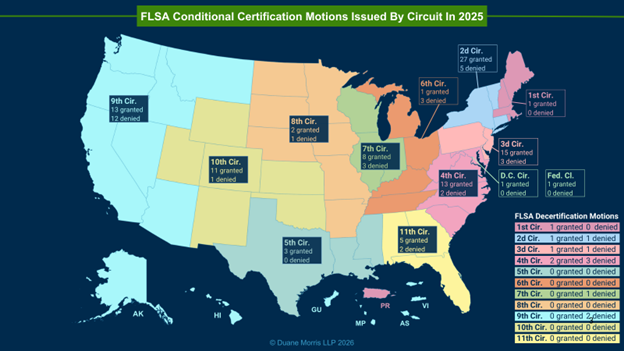
In 2025, courts in the Fifth Circuit, issued rulings on three motions for conditional certification, and plaintiffs prevailed on all of them, for a success rate of 100% and, in the Sixth Circuit, courts issued rulings on three motions for conditional certification, and plaintiffs prevailed on only one, for a success rate of 33% Similarly in 2024, courts in the Fifth Circuit issued rulings on six motions for conditional certification, and plaintiffs prevailed on five, for a success rate of 83%, and, in the Sixth Circuit, courts issued rulings on ten motions for conditional certification, and plaintiffs prevailed on eight, for a success rate of 80%.
While the results continued to be solid for plaintiffs, the investment of time and effort to secure certification has deterred plaintiffs from filing in these circuits. By way of example, in 2022, the last full year before Clark, courts in the Sixth Circuits issued 36 decisions on motions for conditional certification.
In 2023, as Clark began to take hold, courts in the Sixth Circuit issued 22 decisions on motions for conditional certification. In 2024, the first full year after Clark, courts issued rulings on ten motions for conditional certification, and, in 2025, courts in the Sixth Circuit issued rulings on only three motions for conditional certification, reflecting a 92% decline in just four years.
These numbers may continue to shift and decline as plaintiffs shift their case filings to other circuits that have retained the lenient two-step approach or, as more courts revisit the standards applicable to certification, shift their case filings to other areas.
At the decertification stage, courts generally have conducted a closer examination of the evidence and, as a result, defendants historically have enjoyed an equal if not higher rate of success on these second-stage motions as compared to plaintiffs. The results in 2025, however, were less favorable for defendants. Courts issued 13 rulings on motions for decertification. Of these, five favored defendants, for a success rate of 38%, and eight rulings favored plaintiffs, for a success rate of 62%.
In 2022, 2023, and 2024, by comparison, courts issued more rulings on motions for decertification. In 2024, courts issued 15 rulings, five of which favored defendants, for a success rate of only 33.3%, and 10 of which favored plaintiffs, for a success rate of 66.6%. In 2023, courts issued 18 rulings on motions for decertification.
Of these, eight favored defendants, for a success rate of 44.4%, and ten rulings favored plaintiffs, for a success rate of 55.6%. In 2022, courts similarly issued 18 rulings on motions for decertification. Defendants prevailed in nine, for a success rate of 50%, and plaintiffs prevailed in nine, for a success rate of 50%.
Implications: The decrease in rulings on motions for decertification likely flows from the decrease in rulings on motions for conditional certification, as well as the decrease in the number of courts applying the traditional two-step certification model. If more courts abandon the traditional two-step certification process, and thereby increase the time and expense required to gain a certification order, the number of decertification rulings likely will continue to decrease.
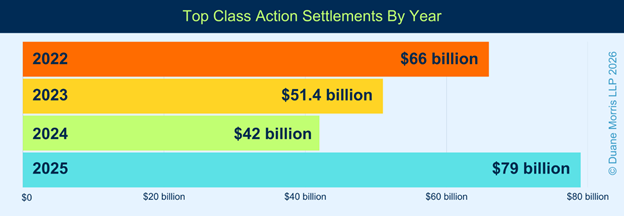
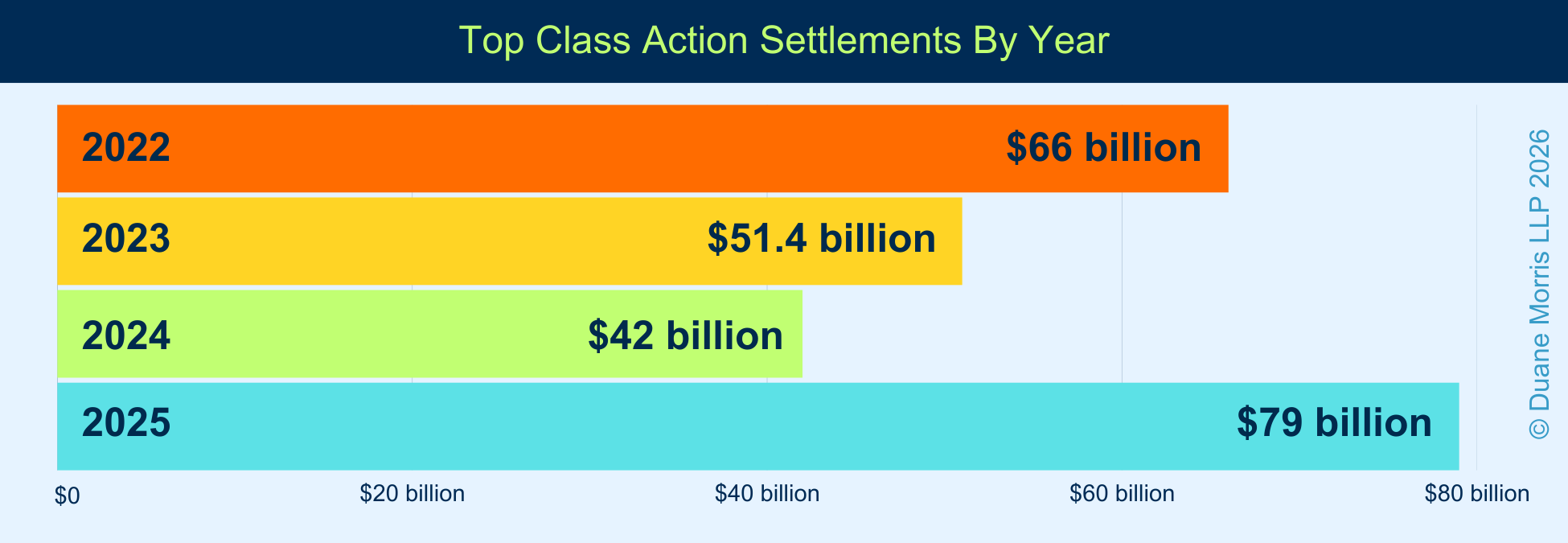
Duane Morris Takeaway:As authors and editors of our firm’s our Class Action Review, we identified ten (10) key trends in class action litigation over the past year. Trend # 1 focuses on how in 2025 settlement numbers reached an unprecedented level in class action litigation. In 2024, settlement numbers broke the $40 billion mark for the third year in a row. In 2025, the cumulative value of the highest ten settlements across all substantive areas of class action litigation surpassed that benchmark and totaled $79 billion.
In today’s video blog, Duane Morris partner Jerry Maatman discusses how the aggregate monetary value of class action settlements continued to reach incredible highs in 2025, as plaintiffs’ lawyers and government enforcement agencies monetarized their claims into enormous settlement values. In 2025, the plaintiffs’ bar was successful in converting case filings into significant settlement numbers again. Tune in below to hear all about this or read the blog post blow for more information.
In 2025 settlement numbers reached an unprecedented level in class action litigation. In 2024, settlement numbers broke the $40 billion mark for the third year in a row. In 2025, the cumulative value of the highest ten settlements across all substantive areas of class action litigation surpassed that benchmark and totaled $79 billion.
That number is the highest value tallied in the past two decades, and exceeding the settlement numbers from 2022, 2023, and 2024 by a significant margin. In 2022, these settlement numbers totaled $66 billion; in 2023, they totaled $51.4 billion; and, in 2024, these settlement numbers totaled $42 billion.
Combined, the settlement numbers of the past four years exceeded $238 billion, representing use of the class action mechanism to redistribute wealth at an unprecedented level.
On an aggregate basis, across all areas of litigation, defendants settled class actions and government enforcement lawsuits for more than $79 billion in 2025.
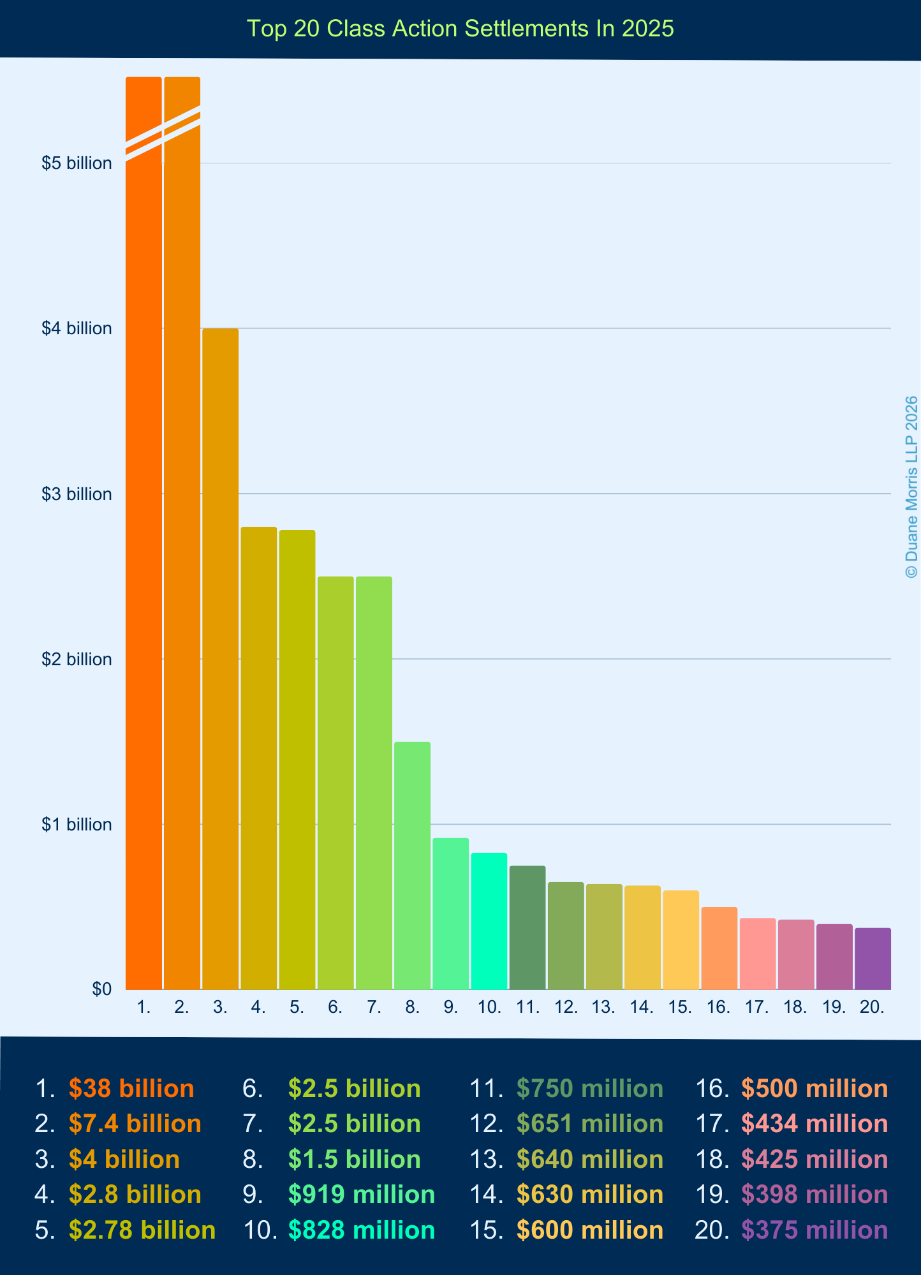
The following chart illustrates the highest 20 settlements during 2025, which collectively totaled $68.63 billion.
The highest 20 settlements during 2024 totaled $34.6 billion, which fell slightly short of the numbers seen in 2023 and 2022.
The value of the highest 20 settlements in class and government enforcement actions topped $51 billion in 2023, whereas the highest 20 settlements topped $66 billion in 2022.
Combined, the four-year settlement total eclipses any other four-year period in the history of American jurisprudence.
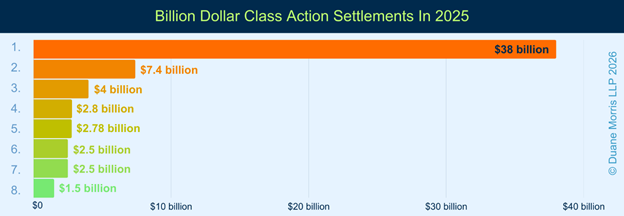
In 2025, several settlements met or exceeded the one-billion-dollar mark.
In 2025, parties agreed to settle eight matters for one billion dollars or more.
There were 10 settlements of one billion dollars or more recorded in 2024, and nine settlements of one billion dollars or more in 2023 and 15 class action settlements of one billion dollars or more in 2022.
Together, corporations have agreed to 42 settlements of one billion dollars or more over the past four years. This string of settlements marks the most extensive set of billion-dollar class action settlements in the history of the American court system. These expansive settlement numbers spanned nearly every area of class action litigation.
In fact, the ten highest settlements cumulatively exceeded one billion dollars in six different areas of class action litigation, including antitrust, consumer fraud, generative artificial intelligence and crypto cases, government enforcement litigation, products liability, and securities fraud.
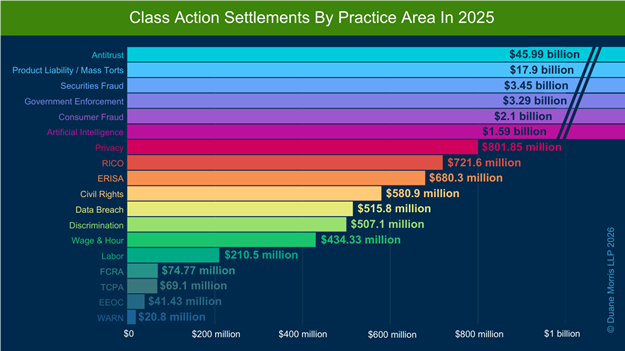
The following shows the cumulative value of the ten highest settlements in each key area of class action litigation:
Antitrust Class Actions: $45.99 billion (up from $8.412 billion in 2024)
Products Liability Class Actions: $17.9 billion (down from $23.40 billion in 2024)
Securities Fraud Class Actions: $3.45 billion (up from $2.55 billion in 2024)
Government Enforcement Litigation: $3.29 billion (up from $335.9 million in 2024)
Consumer Fraud Class Actions: $2.1 billion (down from $2.44 billion in 2024)
Generative AI & Crypto Class Actions: $1.59 billion
Privacy Class Actions: $801.85 million (down from $2.01 billion in 2024)
ERISA Class Actions: $680.30 million (up from $413.3 million in 2024)
Civil Rights Class Actions: $580.9 million (up from $313.8 million in 2024)
Data Breach Class Actions: $515.79 million (down from $593 million in2024)
Discrimination Class Actions: $507.1 million (up from $356.8 million in 2024)
Wage & Hour Class/Collective Actions: $430.58 million (down from $614.55 million in 2024)
Labor Class Actions: $210.5 million (down from $237.0 million in 2024)
BIPA Class Actions: $136.6.0 million (down from $206.85 million in 2024)
TCPA Class Actions: $69.1 million (down from $84.73 million in 2024)
FCRA Class Actions: $74.77 million (up from $42.43 million in 2024)
EEOC Enforcement Litigation: $41.43 million (up from $25.95 million in 2024)
The value of the ten highest settlements in the antitrust, government enforcement, EEOC, securities fraud, ERISA, government enforcement, civil rights, and FCRA areas increased in 2025, reflecting the growth of class action litigation in these areas, as they account for a higher percentage of the overall total.
By contrast, the value of the ten highest settlements in the privacy and BIPA class actions decreased to up to 50% below their 2024 total. In 2025, we began tracking a new category of settlements, for class actions in the generative artificial intelligence and crypto areas of law. The top ten settlements in that category equaled $1.59 billion in 2025.
Implications: Particularly when viewed in conjunction with the settlement values observed in 2023 and 2024, the settlement numbers in 2025 confirm that corporate defendants are operating in a new era of enhanced class action risks. Corporations should expect these numbers to continue to incentivize the plaintiffs’ class action bar to be equally if not more aggressive with their settlement positions in 2026.
The Duane Morris Class Action Review serves as a desk reference on all things class action. General editor Jerry Maatman discusses the origins of the Review and the scope of the findings in the 2026 edition.
Duane Morris Takeaway: The Duane Morris Class Action Review, our 22nd annual study of the class action space, is the biggest and most comprehensive edition yet, at over 750 pages. The 2026 Review has more analysis than ever before, with discussion of over 1,761 class certification rulings from federal and state courts examining all categories of class action litigation.
We will host an in-depth discussion of the key trends analyzed over the past 12 months at the Duane Morris Class Action Review – 2026 Book Launch Event on Thursday, February 5, 2026, from 3:30 p.m. to 6:00 p.m. at the Northwestern University School of Law. Register here to reserve your in-person or virtual seat and join us for a 60-minute live panel with DMCAR editors Jerry Maatman and Jennifer Riley and guest speaker Hon. Wayne R. Andersen (Ret.). CLE, SHRM, and HRCI credit will be available.
Duane Morris Takeaways: As we kick off 2026, we are pleased to announce the publication of the annual edition of the Duane Morris Class Action Review. It is a one-of-its-kind publication analyzing class action trends, decisions, and settlements in all areas impacting corporations, including class certification rulings in the substantive areas of antitrust, appeals, the Class Action Fairness Act, civil rights, consumer fraud, data breaches, discrimination, EEOC-initiated and government enforcement litigation, the Employee Retirement Income Security Act of 1974, the Fair Credit Reporting Act, labor, privacy, procedural issues, product liability and mass torts, the Racketeer Influenced and Corrupt Organizations Act, securities fraud, state court class actions, the Telephone Consumer Protection Act, wage & hour class and collective actions, and the Worker Adjustment and Retraining Notification Act. The Review also highlights key rulings on attorneys’ fee awards in class actions, motions granting and denying sanctions in class actions, the largest class action settlements across all areas of law, and primers on the Illinois Biometric Information Privacy Act, the California Private Attorney General Act and in Generative Artificial Intelligence & Crypto cases. Finally, the Review provides insight as to what companies and corporate counsel can expect to see in 2026.
We are humbled and honored by the recent review of the Duane Morris Class Action Review by Employment Practices Liability Consultant Magazine (“EPLiC”) – the review is here. EPLiC said, “The Duane Morris Class Action Review is ‘the Bible’ on class action litigation and an essential desk reference for business executives, corporate counsel, and human resources professionals.” EPLiC continued, “The review is a must-have resource for in-depth analysis of class actions in general and workplace litigation in particular. The Duane Morris Class Action Review analyzes class action trends, decisions, and settlements in all areas impacting corporate America and provides insight as to what companies and corporate counsel can expect in terms of filings by the plaintiffs’ class action bar and government enforcement agencies like the Equal Employment Opportunity Commission (EEOC) and the Department of Labor (DOL).”
We are also proud that the Review made its way into American jurisprudence on several occasions recently, with a federal district court citing our analysis on class action trends in its decision on a motion for class certification, and both petitioners and amici citing the Review in U.S. Supreme Court briefing as the authoritative source on FLSA certification statistics and the widening circuit split regarding when it is appropriate to send notice to would-be plaintiffs, under 29 U.S.C. § 216(b) in a Fair Labor Standards Act (“FLSA”) collective action.
Click here to access our customized website featuring all the Review highlights, including the ten major trends across all types of class actions over the past year. Order your free copy of the e-book here and download the Review overview here.
Check out an exclusive article featuring the Review posted this morning in Forbes here. The Firm’s press release on the Review can be found here.
The 2026 Review analyzes rulings from all state and federal courts in 23 areas of law. It is designed as a reader-friendly research tool that is easily accessible in hard copy and e-book formats. Class action rulings from throughout the year are analyzed and organized into 23 chapters and 8 appendices for ease of analysis and reference.
Key Class Action Trends In 2025
Trend # 1 – Settlement Numbers Broke The $40 Billion Mark For The Fourth Year In A Row
In 2025, settlement numbers reached an unprecedented level in class action litigation. In 2024, settlement numbers broke the $40 billion mark for the third year in a row. In 2025, the cumulative value of the highest ten settlements across all substantive areas of class action litigation surpassed that benchmark and totaled $79 billion. That number is the highest value tallied in the past two decades, and exceeding the settlement numbers from 2022, 2023, and 2024 by a significant margin. In 2022, these settlement numbers totaled $66 billion; in 2023, they totaled $51.4 billion; and, in 2024, these settlement numbers totaled $42 billion. Combined, the settlement numbers of the past four years exceeded $238 billion, representing use of the class action mechanism to redistribute wealth at an unprecedented level. On an aggregate basis, across all areas of litigation, defendants settled class actions and government enforcement lawsuits for more than $79 billion in 2025.
Trend #2 – Courts Certified Classes At High Rates Across Nearly All Substantive Areas Of Class Action Litigation
Courts issued fewer decisions on motions for class certification in 2025, as compared to 2023 and 2024, but the plaintiffs’ class action bar obtained certification at a higher rate overall. Across all major areas of class action litigation in 2025, courts issued rulings on 435 motions for class certification. By comparison, in 2024, courts issued rulings on 432 motions for class certification, and, in 2023, court issued rulings on 451 motions for class certification. In 2025, however, courts granted motions for class certification at a higher rate. Courts granted 297 motions for class certification in whole or in part, a rate of approximately 68%. This number is higher than the percentage granted in 2024, where courts granted 272 motions for class certification, for a certification rate of approximately 63%, but on par with plaintiffs’ success rate in 2023. In 2023, courts granted 324 motions for class certification, for a certification rate of approximately 72%.
Trend #3 – Class Action Filings Reached New Heights
The gargantuan settlement numbers and high rates of certification have continued to fuel growth in class action filings by the plaintiffs’ class action bar. In 2025, large settlements continued to attract skilled attorneys to the plaintiffs’ side and continued to incentivize plaintiffs’ attorneys to file more and more lawsuits on a class basis. In 2025, the number of class action lawsuits filed in federal courts across the country exceeded 13,229, which equates to more than 52 class actions filed per day on each of the 250 court days in 2025.
That number represents an increase from 2024 and reflects a growth trend relative to the number of class action filed over the past four years. Indeed, the number of class action lawsuits filed in 2022 in federal courts totaled 12,071, the number of class actions filed in 2023 totaled 12,450, and the number of class actions filed in federal courts in 2024 totaled 12,029.
The number filed in 2025 represents a 9% increase over the number of class actions filed in federal court in 2022 and 2024.
Trend #4 – The Landscape Of Privacy Class Actions Continued To Shift
Continued settlements in the privacy space have inspired more members of the plaintiffs’ bar to make privacy litigation the centerpiece of their business models. Although the landscape has shifted over the past five years, the recipe has remained similar — combine archaic statutory schemes, which provide for lucrative statutory penalties, with a ubiquitous technology, to yield the threat of a potential business-crushing class action that can be made via widespread use of form letters and cookie-cutter complaints, to generate payouts on a massive scale. Privacy continued to dominate as one of the hottest areas of growth in terms of class action filings by the plaintiffs’ bar in 2025.
As noted, the landscape has shifted over the past five years. In 2023, many plaintiffs’ attorneys targeted session replay technology, which captures and reconstructs a user’s interaction with a website, or website chatbots, which are programs that simulate conversation through voice or text, or biometric technologies, which capture traits like fingerprints or facial scans for purposes of identification. Over the past two years, the focus for many plaintiffs’ class action lawyers has shifted to website pixels – pieces of code embedded on websites to track activity and, in some circumstances, to provide information about that activity to third-party social media and analytics providers. Plaintiffs have launched thousands of claims via form letters, cookie-cutter complaints, and mass arbitration campaigns.
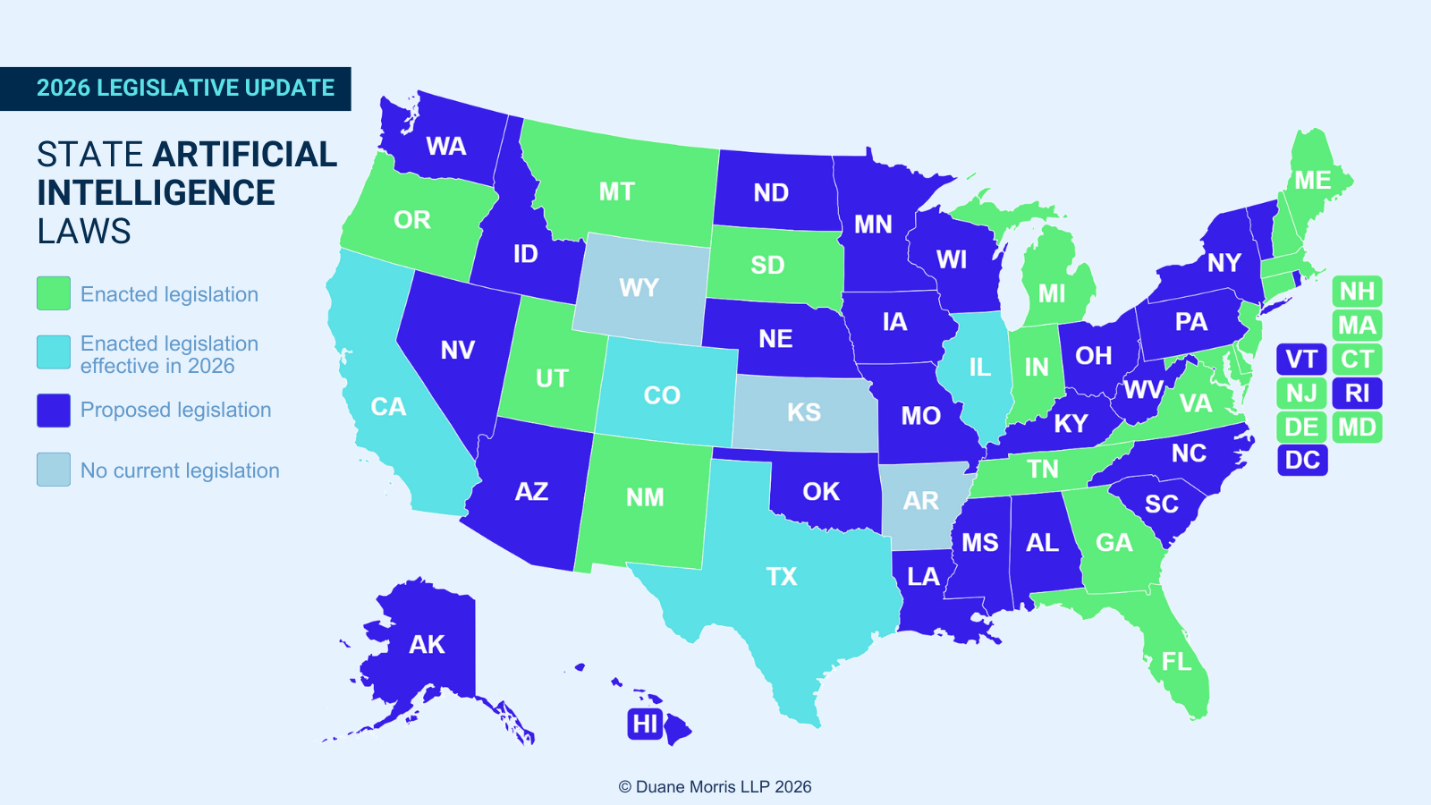
In 2025, while plaintiffs pulled back on filings in areas like biometric privacy, we saw a surge in litigation over internet tracking technologies based on a patchwork quilt of state-level laws, including the California Invasion of Privacy Act (“CIPA”).
Trend #5 – Exceptions Continued To Erode The Rule In The Arbitration Space
Arbitration agreements with class action waivers provide the foundation for one of the most potent defenses to class action litigation. While the U.S. Supreme Court has continued to promote arbitration agreements, plaintiffs have continued to attack their enforceability, and courts across the country have continued to apply exceptions in inconsistent and expansive ways. One of the most impactful examples is the transportation worker exemption, which courts have applied expansively to local workers, such that the U.S. Supreme Court is poised to examine the exemption again, for a third time in the past five years. A defendant’s ability to enforce an arbitration agreement containing a class or collective action waiver continues to reign as one of the most impactful defenses in terms of shifting the pendulum of class action litigation. The U.S. Supreme Court cleared the last hurdle to widespread adoption of such agreements with its decision in Epic Systems Corp. v. Lewis, et al., 138 S. Ct. 1612 (2018). In response, more companies of all types and sizes updated their onboarding systems, terms of use, and other types of agreements to require that employees and consumers resolve any disputes in arbitration on an individual basis. In 2025, defendants continued to win most of the motions to compel arbitration they filed. Across substantive areas of class action litigation, courts issued rulings on approximately 189 motions to compel arbitration, and defendants prevailed on 122 of those rulings, for a success rate of approximately 65%.
Trend #6 – Data Breaches Filings Continued To Grow As The Playbook Became More Refined
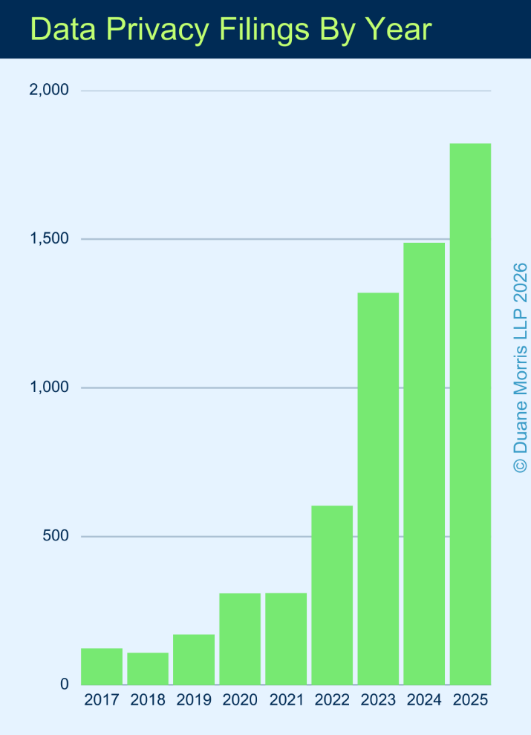
Data breach class action filings continued to expand in 2025, marking it as one of the fastest growing areas in the complex litigation space. Plaintiffs filed approximately 1,822 data privacy class actions in 2025. This represents an average of more than 150 fillings per month and more than seven filings per business day. These numbers reflect growth of more than 18% over the number of data privacy class actions filed in 2024 and growth of more than 200% over the number of data privacy class actions filed just three years ago in 2022.
Trend #7 – The Trump Administration’s Policies Had A Profound Impact On Government Enforcement Litigation
While the EEOC and DOL historically have been among the most aggressive litigants in terms of their pursuit of claims, the Trump Administration has had a profound impact on these agencies and their enforcement agendas. President Trump ran for election on a platform that runs counter to many of the “emerging issues” on the EEOC’s priority list, foreshadowing a realignment of litigation priorities. The Trump Administration has kept its promise of less government oversight and regulation and has shifted the priorities of these agencies to more closely match the administration’s objectives. In several respects, FY 2025 represented a hard pivot in EEOC enforcement targets. While total filings decreased, the new administration foreshadowed a new direction and targeted approach in upcoming EEOC enforcement.
Trend #8 – Chasms Among Circuits Continued To Expand In Several Areas Crucial To Class Action Litigation
In 2025, case law continued to develop in fragmented ways among the federal circuits on issues material to plaintiffs’ ability to maintain and certify class actions, enhancing the likelihood of and incentive for forum shopping. In terms of standards governing conditional certification of FLSA, EPA, and ADEA matters, 2025 saw the crystallization of four distinct standards, ranging in the burdens applicable to plaintiffs, as well as in the review and consideration of the evidence presented. A second chasm relates to courts’ approaches uninjured class members, or the notion that each member of a putative class as defined might not have experienced a concrete injury sufficient to provide such individual standing to pursue a claim. A third chasm reflects courts’ divergent views relative to personal jurisdiction and whether a court that cannot exercise general personal jurisdiction must have a basis for specific personal jurisdiction as to each putative class member. These fractures have made forum selection more consequential than ever. Plaintiffs are increasingly skewing their filings toward federal circuits where they anticipate a greater likelihood of a favorable outcome, including toward jurisdictions where judges are taking a more lenient approach to certification or a more permissive view on issues like standing and jurisdiction. To date, efforts to persuade the U.S. Supreme Court to take up cases that would resolve these splits have failed, so we expect they will continue to drive uncertainty in class-related litigation through 2026.
Trend #9 – Artificial Intelligence Impacted The Class Action Landscape On Multiple Levels
In 2025, Artificial Intelligence – AI – continued to influence class action litigation on multiple fronts. First, we saw a growth of class action lawsuits targeting AI, including in the copyright area and employment space, as well as the securities fraud area with claims of “AI washing.” Second, we saw an increasing number of courts and lawyers err in their use of AI to generate documents filed on dockets across the country and encountered numerous examples of the ways in which AI is continuing to impact the efficiencies that underlie the litigation process.
Trend #10 – California Continued Its Dominance As “Ground Zero” For Expansion Of Representative Litigation
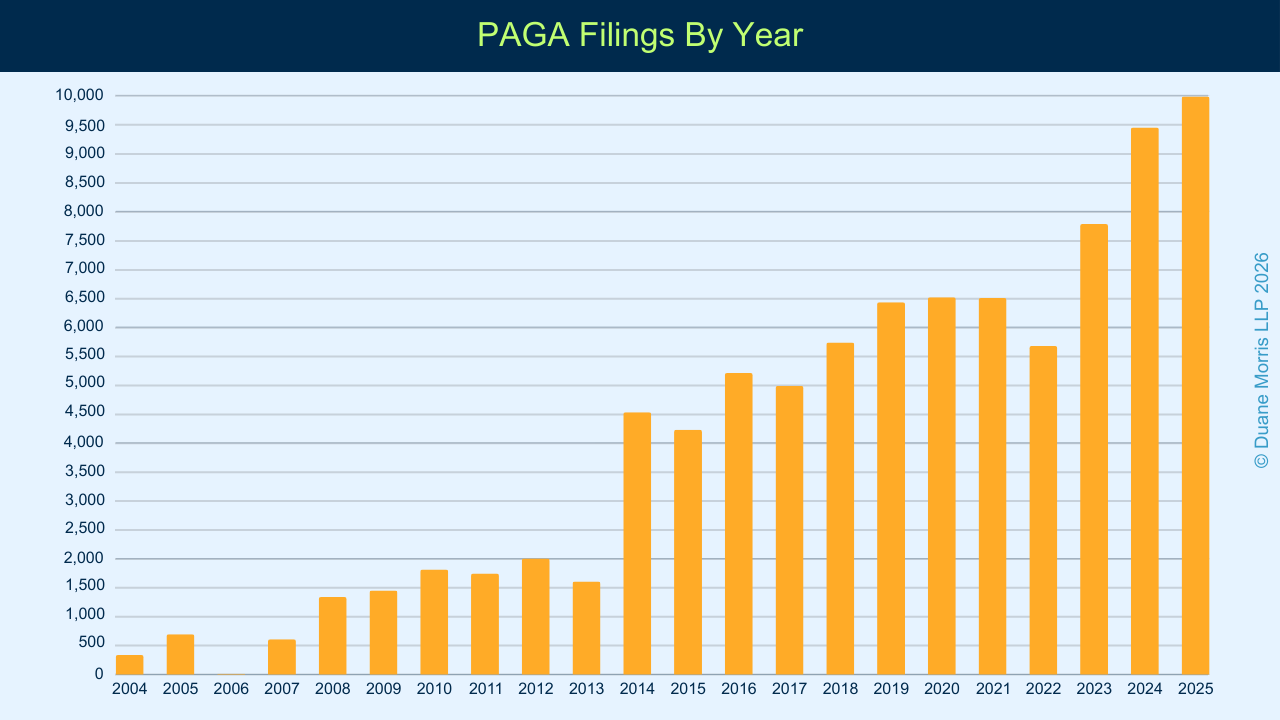
The California Private Attorneys General Act (PAGA) inspired more representative lawsuits than any other statute in America over the past three years. According to the California Department of Industrial Relations, the number of PAGA notices filed in 2025 approached 9,900, which surpasses the 9,464 PAGA notices in 2024. The so-called PAGA reform legislation passed in 2024 by California lawmakers seemingly did little to nothing to curb interest in these cases. The PAGA created a scheme to “deputize” private citizens to sue their employers for penalties associated with violations of the California Labor Code on behalf of other “aggrieved employees,” as well as the State. A PAGA plaintiff may pursue claims on a representative basis, i.e., on behalf of other allegedly aggrieved employees, but need not satisfy the class action requirements of Rule 23. Thus, the PAGA provides the plaintiffs’ class action bar a mechanism to harness the risk and leverage of a representative proceeding without the threat of removal to federal court under the CAFA and without the burden of meeting the requirements for class certification. The PAGA’s popularity in recent years, however, also flows from its status as one of the most viable workarounds to workplace arbitration agreements. Thus, it presents one of the most pervasive litigation risks to companies doing business in California.
According to data maintained by the California Department of Industrial Relations, the number of PAGA notices filed with the LWDA has increased exponentially over the past two decades. In 2024, notices exceeded 9,464 for the first time and, in 2025, the number of PAGA notices reached a new all-time high of over 9,981.
III. What Should Companies Expect In 2026?
Class action litigation is a staple of the American judicial system. The volume of class action filings has increased each year for the past decade, and 2026 is likely to follow that trend. In this environment, programs designed to ensure compliance with existing laws and strategies to mitigate class action litigation risks are corporate imperatives. The plaintiffs’ bar is nothing if not innovative and resourceful. Given the massive class action settlement figures from 2022 through 2025 (a combined total of $238 billion), coupled with the ever-developing law, corporations can expect more lawsuits, expansive class theories, and an equally if not more aggressive plaintiffs’ bar in 2026. These conditions necessitate planning, preparation, and decision-making to position corporations to withstand and defend class action exposures.
We hope the Duane Morris Class Action Review provides practical insights into complex potential strategies relevant to all aspects of class action litigation and other claims that can cost billions of dollars and require changes to business practices in order to resolve such claims.