Duane Morris Takeaway:This week’s episode of the Class Action Weekly Wire features Duane Morris partners Jerry Maatman and Jennifer Riley with their report on trends analyzed in the class certification rulings issued through the first six months of 2025.
Read our detailed breakdown of 2025 class certification rulings here.
Jerry Maatman: Hello everyone, and welcome to the next episode of our Class Action Weekly Wire series. I’m Jerry Maatman, and I’m joined today by my partner, Jennifer Riley, to talk about the mid-year review of class certification numbers. Jen, welcome to the podcast.
Jennifer Riley: Thanks so much, Jerry. It’s great to be here, especially with so much going on in the class action space.
Jerry: Well as of June 30, 2025, we’re six months into the new year. Let’s start with the big picture: courts ruled on approximately 207 class certification motions in the first half of the calendar year, and plaintiffs were successful in 69% of those motions. That’s quite a jump from 2024, isn’t it?
Jennifer: It is. So, last year the success rate was 63%. We’re seeing a notable uptick there, although it’s still a bit lower than what we saw in 2023, and even 2022, when certification success rates hit 72% and 74% respectively. The trajectory so far this year suggests that plaintiffs are regaining some of that ground.
Jerry: Sure sounds like it. I know that certification is a function of where the case is, the judges before it, and the subject matter area. So these are general numbers. What do you look when you peel back that number and look at the specific areas?
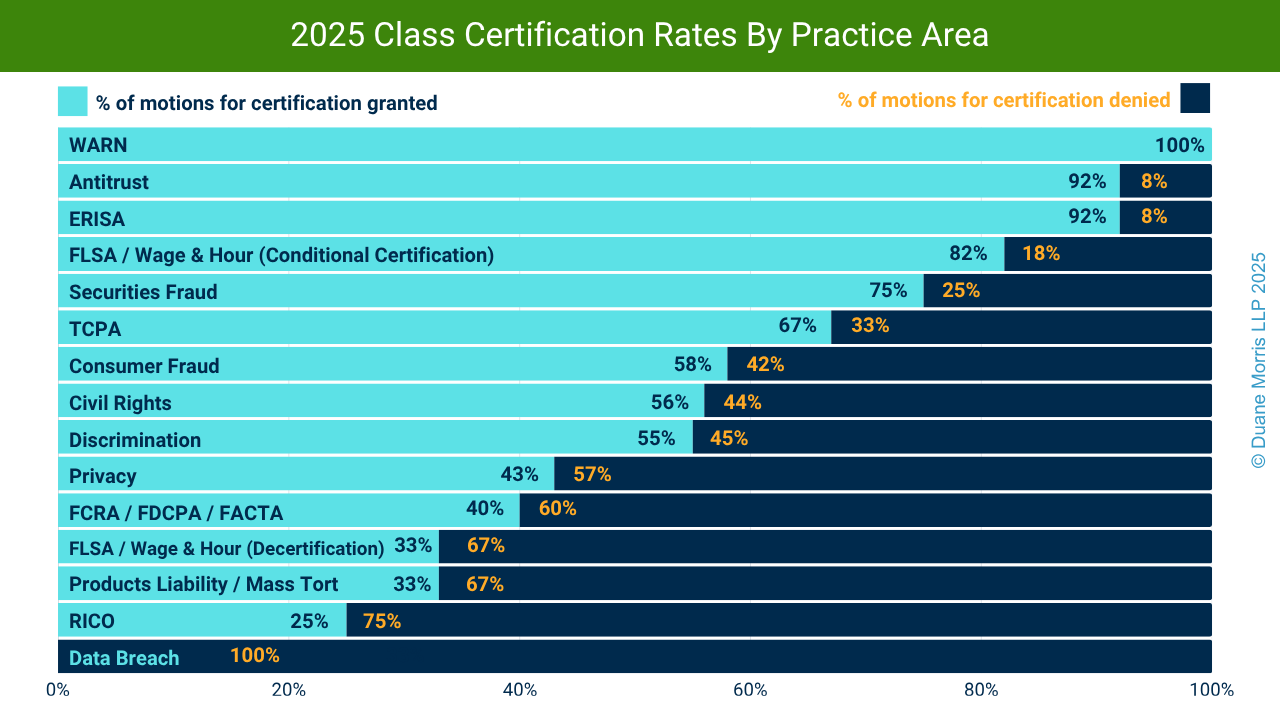
Jennifer: Well, I think the subject matter area has been particularly notable in terms of the numbers we’re seeing. The highest success rates in 2025 so far have come from WARN, antitrust, ERISA, and wage and hour. WARN has had a 100% certification rate so far, even though that was only two cases. Antitrust and ERISA are close behind at 92%. And then there’s wage and hour, which is always a hot topic. Wage and hour is showing us a strong 82% success rate in terms of courts granting certification.
Jerry: Let’s focus on wage and hour. Let’s talk about Fair Labor Standards Act conditional certification. That continues, it appears to be, a very, very hot area of the law, isn’t it?
Jennifer: Absolutely. From January through June of this year, courts issued 74 rulings in FLSA matters. 71 of those were first stage motions for conditional certification, and plaintiffs won 58 of them. That is an 82% success rate, up slightly from the 79% success rate we saw in 2024.
Jerry: I think it’s certainly obvious that there are epicenters of wage and hour FLSA litigation, particularly the Second and Third Circuits, in terms of the number of filings and the success rates there. What makes these places more favorable to the plaintiffs?
Jennifer: That’s absolutely right. So, we’re seeing those jurisdictions particularly show favorable results for the plaintiff at the decertification stage. Also, the usual trend where defendants succeed more often isn’t really playing out this year. We’ve only seen three decertification rulings so far, and plaintiffs have won two of those.
Jerry: I know location impacts certification numbers in terms of the standards in the various circuits. We’re seeing fewer rulings than in past years in the wage and hour space in both the Fifth and Sixth Circuits which are controlled by the Swales case and the Clark case. What’s your thoughts or takeaways on what we’re seeing in 2025?
Jennifer: That’s very important to know, Jerry. I completely agree. I think, what we’re seeing there in those circuits, it’s reflective of a strategic move by the plaintiffs. Both of those circuits have adopted stricter standards for conditional certification, which makes them arguably less appealing venues for plaintiffs. So plaintiffs, therefore, are shifting their filings and their motions toward those more lenient circuits which really boosts their odds of success.
Jerry: Think it’s ironic that [the FLSA] is a piece of new deal legislation signed in 1938. And here, in 2025, we still have three different standards around the country for the circumstances under which wage and hour cases will be certified. Do you see a shift in a geographical sense of where the plaintiffs’ bar hunts out these cases, files them, to maximize their chances for certification?
Jennifer: Absolutely. I think the mid-year numbers are showing us that things like venue selection, subject matter, and timing are all critical components in plaintiffs’ class certification strategy. So, with FLSA continuing to dominate, we’ll definitely be watching closely to see how courts respond in the second half of the year, and whether we see more shifting standards influencing where and when we’re seeing motions filed by the plaintiffs’ bar.
Jerry: Well, the scorecard is interesting through mid-year 2025. We’ll have the final numbers for our clients in the first week of January of 2026 upon publication of the Duane Morris Class Action Review. So, stay tuned and gain more insights in this area. Thanks Jen so much for your thought leadership as always in this particular space.
Jennifer: Thank you, Jerry, and thanks so much to our listeners for tuning in for this week’s edition.
Duane Morris Takeaway: In the first half of 2025, across all major types of class actions, courts issued rulings on more than 211 motions to grant or deny class certification, and plaintiffs succeeded in obtaining or maintaining certification in 145 rulings, with an overall success rate of 69%. In contrast, in 2024, the plaintiffs’ class action bar succeeded in certifying class actions 63% of the time. However, plaintiffs have not been as successful so far this year as compared to 2023, when courts granted 72% of class certification motions, or 2022 when courts granted 74% of class certification motions.
Across all major types of class actions, courts issued rulings last year on 432 motions to grant or to deny class certification. Of these, plaintiffs succeeded in obtaining or maintaining certification in 272 rulings, for an overall success rate of 63%. In 2023, by comparison, courts issued rulings on 451 motions to grant or to deny class certification, and plaintiffs succeeded in obtaining or maintaining certification in 324 rulings, an overall success rate of nearly 72%. In 2022, courts issued rulings on 335 motions to grant or to deny class certification, and plaintiffs succeeded in obtaining or maintaining certification in 247 rulings, an overall success rate of nearly 74%.
2022 – 74% 2023 – 72% 2024 – 63% 2025 – 69%
In 2025, the number of motions that courts considered varied significantly by subject matter area, and the number of rulings varied across substantive areas.
The following list summarizes the results in each of ten key areas of class action litigation:
WARN – 100% granted / 0% denied (2 of 2 granted / 0 of 2 denied) Antitrust – 92% granted / 8% denied (11 of 12 granted / 1 of 12 denied) ERISA – 92% granted / 8% denied (11 of 12 granted / 1 of 12 denied) FLSA / Wage & Hour (Conditional Certification) – 82% granted / 18% denied (58 of 71 granted / 13 of 71 denied) Securities Fraud – 75% granted / 25% denied (12 of 16 granted / 4 of 16 denied) TCPA – 67% granted / 33% denied (4 of 6 granted / 2 of 6 denied) Consumer Fraud – 58% granted / 42% denied (15 of 26 granted / 11 of 26 denied) Civil Rights – 56% granted / 44% denied (19 of 34 granted / 15 of 34 denied) Discrimination – 55% granted / 45% denied (6 of 11 granted / 5 of 11 denied) Privacy – 43% granted / 57% denied (3 of 7 granted / 4 of 7 denied) FCRA / FDCPA – 40% granted / 60% denied (2 of 5 granted / 3 of 5 denied) FLSA / Wage & Hour (Decertification) – 33% granted / 67% denied (1 of 3 granted / 2 of 3 denied) Products Liability / Mass Torts – 33% granted / 67% denied (1 of 3 granted / 2 of 3 denied) RICO – 25% granted / 75% denied (1 of 4 granted / 3 of 4 denied) Data Breach – 0% granted / 100% denied (0 of 2 granted / 2 of 2 denied)
The plaintiffs’ class action bar obtained the highest rates of success in WARN, antitrust, ERISA, and wage & hour class actions. There have only been two WARN certification rulings in 2025, which were both granted by the court for a 100% success rate. In cases alleging antitrust violations, plaintiffs succeeded in obtaining orders certifying classes in 11 of 12 rulings, for a success rate of 92%. In cases alleging ERISA violations, plaintiffs managed to obtain class certification rulings in 11 of 12 rulings issued during the first half of 2025, a success rate of 92%. And in wage & hour litigation, plaintiffs succeeded in obtaining orders certifying classes and/or collective actions in 58 of 71 rulings issued during 2025, a success rate of 82%.
Courts Issued More Rulings In FLSA Collective Actions and Wage & Hour Class Actions Than In Any Other Areas Of Law
For the first half of calendar year 2025, courts issued more certification rulings in FLSA collective actions and wage & hour class actions than in other types of cases. Plaintiffs historically have been able to obtain conditional certification of FLSA collective actions at a high rate, which surely has contributed to the number of filings in this area.
From January 1 to July 1, 2025, courts considered more motions for certification in FLSA matters than in any other substantive area. Overall, courts issued 74 rulings. Of these, 71 addressed first-stage motions for conditional certification of collective actions under 29 U.S.C. § 216(b), and 3 addressed second-stage motions for decertification of collective actions. Of the 71 rulings that courts issued on motions for conditional certification, 58 rulings favored plaintiffs, for a success rate of 82%.
These numbers are higher than the numbers observed in 2024, during which courts issued 171 rulings. Of these, 156 addressed first-stage motions for conditional certification of collective actions under 29 U.S.C. § 216(b), and 15 addressed second-stage motions for decertification of collective actions. Of the 156 rulings that courts issued on motions for conditional certification, 124 rulings favored plaintiffs, for a success rate of 79.5%.
At the decertification stage, courts generally have conducted a closer examination of the evidence and, as a result, defendants historically have enjoyed an equal if not higher rate of success on these second-stage motions as compared to plaintiffs.
The results so far in 2025 have not supported that typical success. There have only been 3 rulings thus far that courts issued on motions for decertification of collective actions, and only 1 ruling favored defendants, for a lower success rate of 33%.
An analysis of the rulings demonstrates that a disproportionate number emanated from traditionally pro-plaintiff jurisdictions, including the judicial districts within the Second Circuit (21 decisions) and Third Circuit (12 decisions), which include New York and Pennsylvania, respectively.
Takeaways From Certification Statistics Midway Through 2025
Notable thus far at the halfway point of the year, there have been a very small number of rulings emanating from the Fifth and Sixth Circuits (1 and 0 decisions, respectfully), which could account for the high overall conditional certification rate in the wage & hour space, given that these two circuits have imposed new, stricter standards for conditional certification. Plaintiffs likely are shifting their case filings away from these two circuits toward jurisdictions with more lenient, more plaintiff-friendly standards for conditional certification.
The numbers no doubt flow from the different standards and approaches that courts in different federal circuits take in evaluating motions for conditional certification and decertification and, in turn, the likelihood of plaintiffs’ success on such motions. If more courts join the Fifth and Sixth Circuits in abandoning the traditional two-step certification process under 29 U.S.C. § 216(b), and thereby increase the time and expense of gaining a conditional certification order, it may lead to a reshuffling of the deck in terms of where plaintiffs file their cases and the types of claims they pursue.
We will continue to track class certification trends in 2025 and will report on final numbers in the Duane Morris Class Action Review – 2026, which will be published in the first week of January. Stay tuned!
Duane Morris Takeaway:This week’s episode of the Class Action Weekly Wire features Duane Morris partners Jerry Maatman and Jennifer Riley with their report on class action settlement trends at the halfway mark of 2025.
Read our detailed breakdown of 2025 class action settlements here.
Jerry Maatman: Hello, everyone, and welcome to the next episode of the Class Action Weekly Wire. I’m Jerry Maatman, and with me today for our special mid-year review of class action settlements is my partner, Jen Riley. Jen, welcome back to the podcast.
Jennifer Riley: Thanks so much, Jerry.
Jerry: Well, we’re halfway through 2025. What sort of developments do we see on the settlement front?
Jennifer: Thanks, Jerry. It’s been quite a ride. The data confirms what we’ve been tracking since 2022 – we’re in a new era of class action litigation, corporate defendants have been facing unprecedented settlement exposures. The total value of class action and government enforcement settlements hit $66 billion in 2022, $51.4 billion in 2023, and $42 billion in 2024. As of mid-2025, we have already reached $21.77 billion, keeping pace with those historic high numbers that I just mentioned.
Jerry: Those are enormous numbers, and obviously the snapshot for the first six months of 2025 only involved the top 5 settlements in each of these areas. So, we’re talking about over a $180 billion dollars in just three and a half years. That’s remarkable.
Jennifer: Exactly. It is the largest 3-year span of settlements in U.S. legal history. If the current trends hold, 2025 may end up right alongside those previous three years. It may not be a record breaker, but it’s definitely in that same upper tier.
Jerry: When you peel back the onion skin and dig down into the numbers, where are you seeing the highest settlement values so far in 2025?
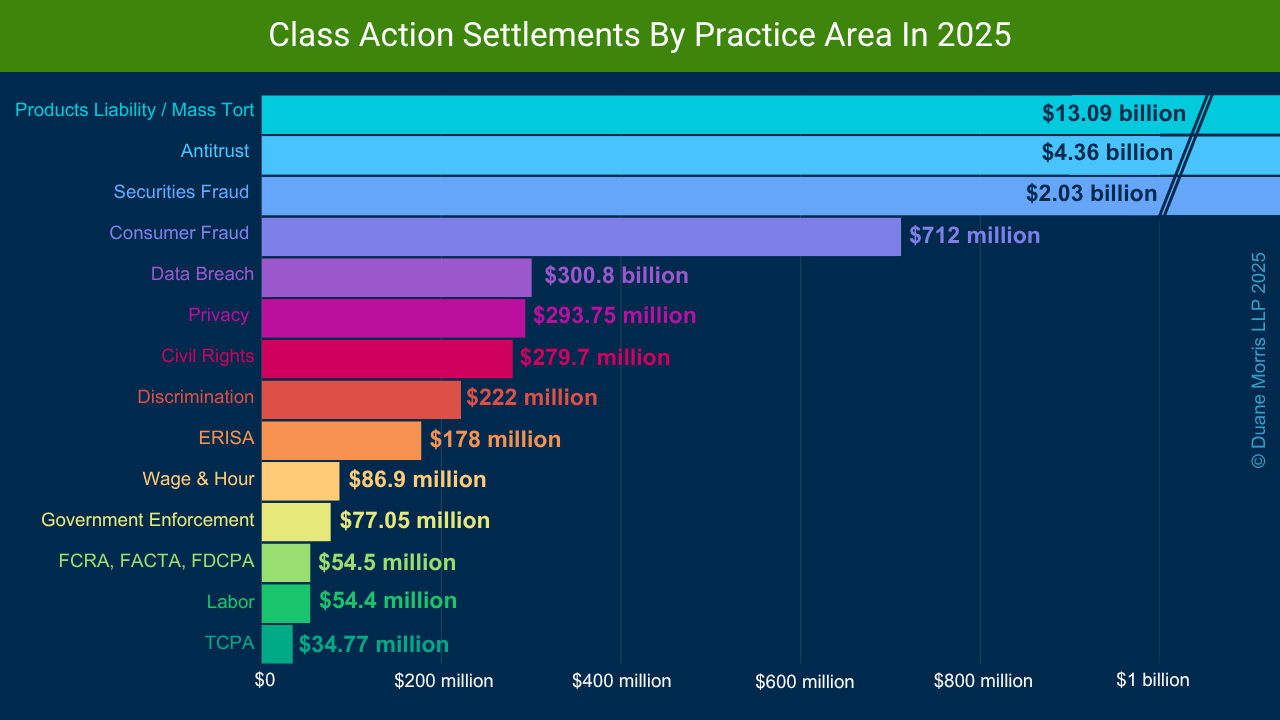
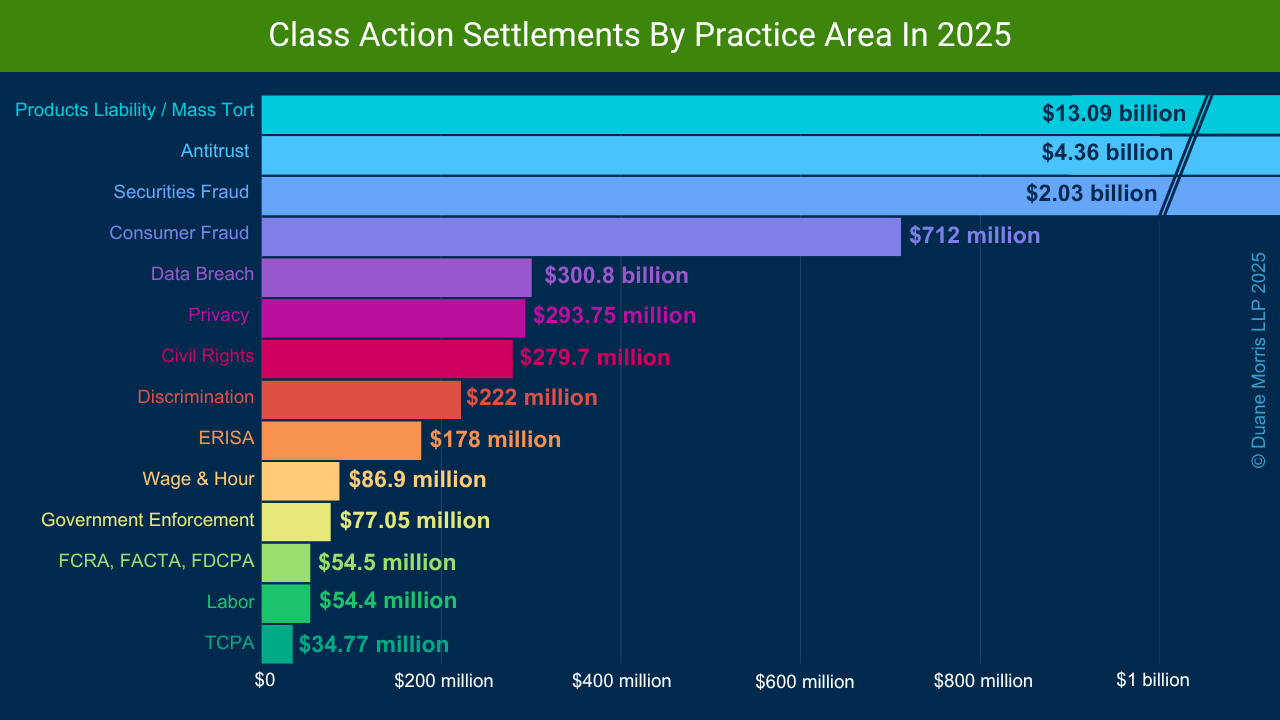
Jennifer: That would probably be in the product liability and mass tort space. Those areas are leading by a long shot, $13.09 billion in just the first half of 2025. The next area is antitrust, which follows at $4.36 billion, and then, after that, securities fraud at $2.03 billion.
Jerry: I recall prior to Covid, one could count the number of $1 billion settlements on one or two fingers, sometimes in a 5-year period, although those are becoming more commonplace these days. Are there any standout billion-dollar settlements so far in 2025?
Jennifer: Great question. There are a few major ones, I would say the In Re College Athlete NIL Litigation – that one hit $2.78 billion. That’s the one that gave athletes retroactive compensation for missed name, image, and likeness opportunities. It’s really a historic shift. Also worth noting, Purdue Pharma’s $7.4 billion opioid-related settlement. Just last week, Purdue announced that it is preparing to send an updated bankruptcy plan and proposed settlement to a vote following a broad sign on by all U.S. states and territories.
Jerry: Way in and of themselves, those are landmark figures for those settlements. Are we seeing, as we did the last three years, increasing number of $1 billion settlements per case?
Jennifer: We are, there have been three billion-dollar settlements so far in 2025, that brings us to 37 total settlements over a $1 billion since 2022. It’s the most in any three-and-a-half-year period ever.
Jerry: Again, remarkable figures in terms of your analysis of that settlement activity. Are there particular sectors you would point out to our listeners that are worth looking at or to view as emerging areas of risk and exposure?
Jennifer: Data, breach and privacy settlements are increasingly prominent. For example, AT&T just agreed to pay $177 million dollars for a breach-related case. And Clearview AI settled for $51.75 million over biometric privacy violations. Also, discrimination and civil rights cases continue to generate large settlements, showing that the courts are still a viable forum for those systemic claims.
Jerry: Let’s talk about antitrust – that’s historically been an area where there have been very high settlements. What’s going on in that space thus far in 2025?
Jennifer: The antitrust sector is very active. The top 5 settlements in 2025 alone total more than $4 billion, with notable cases against the NCAA, CDK Global, and Perdue Farms. There’s a sustained focus on wage suppression and market manipulation. Those are key areas of concern for both the regulators and for the plaintiffs.
Jerry: The Duane Morris Class Action Review also tracks governmental enforcement settlement activity, insofar as those cases certainly have the feel look of a class action. What’s going on on that particular front with government enforcement litigation?
Jennifer: Even with the changes – still going strong. Government enforcement settlements reached over $77 million so far in 2025, covering everything from labor violations to deceptive marketing in the gaming industry. The DOJ, DOL, and state AGs have remained active, especially in sectors affecting workers and vulnerable consumers.
Jerry: If you take a holistic look at all the areas that are tracked that corporations are vulnerable to being sued over, are there any areas that are cooling down, or where the numbers are actually going down?
Jennifer: Great question, I would say securities fraud. Securities fraud is slightly down from the highs of 2023, and we’re also seeing some slowdown in TCPA-related cases, although Realogy Holdings $20 million robocall case is still making headlines over this past year, but overall, I would say most sectors are either holding steady or growing.
Jerry: Jen, I know you recently won an award and you were selected the number one most quoted and followed class action lawyer in the United States in terms of your thought leadership. Tell us about inside baseball in terms of your thoughts and insights in this particular space of what corporations can expect for the remainder of 2025.
Jennifer: Thanks, Jerry. I would say the bottom line is really that corporate defendants are operating in a legal environment where these large-scale class actions – whether driven by consumers, employees, investors, regulators – these are a constant and very costly risk. We’re really in a high-stakes phase of class action litigation right now, and there’s no indication that it’s going to slow down.
Jerry: Jen, thanks, as always, for those insights and thanks for our listeners for joining us for this week’s installment of the Class Action Weekly Wire. We’ll be sure to keep you updated on all the settlement numbers throughout the remainder of 2025, and when we debut the Duane Morris Class Action Review for 2026. I’m sure what we’re going to point out to are the enormous settlement numbers now for four years in a row. So thanks so much.
Jennifer: Absolutely. The 2026 version is going to be a must-read. Thank you, Jerry, and thank you to our listeners.
Duane Morris Takeaways: Corporate defendants saw unprecedented settlement numbers across all areas of class action litigation in 2022, 2023, and 2024, and halfway through 2025, settlement numbers remain robust. The cumulative value of the top ten settlements across all substantive areas of class action litigation hit near record highs in 2024, following the highest levels ever in 2022, and the second highest total in 2023. When the numbers for 2022, 2023, and 2024 are combined, the total signals that corporate defendants have entered a new era of heightened risks and higher stakes in the valuation of class actions.
On an aggregate basis, across all areas of litigation, class actions and government enforcement lawsuits garnered more than $42 billion in 2024, $51.4 billion in settlements in 2023, and a record-setting $66 billion in 2022. When combined, the three-year settlement total eclipses any other three-year period in the history of American jurisprudence.
As a prelude to the Duane Morris Class Action Review – 2026, this blog post reports on our analysis of class action settlements through the first half of 2025. The data shows that for the period of January 1 to June 30, 2025, the current year is on pace with the numbers of the previous three years. As of the end of the first half of 2025, the aggregate settlement total across all areas of class action litigation and government enforcement lawsuits is $21.77 billion (in accounting for the top 5 settlements in the various substantive areas of law). By comparision, in 2024 at the half-way mark, the aggregate settlement total was $22.5 billion.
It is anticipated that these numbers will increase across the board by the end of the year and when measured by the top 10 settlements in each category.
More Billion Dollar Class Action Settlements
At the mid-way point of 2025, there are three settlements over the billion-dollar mark. The 10 individual billion-dollar settlements in 2024 surpassed the number in 2023, and only fell short of the number of billion-dollar settlements in 2022. In 2023, parties resolved nine class actions for $1 billion or more. In 2022, parties resolved 15 class actions for $1 billion or more in settlement dollars. Together with the three thus far in 2025, corporations have seen 37 settlements of one billion dollars or more in three and a half years. This string of settlements marks the most extensive set of billion-dollar class action settlements in the history of the American court system.
Class action settlements totaled $66 billion in 2022, $51.4 billion in 2023, $42 billion in 2024, and $21.77 billion in 2025 so far.
The Scorecard On Leading Class Actions Settlements Halfway Through 2025
The plaintiffs’ class action bar has scored rich settlements thus far in 2025 in virtually every area of class action litigation.
The top 5 class action settlement totals in each practice area. [Click to enlarge]
The following list shows the totals of the top 5 settlements at the mid-year point in 2025 in key areas of class action litigation:
$13.09 Billion – Products liability/mass tort class actions $4.36 Billion – Antitrust class actions $2.03 Billion – Securities fraud class actions $712 Million – Consumer fraud class actions $300.8 Million – Data breach class actions $293.75 Million – Privacy class actions $279.7 Million – Civil rights class actions $222 Million – Discrimination class actions $178 Million – ERISA class actions $86.9 Million – Wage & hour class and collective actions $77.05 Million – Government enforcement actions $54.5 Million – Fair Credit Reporting Act class actions $54.4 Million – Labor class actions $34.77 Million – TCPA class actions
The high dollar settlements of the past three years suggested that the plaintiffs’ bar would continue to be equally, if not more aggressive, with their case filings and settlement positions. From the 2025 data, it certainly looks to be the case as we end the first half of the year.
The data points in each category are set out in the following charts.
Top Class & Collective Action Litigation Settlements In 2025
Top Antitrust Class Action Settlements In 2025
The top 10 antitrust class action settlements totaled $8.412 billion in 2024, $11.74 billion in 2023, and $3.72 billion in 2022.
$2.78 billion – In Re College Athlete NIL Litigation, Case No. 20-CV-3919 (N.D. Cal. June 6, 2025) (final settlement approval granted in a class action requiring the NCAA and its Power Five conference members to pay approximately $2.8 billion in damages, characterized as “back pay,” to compensate student-athletes for the denial of name, image, and likeness (NIL) opportunities under prior NCAA eligibility rules).
$630 million – Loop LLC, et al. v. CDK Global LLC, Case No. 24-CV-571 (W.D. Wis. June 10, 2025) (preliminary settlement approval sought in a class action to resolve claims by automotive technology vendors who alleged the company colluded with Reynolds & Reynolds Co. to inflate prices for data integration services).
$398 million – Jien, et al. v. Perdue Farms Inc., Case No. 19-CV-2521 (D. Md. June 5, 2025) (final settlement approval granted in a class action to resolve claims by workers alleging the poultry firms violated the Sherman Act by conspiring to drive down their hourly wages and salaries at poultry processing operations).
$375 million – Le, et al. v. Zuffa LLC, Case No. 15-CV-1045 and Johnson, et al. v. Zuffa LLC, Case No. 21-CV-1189 (D. Nev. Feb. 6, 2025) (final settlement approval granted to resolve claims in a more than a decade-long class action in which fighters accused UFC of suppressing their wages).
$275 million – In Re Generic Pharmaceuticals Pricing Antitrust Litigation, Case No. 16-MD-2724 (E.D. Penn. Feb. 19, 2025) (preliminary settlement approval granted in a class action to resolve claims brought by consumers, insurers and other end payer plaintiffs alleging that drugmaker Sandoz conspired with other companies to fix the price of certain generic drugs).
Top Civil Rights Class Action Settlements In 2024
The top 10 civil rights class action settlements totaled $313.8 million in 2024, $643.15 million in 2023, and $1.31 billion in 2022.
$140 million – Nnebe, et al. v. Daus, Case No. 06 Civ. 4991 (S.D.N.Y. May 7, 2025) (preliminary settlement approval granted in a class action to resolve claims from over 19,000 taxi drivers challenging the city’s practice of suspending the license of any driver who was arrested for a felony or misdemeanor).
$92.5 million – Onadia, et al. v. City Of New York, Case No. 300940/2010 (N.Y. Oct. 6, 2025) (final settlement approval hearing scheduled in a class action to resolve claims by individuals who were unlawfully detained by the NYC Department of Correction).
$28 million – Doe, et al. v. Johnson City, Case No. 23-CV-71 (E.D. Tenn. May 5, 2025) (preliminary settlement approval sought in a class action to resolve claims alleging that Johnson City businessman Sean Williams drugged and raped more than 50 women in his downtown condo in incidents he captured on video).
$17 million – Allen, et al. v. Global Tel*Link Corporation d/b/a ViaPath Technologies, Case No. 24-CV-827 (E.D. Va. Feb. 21, 2025) (preliminary settlement approval granted in a class action to resolve claims alleging that the company charged incarcerated individuals and their families excessive fees for communications services).
$2.2 million – Vigil, et al. v. 2801 Fifteenth Street NW LLC, Case No. 2022 CA 001459 (D.C. Super. Ct. Mar. 27, 2025) (final settlement approval granted in a class action to resolve claims alleging that the apartment complex charged illegal fees and failed to provide habitable living conditions for tenants).
Top Consumer Fraud Class Action Settlements In 2025
The top 10 consumer fraud class action settlements totaled $2.44 billion in 2024, $3.29 billion in 2023, and $8.596 billion in 2022.
$425 million – In Re Capital One 360 Savings Account Interest Rate Litigation, Case No. 24-MD-3111 (E.D. Va. June 16, 2025) (preliminary settlement approval granted in a class action to resolve claims alleging that the company deceptively advertised its 360 Savings accounts as high-interest savings products).
$145 million – In Re Xyrem (Sodium Oxybate) Antitrust Litigation, Case No. 20-MD-2966 (N.D. Cal. May 16, 2025) (preliminary settlement approval granted in a class action to resolve claims by direct and indirect Xyrem purchasers, alleging that the company’s actions leading up to, and entering into, patent litigation settlement agreements with generic drug manufacturers who had filed abbreviated new drug applications violated U.S. state and federal antitrust, consumer protection and unfair competition laws).
$100 million – Cabrera, et al. v. Google LLC, Case No. 11-CV-1263 (N.D. Cal. Apr. 16, 2025) (preliminary settlement approval granted in a class action to resolve claims from advertisers alleging the defendant overcharged for advertisements through its AdWords service).
$25 million – Anderson, et al. v. Boyne USA, Inc., Case No. 21-CV-95 (D. Mont. June 25, 2025) (final settlement approval granted in a class action to resolve claims from condo property owners alleging that the exclusive rental management requirement of condominium-hotel units violated state and federal law).
$20 million – Smith, et al. v. Apple, Inc., Case No. 21-CV-9527 (N.D. Cal. May 1, 2025) (final settlement approval granted in a class action to resolve claims alleging a battery swelling defect with early-model Apple Watches in some cases caused watch screens to detach or shatter).
Top Data Breach Class Action Settlements In 2025
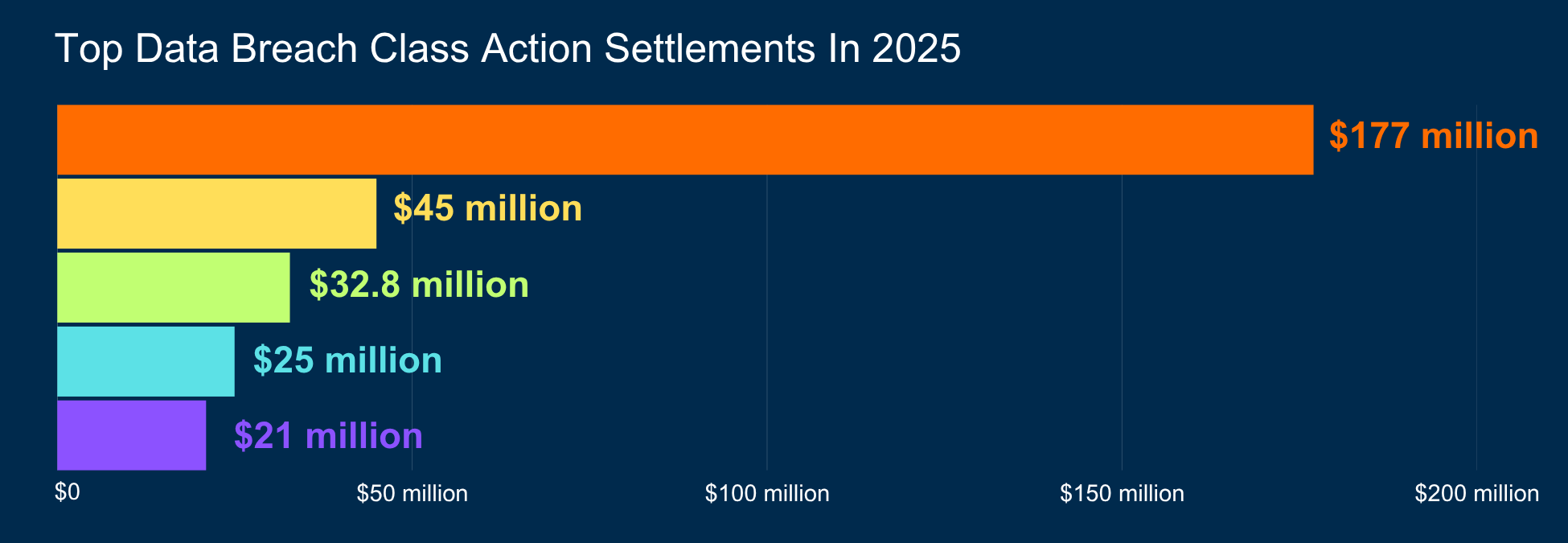
The top 10 data breach class action settlements totaled $593.2 million in 2024, $515.75 million in 2023, and $719.21 million in 2022.
$177 million – In Re AT&T Inc. Customer Data Security Breach Litigation, Case No. 24-CV-757 (N.D. Tex. June 20, 2025) (preliminary settlement approval granted in a class action to resolve claims alleging that the defendant released customer information on the dark web).
$45 million – In Re MGM Resorts International Data Breach Litigation, Case No. 20-CV-376 (D. Nev. June 18, 2025) (final settlement approval granted in a class action to resolve claims alleging that MGM failed to protect 37 million customers’ personal information from multiple data breaches in and 2023).
$32.8 million – Baker, et al. v. ParkMobile, LLC, Case No. 21-CV-2182 (N.D. Ga. Mar. 13, 2025) (final settlement approval granted in a class action to resolve claims alleging that the company harmed consumers by failing to secure their data and therefore exposed them to identity theft, fraud, and the need to spend time securing related accounts).
$25 million – In Re LoanDepot Data Breach Litigation, Case No. 24-CV-136 (C.D. Cal. Jan. 13, 2025) (preliminary settlement approval granted in a class action to resolve claims alleging that the company negligently failed to protect the personal information of nearly 17 million people).
$21 million – In Re Arthur J. Gallagher Data Breach Litigation, Case No. 22-CV-137 (N.D. Ill. Feb. 27, 2025) (final settlement approval granted in a class action to resolve claims the company failed to prevent a 2020 data breach that compromised sensitive employee and client information).
Top Discrimination Class Action Settlements In 2025
The top 10 discrimination class action settlements totaled $356.8 million in 2024, $762.2 million in 2023, and $597 million in 2022
$70 million – Ferris, et al. v. Wynn Resorts Ltd., Case No. 18-CV-479 (D. Nev. Feb. 3, 2025) (final settlement approval granted to resolve claims in a class action alleging sexual misconduct allegations against founder Steve Wynn).
$50 million – Curley, et al. v. Google LLC, Case No. 22-CV-1735 (N.D. Cal. May 8, 2025) (preliminary settlement approval sought in a class action to resolve claims alleging that the company discriminated against Black employees).
$43 million – Rasmussen, et al. v. The Walt Disney Co., Case No. 19-STCV-10974 (Cal. Super. Ct. May 13, 2025) (preliminary settlement approval granted in a class action to resolve claims alleging that the defendant systematically paid female employees in California less than men for substantially similar jobs; regularly passed women over for promotion; and loaded them with extra work without providing additional pay).
$31 million – In Re Norwich Roman Catholic Diocesan Corp., Case No. 21-BK-20687 (D. Conn. Feb. 14, 2025) (settlement entered following Norwich Diocese filing for bankruptcy in July 2021 following lawsuits by survivors of clergy abuse at its Academy at Mount Saint John boarding school).
$28 million – Cantu, et al. v. Google LLC, Case No. 21-CV-392049 (Cal. Super. Ct. Mar. 11, 2025) (preliminary settlement approval granted in a class action to resolve claims alleging that workers identifying as Latino, Native American, and other ethnicities were paid less than white, Asian, and Asian American employees for substantially similar work).
Top EEOC / Government Enforcement Class Action Settlements In 2025
The top 10 EEOC / government enforcement class action settlements totaled $335.9 million in 2024, $263.58 million in 2023, and $404.5 million in 2022
$20.25 million – U.S. Department Of Labor v. UMR, Inc., Case No. 23-CV-513 (W.D. Wis. Mar. 19, 2025) (consent order entered in an enforcement action that challenged adverse benefit determinations regarding hospital emergency services claims and urinary drug screening claims).
$20 million – Federal Trade Commission v. Cognosphere LLC, Case No. 25-CV-447 (C.D. Cal. Jan. 17, 2025) (consent order entered in an enforcement action to resolve claims against a video game maker by the FTC alleged that the company misled children and other users about the actual costs of purchases and illegally collected children’s personal information).
$16.8 million – In The Matter Of The Investigation Of Letitia James, Attorney General Of The State Of New York Of DoorDash Inc., No. 25-007 (N.Y. Feb. 24, 2025) (assurance order effective following an investigation by the Attorney General for New York that found the company cheated about 63,000 food delivery workers out of their full tips in order to subsidize their pay).
$15 million – U.S. Department Of Labor v. Americare Healthcare Services, LLC, Case No. 21-CV-5076 (S.D. Ohio Jan. 9, 2025) (consent order entered in an enforcement action to resolve claims alleging that the third-party home care agency failed to pay employees overtime compensation).
$5 million – In The Matter Of The National Women’s Soccer League, No. 25-002 (N.Y. Feb. 1, 2025) (assurance order effective following an investigation by the attorneys general for New York, Illinois, and the District of Columbia found that the NWSL was “permeated by a culture of inappropriate and abusive behavior, including sexual harassment and harassment and discrimination based upon gender, race, and sexual orientation”).
Top ERISA Class Action Settlements In 2025
The top 10 ERISA class action settlements totaled $413.3 million in 2024, $580.5 million in 2023, and $399.6 million in 2022.
$69 million – Snyder, et al. v. UnitedHealth Group, Inc., Case No. 21-CV-1049 (D. Minn. June 12, 2025) (final settlement approval granted in a class action to resolve claims alleging that the defendant engaged in imprudence, disloyalty, prohibited transactions and failure to monitor in violation of the ERISA).
$60 million – In Re AME Church Employee Retirement Fund Litigation, Case No. 22-MD-3035 (W.D. Tenn. Mar. 24, 2025) (preliminary settlement approval granted in a class action to resolve claims that the church plan was mismanaged leading to participants losing significant money from the plan in violation of the ERISA).
$20.5 million – Baker, et al. v. Save Mart Supermarkets, Case No. 22-CV-4645 (N.D. Cal. June 11, 2025) (preliminary settlement approval granted in a class action alleging that the defendant failed to honor its promise to provide them with lifetime retiree medical benefits).
$14.5 million – Burnett, et al. v. Prudent Fiduciary Services, LLC, Case No. 22-CV-270 (D. Del. Jan. 14, 2025) (final settlement approval granted in a pair of class actions to resolve claims alleging that the resolving claims pilots were forced to overpay for their stake in the company through its employee stock ownership plan).
$14 million – Coleman, et al. v. Brozen, Case No. 20-CV-1358 (N.D. Tex. Jan. 30, 2025) (preliminary settlement approval granted in a class action brought by participants in All My Sons Moving & Storage’s employee stock ownership plan that when the plan was terminated they received losses).
Top FCRA, FDPCA, And FACTA Class Action Settlements In 2025
The top 10 FCRA, FDPCA, and FACTA class action settlements totaled $42.43 million in 2024, $100.15 million in 2023, and $210.11 million in 2022.
$23 million – Norman, Sr., et al. v. TransUnion LLC, Case No. 18-CV-5225 (E.D. Penn. Feb. 24, 2025) (preliminary settlement approval granted in a class action to resolve claims alleging that the defendant did not conduct a reasonable investigation of disputes of hard inquiries in credit files, or in the alternative, did not remove the disputed hard inquiries from credit files in violation of the FCRA).
$15 million – In The Matter Of Equifax Inc. And Equifax Information Services LLC, File No. 2025-CFPB-0002 (CFPB Jan. 17, 2025) (consent order entered to resolve claims alleging that the company violated the FCRA by failing to thoroughly investigate consumer disputes, putting previously deleted errors back on credit reports, failing to block information that resulted from identity theft, and sharing inaccurate credit scores and data about consumers to lenders).
$12.8 million – In The Matter Of American Honda Finance Corp., File No. 2025-CFPB-0003 (CFPB Jan. 17, 2025) (consent order entered to resolve claims alleging that the company violated the FCRA by furnishing false and harmful information that ended up on borrowers’ credit reports, continuing doing so after determining that several types of information were inaccurate, failing to investigate disputes about information it provided to credit reporting companies, and failing to send the results of investigations to those companies and consumers, when required).
$2.2 million – Magallon, et al. v. Robert Half International, Inc., Case No. 13-CV-1478 (D. Ore. May 7, 2025) (final settlement approval granted in a class action to resolve claims alleging that the defendant failed to notify applicants when it saw negative “red” or “yellow” flags in consumer reports provided by third-party credit reporting agencies in violation of the FCRA).
$1.3 million – Wickham, et al. v. Schenker Inc., Case No. 23-CV-946 (N.D. Cal. Jan. 29, 2025) (settlement agreement reached in a class action to resolve claims alleging that the defendant failed to provide proper disclosure under the FCRA that it was conducting background checks on workers during hiring).
Top FLSA / Wage & Hour Class And Collective Settlements In 2025
The top 10 FLSA / wage & hour class and collective action settlements totaled $614.55 million in 2024, $742.5 million in 2023, and $574.55 million in 2022.
$21 million – Wilder, et al. v. The Kroger Co., Case No. 22-CV-681 (S.D. Ohio Feb. 20, 2025) (preliminary settlement approval granted in a class action to resolve claims alleging that the company missed paychecks and made inaccurate deductions to employee wages after it switched payroll systems).
$19.9 million – Morgan, et al. v. Rohr Inc., Case No. 20-CV-574 (S.D. Cal. May 1, 2025) (preliminary settlement approval granted in a class and collective action to resolve claims alleging that the company failed to pay proper overtime, minimum wage, and for meal and rest breaks).
$16 million –Taylor et al. v. Seattle Children’s Hospital, Case No. 22-2-15300-8 (Wash. Super. Ct. Apr. 21, 2025) (preliminary settlement approval sought in a class action to resolve claims from hospital workers alleging they were denied required meal breaks in violation of Washington wage and hour laws).
$15.5 million – Abrishamcar, et al. v. Oracle America Inc., Case No. CIV 535490 (Cal. Super. Ct. Apr. 9, 2025) (preliminary settlement approval sought in a class action to resolve claims from sales employees who alleged that the technology company violated the state’s wage laws for commissioned sales workers).
$14.5 million – Hunter, et al. v. Legacy Health, Case No. 18-CV-2219 (D. Or. Jan. 23, 2025) (final settlement approval granted in a class action to resolve claims alleging that nurses were denied overtime compensation).
Top Labor Class Action Settlements In 2025
The top 10 labor class action settlements totaled $237.0 million in 2024 and $129.67 million in 2023.
$55 million – Saunders, et al. v. State Of Michigan Unemployment Insurance Agency, Case No. 22-000007-MM (Mich. Ct. Claims May 13, 2025) (final settlement approval granted in a class action to resolve claims between the Michigan Unemployment Insurance Agency and individuals who alleged their benefits were improperly clawed back without notice during the COVID-19 pandemic).
$34 million – Borozny, et al. v. RTX Corp., Pratt & Whitney Division, Case No. 21-CV-1657 (D. Conn. May 14, 2025) (final settlement approval granted in a class action to resolve claims alleging that the company engaged in an agreement among contractors not to hire one another’s aerospace engineers).
$6 million – Carmen, et al. v. Health Carousel LLC, Case No. 20-CV-313 (S.D. Ohio Mar. 24, 2025) (final settlement approval granted in a class action to resolve claims from about 5,600 workers accusing the defendant of imposing strict employment contracts, not paying overtime compensation, and mandating a gossip ban).
$4.95 million – Ruiz, et al. v. Bass Pro Group LLC, Case No. 24-CV-3122 (W.D. Mo. May 29, 2025) (final settlement approval granted in a class action to resolve claims alleging that the retailer unlawfully charged employees who use tobacco an extra $2,000 per year for health insurance without properly telling them how to avoid the charge).
$4.75 million – Clarkson, et al. v. v. Alaska Airlines, Inc., Case No. 19-CV-5 (E.D. Wash. Jan. 15, 2025) (final settlement approval granted in a class action to resolve claims that the company failed to provide paid leave for time spent performing military service).
Top Privacy Class Action Settlements In 2025
The top 10 privacy class action settlements totaled $2.01 billion in 2024, $1.32 billion in 2023, and $896.7 million in 2022.
$100 million – Cabrera, et al. v. Google LLC, Case No. 11-CV-1263 (N.D. Cal. Apr. 16, 2025) (preliminary settlement approval granted in a class action to resolve claims alleging that the defendant overcharged them for advertisements).
$95 million – Lopez, et al. v. Apple, Inc., Case No. 19-CV-4577 (N.D. Cal. Feb. 10, 2025) (preliminary settlement approval granted in a class action to resolve claims alleging that the company made unauthorized recordings of Apple device users via its digital assistant Siri).
$51.75 million – In Re Clearview AI Inc. Consumer Privacy Litigation, Case No. 21-CV-135 (N.D. Ill. Mar. 20, 2025) (final settlement approval granted in a multidistrict litigation challenging the company’s practice of automatically collecting biometric facial data online in violation of the BIPA).
$27.5 million – Brooks, et al. v. Thomson Reuters Corp., Case No. 21-CV-1418 (N.D. Cal. Feb. 21, 2025) (final settlement approval granted in a class action to resolve claims alleging that the company collected and sold publicly available information about consumers without their knowledge or consent in violation of California privacy laws).
$19.5 million – Aguilar Auto Repair, et al. v. Wells Fargo Bank NA, Case No. 23-CV-6265 (N.D. Cal. June 3, 2025) (final settlement approval granted in a class action to resolve claims alleging that the defendants recorded phone calls to California businesses without informing the recipients that the calls were being recorded in violation of the California Invasion of Privacy Act (CIPA)).
Top Products Liability And Mass Tort Class Action Settlements In 2025
The top 10 products liability / mass tort class action settlements totaled $23.40 billion in 2024, $25.83 billion in 2023, and $50.32 billion in 2022.
$7.4 billion – In Re Purdue Pharma LP, Case No. 19-BK-23649 (N.Y. Bankr. Ct. Jan. 22, 2025) (settlement agreement in principle reached with the Sackler family and their company Purdue Pharma to resolve claims between 15 states alleging that Purdue, under the Sacklers’ leadership, invented, manufactured, and aggressively marketed opioid products for decades, fueling waves of addiction and overdose deaths across the country).
$4 billion – Doe 1, et al. v. County Of Los Angeles, Case No. 21-STCV-20949 (Cal. Super. Ct. Apr. 29, 2025) (final settlement approval granted to resolve nearly 7,000 claims of sexual abuse at juvenile detention facilities and foster homes).
$750 million – Doe 16, et al. v. Columbia University, Case No. 20 Civ. 1791 (S.D.N.Y. May 5, 2025) (settlement reached to resolve claims from hundreds of patients who say they were sexually abused by a former Columbia University obstetrician-gynecologist).
$651 million – San Miguel Hospital Corp., et al. v. Publix Supermarket, Case No. 23-CV-903 (D.N.M. Mar. 4, 2025) (final settlement approval granted to resolve claims between various Acute Care Hospitals against certain opioid manufacturers and distributors)
$285 million – New Jersey Department Of Environmental Protection, et al. v. E.I. DuPont de Nemours And Co., Case No. 19-CV-14766 (D.N.J. May 12, 2025) (settlement reached in an action to resolve environmental claims brought by New Jersey officials over purported PFAS contamination at the Chamber Works manufacturing facility in Salem County as well as future statewide claims).
Top Securities Fraud Class Action Settlements In 2025
The top 10 securities fraud class action settlements totaled $2.55 billion in 2024, $5.4 billion in 2023, and $3.25 billion in 2022.
$919 million – Tornetta, et al. v. Musk, Case No. 2018-0408 (Del. Chanc. Ct. Jan. 8, 2025) (final settlement approval granted in a class action to resolve shareholder claims that board members overpaid themselves from 2017 to 2020, a period when Tesla’s market capitalization rose dramatically).
$433.5 million – In Re Alibaba Group Holding Ltd. Securities Litigation, Case No. 20 Civ. 9568 (S.D.N.Y. Mar. 27, 2025) (final settlement approval granted in a class action to resolve claims from investors regarding alleged misstatements about the company’s exclusivity practices and its planned initial public offering of a fintech affiliate).
$362.5 million – Ap-Fonden, et al. v. General Electric, Case No. 17 Civ. 8457 (S.D.N.Y Apr. 24, 2025) (final settlement approval granted in a class action to resolve claims from investors alleging that General Electric Co. operated a cash shortfall in its power unit).
$167.5 million – In Re EQT Corp. Securities Litigation, Case No. 19-CV-754 (W.D. Penn. June 26, 2025) (preliminary settlement approval sought in a class action to resolve claims from investors alleging the company overstated the benefits of its $6.7 billion merger with Rice Energy).
$146 million – In Re Alta Mesa Resources, Inc. Securities Litigation, Case No. 19-CV-957 (S.D. Tex. May 6, 2025) (final settlement approval granted in a class action to resolve stemming from the $3.8 billion oil and gas company’s financial collapse in which investors alleged Alta Mesa secretly used unconventional drilling methods to inflate financial estimates before and after its merger with the SPAC).
Top TCPA Class Action Settlements In 2025
The top 10 TCPA class action settlements totaled $84.73 million in 2024, $103.45 million in 2023, and $134.13 million in 2022.
$20 million – Bumpus, et al. v. Realogy Holdings Corp., Case No. 19-CV-3309 (N.D. Cal. Mar. 10, 2025) (preliminary settlement approval granted in a class action to resolve claims alleging that the company made harassing phone calls from real estate agents in violation of federal telemarketing restrictions).
$6.5 million – Williams, et al. v. PillPack LLC, Case No. 19-CV-5282 (W.D. Wash. Apr. 18, 2025) (final settlement approval granted in a class action to resolve claims alleging Amazon.com affiliate PillPack LLC was responsible for unsolicited telemarketing calls that violated a federal consumer law restricting robocalls and texts).
$4.1 million – Truong, et al. v. Truist Bank, Case No. 23-CV-79 (W.D.N.C. Apr. 30, 2025) (preliminary settlement approval granted in a class action to resolve claims alleging that the defendant placed robocalls to cellphone numbers regarding unrelated accounts in violation of the TCPA).
$3.49 million – Johnson, et al. v. United HealthCare Services Inc., Case No. 23-CV-522 (M.D. Fla. July 10, 2025) (final settlement approval granted in a class action to resolve claims alleging the company violated the TCPA by placing calls to consumers about its Optum HouseCalls program).
$2.5 million – Samson, et al. v. United HealthCare Services, Inc., Case No. 19-CV-175 (W.D. Wash. June 20, 2025) (final settlement approval granted in a class action to resolve claims alleging that the company made telemarketing calls to non-members in violation of the TCPA).
Duane Morris Takeaway:This week’s episode of the Class Action Weekly Wire features Duane Morris partner Jennifer Riley and senior associate Ciara Dineen with their analysis of key developments in class action litigation in state courts, including significant rulings on the PAGA front in California.
Jennifer Riley: Thank you, listeners for being here again for the next episode of our weekly podcast, the Class Action Weekly Wire. I’m Jennifer Riley, partner at Duane Morris, and joining me today is Ciara Dineen. Thank you for being on the podcast, Ciara.
Ciara Dineen: It’s great to be here, Jen. Thanks for having me.
Jennifer: So today, we wanted to discuss some trends and important developments in state court class action litigation, since the decision on where to file a class action will always be an important strategic decision for plaintiffs’ lawyers seeking to maximize their odds for class certification as well as maximize their opportunity for larger verdicts and settlements. And as well as for defense lawyers in considering whether to remove a case from state court to federal court. Whether it is between state or federal court or deciding in which particular state to file, many factors impact this decision. Ciara, what are some of those factors?
Ciara: Yeah. Although almost all state law procedural requirements for class certification mirror Rule 23 of the Federal Rules, the plaintiffs’ bar often perceives state courts as having a more positive predisposition towards their clients’ interests, particularly where putative class members have connections to the state, and the events at issue occurred in the state where the action is filed. Beyond forum-shopping between state and federal court, the plaintiffs’ bar also seeks out individual states that are believed to be plaintiff-friendly. These courts are thought to have more relaxed procedural rules related to discovery, consolidation, and class certification, a lower bar for evidentiary standards, and higher than average jury awards, among other considerations, all of which incentivize forum-shopping related to state class actions.
Jennifer: In reviewing key state court class action decisions and analyzing class certification rulings, although state courts tend to apply a fairly typical Rule 23-like analysis, many state decisions focus on the underlying claims at issue in addressing whether a class action should proceed. Nonetheless, understanding how state courts apply their respective Rule 23 analyses really is crucial toward effectively navigating the complexities of these types of lawsuits.
Ciara: Another important topic for companies is state private attorney general laws, in particular California’s Private Attorneys General Act or PAGA. The PAGA authorizes workers to file lawsuits to recover civil penalties on behalf of themselves, other employees, and the State of California for state labor code violations. Although California is the only state to have enacted this type of law so far, several other states are considering their own similar private attorney general laws, including New York, Washington, Oregon, New Jersey, and Connecticut. It will be crucial to monitor state legislation on this topic given the impact such laws will have on classification strategy.
Jennifer: As we discussed in the 2025 edition of the Duane Morris Class Action Review, PAGA filings are surging. According to the California Department of Industrial Relations, plaintiffs filed more than 9,400 PAGA notices in 2024. That’s a near 22% increase over 2023 and a whopping 86,000% increase over the 11 PAGA notices filed in 2006.
Jennifer: So, the so-called PAGA reform legislation passed in 2024 by California lawmakers seemingly did little to curb interest in these cases, which continue to present one of the most viable workarounds to workplace arbitration agreements.
Ciara: That’s right. In 2024, Governor Newsom in California announced that labor and business groups had inked a deal to alter the PAGA in return for removing the referendum to repeal the PAGA from the November 2024 ballot. The California Legislature quickly moved to approve two bills, Assembly Bill 2288 and Senate Bill 92. The alterations include reforms to the penalty structure, new defenses for employers, changes to the PAGA standing requirements, and a new “cure” process for small and large employers, among other changes. These reforms affect all PAGA notices filed on or after June 19, 2024, with some exceptions.
As is clear from the PAGA reform and activity, California is the epicenter of class actions filed in state courts. It has more class action litigation than any other state.
Jennifer: Thanks, Ciara. We have talked a lot about PAGA cases on the Weekly Wire, and we’ve previously discussed a couple of high-profile rulings from 2024. Have there been any significant PAGA rulings so far in 2025?
Ciara: Absolutely, Jen. So far, in 2025, there has been a new ruling on “headless” actions — those actions that only allege representative, or non- individual, PAGA claims and therefore cannot be ordered to arbitration. In Parra Rodriguez, et al. v. Packers Sanitation Services LTD, the plaintiff filed a lawsuit under the PAGA against the defendant, his former employer, seeking civil penalties for alleged labor code violations. The defendant moved to compel arbitration, pointing to an agreement the plaintiff signed at the commencement of his employment which mandated individual arbitration for employment related disputes. The defendant argued that under the U.S. Supreme Court decision Viking River Cruises, Inc. v. Moriana, the plaintiff’s individual PAGA claim must be arbitrated and the remainder of the case dismissed. The plaintiff contended he was not asserting any individual PAGA claims, only representative ones, and thus nothing in his complaint was subject to arbitration. The trial court denied the defendant’s motion, stating that at the time the arbitration agreement was signed, California law prohibited arbitration of any PAGA claims. The defendant appealed, arguing that the plaintiff’s complaint necessarily included an individual component. The California Court of Appeal, Fourth Appellate District affirmed the trial court’s ruling. The Court of Appeal ruled that the plaintiff’s complaint clearly stated he was not seeking individual relief and had deliberately drafted his complaint to omit such claims. Though the defendant argued that simply identifying the plaintiff as an aggrieved employee proved the presence of an individual claim, the Court of Appeal opined that this identification was only necessary for standing, and did not mean that the plaintiff was pursuing individual penalties. The Court of Appeal stated that whether a complaint includes an individual claim must be determined by examining the complaint itself, not by legal assumptions about what a PAGA action should include, and that courts cannot impose claims the plaintiffs have chosen not to assert.
Jennifer: Thanks so much for that overview, Ciara. That decision is incredibly interesting, among other reasons, because it runs counter to a ruling from late December from the Second Appellate District in Leeper v. Shipt, Inc. That ruling stated that all PAGA actions necessarily have “individual” and “representative” components, regardless of whether the plaintiff pleads those individual claims. Under Leeper, then an employer could compel arbitration of the absent individual PAGA claims, and request that the trial court stay the pending representative action pending the completion of that arbitration.
Ciara: Exactly, and that’s why the Parra Rodriguez ruling was so meaningful. Since that decision early this year, the California Supreme Court has granted review of both rulings. In Leeper, the Supreme Court has limited the review to two questions: (i) does every PAGA action necessarily include both individual and non-individual PAGA claims, regardless of whether the complaint specifically alleges individual claims; and (ii) can a plaintiff choose to bring only a non-individual PAGA action? After granting review in Parra Rodriguez, the Supreme Court noted that any ruling in this case will be deferred pending “consideration and disposition of related issues” in Leeper.
Jennifer: Well, we will be sure to keep our listeners updated on those upcoming California Supreme Court rulings, to resolve that split among the Courts of Appeal on whether these “headless” PAGA actions are permissible and can continue. Thank you so much for your insights and analysis, Ciara, and thank you to our listeners for tuning in.
By Gerald L. Maatman, Jr., George J. Schaller, and Jeremy H. Salinger
Duane Morris Takeaways: On June 23, 2025, in Rowe, et al. v. Skyway Concession Company LLC, et al., No. 24-CV-6313, 2025 U.S. Dist. LEXIS 118449 (N.D. Ill. June 23, 2025),Judge Mary M. Rowland of the U.S. District Court for the Northern District of Illinois dismissed a putative class action based on allegations of increased toll charges and instances of double-billing by Defendants who controlled and collected revenue from the Chicago Skyway’s tolls.
The ruling in Rowe illustrates consumers alleging consumer fraud claims stemming from an asserted breach of contract must first show they are beneficiaries to the underlying contract. And even if the consumers are beneficiaries, then they must plead specific facts demonstrating deceptive acts or unfair practices to survive dismissal for Illinois Consumer Fraud Act claims.
Case Background
In January 2025, the City of Chicago transferred control of the Chicago Skyway (a toll road that connects the Indiana Toll Road to the Dan Ryan Expressway in Chicago) to Skyway Concession Company LLC (“Skyway Concession”) under the Chicago Skyway Concession and Lease Agreement (“Agreement”). Id. at 2. The Agreement granted Skyway Concession the right to set tolls and collect all toll revenue from the Chicago Skyway. Id. The Agreement also contained a provision that “nothing contained in the Agreement . . . [shall] be construed in any way to grant, convey or create any rights or interests in any Person not a Party to this Agreement.” Id.
Plaintiffs Rockwell Rowe, Jr., and Michelle Rowe (“Plaintiffs”) brought a putative class action against Skyway Concession and its indirect equity holder Calumet Concession Partners, Inc. (“Calumet Concession”) (collectively “Defendants”).
Plaintiffs alleged that Defendants charged more for certain tolls than allowed under the Agreement, charged a $0.03 surcharge above the maximum tolls to drivers who use the electronic tolling E‑ZPass system, and double-billed some drivers for the E-ZPass surcharge. Id. at 3.
Plaintiffs asserted multiple causes of action, including (i) deceptive acts and unfair practices in violation of the Illinois Consumer Fraud Act (“ICFA”) (Counts I and II); (ii) breach of contract (Count III); and (iii) unjust enrichment (Count IV). Id. at 4. Defendants moved to dismiss.
The District Court’s Order
The Court granted Defendants Motion to Dismiss on all Counts.
The Court began its analysis with Plaintiffs’ breach of contract claim because it was “relevant to all remaining claims.” Id. at 4. The Court explained that “only a party to a contract, or one in privity with a party, may enforce a contract, except that a third party beneficiary may sue for breach of a contract made for his benefit.” Id. at 5. Because Plaintiffs were “not parties to the Agreement and the Agreement expressly provides that it does not benefit non-parties to the agreement,” id., and “Plaintiffs have not identified any provision of the [Agreement] that provides rights or specific benefits to putative class members,” id. at 6, the Court dismissed Count III. For clarity, the Court added “[the fact] that Skyway users may indirectly benefit from [Skyway Concession’s] compliance — or indeed be indirectly harmed by [Skyway Concession’s] non-compliance—does not give them the right to enforce the contract.” Id.
The Court then similarly concluded that the purported ICFA claims were insufficient to survive dismissal. The Court determined that “Plaintiffs failed to allege an actionable deceptive act” because “Plaintiffs nowhere allege that Defendants charged any toll greater than Defendants posted or otherwise communicated to the public the toll prices would be” and “putative class [members] paid the tolls that Defendants communicated they would charge.” Id. at 9. In sum, the Court determined, “Defendants advertised the cost to drive on the Skyway, and armed with that knowledge, Plaintiffs paid the advertised price to drive on the Skyway.” Id. at 10. Furthermore, the Court held that Plaintiffs double-billed EZ-Pass allegations failed to establish any deceptive act because Plaintiffs did “not allege that the charges occurred as a result of any deception.” Id. The Court therefore dismissed Plaintiffs’ Count I deceptive acts ICFA claim.
The Court next determined Plaintiffs “fail[ed] to allege any unfair practice that violate the ICFA.” Id. First, Plaintiffs argued that “the charges violated 815 ILCS 510/2(a)(11) concerning misleading statements regarding price reductions,” but the Court disagreed because “the underlying alleged misconduct has nothing to do with price reductions.” Id. at *11. Second, plaintiffs point to a “well-established public policy that parties uphold their [contractual] obligations,” but the Court opined Plaintiffs cited no case law standing for such a policy under the ICFA. Id. Third, the Court reasoned Plaintiffs’ double-billed EZ-Pass surcharge allegations “likewise fail because it is not immoral, oppressive, unethical, or unscrupulous to mistakenly charge a fee.” Id. at 12. Accordingly, the Court dismissed Plaintiffs’ Count II unfair practices ICFA claim as well.
Given Plaintiffs’ unjust enrichment allegations involved “the same conduct underlying Counts I and II,” the Court also dismissed Count IV concerning unjust enrichment. Id. at 12.
Accordingly, the Court granted Defendants’ Motion to Dismiss and terminated Plaintiffs’ case.
Implications For Companies
With Rowe, Illinois-based companies can rest easier knowing that consumers cannot sustain breach-of-contract claims on the theory that they are indirectly benefitted by a contract. Moreover, the decision reaffirms that consumer discontent does not amount to a deceptive act or unfair practice required to state a claim under the Illinois Consumer Fraud Act.
By Gerald L. Maatman, Jr., Kevin E. Vance, and Ryan T. Garippo
Duane Morris Takeaways: On June 17, 2025, in Smith, et al. v. Costa Del Mar, Inc., No. 18-CV-1011, 2025 WL 1697161 (M.D. Fla. June 17, 2025), Judge Timothy Corrigan of the U.S. District Court for the Middle District of Florida dismissed a Magnuson-Moss Warranty Act (“MMWA”) class claim following a multi-million-dollar settlement between the parties due to lack of subject matter jurisdiction. Although the opinion may seem like a win for the company on its face, this decision only places further limitations on corporate defendants’ ability to access the federal forum and makes it more difficult for such defendants to get a fair trial where class-wide relief is alleged.
Background
Costa Del Mar, Inc. (“Costa”) “is a sunglasses manufacturer that represented to buyers that sunglasses were backed by lifetime warranties.” Smith v. Miorelli, 93 F.4th 1206, 1209 (11th Cir. 2024). Plaintiffs, who were Costa customers, filed three separate class action lawsuits alleging that the “lifetime warranties required Costa to repair their sunglasses either free-of-charge or for a nominal fee.” Id. Rather than repairing the sunglasses for a nominal fee, the plaintiffs alleged that Costa charged them, in some cases, up to $105.18 to repair their sunglasses which was paid by the plaintiffs.
After years of litigation, the plaintiffs ultimately filed an amended complaint “to facilitate a settlement agreement that would resolve the claims in all three cases” based on a MMWA class claim. Id. at 1210. To that end, the parties moved for approval of a class action settlement that would have provided “over $60 million of value to the class in the form of product vouchers and attorneys’ fees” as well as injunctive relief. Id. (quotations omitted). The district court preliminarily approved the parties’ settlement agreement pursuant to Federal Rule of Civil Procedure 23(e). But, the preliminary approval order was not the end of the story.
Several objectors challenged the district court’s order on the basis that “any award of attorneys’ fees to class counsel must be based on the value of product vouchers that are actually redeemed, not the value of vouchers that would be distributed.” Miorelli, 93 F.4th at 1211. The district court, however, overruled these objections and awarded class counsel $8 million dollars in attorneys’ fees.
The objectors appealed and argued, inter alia, that the district court abused its discretion to approve a settlement for injunctive relief because the plaintiffs lacked Article III standing under the U.S. Constitution. As the objectors saw it, the plaintiffs did not have an ongoing injury-in-fact, sufficient to support injunctive relief, where they had already paid the fees for their sunglasses. The Eleventh Circuit agreed with the objectors and reversed the district court’s preliminary approval order. In so doing, it also noted that “[t]he parties have raised other jurisdictional issues that the district court should consider in the first instance” because the Class Action Fairness Act of 2005 (“CAFA”) potentially “does not provide an alternative basis for a federal court to exercise subject matter jurisdiction over a case brought under the MMWA.“ Id. at 1213, n. 8. So, the case was remanded to the district court for further consideration of that question.
The Court’s Opinion
On remand, the district court had the “unenviable task of advising the parties that, notwithstanding the nearly seven years of litigation that have transpired since this case was filed, it is due to be dismissed for lack of subject matter jurisdiction.” Smith, 2025 WL 1697161, at *1.
The district court noted that “[t]he MMWA vests federal district courts with subject matter jurisdiction to hear claims brought under the Act.” Id. at *2. But, a district court only has federal question jurisdiction under the MMWA if there are more than 100 named plaintiffs. Id. at *2 (citing 15 U.S.C. § 2310(d)(3)). Because plaintiffs could not satisfy this requirement, they relied solely on the federal court’s ability to hear the case under CAFA.
Ordinarily, a plaintiff can a bring a class action in federal court, that otherwise must be heard in state court, where the requirements of CAFA are met. Subject to some exceptions, these requirements are that there must be: (a) at least 100 class members; (b) that there is minimal diversity between the parties; and (c) the amount in controversy exceeds $5 million dollars. 28 U.S.C. § 1332(d)(2).
The MMWA often presents a rare exception to that rule. As the district court explained, the Third and Ninth Circuits, as well as numerous federal district courts, have “determined that CAFA does not provide an independent basis for jurisdiction for an MMWA claim.” Smith, 2025 WL 1697161, *2. The district court noted that this opinion is not shared unanimously by its sister districts, but nonetheless agreed “that CAFA does not provide an independent basis for subject matter jurisdiction.” Id.
As a result, the district court held that “because there are fewer than 100 named plaintiffs” and the CAFA was not an independent basis for federal subject matter jurisdiction “plaintiff fails to meet the federal court jurisdictional requirements.” Id. at *3. Accordingly, after seven years of litigation and after a settlement agreement had been reached, the district court simply dismissed the case outright.
Implications For Companies
On its face, the Smith decision may seem like a great result for the company in this litigation because, after all, the lawsuit was dismissed in its entirety which is presumably what the company wanted all along. But, a more nuanced analysis reveals hidden traps for companies faced with class action litigation.
The result of this decision is not that this claim will never be heard at all, but rather that the case will not proceed in federal court. Indeed, the Smith plaintiff explicitly “stated he intended to refile this suit in state court if the Court determined it did not have subject matter jurisdiction.” Id. at *3, n. 6.
In general, it is not uncommon for a company to “prefer[] the federal courts because it fears a corporate defendant . . . will not get a fair trial in state court.” See, e.g., Hosein v. CDL West 45th Street, LLC, No. 12 Civ. 06903, 2013 WL 4780051, at *3 (S.D.N.Y. June 12, 2013). The Smith opinion adds a barrier to corporate defendants to avail themselves of the federal forum, and even goes so far as to place additional barriers on a defendant’s ability to settle claims against it.
If corporate counsel is concerned about their organizations being dragged into a class action, in a less-than-favorable state forum, then they should continue to monitor this blog for potential options or contact experienced outside counsel to discuss such matters.
On June 9-10, NYU hosted its 77th annual conference on Labor & Employment Law, a non-partisan forum for stakeholders and experts to discuss current labor and employment policy and law. We were privileged to attend the conference as an invited guest of sponsor and leading industry expert firm Resolution Economics.
The conference spanned two days, with keynote addresses from Honorable Jonathan Snare, Deputy Solicitor of Labor, U.S. Department of Labor, and Marvin E Kaplan the National Labor Relations Board (NLRB) Chair. The conference featured panels on topics such as the US Workforce, Reimagining Labor in a Conservative Era, Reimagining Civil Service, Federal Labor Preemption of State Captive Audience, Just Cause and Sectoral Bargaining Laws, Equal Access to Justice Reform Act, Facilitating Lawful Immigration (with speaker Ted Chiappari, Partner at Duane Morris,), Labor Union Political Activism, Future of the National Labor Relations Act, Restructuring the NLRB, AI Issues, Emerging Issues in Employment Arbitration, Employment Discrimination Law and Disparate Impact, and Restrictive Covenants.
Future of the Department of Labor
Deputy Solicitor Snare opened the conference stating that the DOL’s new perspective is “personnel as policy” indicating that the Department has onboarded individuals with extensive and varied experience to bring insight and perspective to the Department’s new enforcement directives. He stated that the Department’s enforcement priorities include “helping employers minimize unintentional errors,” child labor law enforcement, and speedy recovery of back way. With regard to the test for independent contractor status, the DOL will rely on Fact Sheet #13 containing the “economic reality” framework and the 2019 Opinion Letter on Independent Contractors and Virtual Marketplace Companies. In analyzing joint employer status, Deputy Solicitor Snare advised practitioners to look at the analysis in effect under the prior Trump administration for guidance which set out a 4-factor control test. Solicitor Snare indicated that the overtime rule implemented in 2024 and joint employer analysis are currently under review by the Department.
On the topic of OSHA enforcement priorities, Solicitor Snare referenced the recent Sea World fine and citation from 2024 for $16,5550 after a trainer was injured by a killer whale during a training session. Solicitor Snare discussed the general duty clause in connection with this citation, found in Section 5(a(1) of the Occupational Safety and Health Act, requiring employers to furnish a place of employment free from recognized hazards that cause or are likely to cause, death or serious physical harm to employees, stating that this duty is not qualified under common law by the assumption of the risk or contributory negligence doctrine.
There was also discussion of the Department’s implementation on May 15, 2025 of the non-enforcement policy regarding the 2024 Mental Health Parity and Addiction Equity Act (MHPAEA). Solicitor Snare stated that this policy would “cut regulatory red tape” and give workers better access to mental health and substance abuse treatment as compliance with the former law was “burdensome.” And, finally, Solicitor Snare discussed the Department’s initiative to improve pharmaceutical pricing transparency and provide Crypto guidance.
Future of the NLRA and Restructuring the NLRB
The panel on the future of the NLRA and restructuring the NLRB advocated for restructuring the Board as opposed to dissolution, acknowledging that Board law on the National Labor Relations Act (NLRA) changing with each administration lacks clarity and consistency but also noting the utility of a quasi-judicial body continuing to provide guidance and decisions on labor disputes. The panel discussed the upcoming decision regarding President Trump’s removal of Democrat Board member Gwynne Wilcox without cause—which reduced the Board to two members lacking the necessary 3-member quorum to issue decisions as to unfair labor practices—as likely to redefine Board authority and the Presidential executive power across the federal government. The panel concluded that, no matter how the issue is decided, it presents an opportunity for both labor and management to consider how to refashion the Board into an exclusively adjudicatory agency likely to pass constitutional requirements and, at the same time, reduce the incidence of policy oscillation that has plagued the agency for decades.
Acting General Counsel for the NLRB William Cowen expressed cautious optimism that a recent proposal to fund the agency at 4.7% below its current level would be “adequate for us to do our jobs” and expressed that he sees “ a way through this.”
Samuel Estreicher, NYU Law professor, Roger King, HR Policy Association senior counsel, and David Sherwyn, Cornell University professor, discussed their proposal for restructuring the NLRB (recently detailed in a paper published by the University of Pennsylvania Carey School of Law) refashioning the board as a six-member court consisting of two Democrats, two Republicans, and two nonpartisans. Further requirements for board members under this proposal would be that they cannot have represented labor or management interests for a six-year period prior to nomination to the Board to show a “propensity for independence.” This requirement is to ameliorate the policy oscillation and lack of consistency in board law and to lend credibility to the agency. The article authors indicated that they have gotten reasonable interest and traction from lawmakers and are actively in discussions regarding their proposal.
Developments in AI
On the topic of AI, panelists discussed the proliferation of generative AI in the last 18 months which is used across the employment life cycle in sourcing, recruiting, predicting high potential employees, employees likely to leave, and even AI that generates job descriptions. Experts indicated that the federal regulatory landscape is evolving with the Trump administration expected to roll out an action plan by the end of July. Several recent reports discuss a Trump administration proposal, included in a House-passed budget reconciliation bill, that would implement a 10-year federal preemption or moratorium on state and local AI laws and regulations. Thus, federal regulation of the AI space is expected to be on the radar of practitioners and experts alike.
Implications for Companies
Employers must stay compliant with existing law (despite shifting prosecutorial priorities current labor and employment laws remain in effect) and monitor legal developments on the horizon. Employers must remain vigilant in their compliance efforts and seek legal guidance for assistance in navigating this rapidly changing legal landscape.
Duane Morris Takeaway:This week’s episode of the Class Action Weekly Wire features Duane Morris partner Jerry Maatman and senior associate Betty Luu with their analysis of settlement approval issues in class action litigation addressed by courts over the past year.
Jerry Maatman: Thank you so much for being here again, loyal blog readers and listeners, for the next episode of our weekly podcast entitled the Class Action Weekly Wire. I’m Jerry Maatman, a partner at Duane Morris, and joining me today is my colleague Betty Luu of our Los Angeles office. Thanks so much for being on today’s podcast.
Betty Luu: Great to be here, Jerry. Thanks for having me.
Jerry: Today, we’re going to discuss settlement issues in class action litigation over the last 12 months. As I assume everyone knows, you can’t settle a class action unless a court approves it as fair and reasonable. So, Betty, how often does this sort of issue percolate in the federal courts?
Betty: Well, class actions typically are dismissed, settled, or tried to verdict. Trials are rare as a financial exposure in most class action cases is vast, and the possibility of an adverse verdict may present unacceptable risk. Most potential class actions are resolved before or on the heels of a class certification order. Rule 23 not only provides a process for certification of a class action, but also a procedure for settlement of such claims. Rule 23(e) lays out a three-part settlement approval process. It includes a preliminary approval described as approval to provide notice to the class, notice to class members, and final settlement approval.
Jerry: Betty, what are the pros and cons in terms of settling or not settling a class action that a company is facing?
Betty: Well, Jerry, there are benefits on both sides. Early settlements offer individual plaintiffs relatively quick payments. They allow defendants the opportunity to end cases early without the need to pay the high costs, including often burdensome discovery related costs. Early settlements benefit the court system, too, by avoiding needless litigation that can clog the court’s dockets. When permitted by law, parties frequently choose to settle on a confidential basis, thereby avoiding a risk of adverse publicity which is a dynamic that benefits both defendants and plaintiffs.
Jerry: I know there’s always kind of a debate in the mind of general counsel: “Should I settle this on an individual basis, where I can do so confidentially, or should I get a settlement bar through a class action settlement?” What are some of the obstacles that general counsel should be aware of in this process?
Betty: Well, in order to secure the court’s approval to send notice to the class, the parties must provide sufficient information for the court to determine whether it will likely be able to approve the settlement and certify the class for purposes of entry of a judgment. Rule 23(e) Includes a detailed list of factors for consideration before final approval of a class settlement, including the quality of class representation, whether the negotiation took place at arm’s length, the adequacy of class relief, and equitable treatment of class members. Class notice is also governed by the rule and outlines the proper process for providing notice to class members.
Jerry: Thanks for that overview, Betty. I’ve often heard that sometimes settlement approvals are rubber stamped, but in my experience, especially in the last decade, it’s anything but a rubber-stamping process. Courts depend on the presentation of facts, case law, argument of counsel, and judges don’t always apply those standards equally from state to state or federal court to federal court. And some jurisdictions hardly deal with settlement issues, whereas in other jurisdictions, it’s a daily occurrence in the courthouse. I would say, for preliminary approval, where notice is to be sent to class members, there is a less rigorous standard for certification, and this is evident with respect to the Rule 23(b)(3) requirement for predominance. In terms of practice pointers, what does this mean for defense counsel? What does it mean for companies when they approach the settlement drafting process to anticipate these issues and the sorts of questions that judges will ask in terms of either preliminary approval or final settlement approval?
Betty: Well, settlement on a class-wide basis often poses strategic dilemmas for plaintiffs and defendants alike. Issues include how much can the defendant concede without compromising its ability to defend the case if the settlement falls through and is not approved? Can a settlement-only class be too cheap, and therefore deemed inadequate or unfair when reviewed by the court? And how extensive and broad can a release be in covering the settling parties and class members?
Jerry: In my experience, that release and its parameters are a very, very set of important data points for a judge, and the notion that you can’t settle a class action with a release that’s broader than the claims actually alleged. In terms of the spectrum of issues that courts ruled upon in the settlement approval process over the last 12 months, to your mind, what are some of the key rulings in 2024 that would give guidance to general counsel?
Betty: Well, class-wide settlements often require that plaintiffs show that all applicable requirements of Rule 23 are met. Courts will deny approval to proposed class-wide settlement where the Rule 23 requirements are not established. As an example, in Galvan, et al. v. First Student Management, LLC, the plaintiffs filed a class action alleging various wage and hour violations. The parties ultimately settled the matter, and the plaintiffs filed a motion seeking preliminary approval for a class action settlement. The court denied that motion. The proposed settlement divided a $3.5 million fund into two sub-classes, including a “Driver Class” and a “Non-Driver Class” with specific periods and conditions for each. The court found that the plaintiffs’ proposed settlement agreement failed to address issues with predominance of common questions required for class certification. The court also stated that the plaintiffs failed to adequately estimate the defendants’ maximum potential exposure, making it difficult to assess the fairness of the settlement. Additionally, the court determined that the proposed settlement distribution formula might unfairly treat class different class members, particularly those who are current employees versus those who have left the company. For these reasons, the court determined that the plaintiffs’ counsel failed to meet the adequacy requirement, the class failed to meet the predominance requirement, the parties failed to provide evidence that the settlement was fair and adequate, and the plaintiffs’ lawyers did not establish that class members would be treated equitably by the settlement terms.
Jerry: In my experience over the last decade, another development in this space is the rise of objectors. Sometimes professional objectors, or sometimes members of the class who actually object to the court granting preliminary or final approval to the settlement. How often in your experience does that happen, and what are some of the key rulings over the last year with respect to objectors?
Betty: Well, there are objections all the time to class action settlements, and objectors are sometimes successful in overturning the settlement or getting it vacated on appeal. An interesting example from last year was in the case of In Re Roundup Products Liability Litigation. The parties reached a nationwide class settlement agreement, resolving the plaintiffs’ claims that Monsanto omitted information on the labeling of its roundup products. Two class members objected, alleging that the settlement process involved collusion, and that the settlement would extinguish higher value claims in their class action in Missouri. The district court rejected the Objectors’ concern and granted the plaintiffs’ motion for final approval and for certification of the nationwide class for purposes of settlement. On the Objectors’ appeal, the Ninth Circuit affirmed the district court’s ruling. The Objectors contended that the district court abused its discretion in approving the class action settlement given the warning signs of collusion and because the settlement extinguished higher value claims in the Objectors’ Missouri action and erred by relying on the parties’ use of a mediator. The Ninth Circuit determined that the district court made reasonable factual findings, including that the settlement amount and compensation rates appeared fair and adequate and that there was no evidence of collusion or inadequate representation. The Ninth Circuit also ruled that the district court did not abuse its discretion by rejecting the Objectors’ argument that the nationwide class action settlement would extinguish higher value claims in the Objectors’ Missouri class action. Finally, the Ninth Circuit found that the district court’s decision to approve the settlement did not rely on the parties’ use of a mediator, and there were no signs of collusion during the mediation itself.
Jerry: I think that Ninth Circuit decision is a great example of the sort of range of fairness considerations where an appellate court thinks that district court should focus on when they pass on objections, or with respect to the propriety of whether or not to approve a class action settlement.
Thanks so much, Betty. I think we’re out of time. Thanks so much for lending your thought leadership and expertise with respect to explaining these considerations to our audience today, and thank you everyone for tuning in. Please be reading the Duane Morris Class Action Defense Blog for further updates with respect to settlement considerations and class action litigation.
By Gerald L. Maatman, Jr., Christian J. Palacios, and George J. Schaller
Duane Morris Takeaways: On June 05, 2025, in EEOC et al., v. Sis-Bro, Inc., Case No. 3:24-CV-00968 (S.D. Ill. June 5, 2025), Judge J. Phil Gilbert of the U.S. District Court for the Southern District of Illinois granted a transgender worker’s petition to intervene in an EEOC discrimination case against her former employer, after the Commission moved to permanently dismiss the lawsuit to comply with a January 2025 Executive Order issued by President Trump. The Court opined that while it “recognize[d] that it may not dictate what cases the EEOC pursues” given that this was “the exclusive purview of the Executive Branch,” the worker also deserved a fair opportunity to litigate her claims. Id. at 3. This decision is noteworthy for its unique procedural posture. During the first few months of the Trump Administration, the EEOC has realigned its enforcement priorities consistent with a flurry of executive orders, but, as this decision illustrates, the Commission’s pending enforcement actions may not be so easily dismissed to the extent a private litigant’s rights are implicated by the dismissal.
Case Background
In March 2024, the EEOC brought an employment discrimination case on behalf of charging party Rafael Figueroa a/k/a Natasha Figueroa, alleging her employer, Sis-Bro Inc., a pig farm, discriminated against her by creating a hostile work environment and constructively discharged her based on her sex and transgender status in violation of Title VII. Id. at 1. After surviving a motion to dismiss, the Court allowed Figueroa to intervene and assert state law tort and discrimination claims, all of which were either voluntarily dismissed, or dismissed by the Court without prejudice, shortly thereafter. While discovery was ongoing, Sis-Bro filed a partial motion for summary judgment on the issue of back pay, front pay, and reinstatement, asserting Figueroa was not entitled to such relief given she was not legally eligible to work in the U.S. Id. at 2.
While the partial motion for summary judgement was pending, the executive administration changed, and on January 20, 2025, President Trump issued Executive Order 14168, “Defending Women From Gender Ideology Extremism and Restoring Biological Truth to the Federal Government.” After the Executive Order was issued, the EEOC moved to dismiss the action with prejudice, on the basis that continuing to litigate the matter would violate the Trump administration’s new Executive Order. Id.
As the EEOC’s motion to dismiss was pending, Figueroa sought to intervene a second time, filing yet another intervenor complaint asserting violations of Title VII (similar claims to that of the Commission), in addition to §1981 claims based on race, color, ethnicity, and national origin. Id. at 7. Figueroa did not request back pay, front pay, or reinstatement in her second intervenor complaint, but instead sought non-pecuniary and punitive damages, as well as attorneys’ fees. Id. at 3. In response, Sis-Bro moved to dismiss Figueroa’s motion to intervene, amongst other related motions, to dispose of the action entirely.
The Court’s Ruling
The Court began its ruling by observing, in dicta, that Figueroa had an interest in her claims that Sis-Bro violated the law, and while her claims may fail for other reasons, “the EEOC’s change of heart will not be one of those reasons.” Id. at 4. The Court then granted the EEOC’s motion to dismiss without prejudice, to ensure Figueroa’s rights were not impaired. Id. at 4-5.
The Court next addressed Sis-Bro’s arguments and rejected the contention that Figueroa’s motion to intervene was untimely, given Sis-Bro was unable to demonstrate her second intervenor action would have any prejudicial effect. Id. at 6. Although the Court did not allow Figueroa to re-plead her §1981 claims (because they were dismissed in the previous intervenor action), Figueroa was allowed to plead a new Title VII claim, given it was like the one that the EEOC abandoned, despite surviving a motion to dismiss. Id. at 7-8. The Court reasoned that although Figueroa did not assert these claims in her original intervenor complaint, “she placed her confidence in the good faith of the EEOC to pursue her rights along with its other statutory claims” and she sought to timely intervene once it became clear that the EEOC “changed its mind.” Id. at 9. Accordingly, the Court found Sis-Bro should be ready to litigate the matter.
Implications For Employers
As the above case illustrates, despite the fact that there has been a “changing of the guard” and the EEOC under President Trump has drastically different enforcement priorities than the Biden Administration, the Commission’s pending enforcement actions will not be so easily dismissed by courts, to the extent pending enforcement actions conflict with newly promulgated executive orders, provided that the allegedly aggrieved private litigant is ready and able to pursue the action without the assistance of the Commission.
Given that the EEOC under President Trump has indicated it will be withdrawing from many areas championed during the Biden Administration (e.g., disparate impact cases and abortion-related Pregnant Workers Fairness Act accommodation actions), private enforcement actions may increase within the coming months to fill in the enforcement vacuum left open by the Commission.