The Class Action Weekly Wire – Episode 124: Illinois Federal Court Approves $12.1 Million BIPA Class Action Settlement

Duane Morris Takeaway: This week’s episode of the Class Action Weekly Wire features Duane Morris partner Jerry Maatman and senior associate Tyler Zmick with their analysis of a $12.1 million settlement resolving a BIPA class action following eight years of litigation.

Check out today’s episode and subscribe to our show from your preferred podcast platform: Spotify, Amazon Music, Apple Podcasts, Samsung Podcasts, Podcast Index, Tune In, Listen Notes, iHeartRadio, Deezer, and YouTube.

Episode Transcript

Jerry Maatman: Thank you, loyal blog listeners and readers, for being here again for our next episode of the Class Action Weekly Wire. I’m Jerry Maatman, a partner at Duane Morris, and joining me today is my colleague, Tyler Zmick. Thanks so much for being on our podcast today.

Tyler Zmick: Great to be here, Jerry. Thank you for having me.

Jerry: Today, we’re diving into a recent class action settlement in Illinois under the Biometric Information Privacy Act, known as BIPA, and a case that centered around a dispute between 7,700 current and former employees of Speedway over biometric data collection. Last Wednesday, the court here in Chicago gave final approval to a class action settlement worth $12.1 million. Tyler, let’s break it down and give our listeners a quick overview of what this litigation was all about.

Tyler: Sure thing. So, this is actually one of the older BIPA class actions that was filed back in 2017 by a lead plaintiff named Christopher Howe. Mr. Howe alleged that Speedway, the convenience store and gas station, required its employees to scan their fingerprints to clock in and out of work without providing informed consent, which is required by the statute. And so, therefore, the lawsuit claimed that Speedway violated BIPA, and the statute, as we all know, requires companies to get written, informed consent from individuals before it collects their biometric data, including fingerprints or facial scans. And the plaintiff alleged that he never received any kind of explanation about the biometric collection, and did not provide any written consent.

Jerry: So, this is a classic BIPA case, kind of that got-you situation, where either you did or you didn’t provide informed consent to workers regarding the collection of their biometric data. But here, the settlement certainly is very significant from a monetary standpoint, and it follows on the heels of pretty extensive litigation, as you had mentioned, back to 2017. In your mind, what were some of the key turning points in the litigation that led to this settlement?

Tyler: Right, so, as you mentioned, getting to the settlement in this particular case was a very long journey. The case hit a major milestone last September of 2024, when the Northern District of Illinois denied Speedway’s motion for summary judgment and granted plaintiffs motion for class certification. In its summary judgment motion, Speedway had argued that the fingerprint scans used with the timekeeping system did not qualify as biometric data under BIPA, because they were just partial prints, not full fingerprints. The court rejected that argument, stating that partial fingerprints are still covered under the statute. And the court also dismissed Speedway’s argument that its potential damages, which ranged from $14.4 million to $72 million, were disproportionate to the harm, and therefore, a class could not be certified. The court basically said that, look, if a company’s misconduct is so extensive that the penalties may be high, that is still no excuse for a defendant to claim that its damages are so excessive just because it violated the statute that many times.

Jerry: Despite all that, Speedway, however, was able to settle the case for $12.1 million. What can you tell us from the public filings about the terms of the settlement?

Tyler: So, as you mentioned, Jerry, the settlement includes a $12.1 million settlement fund, which will be divided among the 7,700 class members who worked at Speedway gas stations in Illinois between 2012 and 2017. The class members will each receive an equal prorated share, minus administrative costs, attorneys’ fees, and incentive award for the class representative, and importantly—and this is somewhat noteworthy—the settlement includes an attorney fee award of $4.5 million for the plaintiffs’ counsel. The court approved that amount, saying that the amounts are reasonable given the complexity and length of the litigation.

Jerry: I know our listeners recognize your name for thought leadership in the BIPA area, probably knowing as much, if not more, about BIPA rulings and BIPA settlements than any attorney in the Chicago area. What is your take in terms of the value of the settlement, the amount of money that the plaintiffs were able to garner here, compared and benchmarked towards other BIPA-related settlements?

Tyler: In my opinion, this settlement is fairly typical of a large BIPA class action, especially one involving a fingerprint-based timekeeping system, which, is more straightforwardly biometric than maybe other fact patterns will present. But this is a typical settlement when you consider the risks and costs involved of continuing litigation and a potential appeal. As we’ve seen in this case, litigation can drag on for years, and there is a degree of unpredictability. So, in this case, for the plaintiff and class members, a $12.1 million settlement ensures that they get a large amount of compensation without any further risks, and without the expense of trial and potential appeal. And the fact that there were no objections to the settlement from class members is a strong indicator that the settlement was viewed as fair by those involved.

Jerry: Well, not unlike taxes, the cost of settlements and class action litigation keeps rising. What does this tell employers and companies dealing with BIPA-related litigation about the state of class action settlements in this area and what the plaintiffs’ bar is trying to do with BIPA-related settlements?

Tyler: Well, that’s a great question. BIPA class actions are not being filed to the extent that they have been filed in previous years. That being said, BIPA continues to be a major issue in Illinois, and we are still seeing many class actions come up under the statute. So, as always, companies that collect biometric data, or potentially biometric data, need to be very diligent about complying with the statute’s notice and consent requirements. And this case really highlights the significant financial risks that companies face if they fail to follow the law to the T, especially since damages for these older cases can be awarded per violation.

Jerry: In sum, what would you say are the key takeaways for companies doing business in Illinois from this settlement, and what are the takeaways and learning lessons that they ought to have about it?

Tyler: Employers, I would say the key takeaway is simple: make sure you’re getting informed written consent from employees before collecting any biometric data, ideally during onboarding, day one of an employee’s work with the company. That means explaining how the data will be used, stored, and deleted, and informing employees of any changes in company policies or procedures regarding biometric data.

Jerry: Well, thanks so much, Tyler. We’ll be watching this settlement and others, and in the upcoming Duane Morris Class Action Review to be published in the second week of January of 2026, you’ll be one of our featured authors with your analysis of the state of BIPA litigation and settlements throughout the year. So, thanks so much for joining us on the podcast, and for giving us your insights to this particular settlement.

Tyler: Thank you, Jerry. Thank you, listeners. It was a pleasure to be here.

Illinois Federal Court Allows Plaintiffs To Proceed In Data Breach Class Action Anonymously

By Gerald L. Maatman, Jr., Brett Bohan, and Andrew Quay

Duane Morris Takeaways: On October 22, 2025, in Doe, et al. v. Veradigm Inc., No. 25-CV-10147, 2025 U.S. Dist. LEXIS 207942 (N.D. Ill. Oct. 22, 2025), Judge Mary M. Rowland of the U.S. District Court for the Northern District of Illinois granted plaintiffs’ motion to proceed under a pseudonym in a class action alleging violations of the Electronic Communication Privacy Act and the California Invasion of Privacy Act, and negligence for improper disclosure of plaintiffs’ protected health information (“PHI”).  The Court held that the potential harm to the plaintiffs in revealing their identities exceeded the likely harm from concealment because revealing their identities would exacerbate the very harm plaintiffs sought to remedy.

The decision illustrates the delicate balancing that courts apply when deciding whether to allow plaintiffs to proceed anonymously, particularly when faced with allegations of improper disclosure of highly sensitive personal information including test results, doctor’s notes, and medical treatment information.  When plaintiffs’ reasons for proceeding anonymously implicate the same reasons they brought the lawsuit, like in Veradigm, the scales are demonstrably tipped in favor of proceeding under a pseudonym.

Case Background

In August 2025, plaintiffs, proceeding under the pseudonyms “Jane Doe,” “Janet Doe,” and “John Doe,” filed a class action lawsuit against Veradigm alleging improper disclosure of their PHI to Google via Google’s online marketing systems.  Id. at *1.  Plaintiffs contended that the disclosure would make them particularly vulnerable if their true names were revealed, as the publication of their names together with improperly released PHI would make them a “prime target” for identity theft, fraud and financial loss, stigma, and similar threats.  Id. at *2.

Plaintiffs’ initial motion to proceed under a pseudonym was denied without prejudice for failing to address recent Seventh Circuit precedent, Doe v. Loyola Univ. Chicago, 100 F.4th 910 (7th Cir. 2024), and Doe v. Blue Cross & Blue Shield United of Wis., 112 F.3d 869, 872 (7th Cir. 1997).  Id at *1.  In Loyola, the expelled plaintiff sought to proceed anonymously where he was accused of engaging in non-consensual sexual activity with another student.  100 F.4th at 912.  In Blue Cross, the plaintiff requested anonymity out of fear that the litigation might result in the disclosure of his psychiatric records.  112 F.3d at 872.  The Seventh Circuit indicated that it was inappropriate to allow the plaintiffs to proceed under fictitious names.  See id.; Loyola, 100 F.4th at 914.

In their renewed motion in the case at hand, plaintiffs argued that Loyola and Blue Cross could be distinguished because, rather than concealing embarrassing information flowing from their own conduct, plaintiffs seek to prevent additional intrusions into their own private affairs.  Veradigm, 2025 U.S. Dist. LEXIS 207942at *2.  Plaintiffs agreed to reveal their true identities to Veradigm pursuant to a protective order to allow Veradigm to investigate their claims.  Id. at *4-5.

The Court’s Opinion

The Court agreed that the sensitive information in Loyola and Blue Cross was “tangential” to the respective Title IX and ERISA claims, whereas in the case at bar “the injury litigated against is the same interest Plaintiffs seek to protect through pseudonyms: disclosure of Plaintiffs’ PHI.”  Id. at *4.  Furthermore, there could be no prejudice to Veradigm where the plaintiffs agreed to reveal their true identities under a protective order to allow Veradigm to investigate their claims.  Id. at *4-5.  Therefore, although the use of fictitious names is generally disfavored in federal court, the harm to plaintiffs in revealing their identities exceeded the likely harm from concealment, and the Court granted plaintiffs’ motion to proceed under a pseudonym.

An analogous decision from the U.S. District Court for the Northern District of California, In Re Meta Pixel Healthcare Litig., No. 22-CV-03580, 2025 U.S. Dist. LEXIS 45310 (N.D. Cal. Mar. 12, 2025), guided the opinion.  There, as in Veradigm, the court considered whether the plaintiffs should be permitted to proceed under pseudonyms where data privacy was at issue.  Id. at *12.  It held that they should, reasoning that requiring the plaintiffs to proceed publicly would “arguably cause a further and greater privacy intrusion” and disclosure may dissuade plaintiffs from bringing privacy cases.  Id.  The court in Veradigm adopted this reasoning when granting plaintiffs’ motion for permission to proceed under a pseudonym.  Veradigm, 2025 U.S. Dist. LEXIS 207942 at *4-5.

Implications for Companies

Veradigm illustrates that, where the privacy of an individual is at issue in a lawsuit, courts may be more inclined to permit plaintiffs to proceed anonymously to avoid intruding further on their privacy. 

Individuals who know that they may be able to avoid disclosing their identities during litigation may feel emboldened to pursue a data privacy lawsuit that they may not have otherwise. 

Therefore, companies should be aware of the risk of additional litigation as the result of plaintiffs being permitted to litigate under pseudonyms.

New York Federal Court’s OpenAI Discovery Orders Provide Key Insights For Companies Navigating AI Preservation Standards

By Gerald L. Maatman, Jr., Justin Donoho, and Hayley Ryan

Duane Morris Takeaways: In a series of discovery rulings in the case of In Re OpenAI, Inc. Copyright Infringement Litigation, No. 23 Civ. 11195 (S.D.N.Y.), Magistrate Judge Ona T. Wang issued a series of orders that signal how courts are likely to approach AI data, privacy, and discovery obligations. Judge Wang’s orders illustrate the growing tension between AI system transparency and data privacy compliance – and how courts are trying to balance them.

For companies that develop or use AI, these rulings highlight both the risk of expansive preservation demands and the opportunity to share proportional, privacy-conscious discovery frameworks. Below is an overview of these decisions and the takeaways for in-house counsel, privacy officers, and litigation teams.

Background

In May 2025, the U.S. District Court for the Southern District of New York issued a preservation order in a copyright action challenging the use of The New York Times’ content to train large language models. The order required OpenAI to preserve and segregate certain output log data that would otherwise be deleted. Days later, the Court denied OpenAI’s motion to reconsider or narrow that directive. By October 2025, however, the Court approved a negotiated modification that terminated OpenAI’s ongoing preservation obligations while requiring continued retention of the already-segregated data.

The Court’s Core Rulings

  1. Forward-Looking Preservation Now, Arguments Later

On May 13, 2025, the Court entered an order requiring OpenAI to preserve and segregate output log data that would otherwise be deleted, including data subject to user deletion requests or statutory erasure rights. See id., ECF No. 551. The rationale: once litigation begins, even transient data can be critical to issues like bias and representativeness. The Court stressed that it was too early to weigh proportionality, so preservation would continue until a fuller record emerged.

  1. Reconsideration Denied, Preservation Continues

A few days later, when OpenAI sought reconsideration or modification of preservation order, the Court denied the request without prejudice. Id., ECF No. 559. The Court noted that it was premature to decide proportionality and potential sampling bias until additional information was developed.

  1. A Negotiated “Sunset” and Privacy Carve-Outs

By October 2025, the parties agreed to wind down the broad preservation obligation. On October 9, 2025, the Court approved a stipulated modification that ended OpenAI’s ongoing preservation duty as of September 26, 2025, limited retention to already-segregated logs, excluded requests originating from the European Economic Area, Switzerland, and the United Kingdom for privacy compliance, and added targeted, domain-based preservation for select accounts listed in an appendix. Id., ECF No. 922.

This evolution — from blanket to targeted, time-limited preservation — shows courts’ willingness to adapt when parties document technical feasibility, privacy conflicts, and litigation need.

Implications For Companies

  1. Evidence vs. Privacy: Courts Expect You to Reconcile Both

These rulings show that courts will not accept “privacy law conflicts” as a stand-alone excuse to delete potentially relevant data. Instead, companies must show they can segregate, anonymize, or retain data while maintaining compliance. The OpenAI orders make clear: when evidence may be lost, segregation beats destruction.

  1. Proportionality Still Matters

Even as courts push for preservation, they remain attentive to proportionality. While early preservation orders may seem sweeping, judges are open to refining them once the factual record matures. Companies that track the cost, burden, and privacy impact of compliance will be best positioned to negotiate tailored limits.

  1. Preservation Is Not Forever

The October 2025 stipulation illustrates how to exit an indefinite obligation: offer targeted cohorts, geographic exclusions, and sunset provisions supported by a concrete record. Courts will listen if you bring data, not just arguments.

A Playbook for In-House Counsel

  1. Map Your AI Data Universe

Inventory all AI-related data exhaust: prompts, outputs, embeddings, telemetry, and retention settings. Identify controllers, processors, and jurisdictions.

  1. Build “Pause” Controls

Design systems capable of segregating or pausing deletion by user, region, or product line. This technical agility is key when a preservation order issues.

  1. Update Litigation Hold Templates for AI

Traditional holds miss ephemeral or system-generated data. Draft holds that instruct teams how to pause automated deletion while complying with privacy statutes.

  1. Propose Targeted Solutions

When facing broad discovery demands, offer alternatives: limit by time window, geography, or user cohort. Courts will accept reasonable, well-documented compromises.

  1. Build Toward an Off-Ramp

Preservation obligations can sunset — but only if supported by metrics. Track preserved volumes, costs, and privacy burdens to justify targeted, defensible limits.

Conclusion

The OpenAI orders reflect a new judicial mindset: preserve broadly first, negotiate smartly later. AI developers and data-driven businesses should expect similar directives in future litigation. Those that engineer for preservation flexibility, document privacy compliance, and proactively negotiate scope will avoid the steep costs of one-size-fits-all discovery — and may even help set the industry standard for balanced AI litigation governance.

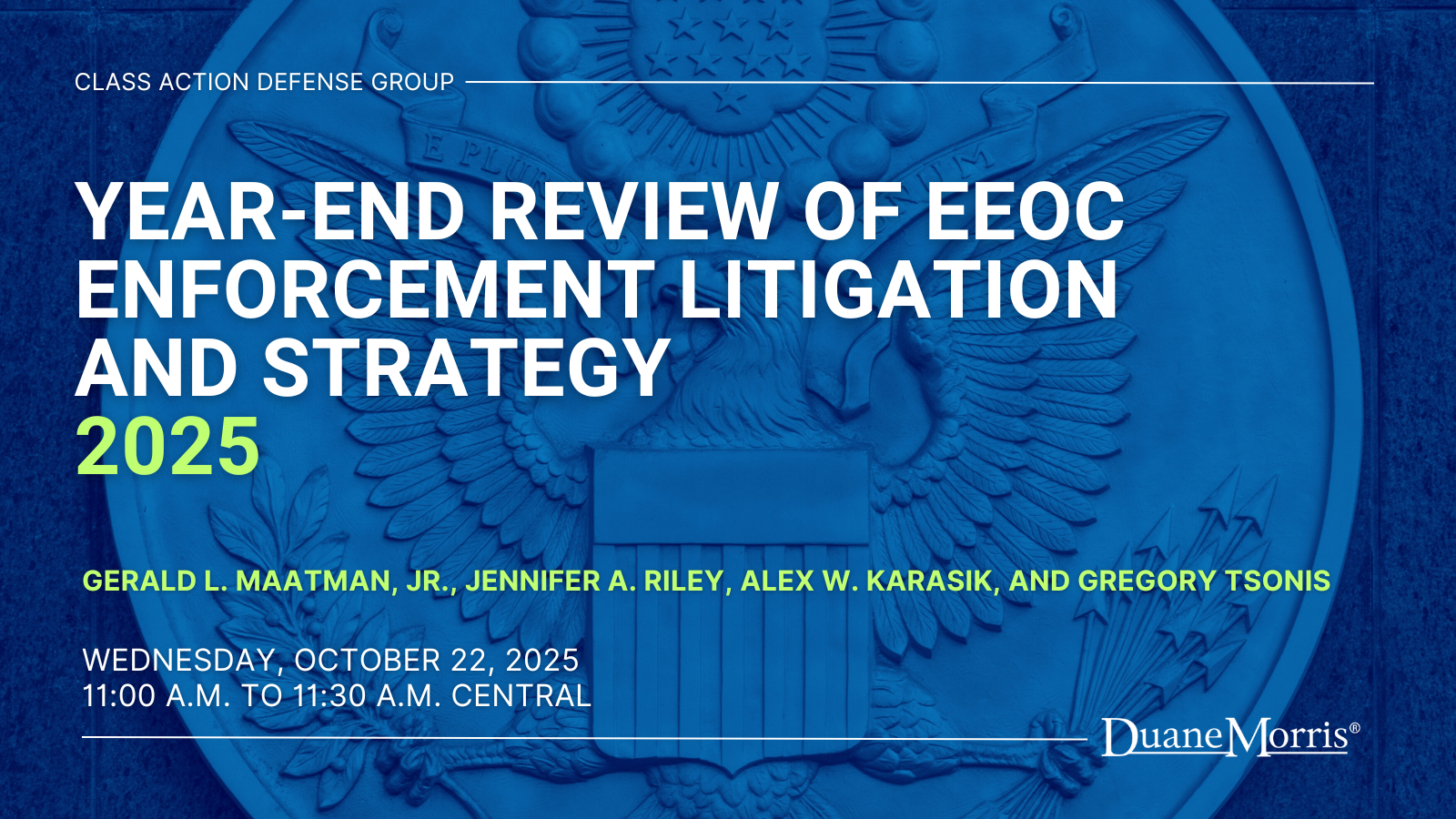
Webinar Replay: Year-End Review Of EEOC Enforcement Litigation & Strategy

By Gerald L. Maatman, Jr., Jennifer A. Riley, Alex W. Karasik, and Gregory Tsonis

Duane Morris Takeaway: Thank you to all the loyal blog readers and followers who joined us for our Year-End EEOC Strategy And Litigation Review webinar! In this 30-minute program, Duane Morris partners Gerald L. Maatman, Jr.Jennifer A. RileyAlex W. Karasik and Gregory Tsonis analyzed the latest impact of the dramatic changes at the U.S. Equal Employment Opportunity Commission, including its new strategic priorities and the EEOC lawsuits filed throughout fiscal year 2025, and discussed how heading into FY 2026 with significant changes implemented by the Trump administration, employers’ compliance with federal workplace laws and agency guidance remains a corporate imperative.

If you were unable to attend the webinar, it is now available on our podcast channel. Click to watch below and stay tuned for important EEOC trends and developments throughout the year.

California Federal Court Narrows CIPA “In-Transit” Liability for Common Website Advertising Technology and Urges Legislature to Modernize Privacy Law

By Gerald L. Maatman, Jr., Justin Donoho, Hayley Ryan, and Tyler Zmick

Duane Morris Takeaways: On October 17, 2025, in Doe v. Eating Recovery Center LLC, No. 23-CV-05561, ECF 167 (N.D. Cal. Oct. 17, 2025), Judge Vince Chhabria of the U.S. District Court for the Northern District of California granted summary judgment to Eating Recovery Center, finding no violation of the California Invasion of Privacy Act (CIPA) where the Meta Pixel collected website event data. Specifically, the Court held that Meta did not “read” those contents while the communications were “in transit.” In so holding, the Court applied the rule of lenity, construed CIPA narrowly, and urged the California Legislature “to step up” and modernize the statute for the digital age. Id. at 2.

This decision is significant because Judge Chhabria candidly described CIPA as “a total mess,” noting it is often “borderline impossible” to determine whether the law – enacted in 1967 to criminalize wiretapping and eavesdropping on confidential communications – applies to modern internet transmissions. Id. at 1. As the Court observed, CIPA “was a mess from the get-go, but the mess gets bigger and bigger as the world continues to change and as courts are called upon to apply CIPA’s already-obtuse language to new technologies.” Id.  This is a “must read” decision for corporate counsel dealing with privacy issues and litigation.

Background

This class action arose after plaintiff, Jane Doe, visited Eating Recovery Center’s (ERC) website to research anorexia treatment and later received targeted advertisements. Plaintiff alleged that ERC’s use of the Meta Pixel caused Meta to receive sensitive URL and event data from her interactions with ERC’s site, resulting in targeted ads related to eating disorders.

ERC had installed the standard Meta Pixel on its website, which automatically collected page URLs, time on page, referrer paths, and certain click events to help ERC build custom audiences for advertising. Id. at 3. Plaintiff alleged that ERC’s use of the Pixel allowed Meta to intercept her communications in violation of CIPA, Cal. Penal Code § 631(a). She also brought claims under the California Medical Information Act (CMIA), the California Unfair Competition Law (UCL), and for common law unjust enrichment. The UCL claim was dismissed at the pleading stage.

ERC later moved for summary judgment on the remaining CIPA, CMIA, and unjust enrichment claims. In a separate order, the Court granted summary judgment on the CMIA and unjust enrichment claims, finding that plaintiff was not a “patient” under the CMIA and that there was no evidence ERC had been unjustly enriched. See id., ECF 168 at 1-2.

The Court’s Decision

With respect to the CIPA claim, the parties disputed two elements under CIPA § 631(a): (1) whether the event data obtained by Meta constituted “contents” of plaintiff’s communication with ERC, and (2) whether Meta read, attempted to read, or attempted to learn those contents while they were “in transit.” ECF 167 at 6.

The Court first held that URLs and event data can constitute the “contents” of a communication because they can reveal substantive information about a user’s activities – such as researching medical treatment. Id. at 7. The court thus deviated from other courts that have held differently on this particular issue when considering additional facts or allegations not addressed by this court (such as encryption, and inability to reasonably identify the data among lines of code).  However, the Court concluded that Meta did not read or attempt to learn any contents while the communications were “in transit.” Instead, Meta processed the data only after it had reached its intended recipient (i.e., ERC, the website operator).

In reaching that conclusion, Judge Chhabria relied on undisputed testimony about Meta’s internal filtering processes: “Meta’s corporate representative testified that, before logging the data that it obtains from websites, Meta filters URLs to remove information that it does not wish to store (including information that Meta views as privacy protected).” Id. at 8.

This evidence supported the finding that Meta’s conduct involved post-receipt filtering rather than contemporaneous “reading” or “learning.” Id. at 9. The Court emphasized that expanding “in transit” to include post-receipt processing would improperly criminalize routine website analytics practices. Because CIPA is both a criminal statute and a source of punitive civil penalties, the Court applied the rule of lenity to adopt a narrow interpretation. Id. at 11-12. The Court further cautioned that an overly broad reading would render CIPA’s related provision (§ 632, prohibiting eavesdropping and recording) largely redundant. Id. at 10.

Finding that Meta did not read, attempt to read, or attempt to learn the contents of Doe’s communications while they were in transit, the court granted summary judgment to ERC on the CIPA claim. Id. at 12.

The opinion concluded by reiterating that California’s decades-old wiretap law is “virtually impossible to apply [] to the online world,” urging the Legislature to “go back to the drawing board on CIPA,” and suggesting that it “would probably be best to erase the board entirely and start writing something new.” Id.

Implications For Companies

The Doe decision narrows one significant avenue for CIPA liability, particularly for routine use of website analytics and advertising pixels. The Northern District of California has now drawn a distinction between data “read” while in transit and data processed after receipt, significantly reducing immediate CIPA exposure for standard web advertising tools.

At the same time, the court’s reasoning underscores that pixel-captured data may be considered by some courts as “contents” of a communication under CIPA, although there is a split of authority on this issue. Companies could therefore face potential exposure under other California privacy statutes, including the CMIA, the California Consumer Privacy Act (CCPA), and the California Privacy Rights Act (CPRA), depending on the data involved and how it is used.

Organizations should continue to inventory the data they share through advertising technologies, minimize sensitive information in URLs, and ensure clear and accurate privacy disclosures. Because the court expressly invited legislative reform, companies should also monitor ongoing case law and potential statutory amendments.

Ultimately, Doe v. Eating Recovery Center reflects a pragmatic narrowing of CIPA’s “in transit” requirement while reaffirming that CIPA was not intended to cover common website advertising technologies or, in any event, should not be interpreted as such given the harsh statutory penalties involved and the rule of lenity — like the Supreme Judicial Court of Massachusetts concluded regarding Massachusetts’ wiretap act, as we previously blogged about here.  While this case is a big win for website operators, companies relying on third-party analytics should treat this decision as guidance—not immunity—and continue adopting privacy-by-design principles in their data collection and vendor management practices.

U.S. Supreme Court Takes Up The Transportation Worker Exemption Again

By Gerald L. Maatman, Jr., Jennifer A. Riley, and Ryan T. Garippo

Duane Morris Takeaways:  On October 20, 2025, in Flower Foods, et al. v. Brock, No. 23-0936 (U.S.), the U.S. Supreme Court granted a writ of certiorari to decide whether last-mile delivery drivers are considered transportation workers, and thus exempt under the Federal Arbitration Act (the “FAA”), when the driver’s route is purely intrastate. 

The decision will have sweeping implications for logistics companies and any business employing delivery drivers across the country.

Case Background

Flower Foods, Inc. (“Flower Foods”) operates one of the largest bakery companies in the United States.  Under Flower Foods’ business model, the company contracts with independent distributors who purchase the rights to distribute products in specific territories.  The delivery-driver distributors “stock shelves, maintain special displays, and develop and preserve positive customer relations.”  Brock v. Flower Foods, Inc., 121 F. 4th 753, 757 (10th Cir. 2024).  Flower Foods “produces and markets the baked goods.”  Id.

Flower Foods delivers the products it produces, via these delivery-driver distributors, who are classified as independent contractors under the Fair Labor Standards Act (the “FLSA”).  These products are usually produced in out-of-state bakeries, but then shipped to a local warehouse, where the local delivery driver picks them up to sell retail stores.  This process is more commonly known as “last-mile delivery.”  Plaintiff Angelo Brock (“Plaintiff or “Brock”), through his company Brock, Inc., was one of those delivery drivers.  When Brock started delivering Flower Foods’ products, he entered into a Distributor Agreement that contained a “Mandatory and Binding Arbitration” clause, which required nearly all disputes to be arbitrated under the FAA.  Id. at 758.

Nonetheless, Brock filed a putative collective and class action under the FLSA, and Colorado labor law, claiming that Flower Foods misclassified him and other delivery-driver distributors as independent contractors.  As a result, Flower Foods moved to compel arbitration, but the U.S. District Court for Colorado denied its request.  The District Court concluded that Brock fell within the ‘‘transportation workers exemption” of the FAA, which exempts transportation workers engaged in interstate commerce from arbitration.  The District Court reasoned that, although Brock did not cross state lines, he ‘‘actively engaged in the transportation of [the company’s] products across state lines into Colorado” and thus was covered by the exemption.  Id. at 759.  Flower Foods appealed that decision to the U.S. Court of Appeals for the Tenth Circuit.

The Lower Court Opinion

On appeal, and on November 12, 2024, Judge Gregory Phillips, writing for the U.S. Court of Appeals for the Tenth Circuit, affirmed the District Court’s decision that delivery-driver distributors were exempt from the FAA.  Judge Phillips explained that, although Brock’s routes were entirely within Colorado, a transportation worker need not cross state lines to qualify for the exemption.  Instead, individuals qualify as transportation workers if they play a direct and necessary role in the interstate flow of goods.

Relying on decisions from the First and Ninth Circuits, which also concluded “that last-mile delivery drivers . . . who make the last intrastate leg of an interstate delivery route . . . are directly engaged in interstate commerce,” the Tenth Circuit reached the same conclusion.  Id. at 762.  The Tenth Circuit explained that “[b]oth [other] circuits focused on whether the goods moved in a continuous interstate journey or as part of multiple independent transactions.”  Id.  Thus, the flow of interstate commerce did not stop when “Brock start[ed] the interstate delivery process by placing orders for products produced in out-of-state bakeries” and Flower Foods “deliver[ed] the products to the agreed-upon warehouse,” only for Brock to “load the products at the warehouse onto his vehicle and deliver[] the goods to retail stores on his intrastate delivery route” within one day.  Therefore, Brock and other delivery-driver distributors were exempt under the FAA even though they did not cross state lines.  But, Flower Foods decided to ask the U.S. Supreme Court to take a third look at the issue.

On October 20, 2025, the U.S. Supreme Court agreed to hear the case, without a making any other comment, in its two-word order holding “certiorari granted.” 

In some ways, this decision is not surprising as the U.S. Supreme Court has decided two recent cases under the transportation worker exemption:  Sw. Airlines Co. v. Saxon, 596 U.S. 450 (2022), and Bissonnette v. LePage Bakeries Park St., LLC, 601 U.S. 246 (2024).  The decision in Brock, however, is poised to be the most impactful of all three of the cases.

Implications For Employers

The importance of the ultimate decision in Brock cannot be overstated.  In both Saxon and Bissonnette, the U.S. Supreme Court dramatically expanded the reach of the transportation worker exemption making it increasingly difficult for employers to move to compel arbitration in class and collective actions brought by workers in logistics-adjacent positions

If workers who engage in wholly intrastate commerce fall within the exemption’s reach, it may require a fundamental re-structuring of many employers’ arbitration programs.  In contrast, if these workers and independent contractors are not exempt from the requirements of the FAA, then employers may finally be able to rest easy knowing that their arbitration defenses remain viable for at least a portion of their workforce.

Although only time will tell what the U.S. Supreme Court will decide, corporate counsel should follow this blog for updates because the authors will be watching this case closely.   Oral arguments are likely to occur during Fall 2025 and a decision will follow in Spring 2026.

Third Circuit Green Lights “Hybrid” Class Action Settlements That Release Unasserted FLSA Claims

By Gerald L. Maatman, Jr., Jennifer A. Riley, and Tyler Zmick

Duane Morris Takeaways:  In Lundeen v. 10 West Ferry Street Operations, LLC, No. 24-3375 (3d Cir. Oct. 16, 2025), the U.S. Court of Appeals for the Third Circuit held that the opt-in requirement set forth in Section 216(b) of the federal Fair Labor Standards Act (“FLSA”) does not prohibit plaintiffs in a class action from settling prospective class members’ unasserted FLSA claims as part of an opt-out class settlement. In a precedential and unanimous opinion, the Third Circuit concluded that Section 216(b) establishes only the mechanism by which FLSA claims may be litigated, not the conditions under which they may be released. The decision is welcome news for both plaintiffs and defendants, as the case makes it easier for parties to settle “hybrid” cases asserting claims under both federal and state wage-and-hour laws.

Background

Plaintiff Graham Lundeen alleged that Defendant – his former employer, and the owner of a restaurant and bar – violated the FLSA and the Pennsylvania Minimum Wage Act (“PMWA”) in connection with its tip-pooling practices. Plaintiff styled his case as a “hybrid” class/collective action, asserting that his FLSA claim should proceed as a collective action under Section 216(b) and that his PMWA claim should proceed as a class action under Federal Rule of Civil Procedure 23(b)(3).

The parties reached a settlement under which class members would agree to release their claims, including those arising under the FLSA, even if class members did not submit claim forms, submit opt-in consent forms, or receive settlement payouts.

The U.S. District Court for the Eastern District of Pennsylvania denied preliminary approval of the proposed settlement, ruling that the settlement “was ‘neither fair nor reasonable’ because it ‘require[d] class members who did not opt in to the FLSA collective to release their FLSA claims.’” Id. at 6.

The Third Circuit’s Decision

After accepting the parties’ interlocutory appeal, the Third Circuit vacated the District Court’s ruling and held that Section 216(b) does not bar approval of a Rule 23 settlement that includes the release of “unasserted FLSA claims.” Id. at 10-11. In reaching its conclusion, the Third Circuit began with the text of Section 216(b):

An action to recover the liability prescribed in the preceding sentences [for failure to pay statutorily required overtime or minimum wages under the FLSA] may be maintained against any employer (including a public agency) in any Federal or State court of competent jurisdiction by any one or more employees for and in behalf of himself or themselves and other employees similarly situated. No employee shall be a party plaintiff to any such action unless he gives his consent in writing to become such a party and such consent is filed in the court in which such action is brought.

Id. at 8-9 (emphasis in original) (quoting 29 U.S.C. § 216(b)).

Acknowledging that no other federal circuit has resolved the split among district courts regarding the propriety of “hybrid” settlements, the Third Circuit ultimately sided “with those courts that have held that § 216(b) of the FLSA provides only a mechanism for opting into collective litigation.” Id. at 10 (emphasis added). In other words, Section 216(b) “requires written consent to litigate FLSA claims, but it does not forbid the release of unasserted claims through a Rule 23(b)(3) opt-out settlement.” Id. at 16 (emphases added).   

The Third Circuit concluded with an important caveat, however, emphasizing that while the FLSA does not prohibit settlements through which Rule 23 class members release unasserted FLSA claims, that does not mean such settlements are always permissible: “[W]hether judges can approve opt-out settlements that release FLSA claims is a different inquiry from whether judges should do so. The former question is an issue of statutory interpretation; the latter turns on whether the settlement is ‘fair, reasonable, and adequate,’ subject to the District Court’s considerable discretion.” Id. at 16-17 (internal citation omitted). Thus, “while § 216(b) does not forbid the release of unasserted FLSA claims in opt-out settlements, such releases remain relevant to the court’s overall Rule 23(e)(2) analysis.” Id. at 18.

Implications Of The Decision

The Lundeen decision provides clarity on the proper scope of “hybrid” settlements involving the simultaneous release of FLSA claims and Rule 23 class claims premised on state wage-and-hour laws. Moving forward, defendants settling such claims will likely rely on Lundeen to broaden their settlements to cover the FLSA claims of all individuals within the Rule 23 settlement class, even if such individuals do not affirmatively opt into the case. This will give defendant-employers closure and alleviate potential risks as to whether settlement class members who did not opt into the case retain their rights to bring FLSA claims.

Parties should take heed of the caveat noted by the Third Circuit, however – namely, that a class settlement involving the release of unasserted FLSA claims will not automatically pass muster. Rather, district courts must still consider whether a class settlement is “fair, reasonable, and adequate.” To increase the likelihood that courts will approve “hybrid” class settlements, parties should ensure their proposed settlements satisfy the Rule 23(e)(2) “fairness” factors, including by: providing clear notice to class members of the scope of the release and a meaningful opportunity to opt out; and ensuring that the relief provided to the class is adequate when accounting for the costs and risks of litigation, the method of distributing relief to the class, and the terms of any proposed award of attorney’s fees.

The Class Action Weekly Wire – Episode 123: Delivery Drivers Seek Approval For $24.8 Million Misclassification Class Action Settlement

Duane Morris Takeaway: This week’s episode of the Class Action Weekly Wire features Duane Morris partners Jerry Maatman and Daniel Spencer with their analysis of a proposed $24.8 million settlement to resolve misclassification claims brought by delivery drivers in 2015.

Check out today’s episode and subscribe to our show from your preferred podcast platform: Spotify, Amazon Music, Apple Podcasts, Samsung Podcasts, Podcast Index, Tune In, Listen Notes, iHeartRadio, Deezer, and YouTube.

Episode Transcript

Jerry Maatman: Thank you again for being here, our loyal blog readers and listeners, for our next episode of our weekly podcast series entitled The Class Action Weekly Wire. I’m Jerry Maatman, a partner at Duane Morris, and joining me today is my colleague, our newest partner, Daniel Spencer of our Los Angeles office. Welcome.

Daniel Spencer: Thanks, Jerry. Great to be here. I appreciate you having me.

Jerry: Today, we’re here to discuss a nearly 10-year settlement in the making in a case called Lawson v. Grubhub. Daniel, can you give us some background on the case and what the plaintiffs’ claims are all about?

Daniel: Absolutely. So, this case has been around for quite some time. It kicked off in late 2015 when a former Grubhub driver, Raef Lawson, filed a suit in California. He claimed Grubhub misclassified him and thousands of others in independent contractors when they were actually employees. Lawson brought his claims for unpaid overtime, failure to reimburse business expenses, and other violations of the California Labor Code. He also brought a representative claim under the California Private Attorneys General Act, and this set the stage for what turned into nearly 10 years of litigation.

Jerry: Let’s start with the first major ruling, a bench trial in 2017. What happened there?

Daniel: That’s correct. So, at the trial, the court ruled against Lawson, finding that he was an independent contractor and not an employee. The court concluded that Grubhub properly classified their drivers as independent contractors under the S.G. Borrello & Sons v. Department of Industrial Relations multi-factor test that was the law at the time. The original test evaluated how much control a potential employer had over the way a worker completed his assigned tasks. To determine whether a worker was classified as an employee or an independent contractor, there were multiple factors that an employer had to look to, such as whether the employee or worker provided the tools for the job, the duration of the working relationship. And Lawson appealed that decision to the Ninth Circuit.

Jerry: While things weren’t, complicated enough, in 2018, the California Supreme Court issued a ruling that replaced the Borrello test with what’s known as a stricter ABC test from the Dynamex v. Superior Court case. The ABC test was then later codified into law with passage of Assembly Bill 5 in 2019. What impact did those developments have on the pending appeal?

Daniel: So, while the AB5 bill was coming into law, Lawson’s appeal was stayed, and the California Supreme Court decided whether the Dynamex ruling would apply retroactively. In 2021, the Ninth Circuit vacated the earlier decision in favor of Grubhub and sent the case back to the district court. The district court was then instructed to determine whether the exemption under the ABC test applied, and if not, to apply the ABC test to the original case.

Jerry: So, we’re back in the lower federal court. What was the outcome? Was it any different than the original bench trial?

Daniel: It was, and the Ninth Circuit vacated the decision. The district court ruled that the plaintiff was actually an employee in 2023. Then, the district court determined that a Grubhub delivery driver is an employee and not an independent contractor for minimum wage and overtime claims under the ABC test.

Jerry: Can you explain to our listeners what the ABC test entails and measures?

Daniel: The ABC test is a three-part test that an employer must meet if they want to classify a worker as an independent contractor. The worker is only an independent contractor if they meet all three parts of the test. The first part is the worker has to be free from control and direction of the hirer in relation to the performance of the work, both under the contract and in fact. The worker also, under the second part, has to perform work that’s outside the usual course of the hirer’s business. And finally, the third factor is that the worker is customarily engaged in an independent, established trade or occupation or business of the same nature as the work performed by the hirer. Grubhub tried to show that an exemption to the ABC test applied, but the court disagreed, holding that Grubhub’s delivery drivers are necessary to Grubhub’s business, which makes sense. That made Lawson an employee. The court awarded Lawson minimal damage for his individual minimum wage claims but found that Grubhub was not liable for any overtime compensation because Lawson didn’t work any overtime hours.

Jerry: That’s quite a turn of events, but I understand Lawson wasn’t satisfied with the result, correct?

Daniel: No. And the parties ultimately agreed to settle the remaining claims under a deal that came together in April of 2024 Just before the remedies bench trial was set to begin, in August of this year, Lawson moved for preliminary approval of a $24.75 million settlement. That proposed class is about 60,000 drivers in California who use Grubhub for at least one delivery since December of 2014. Under the deal, each class member will get at least $25. The preliminary settlement includes a $100,000 service award for Lawson, $260,000 set aside for administration costs, and $2 million in PAGA penalties, most of which will go to the state.

Jerry: And I assume plaintiffs’ counsel is interested in garnering a third of that settlement of $24.75 million?

Daniel: Yes, approximately 33%, which is fairly standard in large class actions of this type, especially ones that drag on for nearly a decade, like this case. If the court grants preliminary approval, the deal will move forward into the notice phase, there will be an opportunity for people to object, and then there will be a final settlement and approval hearing.

Jerry: Well, that’s quite a journey. Dwight D. Eisenhower and the troops invaded Normandy on D-Day in lesser time than it took for this case to wind through the court system, but it’s certainly a cautionary tale for employers in general, and gig companies in particular, in terms of what sort of impact misclassification decisions can have in terms of the litigation setting.

Well, thanks, Daniel, for your debut appearance on the podcast, and for explaining this settlement and what it meant, both to the parties and to other employers. And thanks for our loyal blog listeners for being here. We’ll be watching this settlement closely in terms of the settlement approval process and bring you further PAGA and California-related class updates as they occur. So don’t forget to subscribe to our blog and to our weekly podcast series, and we’ll see you next time.

Daniel: Thanks, Jerry, it was a pleasure to be here.

Robo Boss Rejection: California Governor Newsom Pulls The Plug On AI Bill For Overly Broad Restrictions

By Alex. W. Karasik, Brian L. Johnsrud, and George J. Schaller

Duane Morris Takeaways:  On October 13, 2025, California Governor Gavin Newsom, issued a written statement declining to sign Senate Bill 7 – called the “No Robo Bosses” Act (the “Act”).  While the Act aimed to restrict when and how employers could use automated decision-making systems and artificial intelligence, Governor Newsom rejected the proposed legislation in terms of the Act’s broad drafting and unfocused notification requirements.  Governor Newsom’s statement reflects an initial rebuttal to a wave of pending AI regulations as states wrestle with suitable AI guidance.  Given the pro-employee tendencies of Governor Newsom and California regulators generally, this outcome is a mild surprise.  Employers nonetheless should expect continued scrutiny of AI regulations before enactment.

This legislative activity surely sets the stage for what many believe is the next wave of class action litigation.

Overview Of SB 7: The “No Robo Bosses” Act

The Act was first introduced in December 2024.  After several amendments, it was passed by the Senate Committee on September 23, 2025 for review and signature by Governor Newsom.  The Act’s key proposals included prohibitions on employers solely using AI to make disciplinary or termination decisions, requiring human input for AI disciplinary or termination decisions, detailed advance notice requirements for use of AI in hiring or employment-related decisions, and post-notice requirements if an employer primarily relied on AI for disciplinary or termination decisions. 

The Act focused on automated-decision making systems (“ADS”) and “employment-related decisions.”  Under the Act, an ADS is defined as “any computational process derived from machine learning, statistical modeling, data analytics, or artificial intelligence that issues simplified output, including a score, classification, or recommendation, that is used to assist or replace human discretionary decision making and materially impacts natural personals.”  With this definition, ADS incorporated a swath of technologies utilized by many employers such as call analytic tools, automated scheduling platforms, keystroke and computer monitoring software, and AI-based training programs.  SB 7 also defined “employment-related decisions” as “any decision by an employer that materially impacts a worker’s wages, benefits, compensation, work hours, work schedule, performance evaluation, hiring, discipline, promotion, termination, job tasks, skill requirements, work responsibilities, assignment of work, access to work training opportunity, productivity requirements, or workplace health or safety.” 

The Act also incorporated various pre-notice and post-notice requirements.  Employers using an ADS system to make employment-related decisions (excluding hiring) would have been required to provide “pre-notice” at least 30-days before deploying an ADS, and 30-day notice to new hires for any ADS use.  Similarly, the Act included “post-notice” provisions regarding post-notices when an employer relied on an ADS to make a discipline, termination, or deactivation decision, and to provide the impacted worker with notice at the time the employment decision is made.  Both notices had requirements for the notice to be written in plain language, directed as a routine worker communication, and provided in an accessible format. 

Violations under the “No Robo Bosses” Act included a proposed civil penalty of $500 per violation, with enforcement authority vested in the Labor Commissioner and public prosecutors of California.  The proposed Act did not include a private right of action.  

Governor Newsom’s Veto Of The Act

Governor Newsom’s veto of the Act centered on concerns of unspecified misuses of ADS technology and unfocused notification requirements.  Governor Newsom did recognize the concerns associated with ADS in employment-making decisions but argued the Act’s “proposed solution fail[ed] to directly address incidents of misuse.”  He also found that the restrictions embedded in the Act were broad and removed “a potentially valuable tool” when ADS systems are properly applied and properly employed.  Governor Newsom’s critique of the Act demonstrates that the Act did not distinguish the benefits of ADS systems compared to risks associated with ADS use cases.   Accordingly, Governor Newsom vetoed SB 7.

Implications Of The Veto

California employers do not have to mitigate their ADS systems yet based on Governor Newsom’s veto of SB 7, but given the Governor’s comments, its possible new legislation will be introduced to narrow the use of ADS systems in employment decisions.  Governor Newsom’s veto of the Act further represents a growing concern among ADS systems and AI technologies legislative policies – namely that broad legislative efforts cannot efficiently or effectively address emerging technologies.  While employers can expect other states may propound ADS and AI legislation in the context of employment decision-making, employers should consider that if the notoriously pro-employee State of California struck down legislation as overly broad and unfocused – it may take some time for other jurisdictions to determine how to finesse the legislative landscape.

Employers should continue to monitor federal developments in this area, as well.  In July 2023, the federal “No Robot Bosses Act,” S.2419, was introduced in the Senate.  While the bill has not been enacted, its provisions include similar limitations on the use of automated systems and would require human oversight before an automated decision is finalized.

A Recap Of The R.I.S.E. AI Conference At University Of Notre Dame 

By Alex W. Karasik

Duane Morris Takeaways Artificial Intelligence has brilliantly transformed society to the point where no industry can fully separate from its impact. But the fruits of this technology must be carefully curated to ensure that its adoption is ethical.  An evolving legislative landscape and billion-dollar class action litigation industry loom large. 

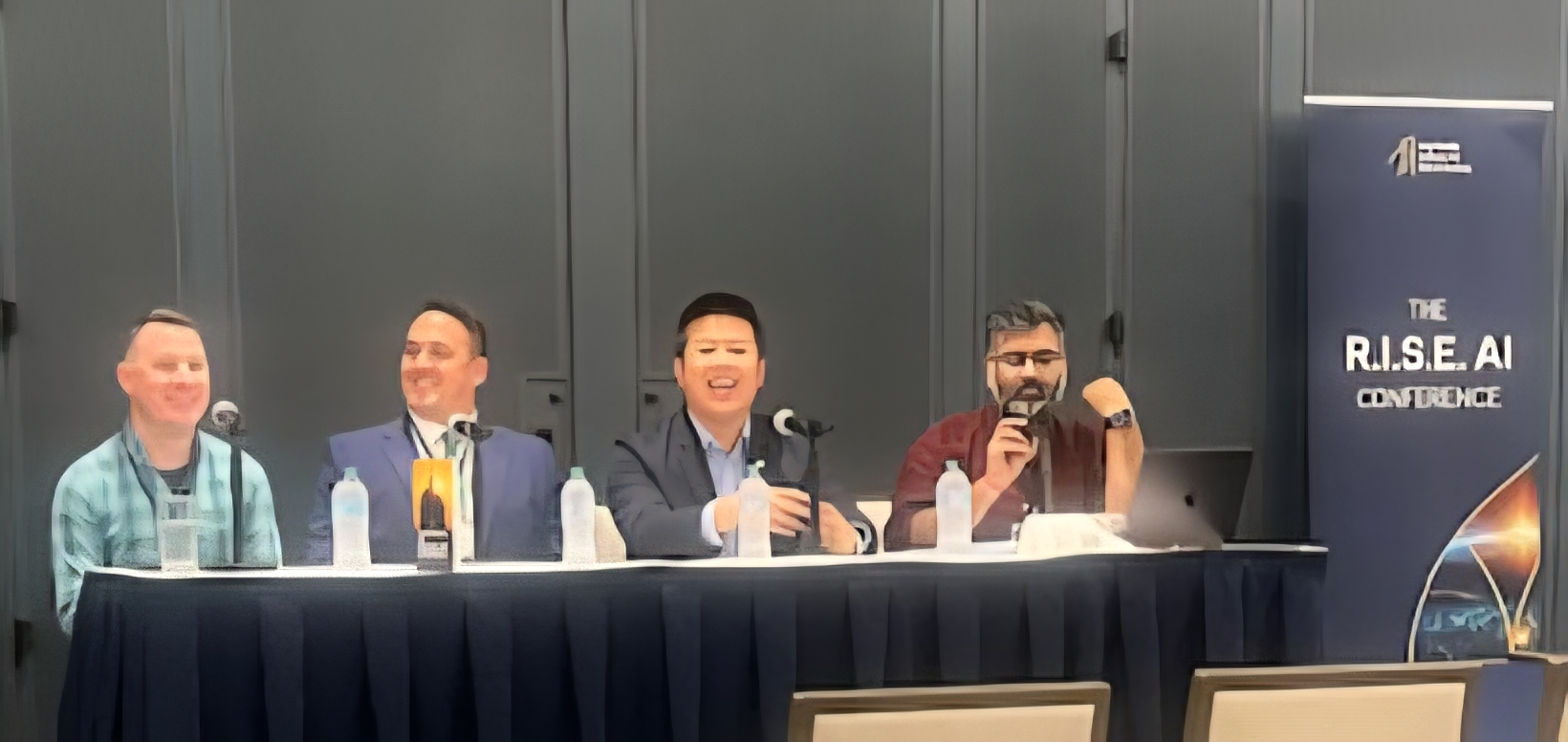
This week, at the University of Notre Dame’s inaugural R.I.S.E. AI Conference in South Bend, Indiana, Partner Alex W. Karasik of the Duane Morris Class Action Defense Group was a panelist at the highly anticipated session, “Challenges And Opportunities For Responsible Adoption Of AI.”  The Conference, which had over 300 attendees from 16 countries, produced excellent dialogues on how cutting-edge technologies can both solve and create problems, including class action litigation.

The Conference covered a wide range of global issues affected by AI.  Some of the topics included AI’s impact on data privacy, information governance, healthcare, education, voting, and its overall impact on Latin America – including discussions about how large language models are developing when machines are trained in non-English languages.  For organizations who deploy this technology, or are thinking about doing so, the Conference was informative in terms of AI’s utility and risk.  The sessions provided valuable insight from a broad range of constituents, including business leaders, world-renowned academic scholars, technology professionals – and a lawyer from Chicago. 

I had the privilege of discussing AI’s integration into the workplace in two areas: (1) proactive implementation; and (2) reactive class action litigation risk. There is no “one-size-fits-all” checklist for organizations to incorporate AI.  But there are several overarching principles that will likely be important factors when establishing an ethical and legally compliant AI framework. These include: (1) creating an AI steering committee with a diverse collection of viewpoints, including Legal, HR, IT, business operations, and other end-users – such as tech-savvy employees – who can collectively opine on the benefits and concerns of AI in the workplace; (2) crafting a robust yet unambiguous policy to ensure that all members of an organization as using AI responsibly and consistently; (3) implementing training programs for both managers and employees on how to equitably implement the AI policy, and understand its interplay with other policies such as EEO; (4) communicating with AI vendors to understand how AI models were trained; and (5) conducting audits before and after implementation to ensure AI use does not result in a disparate impact on certain demographics of applicants or employees.

From a litigation perspective, I discussed the “moving target” of AI laws popping up around the country, which may create compliance challenges.  While most of these laws are guided by the same fundamental principles (i.e. transparency and disclosure when AI is being used in the hiring process), accounting for minor variations may ultimately present compliance challenges for employers with national and international operations.  The class action litigation and EEOC-initiated systemic discrimination litigation will inevitably follow — as the EEOC v. iTutorGroup, Inc., et al., Case No. 1:22-CV-02565 (E.D.N.Y.) settlement (see our blog post) and currently pending Mobley v. Workday, Inc., Case No. 3:23-CV-00770 (N.D. Cal.) class action lawsuit (see our blog post) confirm.

Overall, I was amazed by the amount of business and academic talent at the Conference.  The Conference was an incubator for issue-spotting, brainstorming, and problem-solving.  I am grateful for the opportunity to learn about the statistical impact of AI on organizations – and thankful to my many new PhD friends for sharing explanations of their empirical studies.  Looking forward, I am optimistic that when constituents from all over the world in a variety of professions collaborate together, we will responsibly unlock AI’s greatest potential.

For more information about Duane Morris’s endeavors in the Artificial Intelligence space, please visit our Firm’s AI webpage here.

© 2009- Duane Morris LLP. Duane Morris is a registered service mark of Duane Morris LLP.

The opinions expressed on this blog are those of the author and are not to be construed as legal advice.

Proudly powered by WordPress