By Gerald L. Maatman, Jr., Jennifer A. Riley, and Daniel D. Spencer
Duane Morris Takeaway: Thank you to all the loyal blog readers and followers who joined us for our Year-End EEOC Litigation and Strategy Review webinar! In this 30-minute program, Duane Morris partners Gerald L. Maatman, Jr., Jennifer A. Riley, andDaniel D. Spencer analyzed the latest impact of enforcement litigation at the U.S. Equal Employment Opportunity Commission, including its new National Enforcement Plan and strategic priorities established in fiscal year 2026 and the enforcement lawsuits filed over the past 12 months, and discussed how employers can navigate the EEOC’s latest enforcement initiatives and implement strategies designed to minimize the risk of drawing the agency’s scrutiny.
If you were unable to attend the webinar, it is now available on our podcast channel. Click to watch below and stay tuned for important EEOC trends and developments throughout the year.
By: Gerald L. Maatman, Jr, Daniel D. Spencer, Jamar D. Davis, and Kenny T. Tran
Duane Morris Takeaways: On September 18, 2026, in Sara Reyes v. Grow Smart Labor, Inc., No. 1:24-CV-00028, 2026 U.S. Dist. LEXIS 213967 (E.D. Cal. Sep. 18, 2026), Judge Jennifer L. Thurston of the U.S. District Court for the Eastern District of California denied class certification in a California wage-and-hour action after concluding that, although Plaintiff could identify a common question concerning whether the Donohue meal period presumption arose from Defendant’s timekeeping data, the rebuttal of that presumption would require extensive individualized farm-by-farm, crew-by-crew and day-by-day inquiries, demonstrating that individualized inquiries dominated over common questions.
Case Background
The case arose from Plaintiff Sara Reyes’ employment with Defendant Grow Smart Labor, a farm labor contractor that supplies agricultural workers to third-party farms. Id. at *1. Grow Smart’s workforce was anything but uniform: employees were assigned to different crops, locations, supervisors, and jobs; some were paid hourly while others were paid on a piece-rate basis; and the company used different timekeeping systems, including crew timecards and individual timecards. Id. at *8. Grow Smart presented evidence that its operations and timekeeping practices varied substantially by assignment, such that “farm-by-farm” or “crew-by-crew” investigation regarding meal breaks would ensue. Id. at *8-9.
The Court’s Reasoning
The meal period analysis was the centerpiece of the decision. The District Court recognized that under Donohue v. AMN Services, LLC, 11 Cal. 5th 58 (2021), time records showing missed, short, or delayed meal periods without corresponding compensation can create a rebuttable presumption that the employer violated California law. Id. at *4. But the Court emphasized that the Donohue presumption does not eliminate the separate requirements imposed by Federal Rule of Civil Procedure 23. Id. at *6.
Reyes’ expert provided class-wide evidence by analyzing Grow Smart’s timekeeping data, finding that almost none of Grow Smart’s records included entries that showed when employee meal breaks began or ended. Id. at *7. Grow Smart did not challenge the expert’s experience or qualifications, nor did it offer any contrary analysis of its own data or any rebuttal expert opinions. Id. at *7-8.The District Court concluded that Reyes had demonstrated a common question of law and fact concerning whether the class’s timekeeping data could trigger the Donohue presumption. Id. at *8.
However, Grow Smart successfully argued, to which the magistrate judge agreed to and found, that Reyes had not demonstrated that common questions are likely to predominate the rebuttal portion of the case: the degree of individualized inquiries needed to assess meal period compliance across all of Grow Smart’s California operations. Id. Grow Smart employees worked at different farms under different supervisors, some worked in crews while others had individualized timekeeping, and records varied from assignment to assignment. Id. Most importantly, Grow Smart presented evidence that whether meal periods were required to be recorded could depend on whether operations “ceased” during the relevant meal period. Id. at *8-9.The Court therefore anticipated that a class trial would devolve into “a long series of back-and-forth debates” concerning “what happened on Farm A versus Farm B or under the leadership of Supervisor 1 versus Supervisor 2.” Id. at *9.
The individualized nature of those inquiries also affected Reyes’ proposed class under Rule 23(b)(2). The Magistrate Judge found that a class action cannot be certified under 23(b)(2) when “each class member would be entitled to an individual award of monetary damages” and “a different injunction or declaratory judgment”, which Reyes did not object to. Id. at *9-10. Since Reyes no longer worked for Grow Smart or cited any plans to return, she had not demonstrated that she could pursue prospective relief on behalf of a class of current employees, which is a prerequisite to seek such relief on behalf of a class of current employees. Id. at *10.
Takeaways and Implications for Employers
For employers defending wage-and-hour class actions, Reyes underscores an important distinction between identifying a statistical pattern and proving a class-wide violation. A plaintiff may be able to point to a common data anomaly, such as missing meal punches or apparent deductions, but the defense can still defeat certification by demonstrating that the meaning of those records depends on operational context. Here, the significance of a missing punch could not be evaluated in a vacuum because the company’s vast agricultural operations used different recordkeeping practices, including crew-level records that did not necessarily apply uniformly across business functions.
The decision also highlights the value of developing a factual record demonstrating operational variation before the certification stage. Employers should preserve and present evidence concerning different worksites, supervisors, scheduling practices, timekeeping systems, compensation methods, written policies, policy changes, and the actual practices followed in the field. Reyes shows how those facts can transform an apparently simple “missing meal punch” case into a series of individualized factual inquiries that plaintiffs cannot readily resolve through a single database or expert model. The result is a defense-friendly application of Rule 23’s predominance requirement: common data may establish a common issue, but it does not necessarily establish a common answer to the ultimate liability question.
By Gerald L. Maatman, Jr, Jennifer A. Riley, and Daniel D. Spencer
Mark your calendars for our bi-annual program analyzing the latest EEOC developments: Wednesday, October 14, 2026 from 11:00 a.m. to 11:30 a.m. Central. Reserve your virtual seat for the program here.
Join Duane Morris partners Gerald L. Maatman, Jr., Jennifer A. Riley and Daniel D. Spencer for a live panel discussion analyzing the latest impact of enforcement litigation at the U.S. Equal Employment Opportunity Commission, including its new National Enforcement Plan and strategic priorities established in fiscal year 2026 and the enforcement lawsuits filed over the past 12 months. Our virtual program will empower corporate counsel, human resource professionals and business leaders with key insights into the EEOC’s latest enforcement initiatives and provide strategies designed to minimize the risk of drawing the agency’s scrutiny.
By Gerald L. Maatman, Jr., Jennifer A. Riley, Daniel D. Spencer, and Kenny T. Tran
Duane Morris Takeaways: On June 30, 2026, Governor Newsom signed Assembly Bill 2155 (AB 2155), which amends California Code of Civil Procedure section 1281 to provide that any arbitration agreement deemed unenforceable under the Federal Arbitration Act (FAA) is likewise unenforceable under the California Arbitration Act (CAA). The amendment is designed to align California law with federal law by ensuring that the same limitations, exceptions, and exemptions governing the enforceability of arbitration agreements under the FAA also apply under the CAA.
Overview
AB 2155 expressly incorporates two significant FAA exemptions into the CAA, including: (1) the “transportation worker” exemption, which applies to contracts of employment for seamen, railroad employees, and other classes of workers engaged in foreign or interstate commerce; and (2) the federal Ending Forced Arbitration of Sexual Assault and Sexual Harassment Act of 2021 (EFAA), which renders predispute arbitration agreements unenforceable with respect to claims involving sexual assault or sexual harassment disputes.
AB 2155 becomes effective on January 1, 2027, and the legislation contains no indication that it applies retroactively. Prior to this amendment, employers frequently argued that even if the FAA did not govern an arbitration agreement, the agreement remained enforceable under the CAA because California law did not recognize the FAA’s transportation worker exemption. AB 2155 eliminates that argument. Beginning January 1, 2027, if an arbitration agreement is unenforceable under the FAA due to the transportation worker exemption, it will likewise be unenforceable under the CAA.
Implications for Employers
Employers, particularly those whose operations involve interstate commerce, should review their arbitration agreements and dispute resolution strategies in anticipation of AB 2155’s effective date. The amendment is likely to increase litigation challenging the enforceability of arbitration agreements, including class and representative actions brought by transportation workers and claims falling within the scope of the EFAA.
By Gerald L. Maatman, Jr., Daniel D. Spencer, and George J. Schaller
Duane Morris Takeaways: On June 10, 2026, in Citizens of Humanity, LLC v. John Donboli et al., No. D085849, 2026 Cal. App. LEXIS 360 (Cal. App. June 10, 2026), the California Court of Appeal affirmed the trial court’s decision in favor of Defendants in a malicious prosecution action stemming from a consumer class action over “Made in the U.S.A.” labeling on jeans. The Court of Appeal held that a familial relationship between a named plaintiff and class counsel does not, as a matter of law, deprive a class action of probable cause, and that Apple Computer, Inc. v. Superior Court, 126 Cal.App.4th 1253(2005), does not establish a per se bar on relatives of class counsel serving as class representatives.
For companies that have faced consumer class actions and are considering malicious prosecution counterclaims, this decision underscores that the probable cause standard remains a high bar and requires a showing that any reasonable attorney would agree the underlying claims were totally and completely without merit.
Case Background
Citizens of Humanity LLC is a jeans manufacturer whose products had “Made in the U.S.A.” labels, despite Citizens Ingrid-style jeans having fabrics and components sourced from Japan and China. Citizens of Humanity, LLC v. John Donboli et al., No. D085849, 2026 Cal. App. LEXIS 360, *7 n. 2 (Cal. App. June 10, 2026).
In June 2014, attorneys John Donboli and JL Sean Slattery of Del Mar Law Group LLP filed a putative class action against Citizens in federal court, alleging the labels violated former California Business and Professions Code § 17533.7, the Consumers Legal Remedies Act, and the Unfair Competition Law. Id. at *3.
In the federal court action against Citizens, Louise Clark served as the named-plaintiff who previously purchased Citizens’ Ingrid-style jeans. Citizens later discovered Clark was attorney Slattery’s sister-in-law. Id. Based on this familial relationship, Citizens moved to disqualify Del Mar Law Group as class counsel. While that motion was pending, Clark filed a motion to withdraw and substitute a new named-plaintiff, Coni Hass. Id. at *4. The federal court granted the motion to withdraw and substitute and found that the substitution “vitiate[d]” Citizen’s disqualification motion and also held Citizens “failed to demonstrate that [Clark] or her counsel . . . acted in bad faith” in requesting substitution. Id.
As the action was pending, the California Legislature amended § 17533.7 to permit “Made in the U.S.A.” labeling where foreign-sourced materials constitute no more than 5% (or 10% if not domestically sourceable) of the final wholesale value of the product. Id. In response to the amendment, Citizens moved to dismiss. The district court granted Citizens’ motion and allowed Hass leave to amend, but Hass elected not to amend and the case was dismissed. Id.
In February 2018, Citizens filed this action for malicious prosecution against attorneys Donboli and Slattery, Del Mar Law Group, and former named plaintiffs Clark and Hass (collectively “Defendants”).
Defendants moved to strike the complaint under the anti-SLAPP statute, but the trial court denied their motion, and that ruling was later affirmed by this Court of Appeal (see Citizens of Humanity, LLC v. Hass, 46 Cal.App.5th 589 (2020)). Citizens of Humanity, LLC, 2026 Cal. App. LEXIS 360 at *5.
In affirming, the Court of Appeal “found two conflicting narratives . . . regarding the origin of the federal mislabeling case.” Id. at *5-6. It concluded one possible narrative was “that Clark was a shill plaintiff, and [her attorneys] were aware of this fact.” The second possible narrative focused on Hass and whether Defendants “knew ‘that Hass purchased Ingrid-style jeans with a label that said ‘Made in the U.S.A.’ and components of those jeans came from a foreign country[.]’” Id. at *6.
After affirming, the case was remanded and the matter proceeded to trial. After opening statements, and after Citizens presented testimony from the company’s founder, the parties asked the court “to ‘review certain exhibits, [and] deposition testimony from Clark and Hass’ and the parties ‘agreed to have the [c]ourt make a determination on probable cause’” consequently waiving their right for the jury to decide that issue. Id. at *7. After accepting evidence and hearing argument the trial court ruled in favor of Defendants concluding “Citizens had not established [Defendants] lacked probable cause for” the previously filed putative class action and entered judgment for Defendants. Id. at *7-8. Citizens appealed.
The Court of Appeal’s Decision
The Court of Appeal affirmed the decision of the trial court.
Citizens’ primary argument on appeal was that Defendants lacked probable cause as a matter of law because Clark, as Slaterry’s sister-in-law, was an improper class representative under Apple Computer, Inc. v. Superior Court. Citizens relied on the Apple court’s observation that “the majority of courts . . . have refused to permit class attorneys, their relatives, or business associates from acting as the class representative.” Citizens of Humanity, LLC, 2026 Cal. App. LEXIS 360 at *10-11. The Court of Appeal rejected this argument on multiple grounds.
First, the Court of Appeal distinguished Apple factually and noted that the plaintiff in that case was an attorney at one of the representing firms who stood to gain monetarily from recovery of attorney fees. Id. at *11. The Court of Appeal reasoned that Apple addressed a “‘financial relationship and interdependence between’ the plaintiff and associated.” Id. Here, however, Citizens presented no information “about any ‘financial relationship’ between Slattery and Clark.” The Court of Appeal also determined it was not “reasonable to presume ‘interdependence’ solely based on [Slattery and Clark’s] relationship as siblings-in-law.” Id.
Second, the Court of Appeal held that the relevant passage in Apple is, “at best” “dictum that cannot bind very reasonable attorney on threat of a malicious prosecution judgment.” Id. at *12.
Third, it reasoned that even if a disqualifying conflict existed, it would not be fatal to the putative class action against Citizens. As the Court of Appeal noted “Clark could have pursued the claim with different counsel, or [Del Mar] Law Group could have proceeded with a different representative plaintiff, which is what the district court authorized here after Clark decided to withdraw.” Id. at *13.
Accordingly, the Court of Appeal affirmed and agreed with “the trial court’s conclusion that Apple is not determinative of the probable cause analysis here.” Id.
Implications For Corporate Litigants
For companies facing consumer class actions, including those with origin-of-manufacture claims such as “Made in the U.S.A.,” this decision serves as a reminder that labeling must comply with current statutory standards.
Even assuming a company is successful in defeating a consumer class action, then companies considering malicious prosecution actions should take note that class representative conflicts, including familial relationships with class counsel, are evaluated on a fact-specific basis. There is no per se rule of disqualification, and even where a conflict exists, it goes to the fitness of counsel or the representative, not the viability of the underlying claim itself. As the Court of Appeal noted here, the class action can proceed with substitute counsel or a substitute plaintiff.
The decision in Citizens of Humanity, LLC, serves as a cautionary tale that even relatives of class counsel can potentially serve as class representatives and further narrows adequacy challenges to class certification. It also demonstrates another way class counsel can creatively select representative plaintiffs while still allowing courts to scrutinize representative plaintiffs for actual conflicts on a case-by-case basis.
By Gerald L. Maatman, Jr., Jennifer A. Riley, and Daniel D. Spencer
Duane Morris Takeaways: We were honored to have so many loyal blog readers join us for our annual Mid-Year Review of EEOC Litigation And Strategy For Fiscal Year 2026 yesterday. The full video presentation, hosted by Jerry Maatman, Jennifer Riley, and Daniel Spencer, is below:
The EEOC’s fiscal year (“FY 2026”) spans from October 1, 2025, to September 30, 2026. Through the midway point, EEOC has filed 31 enforcement lawsuits, an uptick when compared to the 22 lawsuits filed in the first half of FY 2025, and the 14 lawsuits filed in the first half of FY 2024.. Traditionally, the second half of the EEOC’s fiscal year – and particularly in the final months of August and September – are when the majority of filings occur. However, an early analysis of the types of lawsuits filed, and the locations where they are filed, is informative for employers in terms of what to expect during the fiscal year-end lawsuit filing rush in September.
Cases Filed By EEOC District Offices
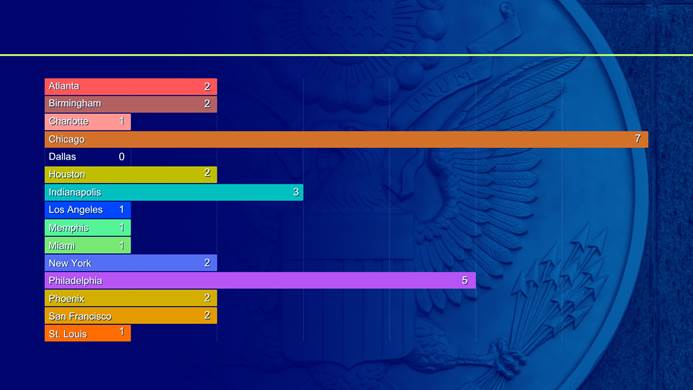
In addition to tracking the total number of filings, we closely monitor which of the EEOC’s 15 district offices are most active in terms of filing new cases over the course of the fiscal year. Some districts tend to be more aggressive than others, and some focus on different case filing priorities. The following chart shows the number of lawsuit filings by EEOC district office.
The most notable trend thus far is the 7 lawsuits filed by the Chicago District Office, followed by the 5 filings by the Philadelphia District Office, 3 filings by Indianapolis, 2 filings each for Atlanta, Birmingham, Houston, New York, Phoenix, and San Francisco, and one filing each for Charlotte, Los Angeles, Memphis, Miami, and St. Louis offices. Dallas has yet to see a lawsuit filing for FY 2026. By comparison, similarly in FY 2025 Chicago and Philadelphia led the pack in lawsuit filings, followed by Indianapolis, Phoenix, Houston, Atlanta, and Birmingham.
Analysis Of The Types Of Lawsuits Filed In First Half Of FY 2026
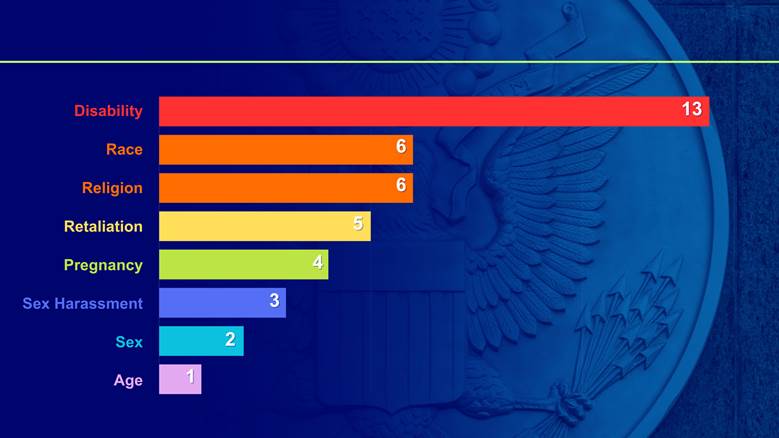
We also analyzed the types of lawsuits the EEOC filed throughout the first six months, in terms of the statutes and theories of discrimination alleged, in order to determine how the EEOC is shifting its strategic priorities. The chart below shows the EEOC filings by allegation type.
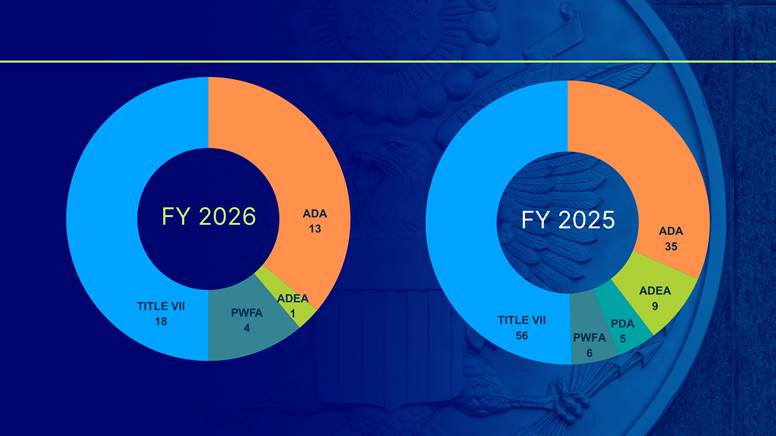
Title VII cases once again made up the majority of cases filed. They constituted 50% of all filings in FY 2026 (same as FY 2025, down from 58% of all filings in FY 2024, and significantly down from 68% of all filings in FY 2023). Overall, ADA cases made up the next most significant percentage of the EEOC’s FY 2026 filings for a total of 40%. This is up from 31% in FY 2025, yet similar to the 42% of filings in FY 2024. So far there has only been one filing under the ADEA in FY 2026, down from the uptick in ADEA filings in FY 2025. The EEOC filed 9 ADEA cases in FY 2025, compared to 6 age discrimination cases in FY 2024, 12 age discrimination cases in FY 2023, and 7 age discrimination cases in FY 2022. In the first six months of FY 2026, the EEOC filed 4 cases under the Pregnant Worker’s Fairness Act, on track compared to 6 filings in FY 2025 and 3 filings in FY 2024. So far, no cases filed under the Pregnancy Discrimination Act. Notably absent from FY 2026’s filings are cases brought under the Equal Pay Act and Genetic Information Nondiscrimination Act – two areas that the EEOC repeatedly has cited among its enforcement priorities prior to the second Trump Administration.
The graph set out below shows the number of lawsuits filed according to the statute under which they were filed (Title VII, Americans With Disabilities Act, Pregnancy Discrimination Act, Equal Pay Act, and Age Discrimination in Employment Act).
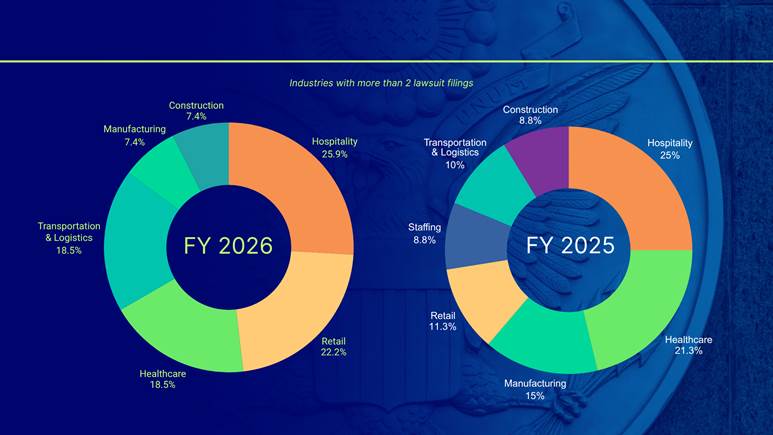
The industries impacted by EEOC-initiated litigation have also remained consistent in FY 2026. The chart below details that hospitality, healthcare, and retail employers have maintained their lead as corporate defendants in the last 18 months of EEOC-initiated litigation. In the first six months of FY 2026, two industries remained in the EEOC’s targets: Hospitality and Retail. On a percentage basis, Hospitality (Restaurants / Hotels / Entertainment) comprised 25.9% of filings, and Retail had 22.2% of filings. A key difference in FY 2025 compared to FY 2024 is Retail (22.2% of FY 2026 filings) overtaking Healthcare (18.5% of FY 2026 filings) and Manufacturing (7.4% of FY 2026 filings) as the next most targeted industry. Transportation & Logistics entered double digit enforcement activity, at 18.5% of the filings. The remaining industry with at least 2 filings is Construction, representing 7.4% of the filings.
Notable 2026 Lawsuit Filings
Disability Discrimination
In EEOC v. Schneider National, Inc., Case No. 26-CV-905 (D. Md. Mar. 4, 2026), the EEOC filed an action alleging that the defendant, Schneider National, Inc., a nationwide transportation and logistics company, violated the ADA when it refused to reasonably accommodate an applicant with PTSD by denying her request to bring her service dog to work, and withdrawing its job offer because of her disability. The EEOC asserted that the defendant extended a conditional offer of employment to the job candidate. However, next day, after learning that she had post-traumatic stress disorder and needed her service dog, the company withdrew her job offer pending further review. In response to Schneider’s request for additional information, the woman disclosed that her dog was certified as a service animal, trained to alleviate and prevent symptoms of PTSD, and had successfully accompanied her in the truck while she trained and obtained her Class A commercial driver’s license. The EEOC asserted that the defendant refused to allow her to drive with her service dog as an accommodation.
Religious Discrimination
In EEOC v. Blue Eagle Contracting, Inc., Case No. 26-CV-226 (D. Nev. Mar. 31, 2026), the EEOC filed an action against the defendant, a bulk mail delivery contractor for the U.S. Postal Service, alleging religious discrimination in violation of Title VII when it allegedly failed to return a Christian employee truck driver to a weekday shift so he could attend Sunday morning church services. According to the EEOC’s lawsuit, the defendant hired the driver, who informed supervisors of his religious obligations on Sundays stemming from his Christian faith. He was assigned a weekday delivery route, which he worked for several months until he volunteered on an emergency basis to fill a Sunday morning shift after a coworker unexpectedly resigned. The driver reminded his supervisors multiple times that he needed to attend church services on Sunday mornings and said he was only willing to work Sunday mornings until a replacement driver for the weekend shift was hired. The EEOC asserted that although the defendant hired a replacement, it continued to schedule the driver for Sunday shifts, while the replacement drove the weekday shift. The driver ultimately resigned from his position, and the EEOC alleged that the defendant’s failure to accommodate the drivers sincerely held religious beliefs ultimately compelled him to leave his job.
Race Discrimination
In EEOC v. Ourisman Cars Management Company, LLC, et al.), Case No. 26-CV-1233 (D. Md. Mar. 27, 2026), the EEOC brought an action alleging race discrimination after a finance manager at one of the defendants’ car dealerships repeatedly used racially offensive language toward Black salesmen in 2023. Employees reported the behavior to management multiple times, but the EEOC alleged the company did not take sufficient corrective action. The conduct continued, and two employees ultimately left their jobs. The EEOC asserted that the company’s conduct violated Title VII of the Civil Rights Act.
In EEOC v. Nike, Case No. 26-MC-128 (E.D. Mo. Feb 4, 2026), the EEOC filed a complaint to enforce a subpoena related to claims alleging race discrimination against white workers through DEI programs. The agency seeks to compel Nike’s compliance with a May 2024 subpoena then-commissioner Andrea Lucas issued pointing to workforce representation quotas.
Release Of Enforcement Statistics
On April 6, 2026, the EEOC published its FY 2027 Agency Performance Plan (“APP”) and FY 2025 Agency Performance Report (“APR”). The EEOC reported $660 million recovered through administrative enforcement and litigation for 17,680 alleged victims of discrimination. It also reported $528 million recovered through pre-litigation enforcement process (the highest amount in the agency’s 60-year history), $104.6 million for federal employees and applicants, $55 million recovered as a result of systemic investigations, $27 million through resolution of 120 merits lawsuits, $10.8 million obtained through the resolution of 13 systemic lawsuits, and six new systemic lawsuit filings.
Takeaways For Employers
We anticipate that the EEOC will continue to aggressively pursue its strategic priority areas in FY 2026. There is no reason to believe that the annual “September surge” is not coming, in what could be another precedent-setting year. We will continue to monitor EEOC litigation activity on a daily basis, and look forward to providing our blog readers with up-to-date analysis on the latest developments.
By Gerald L. Maatman, Jr., Jennifer A. Riley, and Daniel D. Spencer
Duane Morris Takeaway:Please join us for our webinar, Mid-Year Review of EEOC Litigation and Strategy, which will take place on Tuesday, April 7, 2026 at 11:30 a.m. to 12:00 p.m. Central. Click here to register to attend!
Join Duane Morris partners Jerry Maatman, Jennifer Riley and Daniel Spencer for a live panel discussion analyzing the latest impact of the dramatic changes at the U.S. Equal Employment Opportunity Commission, including its new strategic priorities and the array of EEOC lawsuits filed in the first six months of fiscal year 2026. Moving through FY 2026 with significant changes implemented by the Trump administration, employers’ compliance with federal workplace laws and agency guidance remains a business imperative. Our virtual program will empower corporate counsel, human resource professionals and business leaders with key insights into the EEOC’s latest enforcement initiatives and provide strategies designed to minimize the risk of drawing the agency’s scrutiny.
By Gerald L. Maatman, Jr., Jennifer A. Riley, Daniel D. Spencer, Katherine L. Alphonso, and Kenny T. Tran
Duane Morris Takeaways: On January 21, 2026, in Yeh v. Barrington Pacific, LLC, Case No. B337904, 2026 Cal. App. LEXIS 30 (Cal. App. Jan. 21, 2026), the California Court of Appeal for the Second Appellate District held that plaintiffs have standing to sue under the Investigative Consumer Reporting Agencies Act (ICRAA) without showing any actual injury because the statute authorizes a $10,000 minimum recovery untethered to any actual harm. At the same time, the Court of Appeal affirmed dismissal of the Unfair Competition Law (UCL) claims, reinforcing that UCL standing remains firmly rooted in concrete economic loss that cannot be manufactured from purely technical statutory violations.
Case Background
Barrington Pacific, LLC (Barrington) and its related entities own and operate multiple apartment complexes across Los Angeles, all managed under a centralized process. Id. at *3. Prospective tenants were required to complete a standardized rental application, authorize background screening, and pay a nonrefundable $41.50 application fee. Id. at *4. That fee was expressly allocated to obtaining credit reports, eviction histories, and resident screening reports, as well as processing internal costs. Id. Each applicant signed a written authorization permitting Barrington to obtain background information “including, but not limited to, resident screening and credit checking.” Id.
Between November 2020 and July 2022, more than 100 applicants, who were ultimately approved as tenants, filed individual lawsuits alleging Barrington violated the ICRAA’s disclosure requirements. Id. The alleged violations were procedural in nature, including failure to provide plaintiffs with a means of requesting a copy of such reports, failure to identify the consumer reporting agency, failure to disclose the scope of the investigative consumer reports procured, and failure to offer or provide copies of the reports. Id. at *4-5. Notably, no plaintiff alleged inaccurate information, denial of housing, identity theft, or any adverse consequence whatsoever. Id. at *7. Three plaintiffs also asserted UCL claims premised on the same alleged ICRAA violations. Id. at *5.
After the cases were related and consolidated, with Yeh designated as the lead action, Barrington moved for summary judgment. Id. at *5. Barrington argued that plaintiffs lacked standing because they could not show concrete injury, relying heavily on Limon v. Circle K Stores Inc., 84 Cal.App.5th 671 (2002), which held that uninjured plaintiffs lack standing under the federal Fair Credit Reporting Act (FCRA) when claims are based solely on statutory violations. The trial court agreed, concluding that the ICRAA’s $10,000 provision did not create standing through statutory penalty and that plaintiffs suffered no harm because they became tenants and alleged no inaccuracies in any of the information Barrington had. Id. at *6-7. Summary judgment was entered for Barrington on both the ICRAA and UCL claims. Id. at *6.
The California Court of Appeal’s Decision
The Court of Appeal reversed as to the ICRAA, holding plaintiffs need not prove actual harm to bring an ICRAA claim. Id. at *25. Central to the Court of Appeal’s analysis was Civil Code section 1786.50(a)(1), which permits recovery of “[a]ny actual damages sustained by the consumer as a result of the failure or, except in the case of class actions, ten thousand dollars ($10,000), whichever sum is greater.” Id. at *19. Emphasizing the disjunctive “or,” the Court of Appeal concluded that actual damages and the $10,000 amount are alternative remedies, not cumulative or interdependent. Id. at *20. The Court of Appeal relied on a line of recent California decisions recognizing that statutory schemes may confer standing through statutory damages or penalties untethered from actual harm. It cited Chai v. Velocity Investments, LLC, 108 Cal.App.5th 1030 (2025), Guracar v. California Capital Insurance Co., 111 Cal.App.5th 337 (2024), and Kashanian v. National Enterprise Systems, Inc., 114 Cal.App.5th 1037 (2025), each of which held that statutory damages provisions create standing even where plaintiffs admit no concrete injury. Id. at *11-16. Like those statutes, the ICRAA creates informational rights and attaches a fixed monetary consequence to their violation in order to punish and deter noncompliance. Id. at *18.
The Court of Appeal expressly declined to follow Limon, explaining that its reasoning was tied to the FCRA’s distinct statutory language and federal Article III standing concerns. See Limon, supra, 84 Cal.App.5th at 700-03. The Court of Appeal reasoned that the legislative materials make clear that the “ICRAA was designed to overcome the FCRA’s practical limitations by ensuring that consumers could obtain a nontrivial recovery and thus would be motivated to enforce ICRAA, even when actual damages were nonexistent.” Id. at *24-25. Legislative history also showed the California Legislature intentionally set a minimum recovery, which was $300 in 1975 and has since been increased to $10,000, to incentivize enforcement and compliance. Id. at *25. Of note, opponents of the ICRAA’s enactment criticized the statute precisely because it would impose liability “without regard to whether the individual has ever suffered damages,” further confirming that this result was not accidental but deliberate. Id. at *24.
The Court’s Reasoning on the UCL Claims
Where the opinion strongly favors the defense bar is its treatment of the UCL claims, the Court of Appeal affirmed summary adjudication, holding that Business and Professions Code section 17204 requires injury in fact and loss of money or property, regardless of whether the predicate statute allows recovery without harm. Id. at *31-32. Relying on cases such as Peterson v. Cellco Partnership, 164 Cal.App.4th 1583 (2008), the Court of Appeal reiterated that private UCL standing demands real economic injury. Id. at *31. Per Peterson, a private plaintiff must make a twofold showing: “he or she must demonstrate injury in fact and a loss of money or property caused by unfair competition.” Peterson, 164 Cal.App.4th at 1590.
Here, the Plaintiffs’ theory that the $41.50 application fee constituted lost money failed outright. Id. at *32. They argued that they were harmed because they were required to pay for a report that they were not given a copy of. Id. The Court of Appeal disagreed – the rental application described how the $41.50 non-refundable processing fee would be used to screen applicants with respect to their credit history and other background information. Id. Moreover, the application broke down the elements of the $41.50 fee: $22.99 for credit and screening reports, and $18.51 in costs, including overhead and soft costs, related to the processing of the application. Id. Since the application did not suggest that the $41.50 fee was for a consumer report to be provided to the applicant, the Court of Appeal determined that Plaintiffs received precisely what they paid for: the processing and consideration of their rental applications, which resulted in their approval as tenants. Id. at *32-33. Finally, any failure to provide plaintiffs with copies of their consumer reports within three days also does not constitute an injury because plaintiffs failed to allege any concrete or particularized harm as a result of the delay. Id. at *33.
The Court of Appeal emphasized that applicants paid for screening and processing, received exactly that, and were approved as tenants. Id. The alleged failure to timely provide copies of reports did not deprive plaintiffs of property, cause lost opportunities, or result in financial harm. Id. Technical noncompliance alone was not enough.
Implications for Companies
The takeaway here is twofold.
First, Investigative Consumer Reporting Agencies (ICRAs) under the ICRAA, loosely defined as any person who, for compensation, gathers or communicates information regarding a consumer’s character, reputation, or personal characteristics, usually obtained through extensive, often more personal investigative methods — such as interviews or public record checks — should carefully audit ICRAA disclosures as plaintiffs can proceed without needing to prove actual harm. This decision underscores the ICRAA as a strict liability statute with teeth, and technical compliance matters even when no one is harmed.
Second, this case confirms that California courts remain unwilling to dilute UCL standing requirements. Even in an era of expansive statutory enforcement, courts continue to draw a hard line against no injury, no loss UCL claims. This ruling provides powerful authority to limit exposure by cutting off UCL claims early where plaintiffs cannot show injury in fact and a loss of money or property.