
By Gerald L. Maatman, Jr., Jennifer A. Riley, and Daniel D. Spencer
Duane Morris Takeaways: We were honored to have so many loyal blog readers join us for our annual Mid-Year Review of EEOC Litigation And Strategy For Fiscal Year 2026 yesterday. The full video presentation, hosted by Jerry Maatman, Jennifer Riley, and Daniel Spencer, is below:
The EEOC’s fiscal year (“FY 2026”) spans from October 1, 2025, to September 30, 2026. Through the midway point, EEOC has filed 31 enforcement lawsuits, an uptick when compared to the 22 lawsuits filed in the first half of FY 2025, and the 14 lawsuits filed in the first half of FY 2024.. Traditionally, the second half of the EEOC’s fiscal year – and particularly in the final months of August and September – are when the majority of filings occur. However, an early analysis of the types of lawsuits filed, and the locations where they are filed, is informative for employers in terms of what to expect during the fiscal year-end lawsuit filing rush in September.
Cases Filed By EEOC District Offices
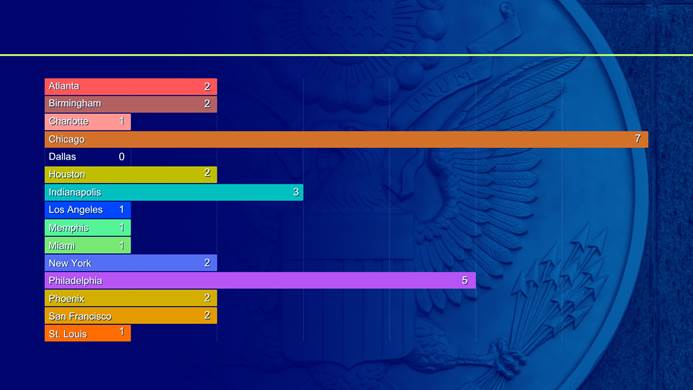
In addition to tracking the total number of filings, we closely monitor which of the EEOC’s 15 district offices are most active in terms of filing new cases over the course of the fiscal year. Some districts tend to be more aggressive than others, and some focus on different case filing priorities. The following chart shows the number of lawsuit filings by EEOC district office.
The most notable trend thus far is the 7 lawsuits filed by the Chicago District Office, followed by the 5 filings by the Philadelphia District Office, 3 filings by Indianapolis, 2 filings each for Atlanta, Birmingham, Houston, New York, Phoenix, and San Francisco, and one filing each for Charlotte, Los Angeles, Memphis, Miami, and St. Louis offices. Dallas has yet to see a lawsuit filing for FY 2026. By comparison, similarly in FY 2025 Chicago and Philadelphia led the pack in lawsuit filings, followed by Indianapolis, Phoenix, Houston, Atlanta, and Birmingham.
Analysis Of The Types Of Lawsuits Filed In First Half Of FY 2026
We also analyzed the types of lawsuits the EEOC filed throughout the first six months, in terms of the statutes and theories of discrimination alleged, in order to determine how the EEOC is shifting its strategic priorities. The chart below shows the EEOC filings by allegation type.
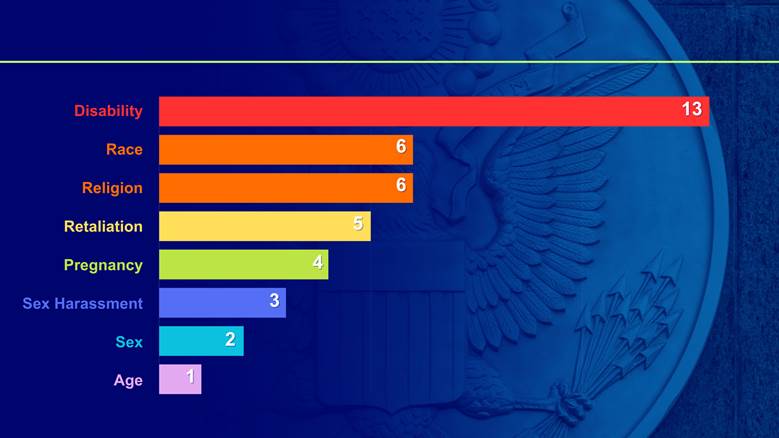
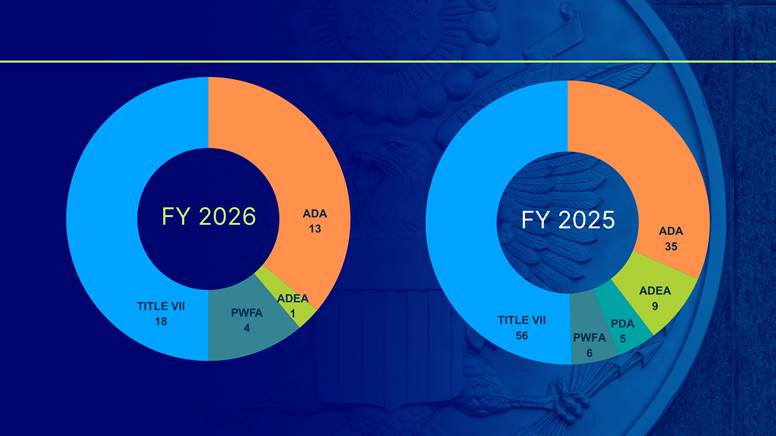
Title VII cases once again made up the majority of cases filed. They constituted 50% of all filings in FY 2026 (same as FY 2025, down from 58% of all filings in FY 2024, and significantly down from 68% of all filings in FY 2023). Overall, ADA cases made up the next most significant percentage of the EEOC’s FY 2026 filings for a total of 40%. This is up from 31% in FY 2025, yet similar to the 42% of filings in FY 2024. So far there has only been one filing under the ADEA in FY 2026, down from the uptick in ADEA filings in FY 2025. The EEOC filed 9 ADEA cases in FY 2025, compared to 6 age discrimination cases in FY 2024, 12 age discrimination cases in FY 2023, and 7 age discrimination cases in FY 2022. In the first six months of FY 2026, the EEOC filed 4 cases under the Pregnant Worker’s Fairness Act, on track compared to 6 filings in FY 2025 and 3 filings in FY 2024. So far, no cases filed under the Pregnancy Discrimination Act. Notably absent from FY 2026’s filings are cases brought under the Equal Pay Act and Genetic Information Nondiscrimination Act – two areas that the EEOC repeatedly has cited among its enforcement priorities prior to the second Trump Administration.
The graph set out below shows the number of lawsuits filed according to the statute under which they were filed (Title VII, Americans With Disabilities Act, Pregnancy Discrimination Act, Equal Pay Act, and Age Discrimination in Employment Act).
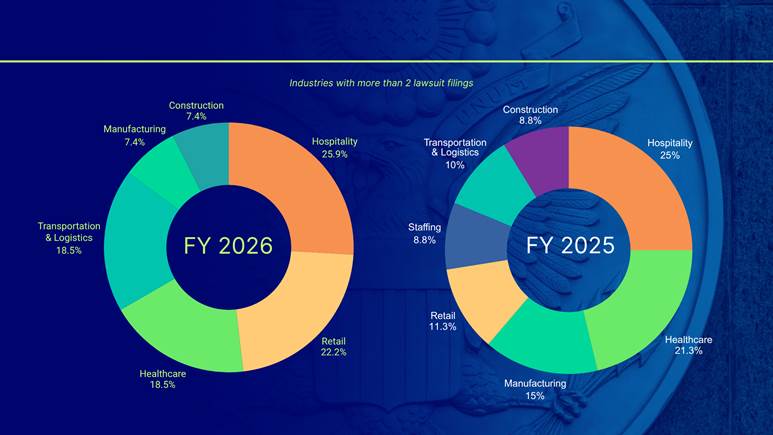
The industries impacted by EEOC-initiated litigation have also remained consistent in FY 2026. The chart below details that hospitality, healthcare, and retail employers have maintained their lead as corporate defendants in the last 18 months of EEOC-initiated litigation. In the first six months of FY 2026, two industries remained in the EEOC’s targets: Hospitality and Retail. On a percentage basis, Hospitality (Restaurants / Hotels / Entertainment) comprised 25.9% of filings, and Retail had 22.2% of filings. A key difference in FY 2025 compared to FY 2024 is Retail (22.2% of FY 2026 filings) overtaking Healthcare (18.5% of FY 2026 filings) and Manufacturing (7.4% of FY 2026 filings) as the next most targeted industry. Transportation & Logistics entered double digit enforcement activity, at 18.5% of the filings. The remaining industry with at least 2 filings is Construction, representing 7.4% of the filings.
Notable 2026 Lawsuit Filings
Disability Discrimination
In EEOC v. Schneider National, Inc., Case No. 26-CV-905 (D. Md. Mar. 4, 2026), the EEOC filed an action alleging that the defendant, Schneider National, Inc., a nationwide transportation and logistics company, violated the ADA when it refused to reasonably accommodate an applicant with PTSD by denying her request to bring her service dog to work, and withdrawing its job offer because of her disability. The EEOC asserted that the defendant extended a conditional offer of employment to the job candidate. However, next day, after learning that she had post-traumatic stress disorder and needed her service dog, the company withdrew her job offer pending further review. In response to Schneider’s request for additional information, the woman disclosed that her dog was certified as a service animal, trained to alleviate and prevent symptoms of PTSD, and had successfully accompanied her in the truck while she trained and obtained her Class A commercial driver’s license. The EEOC asserted that the defendant refused to allow her to drive with her service dog as an accommodation.
Religious Discrimination
In EEOC v. Blue Eagle Contracting, Inc., Case No. 26-CV-226 (D. Nev. Mar. 31, 2026), the EEOC filed an action against the defendant, a bulk mail delivery contractor for the U.S. Postal Service, alleging religious discrimination in violation of Title VII when it allegedly failed to return a Christian employee truck driver to a weekday shift so he could attend Sunday morning church services. According to the EEOC’s lawsuit, the defendant hired the driver, who informed supervisors of his religious obligations on Sundays stemming from his Christian faith. He was assigned a weekday delivery route, which he worked for several months until he volunteered on an emergency basis to fill a Sunday morning shift after a coworker unexpectedly resigned. The driver reminded his supervisors multiple times that he needed to attend church services on Sunday mornings and said he was only willing to work Sunday mornings until a replacement driver for the weekend shift was hired. The EEOC asserted that although the defendant hired a replacement, it continued to schedule the driver for Sunday shifts, while the replacement drove the weekday shift. The driver ultimately resigned from his position, and the EEOC alleged that the defendant’s failure to accommodate the drivers sincerely held religious beliefs ultimately compelled him to leave his job.
Race Discrimination
In EEOC v. Ourisman Cars Management Company, LLC, et al.), Case No. 26-CV-1233 (D. Md. Mar. 27, 2026), the EEOC brought an action alleging race discrimination after a finance manager at one of the defendants’ car dealerships repeatedly used racially offensive language toward Black salesmen in 2023. Employees reported the behavior to management multiple times, but the EEOC alleged the company did not take sufficient corrective action. The conduct continued, and two employees ultimately left their jobs. The EEOC asserted that the company’s conduct violated Title VII of the Civil Rights Act.
In EEOC v. Nike, Case No. 26-MC-128 (E.D. Mo. Feb 4, 2026), the EEOC filed a complaint to enforce a subpoena related to claims alleging race discrimination against white workers through DEI programs. The agency seeks to compel Nike’s compliance with a May 2024 subpoena then-commissioner Andrea Lucas issued pointing to workforce representation quotas.
Release Of Enforcement Statistics
On April 6, 2026, the EEOC published its FY 2027 Agency Performance Plan (“APP”) and FY 2025 Agency Performance Report (“APR”). The EEOC reported $660 million recovered through administrative enforcement and litigation for 17,680 alleged victims of discrimination. It also reported $528 million recovered through pre-litigation enforcement process (the highest amount in the agency’s 60-year history), $104.6 million for federal employees and applicants, $55 million recovered as a result of systemic investigations, $27 million through resolution of 120 merits lawsuits, $10.8 million obtained through the resolution of 13 systemic lawsuits, and six new systemic lawsuit filings.
Takeaways For Employers
We anticipate that the EEOC will continue to aggressively pursue its strategic priority areas in FY 2026. There is no reason to believe that the annual “September surge” is not coming, in what could be another precedent-setting year. We will continue to monitor EEOC litigation activity on a daily basis, and look forward to providing our blog readers with up-to-date analysis on the latest developments.