Duane Morris Class Action Review – 2024/2025: Mid-Year Class Action Settlement Report & Analysis

By Gerald L. Maatman, Jr. and Jennifer A. Riley

Duane Morris Takeaways: Corporate defendants saw unprecedented settlement numbers across all areas of class action litigation in 2022 and 2023, and halfway through 2024, settlement numbers remain robust. The cumulative value of the top ten settlements across all substantive areas of class action litigation hit near record highs in 2023, second only to the settlement numbers observed in 2022. When the numbers for 2022 and 2023 are combined, the totals signal that corporate defendants have entered a new era of heightened risks and higher stakes in the valuation of class actions. On an aggregate basis, across all areas of litigation, class actions and government enforcement lawsuits garnered more than $51.4 billion in settlements in 2023, almost as high as the record-setting $66 billion in 2022. When combined, the two-year settlement total eclipses any other two-year period in the history of American jurisprudence.

As a prelude to the Duane Morris Class Action Review – 2025, this post reports on our analysis of class action settlements through the first half of 2024. The data shows that for the period of January 1 to June 30, 2024, the current year is on pace with the numbers of the previous two years. As of the end of the first half of 2024, the aggregate settlement total across all areas of class action litigation and government enforcement lawsuits is $22.9 billion (in accounting for the top 5 settlements in the various substantive areas of law). It is anticipated that these numbers will increase across the board by the end of the year and when measured by the top 10 settlements in each category.

More Billion Dollar Class Action Settlements

At the mid-way point of 2024, there are four settlements over the billion-dollar mark. In 2023, parties resolved 14 class actions for $1 billion or more in settlements, making 24 billion-dollar settlements in the last two years. Reminiscent of the Big Tobacco settlements nearly two decades ago, 2022 and 2023 marked the most extensive set of billion-dollar class action settlements and transfer of wealth in the history of the American court system.
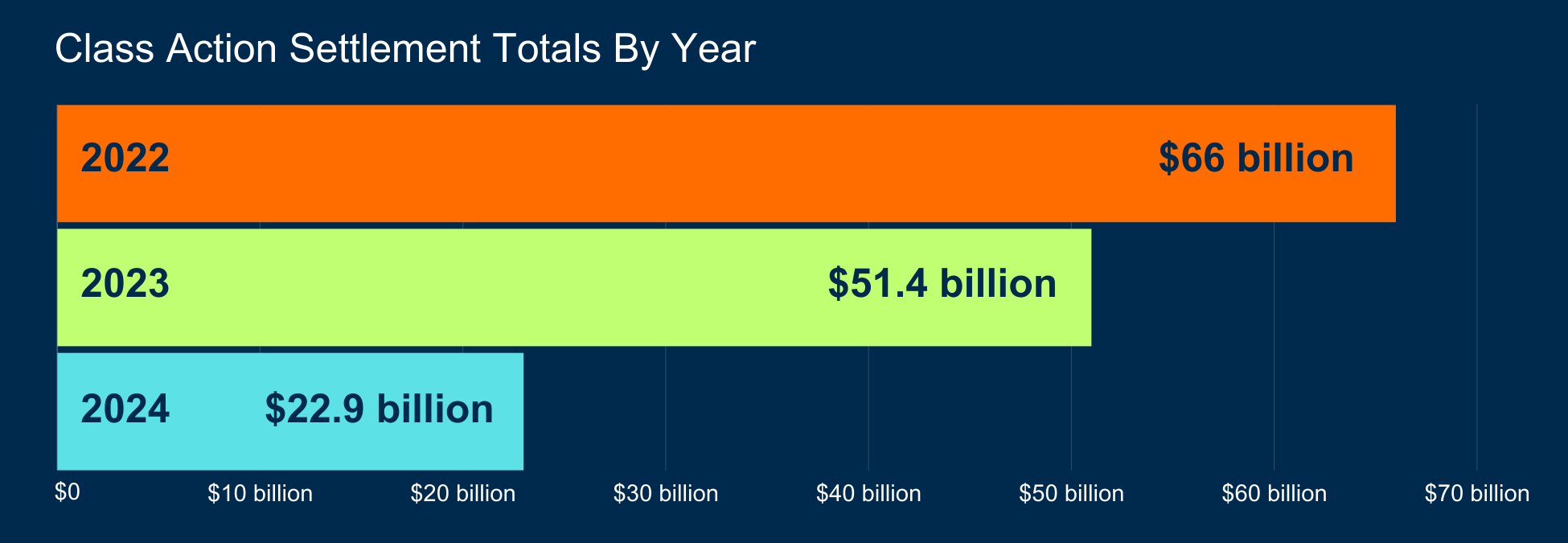
Class action settlements totaled $66 billion in 2023, $51.4 billion in 2023, and $22.9 billion in 2024 so far.

The Scorecard On Leading Class Actions Settlements Halfway Through 2024

The plaintiffs’ class action bar has scored rich settlements thus far in 2024 in virtually every area of class action litigation.

[Click image to enlarge] The top 5 class action settlement totals in each practice area.
The following list shows the totals of the top 5 settlements at the mid-year point in 2024 in key areas of class action litigation:

$14.45 Billion – Products liability/mass tort class actions
$4.17 Billion – Antitrust class actions
$2.05 Billion – Securities fraud class actions
$628 Million – Consumer fraud class actions
$388.95 Million – Data breach class actions
$331.5 Million – Privacy class actions
$288 Million – ERISA class actions
$157.15 Million – Wage & hour class and collective actions
$147 Million – Discrimination class actions
$101.3 Million – Labor class actions
$67.7 Million – Government enforcement actions
$58.8 Million – Civil rights class actions
$49.69 Million – TCPA class actions
$24.96 Million – Fair Credit Reporting Act class actions

The high dollar settlements of the past two years suggested that the plaintiffs’ bar would continue to be equally, if not more aggressive, with their case filings and settlement positions. From the 2024 data, it certainly looks to be the case as we end the first half of the year.

The data points in each category are set out in the following charts.

Top Class & Collective Action Litigation Settlements In 2024

Top Antitrust Class Action Settlements In 2024

The top 10 antitrust class action settlements totaled $11.74 billion in 2023, and $3.72 billion in 2022.
    1. $2.77 billion – In Re College Athlete NIL Litigation, Case No. 20-CV-3919 (N.D. Cal. May 23, 2024) (settlement agreement reached to resolve claims with former college athletes who filed an antitrust class action seeking compensation allegedly denied to them for decades before the Supreme Court overturned the NCAA’s compensation ban)..
    2. $418 million – Burnett, et al. v. the National Association of Realtors, Case No. 19-CV-332, Gibson, et al. v. National Association of Realtors, Case No.  23-CV-788, and Umpa, et al. v. The National Association of Realtors, Case No. 23-CV-945 (W.D. Mo. Mar. 15, 2024) and Moehrl, et al. v. The National Association of Realtors, Case No. 19-CV-1610 (N.D. Ill. Apr. 23, 2024) (preliminary settlement approval granted in a class action to resolve claims that broker commission rules caused home sellers across the country to pay inflated fees).
    3. $385 million – In Re Suboxone (Buprenorphine Hydrochloride and Naloxone) Antitrust Litigation, Case No. 13-MD-2445 (E.D. Penn. Feb. 27, 2024) (final settlement approval granted in a class action to resolve claims brought by states, insurers and buyers of a new dissolvable strip version of Suboxone to the market, encouraging the move from tablets to strips by misrepresenting to the U.S. Food and Drug Administration that the tablets posed a risk to children of accidental consumption).
    4. $335 million – Le, et al. v. Zuffa LLC, Case No. 15-CV-1045 (D. Nev. Mar. Mar. 20, 2024) (preliminary settlement approval sought in a class action to resolve claims that fighters’ wages were suppressed by up to $1.6 billion).
    5. $265 million – In Re Generic Pharmaceuticals Pricing Antitrust Litigation, Case No. 16-MD-2724 (E.D. Penn. June 26, 2024) (preliminary settlement approval granted for a class action to resolve claims by direct purchasers, end-payors and states alleging that multiple makers of generic drugs conspired to keep the prices on their products high, in violation of state laws and the federal Sherman Act).

Top Civil Rights Class Action Settlements In 2024

The top 10 civil rights class action settlements totaled $643.15 million in 2023, and $1.31 billion in 2022.
    1.  $17.5 million – Clark, et al. v. City Of New York, Case No. 18 Civ. 2334 (S.D.N.Y. Apr. 5, 2024) (settlement approval sought in a class action to resolve claims alleging that the city policy department’s policy requiring all arrested individuals to have their photograph taken without a head covering violated the Religious Land Use and Institutionalized Persons Act).
    2. $13.7 million – Sow, et al. v. New York, Case No. 21 Civ. 533, (S.D.N.Y. Mar. 5, 2024) (final settlement approval granted for a class action resolving claims by individuals who were arrested or arrested and subjected to force by the New York City Police Department during protests in 2020 following the murder of George Floyd).
    3. $12.8 million – In Re Chiquita Brands International Inc., Alien Tort Statute And Shareholders Derivative Litigation, Case No. 08-MD-1916 (S.D. Fla. June 24, 2024) (preliminary settlement approval granted in a class action to resolve claims alleging that the company funded Colombian paramilitary groups leading to the deaths of over 2,500 victims.
    4. $10 million – Adberg, et al. v City Of Seattle, Case No. 20-2-14351-1 (Wash. Super. Ct. Jan. 30, 2024) (settlement reached to end a lawsuit brought by more than 50 protesters who say they were brutalized by its police force during Black Lives Matter demonstrations in the summer of 2020).
    5. $4.8 million – Students For Fair Admissions, Inc., et al. v. University Of North Carolina, Case No. 14-CV-954 (M.D.N.C. Jan. 29, 2024) (the University of North Carolina agreed to cover the fees and expenses of a group founded by affirmative action advocates that won a U.S. Supreme Court challenge to the school’s consideration of race in student admissions).

Top Consumer Fraud Class Action Settlements In 2024
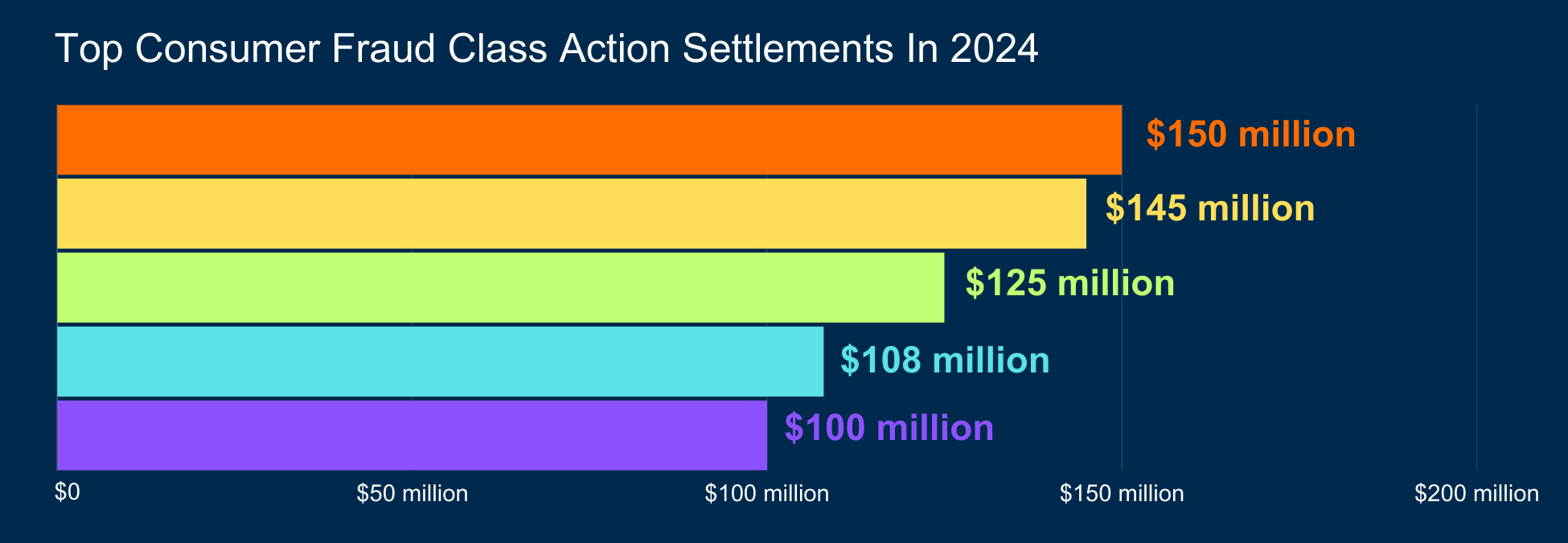
The top 10 consumer fraud class action settlements totaled $3.29 billion in 2023, and $8.596 billion in 2022.
    1. $150 million – In Re Chevrolet Bolt EV Battery Litigation, Case No. 20-CV-13256 (E.D. Mich. May 16, 2024) (preliminary settlement approval sought in a class action to resolve claims against General Motors LLC and LG units over alleged battery which allegedly make cars prone to overheating and fires).
    2. $145 million – In Re Kia Hyundai Vehicle Theft Marketing, Sales Practices, And Products Liability Litigation, Case No. 22-ML-3052 (N.D. Cal. July 15, 2024) (final settlement approval sought in a class action resolving claims that that consumers were left vulnerable to theft and damage due to vehicles being improperly manufactured with design flaws).
    3. $125 million – National Veterans Legal Services Program, et al. v. United States, Case No. 16-CV-745 (D.D.C. Mar. 20, 204) (preliminary settlement approval granted in a class action resolving claims challenging the legality of “excessive” PACER fees).
    4. $108 million – Elder, et al. v. Reliance Worldwide Corp., Case No. 20-CV-1596 (N.D. Ga. Apr. 23, 2024) (preliminary settlement approval granted in a class action to resolve claims alleging that the defendants made and sold water heater connector hoses with defective rubber linings).
    5. $100 million – Esposito, et al. v. Cellco Partnership d/b/a Verizon Wireless, Case No. MID-L-6360-23 (N.J. Super. Apr. 26, 2024) (final settlement approval granted in a class action to resolve claims that the company misled its customers by not disclosing certain fees in its postpaid wireless service plans).

Top Data Breach Class Action Settlements In 2024

The top 10 data breach class action settlements totaled $515.75 million in 2023, and $719.21 million in 2022.
    1. $350 million – In Re Alphabet Inc. Securities Litigation, Case No. 18-CV-6245 (N.D. Cal Apr. 9, 2024) (preliminary settlement approval granted in a class action alleging that a software glitch led to a data breach in which Google+ users’ personal data was exposed for three years).
    2. $15 million – Salinas, et al. v. Block Inc., Case No. 22-CV-4823 (N.D. Cal. June 3, 2024) (preliminary settlement approval granted in a class action to resolve claims that a December 2021 data breach at the companies exposed personally identifiable information, account numbers and trading activity of 8.2 million people).
    3. $8.7 million – Sherwood, et al. v. Horizon Actuarial Services LLC, Case No. 22-CV-1495 (N.D. Ga. Apr. 2, 2024) (final settlement approval granted for a class action to resolve claims that employer benefit plan members’ sensitive data was exposed in a massive breach at a consulting company).
    4. $8 million – In Re Orrick, Herrington & Sutcliffe LLP Data Breach Litigation, Case No. 23-CV-4089 (N.D. Cal. May 31, 2024) (preliminary settlement approval granted in a class action to resolve claims brought by clients of a law firm alleging their personal information was compromised in a March 2023 data breach of some of the firm’s client data).
    5. $7.25 million – In Re Lincare Holdings Inc. Data Breach Litigation, Case No. 22-CV-1472 (M.D. Fla. June 24, 2024) (final settlement approval granted for a class action to resolve claims that the company failed to protect consumers from a 2021 data breach).

Top Discrimination Class Action Settlements In 2024
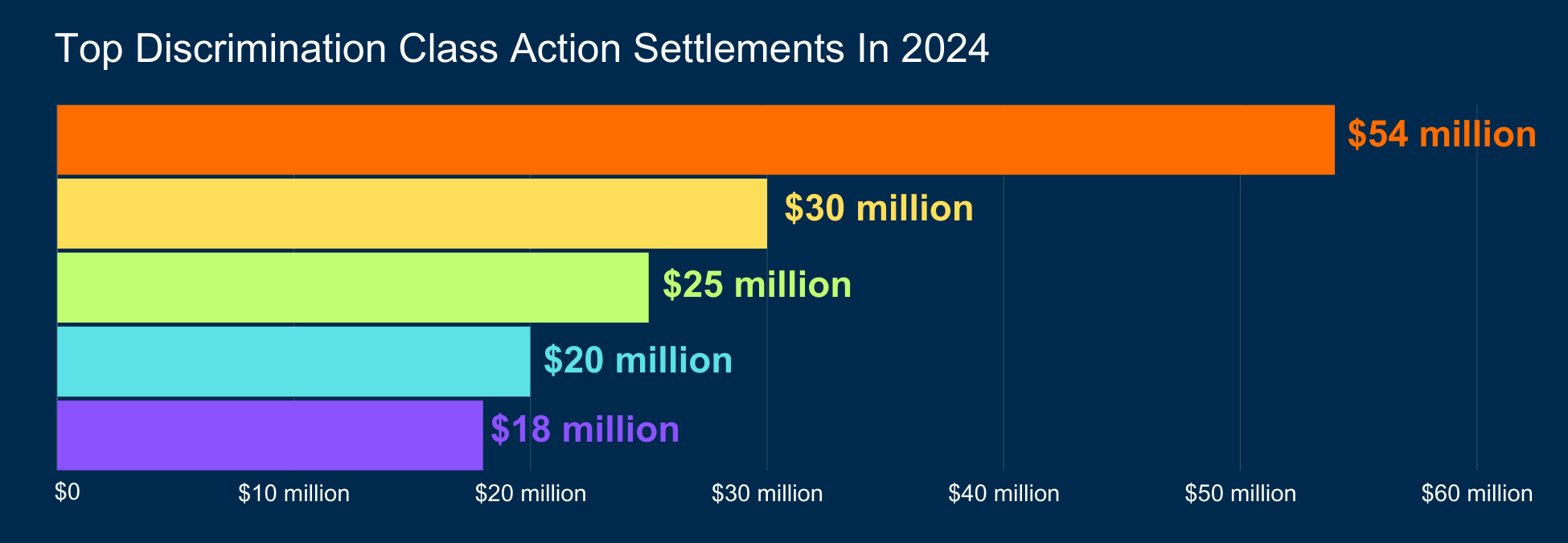
The top 10 discrimination class action settlements totaled $762.2 million in 2023, and $597 million in 2022.
    1. $54 million – California Civil Rights Department v. Activision Blizzard Inc., Case No. 21STCV26571 (Cal. Super. Jan. 17, 2024) (consent decree entered for an action to resolve claims that the company engaged in gender discrimination, pay inequities, and fostered a culture of sexual harassment in the workplace).
    2. $30 million – Employees’ Retirement System Of Rhode Island v. Paul Marciano, et al., Case No. 2022-0839 (Del. Chan. Jan. 4, 2024) (final settlement approval granted for a class action to resolve claims of decades of alleged sexual misconduct by one of the company’s co-founders).
    3. $25 million – Jewett, et al. v. Oracle America Inc., Case No. 17-CIV-02669 (Cal. Super. Ct. Feb. 11, 2024) (preliminary settlement agreement sought in a class action to resolve claims that female employees were paid less than male employees).
    4. $20 million – Council, et al. v. Merrill Lynch Pierce Fenner, Case No. 24-CV-534 (M.D. Fla. May 24, 2024) (preliminary settlement approval sought in a class action to resolve claims alleging discrimination and retaliation against a proposed class of nearly 1,400 Black financial advisers who alleged they received less pay and promotions compared to their white counterparts).
    5. $18 million – Forsyth, et al. v. HP Inc., Case No. 16-CV-4775 (N.D. Cal. Mar. 29, 2024) (final settlement approval granted in a class action to resolve claims alleging that the company unlawfully pushed out hundreds of older workers as part of a workforce reduction plan in violation of the ADEA).

Top EEOC / Government Enforcement Class Action Settlements In 2024
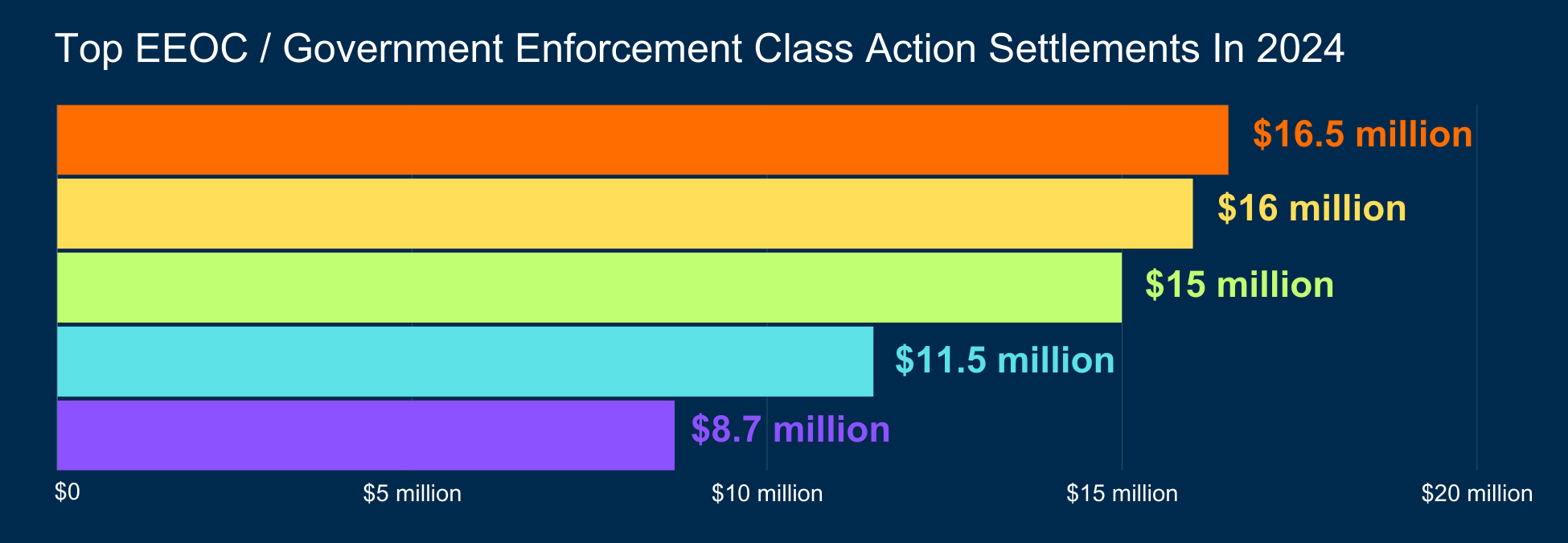
The top 10 EEOC / government enforcement class action settlements totaled $263.58 million in 2023, and $404.5 million in 2022.
    1. $16.5 million – In The Matter Of Avast Ltd., Case No. 202-3033 (FTC Jan. 19, 2024) (consent decree entered following a Federal Trade Commission lawsuit alleging that the company sold personal information to more than 100 third parties despite promising to protect consumers from online tracking).
    2. $16 million – U.S. Department Of Labor v.  Disaster Management Group LLC (DOL Jan. 24, 2024) (consent order entered following investigations into 62 government subcontractors hired to construct temporary housing and provide services to Afghan refugees at Joint Base McGuire-Dix-Lakehurst in New Jersey).
    3. $15 million – California Civil Rights Department v. Snap Inc. (Cal. Super. Ct. June 18, 2024) (consent order entered following an investigation into the company’s hiring and pay practices were discriminatory, finding the company failed to ensure women were treated equally, resulting in a glass ceiling for pay and promotions, sexual harassment and retaliation when female workers spoke up).
    4. $11.5 million – Washington Department Of Labor & Industries v. Boeing (May 24, 2024) (the parties entered into a compliance agreement following an investigation by the agency after it received four complaints in November 2022 from workers who were performing aircraft maintenance overseas, and found that Boeing had not paid or accounted for all overtime and for paid sick leave for the additional time going to worksites while out of town).
    5. $8.7 million – EEOC v. DHL Express (USA) Inc., Case No. 10-CV-6139 (N.D. Ill. Apr. 24, 2024) (consent decree entered resolving a lawsuit filed alleging that the company gave Black workers more difficult and dangerous work assignments than white employees).

Top ERISA Class Action Settlements In 2024
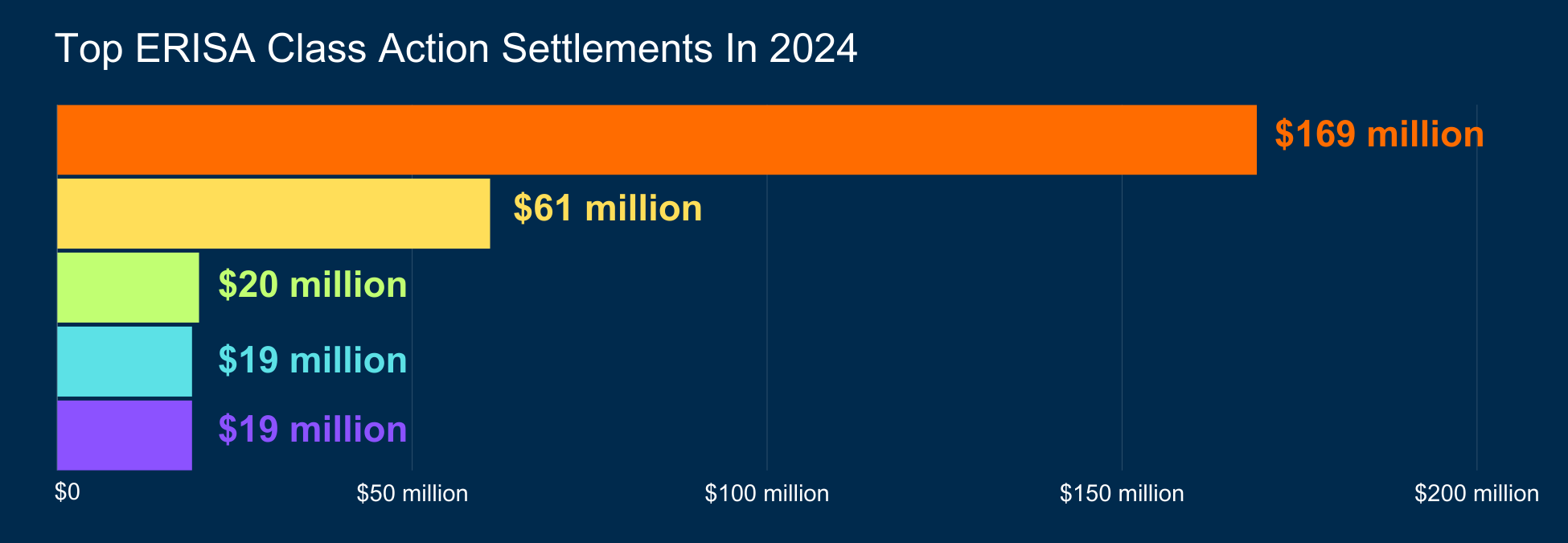
The top 10 ERISA class action settlements totaled $580.5 million in 2023, and $399.6 million in 2022.
    1. $169 million – Electrical Welfare Trust Fund, et al. v. United States, Case No. 19-CV-353, (Fed. Claims Ct. May 16, 2024) (final settlement approval granted in a class action alleging that the government illegally exacted certain contributions from SISAs under it for benefit year 2014).
    2. $61 million – In Re GE ERISA Litigation, Case No. 17-CV-12123 (D. Mass. Mar. 7, 2024) (final settlement approval granted in consolidated class actions alleging that the company violated the ERISA by directing employee retirement savings into underperforming GE Asset Management funds to generate fees for the subsidiary before it was sold).
    3. $20 million – Durnack, et al. v. Retirement Plan Committee Of Talen Energy Corp., Case No. 20-CV-5975 (E.D. Penn. June 4, 2024) (final settlement approval granted for a class action resolving claims from employees alleging that that they were owed early retirement pension benefits and pension supplements due to a change in control).
    4. $19 million – Krohnengold, et al. v. New York Life Insurance Co., Case NO. 21-CV-1778 (S.D.N.Y. Mar. 5, 2024) (preliminary settlement approval granted in a class action to resolve claims alleging that the company unlawfully kept underperforming proprietary investment options in two employee retirement plans).
    5. $19 million – Colon, et al. v. Johnson, Case No. 22-CV-888 (M.D. Fla. June 10, 2024) (preliminary settlement approval granted in a class action to resolve claims alleging that the company and executives enacted a scheme that diverted workers’ retirement benefits to shell companies and private equity firm Palm Beach Capital).

Top FCRA, FDPCA, And FACTA Class Action Settlements In 2024
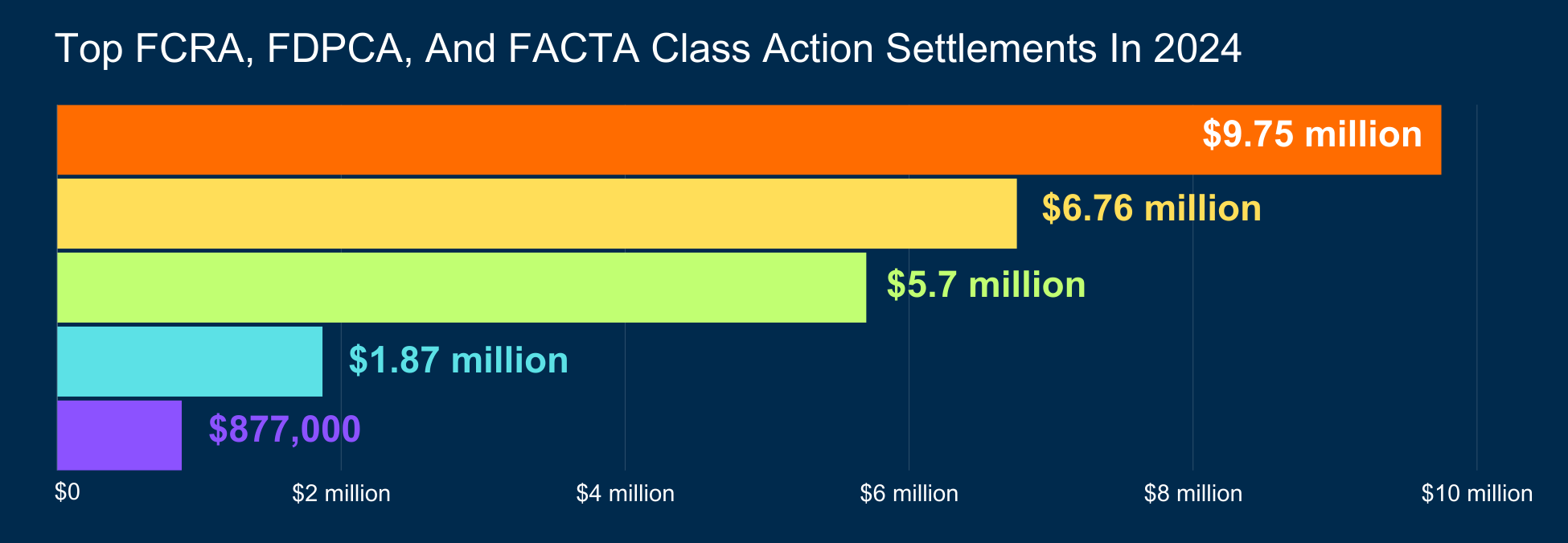
The top 10 FCRA, FDPCA, and FACTA class action settlements totaled $100.15 million in 2023, and $210.11 million in 2022.
    1. $9.75 million – Sullen, et al. v. Vivint, Inc.,Case No. 01-CV-2023-903893 (Ala. Cir. Ct. Apr. 23, 2024) (final settlement approval granted in a class action alleging that the company accessed credit information in violation of the Fair Credit Reporting Act and created Vivint accounts without authorization).
    2. $6.76 million – Martinez, et al. v. Avantus LLC, Case No. 20-CV-1772 (D. Conn. Feb. 27, 2024) (final settlement approval granted in a class action alleging that the company violated federal law by including inaccurate information on mortgage borrowers’ credit reports).
    3. $5.7 million – Steinberg, et al. v. Corelogic,Case No. 22-CV-498 (S.D. Cal. Apr. 9, 2024) (final settlement approval granted in a class action lawsuit to resolve claims that the company violated the federal Fair Credit Reporting Act by listing consumers as deceased on credit reports when they were actually alive).
    4. $1.87 million – Parker, et al. v. The Salvation Army, Case No. 20-CV-4787 (Cal. Super. Ct. Mar. 20, 2024) (preliminary settlement approval granted in a class action to resolve claims to resolve claims the company  failed to comply with the Fair Credit Reporting Act (FCRA) when procuring job applicant background checks for employment applicants.
    5. $877,000 – McKey, et al. v. TenantReports.com LLC, Case No. 22-CV-1908-GJP (E.D. Penn. Feb. 27, 2024) (final settlement approval granted in a class action lawsuit to resolve claims that the company prepared consumer background reports that included outdated criminal non-conviction information).

Top FLSA / Wage & Hour Class And Collective Settlements In 2024
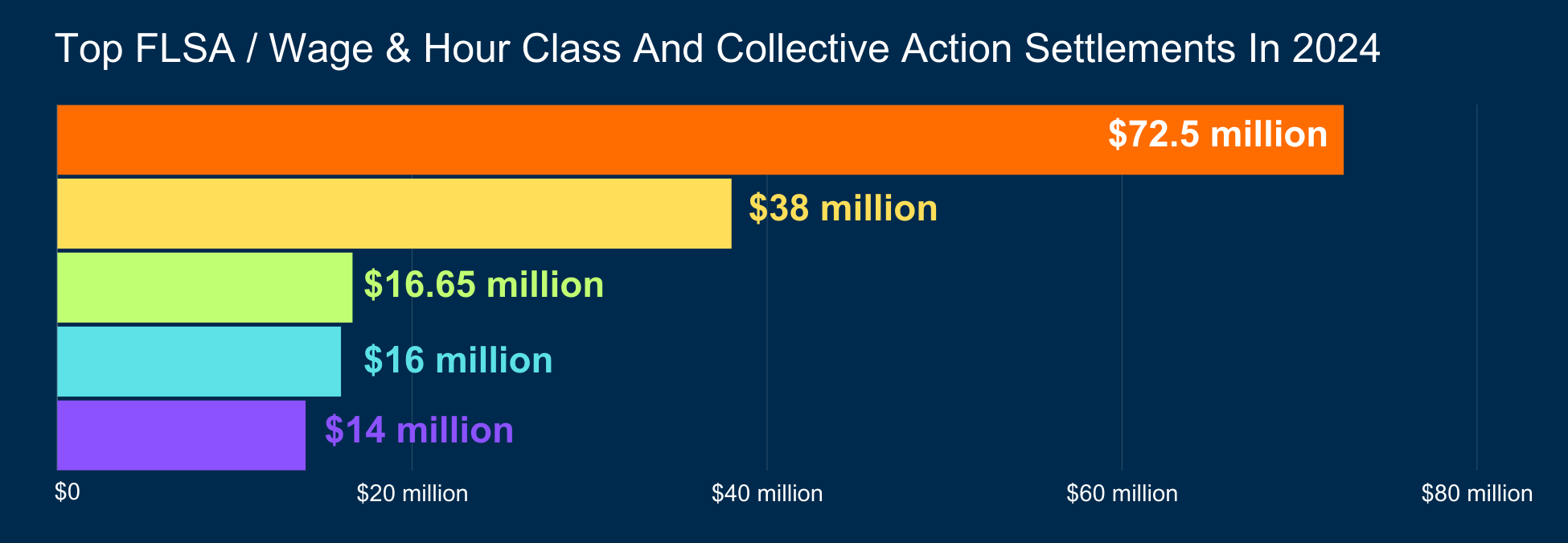
The top 10 FLSA / wage & hour class and collective action settlements totaled $742.5 million in 2023, and $574.55 million in 2022.
    1. $72.5 million – Utne, et al. v. Home Depot USA Inc., Case No. 16-CV-1854 (N.D. Cal. Mar. 8, 2024) (final settlement approval granted for a class action to resolve claims that the company failed to pay hourly wages, pay final wages on time, and provide accurate written wages).
    2. $38 million – In The Matter Of The Investigation Of Letitia James, Attorney General Of The State Of New York Of Lyft Inc., AOD No. 23-041 (AG Labor Bureau Nov. 30, 2024) (the New York Attorney General took legal action against Lyft, claiming the ride-booking company withheld wages from drivers by deducting taxes and fees from their pay instead of having passengers pay those expenses and prevented drivers from receiving the benefits they were entitled to under New York law).
    3. $16.65 million – Goldthorpe, et al. v. Cathay Pacific Airways Ltd., Case No. 17-CV-3233 (N.D. Cal. June 20, 2024) (preliminary settlement approval sought in a class action to resolve claims alleging that the airline violated state labor laws governing meal and rest periods, overtime and reserve duty pay).
    4. $16 million – Oman, et al. v. Delta Air Lines Inc., Case No. 15-CV-131 (N.D. Cal. May 15, 2024) (preliminary settlement approval sought in a class action to resolve claims alleging that the company failed to provide accurate wage statements in violation of California Labor Law).
    5. $14 million – Bolding, et al. v. Banner Bank, Case No. 17-CV-601 (W.D. Wash. Jan. 8, 2024)(final settlement approval sought in a class and collective action to resolve claims that the company misclassified mortgage loan officers as exempt employees and thereby failed to pay overtime compensation in violation of federal and state wage & hour laws).

Top Labor Class Action Settlements In 2024

The top 10 labor class action settlements totaled $129.67 million in 2023.
    1. $55 million – Saunders, et al. v. State of Michigan Unemployment Insurance Agency, Case No. 22-000007-MM (Mich. Cl. Ct. Apr. 16, 2024) (preliminary settlement approval granted in a class action to resolve claims that unemployment benefits were improperly clawed back without notice during the COVID-19 pandemic)
    2. $20 million – In Re International Longshore and Warehouse Union, Case No. 23-BK-30662 (N.D. Cal. Bankr. Feb. 22, 2024) (preliminary settlement approval granted in a class action to resolve claims alleging that the union of engaging in an unlawful boycott of the company during a labor dispute).
    3. $20 million – Bauserman, et al. v. State Of Michigan Unemployment Insurance Agency, Case No. 15-000202 (Mich. Ct. Claims Jan. 29, 2024) (final settlement agreement granted in a class action to resolve claims over the Michigan Unemployment Insurance Agency’s use of a computer program to detect fraudulent claims, which resulted in thousands of false fraud determinations).
    4. $3.8 million – Moliga, et al. v. Qdoba Restaurant Corp., Case No. 23-2-11540-6 (Wash. Super. Ct. Apr. 10, 2024) (preliminary settlement approval granted in a class action to resolve claims that the company violated Washington state’s pay transparency law when it failed to disclose pay information in job postings).
    5. $2.5 million – Arrison, et al. v. Walmart Inc., Case No. 21-CV-481 (D. Ariz. Feb. 16, 2024) (preliminary settlement approval granted in a class action to resolve claims that the company should have paid nearly 80,000 workers for the time they spent undergoing COVID-19 screenings before clocking in for their shifts).

Top Privacy Class Action Settlements In 2024
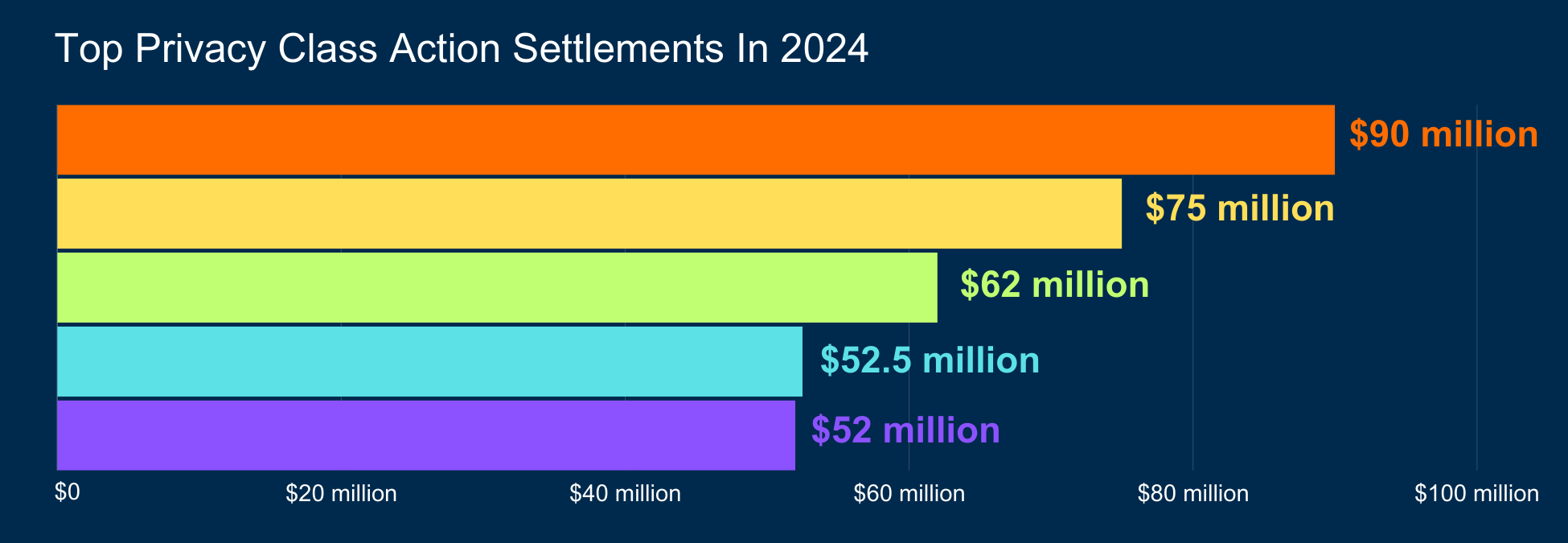
The top 10 privacy class action settlements totaled $1.32 billion in 2023, and $896.7 million in 2022.
    1. $90 million – In Re Facebook Internet Tracking Litigation, Case Nos. 22-16903 and 22-16904 (9th Cir. Feb. 21, 2024) (final settlement approval affirmed in a class action to resolve claims alleging that Facebook used cookies to track the internet activity of logged-out social network users who visited third-party websites containing Facebook “Like” button plugins).
    2. $75 million – Rogers, et al. v. BNSF Railway Co., Case No. 19-CV-3083 (N.D. Ill. June 18, 2024) (final settlement approval granted in a class action to resolve claims alleging that the company unlawfully scanned drivers’ fingerprints for identity verification purposes without written, informed permission or notice when they visited BNSF rail yards).
    3. $62 million – In Re Google Location History Litigation, Case No. 18-CV-5062 (N.D. Cal. May 3, 2024) (final settlement approval granted in a class action to resolve claims that Google illegally collected and stored smartphone users’ private location information).
    4. $52.5 million – Schreiber, et al. v. Mayo Foundation For Medical Education And Research, Case No. 22-CV-188 (W.D. Mich. May 25, 2024) (final settlement approval granted in a class action to resolve claims that the company shared subscriber information with third parties without getting consumer consent).
    5. $52 million – In Re Clearview AI Inc. Consumer Privacy Litigation, Case No. 21-CV-135 (N.D. Ill. June 21, 2024) (preliminary settlement approval granted in a novel settlement in a multidistrict litigation targeting Clearview AI’s allegedly unlawful practice of “scraping” internet photos to collect biometric facial data wherein the class will receive a 23% stake in the company).

Top Products Liability And Mass Tort Class Action Settlements In 2024
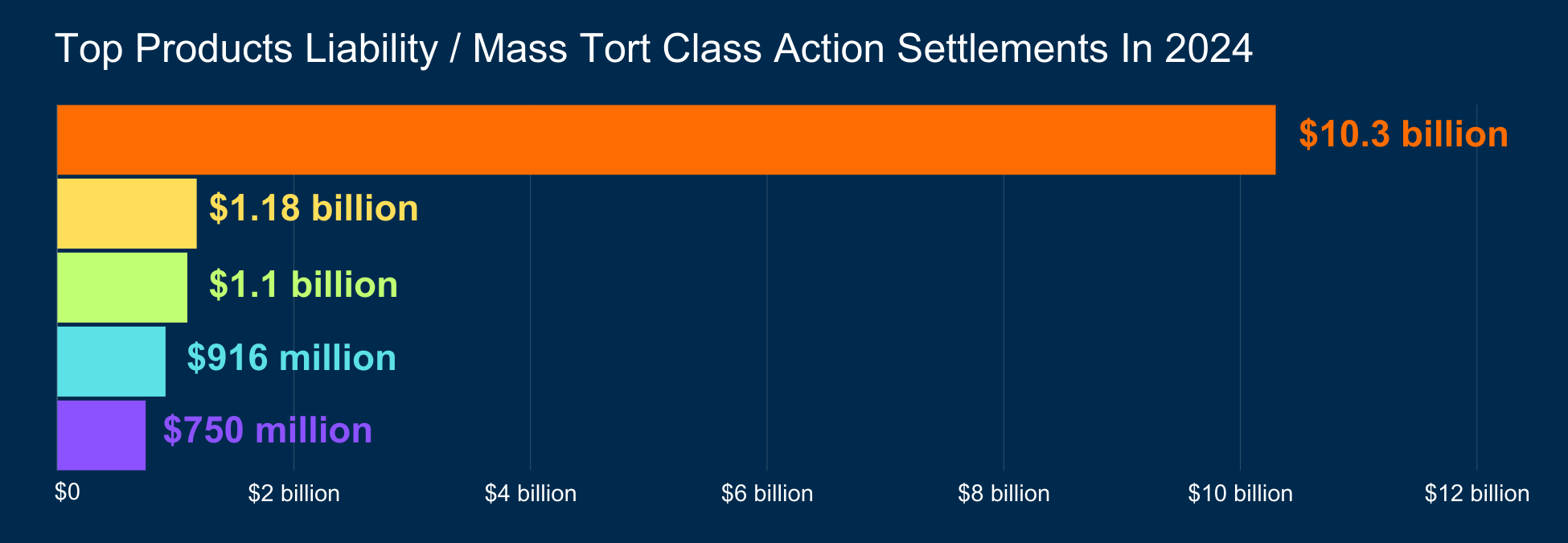
The top 10 products liability / mass tort class action settlements totaled $25.83 billion in 2023, and $50.32 billion in 2022.
    1. $10.3 billion – In Re Aqueous Film-Forming Foams Product Liability Litigation, MDL 2873 (D.S.C. Mar. 29, 2024) (final settlement approval granted in a class action to resolve claims with 3M by utilities that maintain it’s liable for the damage they have and will incur due to its signature PFAS that were used for decades in specialized fire suppressants, called aqueous film-forming foams (AFFF), that were sprayed directly into the environment and reached drinking water).
    2. $1.18 billion – Camden, et al. v. E.I. DuPont de Nemours & Co., Case No. 23-3230 (D.S.C. Feb. 8, 2024) (final settlement approval granted in a class action to resolve claims in a multidistrict litigation for the firefighting agent aqueous film forming foam (AFFF), which contains per- and polyfluoroalkyl substances (PFAS).
    3. $1.1 billion – Philips Recalled CPAP, Bi-Level PAP, And Mechanical Ventilator Products Liability Litigation, Case No. 21-MC-1230 (W.D. Penn. Apr. 29, 2024) (settlement reached in a multi-district litigation claiming that degraded foam in breathing machines caused plaintiffs personal injuries or will require long-term medical monitoring).
    4. $916 million – State Of Hawaii, et al. v. Bristol-Myers Squibb Co., Case No. 1CC141000708 (Hawaii Cir. Ct. May 21, 2024) (court found in favor of the plaintiffs and ordered payment by the companies to resolve claim alleging they marketed and sold Plavix in an unfair and deceptive manner, and that the companies failed to disclose that the drug could be harmful to those of East Asian and Pacific Islander ancestry).
    5. $750 million – In Re Aqueous Film-Forming Foams Products Liability Litigation, Case No. 18-MN-2873 (D.S.C. June 11, 2024) (preliminary settlement approval granted to resolve claims that Johnson Controls International PLC subsidiary Tyco Fire Products LP’s public water systems’ federal claims that some “forever chemicals” they detected in their supplies came from firefighting foam it made).

Top Securities Fraud Class Action Settlements In 2024
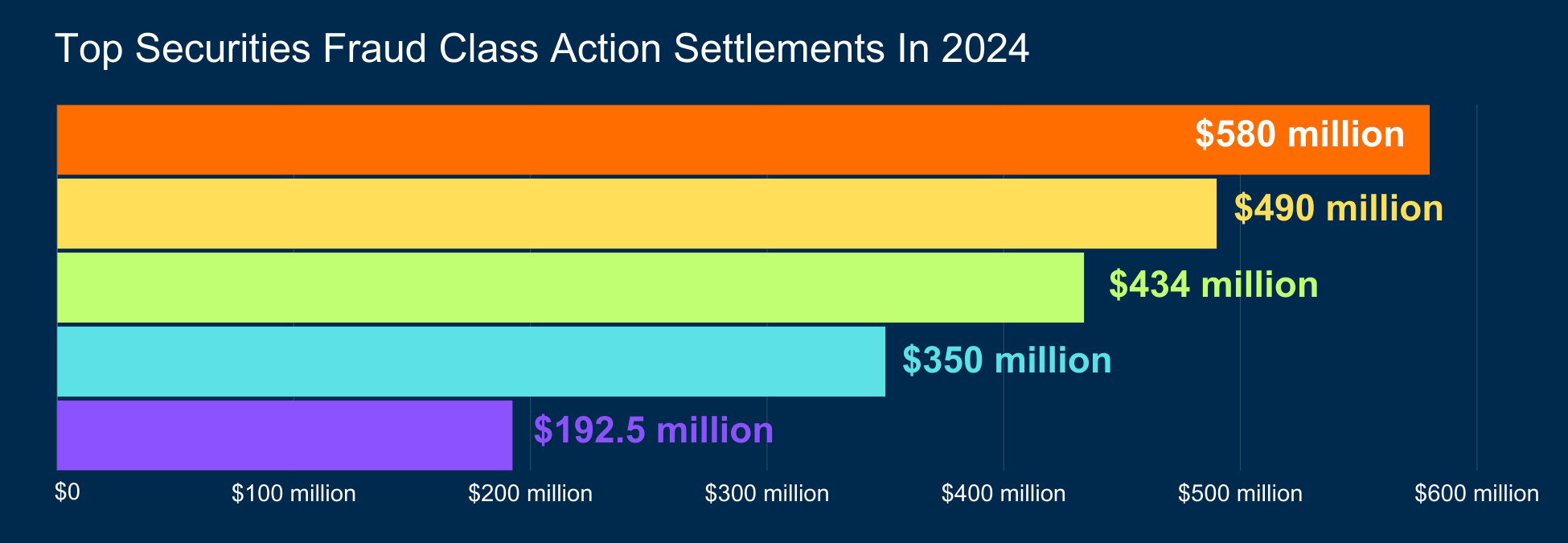
The top 10 securities fraud class action settlements totaled $5.4 billion in 2023, and $3.25 billion in 2022.
    1. $580 million – Iowa Public Employees’ Retirement System, et al. v. Bank of America Corp. Litigation, Case No. 17-CV-6221 (S.D.N.Y. Sept. 4, 2024) (final settlement approval granted in a class action to resolve claims alleging that the defendants conspired to block and boycott new offerings that would have increased competition and improved the efficiency and transparency of the market, in violation of Section 1 of the Sherman Act).
    2. $490 million – In Re Apple Inc. Securities Litigation, Case No. 19-CV-2033 (N.D. Cal. June 3, 2024) (preliminary settlement approval granted in a class action to resolve claims that Apple’s CEO Tim Cook defrauded shareholders by concealing falling demand for iPhones in China).
    3. $434 million – In Re Under Armour Securities Litigation, Case No. RDB-17-388 (D. Md. June 21, 2024) (settlement reached in a class action brought by investors alleging that the company inflated stock prices by hiding declining demand for its products).
    4. $350 million – In Re Alphabet Inc. Securities Litigation, Case No. 18-CV-6245 (N.D. Cal. Apr. 9, 2024) (preliminary settlement approval granted in a class action to resolve claims that the company deceived them about a March 2018 software glitch that allegedly gave third-party app developers the ability to access the private profile data of 500,000 users of the Google Plus social media site).
    5. $192.5 million – Chabot, et al. v. Walgreens Boots Alliance Inc., Case No. 18-CV-2118 (M.D. Penn. Feb. 7, 2024) (final settlement approval granted in a class action to resolve claims that the company’s executives lied about the likelihood of an ultimately unsuccessful merger between the two drugstore chains).

Top TCPA Class Action Settlements In 2024
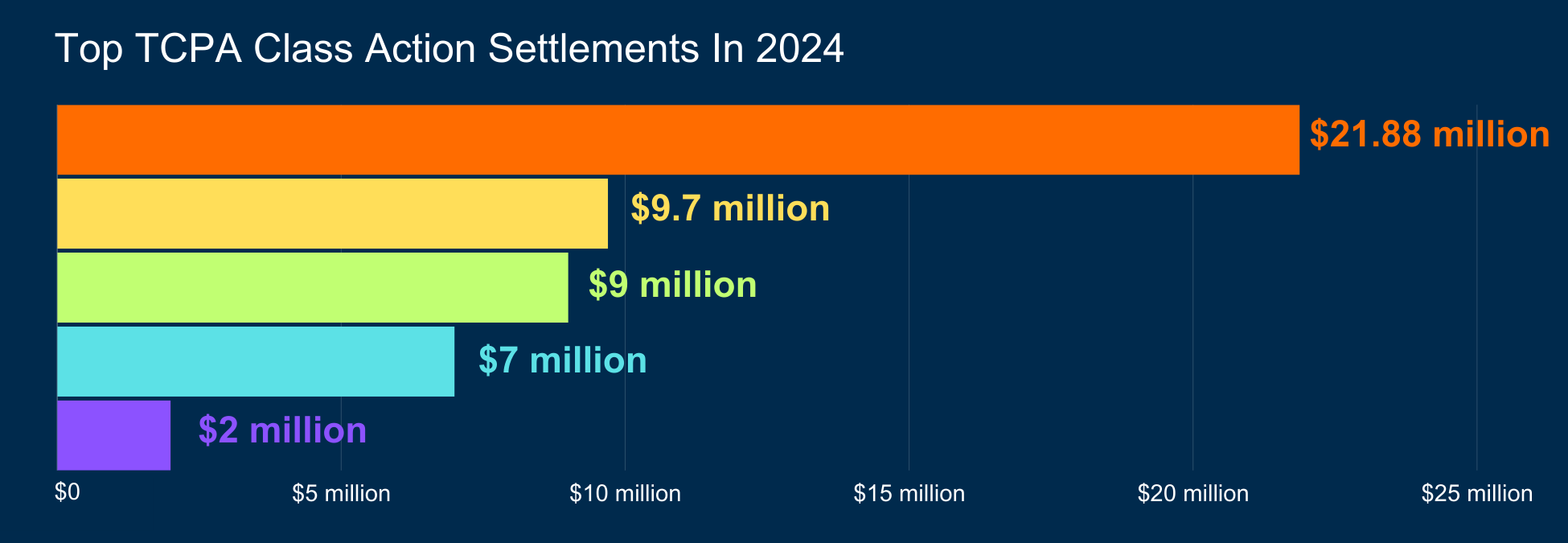
The top 10 TCPA class action settlements totaled $103.45 million in 2023, and $134.13 million in 2022.
    1. $21.88 million – Smith, et al. v. Assurance IQ LLC, Case No. 2023-CH-09225 (Ill. Cir. Ct. Sept. 3, 2024) (final settlement approval granted in a class action to resolve claims alleging that the company violated the Telephone Consumer Protection Act with unsolicited robocalls).
    2. $9.7 million – Berman, et al. v. Freedom Financial Network LLC, Case No. 18-CV-1060 (N.D. Cal. Feb. 16, 2024) (final settlement approval granted in a class action to resolve claims alleging that the debt consolidation company and its subsidiaries made telemarketing calls which violated the Telephone Consumer Protection Act).
    3. $9 million – Moore, et al. v. Robinhood Financial LLC, Case No. 21-CV-1571 (W.D. Wash. July 16, 2024) (final settlement approval granted in a class action to resolve claims that the company’s referral text messages violated Washington telemarketing laws).
    4. $7 million – Williams, et al. v. Choice Health Insurance LLC, Case No. 23-CV-292 (M.D. Ala. July 9, 2024) (final settlement approval granted in a class action to resolve claims that the company violated the TCPA with unsolicited marketing calls).
    5. $2 million – Burnett, et al v. CallCore Media Inc., Case No. 21-CV-3176 (S.D. Tex. June 25, 2024) (final settlement approval granted in a class action to resolve claims the company placed prerecorded phone calls to consumers in violation of state laws and the federal TCPA).
 

EEOC Weighs In On Novel Artificial Intelligence Suit Alleging Discriminatory Hiring Practices

By Gerald L. Maatman, Jr., Alex W, Karasik, and George J. Schaller

Duane Morris Takeaways: In Mobley v. Workday, Inc., Case No. 23-CV-770 (N.D. Cal. April 9, 2024) (ECF No. 60)the Equal Employment Opportunity Commission (“EEOC”) filed a Motion for Leave to File an Amicus Brief in Support of Plaintiff and in Opposition to Defendant’s Motion to Dismiss. This development follows Workday’s first successful Motion to Dismiss, about which we previously blogged here, after which the Court allowed Plaintiff a chance to amend his complaint. 

For employers utilizing Artificial Intelligence in their hiring practices, this notable case is worth monitoring. The EEOC’s decision to insert itself in the dispute demonstrates the Commission’s commitment to continued enforcement of anti-discrimination laws bearing on artificial intelligence use in employment. 

Case Background

Plaintiff, an African American male over the age of forty alleged that he suffered from anxiety and depression and brought suit against Workday claiming that its applicant screening tools discriminated against applicants on the basis of race, age, and disability.  Plaintiff further alleged that he applied for 80 to 100 jobs, but despite holding a bachelor’s degree in finance and an associate’s degree in network systems administration, he did not get a single job offer.  Id., 1-2 (ECF No. 45).

Workday moved to dismiss the Complaint in part arguing that Plaintiff did not allege facts to state a plausible claim that Workday was liable as an “employment agency” under the anti-discrimination statutes at issue.

On January 19, 2024, the Court granted the defendant’s motion to dismiss, but with leave for Plaintiff to amend, on the ground that plaintiff failed to plead sufficient facts regarding Workday’s supposed liability as an employer or “employment agency.”  Shortly thereafter, Plaintiff filed his Amended Complaint.  Id. (N.D. Cal. Feb. 20, 2024) (ECF No. 47.)

On March 12, 2024, Workday filed its Motion to Dismiss Amended Complaint, asserting that Workday is not covered by the statutes at issue – Title VII, the Americans with Disabilities Act (“ADA”), and/or the Age Discrimination in Employment Act (“ADEA”) – because Workday merely screens job seekers rather than procuring them.  Id., (ECF No. 50.)  On April 2, 2024, Plaintiff filed his opposition (id., ECF No. 59) and, on April 12, 2024, Workday filed its reply.  Id., (ECF No. 61.)

The motion is fully briefed and set for hearing on May 7, 2024.

The EEOC’s Motion for Leave to File an Amicus Brief

On April 9, 2024, before Workday filed its Reply, the EEOC filed a Motion for Leave to File an Amicus Brief in Support of Plaintiff and in Opposition to Defendant’s Motion.  Id., (ECF Nos. 60 & 60-1.)  The EEOC noticed its Motion for hearing on May 7, 2024.  Id., (ECF No. 60.)

The EEOC describes Mobley as a case that “implicate[s] whether,” Title VII, the ADA, and the ADEA, “cover[s] entities that purportedly screen and refer applicants and make automated hiring decisions on behalf of employers using algorithmic tools.”  Id., at 1 (ECF No. 60-1.)  The Commission argues that Plaintiff’s Amended Complaint satisfies federal pleading standards “with respect to all three theories of coverage alleged.”  Id., at 4.

First, with respect to Workday as an employment agency, the EEOC notes that Title VII, the ADA, and the ADEA, all prohibit discrimination by employment agencies.  Under each statute, the term “employment agency” includes “any person regularly undertaking with or without compensation to procure employees for an employer.”  Id.  The EEOC maintains courts generally construe “employment agency” based on “‘those engaged to a significant degree’ in such procurement activities ‘as their profession or business,’” and the focus on the degree to which an entity engages in “activities of an employment agency.”  Id.

The EEOC argues, among these activities, screening and referral activities are classically associated with employment agencies.  Id., at 5.  The Commission asserts that “[Plaintiff] has plausibly alleged that Workday’s algorithmic tools perform precisely the same screening and referral functions as traditional employment agencies—albeit by more sophisticated means.”  Id., at 6.  In contrasting Workday’s position, the EEOC urged the Court to find Workday’s arguments that “screening employees is not equivalent to procuring employees,” and that Workday does not “actively recruit or solicit applications” as unpersuasive.  Id., at 7.

Second, the EEOC argues leading precedent weighs in favor of Plaintiff’s allegations that Workday is an indirect employer.  Taking Plaintiff’s allegations as true, the EEOC contends that “Workday exercised sufficient control over [Plaintiff’s] and others applicants’ access to employment opportunities to qualify as an indirect employer,” and “Workday purportedly acts as a gatekeeper between applicants and prospective employers.”  Id., at 11. 

The EEOC argues Workday’s position on sufficient control misses the point.  Workday’s assertion that it “does not exert ‘control over its customers,’ who ‘are not required to use Workday tools and are free to stop using them at any time,” is not the inquiry.  Id., at 12.  Rather, the relevant inquiry is “whether the defendant can control or interfere with the plaintiff’s access to that employer,” and the EEOC notes that the nature of that control or interference “will always be a product of each specific factual situation.”  Id.

Finally, the EEOC maintains that Plaintiff plausibly alleged Workday is an agent of employers. The EEOC also maintains that under the relevant statutes the term “employer” includes “any agent of” an employer and several circuits have reasoned that an employer’s agent may be held independently liable for discrimination under some circumstances.  Id. 

In analyzing Plaintiff’s allegations, the EEOC argues that Plaintiff satisfies this requirement, where Plaintiff “alleges facts suggesting that employers delegate control of significant aspects of the hiring process to Workday.”  Id., at 13.  Accordingly, the EEOC concludes that Plaintiff’s allegations are sufficient and demonstrate “Workday’s employer-clients rely on the results of its algorithmic screening tools to make at least some initial decisions to reject candidates.”  Id., at 14.

On April 15, 2024, the Court ordered any opposition or statement of non-opposition to the EEOC’s motion for leave shall be filed by April 23, 2024.  Id.  (ECF No. 62.)

Implications For Employers

With the EEOC’s filing and sudden involvement, Employers should put great weight on EEOC enforcement efforts in emerging technologies, such as AI.  The EEOC’s stance in Mobley shows that this case is one of first impression and may create precedent for pleading in AI-screening tool discrimination cases regarding the reach of “employment decisions,” by an entity – whether directly, indirectly, or by delegation through an agent.

The Mobley decision is still pending, but all Employers harnessing artificial intelligence for “employment decisions” must follow this case closely.  As algorithm-based applicant screening tools become more common place –the anticipated flood of employment discrimination lawsuits is apt to follow.


EEOC Mid-Year Lawsuit Filing Update For Fiscal Year 2024


By Alex W. Karasik, Gerald L. Maatman, Jr. and Jennifer A. Riley

Duane Morris Takeaways: The EEOC’s fiscal year (“FY 2024”) spans from October 1, 2023 to September 30, 2024. Through the midway point of FY 2024, EEOC enforcement litigation filings have been noticeably down. In the first six months of FY 2023, there were 29 new lawsuits filed by the Commission, while only 14 lawsuits were filed through the midway point of FY 2024.

Traditionally, the second half of the EEOC’s fiscal year – and particularly in the final months of August and September – are when the majority of filings occur. Even so, an analysis of the types of lawsuits filed, and the locations where they are filed, is informative for employers in terms of what to expect during the fiscal year-end lawsuit filing rush in September.

Cases Filed By EEOC District Offices

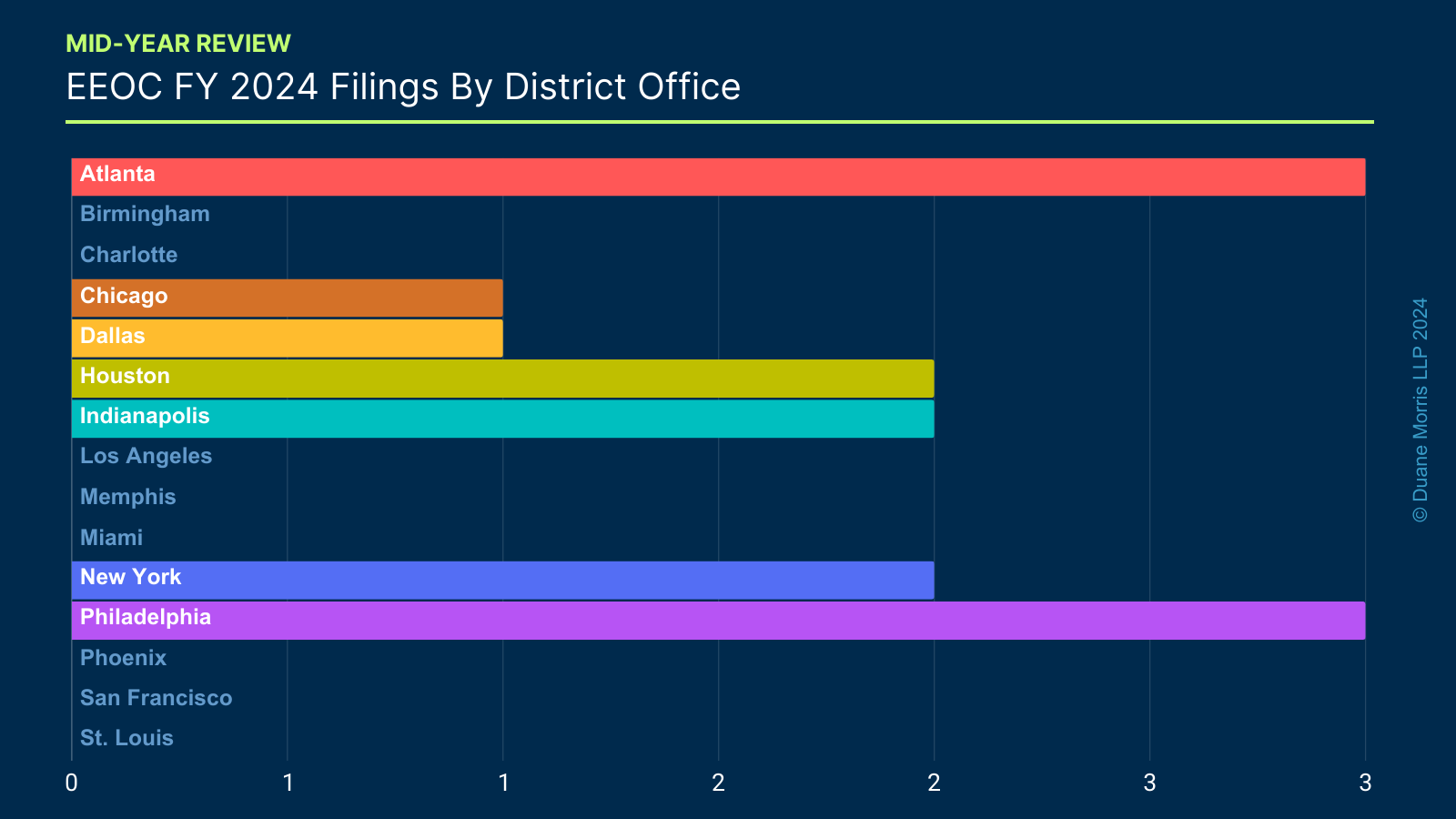
In addition to tracking the total number of filings, we closely monitor which of the EEOC’s 15 district offices are most active in terms of filing new cases over the course of the fiscal year. Some districts tend to be more aggressive than others, and some focus on different case filing priorities. The following chart shows the number of lawsuit filings by EEOC district office.

The most noticeable trend of the first six months of FY 2024 is that the Atlanta and Philadelphia District Offices already filed three lawsuits each. Houston, Indianapolis, and New York each have two lawsuit filings, and Dallas and Chicago have one each. That means that many of the district offices have yet to file a lawsuit at all in FY 2024. But for employers in the Atlanta and Philadelphia metropolitan areas, these early tea leaves suggest that a higher likelihood of pending charges may turn into federal lawsuits by the end of Summer to next Fall.

Analysis Of The Types Of Lawsuits Filed In First Half Of FY 2024

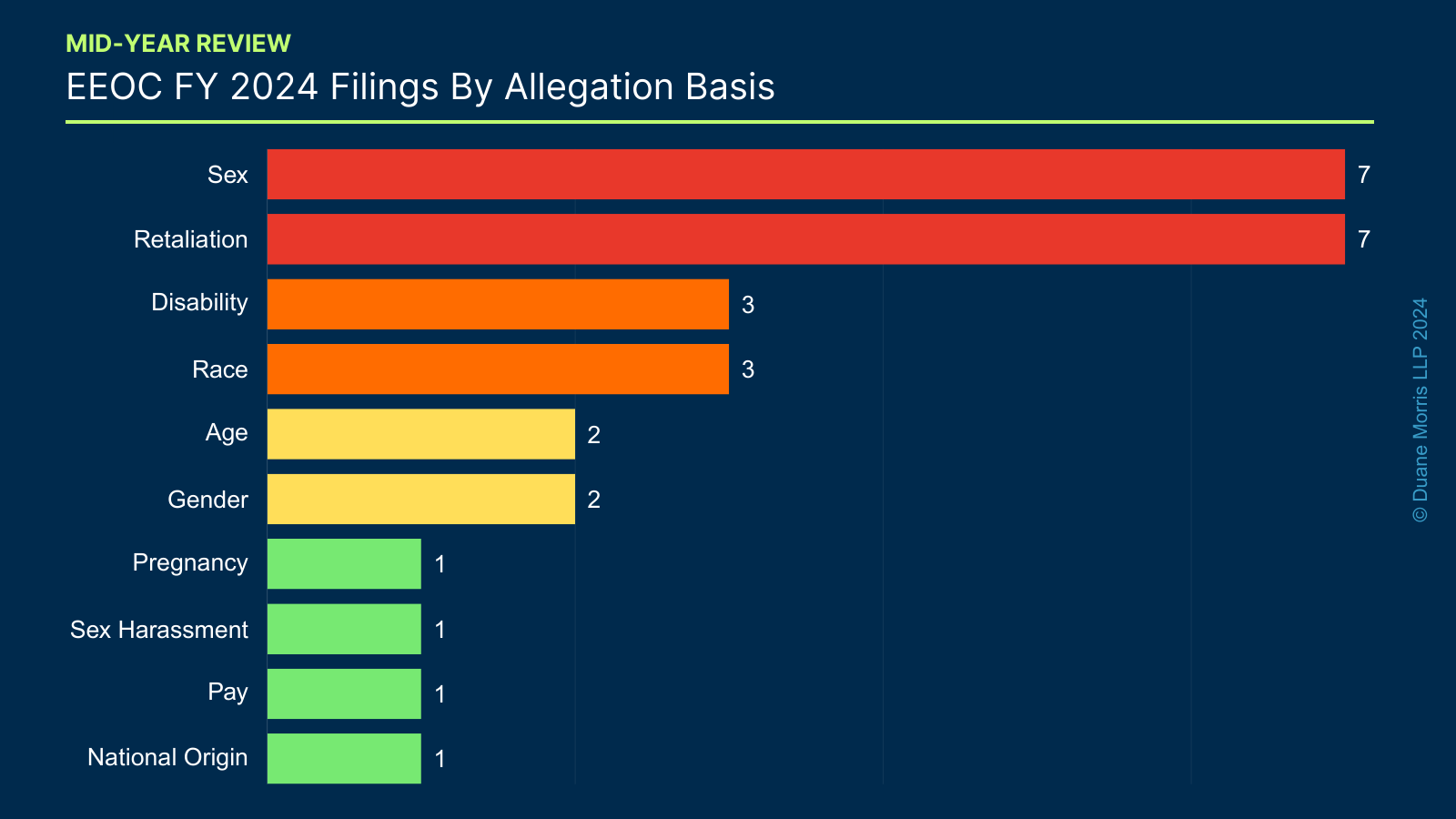
We also analyzed the types of lawsuits the EEOC filed throughout the first six months, in terms of the statutes and theories of discrimination alleged, in order to determine how the EEOC is shifting its strategic priorities. The chart below shows the EEOC filings by allegation type.

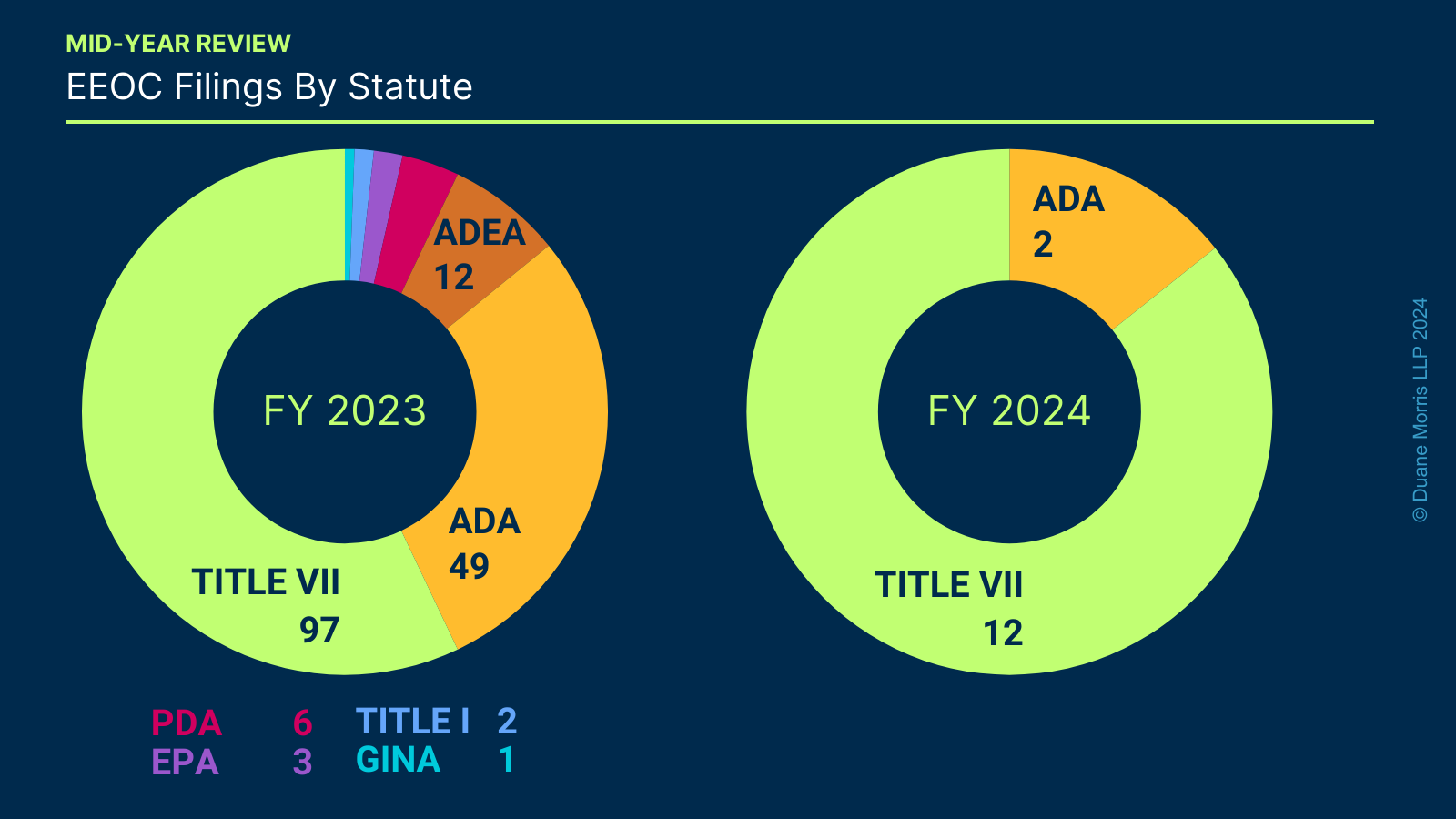
The percentage of each type of filing has remained fairly consistent over the past several years. However, in FY 2024, nearly every filing has contained Title VII claims, with 12 of the 14, or 87% alleging these violations. This is a major increase over past years — in FY 2023, Title VII claims in 59% of all filings, 69% in FY 2022, and 62%. ADA cases were alleged in three lawsuits filed, for 21% of the cases, a decrease from the EEOC’s FY 2023 filings of 31%, 18% in FY 2022, and 36% in FY 2021. There was also an ADEA claim in one of the lawsuits and Pregnancy Discrimination Act claim in another.

The graph set out below shows the number of lawsuits filed according to the statute under which they were filed (Title VII, Americans With Disabilities Act, Pregnancy Discrimination Act, Equal Pay Act, and Age Discrimination in Employment Act) and, for Title VII cases, the theory of discrimination alleged.

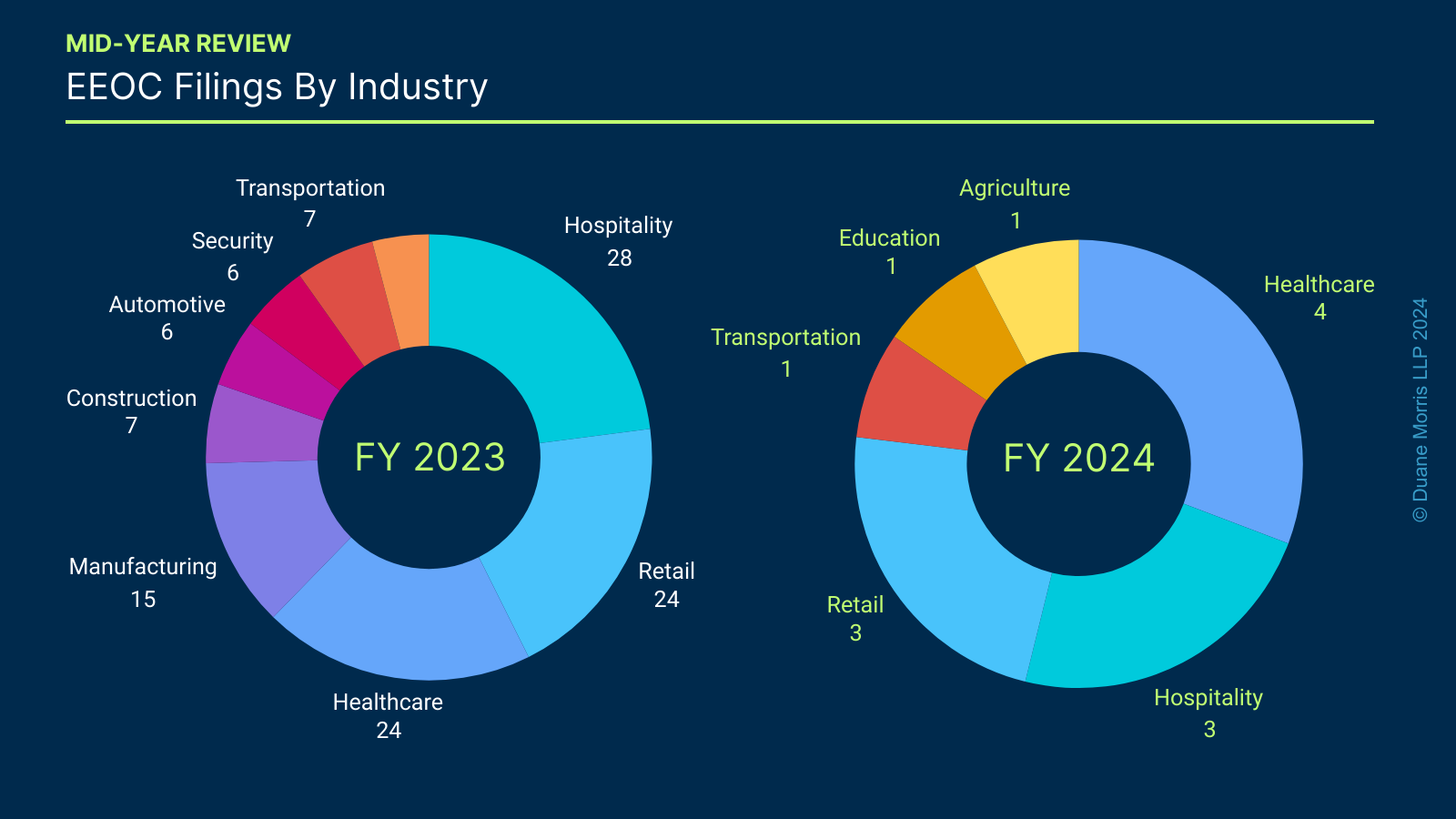
The industries impacted by EEOC-initiated litigation have also remained consistent in FY 2024. The chart below details that hospitality, healthcare, and retail employers have maintained their lead as corporate defendants in the last 18 months of EEOC-initiated litigation.

Notable 2024 Lawsuit Filings

Gender Identity Discrimination

In EEOC v. Sis-Bro, Inc., Case No. 24-CV-968 (S.D. Ill. Mar. 28, 2024), the EEOC brought suit alleging that the farm violated federal law when it allowed an employee to be harassed because of her sex and gender identity after she began transitioning genders. The EEOC contended that the employee was subjected to frequent, derogatory comments about the employee’s gender identity; the co-owner refused to call the targeted employee by her name and referred to her by her former name; repeatedly told her she was “a guy”; and criticized her use of employer-provided health insurance and leave for gender affirming care, in violation of Title VII of the Civil Rights Act.

Disability Discrimination

In EEOC v. Atlantic Property Management, Case No. 24-CV-10370 (D. Mass. Oct. 4, 2023), the EEOC filed an action on behalf of a new hire who the company allegedly rescinded a job offer following the employee’s cancer diagnosis. The EEOC alleged that the individual was offered employment as an executive administrative assistant to the president and vice president of the two companies. Shortly after the offer of employment, the employee was diagnosed with breast cancer. Her doctor confirmed she was able to perform all aspects of her position, but she would need to receive treatment weekly resulting in a need for some limited time off from work. When she provided her doctor’s note to the companies, the president decided to withdraw her job offer without any discussion with the employee, which the EEOC alleged violated the ADA.

Race / National Origin Discrimination

In EEOC v. Bob’s Tire Company, Case No. 24-CV-10077 (D. Mass. Jan. 10, 2024), the EEOC filed an action alleging that the company violated Title VII of the Civil Rights Act by subjecting employees to egregious and constant harassment, including the owner telling Hispanic employees to “go back to [their] country”; calling Guatemalan employees “f—ing Guatemalans”; donning a U.S. Immigration and Customs Enforcement hat to intimidate Hispanic employees; and calling employees homophobic slurs. Additionally, the EEOC contended that employees were also harassed by a co-worker because of their sex, race, and national origin, and at least one employee complained to the owner, who retaliated against this complaining employee by mocking him for being in a romantic and/or sexual relationship with the harassing co-worker.

These filings illustrate that the EEOC will likely continue to prioritize sex, disability, and race discrimination claims in the second half of FY 2024.

March 2024 Release Of Enforcement Statistics

On March 12, 2024, the EEOC published its fiscal year 2023 Annual Performance Report (FY 2023 APR), highlighting the Commission’s recovery of $665 million in monetary relief for over 22,000 workers, a near 30% increase for workers over Fiscal Year 2022. This annual publication from the EEOC is noteworthy for employers in terms of recognizing the EEOC’s reach, understanding financial exposure for workplace discrimination claims, and identifying areas where the EEOC may focus its litigation efforts in the coming year. It is a must read for corporate counsel, HR professional, and business leaders.

As we blogged about here, the Commission reported having one of the most litigious years in recent memory in FY 2023, with 142 new lawsuits filed, marking a 50% increase from FY 2022. Among these new lawsuits, 86 were filed on behalf of individuals, 32 were non-systemic suits involving multiple victims, and 25 were systemic suits addressing discriminatory policies or affecting multiple victims. The EEOC also touted that it obtained $22.6 million for 968 individuals in litigation, while resolving 98 lawsuits and achieving favorable results in 91% of all federal district court resolutions.

These numbers show the EEOC is still aggressively litigating discrimination claims, and despite the slow start in FY 2024, we anticipate the EEOC will turn up the jets in the second half of the fiscal year.

Strategic Priorities

The Commission also reported significant progress in its “priority areas” for 2023, which included combatting systemic discrimination, preventing workplace harassment, advancing racial justice, remedying retaliation, advancing pay equity, promoting diversity, equity, inclusion and accessibility (“DEIA”) in the workplace, and, significantly, embracing the use of technology, including artificial intelligence, machine learning, and other automated systems in employment decisions.

In 2023, the EEOC resolved over 370 systemic investigations on the merits, resulting in over $29 million in monetary benefits for victims of discrimination. The Commission also reported that its litigation program achieved a 100% success rate in its systemic case resolutions, obtaining over $11 million for 806 systemic discrimination victims, as well as substantial equitable relief.  Further, the Commission made outreach and education programs a priority in 2023, and specifically sought to reach vulnerable workers and underserved communities, including immigrant and farmworker communities, hosting over 680 events for these groups and partnering with over 1,120 organizations, reaching over 107,000 attendees.

These statistics confirm the Commission’s prowess, dictating that employers should take heed in the coming months as the EEOC seeks to match these gaudy figures.

Other Notable Developments

Beyond touting its monetary successes, and litigation accomplishments, the FY 2023 APR also highlights the newly enacted Pregnant Workers Fairness Act (“PWFA”), which provides workers with limitations related to pregnancy, childbirth, or related medical conditions the ability to obtain reasonable accommodations, absent undue hardship to the employer.

The Commission began accepting PWFA charges on June 27, 2023 (the law’s effective date) and has conducted broad public outreach relating to employers’ compliance obligations under the new law.

Takeaways For Employers

By all accounts, FY 2023 was a record-breaking year for the EEOC. As demonstrated in the report, the Commission has pursued an increasingly aggressive and ambitious litigation strategy to achieve its regulatory goals.  The data confirms that the EEOC had a great deal of success in obtaining financially significant monetary awards.

Although the early numbers are lagging as compared with last year, we anticipate that the EEOC will continue to aggressively pursue its strategic priority areas in FY 2024.  There is no reason to believe that the annual “September surge” is not coming, in what could be another precedent-setting year.  We will continue to monitor EEOC litigation activity on a daily basis, and look forward to providing our blog readers with up-to-date analysis on the latest developments.

Finally, we are thrilled to announce that will be providing a webinar on May 13, 2024, to further analyze the above data.  Employers will gain insight on what they should be doing to ready themselves for the remainder of FY 2024.  Save the date and stay tuned!

Texas Federal Court Throws Out Data Breach Class Action

By Gerald L. Maatman, Jr., Jennifer A. Riley, and Emilee N. Crowther

Duane Morris Takeaways: In Austin v. Fleming, Nolen & Jez, LLP, No. 4:23-CV-00901, 2024 U.S. Dist. LEXIS 60696 (S.D. Tex. Apr. 2, 2024), Judge Andrew S. Hanen of the U.S. District Court for the Southern District of Texas granted Defendant’s motion for summary judgment in a data breach class action. The Court found that the time Plaintiff’s allegations about the time spent – (i) researching the data breach, (ii) exploring credit monitoring and identity theft options, (iii) self-monitoring her accounts, and (iv) seeking legal counsel – were not compensable damages and could not support her claims.  This case serves as an important reminder that named Plaintiffs in data breach class actions must have suffered an actual, viable, concrete injury to sustain their claims.

Case Background

On February 6, 2023, a cybercriminal breached Defendant’s servers and obtained some of its confidential client data.  Id. at *1.  The cybercriminal then demanded Defendant pay money to avoid the publication of Defendant’s confidential client data on the dark web.  Id.  After Defendant sent out data breach notice letters to their potentially affected clientele, the named Plaintiff, a former client of Defendant, filed a class action complaint against Defendant asserting claims for negligence, breach of confidence, breach of implied contract, and breach of implied covenant of good faith and fair dealing.  Id.

Defendant moved for summary judgment on the basis that Plaintiff had not, and could not, establish that she had suffered any damages as a result of the data breach.  Id.  In response, Plaintiff presented an affidavit from a putative class member who had suffered monetary damages due to identity theft.  Id.

The Court’s Decision

The Court ruled that Plaintiff could not rely on a putative class member’s purported damages to support her claims prior to class certification, and as such, any evidence supporting the claims of other class members was “irrelevant.”  Id. at 4.  As a result, the Court only considered Defendant’s motion for summary judgment as it pertained to Plaintiff’s individual claim against the Defendant. Id.

The Court held that none of the following allegations of harm were sufficient for Plaintiff to maintain her claims — “time spent verifying the legitimacy and impact of the data breach, exploring credit monitoring and identity theft insurance options, self-monitoring her accounts and seeking legal counsel regarding her options for remedying and/or mitigating the effects of the data breach.”  Id. at *5-6.

Accordingly, the Court found that because Plaintiff could not show “that she was injured by the data breach” or that “she suffered any damages,” summary judgment was proper.  Id. at *6.

Implications For Companies

The Court’s ruling in Austin v. Fleming underscores the importance of damages and a viable injury-in-fact in data breach class actions.  The first line of defense in any data breach class action challenging whether the named Plaintiff suffered an actual, concrete injury.  Used effectively, companies can parlay a Plaintiff’s claimed damages in data breach class actions as quick off-ramp out of litigation.

BIPA Plaintiffs Ring The Bell In Class Certification Victory Over Amazon

By Gerald L. Maatman, Jr., Tyler Zmick, and Christian J. Palacios

Duane Morris Takeaways:  In Svoboda v. Amazon, Case No. 21-C-5336, 2024 U.S. Dist. LEXIS 58867 (N.D. Ill. Mar. 30, 2024), Judge Jorge L. Alonso of the U.S. District Court for the Northern District of Illinois granted class certification to a class of plaintiffs who alleged that Amazon’s “virtual try-on” (“VTO”) technology violated the Illinois Biometric Information Privacy Act (“BIPA”).  In doing so, Judge Alonso dealt Amazon a significant blow in its efforts to block the certification of a purported class of claimants that might number in the millions (with pre-certification discovery already establishing that there were over 160,000 persons who used Amazon’s VTO technology during the relevant class period). This decision is the most recent success by the plaintiffs’ bar in a string of victories for class action privacy lawsuits across Illinois and illustrates that even the largest and most sophisticated companies in the world face legal exposure in connection with their biometric retention and application practices. 

Background

Amazon sells products to consumers on its mobile website and shopping application. Its “virtual try-on” technology allows users to virtually try on makeup and eyewear, and is exclusively available on mobile devices. VTOs are software programs that use augmented reality to overlay makeup and eyewear products on an image or video of a face, which allows shoppers to see what the product might look like prior to deciding whether to purchase it. During the relevant class period, there were two VTOs at issue, one of which was developed by a third party (ModiFace), and another which was developed in-house by Amazon that later replaced ModiFace. Id. at 4. Amazon’s VTOs come in two forms, including: (1) VTO technology available for lip products, and; (2) VTOs available for glasses. The ModiFace VTO is available for lip liner, eye shadow, eye liner, and hair color. Amazon licenses, rather than owns ModiFace VTO. Id. at 5.

Both Amazon and ModiFace VTOs essentially works the same for every user. In order to access Amazon’s virtual try-on technology, the user first begins by clicking a “try on” button on an Amazon product page (the use of this try-on feature is entirely optional and does not serve as a barrier to the customer actually purchasing the product). The first time the customer uses Amazon VTO, she is shown a pop-up screen that states, “Amazon uses your camera to virtually place products such as sunglasses and lipstick on your face using Augmented Reality. All information remains on your device and is not otherwise stored, processed or shared by Amazon.”  Only after granting permission can the customer use the VTO technology to virtually try on the product. Users may select “live mode” or “photo upload mode” to superimpose the try-on product on an image of their own face. For both modes, the VTOs use software to detect users’ facial features and use that facial data in order to determine where to overlay the virtual products. Id. at 5.

Based on these facts, plaintiffs brought a class action lawsuit against Amazon, which alleged that the online retailer violated the BIPA’s requirements by collecting, capturing, storing or otherwise obtaining the facial geometry and associated personal identifying information of thousands (if not millions) of Illinois residents who used Amazon’s VTO applications from computers and other devices without first providing notice and the required information, obtaining informed written consent, or creating written publicly-available data retention and destruction guidelines. Id. Plaintiffs sought to certify a class of all individuals who used a virtual try-on feature on Amazon’s mobile website or app while in Illinois on or after September 7, 2016. Significantly, pre-certification discovery established that at least 163,738 people used virtual try-on technology on Amazon’s platforms while in Illinois during the class period. Id. at 6.

The Court’s Ruling

In ruling in favor of the plaintiffs, Judge Alonso systematically rejected each of Amazon’s arguments as to why plaintiffs failed to satisfy Rule 23’s requirements for class certification. Given the size of the purported class, Amazon did not attempt to contest the numerosity requirement. With respect to the adequacy requirement, Amazon argued that the named plaintiffs were inadequate and atypical because they alleged they used VTO for lipstick, and not eyewear or eye makeup (while the majority of the proposed class was comprised of individuals who used VTO for eyewear). Amazon further argued that the named plaintiffs had a conflicting interest with the class members who used VTO for eyewear, because the BIPA’s healthcare exception bars claims arising from the virtual try-on of eyewear. Id. at 12.  The Court rejected this argument. It found that there was no evidence that the named plaintiffs’ interests were antagonistic, or directly conflicted with those members who used VTO to try on eyewear, and Amazon’s concern that plaintiffs lacked an incentive to vigorously contest the healthcare exception defense was merely speculative. Id. The Court was also satisfied that the plaintiffs’ claims arose from the same course of conduct that gave rise to other class members’ claims (such as Amazon’s purported collection, capture, possession, and use of facial templates via its VTOs) and thus the typicality requirement was satisfied. Id. at 15.

Similarly, the Court reasoned that common questions of law or fact predominated over any questions affecting individual members, and a class action was superior to other available methods for fairly and efficiently adjudicating the controversy.  Id. at 17. Amazon asserted that there was no reliable way to identify class members who used VTO in Illinois during the class period, and thus, individualized inquiries predominated rendering the case unmanageable. Id. at 21. The Court rejected this argument. It agreed with the plaintiffs that Illinois billing addresses, IP addresses from which VTO was used, and geo-location data all served as a way of identifying class members. Amazon raised other arguments about the difficulty of identifying potential class members, but Judge Alonzo rejected all of these arguments, observing that plaintiffs did not need to identify every member of the class at the certification stage.  Id. at 23.

Finally, the Court dispatched with Amazon’s various affirmative defenses. In particular, Amazon argued that it had unique defenses for every member of the putative class, since damages were discretionary under the BIPA. The Court disagreed. It noted that the Illinois Supreme Court had determined that a trial court could fashion a damages award in a BIPA lawsuit that fairly compensated class members while deterring future violations, without destroying a defendant’s business. Id. at 25.

Implications for Employers

Employers should be well aware of the dangers associated with collecting or retaining individuals’ biometric information without BIPA-compliant policies in place. This case serves as a reminder that the larger the company, the larger the potential class size of a class or collective action. Although it remains to be seen the actual size of Svoboda v. Amazon, the class will likely number in the hundreds of thousands and this case should serve as a wake-up call for companies, regardless of scale, of the dangers of running afoul of the Prairie State’s privacy laws.

EEOC Scores Summary Judgement Victory Against Indiana RV Maker In Disability Suit

By Gerald L. Maatman, Jr., Alex W. Karasik, and Christian J. Palacios

Duane Morris Takeaways:  In EEOC v. Keystone RV Company, Case No. 3:22-CV-831 (N.D. Ind. Mar. 27, 2024), Judge Damon R. Leichty of the U.S. District Court for the Northern District of Indiana held that an employer was liable under the Americans with Disabilities Act (“ADA”) for failing to accommodate a former employee after the company terminated the worker for attendance issues stemming from his novel medical condition. This rare summary judgement victory in favor of the Commission illustrates the importance of employers engaging in an interactive process with their employees to provide them with reasonable accommodations under federal anti-discrimination laws, and the legal liability associated with non-compliance. 

Background

The Charging party, Brandon Meeks, was diagnosed with cystinuria at the age of 19, a rare chronic illness that caused kidney stones to develop with irregular frequency. Roughly once every two years, he developed a large kidney stone that required surgical removal. In 2019 Meeks was hired as a painter at Keystone’s Wakarusa, Indiana plant, where he painted the base coat on RV wheels.  Keystone had an attendance policy whereby it would terminate an employee who accrued seven “attendance points” (absences) within a year, and allowed an employee to miss up to three consecutive days from one doctor’s note and accrue just one attendance point without applying for an ADA accommodation.  Id. at 2.  According to the record, Mr. Meeks was a “diligent and hard worker,” but he accrued several attendance points for absences related to his medical condition, including a visit to his urologist, and treatment for kidney stone pain. Id.

On November 13, 2019, Meeks collapsed in a restroom due to excruciating pain.  He was promptly rushed to the hospital and informed by a doctor that he had a “golf-ball-sized kidney stone” in his left kidney that would need to be surgically removed.  Id. at 3.  Meeks informed Keystone that he would require two weeks off of work to schedule and recover from surgery, which his employer agreed to given that Keystone’s Wakarusa plant closed down for several weeks from December to January and Meeks would only need a single day off of work. Prior to this request, Meeks had accrued 6 attendance points.  Id. at 4.  When Meeks returned to work on January 13, 2020, he informed Keystone he would need time off for another surgery scheduled on January 24, 2020. Meeks’ manager forecasted to him that he would be terminated if he missed work, and could reapply for employed 60 days later, per company policy.  Id.  According to the manager, Meeks did not provide a return to work date in connection with his second surgery request.  According to Meeks, he knew he could likely return to work on January 27, 2020, but he never communicated this timeline to Keystone because his employer “never asked.” Id. After Meeks underwent his second surgery, on January 24, 2020, his mother drove him to the plant to pick up his paycheck, upon which he was sent to the corporate office and informed he was terminated due to his attendance points.  Meeks subsequently filed a Charge with the EEOC. After its investigation, the EEOC brought suit on his behalf.  On March 27, 2024, Judge Leichty granted summary judgement in favor of the Commission.

The District Court’s Ruling

Judge Leichty began his 19-page ruling by observing that this case illustrated one reason “why the ADA existed.”  Id. at 1.  Judge Leichty observed that “[n]o one can reasonably dispute that Mr. Meeks was a qualified individual with a disability. Keystone knew of the disability. And Keystone failed to accommodate the disability reasonably. A reasonable jury could not find otherwise on this record.”  Id. at 7.

As the record reflected, the Court reasoned that Keystone clearly could have accommodated providing Meeks with two weeks leave, and yet it had not done so. The Court was unpersuaded by Keystone’s arguments that Meeks did not effectively communicate with his employer, and prior to his January surgery, he did not provide Keystone with an estimated return date.  Rather, the Court determined that Keystone had an affirmative obligation to initiate an interactive process with its employees, and had historical knowledge of Meeks’ disability; because of this, the fault was theirs alone.  Thus, “[a] reasonable jury could not lay the fault at Mr. Meeks’ feet,” and the Court granted summary judgement in the EEOC’s favor on ADA liability.  Id. at 10-11.

Judge Leichty scheduled a trial at a later date to assess the question of damages, as factual disputes remained regarding Meeks’ reasonable diligence at finding comparable employment.

Implications For Employers

As the ruling in EEOC v. Keystone RV Company illustrates, it is imperative that employers engage in an interactive process with employees with respect to disability accommodations, provided the employer has reason to know of the employee’s disability. Significantly, a formal ADA request is not necessary on the part of the employee for a court to find an employer at fault for a breakdown of the interactive process.  Because of this, employers should have robust policies in place to proactively provide their employees with reasonable accommodations for their disabilities. To do otherwise risks receiving a pre-liability judgement in favor of a federal, state, or municipal regulatory agency tasked with enforcing anti-discrimination legislation.

California Court Of Appeal Deems Attorneys’ Fees And Costs Awards To Prevailing Plaintiffs Mandatory On Overtime And Minimum Wage Claims

By Eden E. Anderson and Gerald L. Maatman, Jr.

Duane Morris Takeaways:  On March 25, 2024, the California Court of Appeal for the Second District held in Gramajo v. Joe’s Pizza on Sunset, Inc., Case Nos. B322992/B323024 (Cal. App. Mar. 25, 2024), that awards of attorneys’ fees and costs to prevailing plaintiffs in actions for unpaid minimum or overtime wages are mandatory.  Consequently, a trial court lacks discretion to deny fees and costs recovery, even when a plaintiff engages in bad faith litigation tactics and recovers a negligible amount.  On a bright note, mandatory fee and cost awards must still be reasonable, and a trial court retains discretion to reduce the amount sought if it is unreasonable. 

Case Background

Elinton Gramajo worked as a pizza delivery driver.  He sued his employer for failing to pay him minimum and overtime wages, failing to provide meal and rest breaks, failing to reimburse business expenses, and other related claims. He sought a total recovery of $26,159.23.  Coincidentally, that amount was just above the $25,000 jurisdictional threshold for an unlimited civil proceeding.  After four years of litigation, the case proceeded to trial.  A jury found in Gramajo’s favor, but only on his claims for unpaid minimum and overtime wages. The jury awarded him just $7,659.63.

Gramajo then sought to recover a whopping $296,920 in attorneys’ fees, and $26,932.84 in costs.  The trial court denied any recovery.  It found that Gramajo acted in bad faith by artificially inflating his damages claim to justify filing the case as an unlimited civil proceeding.  As evidence of bad faith, the trial court highlighted that, although Gramajo sought $10,822.16 in unreimbursed expenses, he submitted no evidence at trial to support that claim.  He also alleged an equitable claim for injunctive relief, but then never pursued that claim.  Additionally, the trial court found that the case had been “severely over litigated” with Gramajo noticing 14 depositions and serving 15 sets of written discovery requests, while ultimately using just 12 exhibits at trial.  Id. at 4.

The trial court’s denial of Gramajo’s motion for fees and costs was premised upon § 1033(a) of the California Code of Civil Procedure, which vests discretion in a trial court to deny attorneys’ fees and costs recovery when a plaintiff recovers less than the $25,000 jurisdictional minimum for an unlimited civil case.  Gramajo appealed.

The Court of Appeal’s Decision

On appeal, the California Court of Appeal for the Second District reversed.

It held that § 1194(a) of the California Labor Code applied, and not § 1033(a) of the Code of Civil Procedure.  Section 1194(a) of the Labor Code provides than a plaintiff who prevails in an action for unpaid minimum or overtime wages “is entitled to recover in a civil action . . . reasonable attorneys’ fees, and costs of suit.”  The Court of Appeal reasoned that § 1194(a) mandates a fee award to a prevailing plaintiff who alleges unpaid minimum and/or overtime wages, and that it was more specific than § 1033(a) of the Code of Civil Procedure, and more recently enacted.

On a bright note, the Court of Appeal cautioned that its reversal “should not be read as license for attorneys litigating minimum and overtime wages cases to over-file their cases or request unreasonable and excessive cost awards free of consequence” and that § 1194(a) mandates only the recovery of a “reasonable fee and cost award.”  Id. at 15. While remanding that issue to the trial court, the Court of Appeal highlighted an example of a fee award it deemed reasonable.  It noted that, in Harrington v. Payroll Entertainment Services, Inc., 160 Cal.App.4th 590 (2008), the plaintiff recovered just $10,500 in unpaid overtime wages and was awarded attorneys’ fees of just $500.

Implications Of The Decision

While it is an unfortunate outcome that attorneys’ fees and costs awards in overtime and minimum wage cases are mandatory to a prevailing plaintiff, and not entirely discretionary, the silver lining in Gramajo is that a trial court at least retains discretion to award only what is reasonable.

Texas Federal Court Strikes Down NLRB’s 2023 Joint Employer Rule

By Gerald L. Maatman, Jr., Jennifer A. Riley, and Emilee N. Crowther

Duane Morris Takeaways: In Chamber of Commerce of the U.S.A. et al. v. NLRB et al., No. 6:23-CV-00553, 2024 WL 1045231 (E.D. Tex. Mar. 8, 2024), Judge J. Campbell Barker of the U.S. District Court for the Eastern District of Texas granted the Plaintiffs motion for summary judgment and denied the Defendants cross-motion for summary judgment. Under the NLRB’s 2023 joint employer rule, even companies who exercise just “indirect control” over the employees of another entity could be considered a joint employer under federal labor laws. The Court held that the NLRB’s 2023 joint employer rule did not provide a meaningful two-part test to determine joint employer status, and that the NLRB’s reason for rescinding the 2020 Rule was arbitrary and capricious.  Accordingly, the Court vacated the 2023 Rule and reinstated the 2020 Rule. 

This ruling is a huge win for businesses, as it reinstates the 2020 Rule’s heightened “substantial direct and immediate control” standard for determining joint-employer status.

Case Background

In 2020, the NLRB issued a joint-employer final rule, providing that an entity “is a joint employer of a separate employer’s employees only if the two employers share or codetermine the employees’ essential terms and conditions of employment” (the “2020 Rule”).  Id. at 12 (quoting 29 C.F.R. § 103.40(a) (2020)).  Under the 2020 Rule, a company is a joint employer when it exercises “substantial direct and immediate control” over one or more of the following “essential terms or conditions of employment” – “wages, benefits, hours of work, hiring, discharge, discipline, supervision, and direction.”  Id. at 12-13 (quoting 29 C.F.R. § 103.40(a), (c)(1) (2020)).

In 2023, the NLRB rescinded the 2020 Rule and enacted a new joint-employer final rule (the “2023 Rule”).  Id. at 14.  The 2023 Rule defined a joint employer as an entity that exercised “reserved control” or “indirect control” over one of seven terms and conditions of employment, including: “(1) work rules and directions governing the manner, means, and methods of the performance, and (2) working conditions related to the safety and health of employees.”  Id. (29 C.F.R. § 103.40(d)-(e)).

In 2023, Plaintiffs sued the Defendants, challenging the 2023 Rule on two grounds: (i) that it is inconsistent with the common law; and (ii) that it is arbitrary and capricious.  Id. at 14-15.

In response, the Defendants cross-moved for summary judgment on the Plaintiffs claims, alleging that the 2023 Rule was based on, and is governed by, common law principles, that it is not arbitrary and capricious, and that the Board acted lawfully in rescinding the 2020 Rule.  Id. at 20.

The Court’s Decision

The Court granted the Plaintiffs motion for summary judgment, and denied Defendants cross-motion for summary judgment, thereby “vacating the 2023 Rule, both insofar as [the 2023 Rule] rescind[ed] the [2020 Rule] and insofar as it promulgate[d] a new version of [the 2020 Rule].”  Id. at 30.

First, the Court focused on the main dispute between the parties, i.e., whether the 2023 Rule had a meaningful two-step test to determine an entity’s joint employer status, or the 2023 Rule only had one step for all practical purposes.  Id. at 20-21.  The Defendants argued that the 2023 Rule’s joint-employer injury had the following steps: (i) “an entity must qualify as a common-law employer of the disputed employees”; and (ii) “only if the entity is a common-law employer, then it must also have control over one or more essential terms and conditions of employment.”  Id.  The Court disagreed, finding that “an entity satisfying step one, along with some other entity doing so, will always satisfy step two,” since “an employer of a worker under the common law of agency must have the power to control ‘the material details of how the work is to be performed,” and the Defendants proposed step two included “work rules and directions governing the manner, means and methods of the performance of duties.”  Id. at 22-23 (internal citations omitted).

The Court then analyzed whether the Board lawfully rescinded the 2020 Rule.  It opined that “to survive arbitrary-and-capricious review, agency action must be ‘reasonable and reasonably explained.”  Id. at 28-29.  The Court held that the Board did not provide a “reasonable or reasonably explained” purpose for rescinding the 2020 Rule, and therefore, its recension was arbitrary and capricious.  Id. at 29.  Since “vacatur of an agency action is the default rule” in the Fifth Circuit when such rule “is found to be discordant with the law or arbitrary and capricious”, the Court vacated the 2023 Rule.  Id. at 30.

Implications For Employers

The Court’s vacatur of the 2023 Rule in Chamber of Commerce of USA et al. v. NLRB et al. is an important victory for employers. The 2023 Rule would have made “virtually every entity that contracts for labor . . . a joint employer.” Id. at 25. Moreover, the 2020 Rule, in addition to imposing the heightened “substantial direct and immediate control standard,” provides integral guidance for what actions are considered joint, and what actions are not.  The Court’s decision to reinstate the 2020 Rule, therefore, is also a significant win for employers.

Sixth Circuit Is First to Weigh In On Pizza Driver Mileage Reimbursement Battle And Rejects DOL Interpretation

By Gerald L. Maatman, Jr., Jennifer A. Riley, and Kathryn Brown

Duane Morris Takeaways: On March 12, 2024, in Parker v. Battle Creek Pizza, Inc. No. 22-2119 (6th Cir. Mar. 12, 2024), a three-judge panel of the Sixth Circuit addressed the issue of what standard applies for calculating reimbursements of vehicle expenses owed under the FLSA to delivery drivers who use their own vehicles for their jobs. The consolidated appeal arose from dueling opinions of U.S. District Courts in Michigan and Ohio on the same issue.

The Sixth Circuit concluded that neither the IRS standard mileage rate (the approach of the court in Michigan), nor an employer’s “reasonable approximation” of vehicle costs (the approach of the court in Ohio), satisfies an employer’s minimum wage obligations under the FLSA. The Sixth Circuit vacated the district court opinions and sent the cases back to their respective courts for further proceedings on remand. The Sixth Circuit’s decision is essential reading for all businesses with delivery drivers, particularly those defending minimum wage claims involving drivers’ expenses, a hot-button litigation issue percolating in courts across the country.

Case Background

To set the stage, the FLSA requires payment of the minimum wage (currently $7.25 an hour) to employees “free and clear.” In the U.S. Department of Labor regulations interpreting the statute, 29 C.F.R. § 531.35 states that employers cannot shift business expenses to their employees if doing so causes the employees’ wages to drop below the minimum wage. In another section of the FLSA regulations, the DOL addresses how to calculate an employee’s “regular rate of pay” for overtime calculations when the employer reimburses an employee’s business expenses. In that regulation at 29 C.F.R. § 778.217(c), the DOL says employers may “reasonably approximate” the amount of the expenses to be reimbursed. The DOL regulations say nothing, however, about how to calculate such an approximation, and whether the analysis applies to wages owed other than overtime wages.

The district court in Parker v. Battle Creek Pizza, Inc., 20-CV-00277 (W.D. Mich. Apr. 28, 2022), held that use of the IRS mileage rate satisfied the FLSA. The court deferred to the DOL’s Field Operations Handbook, the internal manual that guides investigators for the Wage and Hour Division. In the Field Operations Handbook. The DOL takes the enforcement position at § 30c15(a) that employers may, in lieu of reimbursing an employee’s actual expenses, use the IRS standard business mileage rate to determine the amount of reimbursement owed to employees for FLSA purposes. By contrast, the district court in Bradford v. Team Pizza, Inc., 20-CV-00060 (S.D. Ohio Oct. 19, 2021), rejected the IRS mileage rate in favor of an employer’s “reasonable approximation” of the drivers’ expenses.

The IRS standard business mileage rate, currently $.67 a mile, is intended to represent gasoline, depreciation, maintenance, repair and other fees pertaining to vehicle upkeep. Employers’ “reasonable approximation” of an employee’s costs in using their personal vehicles to perform work typically is lower than the IRS rate.

The Sixth Circuit’s Ruling

The Sixth Circuit highlighted the basic requirement of the FLSA to pay employees at least the minimum wage for hours worked. As the Sixth Circuit stated, when an employee’s hourly wage is the minimum $7.25 an hour, any underpayment of the employee for costs they expended to benefit the employer necessarily causes them to receive less than the minimum wage.

Although it acknowledged the difficulty of calculating vehicle expenses on an employee-by-employee basis, the Sixth Circuit reasoned that any “approximation” of an employee’s personal vehicle costs — whether it be the employer’s own calculation or the IRS’s standard business mileage rate — is contrary to the FLSA where it results in an employee receiving less than the minimum wage.

The Sixth Circuit declined to defer to the DOL’s interpretation in the FLSA regulations or the agency’s Field Operations Handbook. It emphasized that the FLSA regulation supporting the “reasonable approximation” method — 29 C.F.R. § 778.217(c) — addressed overtime calculations, not minimum wage. The Sixth Circuit also found use of the IRS standard business mileage rate to be fatally flawed. As it explained, the IRS’s rate, though more generous in application than the “reasonable approximation” method, disfavors high-mileage drivers like delivery drivers and fails to account for regional and other differences inherent in maintaining a vehicle. Id. at 6.

The Sixth Circuit did not announce a new standard to replace the two approaches it rejected. However, it offered a three-part framework for the district courts to consider on remand. Similar to the burden-shifting framework in Title VII disparate treatment cases, the Sixth Circuit suggested that an FLSA plaintiff might present prima facie proof that a reimbursement was inadequate. The employer would then bear the burden to show that the amount it reimbursed bore a reasonable relationship to the employee’s actual costs. The plaintiff would have an opportunity to attack the employer’s reasoning while bearing the ultimate burden to prove failure to receive minimum wages.

Implications For Employers

Although the Sixth Circuit’s ruling in Parker is binding only on federal courts in Ohio, Michigan, Tennessee and Kentucky, the opinion may prompt courts around the country to reconsider reliance on the DOL’s “reasonable approximation” standard and the IRS’s standard business mileage rate when evaluating minimum wage claims of delivery drivers. Considering that FLSA claims asserting underpayment for vehicle expenses already is a favorite topic of the plaintiffs’ class action bar, we expect the opinion to unleash a flood of new lawsuits in this area. All businesses with delivery drivers ought to keep a close watch on how the Michigan and Ohio district courts apply the Sixth Circuit’s ruling on remand.

A silver lining in the decision may well be the notion that as calculating the appropriateness of reimbursement is required on a driver-by-driver basis, such claims seem difficult to ever certify.

The opinion in Parker is also significant in light of the Supreme Court’s forthcoming ruling on the viability of the Chevron doctrine, the framework in which courts generally defer to agencies’ interpretation of federal statutes. In rejecting the DOL’s interpretation of the FLSA, the reasoning in Parker may be a harbinger of future rulings under the FLSA and a panoply of other statutory schemes if the Supreme Court abandons Chevron deference.

The Duane Morris Private Attorneys General Act Review – 2024


By Gerald L. Maatman, Jr. and Jennifer A. Riley

Duane Morris Takeaways: One law making California so different – and so challenging – for employers is the Private Attorneys General Act (“PAGA”), which authorizes employees to assert claims for alleged labor violations. Such a worker acts as “a private attorney general” to pursue civil penalties against an employer as if they were an arm of the State of its agencies. PAGA claims are not class actions per se – instead, they are known as “representative actions – but they pose analogous risks and exposures like class actions brought under the California Labor Code. Plaintiffs bring thousands of PAGA cases every year, and, because PAGA plaintiffs can bring suit on behalf themselves and other employees, the stakes are often significant, with companies exposed to risks similar to those arising from class action litigation. The PAGA, however, has its own specific rules of the road, which differ from the rules elucidated in familiar Rule 23 jurisprudence.  The explosion of PAGA litigation has resulted in a complex body of case law that is often difficult to navigate, particularly in terms of the application of arbitration agreements and representative action waivers.  Given the wide adoption of such arbitration agreements, companies are struggling to grasp how recent decisions regarding the PAGA and arbitration impact their businesses.

To that end, the class action team at Duane Morris is pleased to present this year’s edition of the Private Attorneys General Act Review – 2024. We hope it will demystify some of the complexities of PAGA litigation and keep corporate counsel updated on the ever-evolving nuances of these issues.  We hope this book – manifesting the collective experience and expertise of our class action defense group – will assist our clients by identifying developing trends in the case law and offering practical approaches in dealing with PAGA litigation.

Click here to download a copy Duane Morris Private Attorneys General Act Review – 2024 eBook.

Stay tuned for more PAGA class action analysis coming soon on our weekly podcast, the Class Action Weekly Wire.

© 2009- Duane Morris LLP. Duane Morris is a registered service mark of Duane Morris LLP.

The opinions expressed on this blog are those of the author and are not to be construed as legal advice.

Proudly powered by WordPress