
Fifth Circuit Casts A Doubtful Eye On The U.S. Department of Labor’s Final Tip Credit Rule

By Gerald L. Maatman, Jr. and Shaina Wolfe

Duane Morris Takeaways: In Restaurant Law Center, et al. v. United States Department of Labor, et al., No. 22-50145 (Apr. 28, 2023), a decision of significant importance to all employers in general and the service and hospitality industry in particular, the U.S. Court of Appeals for the Fifth Circuit reversed a Texas federal district court’s order denying a preliminary injunction against enforcement of the new tip credit rule of the U.S. Department of Labor (“DOL”) and remanded for further proceedings. In Restaurant Law Center, the plaintiffs seek a nationwide preliminary injunction prohibiting enforcement of the DOL Final Rule regarding tip credit and dual jobs (the “Final Rule”).  Importantly, the Final Rule reinstated the “80/20 Rule” by providing that employers can utilize the tip credit so long as 80 percent or more of the work is tip-generating, and not more than 20 percent is directly supporting work. However, the Final Rule also provides that employers cannot utilize the tip credit when an employee performs non-tipped work for more than 30 consecutive minutes. Plaintiffs claim that the DOL impermissibly created a new definition of “tipped occupation” that lacks support in the FLSA, and that enforcement of the Final Rule will impose substantial, ongoing costs on businesses. The district court had denied Plaintiff’s preliminary injunction solely because they failed to establish irreparable harm from complying with the Final Rule. The Fifth Circuit found that Plaintiffs submitted sufficient evidence that the Final Rule necessarily imposes a recordkeeping requirement and that employers who want to continue claiming the tip credit will “incur ongoing management costs” to ensure compliance. This decision is of signal importance as the Fifth Circuit’s decision indicates that the Final Rule may be on shaky ground.

Case Background

In late 2021, the DOL revived and revised the 80/20 Rule by providing that employers can utilize the tip credit only so long as 80 percent or more of the work is tip-producing, and not more than 20 percent is “directly supporting work.” See 29 C.F.R. § 531.56. Under the Final Rule, no tip credit can be taken for any non-tipped work. “Tip-producing work” is defined as work the employee performs directly providing services to customers for which the employee receives tips (i.e. taking orders and serving food). “Directly supporting work” is defined as work that is performed by a tipped employee in preparation of or to otherwise assist tip-producing customer service work (i.e., rolling silverware and setting tables). Non-tipped work includes preparing food or cleaning the kitchen, dining room, or bathrooms.

The Final Rule also includes a new requirement that an employer cannot utilize the tip credit when an employee performs more than 30 consecutive minutes performing “directly supporting work.”  Directly supporting work done in intervals of less than 30 minutes scattered throughout the workday would not invalidate the tip credit, subject to the 80/20 Rule. However, employers must pay minimum wages for “directly supporting work” performed after the lapse of the first 30 continuous minutes.

In December 2021, Plaintiffs challenged the Final Rule in federal district court in Texas on the grounds, among other things, that it violated the Fair Labor Standards Act.  Restaurant Law Center, No. 22-50145 at 3. Plaintiffs moved for a preliminary injunction and after holding an evidentiary hearing, the district court denied the preliminary injunction. Id. The district court did not reach the merits of Plaintiffs’ claims. Id. Rather, the district court assumed Plaintiffs were likely to succeed on the merits, but concluded they had failed to show they were irreparably harmed by the costs of complying with the new rule.  Id. at 3-4. The district court noted that the compliance costs had already been incurred since the Final Rule was in place for more than one month, and any other costs were speculative at best. Id. at 4. Further, the district court found that the new Final Rule, which is similar to the 80/20 rule, does not require employers to monitor their employees’ time. Id.

The Fifth Circuit’s Ruling Reversing The Denial Of The Preliminary Injunction

The Fifth Circuit reversed the district court’s denial of the preliminary injunction and remanded the case for further proceedings with the expectation that the district court “will proceed expeditiously” to reconsider the preliminary injunction motion with the benefit of the Fifth Circuit’s ruling. Id. at 11.

In reversing the district court, the Fifth Circuit found that employers who want to continue claiming the tip credit will “incur ongoing management costs” to ensure employees do not spend more than 30 minutes continuously performing directly supporting work. Id. at 9. Significantly, the Fifth Circuit commented that compliance with the Final Rule requires employers to record their employees’ time. The Fifth Circuit explained that it “cannot fathom how an employer could honor these specific constraints without recording employee time. What if an employer is investigated by the Department or sued by an employee for wrongly claiming the tip credit? Without time records, how could an employer defend itself?” Id. at 7.

The Fifth Circuit also disagreed with the DOL’s assertion that “employers need not engage in ‘minute to minute’ tracking of an employee’s time in order to ensure that they qualify for the tip credit.” Id. The Fifth Circuit opined that “[n]o explanation is given (nor can we imagine one) why an employer would not have to track employee minutes to comply with a rule premised on the exact number of consecutive minutes an employee works” and that an employer will need to account for blocks of employee time, “especially if an employer is accused of violating the rule.” Id. (emphasis in original).

Circuit Judge Higginbotham dissented from the majority opinion. He explained that “the majority yields to the temptation to insert its own logic to fill the void,” insinuating that the majority substituted its own reasoning (and potentially desire for a particular outcome) for Plaintiffs’ lack of a “clear showing they were harmed.” Id. at 17.

The Texas district court now has two important rulings to make. First, according to the Fifth Circuit, it will need to analyze the other preliminary injunction factors and issue another ruling on the motion for preliminary injunction. Second, the district court will need to analyze and issue its opinion on the parties’ fully-briefed motion for summary judgment. It is likely that the district court will issue one ruling tackling both motions. Regardless of the outcome, this case will likely be heavily litigated in the Fifth Circuit.

Implications For The Service & Hospitality Industry

The Fifth Circuit’s decision indicates that a nationwide preliminary injunction preventing enforcement of the Final Rule may be on the horizon. The Fifth Circuit’s decision showcases the unreasonable and costly task of complying with the Final Rule. The service and hospitality industry should stay tuned for the Texas federal district court’s imminent rulings on Restaurant Law Center’s motion for preliminary injunction and motion for summary judgment.
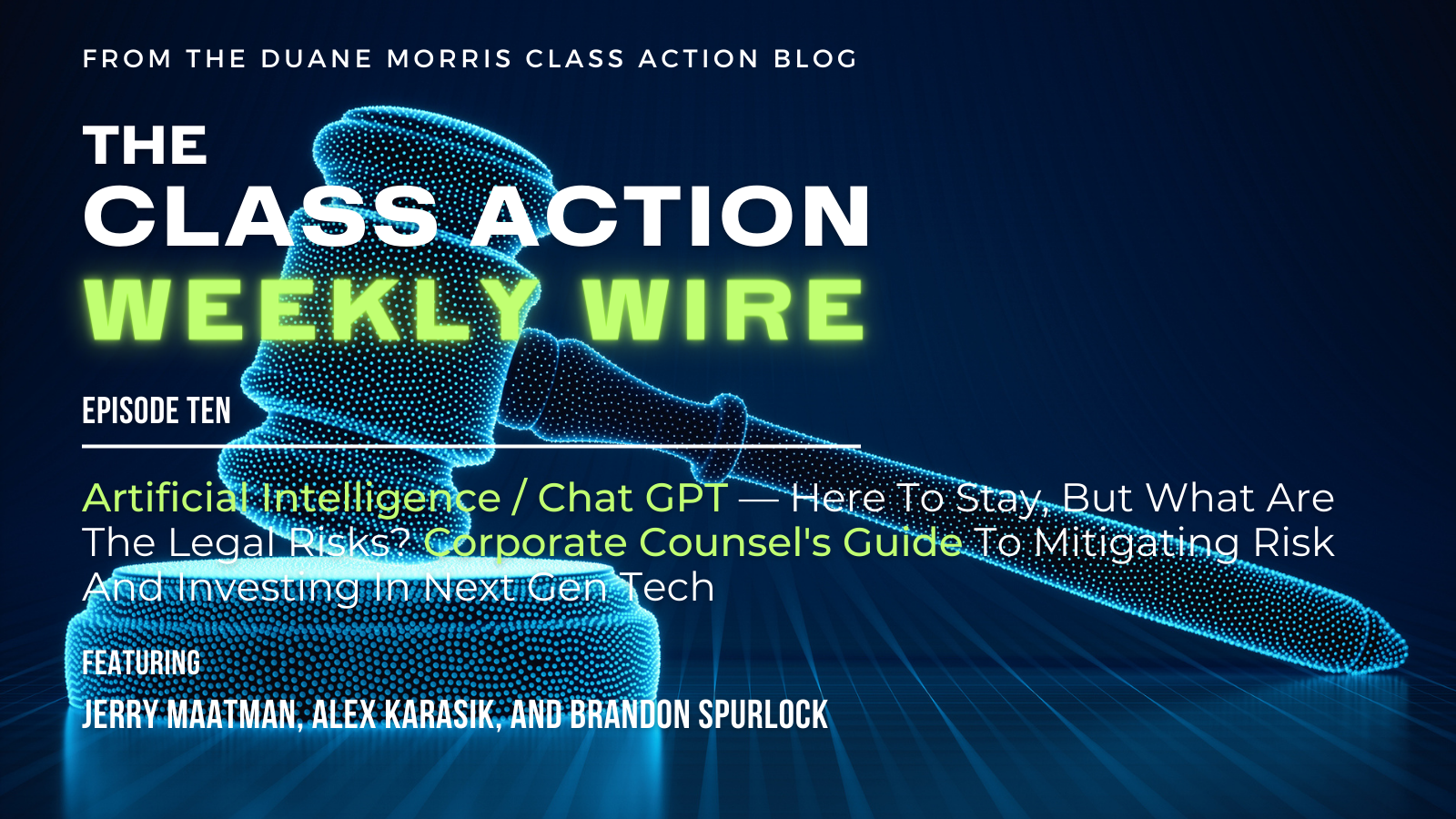
 

Artificial Intelligence / Chat GPT – Here To Stay, But What Are The Legal Risks? Corporate Counsel’s Guide To Mitigating Risk And Investing In Next Gen Tech

Duane Morris Takeaway:  This week’s episode of the Class Action Weekly Wire features Duane Morris partners Jerry Maatman, Alex Karasik, and special counsel Brandon Spurlock with their analysis of significant trends and developments in artificial intelligence and Chat GPT and how it will impact class action litigation. We hope you enjoy it!

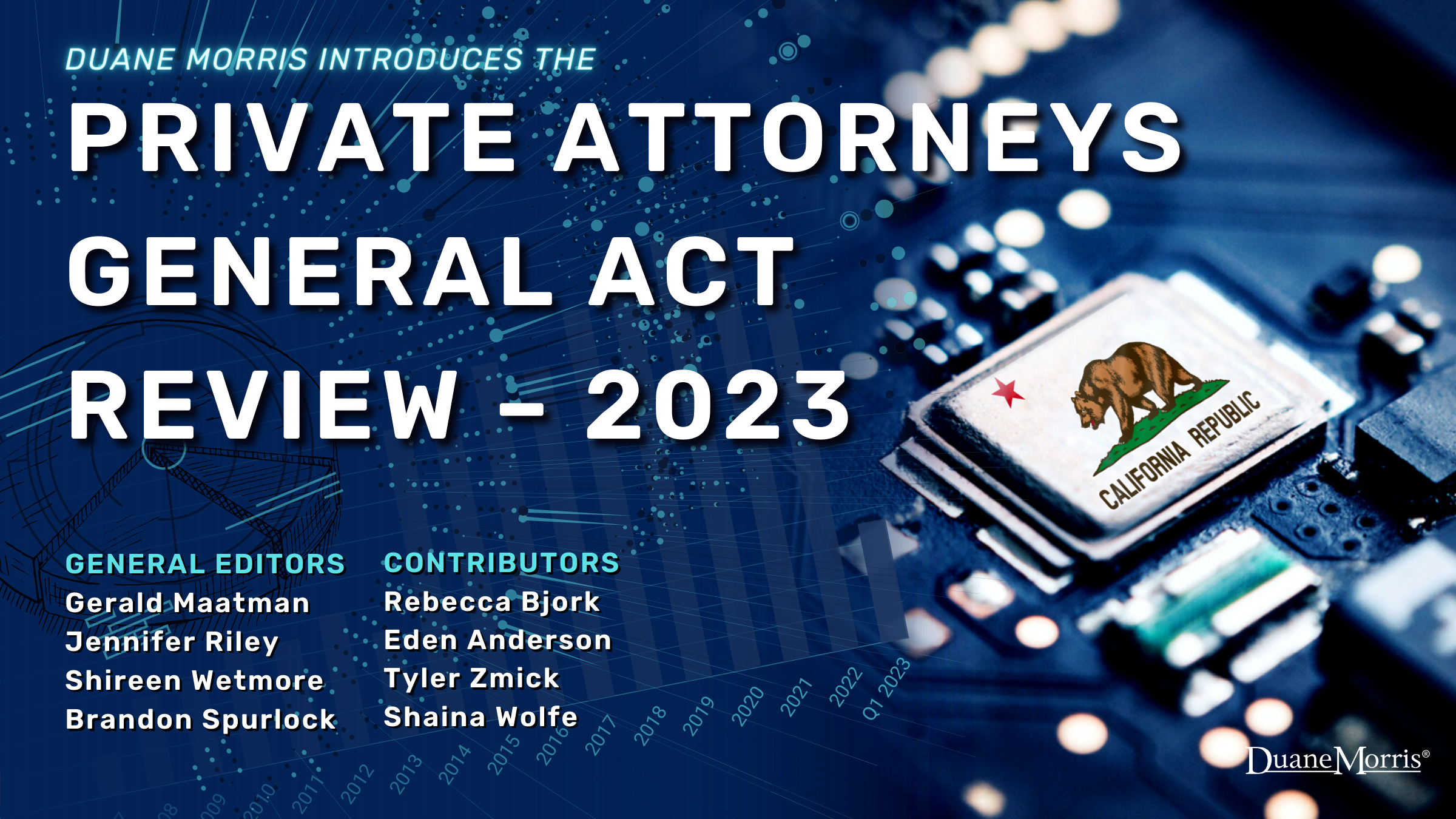
Introducing The Duane Morris Private Attorneys General Act Review – 2023

By Gerald L. Maatman, Jr. and Jennifer A. Riley, 

Duane Morris Takeaways: One law making California so different – and so challenging – for employers is the Private Attorneys General Act (“PAGA”), which authorizes employees to assert claims for alleged labor violations. Such a worker acts as “a private attorney general” to pursue civil penalties against an employer as if they were an arm of the State of its agencies. PAGA claims are not class actions per se – instead, they are known as “representative actions – but they pose analogous risks and exposures like class actions brought under the California Labor Code. Plaintiffs bring thousands of PAGA cases every year, and, because PAGA plaintiffs can bring suit on behalf themselves and other employees, the stakes are often significant, with companies exposed to risks similar to those arising from class action litigation. The PAGA, however, has its own specific rules of the road, which differ from the rules elucidated in familiar Rule 23 jurisprudence.  The explosion of PAGA litigation has resulted in a complex body of case law that is often difficult to navigate, particularly in terms of the application of arbitration agreements and representative action waivers.  Given the wide adoption of such arbitration agreements, companies are struggling to grasp how recent decisions regarding the PAGA and arbitration impact their businesses.

To that end, the class action team at Duane Morris is pleased to present the inaugural edition of the Private Attorneys General Act Review – 2023. We hope it will demystify some of the complexities of PAGA litigation and keep corporate counsel updated on the ever-evolving nuances of these issues.  We hope this book – manifesting the collective experience and expertise of our class action defense group – will assist our clients by identifying developing trends in the case law and offering practical approaches in dealing with PAGA litigation.

Click here to download a copy Duane Morris Private Attorneys General Act Review 2023 ebook.

Stay tuned for more PAGA class action analysis coming soon on our weekly podcast, the Class Action Weekly Wire.

ESG And The Growing Interplay With Class Action Lawsuits

By Gerald L. Maatman, Jr. and Brad A. Molotsky 

Duane Morris Takeaways: The plaintiffs’ class action bar is exceedingly innovative and in constant pursuit of “the next big then” insofar as potential liability is concerned for acts and omissions of Corporate America. Environmental, Social, and Governance – known as “ESG” – each of the verticals within ESG are surely are topics on the mind of leading plaintiffs’ class action litigators. As ESG-related issues evolve and become increasingly more important to corporate stakeholders, class action litigation against companies is inevitable and has already begun to take shape. This blog post reviews the current landscape of litigation risks, and underscores how good corporate compliance programs and corporate citizenship are prerequisites to minimizing risk.

The Class Action Context

In 2022, the plaintiffs’ class action bar filed, litigated, and settled class actions at a breathtaking pace. The aggregate totals of the top ten class action settlements – in areas as diverse as mass torts, consumer fraud, antitrust, civil rights, securities fraud, privacy, and employment-related claims – reached the highest historical totals in the history of American jurisprudence. Class actions and government enforcement litigation spiked to over $63 billion in settlement totals. As analyzed in our Duane Morris Class Action Review, the totals included $50.32 billion for products liability and mass tort, $8.5 billion for consumer fraud, $3.7 billion for antitrust, $3.25 billion for securities fraud, and $1.3 billion for civil rights.

As “success begets success’ in this litigation space, the plaintiffs’ bar is loaded for bear in 2023, and focused on areas of opportunity for litigation targets. ESG-related areas are a prime area of risk.

The ESG Context

Corporate ESG programs is in a state of constant evolution. Early iterations were heavily focused on corporate social responsibility (or “CSR”), with companies sponsoring initiatives that were intended to benefit their communities. They entailed things like employee volunteering, youth training, and charitable contributions as well as internal programs like recycling and employee affinity groups. These efforts were not particularly controversial.

In recent years, ESG programs have become more extensive and more deeply integrated with companies’ core business strategies, including strategies for avoiding risks, such as those presented by employment discrimination claims, the impacts of climate change, supply chain accountability, and cybersecurity and privacy. Companies and studies have increasingly framed ESG programs as contributing to shareholder value.

As ESG programs become larger and more integrated into a company’s business, so do the risks of attracting attention from regulators and private litigants.

And The Lawsuits Begin From All Quarters

While class action litigation can emanate from many sources, four areas in particular are of importance in the ESG space.

Shareholders: Lawsuits by shareholders regarding ESG matters are accelerating. Examples include claims that their stock holdings have lost value as a result of false disclosures about issues like sexual harassment allegations involving key executives, cybersecurity incidents, or environmental disasters. Even absent a stock drop, some shareholders have brought successful derivative suits focused on ESG issues. Of recent note, employees of corporations incorporated in Delaware who serve in officer roles may be sued for breach of the duty of oversight in the particular area over which they have responsibility, including oversight over workplace harassment policies. In its ruling in In Re McDonald’s Corp. Stockholder Derivative Litigation, No. 2021-CV-324 (Del. Ch. Jan. 25, 2023), the Delaware Court of Chancery determined that like directors, officers are subject to oversight claims. The ruling expands the scope of the rule established in the case of In Re Caremark International Inc. Derivative Litigation, 698 A.2d 959 (Del. Ch. 1996), which recognized the duty of oversight for directors. The decision will likely result in a flurry of litigation activity by the plaintiffs’ bar, as new cases will be filed alleging that officers in corporations who were responsible for overseeing human resource functions can be held liable for failing to properly oversee investigations of workplace misconduct such as sexual harassment.

Vendors and Business Partners: As companies face increasing demands to address ESG issues in their operations and throughout their supply chains, ESG requirements in commercial contracts are increasing in prevalence. Requirements imposed on vendors, suppliers, and partners – to ensure their operations do not introduce ESG risks (e.g., by using forced or child labor or employing unsustainable environmental practices) are becoming regular staples in a commercial context. In addition, as more companies report greenhouse gas emissions – and may soon be required by the SEC to report on them – they increasingly require companies in their supply chain to provide information about their own emissions. Furthermore, if the SEC’s proposed cybersecurity disclosure rules are enacted, companies also may require increased reporting regarding cybersecurity from vendors and others. These actions – and disclosures – provide fodder for “greenwashing” claims, where consumers claim that company statements about environmental or social aspects of their products are false and misleading. The theories in these class actions are expanding by encompassing allegations involving product statements as well as a company’s general statements about its commitment to sustainability.

State Consumer Protection and Employment Laws: The patchwork quilt of state laws create myriad causes of action for alleged false advertising and other misleading marketing statements. The plaintiffs’ bar also has invoked statutes like the Trafficking Victims Protection Reauthorization Act to bring claims against companies for alleged failures to stop alleged human rights violations in their supply chains. These claims typically allege that the existence of company policies and programs aimed at helping end human rights violations are themselves a basis for liability. In making human capital management disclosures a part of ESG efforts (including whether to disclose numeric metrics or targets based on race or gender), companies may find themselves in a difficult place with respect to potential liability stemming from stated commitments to diversity and inclusion. On the one hand, companies that fail to achieve numeric targets they articulate (e.g., a certain percent or increase in diversity among management) may subject themselves to claims of having overpromised when discussing their future plans. Conversely, employers that achieve such targets may face “reverse discrimination” claims alleging that they abandoned race-based or gender-neutral employment practices to hit numbers set forth in their public statements.

Government Enforcement Litigation: Federal, state and local government regulators have taken multiple actions against companies based on their alleged contributions to climate change or alleged illegal activities. For instance, in 2019, the U.S. Department of Justice investigated auto companies for possible antitrust violations for agreeing with California to adopt emissions standards more restrictive than those established by federal law. While the investigation did not reveal wrongdoing, it underscores the creativity that proponents and opponents of ESG efforts can employ.

Implications For Corporate America

The creation, content, and implementation of ESG programs carries increasing litigation risks for corporations but it is unlikely that ESG programs will diminish is size or scale in the coming years given increased focus by Fortune 100s and 500s and increased regulation at the federal and state levels.

Sound planning, comprehensive legal compliance, and systematic auditing of ESG programs should be a key focus and process of all entities beginning or continuing their ESG journey.  As more and more companies adopt some level of corporative ESG strategy planning, compliance and auditing are some of the key imperatives in this new world of exposure to diminish and limit one’s exposure.

Duane Morris has an active Class Action Team to help organizations respond to the ever increasing need to be proactive to these types of risks.  For more information or if you have any questions about this post, please contact Gerald (Jerry) L. Maatman, Jennifer Riley or the attorney in the firm whom you are regularly in contact with.  We also have ESG and Sustainability Team to help organizations and individuals plan, respond to, and execute on your Sustainability and ESG planning and initiatives. For more information or if you have any questions about this post, please contact Brad A. Molotsky, David Amerikaner, Sheila Rafferty-Wiggins, Alice Shanahan, Jeff Hamera, Nanette Heide, Joel Ephross, Jolie-Anne Ansley, Robert Montejo, Seth Cooley, or the attorney in the firm with whom you are regularly in contact.

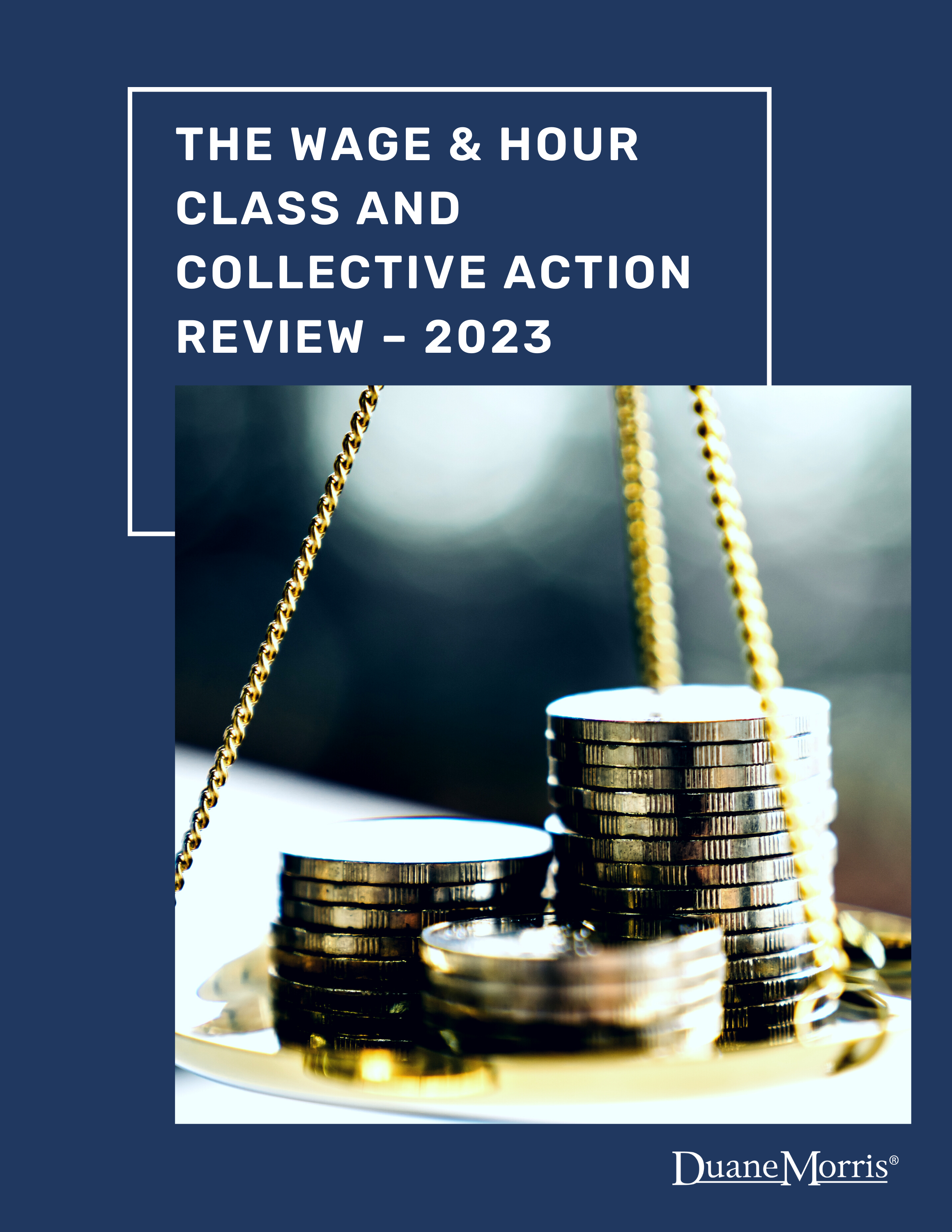
Introducing The Duane Morris Wage & Hour Class And Collective Action Review – 2023

By Gerald L. Maatman, Jr., Jennifer A. Riley, and Gregory Tsonis

Duane Morris Takeaways: Complex wage & hour litigation has long been a focus of the plaintiffs’ class action bar. The relatively low standard by which plaintiffs can achieve conditional certification under the Fair Labor Standards Act (FLSA), often paired with state law wage & hour class claims, offers a potent combination by which plaintiffs can pursue myriad employment claims. To that end, the class action team at Duane Morris is pleased to present the inaugural edition of the Wage & Hour Class And Collective Action Review – 2023. This new publication analyzes the key wage & hour-related rulings and developments in 2022 and the significant legal decisions and trends impacting wage & hour class and collective action litigation for 2023. We hope that companies and employers will benefit from this resource and assist them with their compliance with these evolving laws and standards.

Click here to download a copy of the Wage & Hour Class And Collective Action Review – 2023 eBook.

Stay tuned for more wage & hour class and collective action analysis coming soon on our weekly podcast, the Class Action Weekly Wire.

© 2009- Duane Morris LLP. Duane Morris is a registered service mark of Duane Morris LLP.

The opinions expressed on this blog are those of the author and are not to be construed as legal advice.

Proudly powered by WordPress