
The Class Action Weekly Wire Podcast – Episode Two
DMCAR Trend #10 – DMCAR Trend # 10 – PAGA Actions Suffered Their First Setback, Work-Arounds Continued To Percolate Video
Introducing The Class Action Weekly Wire Podcast!
U.S. Supreme Court Decides FLSA Requires Overtime Pay For Highly Paid Day-Rate Workers
On February, 23, 2023, the U.S. Supreme Court decided Helix Energy Solutions Group, Inc. v. Hewitt No. 21-984 (U.S. Feb. 22, 2023), a highly anticipated ruling on the Fair Labor Standards Act (FLSA). The ruling is a cautionary tale for employers, warning that any cracks in their compensation structure may put them on the hook to pay overtime to high-earning employees. Hewitt determined that the FLSA required an employer to pay overtime to an offshore oil rig worker who earned over $200,000 annually because it paid him a daily, not weekly, rate. The decision is a must-read for all employers on their strategies for wage-and-hour compliance.
Read the full Alert on the Duane Morris LLP website.
DMCAR Trend # 10 – PAGA Actions Suffered Their First Setback, Work-Arounds Continued To Percolate
 By Gerald L. Maatman, Jr. and Jennifer A. Riley
Duane Morris Takeaway: In 2022, actions under the California Private Attorneys General Act (PAGA), Cal. Lab. Code, §§ 2698, et seq., saw their first setback as the U.S. Supreme Court’s decision in Viking River Cruises, Inc. v. Moriana, et al., 142 S.Ct. 1906 (2022), created a workaround to arbitration programs that require individual proceedings.
The PAGA created a scheme to “deputize” private citizens – “aggrieved employees” – to sue their employers for violations of the California Labor Code on behalf of their co- workers as well as the State. If successful, aggrieved employees receive 25% of any recovered civil penalties and pass the other 75% to the California Labor and Workforce Development Agency (LWDA). The PAGA authorizes the attorneys who pursue the action to collect their attorney’s fees and costs in addition to the civil penalties. As a result, PAGA claims have exploded over the past two decades.
The Explosion Of PAGA Notices
According to data maintained by the California Department of Industrial Relations, the number of PAGA notices filed with the LWDA has increased exponentially over the past two decades. The number grew from 11 notices in 2006 to 1,743 in 2011, to 5,208 in 2016, and to 6,502 in 2021. From 2013 to 2014, employers saw the largest single year increase, from 1,605 notices in 2013 to 4,532 notices in 2014, an increase of 182%. Over the five-year period from 2017 to 2021, the number of notices grew from 4,985 in 2017, to 6,502 in 2021, an increase of 30%.
The following chart illustrates this trend.
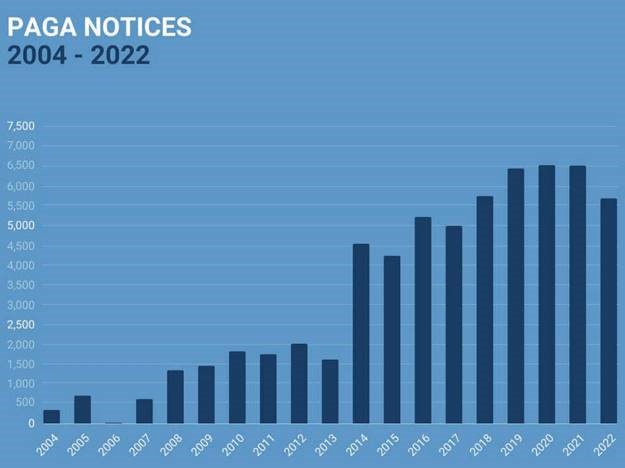
The increase is a likely reaction to the growth of workplace arbitration, fueled by the availability of fee-shifting.
The PAGA As A Work-Around To Arbitration
Although the proliferation of mandatory arbitration programs started as early as 1991 when the U.S. Supreme Court issued Gilmer, et al. v. Interstate/Johnson Lane Corp., 500 U.S. 20 (1991), the movement did not gain steam until 2011, when the U.S. Supreme Court issued its ruling in AT&T Mobility LLC v. Concepcion, et al., 563 U.S. 333 (2011), and held that the FAA preempts state rules that stand “as an obstacle to the accomplishment of the FAA’s objectives,” and it did not peak until 2018 with the U.S. Supreme Court’s decision in Epic Systems Corp. v. Lewis, et al., 138 S.Ct. 1612 (2018), wherein the last hurdle to enforcement of class and collective action waivers was eliminated.
As the adoption of arbitration programs gained popularity as a mechanism to contract around class and collective actions, the plaintiffs’ class action bar identified work-arounds. The California Supreme Court’s cemented the PAGA as the frontrunner for generated labor-related claims with its 2014 decision in Iskanian, et al. v. CLS Transportation Los Angeles, 59 Cal.4th 348 (Cal. 2014), which seemingly immunized the PAGA from arbitration programs. In Iskanian, the California Supreme Court held that “where an employment agreement compels the waiver of representative claims under the PAGA, it is contrary to public policy and unenforceable as a matter of state law.” Id. at 384. Whereas the California Supreme Court acknowledged Concepcion, it nevertheless reasoned that the rule against PAGA representative action waivers did not frustrate the FAA’s objectives because, whereas the FAA aims to ensure an efficient forum for the resolution of private disputes, a PAGA action “is a dispute between an employer and the state Labor and Workforce Development Agency.” Id.
The ruling likely fueled the filing of PAGA notices in 2014 and thereafter, as it cleared the PAGA as a mechanism by which to maintain a representative action unhindered by agreements to arbitrate on an individual basis. The PAGA workaround suffered its first significant set-back in 2022 with the U.S. Supreme Court’s highly anticipated decision in Viking River Cruises, Inc. v. Moriana, et al., 142 S.Ct. 1906 (2022), which addressed the arbitrability of PAGA claims.
The Dagger Of Viking River
In Viking River, the U.S. Supreme Court drove a dagger through the heart of this work- around by continuing its trend of enforcing the FAA over state efforts to avoid or flat-out prohibit arbitration. See, e.g., Cal. Lab. Code § 229 (“Actions to enforce the provisions of this article for the collection of due and unpaid wages claimed by an individual may be maintained without regard to the existence of any private agreement to arbitrate.”). The U.S. Supreme Court confirmed that, whether judicial or legislative in nature, where the FAA is in play, it preempts efforts to enforce those rules.
In Viking River, the U.S. Supreme Court found a conflict between the FAA and PAGA’s procedural structure. It recognized that the statute contains a “built-in mechanism of claim joinder,” which permits “aggrieved employees” to use the Labor Code violations they personally suffered as a basis to join to the action any claims that could have been raised by the State in an enforcement proceeding. Id. at 1923. It held that, to the extent that Iskanian precludes division of PAGA actions into individual and non-individual claims, and thereby “prohibits parties from contracting around this joinder device,” the FAA preempts such rule. Id.
Importantly, however, after finding that Viking should have been able to compel arbitration of plaintiff’s individual claim, the U.S. Supreme Court addressed “what the lower courts should have done with Moriana’s non-individual claims.” Id. at 1925. It ruled that, once an individual claim has been committed to a separate proceeding, the employee is no different from a member of the general public, and the PAGA provides no mechanism for such person to maintain suit. As a result, the correct course was to dismiss the remaining claims. Id.
As a result, the U.S. Supreme Court eviscerated perhaps the most popular work-around to workplace arbitration, dealing a significant blow to the plaintiffs’ bar and its ability to pursue claims on a representative basis.
What’s Next?
In her concurrence, Justice Sotomayor expressly opened the door to two potential solutions to the majority opinion. She suggested that, in its analysis of the parties’ contentions, the Supreme Court detailed “several important limitations on the pre-emptive effect of the [FAA],” meaning that “California is not powerless to address its sovereign concern that it cannot adequately enforce its Labor Code without assistance from private attorneys general.” Id. at 1925. First, she suggested that, if the majority was incorrect in its understanding that the plaintiff lacked “statutory standing” under the PAGA to litigate her “non-individual” claims separately, “California courts, in an appropriate case, will have the last word.” Second, alternatively, Justice Sotomayor opined that “the California Legislature is free to modify the scope of statutory standing under the PAGA within state and federal constitutional limits.” Id. at 1925-26.
Although the California State Legislature has not taken action, on July 20, 2022, the California Supreme Court granted review in Adolph, et al. v. Uber Technologies, Inc., No. G059860, on the question as to whether an aggrieved employee, who agreed to arbitrate claims under the PAGA that are “premised on Labor Code violations actually sustained by” the aggrieved employee, maintains standing to pursue “PAGA claims arising out of events involving other employees” in court or in any other forum agreed by the parties. The California Supreme Court is likely to issue a decision on these questions in 2023.
In the meantime, despite the U.S. Supreme Court’s ruling in Viking River, many plaintiff’s attorneys have requested, and many California courts have granted, stays of representative claims, rather than dismissals, likely in order to preserve tolling in the event that the California Supreme Court fashions a rule that permits them to proceed with representative claims.
DMCAR Trend # 8 – Courts Continued To Grapple With Problems Of Standing And Uninjured Class Members Video
DMCAR Trend #5 – Government Enforcement In 2022 Took A Back Seat Video

DMCAR Trend #3 The Arbitration Defense Suffered Setbacks In 2022 Video
The Fifth Circuit Breathes Live Into A Securities Fraud Class Action Based On Information From Confidential Witnesses
 By James J. Coster and Nelson Stewart
Duane Morris Takeaways: At the motion to dismiss stage of a securities fraud class action, the weight given to the statements of a confidential witness will depend on the basis of that individual’s knowledge concerning the allegations at issue. In Oklahoma Firefighters Pension & Retirement Systems v. Six Flags Entertainment Corp., No. 21-10865, 2023 WL 228268 (5th Cir. Jan. 18, 2023), the Fifth Circuit reversed a decision from the District Court dismissing a class action complaint against Six Flags Entertainment Corp. The District Court had applied a significant “discount” to the allegations of a confidential witness. The Fifth Circuit’s decision indicates that the heightened pleading requirements of securities fraud claims brought under the Securities Exchange Act can be satisfied by an anonymous witness if the source of the information identified in the complaint demonstrates the significant knowledge of the witness and the statements are accompanied by corroborating evidence. As such, this ruling is a “must read” for corporate decision-makers involved in securities fraud class action litigation.
Background
In 2014 Six Flags Entertainment Corp. partnered with Chinese real estate developer Riverside Investment Group to construct and manage new theme parks across three cities in China as part of its plan to increase development and licensing revenues through international expansion. From April 2018 to October 2019, Six Flags, as well as its CEO and CFO, issued public statements confirming the progress of the parks and projected opening dates for the new parks. Plaintiff brought claims under Sections 10(b) and 20(a) of the Securities Exchange Act and SEC Rule 10b-5, alleging that Six Flags and its officers made material omissions of fact and misleading statements concerning the competence and financial health of Riverside, the progress of construction on the new parks, and projected openings and revenue. The complaint relied primarily on the allegations of a confidential witness, who formerly held the position of Six Flags International Director of International Construction and Project Management, to assert that construction of the parks was well behind schedule because Riverside could not pay its contractors, and the timelines Six Flags had projected for the opening of its parks in China were not possible. In early 2020 Six Flags acknowledged that it expected a $1 million negative revenue adjustment and charges of $10 million because Riverside had defaulted on its payment obligations. Shortly thereafter, Six Flags also announced that it was terminating its agreement with Riverside. Shares of Six Flags fell from $73.38 to a seven year low of $31.89 in during the Putative Class Period.
Citing earlier decisions from the Fifth Circuit, the District Court determined that it was required to substantially discount the statements of the confidential witness. The District Court dismissed the complaint with prejudice and held that Plaintiff had not met the heightened pleading requirements for securities fraud claims under Rule 9(b) or the Private Securities Litigation Reform Act (PSLRA).
The Fifth Circuit’s Ruling
On appeal, a key consideration in determining whether the complaint had adequately alleged material misrepresentations and the scienter required for securities fraud claims under the Securities Exchange Act concerned the appropriate weight that should be given to the confidential witness. The Fifth Circuit distinguished the cases cited by the District Court and found that while allegations of an anonymous witness must be discounted under the heightened pleading standards of Rule 9(b) and the PSLRA, the degree of that discount depends on the details in the complaint describing the source and whether the source’s knowledge has been substantiated by those details.
Plaintiff’s confidential witness supervised and inspected the development of the parks in China onsite and sent progress reports to Six Flags. The witness also interacted directly with Riverside, attended meetings with Six Flags personnel in China (where it was disclosed that Riverside did not have sufficient funds to complete the project), and sent a letter warning that Riverside had inadequate funds to a Senior Vice President of Six Flags in August 2019. The Fifth Circuit cited cases from the Seventh Circuit and Third Circuit, which held that the level of detail provided and first-hand knowledge of the facts can determine the weight afforded to anonymous sources. It reasoned that the level of details in the complaint concerning the former employee’s duties, and corroborating evidence in the form of a photograph that showed minimal construction at one of the park sites, warranted only a minimal discount of the former employee’s general allegations. As for the allegations concerning the financial health of Riverside, the District Court applied a significant discount to the statements of the confidential witness because it concluded the witness would not have personal knowledge of Riverside’s internal finances. The Fifth Circuit held that personal knowledge of Riverside’s financial condition based on the position the witness held at Six Flags, rather than comprehensive personal knowledge, was sufficient and applied a minimal discount to those allegations as well.
With greater weight given to the statements of the confidential witness, the remaining findings of the District Court with respect to forward looking statements, i.e., Plaintiff’s failure to adequately plead misstatements of facts and Plaintiff’s failure to adequately plead scienter, were also reversed. The Fifth Circuit denied Six Flags’ argument that statements made during the Class Period were forward looking, included appropriate cautionary language and should be granted protection under the PSLRA’s safe harbor provision. Because many of the alleged misstatements concerned projections that were based on the current status of the construction, they were deemed mixed statements of present and future conditions that were ineligible for safe harbor protection. Certain statements that did address future projections were also denied protection. The Fifth Circuit ruled that the cautionary language cited by Six Flags was not sufficiently specific to the risks at issue in the forward looking statements.
In the absence of appropriate cautionary language, the Fifth Circuit examined whether the complaint sufficiently alleged materially misleading statements of fact. Where the District Court found the allegations of the confidential witness conclusory as to statements concerning the impossibility of the projected opening dates of the parks, the Fifth Circuit concluded the impossibility of the timeline necessary to construct the park was a fact-based, industry specific question that was not applicable at the motion to dismiss stage of the litigation. Plaintiff was also found to have sufficiently alleged that the Six Flags omitted critical information about Riverside’s financial difficulties based on the minimally discounted allegations of the complaint. The Fifth Circuit specifically cited the August 2019 letter to Six Flags that contradicted its positive statements regarding Riverside’s financial viability.
In its analysis of the scienter requirements under the PSLRA, the Fifth Circuit considered the collective weight of motive, and reports from the confidential witness detailing the poor progress of the theme parks that were sent to Six Flags management. Bonuses well in excess of base salaries would be awarded to management if Six Flags achieved a $600 million EBITDA by the end of 2018. While acknowledging that this motive alone could not support a strong inference of scienter, the bonus incentives, when viewed together with the progress reports, were held sufficient to create a strong inference that Six Flags had actual knowledge that its 2018 statements were false. After the target was missed the bonus incentives were eliminated and thus inapplicable to the alleged misstatements or omissions of fact made in 2019. Nevertheless, the Fifth Circuit found that Six Flags had boasted that its international licensing deals would be a significant driver of increased EBITDA. A February 2019 statement concerning a comprehensive review of the parks also indicated that Six Flags was aware of the progress of construction at the various sites in China. Plaintiff alleged a “core operations” theory of scienter, which asserts that when a transaction at issue is critical to a company’s success, misstatements or omissions concerning the transaction should be readily apparent to the speaker. The decision acknowledged that all elements of a core operations theory of scienter were not entirely satisfied. However, the Fifth Circuit held that the circumstances of the 2019 statements, combined with the witness reports to Six Flags, also created a strong inference of scienter for the 2019 statements.
Implications for Public Companies
The ruling in Oklahoma Firefighters Pension & Retirement Systems provides clarification concerning the discount that should be applied to the allegations of a confidential witness that is consistent with decisions of the Seventh Circuit and the Third Circuit. These decisions suggest that descriptions in a complaint that detail the source of relevant information provided by an anonymous witness increase the credibility of that information. This clarification may help the plaintiff’s bar navigate motions to dismiss by offering increased guidance in framing securities fraud complaints in the Fifth Circuit.