The Class Action Weekly Wire – Episode 137: Key Developments In Consumer Fraud Class Actions

Duane Morris Takeaway: This week’s episode features Duane Morris partner Jennifer Riley and associate Olga Romadin with their discussion of the key trends and developments analyzed in the 2026 edition of the Consumer Fraud Class Action Review.   

Check out today’s episode and subscribe to our show from your preferred podcast platform: Spotify, Amazon Music, Apple Podcasts, Podcast Index, Tune In, Listen Notes, iHeartRadio, Deezer, and YouTube.

Episode Transcript

Jennifer Riley: Welcome to our listeners. Thank you for being here for our weekly podcast, the Class Action Weekly Wire. I’m Jennifer Riley, partner at Duane Morris, and joining me today for the first time on the podcast is Olga Romadin. Thank you for being on the podcast, Olga.

Olga: Thank you, Jen. Happy to be part of the podcast.

Jennifer: Today on the podcast, we are discussing the recent publication of the third edition of the Duane Morris Consumer Fraud Class Action Review. Listeners can find the e-book publication on our blog, the Duane Morris Class Action Defense Blog. Olga, can you tell our listeners a bit about the publication?

Olga: Absolutely, Jen. So, class action litigation in the consumer fraud space remains an area of key focus of skilled class action litigators in a plaintiffs’ bar, and as a result, compliance with consumer fraud laws and the myriad of ways that companies, customers, and third-parties interact is a corporate imperative. To that end, the class action team at Duane Morris is pleased to present the Consumer Fraud Class Action Review – 2026, which analyzes key consumer fraud-related rulings and developments in 2025, and the significant legal decisions and trends impacting this type of class action litigation in 2026. So we hope that companies will benefit from this resource in their compliance with these evolving laws and standards.

Jennifer: Thanks, Olga. In 2025, courts across the country issued really a mixed bag of results, leading to major victories for both plaintiffs as well as defendants. What were some of the key takeaways from the publication with regard to litigation in this area?

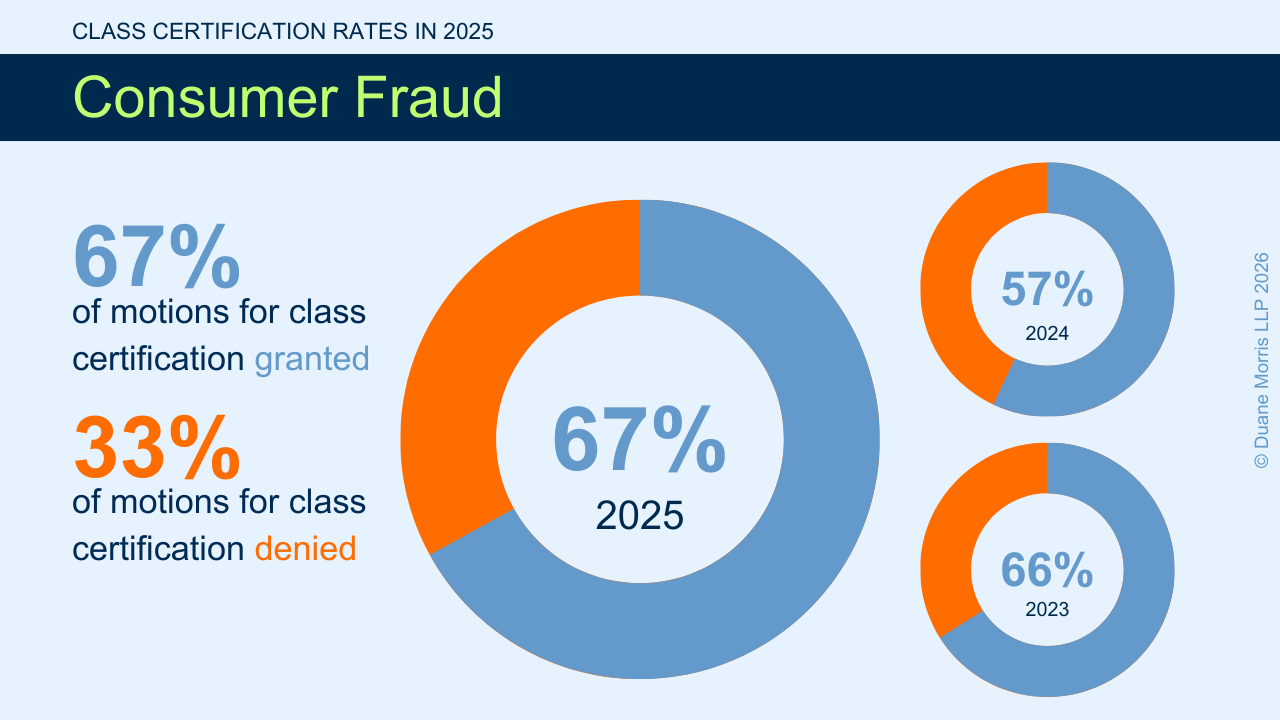
Olga: So, obtaining class certification is one of the most effective procedural tools used to vindicate the rights of consumers. And in 2025, plaintiffs were successful in receiving class certification in 67% of the motions filed, which was up from the number in 2024, when courts granted 57% of the motions filed.
Jennifer: Wow, that higher number of overall class certification motions being granted is certainly interesting. What do you anticipate this will mean for companies in 2026?

Olga: Ultimately, as the class action landscape continues to evolve, so too are the playbook theories of the plaintiff and defense bars. Counsel on both sides are becoming more sophisticated and creative in their approaches to prosecuting and defending class actions. And there’s a wide variety of conduct that gives rise to consumer fraud claims, and every industry is susceptible. In 2025, consumer fraud class actions ran the gamut of false advertising and false labeling claims. The products at issue included everything from cannabis to nuts, and we anticipate that this will continue to be the case in 2026.

Jennifer: Thanks so much for that information, Olga. Very important for companies navigating compliance with consumer fraud statutes. The review also talks about the top consumer fraud settlements in 2025. How did the plaintiffs do in securing settlements last year?

Olga: So, plaintiffs did very well in securing high-dollar settlements in 2025. The top 10 consumer fraud settlements totaled a staggering $2.1 billion. However, although it’s a huge dollar amount, it’s still a decrease over 2024 when the top 10 consumer fraud class action settlements totaled about $2.437 billion. So, it just shows that the massive amount of money involved in some of these class actions where thousands to millions of consumers could potentially be involved.

Jennifer: Absolutely. We will continue to track those settlement numbers in 2026. Record-breaking settlement amounts have been a huge trend that we’ve been following for the past few years. Well, thank you, Olga, for being here today, and thank you to our loyal listeners for tuning in. Listeners, please stop by the blog for a free copy of the Consumer Fraud Class Action Review.

Olga: Thanks so much, everyone, and thanks for having me, Jen.

Illinois Federal Court Denies Certification Of Deceptive Advertising Class Where Named Plaintiff Knew The Truth But Continued Purchasing The Product

By Gerald L. Maatman, Jr., Jennifer A. Riley, and Hayley Ryan

Duane Morris Takeaways:  On February 20, 2026, in Clark v. Blue Diamond Growers, Case No. 22-CV-01591, 2026 WL 483275 (N.D. Ill. Feb. 20, 2026), Judge Jorge L. Alonso of the U.S. District for the Northern District of Illinois denied class certification in a deceptive advertising lawsuit brought under the Illinois Consumer Fraud and Deceptive Business Practices Act (“ICFA”). The Court concluded that the named plaintiff was not an adequate class representative because she knew the allegedly misleading representation was false yet continued purchasing the product.  Because that knowledge defeated proximate causation and created a unique defense, the Court determined that class certification was improper.

This decision is a reminder that plaintiffs asserting deceptive advertising claims must show they were actually deceived.  Where a named plaintiff knew the truth and continued to buy the product anyway, adequacy under Rule 23(a)(4) is vulnerable.

Background

Plaintiff Margo Clark filed a putative class action complaint against Blue Diamond Growers, a cooperative of California almond growers that sells flavored almonds, including “Smokehouse® Almonds.” Id. at *1. She alleged that the “Smokehouse®” label misled consumers into believing the almonds were smoked in a smokehouse, when in fact the smoky flavor derived from added seasoning. Id. According to Plaintiff’s Complaint, this purported misrepresentation enabled Blue Diamond to charge a price premium in violation of the ICFA. Id.

Plaintiff moved to certify a class of Illinois purchasers of Smokehouse® Almonds from March 2019 to the present. Id.

The Court’s Ruling

Judge Alonso denied certification based on a failure to establish adequacy of representation. Id. at *2. Under Federal Rule of Civil Procedure 23(a)(4), a class may be certified only if “the representative parties will fairly and adequately protect the interests of the class.” Where the named plaintiff is subject to an arguable unique defense, however, adequacy is lacking. Id. at *1. 

Here, the dispositive issue was proximate causation under the ICFA. To prevail on a deceptive advertising claim under the ICFA, a plaintiff must establish that the alleged deception proximately caused her injury, i.e., that she was actually deceived. Id. at *2. A plaintiff who knows the truth cannot establish proximate cause because she was not misled. Id.

At her deposition, Plaintiff testified that she learned as early as 2019 or 2020, after viewing a Facebook advertisement from her counsel, that the almonds were seasoned rather than smoked. Id. Despite that knowledge, she continued to purchase the product for over a year. Id.  The Court found this testimony fatal, holding that Plaintiff was “inadequate to serve as the class representative because she cannot show proximate causation as required to prevail on her claim.” Id.

Plaintiff’s counsel attempted to rehabilitate the claim through a declaration asserting that the Facebook advertisements were not targeted to Illinois consumers in 2019 or 2020. Id. However, counsel also acknowledged in the same declaration that Plaintiff submitted her information in response to the advertisement approximately one year before signing her representation agreement in March 2022.  Id. The Court concluded that this timeline did not resolve the proximate cause problem. Even accepting counsel’s version, Plaintiff “saw the advertisement around March 2021, yet she still continued to purchase almonds for another year.” Id.

Plaintiff’s counsel also relied on Plaintiff’s amended interrogatory responses in which she claimed she first learned the almonds were not smoked during a conversation with her attorney after signing the representation agreement. Id. at *3. Based on that revision, Plaintiff’s counsel argued that Plaintiff could establish proximate causation because she stopped purchasing the almonds after she signed the representation agreement. Id.

The Court was unpersuaded. Weighing the deposition testimony, the declaration, and Plaintiff’s original interrogatory responses, the Court concluded that Blue Diamond’s proximate cause defense was at least arguable – and that was sufficient. Id. The Court emphasized that a unique defense need only be “arguable” to defeat adequacy, and here it was “certainly arguable.” Id.

Accordingly, the Court denied certification and directed the parties to submit a joint status report addressing how they intend to proceed on Plaintiff’s individual claims and whether they have considered settlement discussions in light of the Court’s certification ruling. Id.

Implications for Companies

Clark reinforces a core Rule 23 principle that a named plaintiff subject to a unique defense cannot adequately represent a class. In deceptive advertising cases under the ICFA and similar statutes, knowledge is often outcome-determinative. If a plaintiff knew of the alleged defect before purchasing, or continued purchasing after learning the truth, proximate causation becomes vulnerable.

For companies defending consumer fraud class actions, deposition testimony, purchase history, and discovery into when and how the plaintiff allegedly learned of the “defect” or deception may provide a powerful adequacy challenge. As Clark illustrates, even an “arguable” unique defense can be enough to defeat class certification.

It’s Here! The Duane Morris Consumer Fraud Class Action Review – 2026!

By Gerald L. Maatman, Jr., Jennifer A. Riley, and Courtney Baird

Duane Morris Takeaway: For more than seven decades, class actions have been one of the most effective procedural tools employed by consumers who, had they attempted to vindicate their rights individually, may have been unsuccessful for a variety of reasons. Consumer fraud class actions typically involve a group of consumers who believe they participated in legitimate business transactions, but, due to alleged deceptive or fraudulent practices by a retailer, merchant, or manufacturer, the defendant defrauded the consumers or violated their statutory rights.

Every state has consumer protection laws, and consumer fraud class actions require courts to analyze these statutes both with respect to plaintiffs’ claims, and also with respect to choice of law analyses when a complaint seeks to impose liability upon multiple states’ consumer protection laws.

To that end, the class action team at Duane Morris is pleased to present a new publication – the 2026 edition of the Consumer Fraud Class Action Review. We hope it will demystify some of the complexities of consumer fraud class action litigation and keep corporate counsel updated on the ever-evolving nuances of these issues.  We hope this book – manifesting the collective experience and expertise of our class action defense group – will assist our clients by identifying developing trends in the case law and offering practical approaches in dealing with consumer fraud class action litigation.

Click here to bookmark or download a copy of the Duane Morris Consumer Fraud Class Action Review – 2026 eBook.

Stay tuned for more consumer fraud class action analysis coming soon on our weekly podcast, the Class Action Weekly Wire.

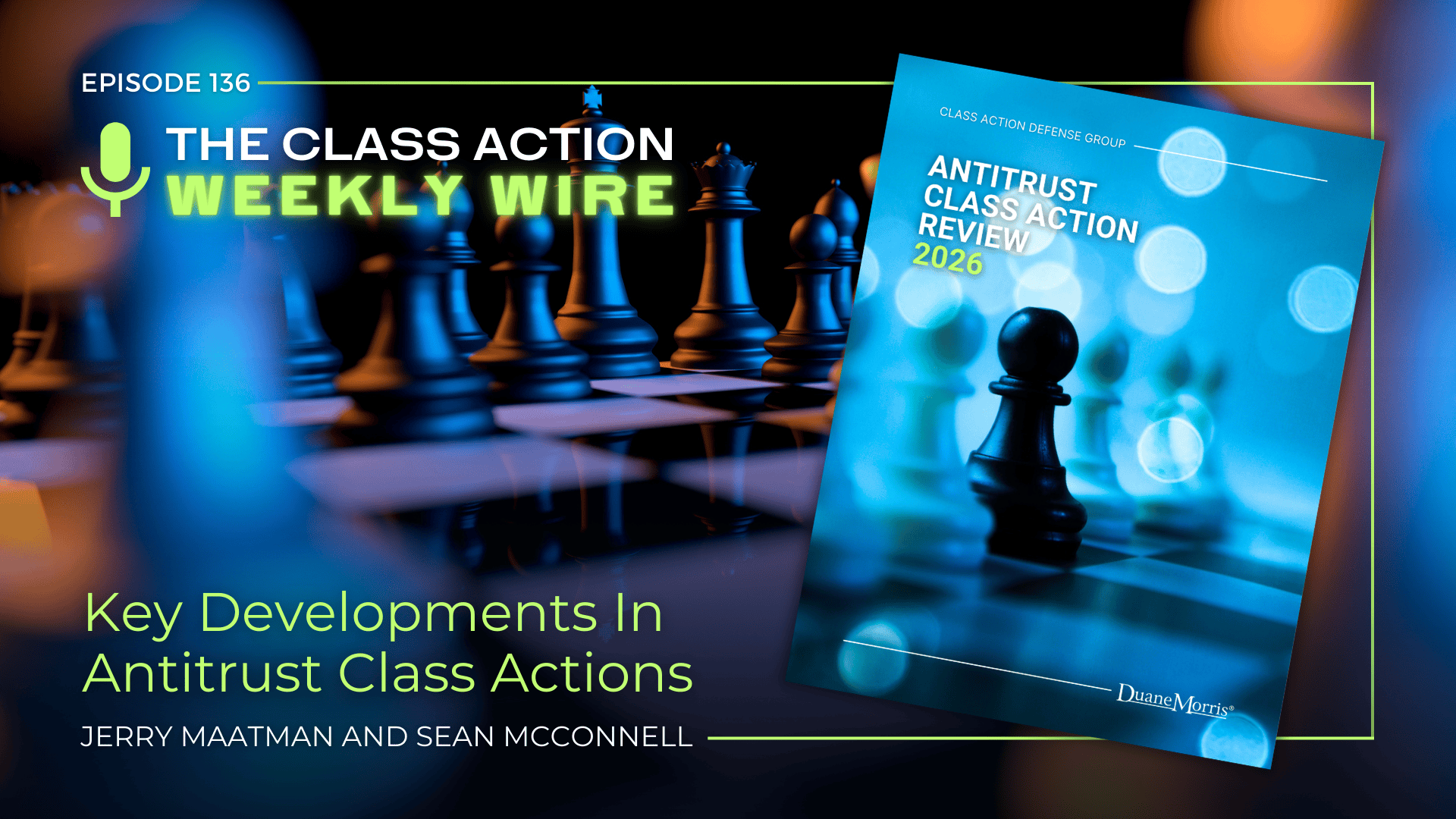
The Class Action Weekly Wire – Episode 136: Key Developments In Antitrust Class Actions

Duane Morris Takeaway: This week’s episode features Duane Morris partners Jerry Maatman and Sean McConnell with their discussion of the key trends and developments analyzed in the 2026 edition of the Antitrust Class Action Review.   

Check out today’s episode and subscribe to our show from your preferred podcast platform: Spotify, Amazon Music, Apple Podcasts, Podcast Index, Tune In, Listen Notes, iHeartRadio, Deezer, and YouTube.

Episode Transcript

Jerry Maatman: Welcome to our listeners. Thank you for being here for our weekly podcast series, the Class Action Weekly Wire. I’m Jerry Maatman, a partner at Duane Morris, and joining me today is my colleague and partner from Philadelphia, Sean McConnell, who is the chair of the Duane Morris Antitrust and Competition Department. Thanks for being on the podcast, Sean.

Sean McConnell: Thank you, Jerry. Happy to be part of the podcast.

Jerry: Today on the podcast, we are discussing the recent publication of this year’s edition of the Duane Morris Antitrust Class Action Review. Listeners can find the e-book publication on our blog, the Duane Morris Class Action Defense Blog. Sean, can you tell our listeners a bit about this publication and desk reference?

Sean: Absolutely, Jerry. In 2025, class action litigation involving antitrust claims had several key developments. Most antitrust class actions are settled before trial, and one of the most critical phases is class certification. Thus, the order granting or denying a motion to certify a class in these cases is critical. To assist with understanding what this means for businesses facing antitrust claims, Duane Morris has released the Duane Morris Antitrust Class Action Review – 2026, which analyzes the key rulings and litigation developments in 2025, and the significant trends that are apt to impact these types of actions in 2026. We hope that companies will benefit from this resource and their compliance with these evolving laws and standards.

Jerry: Well, I know you’re a thought leader in this space, and one of the notable shifts that we saw in 2025 in the cases involve pricing algorithms, information sharing, and data management. And this trend seemingly mirrors the technological evolution within organizations. As businesses rely more heavily upon automated pricing and complex data systems. Plaintiffs’ lawyers are adapting their antitrust strategies to challenge those tools and technologies. What’s your take on this space in the courts over the past year, Sean?

Sean: Great question, Jerry. In In re Hard Disk Drive Suspension Assemblies Antitrust Litigation, the U.S. District Court for the Northern District of California certified two classes in a long-running price-fixing case. The plaintiffs alleged that two manufacturers of hard disk drive suspension assemblies conspired from 2003 to 2016 to fix prices, inflating the cost of hard drives and devices containing them. The court certified both a reseller class and an end-user class. Defendants argued that the named reseller plaintiffs weren’t typical of the class because some large buyers negotiated better deals, and that “pass-through” defenses made them atypical. The court disagreed, however, holding that in price-fixing cases, differences in purchasing arrangements don’t defeat typicality, as long as the central question of whether there was a conspiracy is common to everyone. As for the end-users, defendants claim there were conflicts between corporate buyers and illegal consumers. Again, the court found the core issue, an alleged price-fixing conspiracy, was shared across the class. Finding that common issues predominated, and that class treatment was appropriate, the court granted that certification.

Jerry: Well, that’s an interesting take on that space. I know in past years, labor wage suppression antitrust cases were in the main, but took a bit of a backseat, it seemed, this year to antitrust cases involving intercollegiate sports.

Sean: Yes, absolutely. One notable one was Brantmeier v. NCAA, where a federal court in North Carolina certified two classes in an antitrust challenge to the NCAA’s tennis prize money rules. Two current and former Division I tennis players allege the NCAA’s rules – limiting athletes’ ability to accept prize money – amount to price-fixing and a group boycott in violation of the Sherman Act. They claim the rules suppress the market of college tennis players’ labor. The NCAA argued most players weren’t good enough to earn meaningful prize money, and that lifting the rules could hurt lower-level athletes. The court rejected those arguments, emphasizing that rules apply uniformly to all Division I tennis players, making the core legal question of whether the rules violate antitrust law common to the entire class. The court granted class certification, finding that common issues predominated, and that a class action was the most efficient way to resolve the dispute.

Jerry: I know you mentioned that class certification is, in essence, the Holy Grail in these cases, and that antitrust class actions either shatter, vaporize, or end up getting monetized based on class certification. In terms of the scorecard over 2025, how did the plaintiffs’ bar do in converting their case filings into certified class actions?

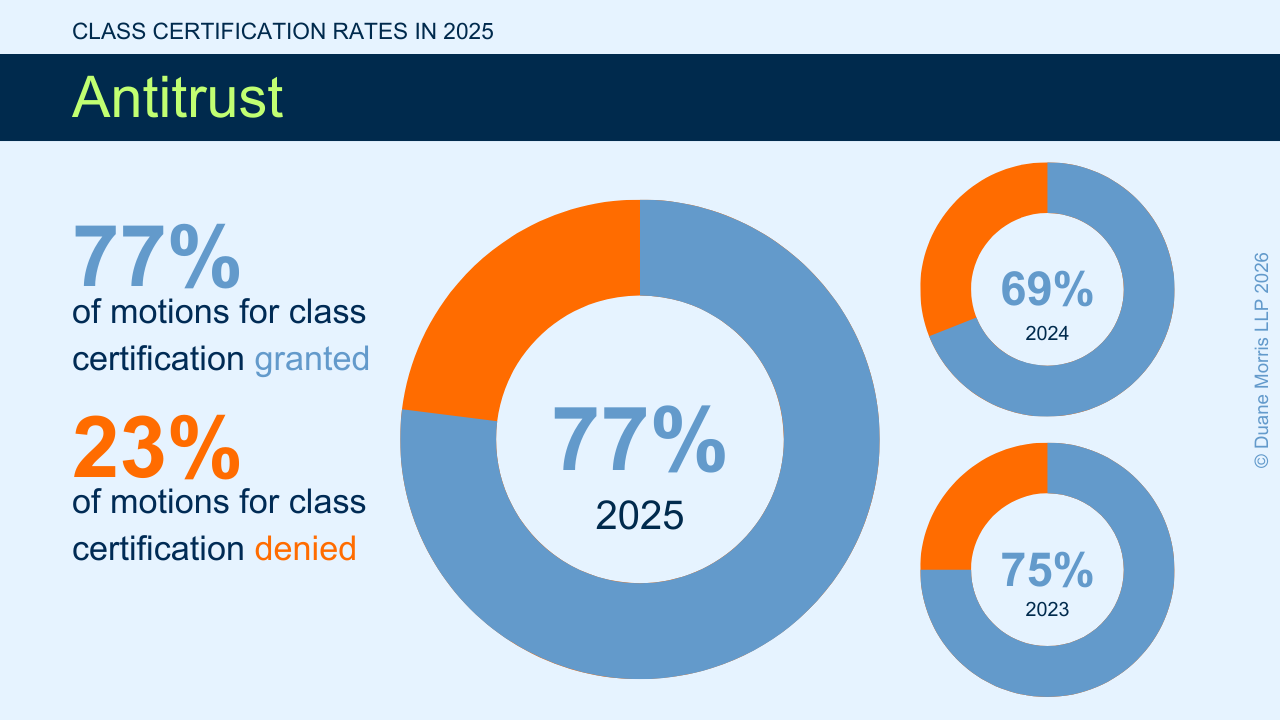
Sean: Well, Jerry, since we’ve already highlighted two victories for plaintiffs, you’ll probably be unsurprised to hear that in 2025, class certifications were granted in 77% of antitrust class actions, or in 17 of 22 motions. That’s up from 68% in 2024, where 15 out of 22 motions for class certification are granted. So, last year, the plaintiffs’ bar was quite successful in getting motions for class certification granted.

Jerry: I know it’s somewhat of a simplification, but nonetheless apt in terms of an analogy that the business model of the plaintiffs’ bar is to find the client, file the lawsuit, certify it, and then monetize it. How did the plaintiffs’ bar do in terms of the top settlements in the antitrust class action space over the past year?

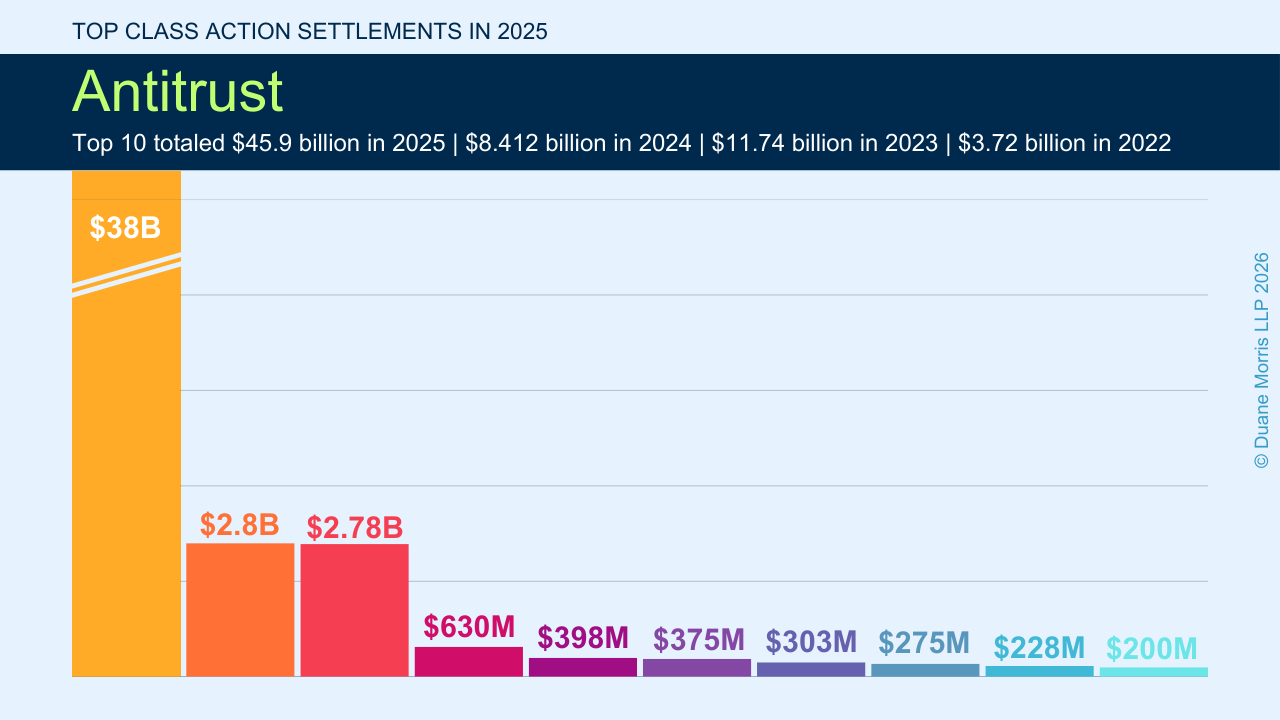
Sean: In 2025, we saw the biggest settlement numbers ever, and antitrust class actions led the charge. The top 10 antitrust class action settlements totaled $46 billion, a huge increase from the $8.42 billion in 2024, and the $11.74 billion in 2023, which was nearly a three-fold increase from the 2022 number.

Jerry: Those are phenomenal settlement numbers in this space. Here at Duane Morris in the Class Action Antitrust Group, we’re tracking 2026 settlements in this area, and we’ll be sure to keep our listeners and readers of our blog updated on those developments. Well, thanks, Sean, for being here today and lending your thought leadership in this space. Readers, listeners, please stop by the blog and pick up and download your free copy of the Duane Morris Antitrust Class Action Review for 2026.

Sean: Thank you, as always, Jerry, and thank you for the listeners.

A Win For Plaintiffs And A Warning For Class Counsel: New Jersey Appellate Division Reverses Dismissal Of Class Action Consumer Fraud Claims But Bars Attorney From Dual Role

By Gerald L. Maatman, Jr., Gregory S. Slotnick, Gregory D. Herrold, and Elizabeth G. Underwood

Duane Morris Takeaways: On February 17, 2026, in Paciorkowski v. Jetson Electric Bikes LLC, No. A-1640-24, 2026 WL 438086, at *1 (N.J. App. Div. Feb. 17, 2026), the New Jersey Appellate Division reversed a trial court’s dismissal of a plaintiff’s individual consumer fraud claims against an electric bike manufacturer, holding that a plaintiff need not demonstrate personal injury to establish standing under the New Jersey Consumer Fraud Act (“CFA”).  However, the Appellate Division affirmed the denial of class certification, holding that an attorney cannot serve in the dual role of class representative and class counsel due to inherent conflicts of interest, reaffirming a general rule established over forty years ago that remains valid today.  Id. at *6.

This decision underscores that economic losses, such as purchasing defective products, are sufficient to establish standing under the CFA, while also reinforcing the longstanding prohibition against attorneys wearing two hats in class action litigation.

Case Background

Plaintiff Thomas Paciorkowski, an attorney proceeding pro se, purchased three electric Bolt bikes manufactured by defendant Jetson Electric Bikes, LLC (“Jetson”) over the course of eight months in 2020.  Id. at *1.  Plaintiff alleged that he purchased the bikes for personal use, primarily for vacations, and did not use them for over a year after purchase. Id.  He stated he first became aware the bikes were defective over a year after purchase when he went to inflate the bike tires and discovered they would not support his weight or the weight capacity listed on the bikes.  Id.

On January 5, 2024, nearly four years after purchasing his first bike, Plaintiff filed a complaint against Jetson asserting individual claims and seeking to certify a class action.  Id.  The complaint asserted seven causes of action: two violations of the CFA; common law fraud; breach of express warranties; breach of implied warranties of merchantability; violations of the Magnuson-Moss Warranty Act, 15 U.S.C. §§ 2301-2312; and unjust enrichment.  Id.

Plaintiff alleged that Jetson made misrepresentations and engaged in unconscionable commercial practices in advertising and marketing its electric bikes.  Id. at *2.  Specifically, plaintiff asserted four main contentions.  Id.  First, plaintiff claimed the Bolt had a maximum rider-weight limit of 250 pounds and the Bolt Pro had a maximum rider-weight limit of 265 pounds, but both bikes were equipped with tires that could not support those weights.  Id. Second, plaintiff alleged that Jetson advertised the bike tires as being made from rubber when they were actually made from cheaper nylon.  Id.  Third, plaintiff contended that Jetson advertised the bikes as made from rust-proof aluminum, but the frames were made from cheaper steel or iron that could rust.  Id.  Fourth, plaintiff asserted that both bikes are illegal to use in New Jersey because the Bolt, being motorized but lacking pedals, should be classified as a motorcycle under New Jersey law and cannot be used on bike paths or bike lanes.  Id.

Jetson did not appear in the trial court, and on May 10, 2024, a default was entered against it.  Id. at *1.  On September 18, 2024, plaintiff moved to certify a class, which he defined as “[A]ll purchasers of Jetson Bolts and Bolt Pros who purchased the products at Costco stores in New Jersey or who purchased online at Costco and had the product shipped to a New Jersey address. The class excludes everyone who returned the product to Costco.”  Id. at *2.  Plaintiff represented that there were 230 potential plaintiffs who purchased Bolts and 4,863 potential plaintiffs who purchased Bolt Pros.  Id.

On December 24, 2024, the trial court entered an order denying plaintiff’s motion to certify a class.  Id. at *3.  In a brief written statement, the trial court determined plaintiff lacked standing to bring any claims because he had “suffered no personal injury from the product.”  Id.

The Appellate Division’s Ruling

On appeal, the Appellate Division reversed the dismissal of plaintiff’s individual claims, holding that the trial court erred in concluding plaintiff lacked standing.  Id. at *6.

The Appellate Division explained that a plaintiff can bring a claim under the CFA if he “suffers any ascertainable loss of moneys or property” as a result of unlawful conduct.  Id. at *3.  According to the Appellate Division, an ascertainable loss is one that is “quantifiable or measurable,” and can be established by demonstrating either an out-of-pocket loss or a deprivation of the benefit of one’s bargain.  Id. (citing Robey v. SPARC Grp. LLC, 256 N.J. 541, 548 (2024)).

The Appellate Division found that plaintiff alleged ascertainable losses under the CFA because he purchased three Jetson bikes for just under $700 and alleged they are defective and unusable.  Id. at *4.  It emphasized that personal injury is not a requirement for standing under the CFA, noting that the New Jersey Supreme Court has clarified the CFA only allows recovery of economic damages and does not permit recovery of non-economic damages.  Id. at *4.

However, while the Appellate Division reversed on standing grounds regarding plaintiff’s individual claims, the court affirmed the denial of class certification on alternative grounds, holding plaintiff cannot serve in the dual role of class representative and class counsel.  Id. at *5.

The Appellate Division relied on the New Jersey Supreme Court’s decision in In Re Cadillac V8-6-4 Class Action, 93 N.J. 412 (1983), which adopted a general rule prohibiting a lawyer from serving in the dual capacities of class representative and attorney for the class.  Id. at *6.  The ruling in In Re Cadillac identified three concerns: (1) the appearance of impropriety; (2) a potential conflict of interest because attorneys’ fees are drawn from the fund that also provides compensation to class members; and (3) the prohibition against an attorney acting as counsel in a case where he or she might also be a witness.  Id.

Moreover, the decision noted that the U.S. Court of Appeals for the Third Circuit continues to adhere to a per se prohibition against a plaintiff class representative serving as class counsel.  Id. (citing Kramer v. Scientific Control Corp., 534 F.2d 1085, 1090 (3d Cir. 1976)).  The court noted that it was unaware of any case questioning the validity of the rule established in In re Cadillac, and interpreted the lack of recent cases questioning this rule as “acceptance of the well-established rule and its continued validity.”  Id. 

Of note, it acknowledged the single narrow exception to the rule adopted by In Re Cadillac, which potentially allows for an attorney to serve as both counsel and class representative in certain public interest litigation.  The Appellate Division held that the instant case did not qualify as the type of action covered by the public interest except

Implications For Employers

This decision reinforces New Jersey’s (and the Third Circuit’s) longstanding prohibition against attorneys serving as both class counsel and class representative.  While this may seem to limit class action exposure in situations when a plaintiff-attorney brings suit, employers should recognize that this procedural bar does not eliminate potential individual claims or prevent a class from proceeding with separate counsel and representative plaintiffs.

Settlement Stalled Yet Again: Second Circuit Affirms Denial Of Consent Decree To Resolve Decades‑Long Race Discrimination Lawsuit

By Gerald L. Maatman, Jr., Gregory S. Slotnick, and Elizabeth G. Underwood

Duane Morris Takeaways: On February 12, 2026, the U.S. Court of Appeals for the Second Circuit affirmed a district court’s refusal to so order a proposed consent decree between the Equal Employment Opportunity Commission (“EEOC”) and a union that would have substantially modified and terminated court supervision over the union’s referral hall and hiring practices in a Title VII enforcement action that has been pending for fifty-five years.  United States Equal Emp. Opportunity Comm’n v. Loc. 580 of the Int’l Ass’n of Bridge, Structural & Ornamental Ironworkers, Joint Apprentice-Journeymen Educ. Fund of the Architectural Ornamental Iron Workers Loc. 580, Allied Bldg. Metal Indus., No. 25-CV-44, 2026 WL 392327, at *1 (2d Cir. Feb. 12, 2026).  Applying the standard set out in S.E.C. v. Citigroup Glob. Mkts., Inc., 752 F.3d 285, 294 (2d Cir. 2014), the Second Circuit held that the district court did not abuse its discretion in finding the proposed settlement was not “fair and reasonable” and did not adequately resolve the core discrimination claims in the original 1971 complaint.  Id. at *4.  The Second Circuit, like the district court, emphasized the union’s consistent failures to comply with court‑ordered recordkeeping obligations, the gaps in the critical referral‑hall data, and the need for a more extensive factual record before the court may unwind extensive injunctive relief and oversight in this case.  Id.

Case Background

The litigation began in 1971, when the U.S. Department of Justice (“DOJ”) filed suit against Local 580 of the International Association of Bridge, Structural, and Ornamental Ironworkers and the Join Apprentice-Journeymen Educational Fund of the Architectural Ornamental Iron Workers Local 580 (“Local 580”), alleging race discrimination in their employment practices, in violation of Title VII of the Civil Rights Act of 1964.  Id. at *1.  The complaint asserted that Local 580 engaged in “patterns and practices” of discrimination that denied non-white individuals employment opportunities because of their race.  Id.  Specifically, the complaint alleged that Local 580 systemically excluded non-white individuals from union membership and refused to refer them for available ironworking jobs.  Id.

In 1974, the EEOC was substituted as plaintiff for the DOJ.  Id. at n.1.  In 1978, following negotiations, the district court entered a consent judgment that: (1) permanently enjoined the union from discriminating against Black and Hispanic ironworkers; (2) established remedial membership benchmarks for Black and Hispanic workers; and (3) imposed specific data‑collection and recordkeeping requirements regarding operation of the union’s referral hall — “a clearinghouse in which the union matches available members with employers requesting ironworking services.”  Id.

Over the ensuing decades, however, the union repeatedly failed to comply with its obligations.  Id.  Throughout the 1980’s and 1990’s, the district court issued multiple contempt orders addressing non‑compliance and increased the scope of its mandatory union remedial obligations.  Id.

In 2019, following a period without discrimination complaints, the EEOC assessed whether ongoing court supervision remained necessary.  Id. at *2.  Interviews with 41 Black and Hispanic current and former Local 580 members revealed that 17% reported racial discrimination, often involving referral-hall operations or job allocation.  Id.  The EEOC’s labor economist analyzed “fund office” data from 2009–2019, which showed racial disparities in overtime and working days (attributed to employer rather than union conduct), and “hiring hall dispatch” data limited to June 2018–2019, which showed no statistically significant disparities and mixed results on unemployment duration.  Id.  Based on this record, the EEOC and the union negotiated a proposed consent decree that would impose new, less stringent compliance obligations, vacate all prior remedial obligations and court orders, immediately terminate the special master’s appointment, and end judicial oversight after three years.  Id.

In 2020, the parties jointly moved to enter the proposed consent decree.  Id.  The district court requested supplemental information, including the union’s 2009–2018 referral-hall data, which was missing from the economist’s report but which had been required by court order, and evidence of efforts to address the documented disparities.  Id.  Ultimately, the district court denied the motion without prejudice in 2022, determining the EEOC’s submission was insufficient, and the parties had “entirely failed” to produce the missing data and had not described remedial actions, as required.  Id.

In 2023, the parties renewed their motion for the same proposed decree.  Id. at *3.  The district court again denied the motion in 2024, concluding the settlement was not “fair and reasonable” and not in the public interest.  Id.  The court reasoned that without mandated referral-hall data and evidence of remedial efforts, it could not conclude the decree would resolve the core discrimination allegations, and that approval could signal that other litigants may ignore court-ordered recordkeeping without consequence.  Id.

The EEOC appealed, arguing that the district court abused its discretion in finding the proposed consent decree was not fair and reasonable and was not in the public’s interest.  Id.

The Second Circuit’s Ruling

The Second Circuit ultimately affirmed the district court’s denial of the proposed consent decree, finding the district court did not abuse its discretion in concluding that the decree failed the “fair and reasonable” standard.  Id. at *1.  The Second Circuit applied the Citigroup framework, which requires a proposed consent decree to be both “fair and reasonable” and not disserve the public interest.  Id. at *4 (quoting Citigroup, 752 F.3d at 294).  According to the Second Circuit, to determine whether a proposed settlement is “fair and reasonable,” a district court considers four factors, including: “(1) the basic legality of the decree; (2) whether the terms of the decree, including its enforcement mechanism, are clear; (3) whether the consent decree reflects a resolution of the actual claims in the complaint; and (4) whether the consent decree is tainted by improper collusion or corruption of some kind.”  Id. (quoting Citigroup, 752 F.3d at 294–95).

The Second Circuit held that the district court did not abuse its discretion in concluding that the proposed decree failed the third factor – whether the consent decree reflects a resolution of the original claims.  Id.  Specifically, Local 580’s persistent failure to comply with court-ordered recordkeeping requirements left critical gaps in the data about referral-hall operations, rendering the economist’s conclusion of race-neutral operations of “limited utility.”  Id.  The Second Circuit noted that, given a history of over fifty-five-years and multiple contempt orders, the district court reasonably required a more extensive factual record to evaluate whether the proposed settlement addressed the 1971 complaint’s core allegations.  Id.

Regarding the public interest analysis, the Second Circuit found that the district court’s first rationale, that entering a favorable judgment despite Local 580’s disregard for recordkeeping mandates could signal to future litigants that court orders may be ignored without consequence, was a permissible public interest consideration independent of agency policy.  Id. at *5.  However, the Second Circuit noted that the district court’s second rationale, declining to defer to the EEOC’s public interest determination based on the agency’s shifting policy priorities—was likely an error under the Citigroup standard, which instructs courts not to reject settlements based solely on disagreement with agency policy decisions.  Id.  Ultimately, because the proposed decree still failed the “fair and reasonable” requirement, the Second Circuit affirmed the district court’s denial without needing to reverse on the public interest issue.  Id.

Implications For Employers

This decision signals that, in long-running cases – particularly those with a history of noncompliance – district courts may demand more extensive factual showings before approving proposed consent decrees, even when the parties reach an agreement and even when an enforcement agency also supports settlement.  Moreover, this decision underscores the importance for employers to ensure strict compliance with all court-ordered recordkeeping requirements, as courts may refuse to approve favorable settlements where mandated records are missing or incomplete, despite the parties’ agreement.

Fourth Circuit Splits The Baby In Deciding That Virginia District Court Erred By Striking Class Allegations Under One Subsection Of Rule 23 But Not Another

By Gerald L. Maatman, Jr., Rebecca S. Bjork, and Anna Sheridan

Duane Morris Takeaways: On February 9, 2026, in Oliver, et al. v. Navy Federal Credit Union, Case No. 24-1656 (4th Cir. Feb. 9, 2026), the Fourth Circuit issued a 2-1 ruling partially affirming a district court’s order striking class allegations from a complaint alleging racial discrimination in mortgage lending before any discovery had occurred.  In addition to the parties’ briefs, the Fourth Circuit received briefs from four amici supporting the defendant, indicating substantial interest in the outcome of the appeal.  Navy Federal Credit Union prevailed in the district court on its motion to strike the class allegations from the complaint pled under Rule 23(b)(2) and Rule 23(b)(3).  On appeal, the Fourth Circuit reversed the decision striking the Rule 23(b)(2) allegations because it found that the district court acted prematurely, given the legal standards governing when courts are authorized to do so (which it helpfully clarified).  However, under those same legal standards, the majority concluded that the district court properly struck the plaintiffs’ Rule 23(b)(3) allegations.  The dissenting judge concurred with the decision to affirm striking the Rule 23(b)(3) allegations but would also have affirmed the ruling striking the Rule 23(b)(2) allegations. 

The decision is a helpful illustration of how defendants facing class action litigation can use the mechanism of Rule 23(c)(1)(A) to eliminate class-wide exposure early in the process, along with the limitations of such an approach. 

Case Background

Laquita Oliver and nine other named plaintiffs, who all are either Black or Latino, brought a putative class action against Navy Federal Credit Union in 2023 alleging that the lender systematically discriminates against minority mortgage loan applicants based on their race.  Slip op. at 3.  Plaintiffs allege that the lender uses a “semi-automated underwriting process” and a single form for collecting information from every applicant that includes information that can be proxies for race, resulting in unlawful intentional and disparate impact discrimination.  Id. at 4, 15-16.  They sought class-wide relief for “all minority residential loan applicants from 2018 through the present” whose loans were denied, issued with less favorable terms, or processed more slowly than non-minority applicants.  Id. at 4. Plaintiffs sought certification of a class to provide injunctive and declaratory relief generally applicable to the class as a whole under Rule 23(b)(2), and also certification under Rule 23(b)(3) – allowing class treatment where common issues predominate over individualized issues.  Id. at 16.

The defendant filed a motion to dismiss under Rule 12(b)(6) and a motion to strike the class allegations in the complaint under Rule 12(f) and Rule 23(d)(1)(D).  Id. at 5.  It argued the case could not proceed as a class action due to myriad differences between the loan products they offer, and because the plaintiffs “failed to explain how an undefined underwriting process could produce discriminatory effects for class members who applied for different [loan] products.”  Id.  The district court denied the motion to dismiss but granted to motion to strike the class allegations, and the Plaintiffs appealed to the Fourth Circuit.  Id. at 5. 

The Fourth Circuit’s Decision

A divided panel of the Fourth Circuit affirmed the district court’s decision striking the Rule 23(b)(3) class allegations from Plaintiffs’ complaint before any discovery had occurred but reversed the decision to strike the class allegations seeking injunctive and declaratory relief under Rule 23(b)(2).  The dissenting judge would have affirmed the district court’s decision in full. 

As a threshold matter, which this blog’s more wonkish readers will appreciate, the Court of Appeals took the time to sort through a procedural miasma present in Rule 23 litigation relating to motions to strike class allegations.  Navy Federal Credit Union, like many other defendants before them, had moved to strike under Rule 12(f) – which allows courts to strike material from complaints that they deem to be “redundant, immaterial, impertinent or scandalous” (id. at 7) – along with Rule 23(d)(1)(D), which allows them to order that a party amend their pleadings to remove class allegations.  Id. at 8.  The Fourth Circuit determined that those rules, as a logical and practical matter, cannot form the basis for a district court to issue an order striking class allegations, but instead, Rule 23(c)(1)(A) does.  Id. at 6, 9.  That rule requires district courts to decide class certification issues at “an early practicable time.”  Fed. R. Civ. P. 23(c)(1)(A).  Because a decision to strike class allegations necessarily implies that those allegations cannot possibly form the basis for a decision on class certification, the Fourth Circuit concluded that Rule 23(c), which is entirely concerned with the class certification process, is the proper procedural vehicle. Id. at 6-9.  Even though Navy Federal Credit Union did not raise that rule as its procedural mechanism for seeking to strike the class allegations, the Court of Appeals decided it would do so sua sponte in affirming the order striking the Rule 23(b)(3) class.  Id. at 9, n.1. 

Then, the majority explained how district courts should analyze allegations in class action complaints when defendants move to strike them to determine whether the time is right to do so.  In other words, such motions may not be granted prematurely, and district courts within the Fourth Circuit must now do so by looking to the face of the complaint.  Applying the 1978 precedent established in Goodman v. Schlesinger, 584 F.2d 1325 (4th Cir. 1978), it decided that if the class claims fail as a matter of law, district courts may strike them before any discovery has occurred.  Id. at 6.  However, district courts commit legal error if they grant such motions where the dispute cannot readily be resolved by looking at the complaint alone.  Id. at 11-12.  The majority concluded that just as a district court may never grant class certification based solely on the face of the complaint, a court may deny class certification at that preliminary stage only if the class allegations do not satisfy Rule 23’s class certification requirements as a matter of law.  Id. at 13.  

Finally, the majority examined whether the district court erred when it granted Navy Federal Credit Union’s motion to strike both class claims before discovery occurred.  It decided that the district court exceeded its discretion when it struck the Rule 23(b)(2) class claim, but it was not error to strike the Rule 23(b)(3) class claim.  Id. at 14.  The majority noted that while it was not entirely clear based on the record before why the district court ruled the way it did on the defendant’s motion, the language used indicated a concern from the district court judge about the manageability of the Rule 23(b)(3) class claims and whether a class action would be a superior method for trying such claims, given the material variations in the types of mortgage products applied for and their various requirements.  Id. at 14-15.  Thus, the plaintiffs’ factual allegations could not be tried on a class-wide basis consistent with Rule 23.  But the allegations relating to the Rule 23(b)(2) injunctive relief class was different, the majority concluded.  The allegations underlying that class claim are far more cohesive and centralized than the others, making it error for the district court to strike those allegations under Rule 23.  Id. at 16-18. 

Implications For Class Action Defendants

When companies are sued in class actions, it is crucial for them to have corporate counsel that understand not only the stakes and extreme exposure risk such lawsuits present, but also the nuances and often-changing jurisprudence governing Rule 23. Motions to strike class allegations are a very powerful tool for such companies to use, and the Fourth Circuit’s decision is a welcome clarification of how to think deliberately and critically about the prospects for such motion practice to succeed.  The key is to understand the relationship between the specific facts alleged in such complaints and the requirements of Rule 23, in all of its nuances.

Here It Is – The Third Edition Of The Duane Morris Antitrust Class Action Review – 2026!

By Gerald L. Maatman, Jr., Jennifer A. Riley, and Sean McConnell

Duane Morris Takeaway: Class action litigation involving antitrust claims had several key developments in 2025, despite a relative lack of actual verdicts. Because antitrust remedies often allow recovery of treble damages, the incentive to settle these cases is often paramount. Additionally, plaintiffs are entitled to reasonable attorneys’ fees that may be substantial because of the complexity of this kind of litigation. As a result, most antitrust class actions are settled before trial, and one of the most crucial phases in these cases is class certification. Thus, the order granting or denying a motion to certify a class in these cases is critical.

The class action team at Duane Morris is pleased to present the 2026 edition of the Antitrust Class Action Review. We hope it will demystify some of the complexities of antitrust class action litigation and keep corporate counsel updated on the ever-evolving nuances of these issues.  We hope this book – manifesting the collective experience and expertise of our class action defense group – will assist our clients by identifying developing trends in the case law and offering practical approaches in dealing with antitrust class action litigation.

Click here to bookmark or download a copy of the Antitrust Class Action Review – 2026 e-book.

Stay tuned for more Antitrust class action analysis coming soon on our weekly podcast, the Class Action Weekly Wire.

The Class Action Weekly Wire – Episode 135: Key Developments In TCPA Class Actions

Duane Morris Takeaway: This week’s episode features Duane Morris partners Jerry Maatman and Jennifer Riley and associates Ryan Garippo and Elizabeth Underwood with their discussion of the key trends and developments analyzed in the 2026 edition of the TCPA Class Action Review.   

Check out today’s episode and subscribe to our show from your preferred podcast platform: Spotify, Amazon Music, Apple Podcasts, Podcast Index, Tune In, Listen Notes, iHeartRadio, Deezer, and YouTube.

Episode Transcript

Jerry Maatman: Welcome, loyal blog listeners and readers. Thank you for being here for our weekly podcast of the Class Action Weekly Wire. I’m Jerry Maatman, a partner at Duane Morris, and joining me today on the podcast are my colleagues Jennifer Riley, Elizabeth Underwood, and Ryan Garippo. Thanks all for being here.

Jennifer Riley: Thanks, Jerry, it’s always good to be here.

Elizabeth Underwood: Thank you, Jerry. Happy to be part of the podcast.

Ryan Garippo: Thanks for having me, Jerry.

Jerry: Today on the podcast, we’re discussing a recent publication of the Duane Morris Class Action Defense Group called the TCPA Class Action Review – the Telephone Consumer Protection Act. Listeners can find this e-book publication on our blog, the Duane Morris Class Action Defense Blog. Jen, can you tell our listeners a little bit about this desk reference?

Jennifer: Absolutely, Jerry. So, the TCPA has long been a focus of litigation, particularly for class actions. The class action team at Duane Morris released its third edition of the TCPA Class Action Review earlier this week. The publication analyzes the key TCPA-related filings and rulings and developments in 2025, as well as the significant legal decisions and trends impacting this type of class action litigation for 2026. We hope that companies will benefit from this resource in their efforts to comply with these evolving and ever-changing laws and standards.

Jerry: In 2025, I think it’s fair to say that courts issued a mixed bag of results and rulings on issues arising under the TCPA, sometimes for the defense, sometimes for the plaintiffs. Ryan, overall, how often were plaintiffs’ classes certified in TCPA lawsuits?

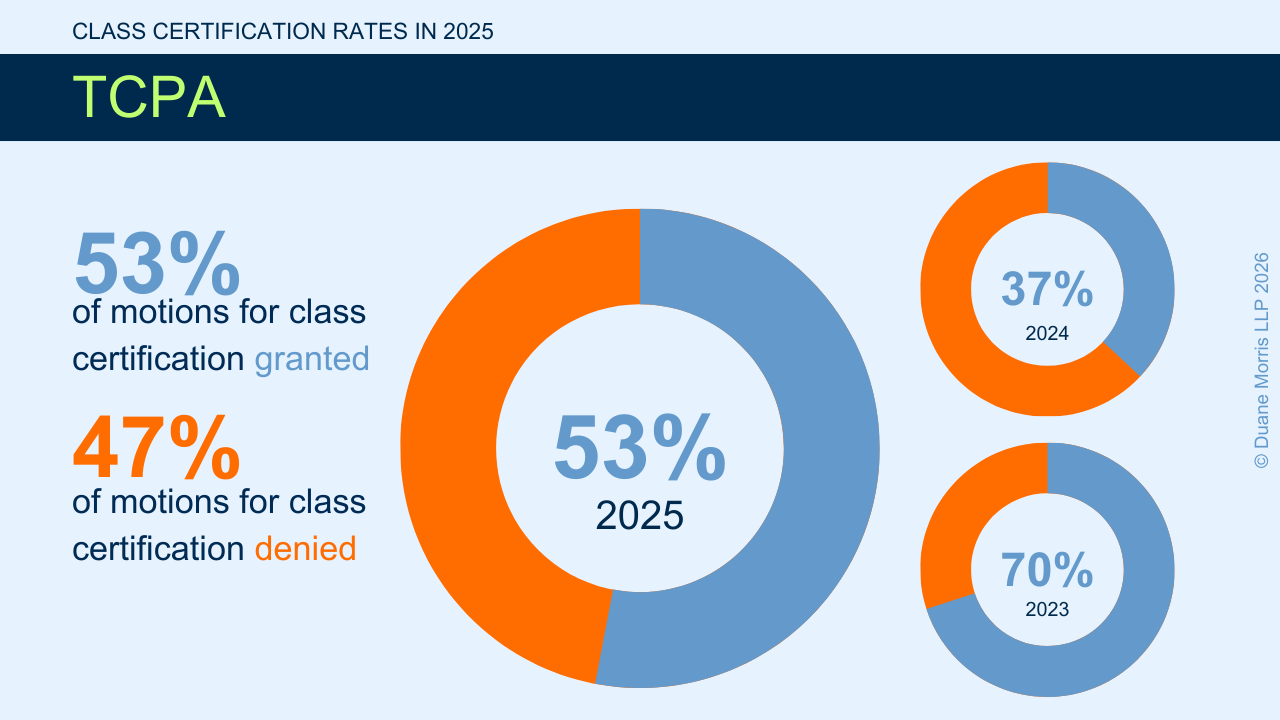
Ryan: Well, Jerry, I would say there were wins on both sides, but plaintiffs came way ahead in terms of having classes certified. Courts granted motions for class certification in 53% of cases and denied them in 47% of cases in 2025. However, that’s higher than in 2024, when courts granted certification in 37% of the time, however, much lower than in 2023, when the plaintiffs’ bar was much more successful in obtaining class certification, with courts granting such motions upwards of 70% of the time.

Jerry: Well, for those keeping a scorecard, those are certainly up and down results that swing from year to year. Elizabeth, in terms of your thought leadership in following this area, what, to you, were the most notable rulings in this space in 2025?

Elizabeth: Yes, Jerry, in Fischbein v. IQVIA Inc. A federal court in Pennsylvania denied class certification in a TCPA fax case – and the decision turned on old-school technology. The proposed class included more than 25,000 healthcare providers who allegedly received unsolicited fax advertisements. But the court closely examined the TCPA’s language and concluded that the statute only protects faxes received on traditional stand-alone fax machines and not modern online fax services. The key statutory phrase was “telephone facsimile machine,” which the law defines as equipment that transmits or receives documents over a “regular telephone line.” The court interpreted that to mean an analog telephone line, not internet-based fax platforms. The court thus found that the plaintiffs could not show through common evidence which recipients received the faxes on traditional machines versus online fax services. Without a reliable way to distinguish between the two, the court found the class was not ascertainable. And because determining the method of receipt would require individualized inquiries, common issues did not predominate.

For TCPA defendants, Fischbein underscores the importance of scrutinizing class definitions. If liability depends on the method of receipt – traditional fax machine versus online service – and that distinction can’t be determined through common proof, that’s a powerful argument against certification.

Jerry: Well, thanks so much, Elizabeth. I think another important TCPA ruling this past year emanated from the Third Circuit in Conner v. Fox Rehabilitation Services. In that case, the Third Circuit affirmed a district court’s denial of class certification in a TCPA case involving facsimiles. The key issue there was consent. Ryan, how do you read that Third Circuit decision?

Ryan: Sure, Jerry. I think it remains true to this day that consent is still the most powerful defense in response to a TCPA case. So, during the early months of the COVID-19 pandemic, Fox Rehabilitation sent more than 20,000 faxes to healthcare providers, promoting its therapy services, while also reassuring providers that it remained operational. The plaintiff alleged that the faxes were unsolicited advertisements in violation of the TCPA and sought to certify a class. The district court actually denied certification there, finding that individualized questions regarding whether each recipient had consented would overwhelm the common issues. Although the court later ruled for the plaintiff in his favor at a bench trial on the individual claim, but that said it did not allow the case to proceed as a class. On appeal, the Third Circuit clarified one important point: although the class was ascertainable, because it could be identified using the defendant’s own facts transmission logs, that wasn’t enough. The Third Circuit agreed that consent would require individualized inquiries regarding how and when each recipient provided their fax number, and when the faxes fell within the scope of that consent. Because these individualized issues predominated over the common ones, the Third Circuit affirmed the denial of class certification, reinforcing what has been traditionally known that consent is the most powerful barrier to a TCPA case.

Jerry: Thanks, Ryan. I agree that consent issue tends to be a very good weapon in the arsenal of defendants to try and block or fracture classes in this space. I suspect we’re going to see that issue playing out in other circuits in 2026. Jen, the review also, analyzes the top settlements in this space, and it seemed like plaintiffs did very well this year in monetizing their class action settlements and TCPA cases.

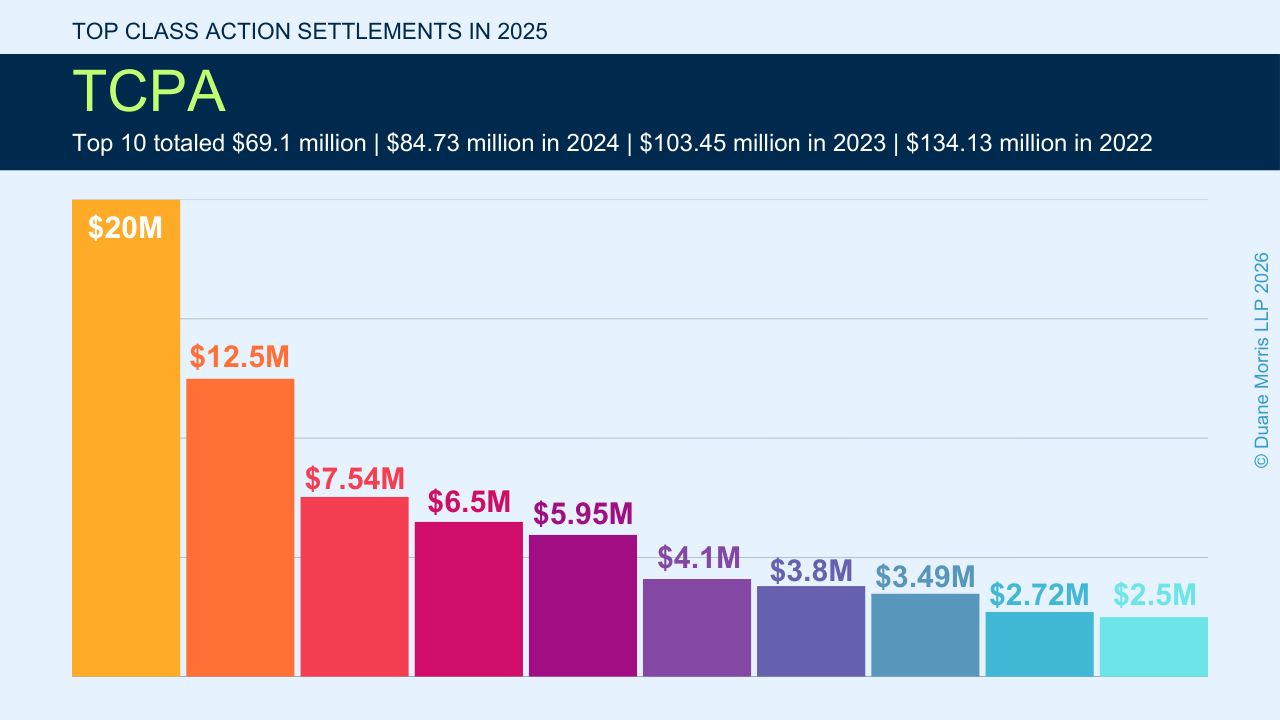
Jennifer: Agreed, Jerry. Plaintiffs did very well in securing high-dollar settlements in 2025 in the TCPA space. The top 10 TCPA class action settlements totaled $69.1 million. That’s down just slightly from what we saw in 2024, where the top 10 settlements totaled $84.73 million.

Jerry: As our loyal readers know, we track the settlements on a 24/7/365 basis, so we’ll be analyzing top TCPA class action settlements throughout the year. Well, thank you very much for being here on today’s podcast, and thank you for our loyal listeners and readers for tuning in.

Jennifer: Thanks, Jerry, and thanks to all of our listeners. We hope you enjoy the TCPA Review. Please stop by the blog and download your free copy of the e-book.

Ryan: Thanks so much for the opportunity, Jerry.

Elizabeth: Thanks for having me, Jerry, and thank you to all the listeners.

Announcing The Third Edition Of The Duane Morris TCPA Class Action Review!

By Gerald L. Maatman, Jr. and Jennifer A. Riley

Duane Morris Takeaway: The Telephone Consumer Protection Act (TCPA), 47 U.S.C. § 227, et seq., has long been a focus of class action litigation. Since the TCPA was enacted 30 years ago, the methods and technology that businesses use to engage and interact with customers has evolved and changed. The trend of states enacting or amending their own mini-TCPAs shows no signs of slowing down, making this subject area a likely continued focus for the plaintiffs’ class action bar in years to come.

To that end, the class action team at Duane Morris is pleased to present the 2026 edition of the TCPA Class Action Review. We hope it will demystify some of the complexities of TCPA class action litigation and keep corporate counsel updated on the ever-evolving nuances of these issues.  We hope this book – manifesting the collective experience and expertise of our class action defense group – will assist our clients by identifying developing trends in the case law and offering practical approaches in dealing with TCPA class action litigation.

Click here to bookmark or download a copy of the TCPA Class Action Review – 2026 e-book.

Stay tuned for more TCPA class action analysis coming soon on our weekly podcast, the Class Action Weekly Wire.

© 2009- Duane Morris LLP. Duane Morris is a registered service mark of Duane Morris LLP.

The opinions expressed on this blog are those of the author and are not to be construed as legal advice.

Proudly powered by WordPress