
Third-Party Complaint Dismissed With Prejudice After Alabama Federal Court Finds Parties’ Indemnity Provisions Do Not Apply To Title VII In EEOC Sex Discrimination Lawsuit

By Gerald L. Maatman, Jr., George J. Schaller, and Andrew P. Quay

Duane Morris Takeaways: On March 9, 2026, in EEOC v. TCI of Alabama, LLC, Case No. 25-CV-89, 2026 U.S. Dist. LEXIS 47895 (N.D. Ala. Mar. 9, 2026), Judge Corey L. Maze of the U.S. District Court for the Northern District of Alabama dismissed a third-party complaint seeking to enforce indemnity provisions between Defendant-TCI and third-party staffing firms with the aim of indemnifying TCI from liability under Title VII.  The Court held that parties cannot contract away their responsibilities under Title VII in light of its comprehensive remedial scheme. 

The Court’s decision illustrates that corporate defendants cannot shift potential Title VII liability through contracted indemnity clauses entered into by staffing firms that refer employees.

Case Background

TCI of Alabama, LLC (“TCI”) disposes and recycles PCB contaminated items at various plants and employs laborers to do so.  Id. at *3.  To hire laborers, since 2020, TCI has “relied exclusively on third-party temporary staffing agencies” who refer qualified applicants.  Id.

The EEOC investigated TCI after the Commission learned that TCI allegedly refused to recruit and hire qualified women for laborer positions.  Id.  Following its investigation, the EEOC issued TCI a letter of determination, found reasonable cause to believe that TCI violated Title VII, and invited TCI to conciliate.  Id.  The Parties did not reach a conciliation agreement, and the EEOC filed the instant lawsuit.  Id. 

The EEOC’s lawsuit brought one claim for sex discrimination under Title VII.  Id. at *3-4.  According to the EEOC, TCI “intentionally excluded from employment a class of qualified females seeking employment as laborers in favor of hiring equally or less qualified male applicants.”  Id. at *4.  The EEOC maintained that TCI refused to hire women for numerous reasons including that TCI instructed third party staffing agencies, Orin Staffing, LLC, Personnel Staffing, Inc., and WorkSmart Staffing, Inc. (the “Staffing Firms”) not to refer women for its laborer positions because “among other reasons, women would ‘distract’ male workers and increase the risk of sexual harassment in the workplace.”  Id. 

TCI answered the complaint and then filed its own third-party complaint for breach of contract against the Staffing Firms.  Id.  TCI’s third-party complaint alleged the Staffing Firms “agreed via contracts” to lawfully refer qualified laborers to TCI.  Id.  The contracts also contained indemnification provisions, which required the Staffing Firms, as joint employers of referred employees, to indemnify TCI “for all claims caused by the [Staffing Firms’] breach of contract, including a breach caused by failing to follow the law when referring applicants.”  Id. at *4-5.

Accordingly, TCI contended that even if the EEOC’s allegations were true, the Staffing Firms’ compliance with TCI’s alleged unlawful instruction was itself “unlawful and violated Title VII.”  Id. at *5.  Therefore, the Staffing Firms exposed TCI to legal claims which TCI was indemnified for under their agreed contracts.  Id.

The EEOC and the Staffing Firms moved to dismiss TCI’s third-party complaint.  Id.  Their arguments for dismissal varied. Id.  The Court focused on one argument raised by the EEOC, whether Title VII preempts TCI’s breach of contract claim and therefore requires dismissal of TCI’s third-party complaint.  Id. at *6-7.

The Court’s Opinion

Judge Maze agreed with the EEOC that Title VII preempts TCI’s breach of contract claim and dismissed the third-party complaint with prejudice, explaining that any amendment would be futile.  Id. at *9.

Acknowledging Title VII’s “comprehensive remedial scheme,” the Court adopted the holding in EEOC v. Blockbuster, Case No. 07-CV-2612, 2010 U.S. Dist. LEXIS 2889 (D. Md. Jan. 14, 2010), which held that parties accused of violating Title VII may not bring claims for indemnification against third parties “to skirt their own liability.”  TCI of Alabama, LLC,2026 U.S. Dist. LEXIS47895, at *7.  In Blockbuster, the EEOC brought a Title VII action against the home video rental chain for failing to prevent and correct known sexual harassment at one of its warehouse facilities.  Blockbuster, 2010 U.S. Dist. LEXIS 2889, at *1.  Blockbuster, like TCI here, filed a third-party complaint against a staffing firm that agreed to indemnify Blockbuster against any losses arising from any employment claim brought by its employees.  Id. The Court in Blockbuster granted judgment on the pleadings against Blockbuster and held that “[t]he primary goal of Title VII to eradicate discriminatory conduct would be thwarted if Blockbuster were permitted to contract around its obligations and shift its entire responsibility for complying with Title VII” to a third party.  Id.

The Court here agreed that the policy rationale in Blockbuster applied in greater force to TCI’s third-party indemnification claims given those claims rested on the EEOC’s allegation that TCI instructed staffing firms not to refer qualified women.  TCI of Alabama, LLC,2026 U.S. Dist. LEXIS47895, at *8. “Federal public policy would be undermined,” the Court explained, “if TCI had the ability to tell others to help TCI violate federal law and then pay TCI if TCI got caught.”  Id.  Therefore, a contractual indemnity provision could not shield TCI from liability under Title VII.

Even though the EEOC’s lawsuit continues against TCI, the Staffing Firms involved in hiring are not off the hook.  In a footnote, the Opinion clarifies that if the Staffing Firms violated Title VII by complying with TCI’s unlawful request to not refer qualified women for laborer jobs, they too can face liability in another case.  Id. at *9, n. 2. 

Accordingly, the Court dismissed TCI’s third-party complaint with prejudice.

Implications For Businesses

EEOC v. TCI of Alabama, LLC demonstrates that corporate defendants cannot turn a blind eye to potential Title VII harms and attempt to contract away Title VII liability.  While indemnity clauses may appear all-encompassing, courts continue to decline coverage where Title VII violations are alleged. 

This Court agreed that public policy concerns control and remain critical in analyzing the scope of an indemnity provision in alleged gender-bias hiring under Title VII.  After TCI of Alabama, LLC, Companies contracting with outside staffing firms cannot rely on “shifting the blame” through indemnity provisions in contracts when faced with Title VII claims brought by the EEOC. 
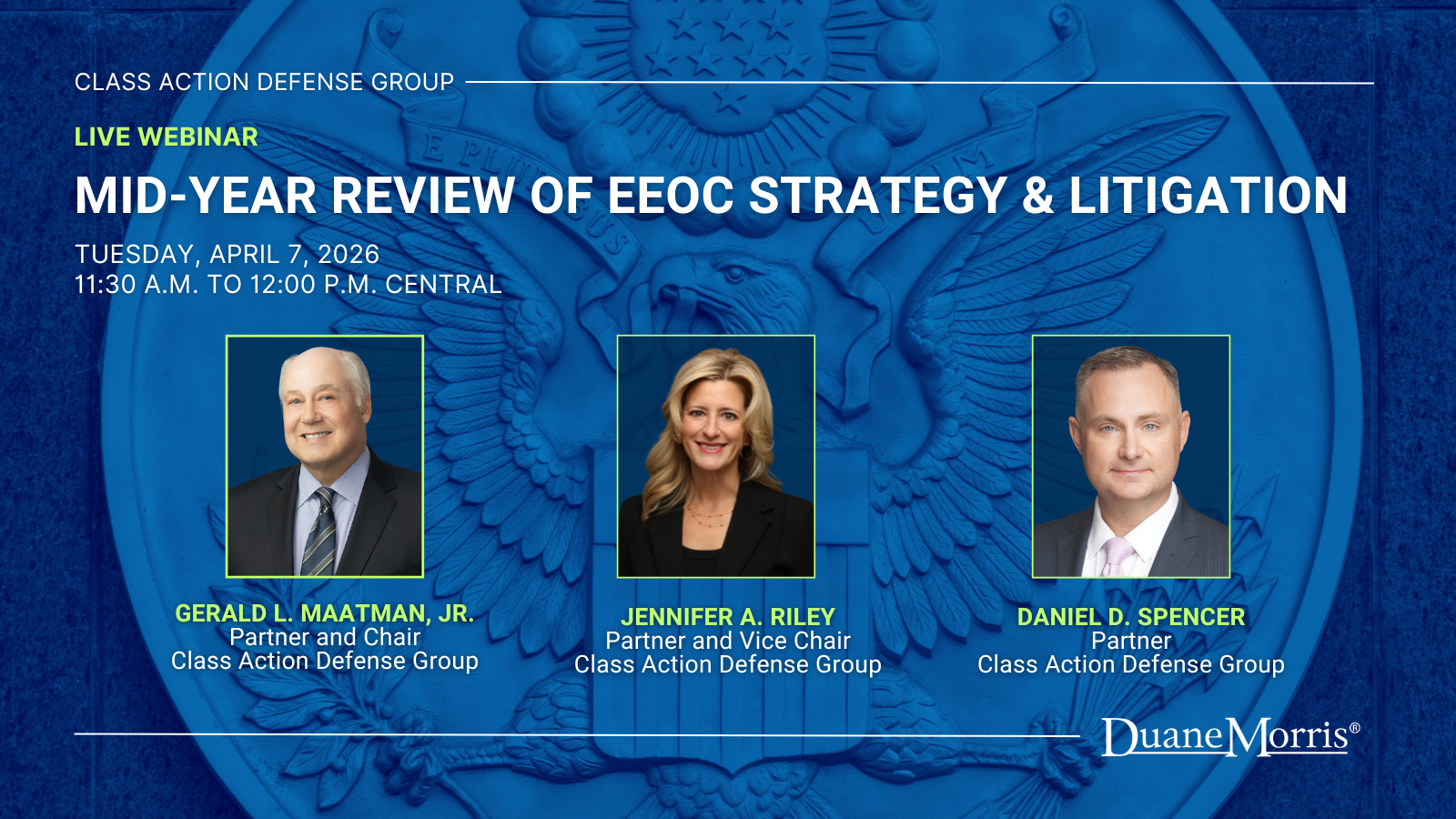
Join Us For A Mid-Year Review of EEOC Litigation and Strategy

By Gerald L. Maatman, Jr., Jennifer A. Riley, and Daniel D. Spencer

Duane Morris Takeaway: Please join us for our webinar, Mid-Year Review of EEOC Litigation and Strategy, which will take place on Tuesday, April 7, 2026 at 11:30 a.m. to 12:00 p.m. Central. Click here to register to attend!

Join Duane Morris partners Jerry MaatmanJennifer Riley and Daniel Spencer for a live panel discussion analyzing the latest impact of the dramatic changes at the U.S. Equal Employment Opportunity Commission, including its new strategic priorities and the array of EEOC lawsuits filed in the first six months of fiscal year 2026. Moving through FY 2026 with significant changes implemented by the Trump administration, employers’ compliance with federal workplace laws and agency guidance remains a business imperative. Our virtual program will empower corporate counsel, human resource professionals and business leaders with key insights into the EEOC’s latest enforcement initiatives and provide strategies designed to minimize the risk of drawing the agency’s scrutiny.

The Class Action Weekly Wire – Episode 139: Key Developments In FCRA, FACTA, and FDCPA Class Actions

Duane Morris Takeaway: This week’s episode features Duane Morris partner Jerry Maatman, senior associate Anna Sheridan, and associate Caitlin Capriotti with their discussion of the key trends and developments analyzed in the 2026 edition of the FCRA Class Action Review.   

Check out today’s episode and subscribe to our show from your preferred podcast platform: Spotify, Amazon Music, Apple Podcasts, Podcast Index, Tune In, Listen Notes, iHeartRadio, Deezer, and YouTube.

Episode Transcript

Jerry Maatman: Welcome to our listeners. Thank you for being here for our weekly podcast series, the Class Action Weekly Wire. I’m Jerry Maatman, a partner at Duane Morris, and joining me today on the podcast are my colleagues Anna Sheridan and Caitlin Capriotti. Thanks so much for being with us today.

Anna Sheridan: Thank you, Jerry. I’m happy to be a part of the podcast.

Caitlin Capriotti: Yes, thanks so much for having me, Jerry.

Jerry: Today, we’ll be discussing the second edition of the Duane Morris Fair Credit Reporting Act Class Action Review. Listeners can find this e-book publication and desk reference on our blog, the Duane Morris Class Action Defense Blog. Anna, can you tell our listeners a little bit about the desk reference?

Anna: Yeah, absolutely, Jerry. This review dives deep into the world of consumer protection laws, specifically the Fair Credit Reporting Act (the FCRA), the Fair and Accurate Credit Transactions Act (the FACTA), and the Fair Debt Collection Practices Act (the FDCPA). Since these areas have long been a focus of litigation, particularly for class actions, Duane Morris created this review to analyze the key rulings and developments in these areas in 2025, and the significant legal decisions and trends impacting the type of class action litigations for 2026. We hope that companies will benefit from this resource in their compliance with these evolving laws and standards.

Jerry: Great, let’s start with the basics. The FCRA, as enacted by Congress, aims to ensure that consumer reporting agencies and employers act responsibly and fairly in using background checks and credit checks. Caitlin, can you give us a quick overview of the substantive key provisions of the FCRA?

Caitlin: Yes, of course. The FCRA is focused on ensuring that consumer reporting agencies, or CRAs, maintain accuracy, fairness, and respect for consumers’ privacy rights. It mandates that CRAs follow reasonable procedures to ensure that consumer reports are as accurate as possible. The law also requires employers to disclose when they are obtaining a consumer report on an applicant for a job, and to follow specific procedures if they decide to take adverse action based on that report. Well, FCRA violations often do come down to technicalities, things like failure to provide proper disclosures or obtaining consent incorrectly, and the penalties can be significant, ranging from $100 to $1,000 per violation, with punitive damages up to $2,500 if the violation is deemed willful.

Jerry: Well, thanks so much. Anna, what about the FACTA?

Anna: FACTA requires consuming reporting agencies to present information in a clearer, more understandable manner. One of the key parts of the FACTA is the requirement for adverse action doses. If a consumer is denied credit or offered less favorable terms based on their credit report, they must be informed. This gives consumers the opportunity to dispute any inaccuracies. In fact, it also emphasizes the need for better protections against identity. Similar to the FCRA, the plaintiffs’ bar has been aggressive in bringing class action lawsuits under FACTA, particularly when the accuracy of credit reports and whether consumers are properly notified when adverse actions are taken. The penalties for noncompliance with FACTA are very much in line with the FCRA violation – up to $2,500 for willful violence. However, there have been some significant Supreme Court rulings that have limited the scope of these lawsuits, especially when it comes to proving actual harm or injury-in-fact.

Jerry: Thank you. I’ll go over the last one, which is the FDCPA, the federal Fair Debt Collection Practices Act. This statute governs debt collection practices, and while it doesn’t directly address credit reporting, it’s closely related, because many debt collectors rely on credit reports to pursue collection actions. The FDCPA regulates how they can communicate with individuals. The information that must be disclosed and their conduct during the collection process. In essence, it’s a companion law that protects consumers in the broader context of both credit and debt. So, in terms of these three statutes, what were some of the notable trends that we saw in the class action space in 2025?

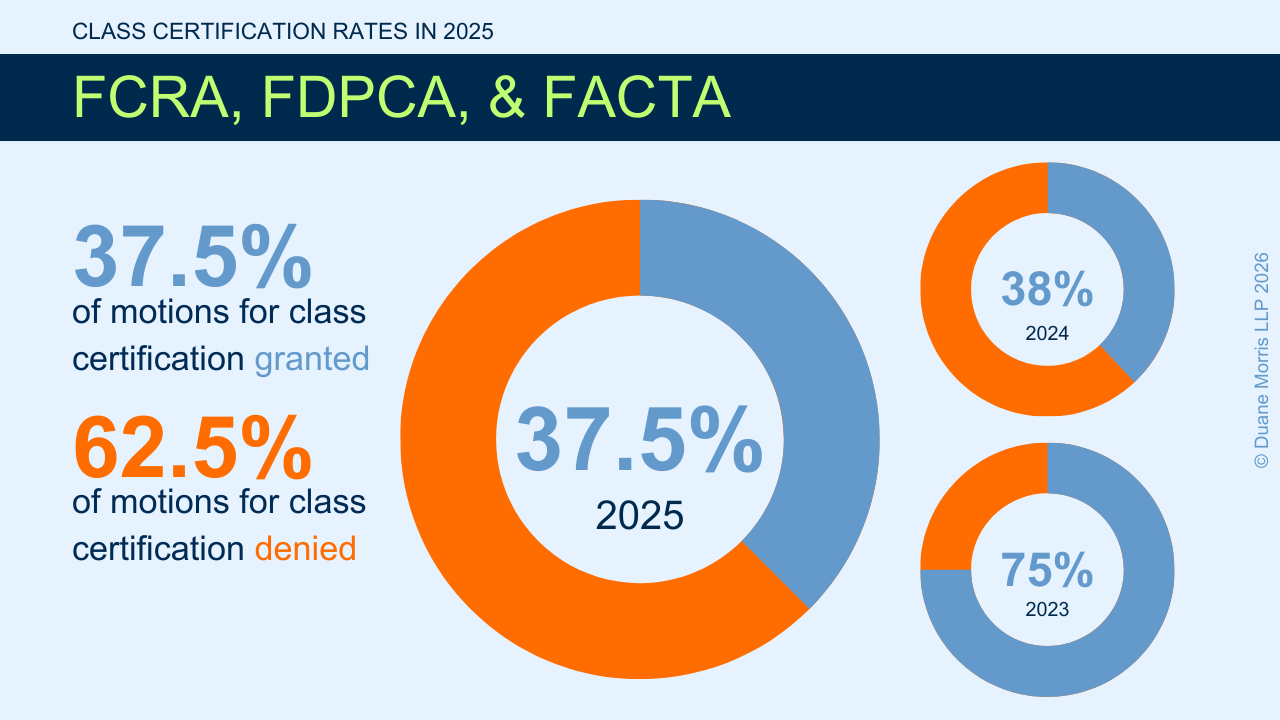
Anna: One notable thing was that courts granted motions for class certification in these cases at almost the exact same rate in 2025 as they did in 2024. Both were around 38%. These rates were down significantly from the 75% of motions being granted in 2023. This could partly be due to the 2021 TransUnion decision and the increasing complexity of FCRA violations. Employers and consumer reporting agencies are now more careful about complying with technical requirements. And plaintiffs are facing higher hurdles in improving harm.

Caitlin: Another thing we’re seeing is the rise of state-level laws that track the FCRA but impose even stricter standards. States like California, New York, and Texas have their own consumer credit reporting laws, and companies need to stay on top of both federal and state regulations to avoid liability.

Jerry: Well, it seems like this area is very much like the rest of the class action state or space where judicial precedents are constantly evolving, and the obligations and duties of companies are in a state of flux. By your way of thinking, what were some of the key, important rulings in this space in 2025?

Caitlin: Yes, so one of the important rulings was Fausett v. Walgreen Co., where the Illinois Supreme Court ruled that plaintiffs bringing claims under the FCRA, or its amendment FACTA, must show a concrete injury to have standing in Illinois state courts. The court held that because the FCRA does not explicitly identify who may sue, plaintiffs cannot rely on statutory standing based solely on a technical violation. Instead, they must meet common law standing, which requires a distinct and concrete injury. In this case, the plaintiff alleged that Walgreens printed too many digits of her debit card number on a receipt, violating FACTA, but she admitted she suffered no actual harm, such as identity theft or misuse of the receipt. The court found this insufficient and ruled that the plaintiff lacked standing overturning the class certification. The decision blocks no-injury FCRA/FACTA lawsuits in Illinois state courts, aligning them more closely with federal standing rules established in Spokeo v. Robins, and potentially affecting other federal statutes with similar private action provisions.

Jerry: That is a key ruling. Certainly, it underscores the M.O. of the plaintiffs’ bar to find a case, file it, certify it, and then monetize it with a settlement. How did the plaintiffs’ bar do in this space in 2025 in terms of class action settlements?

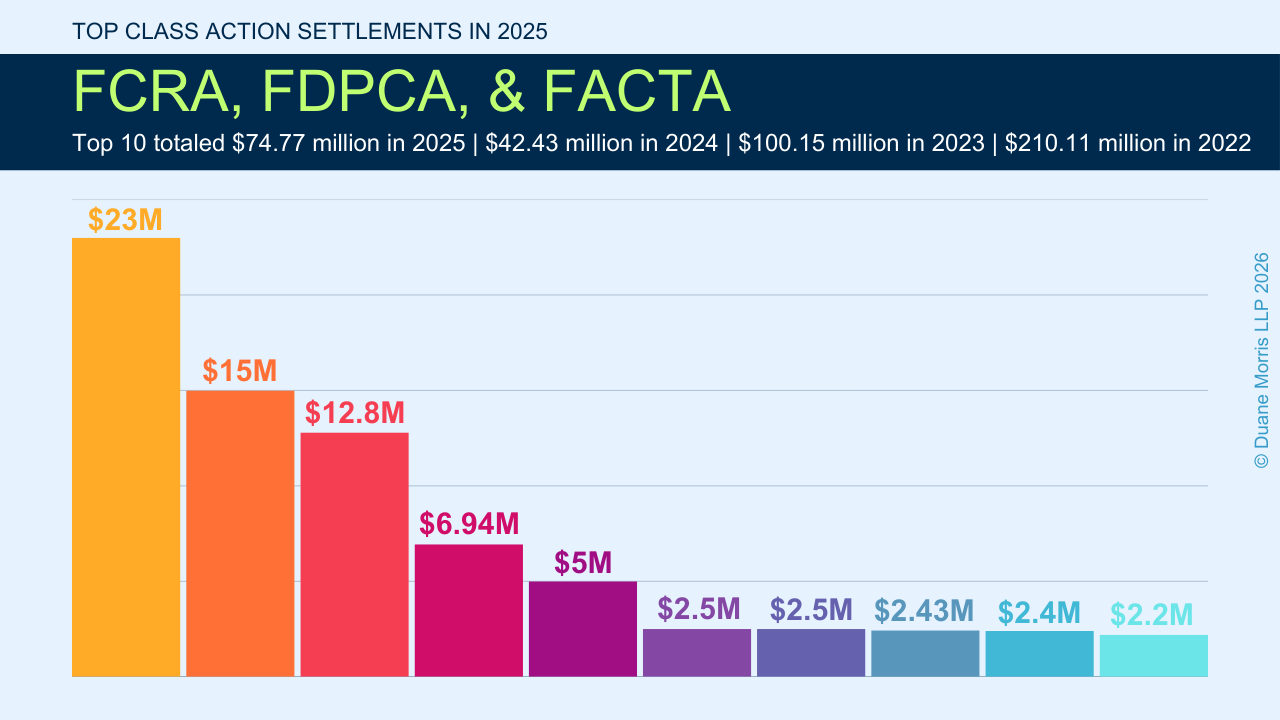
Anna: In 2025, the top 10 FCRA, FDCPA, and FACTA settlements totaled $74.77 million. This was a significant increase from the prior year, when the top 10 class action settlements totaled $42.43 million. However, it’s lower than 2023, when the top 10 settlements totaled just around $100 million.

Jerry: Well, we continue to track class action settlements in all substantive areas on a 24-7, 365 basis, and so we’ll be analyzing and providing analytics on those numbers throughout the year. Thank you both for being here today, and thank you, our loyal listeners, for tuning in. Please stop by our website and our blog for a free copy of the FCRA Class Action Review e-book.

Caitlin: Thank you so much for the opportunity, Jerry.

Anna: Thanks for having me, Jerry, and thanks to everyone for listening.

Illinois Court Holds “Interested Party” Enforcement Provision Of The Day And Temporary Labor Services Act Unconstitutional

By Gerald L. Maatman, Jr., Jennifer A. Riley, and Gregory Tsonis

Duane Morris Takeaways:  In a significant decision issued on March 6, 2026, Judge Neil H. Cohen of the Circuit Court of Cook County, Illinois, held that Section 67 of the Illinois Day and Temporary Labor Services Act (“DTLSA”), 820 ILCS 175/67, is unconstitutional because it improperly authorizes private parties to enforce the statute in a manner that usurps the constitutional authority of the Illinois Attorney General. The ruling arose in Figueroa, et al. v. Visual Pak Holdings, LLC, et al., No. 2025 CH 04411 (Cir. Ct. Cook County Mar. 6, 2026), and can be found here.

The court concluded that the statute’s “interested party” enforcement provision effectively creates a qui tam-style enforcement mechanism without the safeguards that preserve the Attorney General’s control over litigation brought on behalf of the State.  Because the statute does not require notice to the Attorney General and gives the Attorney General no authority to intervene, control, dismiss, or settle such cases, the court held that the provision violates the Illinois Constitution.  The ruling could significantly affect the growing wave of DTLSA litigation brought by worker advocacy organizations and may reshape how the statute is enforced going forward.

Background On The Day And Temporary Labor Services Act And Figueroa Lawsuit

The Illinois Day and Temporary Labor Services Act, 820 ILCS 175/1 et seq., regulates staffing agencies that provide temporary or day laborers to client companies. The statute imposes obligations on staffing agencies and the client companies that utilize temporary labor.  These obligations include registration requirements, disclosure rules governing job assignments, and compliance with wage and safety protections designed to regulate the temporary labor industry.

In recent years, amendments to the statute expanded its scope and enforcement mechanisms, including provisions mandating equal pay to equivalent permanent employees, safety training, recordkeeping and disclosure requirements, and joint compliance obligations between staffing agencies and the companies that receive temporary workers.

Central to the dispute in Figueroa was Section 67 of the statute, which authorizes enforcement actions by so-called “interested parties.” The statute defines an “interested party” broadly as “an organization that monitors or is attentive to compliance with public or worker safety law, wage and hour requirements, or other statutory requirements.”  820 ILCS 175/5.   Under Section 67, these organizations may file civil actions after providing notice to the Illinois Department of Labor and certain requirements are met, and can seek injunctive relief to compel compliance with the statute even if the organization itself did not employ the workers and did not suffer a direct injury.  Pursuant to Section 67(d) of the DTLSA, an “interested party” that prevails in a civil suit can recover 10% of any statutory penalties awarded, as well as attorneys’ fees and costs. 

The Figueroa litigation was brought by temporary workers and the Chicago Workers’ Collaborative (“CWC”), a nonprofit worker advocacy organization, alleging violations of the DTLSA by the defendants. The defendants moved to dismiss CWC’s claims in the complaint, asserting that CWC lacks standing to bring suit because its standing is based Section 67 of the DTLSA, which is unconstitutional.  The defendants also moved to dismiss the individual plaintiffs’ claims and challenged venue in Cook County, as CWC is the only entity located in Cook County and the defendants and employee plaintiffs are located in Lake County, Illinois.  

Because the challenge implicated the constitutionality of a state statute, the Illinois Attorney General intervened in the case to defend the law.

The Court’s Decision

After first establishing that CWC lacked associational standing that would allow it to bring claims, the court turned to assessing the constitutionality of Section 67, on which CWC’s standing relied.

The court first analyzed whether Section 67 of the DTLSA is a “qui tam” statute.  Under a “qui tam” enforcement mechanism, private parties may bring lawsuits on behalf of the government and receive a portion of the penalty recovered.  “Qui tam” statutes are not inherently unconstitutional, but typically contain procedural safeguards that ensure the government retains ultimate control over the litigation.  Although the Attorney General “argue[d] that section 67 is not a qui tam statute,” the court noted that the Attorney General took the opposite position in another case, Staffing Services Association of Illinois v. Flanagan, Case No. 1:23-cv-16208 (N.D. Ill).  Ultimately, because the State, and not the interested party, is the entity with “an actual and substantial interest” in the action, the court had little difficulty concluding that “Section 67 is a qui tam statute.”  Id. at 5.  

Next, the court turned to whether Section 67 of the DTLSA improperly usurps the power of the Attorney General to represent the state.  Under the Illinois Constitution, the Attorney General serves as the State’s chief legal officer and possesses the authority to enforce state law on behalf of the public.  While the legislature may create private rights of action, it cannot enact statutes that effectively transfer the State’s enforcement authority to private actors.  Qui tam statutes found constitutional, such as the False Claims Act, “provide for control over the litigation by the Attorney General by granting the Attorney General authority to intervene at any time, authority to control the litigation. and the authority to dismiss or settle the litigation at any time regardless of the wishes of the qui tam plaintiff.”  Id. at 5. 

By contrast, the court concluded, the DTLSA contains none of those safeguards.  Section 67 does not require notice to the Attorney General when an interested party files suit, nor does it give the Attorney General authority to intervene, take control of the case, or dismiss or settle the action. The statute therefore allows private organizations to pursue enforcement litigation entirely independent of the State. 

The Attorney General argued that such explicit authority over suits was unnecessary in the statutory text of the DTLSA, as the Attorney General Act provides the Attorney General with authority to intervene, initiate, and enforce any proceedings concerning “the payment of wages, the safety of the workplace, and fair employment practices.”  Id. at 6 (quoting 15 ILCS 205/6.3(b)).   The court, however, noted that the DTLSA does not require an “interested party” to provide the Attorney General with notice that it filed a suit under Section 67, and thus the Attorney General “cannot exercise its authority to represent the State if it has no notice of the filing of suit under Section 67” of the DTLSA.  Id. at 6.  As a result, the court held, the lack of notice “renders section 67 an unconstitutional usurpation of the Attorney General’s authority[.]”  Id. at 6.

Although the failure to provide notice was sufficient to find Section 67 unconstitutional, the court also held that Section 67 was also unconstitutional on the separate grounds that it “does not grant the Attorney General any control over the interested party’s suit.”  Id.  The court found unpersuasive the argument that the Attorney General Act provides the Attorney General with the right to intervene, reasoning that “[a] right to intervene is not the same as a right to control the litigation, including the right to dismiss that litigation over the objections of the plaintiff.  Id.   Because the statute allows private actors to enforce public rights without oversight or control by the Attorney General, the court concluded that Section 67 improperly interferes with the Attorney General’s constitutional authority and is therefore unconstitutional. 

Because Section 67 was found unconstitutional, the court dismissed CWC’s claims for lack of standing and the case was appropriately transferred to a proper venue in Lake County, which could properly consider the arguments for dismissal of the individual plaintiffs.

Implications For Employers

The Figueroa decision could significantly affect the enforcement landscape under the DTLSA, though it is likely to face appellate review.   Employers operating in Illinois should therefore closely monitor further developments as the courts continue to address the scope and enforcement of the statute.

In recent years, worker advocacy organizations have increasingly relied on Section 67 to bring enforcement actions seeking injunctive relief against staffing agencies and the companies that utilize temporary labor.  By holding that provision unconstitutional, the decision calls into question the viability of those lawsuits and may substantially limit the ability of advocacy groups to initiate DTLSA litigation.  As a result, the ruling may shift enforcement of the statute more squarely toward state regulators, including the Illinois Department of Labor and the Attorney General’s Office.  While this could reduce the number of private enforcement actions filed by advocacy organizations, employers should expect that regulatory authorities will continue to scrutinize staffing practices and DTLSA compliance. 

Finally, employers should not interpret the ruling as diminishing the importance of DTLSA compliance.  Importantly, the decision does not invalidate the DTLSA itself, but strikes only the statute’s “interested party” enforcement mechanism as unconstitutional.  The statute’s substantive requirements remain in effect, including the provisions governing wage protections, safety obligations, and responsibilities shared between staffing agencies and client companies.  Staffing agencies and employers that utilize temporary labor should continue to review their staffing arrangements and compliance practices carefully.

New York Federal Court Certifies Crypto Class Action With Modifications And Reserves Causation Question For Summary Judgment Proceedings

By Gerald L. Maatman, Jr. and Justin R. Donoho

Duane Morris Takeaways:  On March 6, 2025, Judge Katherine Polk Failla of the U.S. District Court for the Southern District of New York granted class certification with modifications in a case involving a stablecoin issuer’s alleged issuance of unbacked or debased stablecoins in furtherance of an alleged scheme to manipulate the market prices for crypto commodities and futures in the litigation captioned In Re Tether & Bitfinex Crypto Asset Litigation, No. 19 Civ. 9236, 2026 WL 629826 (S.D.N.Y. Mar. 6, 2026).  The ruling is significant as it shows that while crypto purchasers who file class action complaints alleging violations of the Sherman Act and Commodities Exchange Act may be able to satisfy Rule 23 so long as they offer reliable expert models on class-wide causation and damages and limit their proposed classes to purchasers who used fiat currency or stablecoins to make their purchases on domestic or stateless exchanges, such class actions may also be subject to dismissal based on summary judgment on the question of whether the defendants’ alleged provision of unbacked or debased stablecoins caused an increase in price of crypto commodities and futures. 

Background

In the litigation captioned In Re Tether & Bitfinex Cryto Asset Litigation, the plaintiffs, four purchasers of Bitcoin, Bitcoin futures, and other crypto assets, brought a class action against various entities and individuals associated with the issuer of a stablecoin and the stablecoin issuer’s sister company, a crypto asset exchange, alleging that the defendants artificially inflated the prices of the plaintiffs’ crypto asset purchases by engaging in market manipulation under the Commodities Exchange Act and monopolization and restraint of trade under the Sherman Act.  Id. at *2, 26. 

According to the plaintiffs, the stablecoin issuer issued hundreds of millions of unbacked or debased stablecoins while telling the market that these stablecoins were fully backed by U.S. dollars whereas actually they were backed only by the sister crypto exchange’s accounts receivables and inaccessible funds.  Id. at *2-3.  Further according to plaintiffs, the defendants used an anonymous trader to engage in cross-exchange arbitrage by purchasing “massive” amounts of crypto commodities on other exchanges with the debased stablecoin, selling them on the defendant exchange for U.S. dollars, and withdrawing those funds as the stablecoin.  Id. at *4.  All these activities were allegedly performed by the defendants with knowledge and intent to inflate crypto commodity and futures prices and allegedly resulted in artificially inflated prices of crypto assets purchased by the plaintiffs.  Id.

The plaintiffs moved for class certification under Rule 23, seeking to certify classes of acquirers in the United States during the class period of crypto commodities and futures, respectively.  Id. at *5.  In support, the plaintiffs submitted a report from an antitrust and economics expert that included an event study purporting to show that the issuance of the unbacked or debased stablecoin caused the price of Bitcoin to increase, a regression analysis that purported to model how a change in the outstanding volume of the stablecoin affects Bitcoin prices, and an overcharge model that purported to quantify the artificial inflation of Bitcoin based on the extent to which the stablecoin was debased or unbacked.  Id. at *6.

The defendants moved to exclude the plaintiff’s expert and opposed class certification by challenging only adequacy and predominance (not any of the other Rule 23 requirements).  On adequacy, the defendants argued that adequacy was not satisfied due to two sources of potential intraclass conflict – intraclass trading and plaintiffs’ alternative models for showing debasement and inflation.   On predominance, the defendants argued that individual questions would predominate when resolving questions of class-wide impact, injury, and extraterritoriality.

The Court’s Decision

The Court began its analysis by excluding the plaintiffs’ expert’s event study purporting to show that the issuance of the unbacked or debased stablecoin caused the price of Bitcoin to increase.  As the Court explained, the event study was unreliable because the “t-test” model it employed violated the key assumption of the model “that the values within in each tested group are independent, meaning that they are not correlated with each other..  Id. at *6 n.5, 12-13.  However, the court denied exclusion of the expert’s regression model, overcharge model, and other opinions.  Id. at *14-19.

Turning next to the defendants’ two adequacy challenges, the Court rejected both.  First, the Court found that intraclass trading did not create any conflicts because the alleged classes included only buyers alleging only price inflation.  Id. at *23-24.  Second, the Court found that there were also no intraclass conflicts based on plaintiffs’ alternative methods for showing stablecoin debasement because the methods differed only “in the extent of the debasement they show on certain days, but they are not diametrically opposed. In fact, the debasement is, by default, one-directional.”  Id. at *25.

Turning to defendants’ challenges to predominance, the court found that common evidence would be used “to establish that Defendants engaged in certain conduct, such as issuing debased or unbacked [stablecoins], misrepresenting that [the stablecoins were] always backed one-to-one by USD held in reserve by [the defendant crypto exchange], disseminating debased [stablecoins] through the Anonymous Trader, and conspiring with the Anonymous Trader to increase cryptocommodity prices.”  Id. at *27.  The court also found that common evidence would be used for the elements relating to the defendants’ scienter or intent.  Id. at *27.  In sum, the Court found that common questions predominated as to “issues related to defendants’ anticompetitive conduct.”  Id.  However, as the Court explained, “the elements of antitrust and CEA cases that pertain to Defendants’ conduct almost always present a common question that predominates … Because of this, class certification in CEA and antitrust cases often turns on whether common issues predominate in establishing injury, causation, or damages.”  Id. at *26-27 (emphasis added). 

Next the Court found that the plaintiffs could demonstrate class-wide impact or causation through plaintiffs’ expert’s regression analysis, although the Court found this to be a “closer question.”  Id. at *28.  Although the defendants did not provide a sufficient reason to exclude the regression analysis such as the expert’s failure to account for a key variable, the Court found nevertheless that the defendants called into question the plaintiffs’ ability with its regression model to establish “the fact of causation.”  Id. at *28-30.  However, as the Court explained, “That type of challenge sounds more in summary judgment than in Rule 23(b)(3). Indeed, the Supreme Court has warned that when ‘the concern about the proposed class is not that it exhibits some fatal dissimilarity but, rather, a fatal similarity — [an alleged] failure of proof as to an element of the plaintiffs’ cause of action — courts should engage that question as a matter of summary judgment, not class certification.’”  Id. (quoting Tyson Foods, Inc. v. Bouaphakeo, 577 U.S. 442, 457 (2016)). 

Further, the Court found that the plaintiffs could measure damages on a class-wide basis using Plaintiffs’ overcharge model.  Id. at *31.

Finally, as to the defendants’ remaining challenges to predominance, the Court rejected them as to the predominance finding but embraced them for purposes of narrowing the Plaintiffs’ proposed class definitions in two ways. 

First, on the question of injury, the Court found that whether common issues predominate turns on whether injury occurs “(i) when a Class Member purchases an artificially inflated cryptocommodity, or (ii) when that Class Member experiences economic loss flowing from their purchase of that cryptocommodity.”  Id. at *31.  As the Court explained, whereas the defendants argued “that economic loss is required for Class Members to establish injury — like in the securities context,” Plaintiffs argued “that the magnitude of loss only matters for the calculation of damages — like in the antitrust context.”  Finding this issue “close,” the Court ruled for the plaintiffs, reasoning as follows: “The [d]efendants are correct that the Class Assets share more in common with securities than commodities such as olive oil, especially given that purchasers of cryptocommodities often sell them later, either at a loss or gain … But the Court ultimately sides with Plaintiffs because, at its core, this is an antitrust case, not a securities action. And unlike in securities cases, antitrust injury flows from the overcharge itself.”  Id. at *32.  The Court “remain[ed] concerned, however, that the initial harm that is required to establish an antitrust injury is not as clearcut for Class Members who purchased cryptocommodities with other cryptocommodities” because “whether that purchaser has incurred the required initial overcharge would depend on whether the purchasing cryptocommodity was more or less inflated than the purchased cryptocommodity.”  Id. at *33.  In addition, the court found no injury for any alleged class members who acquired class assets only by engaging in mining, using a crypto fork, or receiving them as gifts.  Id. at *33.  Thus, the Court limited the proposed classes of crypto commodity and futures acquirers to purchasers who used fiat currency or stablecoins.  Id.

Second, on the question of extraterritoriality, the Court found that “[o]n Plaintiffs’ CEA [Commodities Exchange Act] cause of action, individual questions predominate regarding futures trades on foreign exchanges” because “the domesticity of transactions on foreign exchanges is too fact-specific for class certification,” including “facts concerning the formation of the contracts, the placement of purchase orders, the passing of title, or the exchange of money.”  Id. at *34-36.  Foreign exchanges aside, the Court found that there are no individualized questions as to domesticity for futures transactions executed on domestic exchanges.”  Id.  Lastly, on the remaining question of whether stateless exchanges “are governed by the domestic exchange rule or foreign exchange rule,” which question the Court found “especially important in the context of the crypto-economy,” the Court held that this inquiry satisfied predominance because it “can be determined on an exchange-by-exchange, rather than person-to-person, basis.”  Id. at *35.  Accordingly, the Court limited the futures subclass to all purchasers of crypto commodity futures with fiat currency or stablecoins in the United states during the class period so long as they purchased futures on either U.S.-based exchanges or stateless exchanges “that either (a) matched trades on servers in the United States or (b) prohibited buyers from revoking their orders once placed.”  Id. at *38.

For these reasons, the Court granted the plaintiffs’ motion for class certification and narrowed the plaintiffs’ proposed class definitions.

Implications For Companies

The In Re Bitfinex class certification ruling is an instructive one for litigants on either side of crypto class actions alleging antitrust and commodities violations.  For plaintiffs, it shows that table stakes for achieving class certification of such claims include (a) proffering reliable models regarding class-wide causation and damages and (b) limiting class definitions to transactions that can use common evidence to satisfy the injury element and escape the extraterritoriality defense.  For defendants, it shows that if their challenges to plaintiffs’ causation and damages models are ineffective, then summary judgment remains as a vehicle to show the absence of sufficient evidence for the plaintiff to demonstrate causation of any purported antitrust or commodities injury due to defendants’ alleged conduct.

Massachusetts Federal Court Dismisses Adtech ECPA Class Action For Failure To Allege Defendants Purposefully Committed A Criminal Act, Furthering Split Of Authority

By Gerald L. Maatman, Jr., Justin Donoho, and Hayley Ryan

Duane Morris Takeaways: On March 6, 2026, in Progin v. UMass Memorial Health Care, Inc., No. 25-CV-40003, 2026 U.S. Dist. LEXIS 46522 (D. Mass. Mar. 6, 2026), Judge Allison D. Burroughs of the U.S. District Court for the District of Massachusetts granted a motion to dismiss a class action complaint brought by website users against Massachusetts health care and hospital entities. Plaintiffs alleged that the defendants’ use of website advertising technology (“adtech”) violated the federal Wiretap Act, also known as the Electronic Communications Privacy Act (“ECPA”).  Following another similar ruling in the same court,  see Goulart v. Cape Cod Healthcare, Inc., 2025 U.S. Dist. LEXIS 119435 (D. Mass. June 24, 2025),  the decision is significant because it reflects the Massachusetts Federal court’s alignment with other federal courts (including the U.S. District Court for the Southern District of Texas, as we blogged about here) that have interpreted the ECPA in a defense-friendly manner. In contrast, courts in other jurisdictions (including Illinois Federal courts, as we blogged about here) have adopted more plaintiff-friendly interpretations, further deepening the emerging split of authority in adtech privacy litigation.

Background

Progin is one of a legion of class actions that plaintiffs have filed nationwide alleging that Meta Pixel, Google Analytics, and other similar software embedded in websites secretly captured plaintiffs’ web-browsing data and transmitted that data to Meta, Google, and other online advertising agencies and data analytics companies.

In these adtech and similar internet-based technology class actions, plaintiffs frequently rely on the ECPA’s statutory damages provision. Their theory is simple: multiply the number of website visitors – potentially hundreds of thousands – by $10,000 in statutory damages per claimant to produce enormous potential exposure. Although plaintiffs have filed a majority of these lawsuits to date against healthcare providers, they have filed suits against companies that span nearly every industry including education, retailers, and consumer products. Some of these cases have resulted in multimillion-dollar settlements, while others have been dismissed at the pleading stage (as we blogged about here) or the summary judgment stage (as we blogged about here), and the vast majority remain undecided.

In Progin, the plaintiffs sued a group of health care and hospital entities, seeking to represent a class of patients whose personal health information was allegedly disclosed by the Meta Pixel installed on defendants’ websites. The plaintiffs claimed that these alleged transmissions constituted an “interception” by defendants in violation of the ECPA.

Under the ECPA, a “party to the communication” generally cannot be sued unless it intercepted the communication “for the purpose of committing any criminal or tortious act.” 18 U.S.C. § 2511(2)(d). This provision is commonly referred to as the “crime-tort exception.”

Plaintiffs argued that alleged violations of the Health Insurance Portability and Accountability Act (HIPAA) served as the predicate crime to trigger this exception. Specifically, plaintiffs argued that defendants were liable under the crime-tort exception because they intercepted and disclosed plaintiffs’ communications and personal information to third parties without consent in violation of HIPAA. 2026 U.S. Dist. LEXIS 46522, at *11.

The defendants moved to dismiss, arguing that the crime-tort exception did not apply because they did not install the Meta Pixel “for the distinct purpose of violating HIPAA or perpetrating a tort.” Id. at *11-12.

The Court’s Decision

The Court agreed with defendants and granted their motion to dismiss, holding that the amended complaint’s allegations “do not support the inference that Defendants purposefully committed the ‘criminal and tortious acts’ specified by Plaintiffs.” Id. at *13-14.

As the Court explained, based on the alleged predicate acts, plaintiffs were required to plausibly allege that defendants “purposefully used or caused to be used” plaintiffs’ unique health identifiers without authorization; “purposefully disclosed” plaintiffs’ individually identifiable health information to Facebook or Google without authorization; or “purposefully invaded” plaintiffs’ privacy.  Id. at *12-13.

Importantly, the Court emphasized that merely alleging that defendants knowingly committed such acts is insufficient because “‘purpose’ is an essential element of ECPA, distinct from the minimal intent [of knowingness] required under HIPAA.” Id. at *13 (quoting Doe v. Lawrence Gen. Hosp., 2025 U.S. Dist. LEXIS 195964, at *32 (D. Mass. Aug. 29, 2025)). The Court further explained that “[i]t is not enough that a crime or tort [may have been] a . . . side effect of the interception.” Id. at *14 (quoting Doe, 2025 U.S. Dist. LEXIS 195964, at *30).

Implications For Companies

The decision in Progin is a big win for healthcare providers and other defendants facing adtech class actions. This ruling reinforces a critical principle in ECPA and other privacy-based litigation: the defendants’ state of mind matters.

Under the ECPA’s HIPAA-based crime-tort exception, as well as under similar privacy statutes such as the Video Privacy Protection Act (“VPPA”), liability depends on the defendant’s knowledge and purpose. Where a defendant lacks knowledge that transmitted data is tied to specific individuals, or lacks the purpose to disclose identifiable information, the statutory requirements for liability may not be satisfied.

Accordingly, Progin provides strong authority for defendants to argue that routine adtech data transmissions cannot satisfy the purposeful intent requirements of the ECPA’s HIPAA-based crime-tort exception or similarly worded privacy statutes – a position that may prove critical as courts continue to confront the growing wave of adtech privacy class actions.

Announcing The Second Edition Of The FCRA Class Action Review!

By Gerald L. Maatman, Jr. and Jennifer A. Riley

Duane Morris Takeaway: Courts have often noted that Fair Credit Reporting Act (FCRA) violations lend themselves to resolution through class action litigation, and FCRA class actions have increased partially because of the Fair and Accurate Credit Transactions Act (FACTA) amendments, passed in 2003. In 2025, in FCRA cases, the class action plaintiff’s bar continued to look for any technical failure of an employer to provide disclosures or obtain proper authorization from an applicant. Of note, although these authorization and disclosure requirements may appear to be relatively straightforward, case law has created additional requirements separate and distinct from the plain statutory requirements, which may not be obvious from a plain and ordinary reading of the FCRA alone.

To that end, the class action team at Duane Morris is pleased to present the second edition of the FCRA Class Action Review. We hope it will demystify some of the complexities of FCRA, FACTA, and Fair Debt Collection Practices Act (FDCPA) class action litigation and keep corporate counsel updated on the ever-evolving nuances of these issues.  We hope this book – manifesting the collective experience and expertise of our class action defense group – will assist our clients by identifying developing trends in the case law and offering practical approaches in dealing with these types of class action litigation.

Click here to bookmark or download a copy of the Duane Morris FCRA Class Action Review – 2026 eBook.

Stay tuned for more FCRA/FACTA/FDCPA class action analysis coming soon on our weekly podcast, the Class Action Weekly Wire.

The Class Action Weekly Wire – Episode 138: Key Developments In Discrimination Class Actions

Duane Morris Takeaway: This week’s episode features Duane Morris partner Jerry Maatman, senior associate Zev Grumet-Morris, and associate Bernadette Coyle with their discussion of the key trends and developments analyzed in the 2026 edition of the Discrimination Class Action Review.   

Check out today’s episode and subscribe to our show from your preferred podcast platform: Spotify, Amazon Music, Apple Podcasts, Podcast Index, Tune In, Listen Notes, iHeartRadio, Deezer, and YouTube.

Episode Transcript

Jerry Maatman: Welcome to our listeners. Thank you for being here for our weekly podcast entitled The Class Action Weekly Wire. I’m Jerry Maatman, a partner at Duane Morris, and joining me today are my colleagues Bernadette Coyle and Zev Grumet-Morris. Thanks so much for being here on our podcast.

Bernadette Coyle: Thank you, Jerry.

Zev Grumet-Morris: Thanks, Jerry, glad to be here.

Jerry: Today on the podcast, we’re discussing our newest publication and desk reference, the Duane Morris Discrimination Class Action Review. Listeners can find the e-book publication on our blog, the Duane Morris Class Action Defense Blog. Bernadette, can you tell our listeners about the publication?

Bernadette: Absolutely, Jerry. Class action litigation in the discrimination space remains an area of key focus for skilled class action litigators in the plaintiffs’ bar. And Duane Morris is pleased to present the Discrimination Class Action Review – 2026 edition. This publication analyzes the key discrimination-related rulings and developments in 2025, and significant legal decisions and trends impacting discrimination class action litigation for 2026. We hope that companies and employers will benefit from this resource in their compliance with these evolving laws and standards.

Jerry: It’s very clear that the discrimination class actions are front-page news and big-ticket items for the plaintiff’s bar. Zev, could you share your thoughts with respect to the success rate of the plaintiffs in this space over the last 12 months?

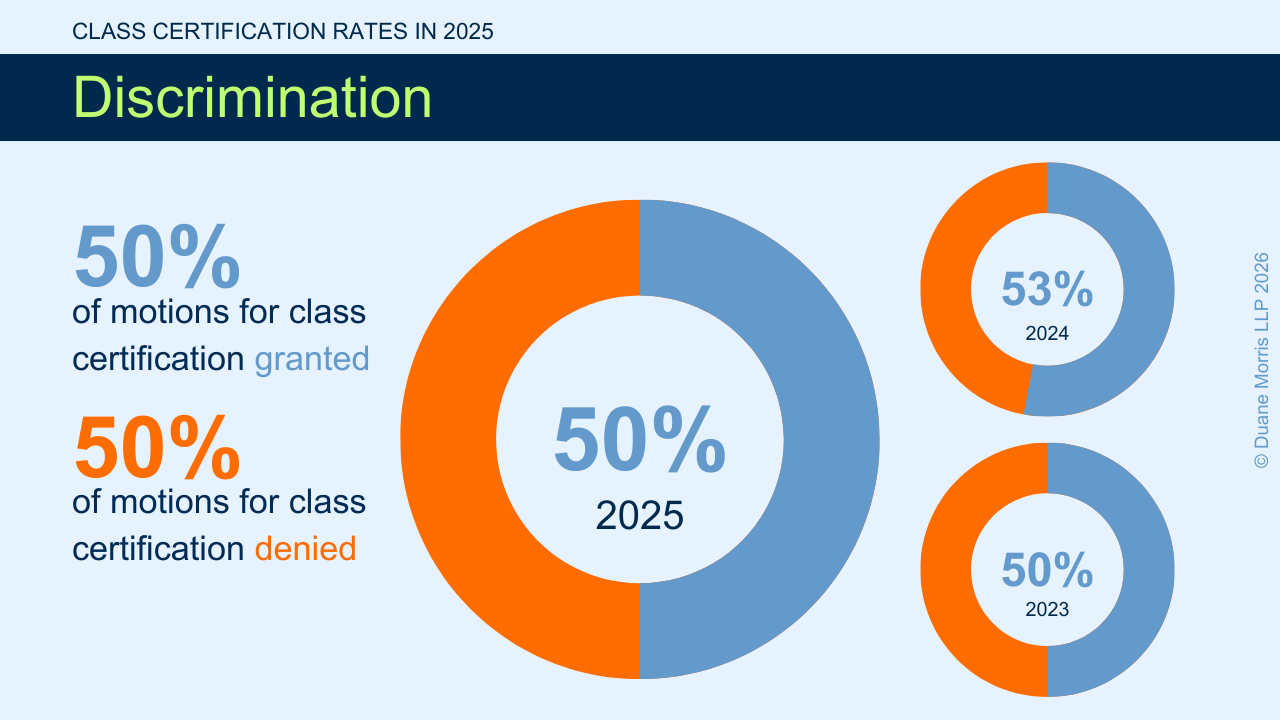
Zev: Absolutely, Jerry. So, over the past year, we’ve seen plaintiffs succeed in certifying their cases at just a slightly lower rate than before. So, in 2025, courts granted class certification 50% of the time. Which was down slightly from 53% in 2024. And even though that’s a bit lower, plaintiffs are still having considerable success in achieving certification. And really, this is a reflection of courts being more inclined to allow these cases to proceed forward, particularly in discrimination cases where there’s broader societal awareness of issues like racial inequality and gender discrimination.

Jerry: Those certification analytics are certainly interesting, somewhat of a jump ball to the extent it’s 53% versus 47%. Bernadette, what are some of the key defenses and things that courts focus on in terms of motions in these particular types of class actions?

Bernadette: Well, it’s certainly become a much more rigorous process in terms of certifying these class actions, and particularly in the wake of the Walmart v. Dukes decision, courts have been much stricter about class certification. For a class to be certified, plaintiffs need to meet the requirements of Rule 23, especially around the issue of commonality. And in discrimination cases, that often means proving that the alleged discriminatory practices or policies apply uniformly across different departments, and sometimes even across state lines. It’s not enough just to claim that one person was discriminated against. Plaintiffs need to show that this discrimination is a broader systemic issue. And if they can’t do that, defense counsel will argue that the class should not be certified.

Jerry: I know the Walmart v. Dukes ruling in 2011 really shifted the ground and the battlefield for plaintiffs and defendants, and – at least for a few years – defendants did quite well. I think we’re entering kind of a zone of Walmart 2.0, and Zev, you had mentioned that the pendulum is tending to shift back towards the plaintiffs. In your opinion, what’s really fueling that swing of the pendulum?

Zev: It’s a combination of several factors. Public opinion is certainly becoming more critical of large corporations, and social movements like Black Lives Matter and MeToo have kept workplace inequality in the spotlight. Businesses are facing not only increasing employee-friendly legislation, but also a more aggressive plaintiffs’ bar. And courts, especially in the current climate, are more inclined to acknowledge these issues, and to allow these cases to move forward, especially in the discrimination context. The heightened awareness around issues of inequality has made it harder for employers to escape accountability, and we’re seeing more court rulings that favor plaintiffs in this space.

Bernadette: But it’s not all one-sided. While plaintiffs have gained some ground, courts are still very serious about ensuring that class actions meet the rigorous standards set by Walmart v. Dukes. And the bar is high. Plaintiffs can’t simply rely on generalized statements along the lines of ‘I was harmed, and others were likely too.’ They have to provide concrete evidence that the issues they face are systemic across the class.

Jerry: Those are great takeaways and insights in terms of what’s going on in this space. As we enter 2026. What do you view as the future of discrimination-based class action litigation, and where will the plaintiff’s bar be focusing in the coming months?

Bernadette: Employers can expect to see more class actions in 2026, particularly as discrimination remains a high-profile issue. As I’ve mentioned, the public’s growing interest in workplace equality and ongoing social justice movements will continue to provide momentum for plaintiffs. And even though there are challenges in securing class certification, the plaintiff’s bar is becoming more strategic and sophisticated in their approaches, and they will certainly continue to press forward. Businesses will have to remain vigilant in defending these claims, and it’s a constantly evolving landscape.

Jerry: Well, very important for clients to comply with just fundamental HR concepts and the like to root out discrimination and stop it from escalating into a class action. I know the review also analyzed the numbers on class action settlements in this space. How did the plaintiffs do in terms of monetizing their cases in 2025?

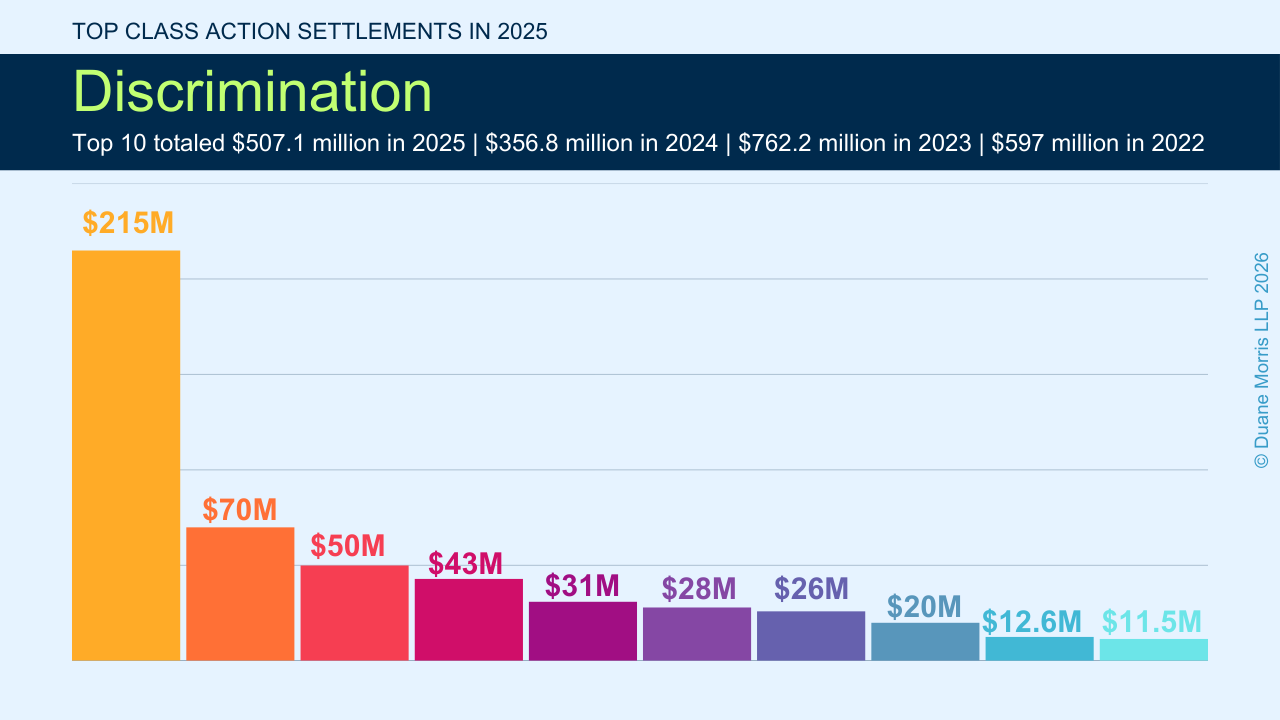
Zev: Plaintiffs did real well in securing high-dollar settlements in the past year,  2025, with the top 10 discrimination settlements totaling $507.1 million, which was significantly higher than the $356.8 million number that we saw in 2024.

Jerry: Well, here at the Duane Morris Class Action Review editorial desk, we’ll certainly be following those settlements throughout 2026 to see if the trend continues of higher and higher numbers of settlements in the discrimination class action space. Well, thank you, Bernadette, and thank you, Zev, for loaning your thought leadership in this space to us, and thank you for your contributions in this area to the Duane Morris Class Action Review.

Zev: Thanks for having me, Jerry, and thanks to all the listeners.

Bernadette: Thanks so much, everyone.

Announcing The Release Of The Duane Morris Discrimination Class Action Review – 2026!

By Gerald L. Maatman, Jr. and Jennifer A. Riley

Duane Morris Takeaways: Legal compliance to prevent discrimination is a corporate imperative. Companies and business executives operate in the court of public opinion and workplace inequality continues to grab headlines and remains forefront in the public eye. In this environment, employers can expect discrimination class actions to reach even greater heights in 2025. To that end, the class action team at Duane Morris is pleased to present the second edition of the Discrimination Class Action Review – 2026.

This publication analyzes the key discrimination-related rulings and developments in 2025 and the significant legal decisions and trends impacting discrimination class action litigation for 2026. We hope that companies and employers will benefit from this resource in their compliance with these evolving laws and standards.

Click here to bookmark or download a copy of the Discrimination Class Action Review – 2026 e-book. Look forward to an episode on the Review coming soon on the Class Action Weekly Wire!

The Fifth Circuit Green Lights Oral Consent Under The TCPA For Telemarketing Calls

By Gerald L. Maatman, Jr., Jennifer A. Riley, and Ryan T. Garippo

Duane Morris Takeaways:  On February 25, 2026, in Bradford v. Sovereign Pest Control of Texas Inc., No. 24-20379, 2026 WL 520620, at *2 (5th Cir. Feb. 25, 2026), the Fifth Circuit held that the Federal Communications Commission (the “FCC”) lacked the statutory authority under the Telephone Consumer Protection Act (the “TCPA”) to require prior express written consent for all telemarketing calls using a prerecorded voice.  This decision reverses decades of precedent requiring written consent for such calls and green lights a path to future challenges to the TCPA’s implementing regulations.

Case Background

In 2023, Radley Bradford agreed to a contract with Sovereign Pest for pest control services.  When Bradford executed that agreement, he orally provided his phone number to Sovereign Pest.  As a result, Sovereign Pest called him on that telephone number several times to schedule renewal inspections and Bradford agreed to those renewals.  By every account, it was a normal business relationship.

But there was one wrinkle.  Sovereign Pest did not call Bradford using one of its live employees.  Instead, it used a prerecorded voice.  Prerecorded voice calls always implicate the TCPA and its draconian statutory damages.  As a result, Bradford ultimately sued Sovereign Pest in a federal class action lawsuit claiming the call constituted telemarketing.  Thus, because Sovereign Pest did not have “prior express written consent” to contact him using a prerecorded voice, Bradford claimed he was entitled to damages in the amount of $1,500 per call for the 24 calls it made to him.  In other words, Bradford claimed Sovereign Pest owed him $36,000 in statutory damages and millions of dollars more to the putative class.

The only problem for Bradford was that the TCPA does not contain the term “prior express written consent.”  It only refers to “prior express consent.”  So, Bradford sought to rely on FCC regulations that have long required written consent to make telemarketing calls using a prerecorded voice.  Bradford claimed that Sovereign Pests calls constituted such telemarketing.  The district court disagreed with Bradford, granting a motion for summary judgment filed by Sovereign Pest, and held that the calls did not constitute telemarketing as a matter of law.  Bradford appealed.

The Fifth Circuit’s Ruling

Judge Jennifer Elrod, writing for the U.S. Court of Appeals for the Fifth Circuit, affirmed the judgment entered by the district court, but not for the reasons one might think.  Rather than dive into whether or not the calls constitute telemarketing, the Fifth Circuit held that the distinction was irrelevant.  It explained that although “[t]he regulation relevant to this case mostly tracks the statute” it adds an additional prohibition of “written consent for pre-recorded telemarketing calls.”  Bradford, 2026 WL 520620, at *2.  The FCC, however, did not have the authority to add that language to the statute.

In years past, courts may have deferred to the FCC’s interpretation of the TCPA.  In 2025, however, the U.S. Supreme Court unequivocally held that district courts are “not bound by the FCC’s interpretation of the TCPA” and that courts are required to interpret the text of the statute for themselves.  McLaughlin Chiropractic Assocs., Inc. v. McKesson Corp., 606 U.S. 146, 168 (2025).  Thus, because the plain language of the TCPA does not impose an additional requirement of written consent for telemarketing calls, the Fifth Circuit concluded that it was outside the scope of the FCC’s regulatory authority to require such consent.   As a result, the Fifth Circuit affirmed the judgement entered below.

Implications For Companies

The implications of Bradford cannot be understated. 

The FCC’s imposition of a bright line rule requiring written consent for prerecorded telemarketing calls is one of the hallmarks of the statute’s regulatory regime.  It is also a frequent tool used by the plaintiff’s bar to assert technical violations of the TCPA where it is clear by the context that a customer approved of such calls.  In the wake of McKesson, however, the FCC’s regulations now fall by the wayside for district courts in Louisiana, Mississippi, and Texas.  Companies operating in those states will now be able to rely on oral agreements with their customers to prove the existence of prior consent.

The Bradford decision is not alone.  Some district courts have even suggested Congress’s delegation of any authority to the FCC “may run afoul of the nondelegation doctrine, since there are no delimitations on the discretion it grants the Commission.”  McGonigle v. Pure Green Franchise Corp., No. 25-CV-61164, 2026 WL 111338, at *2 (S.D. Fla. Jan. 15, 2026).  Although Bradford does not go that far, the decision represents unmistakable pushback on the FCC’s longstanding unchecked power to interpret the TCPA.

Of course, the standards are still far from clear as the Fifth Circuit is the only federal appellate court to have endorsed this approach.  This decision continues the trend which has started to create a “patchwork” approach to the TCPA’s standards and complicates compliance for companies making calls nationwide.  Thus, corporate counsel should continue to monitor this blog to stay on top of these varying decisions and contact experienced counsel if their organizations are facing TCPA related threats as the resulting liability can be ruinous.

© 2009- Duane Morris LLP. Duane Morris is a registered service mark of Duane Morris LLP.

The opinions expressed on this blog are those of the author and are not to be construed as legal advice.

Proudly powered by WordPress