Signaling A Slowdown? EEOC’s FY 2025 Lawsuit Filings Reflect A Narrowing Of Priorities After Change In Presidential Administration

By Gerald L. Maatman, Jr., Alex W. Karasik, Jennifer A. Riley, Gregory Tsonis, and George J. Schaller

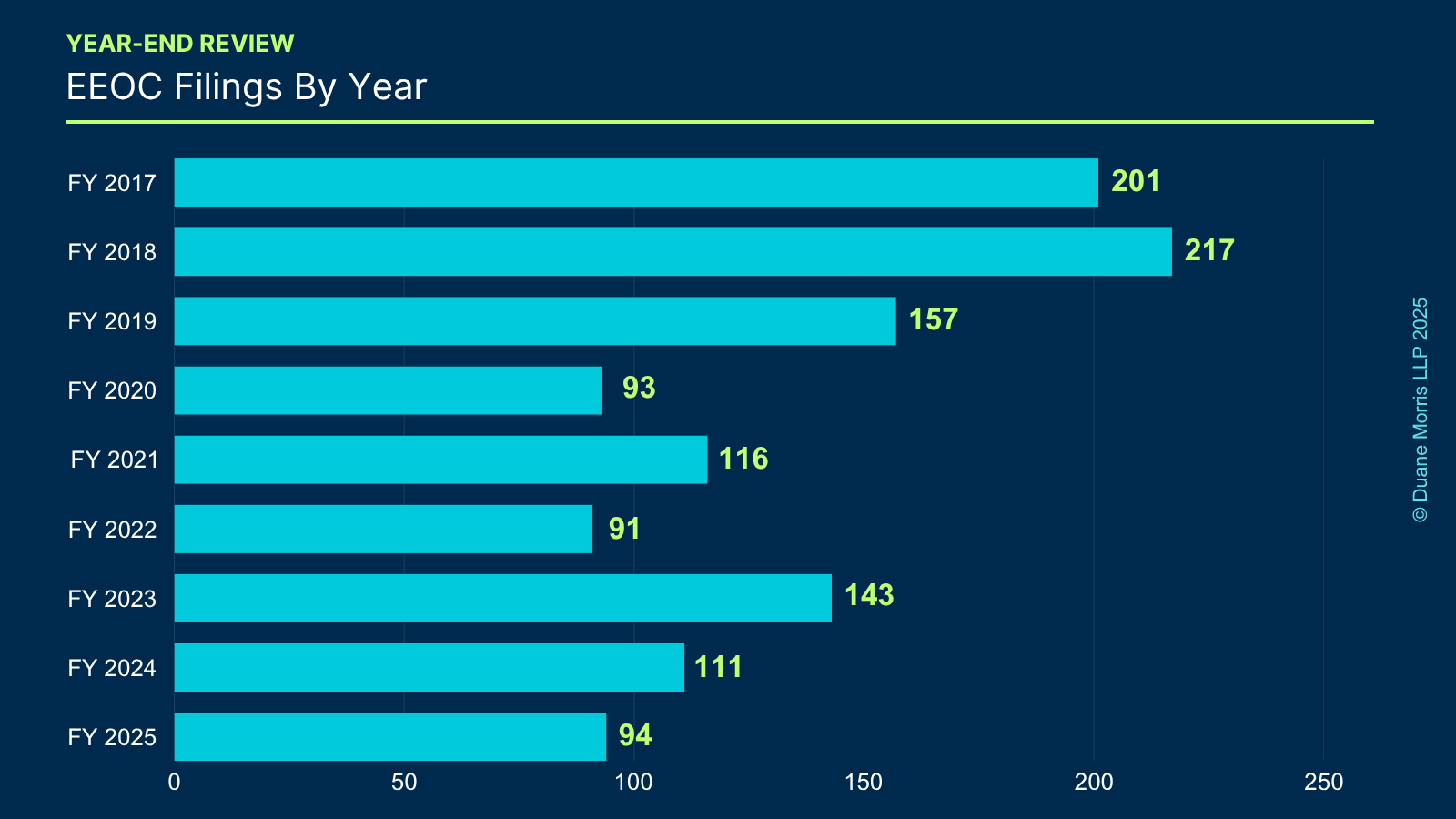
Duane Morris Takeaways:  In FY 2025 (October 1, 2024 to September 30, 2025), the EEOC’s litigation enforcement activity stalled significantly compared to previous years.  By the numbers, FY 2025 lawsuit filings ended on the lower end of the spectrum with 94 lawsuits filed compared to the height of filings in FY 2018 (217 lawsuits).  The decline in enforcement activity suggests that during President Trump’s second term in office, employers should not expect the EEOC to be as aggressive as past regimes in terms of the volume of government enforcement lawsuits, particularly in terms of systemic litigation.

Though the overall filings totals are lower than previous years, certain geographic regions, types of claims, and key industries remain prime targets of the Commission’s lawsuits.  Our analysis of these patterns is set forth below and is offered to arm employers with the EEOC’s FY 2025 litigation scorecard through an evaluation of district office enforcement activity, filings by statute and discrimination basis, and the most impacted industries. 

In sum, there is still a bevy of EEOC lawsuits being filed against businesses, but in a more localized and targeted fashion.  Employers should continue their legal compliance with all EEOC initiatives.

Lawsuit Filings Based On Month And Year

The EEOC’s fiscal year ends each year on September 30.  The final deluge of filings for EEOC-initiated litigation maintained its year-end boost in 2025.  This year, in September alone, 35 lawsuits were filed, down from September filings in FY 2024 (50 lawsuits filed) and September filings in FY 2023 (67 lawsuits filed) – but still a significant total, nonetheless.  Of the 94 total filings this year, just over one-third of EEOC lawsuits were filed in September, down from FY 2024’s last-minute filing frenzy accounting for half of that year’s filings.  The following chart shows the EEOC’s filing pattern over FY 2025:
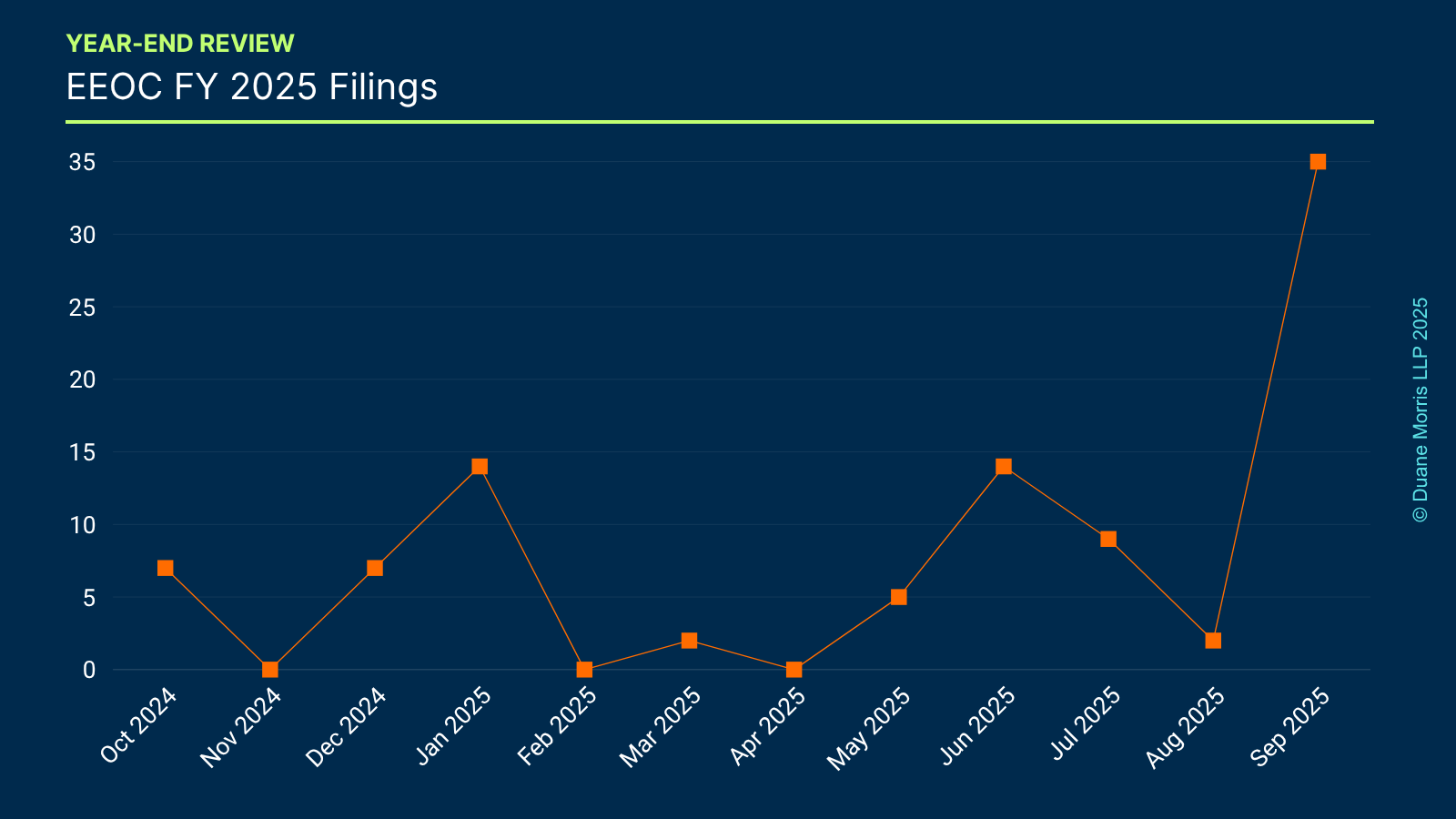
We track the EEOC’s filing efforts across the entire fiscal year with its beginning in October through the anticipated filing spree in September.  Unlike other fiscal years, the EEOC’s filing patterns were consistent in the first half of FY 2025, peaking with 14 lawsuits in January.  Filings again slowed down until Summer, where there was a resurgence of another 14 lawsuits in June 2025.  Thereafter, lawsuit filings dipped until the “eleventh hour” in September.

Comparing these filings in FY 2025 to previous years, the EEOC filed significantly less lawsuits than in FY 2024 (111) and FY 2023 (144 lawsuits), signaling a trend in decreased EEOC enforcement activity.  Though EEOC litigation filings continuously decreased compared to pre-COVID era filing metrics, the EEOC’s presence as a litigation powerhouse persists.  The following graph shows the EEOC’s year-over-year fiscal year filings beginning in FY 2017 through FY 2025:
Lawsuit Filings Based On EEOC District Offices

In addition to tracking the total number of filings, we closely monitor which of the EEOC’s 15 district offices are most actively filing new cases throughout the EEOC’s fiscal year.  Some district offices tend to be more aggressive than others.  Some focus on different case filing priorities.  The following chart shows the number of lawsuit filings by each of the EEOC district offices.
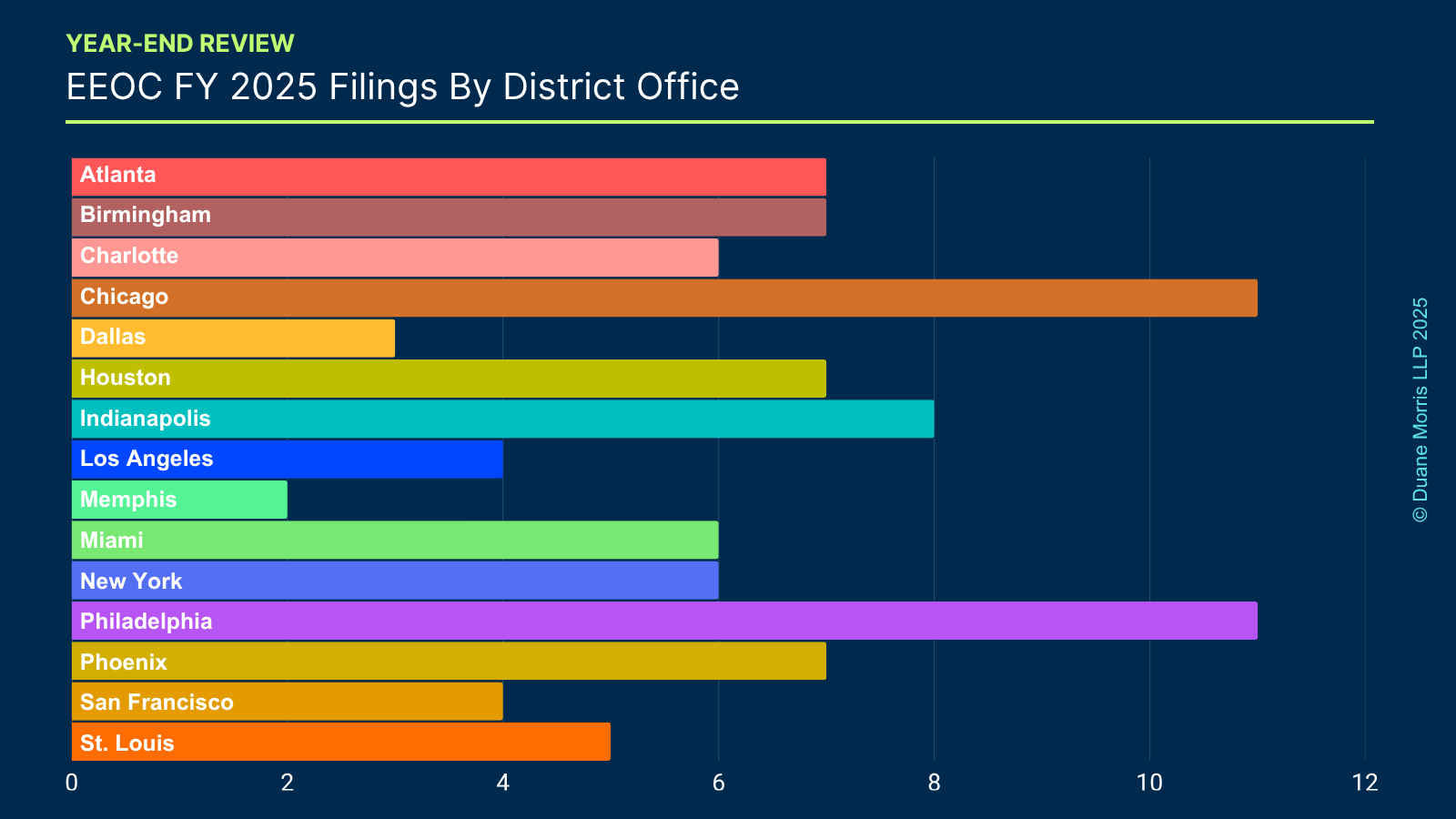
In FY 2025, Philadelphia and Chicago led the pack in filing the most lawsuits at 11 each, followed by Indianapolis with 8 filings, then Atlanta, Birmingham, Houston, and Phoenix with 7 filings, and Charlotte, New York, and Miami each with 6 filings.  St. Louis had 5 filings, Los Angeles and San Francisco had 4 filings, and Dallas had 3 filings.  Memphis had the lowest amount with only 2 filings. 

Like FY 2024, Philadelphia proved itself as a leader in EEOC enforcement filings. Chicago remained steady with 11 filings, same as FY 2024.  St. Louis (2 filings in FY 2024) and Phoenix (4 filings in FY 2024) also experienced increases in filings compared to last year.  Other offices comparatively lagged in enforcement activity, Atlanta (11 filings in FY 2024), Indianapolis (9 filings in FY 2024), and Houston (8 filings in FY 2024), showed slight decreases in enforcement activities.  Across the board filings generally evened out for each district office compared to FY 2024, but overall, filings fell.  

Although filing trends were down for all Districts, the total filings demonstrate the EEOC maintained its consistent litigation strength, across all district offices.  Employers with operations in Philadelphia and Chicago should pay extra attention to EEOC charge activity given the aggressiveness of the Commission in those regions.

(Note: Three EEOC press releases from the Washington D.C. Field Office included their lawsuit filings as part of the Philadelphia District Office statistics)

Lawsuit Filings Based On Type Of Discrimination

We also analyze the types of lawsuits the EEOC filed in terms of the statutes and theories of discrimination alleged. This enables us to determine how the EEOC is shifting its strategic priorities.

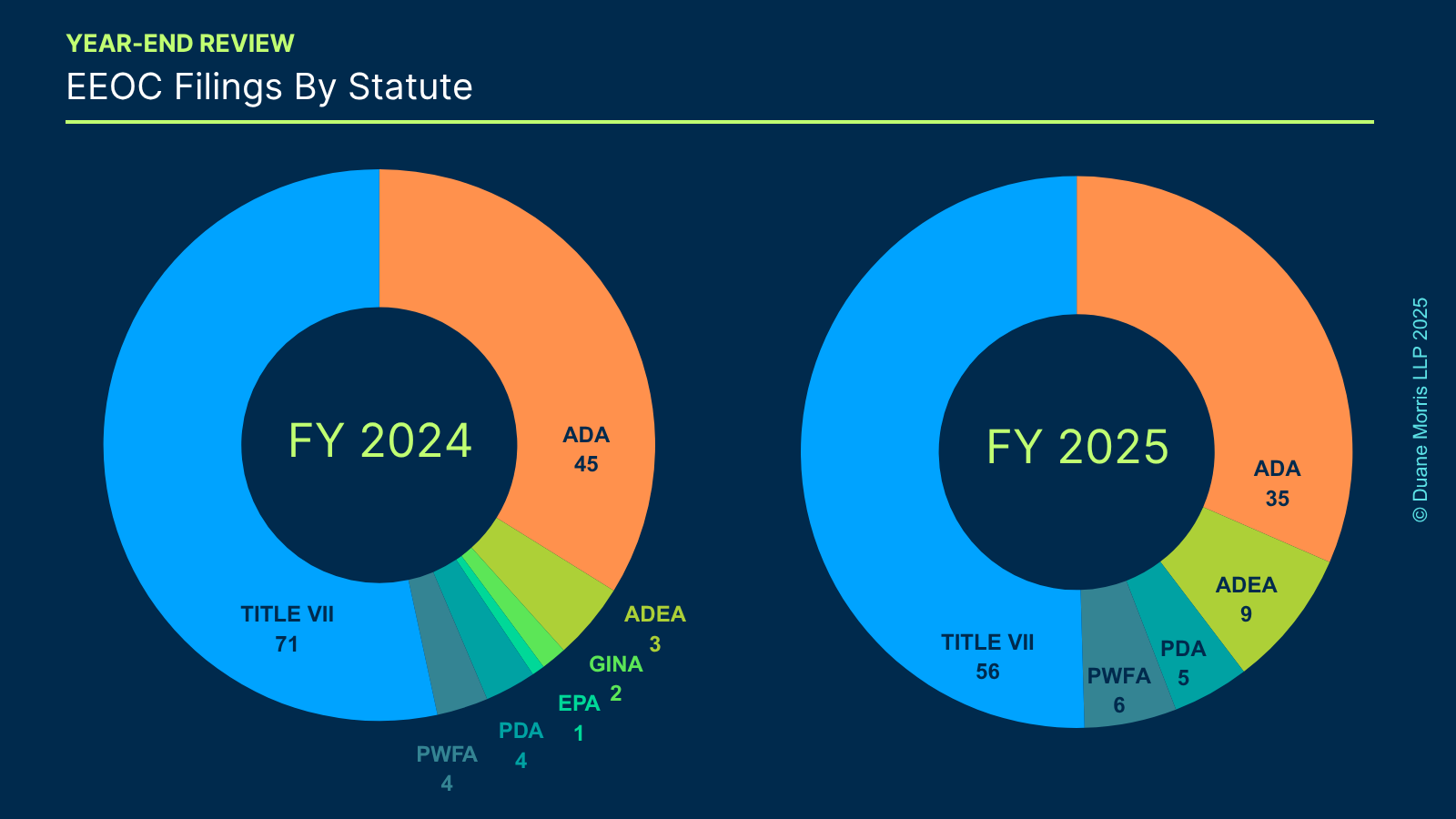
When considered on a percentage basis, the distribution of cases filed by statute skewed significantly in favor of Title VII cases when comparing FY 2025 to previous fiscal years.  Title VII cases once again made up the majority of cases filed, as they constituted 50% of all filings in FY 2025 (decreased from 58% of all filings in FY 2024, significantly down from 68% of all filings FY 2023 and 69% of filings in FY 2022, and decreased compared to 61% of all filings in FY 2021).

Overall, ADA cases also made up the next most significant percentage of the EEOC’s FY 2025 filings – totaling 31.5%.  This is an overall decrease in previous years where ADA filings amounted to 42% in FY 2025, 34% in FY 2023, and 37% in FY 2021.  Though these filings are marginally higher than FY 2022 where ADA filings on a percentage basis amounted to 29.7% of all filings.

There was also an uptick in ADEA filings, as 9 ADEA cases were filed in FY 2025, whereas 6 age discrimination cases were filed in FY 2024, after 12 age discrimination cases were filed in FY 2023 and 7 age discrimination cases were filed in FY 2022.  Like FY 2024, this year the EEOC pursued Pregnant Worker’s Fairness Act cases with 6 filings compared to FY 2024’s 3 filings.  In addition, FY 2025 had a slight increase in Pregnancy Discrimination Act cases where 5 cases were filed compared to FY 2024’s 4 filed cases.  Notably absent from FY 2025’s filing balance are cases under the Equal Pay Act and Genetic Information Nondiscrimination Act.  The following graph shows the number of lawsuits filed according to the statute under which they were filed.
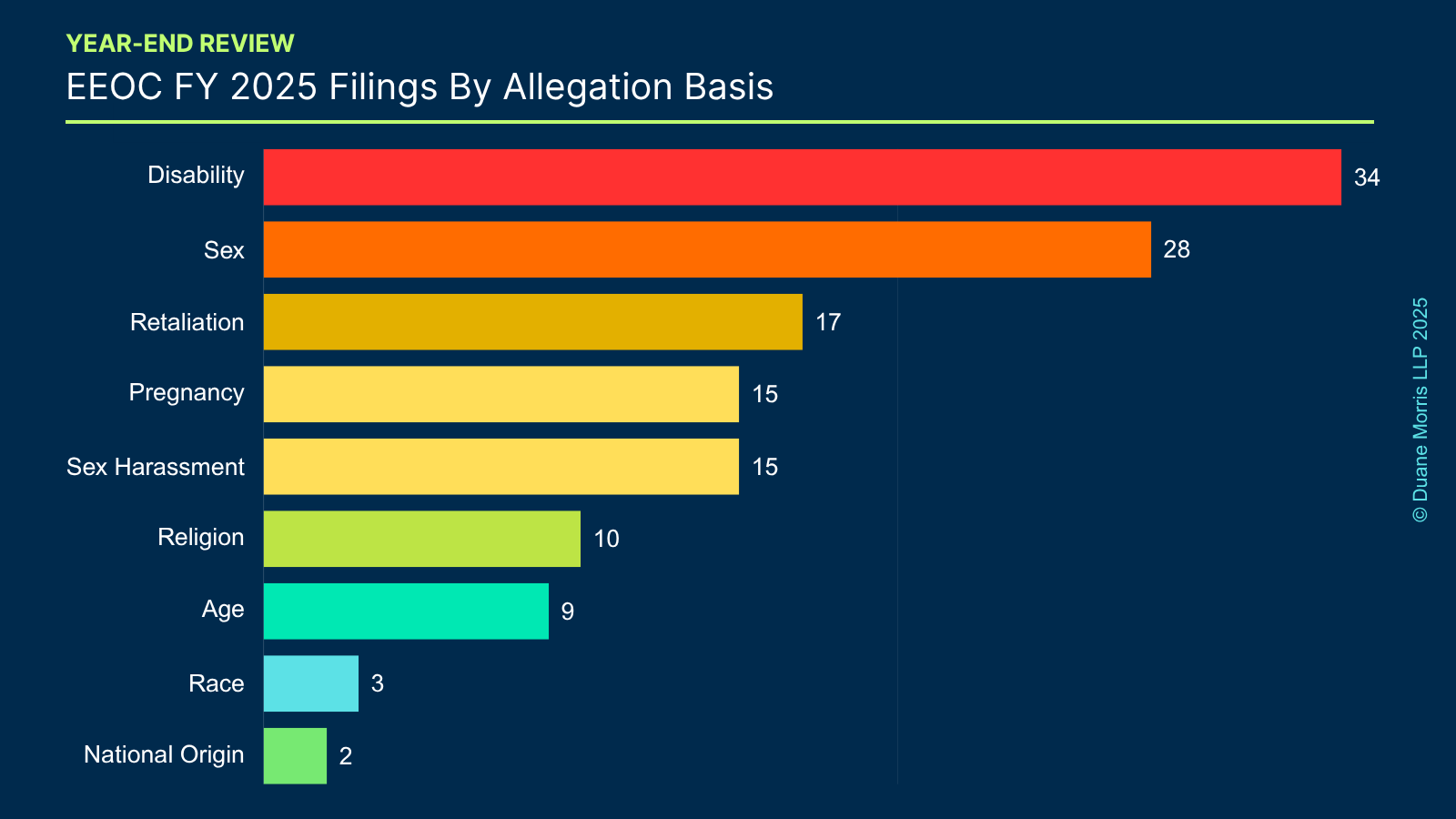
We also collect data on the allegations for which the EEOC bases its litigation filing. 

The EEOC’s basis for suit remained the same among its core tenets, with Disability, Sex, and Retaliation claims leading the way.  Collectively, these three bases were alleged in 59.4% of FY 2025 EEOC filings.  In FY 2024, those same three core tenets also took the top three spots (collectively alleged in 67.6% of FY 2024 EEOC filings). Notably, in FY 2025, only 3 Race or National Origin based lawsuits were filed by the EEOC, or 2.3% of the total lawsuit filings.  In FY 2024, 8.9% of all filings included Race claims.  The following graph shows a comparison of the filings in FY 2025 to FY 2024 for the allegation basis in filings:
Lawsuits Filings Based On Industry

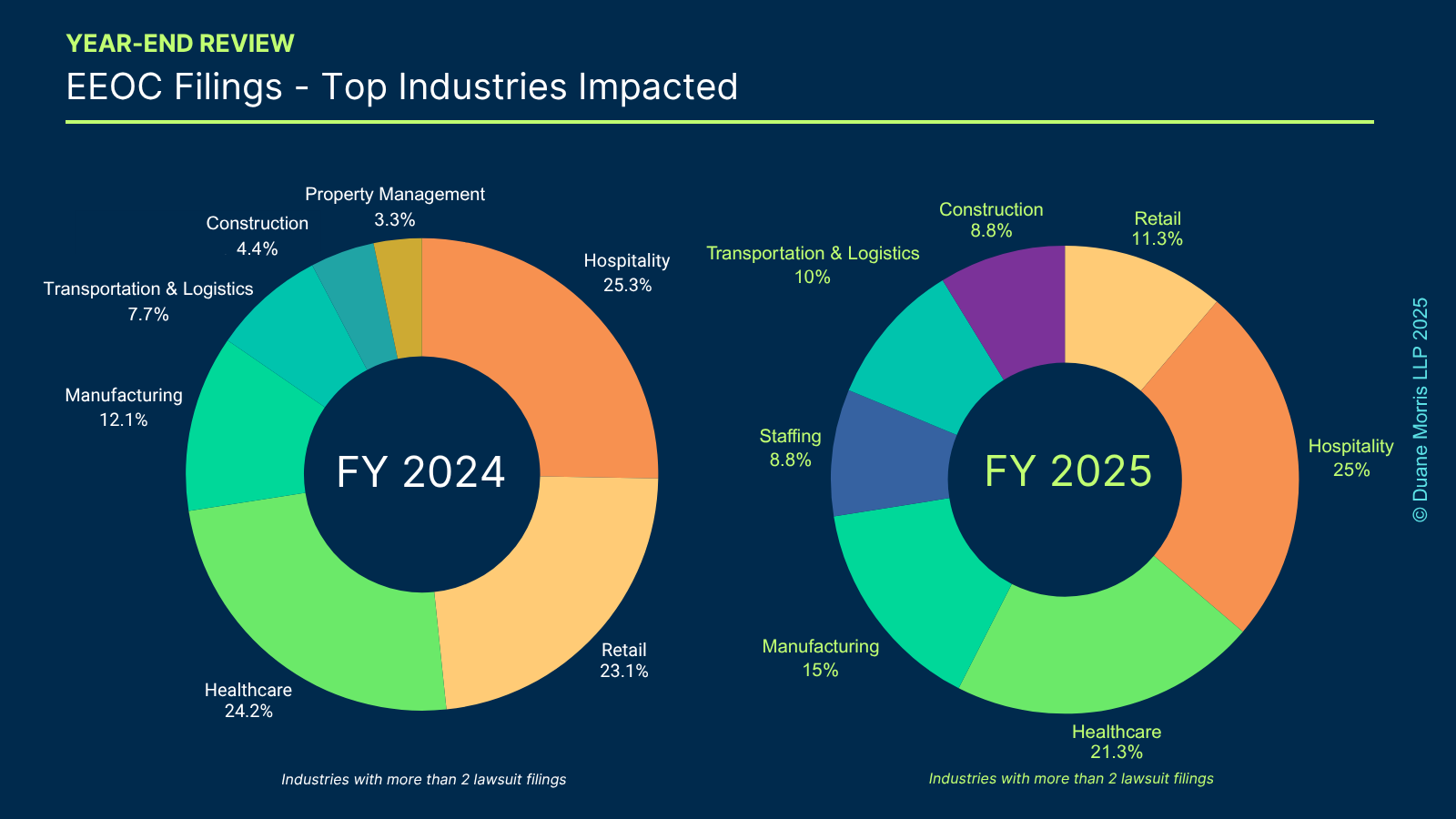
In monitoring the EEOC’s filings by industry, FY 2025 aligns with prior EEOC-initiated lawsuits in the top two industries compared to FY 2024, demonstrating the Commission’s focus on a few major industries.

In FY 2025, two industries remained in the EEOC’s targets: Hospitality and Healthcare:   On a percentage basis, Hospitality (Restaurants / Hotels / Entertainment) comprised 25% of filings, and Healthcare had 21.3% of filings.  A key difference in FY 2025 compared to FY 2024 is Manufacturing (15% of FY 2025 filings; 12.1% of FY 2024 filings) overtaking Retail (11.3% of FY 2025 filings; 23.1% of FY 2024 filings) as the next most targeted industry.  The staggering drop in enforcement actions against Retailers poses a distinct drop in enforcement actions in this industry.  Only one other industry, Transportation & Logistics, entered double digit enforcement activity (with 10%).The remaining industries in FY 2025 did not enter double-digit percentages though Staffing and Construction each experienced EEOC initiated litigation in FY 2025 (8.8%, and 8.8% of filings respectively per industry).

Unlike FY 2024, FY 2025 did not have any actions which involved Property Management industries.  Overall, the FY 2025 industry spread aligns with FY 2024, where Hospitality and Healthcare are the most heavily targeted industries.  Though Manufacturing and Retail swapped positions in enforcement priority, both still placed in the third and fourth impacted industries.  Like FY 2024, the EEOC’s FY 2025 fiscal year again did not advance any industry-based filings in the Automotive, Security, and/or Technology industries.

Like FY 2024, Hospitality and Healthcare employers should continue to monitor their compliance with federal anti-discrimination laws.  These industries are regular hotbeds for charges and ultimately lawsuits.  No matter the industry, every employer should recognize they are vulnerable to EEOC-initiated litigation as detailed by the below graph.
Looking Ahead To Fiscal Year 2026

Moving into FY 2026, the EEOC’s budget justification includes a $19.618 million decrease from FY 2025.  President Trump’s Administration prioritizes a return to the “agency’s true mission.”  The reinvigorated EEOC aims to “return to its founding principles and restore evenhanded enforcement of employment civil rights laws on behalf of all Americans.”  The EEOC’s mission is guided by the President’s pledge to “restore dignity to the American worker” and is bolstered by the President’s series of executive orders.

The FY 2026 EEOC budget justification signals a transition to “attacking all forms of race discrimination, including rooting out unlawful race discrimination arising from DEI programs, policies, and practices; protecting American workers from unlawful national origin discrimination involving preferences for foreign workers; defending women’s sex-based rights at work; and supporting religious liberty by protecting workers from religious bias and harassment and protecting their rights to religious accommodations at work.”  The Commission also intends to continue its efforts in incorporating technological advances, streamlining and improving operational processes, and refining its organizational structure to ensure efficiency and effective EEOC enforcement.

The EEOC also shifted its goals in FY 2025.  The EEOC now prioritizes three strategic goals.  First, the EEOC will combat and prevent employment discrimination through the strategic application of the EEOC’s law enforcement authorities.  In achieving this goal, the EEOC will employ broad remedial measures and exercise its enforcement authority fairly, efficiently, and based on the circumstances of the charge or complaint.  Second, the EEOC will prevent employment discrimination and advance equal employment opportunities through education and outreach.  Namely, the EEOC will increase public awareness of employment discrimination laws, and knowledge of specific rights and responsibilities under these laws, while also using its agencies to advance and resolve EEO issues.  Third, the EEOC will strive for organizational excellence through its people, practices, and technology.  In so doing, the EEOC intends to achieve a culture of accountability, inclusivity, and accessibility balanced against intake, outreach, education, enforcement, and service to the public to protect and advance civil rights in the workplace.

Key Employer Takeaways

In several respects, FY 2025 represented a change in enforcement targets and continued efforts in key discriminatory areas.  While total filings decreased, the new administration foreshadows a targeted approach in upcoming EEOC enforcement.  This is considerably true where the requested budget decrease reflects a narrower window of enforcement priorities but maintains the EEOC’s hallmark tradition of defending public civil liberties. 

Given the President’s second term is just beginning, the EEOC’s FY 2025 data should be taken with a grain of salt.  After all, it was a year of transition for the Commission.  The Commission’s FY 2025 filings suggest discrimination always stays within the purview of the EEOC’s priorities, but what constitutes “actionable” or “litigation-worthy” discrimination is wavering.  We anticipate these figures will grow by next year’s report.  Finally, given the volatility of the EEOC’s priorities, it is more crucial than ever for employers to stay abreast of EEOC developments and comply with anti-discrimination laws.

***This article is published in advance of EEOC’s FY 2025, with the data current as of 5:00 p.m. CST. Duane Morris will post the final numbers and statistics through FY 2025, by 5:00 p.m. CST on October 1, 2025.

***For more on the EEOC’s FY 2025, we invite you to attend Duane Morris’ Year-End EEOC Review Webinar on October 22, 2025.  To register for the webinar access the link here.

Florida Court Finds No Standing For “Disappointed” Consumers In Class Action Lawsuit Concerning Halloween-Themed Candies

By Gerald L. Maatman, Jr., George J. Schaller, and Andrew P. Quay

Duane Morris Takeaways:  On September 19, 2025, in Vidal, et al. v. The Hershey Co., No. 24-CV-60831, 2025 U.S. Dist. LEXIS 184308 (S.D. Fla. Sept. 19, 2025), Judge Melissa Damian of the U.S. District Court for the Southern District of Florida dismissed a class action complaint alleging violations of the Florida Deceptive and Unfair Trade Practices Act for deceptive candy packing.  The Court held the plaintiff-consumers failed to plausibly allege an economic injury, and therefore, lacked Article III standing.  Plaintiffs’ allegations that they were “disappointed” with the lack of carved designs on Halloween-themed candy and blanket assertions that they “paid a premium” was not enough to sustain an economic injury. 

The decision illustrates that conclusory statements, without an economic injury, are not enough to confer Article III standing.  Though the ruling demonstrates “spooky” claims for deceptive labeling and deceptive advertising can support a potential class action, the Plaintiffs here could not show they sustained an economic injury. 

Case Background

Plaintiffs Nathan Vidal and Eduardo Granados, on behalf of themselves and a putative class of consumers, filed a class action complaint against The Hershey Company (“Hershey”).  Plaintiffs alleged  they purchased certain decorative Reese’s products in Florida and that these products “misled” them in violation of the Florida Deceptive and Unfair Trade Practices Act.  Id. at *4

Plaintiffs asserted they would not have purchased Reese’s Peanut Butter Pumpkins and Reese’s White Pumpkins had they known that the products did not contain detailed carvings of eyes and a mouth as pictured on the packaging.  Id. at *3-4.  Plaintiffs maintained “Hershey [] deceived reasonable consumers … into believing the [p]roducts were something that they were not.”  Id. at *5.  In true Halloween horror story fashion, Plaintiffs claimed that without the carvings and designs the products were “worthless” and that they would not have purchased them.  Id. at *14. 

Hershey moved to dismiss for lack of subject-matter jurisdiction or, in the alternative, for failure to state a claim, Hersey also moved to strike Plaintiffs’ class action allegations.  Id. at *4. 

Hershey primarily argued Plaintiffs lacked standing because “they suffered no injury-in-fact.”   Id. at *6.  Hershey maintained Plaintiffs lacked standing because they only alleged an economic injury.  Hershey however contended Plaintiffs did not suffer an economic injury because they still received “delicious Reese’s candy.”  Id.  Even still, Hershey countered that most of the at-issue products, contained “DECORATING SUGGESTION” disclaimers and both carved and uncarved images.  Id. at * 7.  Hershey similarly highlighted that Plaintiffs did not allege the products were defective, inedible, did not meet taste/flavor expectations, or that they lost any economic value without the decorative carvings.  Id. at *14.

While Hershey’s motion was pending, Plaintiffs moved for class certification arguing they satisfied all the requirements under Rule 23 to certify a class of consumers who purchased any of the at-issue Reese’s products “based on a false and deceptive representation of an artistic carving” on the products packaging.  Id. at *5.

The Court’s Decision

The Court dismissed Plaintiffs’ complaint because they did not allege a concrete economic injury and therefore lacked standing to pursue their personal claims and class claims.

In dismissing Plaintiffs’ complaint, the Court reasoned the Eleventh Circuit’s analysis of standing emphasizes that “[e]conomic injuries are the ‘epitome’ of concrete injuries,” and that such an economic injury can be the “result of a deceptive or unfair practice” where an individual is “deprived of the benefit of her bargain.”  Id. at *15.  In analyzing the benefit of the bargain a plaintiff’s damages are calculated based on “the difference in the market value of the product or service in the condition in which it was delivered and its market value in the condition in which it should have been delivered according to the contract of the parties.”  Debernardis v. IQ Formulations, LLC, 942 F.3d 1076, 1084 (11th Cir. 2019) (citing Carriuolo v. Gen. Motors Co., 823 F.3d 977, 986-87 (11th Cir. 2016)). 

The Court relied on two analogous cases in considering Plaintiffs’ economic injury assertions.  The first case concerned “honey-lemon cough drops” that “soothe[] sore throats” and based on those representations the “plaintiff believed that the cough drops contained lemon ingredients and were capable of soothing bronchial passages.”  Id. at *17-18 (citing Valiente v. Publix Super Markets, Inc., 2023 U.S. Dist. LEXIS 91089 (S.D. Fla. May 24, 2023)).  The Court in Valiente held plaintiff failed to allege an economic injury because the plaintiff did not allege the cough drops were defective, did not work as advertised, or were otherwise so flawed to render them worthless.  Id.  at *18.

The second case concerned plaintiffs who alleged they “paid a premium price” for “protein-infused brownies” that contained less than the advertised protein content.  Id. at *18 (citing Melancon v. Alpha Prime Supps, LLC, 2025 U.S. Dist. LEXIS 21114 (S.D. Fla. Jan. 13, 2025).  The Court in Melancon held plaintiffs failed to allege they suffered an economic injury for the same reasons as Valiente and also failed to identify any competing products for the Court to plausibly conclude that plaintiffs suffered a concrete injury in fact.  Id.

Based on these cases, the Court agreed that “Plaintiffs here fail to allege Reese’s Products they purchased were defective or worthless.”  Id.  The Court explained “[p]ut simply, Plaintiffs do not allege that the products were unfit for consumption, did not taste as Plaintiffs expected, or otherwise were so flawed as to render them worthless.” Id. a

The Court reasoned Plaintiffs’ disappointment and conclusory allegations as to why they were deprived of the benefit of their bargain merely reflected their subjective, personal expectations of how the candies would or should have looked when unpackaged.  Id.  The Court held Plaintiffs’ failure to tie the value of the candies to their purported misrepresentation theory did not plausibly allege a concrete economic injury for purposes of Article III standing.  Id. at *19.  Further, the Court reasoned Plaintiffs made no allegations that would allow any measurement of “the difference between the value of the Reese’s Products with or without the decorative carvings.” Id. 

The Court also determined Plaintiffs’ “[c]omplaint contain[ed] nothing more than allegations of Plaintiff’s subjective belief that they paid a price premium” and these blanket allegations were not enough to allege a concrete injury.  Id. at *19-20. 

Accordingly, the Court dismissed Plaintiffs’ complaint finding “Plaintiffs lack Article III standing to assert a claim for relief” individually or on behalf of a purported class.  Id. at *20.  The Court dismissed Plaintiffs’ complaint without prejudice preserving Plaintiffs’ ability to move for leave to amend within 15 days from the date of the Court’s Order.  Id. at *23.  

Implications For Companies

Companies faced with consumer fraud class action lawsuits alleging theories of false advertising and deceptive practices related to their products must consider standing at the outset of any litigation. 

Vidal illustrates the importance of analyzing Article III standing issues in every lawsuit.  The Vidal Plaintiffs did not allege a sufficient economic injury based on their personal expectations of how Halloween-themed candies should have looked and did not allege the candies were defective, flawed, or reduced the actual value of the product.  Accordingly, the Court subjected their claims to dismissal.

Companies should not treat defective or false advertising product class action claims lightly, and if faced with such a lawsuit, Companies must consider all available defenses. 

Hospital Defeats Wiretap Adtech Class Action After Texas Federal Court Finds No Knowing Disclosure Of Protected Health Information

By Gerald L. Maatman, Jr., Justin Donoho, and Hayley Ryan

Duane Morris Takeaways: On September 22, 2025, in Sweat v. Houston Methodist Hospital, No. 24-CV-00775, 2025 U.S. Dist. LEXIS 185310 (S.D. Tex. Sept. 22, 2025), Judge Lee H. Rosenthal of the U.S. District Court for the Southern District of Texas granted a motion for summary judgment in favor of a hospital accused of violating the federal Wiretap Act through its use of website advertising technology. This decision is significant. In the wave of adtech class actions seeking millions – sometimes billions – in statutory damages under the Wiretap Act and similar statutes, the Court held that the Act’s steep penalties (up to $10,000 per violation) were not triggered because the hospital did not knowingly transmit protected health information.

Background

This case is part of a rapidly growing line of class actions alleging that website advertising tools – such as the Meta Pixel, Google Analytics, and other similar website advertising technology, or “adtech,” –secretly capture users’ web-browsing activity and share it with third-party advertising platforms.

Adtech is ubiquitous, embedded on millions of websites. Plaintiffs’ lawyers frequently invoke the federal Wiretap Act, the Video Privacy Protection Act (VPPA), state invasion-of-privacy statutes like the California Invasion of Privacy Act (CIPA), and even the Illinois Genetic Information Privacy Act (GIPA). Their theory is straightforward: multiply hundreds of thousands of website visitors by $10,000 per alleged Wiretap Act violation and the potential damages skyrocket. While some of these class actions have resulted in multi-million-dollar settlements, others have been dismissed (as we blogged about here), and the vast majority remain pending. With some district courts allowing adtech class actions to survive motions to dismiss (as we blogged about here), the plaintiffs’ bar continues to file adtech class actions at an aggressive pace.

In Sweat, the plaintiffs sued a hospital, seeking to represent a class of patients whose personal health information was allegedly disclosed by the Meta Pixel installed on the hospital’s website. The district court granted the hospital’s motion to dismiss the state law invasion of privacy claim but allowed the Wiretap Act claim to proceed to discovery. The hospital then moved for summary judgment, arguing that the Wiretap Act’s crime-tort exception did not apply because the hospital lacked knowledge that it was disclosing protected health information.

Under the Wiretap Act, “party to the communication” cannot be sued unless it intercepted the communication “for the purpose of committing any criminal or tortious act.” 18 U.S.C. § 2511(2)(d). This provision is commonly called the “crime-tort exception.” The plaintiffs pointed to alleged violations of the Health Insurance Portability and Accountability Act (HIPAA) as the predicate crime to trigger this exception.

The Court’s Decision

The Court agreed with the hospital and granted summary judgment, holding that the record contained no evidence that the hospital acted with the “purpose of committing any criminal or tortious act” that would trigger the crime-tort exception. 2025 U.S. Dist. LEXIS 185310, at *13.

As the Court explained, case law authorities have developed two different approaches to determine “purpose” under the crime-tort exception. Some courts use the “independent act” approach, under which the unlawful act must be independent of the interception itself. Other courts have used the “primary purpose” approach, under which the defendant’s primary motivation must be to commit a crime or tort.

Applying the “primary purpose” approach, the Court found “no evidence that [the hospital] acted with the purpose of violating HIPAA…the evidence shows that it did not know it was doing so.” Id. at *13. In so holding, the Court cited to the fact that, although the Pixel was installed on “arguably sensitive portions” of the hospital’s website, the hospital received only aggregated, anonymized data, and there was no proof it knew any protected health information was being disclosed. Id. at *13-14. The Court rejected the plaintiffs’ argument that anonymized aggregate data necessarily originates from identifiable data, emphasizing that Meta’s algorithm could anonymize data “at the input level,” preventing the hospital from receiving identifiable data in the first place. Id. at *16.

Implications For Companies

The Court’s holding in Sweat is a significant win for healthcare providers and other defendants facing adtech class actions. This ruling reinforces two key principles. First, knowledge is critical. Like the Wiretap Act’s HIPAA-based crime-tort exception, similar statutes such as the VPPA require a knowing disclosure of identifiable information. If a defendant lacks knowledge that data is tied to specific individuals, liability should not attach. Second, anonymization matters. Where transmissions are encrypted, anonymized, or otherwise inaccessible at the point of input, there may be no “disclosure” at all.

For example, the VPPA requires disclosure of a person’s specific video-viewing activity, and GIPA requires disclosure of an identified individual’s genetic information. When adtech merely sends anonymized or encrypted data to third-party algorithms—data that cannot be traced back to a specific person—there is no knowing disclosure.

Sweat provides strong authority for defendants to argue that anonymized adtech transmissions cannot satisfy the statutory knowledge requirements of the Wiretap Act’s HIPAA-based crime-tort exception or similarly worded privacy statutes.

The Class Action Weekly Wire – Episode 120: Florida Federal Court Approves $20 Million Settlement In Data Breach MDL

Duane Morris Takeaway: This week’s episode of the Class Action Weekly Wire features Duane Morris partner Jerry Maatman and associate Ryan Garippo and Andrew Quay with their discussion of a major settlement in the data breach class action space.  

Check out today’s episode and subscribe to our show from your preferred podcast platform: Spotify, Amazon Music, Apple Podcasts, Samsung Podcasts, Podcast Index, Tune In, Listen Notes, iHeartRadio, Deezer, and YouTube.

Episode Transcript

Jerry Maatman: Thank you, loyal blog readers, for being here again for our next episode of our podcast series entitled the Class Action Weekly Wire. I’m Jerry Maatman, a partner with Duane Morris, and joining me today are my colleagues Ryan Garippo and Andrew Quay. Thanks for being here.

Ryan Garippo: Thanks for having me, Jerry. Great to be here.

Andrew Quay: Glad to be here. Thanks, Jerry.

Jerry: Today, we’re going to dive into a ruling granting final settlement approval in litigation entitled In Re Fortra File Transfer Software Data Breach Security Litigation – certainly a mouthful. Ryan, can you give our podcast listeners some background on what this litigation was all about?

Ryan: Yeah, of course, Jerry. This case is one that stems from a massive data breach that occurred a couple years ago, back in January of 2023, linked to the Clop ransomware group, which is a Russian-based operation. They exploited a zero-day vulnerability in Fortra’s GoAnywhere MFT software, which a lot of health and financial institutions use to securely transfer files. As a result, the hackers allegedly used that vulnerability to access and steal the personal health information of at least 5 million people.

Jerry: Were there any organizations that were impacted, or strictly just individuals?

Andrew: There were. The breach also affected about 130 organizations, including big names like Aetna, Community Health Systems, and NationsBenefits, all of which ended up as defendants in the resulting lawsuits.

Jerry: So, for our listeners, this case ended up then in a multidistrict litigation proceeding venued in the U.S. District Court for the Southern District of Florida, is that right?

Ryan: Yeah, that’s right, Jerry. It’s common practice in these data breach cases where, several dozen lawsuits are filed across the country, at least here, two dozen were filed, and they ultimately get consolidated into a multidistrict litigation, which here was in February of 2024, before Judge Rodolfo Ruiz. Plaintiffs’ consolidated complaints allege that the defendants failed to adequately protect their private health information of the plaintiffs and the settlement class from the unauthorized access. They also assert multiple counts of common law and statutory violations, all of which seek relief coming from the same events.

Andrew: And to follow up with Ryan, after the parties settled the claims, Judge Ruiz just issued final approval of a $20 million global settlement, which followed a separate $7 million settlement that was reached earlier in the year with a subclass of plaintiffs who sued another big defendant, Brightline.

Jerry: Let’s talk a little bit about specifics and drill down. What was exactly encompassed within the $20 million settlement?

Ryan: Well, the settlement is a $20 million cash fund to cover class member benefits, attorneys’ fees, and administration costs. However, each member can choose between up to $5,000 in documented losses, or a flat $85 cash payment.

Jerry: What about non-monetary benefits? I understand that those can be determinative in data breach class action settlements.

Andrew: There’s the option for dark web monitoring, except for the Brightline subclass, as those class members had already elected credit monitoring under the earlier settlement. However, the settlement does not constitute any admission of fault or liability by the defendants. That’s standard language in these types of agreements, but it’s worth noting that the court also emphasized this was not a ruling on the validity of the claims or the defenses.

Jerry: What did the judge do with respect to the plaintiffs’ petition for an award of attorney’s fees and costs?

Ryan: Well, the plaintiffs’ attorneys, of course, needed their fees, and he awarded up to 33% of the $20 million, which comes out to $6.67 million for the class counsel. There was also $263,800 in litigation costs separately, so about $2.3 million in attorneys’ fees for the Brightline subclass counsel as well.

Andrew: And just to highlight this, following the settlement several defendants, including Fortra, NationsBenefits, Intellihartx, Imagine360, and Community Health Systems have provided attestations confirming they’ve enhanced their cybersecurity to prevent future breaches.

Jerry: We’ve seen several large and significant class action settlements in the data breach space so far in 2025, including a ruling granting preliminary settlement approval to a $177 million settlement in In Re AT&T Inc. Customer Data Security Breach Litigation. When you measure that against what occurred in Florida, what do you think with respect to the terms being fair, adequate, and reasonable to the settlement class here?

Ryan: Well, the court stated that “despite the risks involved with further litigation, the Settlement provides outstanding benefits, including Cash Payments, Dark Web Monitoring, injunctive relief, for all Settlement Class Members.” in which we just discussed. In light of those factors, the court found the settlement to be “fair, reasonable, and adequate,” and there were no objections filed, which, for a class of this size, is fairly significant. So, it usually means that the settlement terms were both well-structured and negotiated.

Jerry: So, at a 100,000-foot level, what would be the takeaways for corporate counsel with respect to this litigation?

Andrew: Well, it’s highly important for companies to monitor any vulnerabilities and proactively invest in cybersecurity. These attacks can happen fast and get more sophisticated by the day. And for companies holding sensitive data – particularly health data – regulators, plaintiffs’ attorneys, and courts are all watching, so make sure that you are in compliance and engaging in best practice cybersecurity measures.

Jerry: Well, thanks, Ryan and Andrew. These are great insights, and listeners, thanks for joining us today, and appreciate my colleagues breaking down this settlement and what it means for corporate counsel. So please, listeners, join us for future episodes of the Class Action Weekly Wire, and subscribe to stay updated to the latest trends in class action litigation.

Ryan: Thanks for having me on the podcast, Jerry, and as always, thanks to the listeners for joining us.

Andrew: Thanks, everyone.

What The Click?:  Third Circuit Finds No Standing For Class Complaining Of Website Operator Monitoring Clicks 

By Gerald L. Maatman, Jr., Anna Sheridan, and Shannon Noelle

Duane Morris Takeaways: On August 7, 2025, in an opinion authored by Circuit Judge D. Michael Fisher, the United States Court of Appeals for the Third Circuit issued a precedential decision in Cook v. GameStop, Inc., 148 F.4th 153 (3d Cir. 2025), affirming the U.S. District Court for the Western District of Pennsylvania’s dismissal for lack of standing of a putative class action asserting privacy causes of action against a website operator monitoring clicks.  The Third Circuit found that merely tracking internet users’ browsing time and website interactions — without recording or disclosing sensitive or personal information — fails to constitute the type of concrete injury required to confer Article III standing.  The decision is instructive for corporate counsel dealing with privacy issues and defense of class action litigation.

Case Background

Plaintiff Amber Cook (“Cook” or “Plaintiff”) was an internet user that visited GameStop’s website in Pennsylvania.  See Cook, 148 F.4th 153, 156.  Through third-party vendor Microsoft and its programming script called Clarity, GameStop was tracking internet user’s browsing history and interaction with its website.  Id.  The script Clarity creates is known as a “session replay code” that aggregates data about how long the user browsed the website, mouse movement, links clicked, scrolling, search bar entries, and products added and removed from the “cart.”   Id.  The script creates a unique id and profile for each user and recaptures each user’s session through a video which GameStop could review to improve functionality and user experience.  Id.  The unique ids and profiles do not utilize personally identifying information such as names, addresses, and the like.  Id. at 160.  GameStop’s website has a privacy policy describing the script and information collected but this policy is “buried at the very bottom of the website.”   Id. at 156.

Cook sued GameStop for its use of the Clarity script, alleging that it violated the Pennsylvania Wiretapping and Electronic Surveillance Control Act (“WESCA”) and asserting a common law cause of action for intrusion upon seclusion.  Cook alleged that the WESCA and privacy tort for intrusion upon seclusion prohibit the interception of electronic communications without prior consent and she suffered an injury in fact “‘‘when her communications with . . . GameStop’s website were intercepted’ by the session replay code.”   GameStop moved to dismiss the First Amended Complaint at the District Court level pursuant to Federal Rule of Civil Procedure 12(b)(6) and 12(b)(1).  See Case No. 2:22-CV-01292, ECF No. 25-27.  The District Court granted GameStop’s motion under Rule 12(b)(1) with prejudice and, in the alternative, held that Cook failed to “plead the necessary facts to support her claims for violation of [WESCA] or intrusion upon seclusion.”  See Case No. 2:22-CV-01292, ECF No. 45-46.  Specifically, the District Court concluded that Cook’s harms were not analogous to the traditional intangible harms recognized by privacy torts because none of the data gathered “could connect her browsing activity to her.”   See Case No. 2:22-cCV01292, ECF No. 46, at 8 (emphasis in the original).  Cook appealed the District Court’s decision on standing to the Third Circuit.

The Third Circuit’s Ruling

Reviewing whether Cook’s allegations met the Article III standing threshold de novo, the Third Circuit determined that the appeal concerned only the first element of the analysis, or whether Cook had sufficiently alleged an injury in fact (as opposed to the other requirements of traceability and redressability).  The Third Circuit adopted the standard articulated in Barclift and Transunion that — to determine whether a plaintiff has suffered a concrete injury — the framework is whether the harm asserted bears a “close relationship to a harm traditionally recognized as providing a basis for a lawsuit in American courts — such as physical harm, monetary harm, or various intangible harms including . . . reputational harm.”  Id. at 158 (citing Barclift v. Keystone Credit Servs., LLC, 93 F.4th 136, 141, 145 (3d Cir. 2024); TransUnion LLC v. Ramirez, 594 U.S. 413, 417 (2021)). 

The Third Circuit clarified that it would not take as “rigid” of an approach as other federal circuits but that it would consider the privacy torts that Cook identified of disclosure of private information and intrusion upon seclusion to determine if the harm she alleges is “the kind of harm caused by the comparator tort[s].”   The Third Circuit found that she failed to identify sufficiently concrete harms under either analogy.

  1. Tracking Information That Is Not Personal Or Sensitive Nor Disclosed Publicly Not Sufficient To Allege Concrete Injury

With regard to the disclosure of private information analogy, the Third Circuit found that the information captured by the session replay code — recording clicks, mouse hovers, and search bar searches — was neither sensitive or personal.  In support of this conclusion, the Third Circuit reasoned that the disclosure of such information cannot plausibly be said to result in embarrassment or humiliation.  Cook did not share her name, contact information, address, or billing information while on GameStop’s website.  Further, though Cook alleged that GameStop obtained information about her device and browser and created a unique ID and profile for her to capture the session replay information, she did not allege that GameStop identified her through this information.  Id. at 160.  Cook alleged only that if a user “eventually identifies themselves” then GameStop could “back-reference all of that user’s other web browsing.”   Id.  The Third Circuit found these allegations were too hypothetical to meet Article III’s injury-in-fact requirement.

Going one step further, the Third Circuit found that “even assuming the information was the type that could cause Cook humiliation under ‘public scrutiny,’” Cook did not allege that the information was ever publicized or disclosed publicly.  Id.  Cook alleged only that the information was disclosed to third-party vendor Microsoft, “not the broader public.”  Id. 

As the information collected was not personal or sensitive, the Third Circuit also rejected Cook’s intrusion upon seclusion analogy.  As an additional basis for rejecting this tort analogy, the Third Circuit acknowledged that “[m]ost of us understand that what we do on the Internet is not completely private.”   Id. (citation omitted). 

  1. The WESCA Does Not Provide A Statutory Avenue For Circumventing The Injury-In-Fact Requirement For Standing

The Third Circuit next considered and rejected Cook’s argument that the WESCA provides a separate avenue to circumvent Article III’s injury-in-fact requirement.  In making this argument, Cook relied on language in the TransUnion decision that the legislature can “‘elevate harms that exist in the real world’ to make them legally actionable” and went on to claim the WESCA did just that in protecting a “wider range of information” from collection during electronic communications.  The Third Circuit disagreed with this logic and reading of the TransUnion decision, determining that the theory “contradicts the fundamental holding of TransUnion” which instructs courts to consider the concrete harm actually alleged by the Plaintiff rather than the “harm the statutory cause of action typically protects against.”   Id.at 161 (emphasis added).  The Third Circuit analyzed that a statutory violation of the WESCA for tracking web browsing information does not dispense with the Article III standing inquiry and Cook was still required to articulate a harm existing in the “real world” under TransUnion, as legislatures cannot “transform something that is not remotely harmful into something that is.”  Id. 

  1. Precedent In Which Website Operators Affirmatively Represented They Would Not Track Information Are Not Controlling

The Third Circuit further opined that the Nickelodeon and Google II decisions — which Cook cited in favor of her argument that tracking internet browsing history has been found to constitute a concrete harm — were not controlling.  The Third Circuit explained that Nickelodean involved claims that a website operator was collecting minors’ personal information despite affirmatively representing that it would not do so.  Id. at 162 (citing In Re Nickelodeon Consumer Priv. Litig., 827 F.3d 262, 269 (3d Cir. 2016)).  And, similarly, Google II involved allegations that Google bypassed browser privacy settings through the use of browser cookies to track user information.  Id. (citing In Re Google Inc. Cookie Placement Consumer Priv. Litig., 934 F.3d 316, 321 (3d Cir. 2019) (Google II)).  The Third Circuit found that both were instances of affirmative “promises not to” collect information that the website operator collected in any event.  Id.  Here, by contrast, Cook failed to identify an affirmative representation on the part of GameStop to refrain from tracking user browsing and website usage information.

  1. Current Status of GameStop Action

A mandate was issued on September 12, 2025 transferring the action back to the jurisdiction of the District Court, where the matter is still pending.

Implications for Website Operators Tracking Browsing History and Use:

The Third Circuit has provided a helpful roadmap for website operators — at least in this jurisdiction — that merely tracking clicks and interaction with a website is insufficient to confer standing in federal court to potential plaintiffs challenging such tracking.  It is critical that the tracking at issue in GameStop, however, did not collect personal or sensitive information nor disclose the same.  GameStop also did not affirmatively represent that it would not track website use and interaction.  Website operators would be well-advised to review any website tracking using this rubric and to seek legal advice in the event of doubt or ambiguity. 

You’re Invited: Year-End Review Of EEOC Strategy And Litigation Review Webinar

By Gerald L. Maatman, Jr., Jennifer A. Riley, and Alex Karasik And Gregory Tsonis

Mark your calendars for our bi-annual program analyzing the latest EEOC developments: Wednesday, October 22, 2025 from 11:00 a.m. to 11:30 a.m. Central. Reserve your virtual seat for the program here.

Join Duane Morris partners Gerald L. Maatman, Jr.Jennifer A. RileyAlex W. Karasik and Gregory Tsonis for a live panel discussion analyzing the latest impact of the dramatic changes at the U.S. Equal Employment Opportunity Commission, including its new strategic priorities and the EEOC lawsuits filed throughout fiscal year 2025. In its annual performance report for FY 2024, the agency touted a record $700 million in monetary recoveries for workers through litigation and administrative avenues. Heading into FY 2026 with significant changes implemented by the Trump administration, employers’ compliance with federal workplace laws and agency guidance remains a corporate imperative. Our virtual program will empower corporate counsel, human resource professionals and business leaders with key insights into the EEOC’s latest enforcement initiatives and provide strategies designed to minimize the risk of drawing the agency’s scrutiny.

Presenters

Gerald L. Maatman Jr.

Jennifer A. Riley

Alex W. Karasik

Gregory Tsonis

Second Circuit Rejects Former Employees’ Attempt To Seek Review Of Arbitral Fees Dispute

By Gerald L. Maatman, Jr., Andrew Quay, and Eden Anderson

Duane Morris Takeaways:  A Second Circuit panel of Judges Gerard Lynch, Michael Park, and Beth Robinson reversed the Southern District of New York in Frazier v. X Corp., Case No. 24-1948 (2d Cir. Sept. 2, 2025), holding that X’s (formerly Twitter) refusal to pay ongoing arbitral fees did not amount to a “failure, neglect, or refusal … to arbitrate” that the district court was empowered to remedy under the Federal Arbitration Act (“FAA”).  The Second Circuit explained that under 9 U.S.C. § 4, district courts may only address a narrow category of disputes limited to whether arbitration must occur between particular parties over particular issues.  The decision follows related precedent set by the Third, Fifth, Ninth, and Eleventh Circuits and makes clear that a party’s decision not to abide by the procedural determinations of an arbitrator or arbitral body does not empower a district court to intervene and review.

The decision is an important primer for corporate counsel in handling disputes over ongoing arbitral proceedings.

Case Background

Plaintiff-Petitioners, seven former employees of Twitter, signed arbitration agreements committing them to resolve any employment-related disputes in binding individual arbitration.  The employees filed arbitration demands following their termination, believing that they had been denied severance and had been illegally discriminated against, among other claims.  After making certain payments of arbitral fees, Twitter asserted that the arbitration agreements required that the fees be apportioned equally between it and the former employees.  The agreements called for a pro-rata split of arbitral fees but incorporate by reference Judicial Arbitration and Mediation Services’ (“JAMS”) rules and policies, which required Twitter to pay all but the case initiation fees.  The employees sued to compel arbitration under 9 U.S.C. § 4, arguing that by refusing to pay the fees allocated to it by the arbitral body, Twitter was “refus[ing] to arbitrate” in accordance with the arbitration agreements.

At issue before the Second Circuit was whether Twitter’s refusal to pay ongoing arbitral fees constituted an outright refusal to arbitrate that the district court was empowered to remedy under 9 U.S.C. § 4.  The former employees took the position that by incorporating the arbitral body’s rules in the arbitration agreements, Twitter agreed to be bound by the arbitral body’s initial determination that Twitter was responsible for the disputed fees.  Therefore, the former employees argued, the district court could compel Twitter to pay the disputed fees under 9 U.S.C. § 4.

The Decision

The Second Circuit rejected the former employees’ argument.

It held that a party’s decision not to abide by the procedural determinations of an arbitrator or arbitral body is an intra-arbitration delinquency that arbitral bodies are empowered to manage.  Therefore, the former employees could not use 9 U.S.C. § 4 as a vehicle to seek judicial review of the arbitral body’s decision not to proceed with the arbitration process.

Implications Of The Decision

The Frazier decision marks another federal circuit keeping the courts out of disputes in ongoing arbitral proceedings over a party’s payment of fees or compliance with arbitral policies. Corporate counsel must consider the limited scope of permitted review under 9 U.S.C. § 4 when facing disputes in ongoing arbitral proceedings, whether over payment of fees or otherwise.

California Adopts New Rules Expanding The FEHA’s Reach To AI Tool Developers

By Gerald L. Maatman, Jr., Justin Donoho, and George J. Schaller

Duane Morris Takeaways: On October 1, 2025, California’s “Employment Regulations Regarding Automated-Decision Systems” will take effect.  These new AI employment regulations can be accessed here.  The regulations add an “agency” theory under the California Fair Employment and Housing Act (FEHA) and formalize this theory’s applicability to AI tool developers and companies employing AI tools that facilitate human decision making for recruitment, hiring, and promotion of job applicants and employees.  With California’s inclusion of a private right of action under the FEHA, these new AI employment regulations may augur an uptick in AI employment tool class actions brought under the FEHA.  This blog post identifies key provisions of this new law and steps employers and AI tool developers can take to mitigate FEHA class action risk.

Background 

In the widely-watched class action captioned Mobley v. Workday, No. 23-CV-770 (N.D. Cal.), the plaintiff alleges that an AI tool developer’s algorithm-based screening tools discriminated against job applicants on the basis of race, age, and disability in violation of Title VII of the Civil Rights Act of 1964 (“Title VII”), the Age Discrimination in Employment Act of 1967 (“ADEA”), the Americans with Disabilities Act Amendments Act of 2008 (“ADA”), and California’s FEHA.  Last year the U.S. District Court for the Northern District of California denied dismissal of the Title VII, ADEA, and ADA disparate impact claims on the theory that the developer of the algorithm was plausibly alleged to be the employer’s agent, and dismissed the FEHA claim which was brought only under the then-available theory of intentional aiding and abetting (as we previously blogged about here).

In recent years, discrimination stemming from AI employment tools has been addressed by other state and local statutes, including Colorado’s AI Act (CAIA) setting forth developers’ and deployers’ “duty to avoid algorithmic discrimination,” New York City’s law regarding the use of automated employment decision tools, the Illinois AI Video Interview Act, and the 2024 amendment to the Illinois Human Rights Act (IHRA) to regulate the use of AI, with only the last of these laws providing for a private right of action (once it becomes effective January 1, 2026).

Key Provisions Of California’s AI Employment Regulations

California’s AI employment regulations amend and clarify how the FEHA applies to AI employment tools, thus constituting a new development in case theories available to class action plaintiffs regarding alleged harms stemming from AI systems and algorithmic discrimination.  

Employers and AI employment tool developers should take note of key provisions codified by California’s new AI employment regulations, as follows:

  • Agency theory.  An “agency” theory is added under the FEHA like the one that allowed the plaintiff in Mobley v. Workday to proceed past a motion to dismiss on his federal claims, whereby an AI tool developer may face litigation risk for developing algorithms that result in a disparate impact when the tool is used by an employer.  While Mobley v. Workday continues to proceed in the trial court, no appellate authority has yet had occasion to address the “agency” theories being litigated in that case under federal antidiscrimination statutes.  However, with the California AI employment regulations taking effect October 1, 2025, that theory is now expressly codified under the FEHA.  2 Cal. Code Regs § 11008(a).
  • Proxies for discrimination.  The regulations clarify that it is unlawful to use an employment tool algorithm that discriminates by using a “proxy,” which the regulations define as a “characteristic or category closely correlated with a basis protected by the Act.”  Id. §§ 11008(a), 11009(f).  While the regulations do not explicitly identify any proxies, proxies that have been identified in literature by the EEOC’s former Chief Analyst include zip code (this proxy is also codified in the IHRA), first name, alma mater, credit history, and participation in hobbies or extracurricular activities.
  • Anti-bias testing.  The regulations state that relevant to a claim of employment discrimination or an available defense are “anti-bias testing or similar proactive efforts to avoid unlawful discrimination, including the quality, efficacy, recency, and scope of such efforts, the results of such testing or other effort, and the response to the results.”  Id. § 11020(b).  Thus, for example, adoption of the NIST’s AI risk management framework, itself codified as a defense under the CAIA, could be a factor to consider as a defense under the FEHA.  Many other factors are pertinent with respect to anti-bias testing, including auditing, tuning, and the use of various interpretability methods and fairness metrics, discussed in our prior blog entry and article on this subject (here).
  • Data retention.  The regulations provide that employers, employment agencies, labor organizations, and apprenticeship training programs must maintain employment records, including automated-decision data, for a minimum of four years.  Id. § 11013(c).

Implications For Employers

California’s AI employment regulations increase employers’ and AI tool developers’ risks of facing class action lawsuits similar to Mobley v Workday and/or alleging discrimination under the FEHA.  However, developers and employers have several tools at their disposal to mitigate AI employment tool class action risk.  One is to ensure that AI employment tools comply with the FEHA provisions discussed above and with other antidiscrimination statutes.  Others include adding or updating arbitration agreements to mitigate the risks of mass arbitration; collaborating with IT, cybersecurity, and risk/compliance departments and outside advisors to identify and manage AI risks; and updating notices to third parties and vendor agreements.

Simon Says “No” – Again: Court Refuses To Approve Consent Decree For The Second Time In EEOC v. Support Center For Child Advocates

By Gerald L. Maatman, Jr., Bernadette M. Coyle, and Elizabeth G. Underwood

Duane Morris Takeaways: On September 12, 2025, in EEOC v. Support Center for Child Advocates, No. 2:25-CV-00310, (E.D. Pa. Sept. 12, 2025), Judge John F. Murray of the U.S. District Court for the Eastern District of Pennsylvania denied the EEOC’s second unopposed motion for approval of a consent decree between the EEOC and Support Center for Child Advocates.  The Court remained unsatisfied with the lack of information with which the Court could assess the appropriateness of the parties’ agreement. 

This ruling demonstrates that approval of an agreed upon consent decree is anything but a guaranteed rubber stamp. Instead, it shows the importance of providing a factual basis and thorough reasoning to justify gaining court approval, even when motions are unopposed.

Case Background

On January 17, 2025, the EEOC, on behalf of charging party Meghan Seitz, filed a lawsuit against Defendant Support Center for Child Advocates regarding allegations of pregnancy discrimination under Title VII of the Civil Rights Act of 1964.  (ECF 1.)  Specifically, the EEOC alleged that the child advocacy organization discriminated against Ms. Seitz, a former employee with a high-risk pregnancy, when the organization denied Ms. Seitz an accommodation to work remotely during the COVID-19 pandemic.  (Id. ¶¶ 21–24.)

On August 15, 2025, the EEOC first moved for approval of the proposed consent decree.  (ECF 29.)  The motion includes the consent decree as “Exhibit A,” which sets forth the parties’ agreed-upon plan for Support Center for Child Advocates to provide future accommodations to similar employees, adopt an Equal Employment and non-discrimination policy, implement human resources and management personnel training, inform workers about their rights to accommodations, and pay Seitz $30,000, among other provisions.  (ECF 29-1.)

The Court denied the EEOC’s initial motion for entry of the consent decree on August 18, 2025.  (ECF 30.)  The Court reasoned that the motion requested the consent decree be entered “for the reasons stated therein” but included no reasons stated therein.  (Id. at 1 n.1.) 

The Court opined that it had no way of knowing whether the agreement was appropriate or not.  As a solution, the Court invited the parties to either file a stipulated dismissal after agreeing amongst themselves to the terms of the proposed consent decree or refile the motion with additional information.

Most Recent Filings And Order

On September 8, 2025, the EEOC filed a supplemental motion for entry of the consent decree, which provided an overview of the procedural history of the case.  (ECF 31.)  The EEOC also filed an unopposed memorandum in support of its motion.  (ECF 31-1.)  In the memorandum, the EEOC further outlined the case history, labeled as the statement of the case, and argued that settlement through a consent decree is a regular and appropriate manner of resolution and that the proposed consent decree satisfies the legal standard for judicial review.

On September 12, 2025, the Court denied the EEOC’s second motion for entry of the consent decree, finding the motion did not provide an adequate factual basis from which the Court could assess the appropriateness of the consent order.  (ECF 32.)  To resolve this issue, the Court noted that it would be willing to conduct an evidentiary hearing to build a record if the parties were interested.  (Id. at 1 n.1.)

Implications For Employers

The Court’s denial of the second motion for entry of the proposed consent decree in EEOC v. Support Center for Child Advocates should serve as a cautionary reminder to litigants that courts will not merely rubber-stamp EEOC consent decrees where a sufficient factual basis justifying approval is not provided to courts. 

Litigants must provide courts with more information than mere conclusory statements that the proposed consent decree is fair and reasonable for courts to approve of consent decrees.  Otherwise, litigants may find themselves forced to backtrack in the settlement approval process.

The Class Action Weekly Wire – Episode 119: Landmark $1.5 Billion Class Action Settlement Addresses AI Copyright Claims

Duane Morris Takeaway: This week’s episode of the Class Action Weekly Wire features Duane Morris partner Jerry Maatman and special counsel Justin Donoho with their discussion of a historic settlement agreement in the intellectual property class action space that is paving the way for AI copyright infringement litigation.

Check out today’s episode and subscribe to our show from your preferred podcast platform: Spotify, Amazon Music, Apple Podcasts, Samsung Podcasts, Podcast Index, Tune In, Listen Notes, iHeartRadio, Deezer, and YouTube.

Episode Transcript

Jerry Maatman: Thank you to our loyal blog readers for joining us for this week’s edition of the Class Action Weekly Wire. I’m Jerry Maatman, a partner at Duane Morris, and joining me today is special counsel Justin Donoho. Thanks so much for being on the podcast.

Justin Donoho: Great to be here, Jerry. Thanks for having me.

Jerry: Today we’re here to discuss a massive class action case involving Anthropic and what could be one of the largest copyright settlements in the history of American jurisprudence at a staggering $1.5 billion. Let’s start with the basics. What is the case about, Justin?

Justin: Jerry, this case has everything – artificial intelligence, copyright law, alleged piracy, and a $1.5 billion settlement hanging in the balance. The plaintiffs allege that Anthropic, a leading developer of AI large language models, or LLMs, used copyrighted content from their books to train Anthropic’s Claude LLMs without obtaining consent. Part of that training included Anthropic allegedly downloading over 7 million digital copies of works acquired from pirating websites. The plaintiffs claimed that Anthropic’s practices violated copyright law and sought damages as well as injunctive relief. Anthropic maintained that its alleged conduct fell within the bounds of fair use and was essential for the development of competitive AI technologies. Judge William Alsup of the U.S. District Court for the Northern District of California ruled in June that while it was fair use for Anthropic to use the non-pirated copyrighted material to train Claude, at least in this case, the use of pirated works for training, if plaintiffs could prove piracy at trial, could still be copyright infringement.

Jerry: After that ruling, which I believe was one of the most few significant rulings we have seen this year to weigh in on fair use for training AI, the parties ultimately came to a settlement. And the judge issued a ruling on the plaintiff’s motion for preliminary approval of a class action settlement this past week. What did Judge Alsup decide in that ruling?

Justin: Judge Alsup denied preliminary settlement approval and had what he called a list of grievances regarding the settlement. One of his key concerns was that while the parties said they had an agreement in principle, the only thing that they seemed to agree on was the $1.5 billion price tag. He questioned whether that number had asterisks attached to it, because while Anthropic allegedly retained 7 million pirated books, the settlement list only included about 465,000.

Jerry: That’s quite a large gap between the parties. What would it qualify to be a book on the list?

Justin: The settlement only covers works that had ISBNs or ASINs and were registered with the Copyright Office before or shortly after Anthropic downloaded them. The judge questioned whether the list was final, and if there would be more works added. He did not want to see new claims coming out of the woodwork once Anthropic pays up. He emphasized that if Anthropic was settling for $1.5 billion, the company deserves certainty and closure. The judge also worried about other hangers-on joining the case and the impact that it would have on the posture of pending AI copyright litigation across the country.

Jerry: So where does that leave the parties and leave the lawsuit, given his ruling?

Justin: Judge Alsup denied preliminary approval but gave the parties a chance to amend the proposed settlement agreement. He ordered the parties to submit an updated list of qualified works by the 15th, a reworked claims process by September 22nd, and a new hearing is scheduled for September 25th.

Jerry: Let’s talk about the broader impact of the ruling. What does this suggest for other class actions in the copyright space involving AI?

Justin: A couple of things. First, in the context of allegedly training on pirated works, the action in these types of cases is likely to be on whether the plaintiffs can meet their evidentiary burden to actually show any piracy. And then outside the context of piracy, there’s still a fundamental legal question out there – can you train your AI on otherwise legally obtained copyrighted works without permission? Courts this year have been drawing different conclusions and saying, “maybe,” and it really depends on how the material was sourced and used, how much, and other factors, like nature of the copyrighted work and the effect on the market. And AI just makes the stakes higher. With respect to class actions involving piracy, for example, this $1.5 billion settlement is an exponential increase from the Napster and Grokster settlements in the early 2000s for $26 million, $50 million, and those kinds of digital distribution cases since then have been relatively sparse over the years. Compared with today, we are seeing many of these AI training class actions filed. So, given this legal landscape, the Anthropic settlement is likely to push more content creators to register their works with the Copyright Office, which is a requirement to be eligible for statutory damages in these types of cases.

Jerry: So, the big takeaway, maybe, to quote Yogi Berra, is “it’s not over till it’s over,” and there’s a chance this could become the largest class action copyright AI-related settlement in the history of American jurisprudence, but the court wants more precision, more fairness, more transparency. And even if this deal goes through, it’s certainly not going to be the last word in AI copyright law.

Justin: Not by a long shot. There are dozens of pending AI copyright cases. The rate of new complaints we are seeing this year seems to be increasing. Courts are coming out different ways on the fair use doctrine when there’s no issue of whether piracy is involved. And eventually, we could see the Supreme Court weigh in on AI and fair use.

Jerry: Well, thank you, Justin, for your thought leadership in this area, and for breaking things down for our listeners. This is one of those legal stories that really shows how quickly the law is advancing and trying to keep up with technology and the intersection of the law, IP, and AI. And thanks to all our loyal blog listeners for being here today. We’ll be watching this case closely, and bring you updates when things develop. Don’t forget to subscribe to our channel, and we’ll see you next time.

Justin: Thanks, Jerry, always a pleasure.

© 2009- Duane Morris LLP. Duane Morris is a registered service mark of Duane Morris LLP.

The opinions expressed on this blog are those of the author and are not to be construed as legal advice.

Proudly powered by WordPress